177
Incorporating Image Matching Into Knowledge Acquisition for
Event-Oriented Relation Recognition
Yu Hong Yang Xu Huibin Ruan Bowei Zhou Jianmin Yao Guodong Zhou∗
School of Computer Science and Technology, Soochow University No.1 Shizi ST, Suzhou, China, 215006
{tianxianer, andreaxu41, hbr416, zoubowei}@gmail.com;
{jyao, gdzhou}@suda.edu.cn
Abstract
Event relation recognition is a challenging language processing task. It is required to determine the relation class of a pair of query events, such as causality, under the condition that there isn’t any reliable clue for use. We follow the traditional statistical approach in this paper, speculat-ing the relation class of the target events based on the relation-class distributions on the similar events. There is minimal supervision used during the speculation process. In particular, we incor-porate image processing into the acquisition of similar event instances, including the utilization of images for visually representing event scenes, and the use of the neural network based image matching for approximate calculation between events. We test our method on the ACE-R2 corpus and compare it with the fully-supervised neural network models. Experimental results show that we achieve a comparable performance to CNN while slightly better than LSTM.
1 Introduction
Event relation recognition aims to predict the relationship between the query events. Here, an event is defined as a text span (sentence or clause) which describes the occurrence of a genuine event, such as “The 2nd industrial revolution”. An event-oriented relation recogntion system is required to assign a relation type tag to a pair of query events, such as those defined in Hong et al (2016)’s natural event relation scheme, including causality, temporality, conditionality, etc. Listed below are a pair of related query events, along with the relation need to be predicted:
(1) Event Instance 1–The 2ndindustrial revolution<Cause>
Event Instance 2–The killer fog that blanketed London<Result>
Relation–Causality<Need to be predicted>
Recognizing event relations in an automatic way is a challenging task. It is because the query events are selected from different paragraphs in a document or even different documents, so that there is lack of explicit clue and shared context can be used for semantic relation analysis.
Statistics based inference is one of the promising solutions. It performs in a straight-forward manner: i) seeking for the similar events to the query events, ii) surveying the probability distribution of different types of relations over the similar events, and iii) assigning the most widely distributed relation to the query events. In order to fully implement the inference process, we need to address two crucial issues. One is to collect a large set of pairwise event instances whose relations are either previously known or explicitly signaled, such as the ones in (2). The other is to develop effective similarity measurement approaches, so as to retrieve the event instances similar to the query events.
(2) Query Event 1–China’s industrial development in the 21st century<Cause>
Query Event 2–Heavy smog alerts issued for Beijing and other cities<Result>
Relation–Causality<Previously Known>
∗
Corresponding author
With regard to the first issue, we employ a connective based approach to collect explicitly related events. Current connective-based explicit relation recognition techniques (Pitler and Nenkova, 2009; Wu et al., 2017) have been proven effective in determining the explicit relations, with no less than 93% accuracy, for the sequential text structures connected by a connective. For example, a pair of clauses
connected by the connective “because” can be determined to have acausalrelation with a high level of
confidence. This allows us to acquire numerous explicitly-related events from texts using a few carefully-selected connectives and simple patterns. Accordingly, we build a large-scale Textual Event Relation Bank (TERB) to support the relation inference.
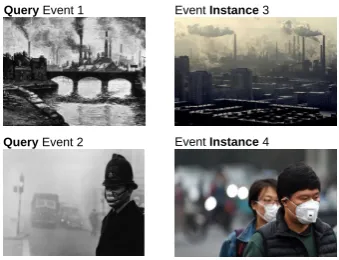
Query Event 1
Query Event 2
Event Instance 3
Event Instance 4
Figure 1: Similar visual scenes We focus on the second issue in this paper, measuring the
similarity between events. Recently, neural network has been successfully used in event-oriented semantic encoding to some extent (Nguyen and Grishman, 2016; Ghaeini et al., 2016; Feng et al., 2016; Peng et al., 2016; Liu et al., 2017; Chen et al., 2017), yielding substantial performance gains in the re-lated information extraction tasks, such as event extraction (Doddington et al., 2004; Ahn, 2006) and nugget detection (Ellis et al., 2015). Semantic encoding enables the generation of a high-dimensional distributed representation for character-izing an event. So that it prompts semantic learning, comput-ing and understandcomput-ing at a very deep level. Undoubtedly, this can facilitate the acquisition of the “semantically-similar but
pragmatically-different” event instances for the query events, such as those in (2).
However, in our recent research on utilizing semantic similarity calculation, we fail to pass through a bottleneck that, for some query events, there doesn’t exist any semantically-similar event instance in a finite dataset (e.g., TERB). It causes that the performance of the state-of-the-art approaches is actually far from what it should be. In order to overcome the problem, we propose to use visual scenes of events for similarity calculation. It is motivated by the fact that some semantically-dissimilar event instances may possess similar visual scenes with the query events. Figure 1 exhibits the scenes of the query events in (1) and that of the event instances in 3), where the visual scenes are similar (compared between the left and the right images), although the textual descriptions of the events are semantically different.
(3) Event Instance 3–Pollution from steel mills blows over residential buildings<Cause>
Event Instance 4–Mask wearing is in fashion<Result>
Relation–Causality<Previously known>
In our experiments, images are taken as the visual scenes. On the basis, we introduce image captions into cross-media semantic matching, with the purpose of mining possible visual scenes by similarity measurement between query events and image captions. In addition, the Convolutional Neural Network (CNN) based image representation is utilized in visual scene matching. Over the ACE-R2, we compare our model with two fully-supervised discourse relation classification models, including Qin et al. (2016)’s CNN and Chen et al. (2016)’s Long-Short Term Memory (LSTM) based Recurrent Neural Network. Experimental results show that our minimally-supervised model slightly outperforms LSTM and obtain comparable performance with CNN.
In the rest of the paper, we overview the related work in section 2. And then we present the method-ological framework in section 3, the caption based cross-media semantic matching in section 4 and image matching in section 5. Section 6 will give the TERB establishment method. In section 7, we evaluate the proposed method and analyze the experimental results. We conclude the paper in section 8.
2 Related Work
2.1 Causal and Temporal Event Relation Identification
the use of lexical-syntactic patterns (Girju et al., 2002; Girju, 2003). Soon thereafter, Chang and Choi
(2004) revise Girju et al. (2002)’s patterns using lexical pairs (LP) and cue phrases (e.g.,due to). Besides
they generalize the model for binary relation classification using the Bayes theorem. Abe et al. (2008) further use co-occurrence probability as the novel feature. Recently, scholars have made a great effort to model fine-grained causal relations (Inui et al., 2005), exploit the features for classification (Blanco et al., 2008), refine the patterns by syntactic and discourse parsing (Ittoo and Bouma, 2011; Do et al., 2011) and predict relations by semantic network (Radinsky et al., 2012).
Mani et al. (2006) and Lapata and Lascarides (2006) presented the first study on the temporal relation parsing. Both focus on the machine learning approaches. In the past decade, the SemEval (Verhagen et al., 2007; Pustejovsky and Verhagen, 2009) has promoted a great deal of experimental study, including on the grammatical, syntactic, semantic and ordering features (Bethard and Martin, 2007; Hepple et al., 2007; Pus¸cas¸u, 2007; Bethard, 2013; Mirza and Minard, 2015; Caselli et al., 2015; Hashimoto et al., 2015). Meanwhile, temporal relation modeling has been implemented in different ways, such as sequence labeling, Markov logic networks and hybrid systems (Cheng et al., 2007; Min et al., 2007; Yoshikawa et al., 2009; UzZaman and Allen, 2010; Llorens et al., 2010; Velupillai et al., 2015).
2.2 Multi-class Discourse Relation Classification
In April 2006 (Prasad et al., 2007), the Penn Discourse Tree Bank (PDTB) was released as a corpus of discourse-level arguments as well as annotations of explicit and implicit relations. The PDTB relation scheme consists of 4 main relation classes and 16 sub-classes. Since it is released together with the corpus, a great deal of research has focused on the methodologies for multi-class relation classification.
Motivated by Marcu and Echihabi (2002)’s work, in the earlier study, both feature engineering and sophisticated machine learning dominated the field in a large region (Pitler and Nenkova, 2009; Lin et al., 2009; Louis et al., 2010; Park and Cardie, 2012; Rutherford and Xue, 2014).
Recently, it becomes increasingly popular to use neural networks for learning to classify discourse relations (Zhang et al., 2015; Qin et al., 2016; Chen et al., 2016; Qin et al., 2017; Liu and Li, 2016). Typically, Zhang et al (2015) propose a Shallow Convolutional Neural Network (SCNN) model, which is used by Ponti and Korhonen (2017) to identify contingent relation. Qin et al (2016) utilize CNN with a collaborative gated neural network (CGNN) for recognizing implicit relations. Chen et al (2016) develop a Gated Relevance Network (GRN) based on Bidirectional Long-Short Term Memory (Bi-LSTM) frame-work, combining bilinear model and single layer network for relevance measurement between arguments. Besides, the current work improves the classification performance of implicit relations by expanding the training data with connectives (Rutherford and Xue, 2015; Braud and Denis, 2016; Wu et al., 2017) or combining multiple corpora via multi-task learning (Liu et al., 2016).
3 Relation Inference Engine
In our statistical inference process, TERB is an indispensable knowledge base and needed to be build first. But in this section, we suppose that TERB has been established successfully, and focus on presenting the inference approach. TERB building will be treated as a separate work and presented in section 6.
3.1 Framework and Terminology
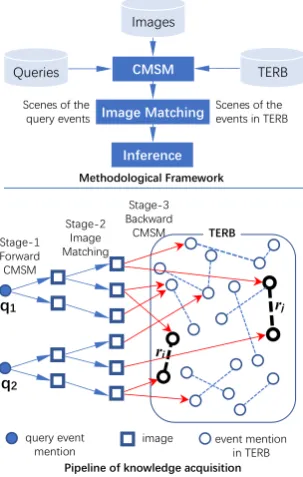
The input of the relation inference engine is a pair of query events, while the output is a relation type tag. The inference engine is constituted of three components, including Cross-Media Semantic Matching (CMSM), image matching and inference model (see the framework in Figure 2). In order to facilitate understanding of the following discussion, we first define the terminologies used as below.
Captionis the textual annotation of an image.
Mentionis the textual description of an event.
Visual Sceneis an image that best describes how an event happens as well as the surroundings. There
is no regard to any concrete element or fact (such as who the participants are ).
CMSMverifies whether an event mention has the consistent meaning with a scene, or in other word,
it helps transform the textual representation (i.e., mention) of an event to a visual version (scene), or vice versa. There are two CMSMs of different directions included in the inference process: forward CMSM and backward CMSM. They are methodologically the same, both measuring similarity between captions and mentions. The difference lies in the use of CMSM. The forward CMSM is used to transform mentions into scenes, while the backward CMSM is applied in a scene-to-mention direction.
Figure 2: Framework and workflow
Image Matchingis put forth for calculating scene similarity.
It is conducted between the scenes of the query events and that of the events in TERB. The events in TERB which have the similar scenes with the queries will be adopted, along with their explicit relations. They are used as the reference samples.
3.2 Pipeline for Reference Sample Acquisition
We acquire the reference samples by a three-stage information retrieval system, which consists of three successive one-to-many retrieval stages (see the pipeline in Figure 2):
Stage 1: Mention-to-Scenetransformation
The forward CMSM is performed. It is used to retrieve
top-n1 most possible scenes of the query event in a large-scale
im-age database. The imim-ages whose captions are most similar to the
query event mention will be adopted. The image database (D) we
use includes about 5 million images crawled from Wikipedia.
Stage 2: Scene-Scenematching
Each scene obtained in the first stage is used as a query of
image search, where image matching is used. There aren2most
similar images adopted from the image databaseD, and used as
the similar scenes to that of the query event.
Stage 3: Scene-to-Mentiontransformation
The similar scenes are then used as queries. For each of them,
the backward CMSM is performed, so as to acquiren3 semantically-similar mentions in TERB.
By the knowledge acquisition, for a query event, we can obtainN(N=n1×n2×n3)reference samples
in TERB. Thus, given a pair of query eventsq1 andq2, we obtain a collectionS of pairs of reference
samples (in the size of N ×N). Most of the pairs have gone out of use in practice because they are
irrelevant and fail to hold a relation. The rest will be reserved as the available reference samples. Their
relations are named as reference relations (seeriandrj in Figure 2).
3.3 Statistical Inference
Given the set S of reference relations, we use the maximum likelihood estimation to speculate the
relationr∗between the query events:
r∗=argmax p(r) ∃r∈R p(r) = (ωr)−1×PC(r)
r∈RC(r)
ωr= pˇ(r)
λr (1)
where,Rdenotes all kinds of predefined relation types. We follow Hong et al. (2016)’s relation scheme
to discrminate among different relation types. The functionC(r)computes the occurrence frequency of
the relationrinS. The coefficientωris prodced with a penalty factorλrand the prior probabilitypˇ(r)of
r. The penaltyλrs of different relation types are inconsistent and need to be fine-tuned on a development
set. The prior probabilitypˇ(r)of every considered relation type need to be obtained on the training set
beforehand. In this paper, we calculatepˇ(r)using the distribution ofrin TERB.
4 Cross-Media Semantic Matching (CMSM)
Activation Function Loss Function
Optimizer: Adadelta Dropout ratio: 0.5 (FC)
Learning rate:10−3
Table 1: Hyper-parameter settings for CMSM
Activation Function Loss Function
Reluθ(x) =ln(1 +eθ>x) L=−P
ryr·log(sθ(x)r)
Batch size: 256 Epoch: 74
Momentum: 0.9 Padding: 1 pixel
Optimizer: Adadelta Dropout ratio: 0.5 (FC1)
Learning rate:10−5 Dropout ratio: 0.5 (FC2)
Table 2: Hyper-parameter settings for ConvNet
(Note:θrepresents all the parameters ands(∗) is the ground truth (Vadapalli and Gangashetty, 2016))
For a caption and a mention, we encode each of them as a sentence-level embedding (Sen2vec). We calcualte the cosine similarity of the Sen2vecs and use it as the caption-mention approximation. CNN is utilized for generating the Sen2vecs. As usual, it produces the convolutional features on the concate-nated word embeddings of the words in the input short text. There is only 1 hidden layer included in the network. Thus it fails to possess very deep-level perceptions of semantics. Undoubtedly, it can be enhanced by either adding more hidden layers to the network, or instead, using other state-of-the-art network models, such as attention based bidirectional LSTM (Zhou et al., 2016) or gated recurrent unit (Vadapalli and Gangashetty, 2016). In this paper, we choose to use a relatively simple model because we are more willing to verify the validity of the methodological framework.
The configuration of the employed CNN is presented as below: in theinput layer, a short text (caption
or mention) is represented as a fixed-size sequence of real numbers, involving 30 256-dimensional word embeddings. Zero padding is performed when the text length is smaller than 40, otherwise tail clipping. We follow Mikolov et al. (2013) to use skip-gram based word2vec to compute embeddings, and conduct training on the English articles in the latest 2015 Wikipedia dump (Dos Santos and Gatti, 2014). In the
hidden layer, there are 128 (3×256) filters used for the convolutional computation with a stride of 1.
This yields 28 128-dimensional feature vectors. Max pooling is then used to produce a lower dimensional
(1×128) vector. As usual, we apply a dense layer to slightly increase the depth. And further, a dropout
layer (rate=0.5) is used to produce a 64-dimensional vector. The vector produced in this way is specified
as the semantic representation of the text. In the output layer, a fully-connected (FC) layer is used,
followed by a 18-way softmax classification layer. We train the model on about 50 thousand short texts of 18 domains. Table 1 shows the parameter settings.
It is noteworthy that the domain classification has nothing to do with the task mentioned in this paper. What we really need in the training process is just the well-trained network. The network can be practi-cally used to generate the sentence embeddings (i.e., the ones in FC layer) for captions and mentions.
5 Image Matching
Image matching is used to recognize similar visual scenes and thus enables the events of similar scenes to be acquired. Similarly, we apply the cosine similarity between image embeddings to align images. Simonyan and Zisserman (2014)’s ConvNet is employed to generate the image embeddings.
FC1
Figure 3: Structure of ImageNet (Plan-A) ConvNet provides an architecture
for learning visual features. Each fea-ture indicates a spatial concept of an image patch (only in the input layer) or a multiple-cell receptive field (in hidden layers), preserving the local information about the notions of left, right, top, down and center.
In this paper, we follow Simonyan and Zisserman (2014)’s Plan-A, in
The ConvNet structure is presented as below and the parameter settings are listed in Table 2. In the
input layer, a fixed-size 224×224 RGB image is input to the network. The preprocessing we do includes
two aspects. One is to normalize images in batches by limiting the size of each to be uniformly 224×224
pixels. The other is to subtract the mean RGB value from each pixel. The mean RGB is computed on the
training set. In thehidden layers, there are totally 8 convolutional layers deployed, along with 5
max-pooling layers. The number of filters in the convolutional layers is gradually increased (from 64 to 512)
with depth. See the layout in Figure 3. In theoutput layers, there are 3 fully-connected (FC.) layers.
The first two have 4,096 dimensions each. The third (FC3) is required to perform 1,000-way ILSVRC (Witten et al., 2016) classification during the training procedure and thus contains 1,000 dimensions. A non-linear softmax layer is deployed behind the FCs.
We train the network on ILSVRC-2012. There are about 5 million images used. In our experiments, we pass an image through the well-trained network and employ the FC3 layer as the image embedding.
Instead of reproducing the network, we recommend the potential users to use the open source toolkit1.
6 Textual Event Relation Bank (TERB)
TERB is an event and relation databank we build. There are about 0.74 million pairs of event mentions included in TERB. The mentions are automatically extracted in pairs from Gigaword corpus (Graff and Cieri, 2003). Each pair of events has been exclusively assigned with an exact relation. Below is a
stan-dard sample in TERB:<Event Instance 1: “pollution emission level keeps rising”> +causalrelation
+<Event Instance 2: “mask wearing is in fashion”>.
We only take clause-level event mentions into consideration during the process of building TERB. And the eligible clauses for use are limited to the ones that contain a predicate. Syntactic parsing is used for clause segmentation and predicate identification (Bj¨orkelund et al., 2010).
There are three patterns used for pairwise mention extraction, including CEE, ECE and EEC, which are distinguishable by means of the position of a connective (C) relative to the neighbor event mentions
(E). Below are the examples, where the words in bold font are connectives:{CEE−Although< Clause1>
, < Clause2>};{ECE−< Clause1>,but< Clause2>};{EEC−< Clause1>, < Clause2>,though}. The connectives are the words that structurally link sentence
constituents. They have been widely used as the reliable clues for explicit semantic relation resolution between text spans. For
example, the connective “because” frankly signals a causal
rela-tion. Nowadays, the utilization of connectives contributes to the high accuracy of explicit relation recognition, reaching a score more than 93% (Pitler and Nenkova, 2009; Wu et al., 2017). Thus, for a pair of event mentions extracted by the patterns, we determine their explicit relation by the one-to-one correspon-dence between connectives and relation types.
We employ 50 connectives which are elaborately collected from the PDTB corpus (Prasad et al., 2007). The relations they signal have been manually annotated beforehand and double-checked. We filter some ambiguous connectives before use be-cause they generally signal different types of relations. For
ex-ample, “since” may signal a causal relation with the meaning of “because”, while in some cases, it signals
a temporal relation with the meaning of “from then on”.
7 Experimentation
7.1 Corpus, Settings and Evaluation
Corpus— We use Hong et al. (2016)’s ACE-R2 corpus in our experiments. Table 3 shows the relation scheme, which consists of 5 main types and 10 subtypes. ACE-R2 contains 2,271 pairs of news events.
Each is annotated with a sole relation. The mentions are selected from the Automatic Content Extraction (ACE) corpus (Doddington et al., 2004).
Settings— Both the CNN models and the captioning model that we use in the experiment have been pretrained with external data. What we need to fine-tune is the number of the reference samples (section
3.2), i.e.,N, which is produced by the parametersn1,n2 andn3 (N=n1×n2×n3) in the three-stage
knowledge acquisition process. A larger value ofNwill introduce many noises in our inference process.
By contrast, a smaller value causes the lack of reference samples and thus the statistical uncertainty.
Evaluation— The methods we concern are evaluated by the metrics of macro-average Precision
(Mac-P), Recall (Mac-R) and F-score (Mac-F). For a particular typet, the positive examples are defined as the
event pairs that hold the relationt. Thus fort, the precision score is calculated as the ratio of the positive
examples in all the output examples of typet. The recall is defined as the ratio of the output positive
examples in all the ground-truth ones.
7.2 Compared Methods
Based on the framework mentioned in section 3, we implement an event relation predictor, named as
Holmes. For the purpose of validating statistically non-random effect, Holmes is compared with the
weighted random sampling (Baseline 1). By the baseline method, a test sample is most probably
de-termined to hold one of the widely-distributed relations (such as Temporality). The distribution is com-puted over the development set. Second, Holmes is required to compete with a pure text based approach
(Baseline 2). In this approach, the statistical inference (section 3.3) is still followed, and similarly to
Holmes, the CNN based Sen2vec (section 3) is involved, and devoted to representing the query event mentions and those in TERB. But unlike Holmes, it skips the steps of CMSM and image matching, and
instead, directly acquiresnbassimilar events from TERB by sentence-level embedding similarity.
In addition, we compare Holmes with two discourse classification models, which are based on more
general models and trained in a fully supervised fashion. One is Qin et al. (2016)’s CNNmodel. The
other is Chen et al. (2016)’s bidirectional LSTM (Bi-LSTM) based recurrent model. There are two kinds
of performance of the competitors are reported. One is achieved by training the competitors over the standard PDTB corpus (sections 1-20), which is consisted of no more than 6,234 handmade sentence-level argument pairs and relations. The other is achieved by training the competitors over the TERB corpus, a large-scale set of automatically-extracted mentions and explicit relations.
Most of the relation types in PDTB are compatible with those in ACE-R2 and TERB. For example,
theTemporality has been divided in two subtypes,SynchronousandAsynchronous, which
are compatible with the Temproality.Equal&During and Temporality.Before&After.
However PDTB fails to include the Coreference relation. Therefore, it isn’t considered in the
ex-periments. Besides, in ACE-R2, the numbers of available instances of the subtypesConfirmingand
Concessiveare far from large (see Table 3). This makes it difficult to develop Holmes with a
high-level confidence. Therefore, the two types aren’t taken into consideration too. Thus the total number of available instances in ACE-R2 is 1,974. We use 1,579 as the development set, occupying about 80 per-cent of all, while the rest (395) for test. We run 5-fold cross validation and report the best performance, while the performance in every validation experiment will be presented in the discussion subsection.
7.3 Experimental Results
Knowledge Acquisition Performance— In the development process, we fine-tune the parametersn1,
n2 andn3 for Holmes, and the parameter nbas for the Baseline 2. The NDCG@N metric is used to
access the quality of the obtained reference samples (i.e., the retrieved similar events). For the image
based retrieval approach in Holmes,N is the product ofn1,n2andn3, while for the text based approach
in Baseline 2, N equals tonbas. The high value of NDCG@N implies that most of theN references
0
Figure 4: Partial development stages for Holmes-α
Type Mac-P Mac-R Mac-F Expansion 0.17 0.08 0.11
Contingency 0.82 0.80 0.81
Comparison 0.04 0.07 0.05
Table 4: Best Performance of Holmes for the three main relation types
Subtypes Mac-P Mac-R Mac-F Contingency.Cus 0.79 0.64 0.71
Contingency.Cnd 0.35 0.53 0.42
Table 5: Results on subtypes ofContingency
Subtypes Mac-P Mac-R Mac-F Temporality.Baf 0.79 0.97 0.87
Temporality.Equ&Dur 0.25 0.04 0.07
Table 6: Results on subtypes ofTemporality
Figure 4 illustrates partial stages in the development process before the performance remains steady.
For example, the subgraph 2 shows the changing tendency of NDCG when n2 is gradually adjusted,
and n1 and n3 are kept unchanged. It can be observed from the NDCG curves that the image based
approach performs better than the text based (i.e., Baseline 2), obtaining more reliable reference samples. Using such samples, as presented below, we enable Holmes to achieve comparable performance to the sophisticated supervised learning models. It proves that the image based approach performs better than the text based approach in acquiring reference samples. Using such samples, as presented below, we enable the simple statistical inference to outperform some sophisticated supervised learning models.
On the basis, we fine-tune the penalty factor λ for different types of relations. In each-fold cross
validation, the penalty factor of a particular relation type will be adopted if it effectively cooperates with the penalty factors of other relation types. The effectiveness is ensured by verifying whether the factors enable the recognizer to achieve the best performance on the development set. We have made the source
codes, penalty factors and datasets publicly available2, so as to enable the reproduction of the whole
experiments.
Relation Recognition Performance— We test Holmes by setting the parametersn1,n2andn3as 10,
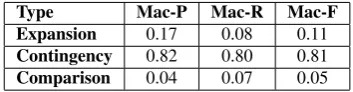
85 and 10. Table 4 shows the performance for the three main relationsContingency,Expansion
andComparison. It is the best performance Holmes achieves in the 5-fold cross validations. Note that
the performance for theTemporalrelation type is evaluated separately and only a 2-way classification
is conducted for its subtypes. It is because that every event pair can be regarded to be related temporally,
although some of relations fail to be annotated in ACE-R2. The lack of annotations onTemporality
definitely causes biased assertions on the performance of automated relation prediction.
Method Training 3-way Temp Cont
Baseline1 PDTB 0.11 N/A N/A
Baseline2 N/A 0.12 N/A N/A
CNN PDTB 0.38 0.17 N/A
CNN TERB 0.41 0.54 0.60
Bi-LSTM PDTB 0.39 0.17 N/A
Bi-LSTM TERB 0.42 0.48 0.63
Holmes N/A 0.33 0.51 0.63
Table 7: Evaluated by General Macro-F
Method Training 3-way Temp Cont
Baseline1 PDTB 0.11 N/A N/A
Baseline2 N/A 0.12 N/A N/A
CNN PDTB 0.36 0.17 N/A
CNN TERB 0.32 0.48 0.56
Bi-LSTM PDTB 0.34 0.17 N/A
Bi-LSTM TERB 0.40 0.45 0.58
Holmes N/A 0.31 0.47 0.56
Table 8: Evaluated by Average Macro-F
It is observed that Holmes precisely predicts theContingencyrelation. Most of the
contingently-related instances have been successfully recalled. By contrast, Holmes performs much worse for
ExpansionandComparison. We overview the errors and analyze the reasons as below.
Due to the omission of Expansion.Confirming, the performance of Holmes on Expansion
actually derives from that on Expansion.Conjunctive. In general, Conjunction appears as
a rhetoric method. By Conjunction, a series of similar events can be enumerated, such as
earth-quake,tsunamiandstorm. Co-occurrence probabilities of such events play important roles for predicting
Conjunction. However, there are few connectives can be used for pursuing the co-occurred events or
they are extraordinarily general. For example, the connective “and” is frequently used to signal the
co-occurred events, but frankly it nearly connects kinds of linguistic units or even acts as a pause from the
perspective of mood. If we use “and” to collect sample events which hold conjunctive relations, TERB
will be full of pseudo-instances, such as “sunshineandbeach”. This will reduce the precision more
seri-ously. By contrast, if we neglect a connective “and”, there will be lack of available sample events. This
inevitably results in the incomplete statistics for the frequently-cooccurred events. We didn’t overcome the bottleneck in this paper and use no more than 6 uncommon connectives to collect the sample events. Both the diversity and scale of the events are far from expectation. This makes it difficult to effectively
recognize theConjunctiverelationship using a statistical approach.
We encounter a similar problem when treating withComparison. A connective like “than” is
effec-tive to signal a pair of Contrastiveevents. However, due to the limitation of literal expression, in
general, such event mentions aren’t directly connected by “than”, but instead the concrete elements in
the events are. For example, in a story abouteconomic competition, the contrastive events are introduced
respectively in different sentences, on the contrary theprofit forecastsin the events are connected bythan
in a sentence. The neglect of commonly-used connectives (e.g., “than”) during TERB building causes the
lack of sample events. Similarly, the statistic strategy we use fails to perform better under this condition.
Table 5 shows the performance of Holmes on theContingentsub-type relations, i.e.,Causeand
Condition. It can be observed that Holmes is adept in predicting causal relations. Table 6 exhibits the
performance on theTemporalsub-type relations, i.e.,Before&AfterandEqual&During. It is
il-lustrated that Holmes effectively predicts the synchronous events, though fails to infer the asynchronous.
7.4 Discussion
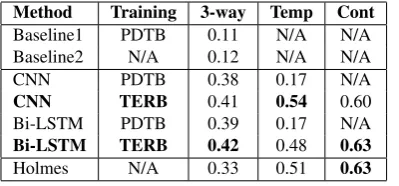
We carefully evaluate Holmes and the competitors with the general Macro F and average Macro F scores respectively. The former is calculated with the average Macro P and Macro R on the concerned relation types, while the latter is the average value of Macro F on the types. The average Macro F score plays a role of assistance because it is able to reveal the unbalance problem. If a system shows significantly different performance on different types of relations. the average Macro F will be substantially lower than the general. Tables 7 and 8 respectively exhibit the performance of the entrants for the 3 main relation
types (3-way),Temporalsubtypes (Temp) andContingentsubtypes (Cont). The tables only exhibit
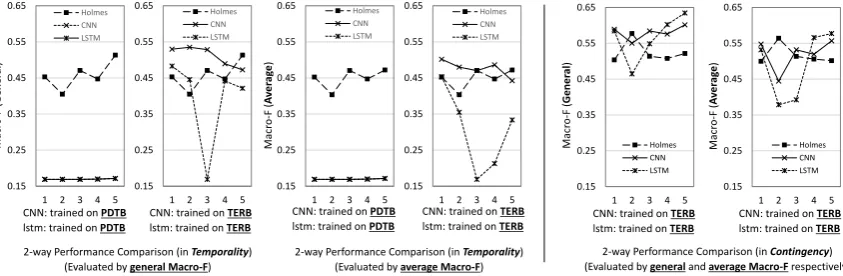
the best performance the competitors achieves through the 5-fold cross validations. The performance in every validation experiment is shown in Figure 5 and 6.
It can be observed that Holmes performs worse than CNN and LSTM for the 3-way main relation classification. Nevertheless, Holmes obtains a smaller gap between general and average Macro F scores. Besides, it achieves a comparable performance to the well-trained CNN and LSTM for the fine-grained
(Evaluated by general Macro-F)
3-way Performance Comparison (Evaluated by average Macro-F) CNN: trained on PDTB
lstm: trained on PDTB
CNN: trained on TERB
lstm: trained on TERB
CNN: trained on PDTB
lstm: trained on PDTB
CNN: trained on TERB
lstm: trained on TERB
Figure 5: Cross validation for main relation types (Contingency,ComparisonandExpansion)
2-way Performance Comparison (in Temporality)
(Evaluated by general Macro-F)
2-way Performance Comparison (in Temporality)
(Evaluated by average Macro-F)
CNN: trained on PDTB
lstm: trained on PDTB
CNN: trained on TERB
lstm: trained on TERB
CNN: trained on PDTB
lstm: trained on PDTB
CNN: trained on TERB
lstm: trained on TERB
Mac
lstm: trained on TERB
CNN: trained on TERB
lstm: trained on TERB
2-way Performance Comparison (in Contingency)
(Evaluated by general and average Macro-F respectively)
Figure 6: Cross validation for the subtypes inTemporalityandContingency
that CNN and LSTM fail to be trained on PDTB for classifying theContingentsub-type relations.
It is because PDTB contains only one implicit conditionally-related argument pair. The scale of training data and domain adaptation impose great influences on the performance. For example, for the subtypes, CNN and LSTM perform significantly worse than Holmes when trained on PDTB. In addition, Holmes outperforms Baseline 2. It demonstrates that, in TERB, there is lack of semantically-consistent events to the queries. Holmes bypasses the bottleneck, using CMSM and image matching to acquire visually-similar events. This contributes to the reference sample based statistical inference.
When we look through the 5-fold cross validation, we find that Holmes actually performs better than expectation. As shown in Figures 5 and 6, Holmes seldom shows an exceptionally high or an unusually low Marcro F score. And the mean level of Macro F scores of Holmes appears to be no less than that of
LSTM for the subtypes of bothTemporalityandContingency.
8 Conclusion
We demonstrate that the use of images also contributes to knowledge acquisition in the field of linguistic computing. By image matching, we open up a new perspective for the identification of similar events, i.e., measuring the similarity of visual scenes. On the basis, we have successfully acquired a variety of events which have comparable scenes with the queries. Using the obtained events and their explicit relations, we enable a simple statistical inference model to achieve competitive performance for event relation recognition. In the future we will introduce active learning into the refinement of the collected event instances, and expand the existing training data to strengthen the supervised classification models.
Acknowledgements
References
Shuya Abe, Kentaro Inui, and Yuji Matsumoto. 2008. Acquiring event relation knowledge by learning
cooccur-rence patterns and fertilizing cooccurcooccur-rence samples with verbal nouns. InIJCNLP, pages 497–504.
David Ahn. 2006. The stages of event extraction. InProceedings of the Workshop on Annotating and Reasoning
about Time and Events, pages 1–8. Association for Computational Linguistics.
Steven Bethard and James H Martin. 2007. Cu-tmp: Temporal relation classification using syntactic and semantic
features. InWorkshop on Semantic Evaluations, pages 129–132.
Steven Bethard. 2013. Cleartk-timeml: A minimalist approach to tempeval 2013. InSecond Joint Conference on
Lexical and Computational Semantics, volume 2, pages 10–14.
Anders Bj¨orkelund, Bernd Bohnet, Love Hafdell, and Pierre Nugues. 2010. A high-performance syntactic and
se-mantic dependency parser. InProceedings of the 23rd International Conference on Computational Linguistics:
Demonstrations, pages 33–36. Association for Computational Linguistics.
Eduardo Blanco, Nuria Castell, and Dan I Moldovan. 2008. Causal relation extraction. InLREC.
Chlo´e Braud and Pascal Denis. 2016. Learning connective-based word representations for implicit discourse
relation identification. InEMNLP, pages 203–213.
Tommaso Caselli, Antske Fokkens, Roser Morante, and Piek Vossen. 2015. Spinoza vu: An nlp pipeline for cross
document timelines. SemEval-2015, page 787.
Du-Seong Chang and Key-Sun Choi. 2004. Causal relation extraction using cue phrase and lexical pair
probabili-ties. InIJCNLP, pages 61–70. Springer.
Jifan Chen, Qi Zhang, Pengfei Liu, Xipeng Qiu, and Xuanjing Huang. 2016. Implicit discourse relation detection
via a deep architecture with gated relevance network. InACL (1).
Yubo Chen, Shulin Liu, Xiang Zhang, Kang Liu, and Jun Zhao. 2017. Automatically labeled data generation for
large scale event extraction. InProceedings of the 55th Annual Meeting of the Association for Computational
Linguistics (Volume 1: Long Papers), volume 1, pages 409–419.
Yuchang Cheng, Masayuki Asahara, and Yuji Matsumoto. 2007. Naist. japan: temporal relation identification
using dependency parsed tree. InSemantic Evaluations, pages 245–248.
Siyuan Ding, Yu Hong, Shanshan Zhu, Jianmin Yao, and Qiaoming Zhu. 2016. Combining event-level and
cross-event semantic information for cross-event-oriented relation classification by scnn. InChina National Conference on
Chinese Computational Linguistics, pages 216–224. Springer.
Quang Xuan Do, Yee Seng Chan, and Dan Roth. 2011. Minimally supervised event causality identification.
In Proceedings of the Conference on Empirical Methods in Natural Language Processing, pages 294–303.
Association for Computational Linguistics.
George R Doddington, Alexis Mitchell, Mark A Przybocki, Lance A Ramshaw, Stephanie Strassel, and Ralph M
Weischedel. 2004. The automatic content extraction (ace) program-tasks, data, and evaluation. In LREC,
volume 2, page 1.
C´ıcero Nogueira Dos Santos and Maira Gatti. 2014. Deep convolutional neural networks for sentiment analysis
of short texts. InCOLING, pages 69–78.
Joe Ellis, Jeremy Getman, Dana Fore, Neil Kuster, Zhiyi Song, Ann Bies, and Stephanie Strassel. 2015. Overview
of linguistic resources for the tac kbp 2015 evaluations: Methodologies and results. InProceedings of TAC KBP
2015 Workshop, National Institute of Standards and Technology, pages 16–17.
Xiaocheng Feng, Lifu Huang, Duyu Tang, Heng Ji, Bing Qin, and Ting Liu. 2016. A language-independent neural
network for event detection. InProceedings of the 54th Annual Meeting of the Association for Computational
Linguistics (Volume 2: Short Papers), volume 2, pages 66–71.
Reza Ghaeini, Xiaoli Fern, Liang Huang, and Prasad Tadepalli. 2016. Event nugget detection with
forward-backward recurrent neural networks. InProceedings of the 54th Annual Meeting of the Association for
Compu-tational Linguistics (Volume 2: Short Papers), volume 2, pages 369–373.
Roxana Girju. 2003. Automatic detection of causal relations for question answering. InACL, pages 76–83.
David Graff and C Cieri. 2003. English gigaword corpus. Linguistic Data Consortium.
Chikara Hashimoto, Kentaro Torisawa, Julien Kloetzer, and Jong-Hoon Oh. 2015. Generating event causality
hypotheses through semantic relations. InAAAI, pages 2396–2403.
Mark Hepple, Andrea Setzer, and Rob Gaizauskas. 2007. Usfd: preliminary exploration of features and classifiers
for the tempeval-2007 tasks. InWorkshop on Semantic Evaluations, pages 438–441.
Yu Hong, Tongtao Zhang, Tim OGorman, Sharone Horowit-Hendler, Heng Ji, and Martha Palmer. 2016. Building
a cross-document event-event relation corpus. LAW X, page 1.
Takashi Inui, Kentaro Inui, and Yuji Matsumoto. 2005. Acquiring causal knowledge from text using the connective
marker tame.TALIP, 4(4):435–474.
Ashwin Ittoo and Gosse Bouma. 2011. Extracting explicit and implicit causal relations from sparse,
domain-specific texts. InNatural Language Processing and Information Systems, pages 52–63. Springer.
Maria Lapata and Alex Lascarides. 2006. Learning sentence-internal temporal relations. J. Artif. Intell.
Res.(JAIR), 27:85–117.
Ziheng Lin, Min-Yen Kan, and Hwee Tou Ng. 2009. Recognizing implicit discourse relations in the penn discourse
treebank. In Proceedings of the 2009 Conference on Empirical Methods in Natural Language Processing:
Volume 1-Volume 1, pages 343–351. Association for Computational Linguistics.
Yang Liu and Sujian Li. 2016. Recognizing implicit discourse relations via repeated reading: Neural networks
with multi-level attention. arXiv preprint arXiv:1609.06380.
Yang Liu, Sujian Li, Xiaodong Zhang, and Zhifang Sui. 2016. Implicit discourse relation classification via
multi-task neural networks. InAAAI, pages 2750–2756.
Shulin Liu, Yubo Chen, Kang Liu, and Jun Zhao. 2017. Exploiting argument information to improve event detection via supervised attention mechanisms. 1:1789–1797.
Hector Llorens, Estela Saquete, and Borja Navarro. 2010. Tipsem (english and spanish): Evaluating crfs and
semantic roles in tempeval-2. InWorkshop on Semantic Evaluation, pages 284–291.
Annie Louis, Aravind Joshi, Rashmi Prasad, and Ani Nenkova. 2010. Using entity features to classify implicit
discourse relations. InProceedings of the 11th Annual Meeting of the Special Interest Group on Discourse and
Dialogue, pages 59–62. Association for Computational Linguistics.
Inderjeet Mani, Marc Verhagen, Ben Wellner, Chong Min Lee, and James Pustejovsky. 2006. Machine learning
of temporal relations. InCOLING and ACL, pages 753–760.
Daniel Marcu and Abdessamad Echihabi. 2002. An unsupervised approach to recognizing discourse relations.
In Proceedings of the 40th Annual Meeting on Association for Computational Linguistics, pages 368–375.
Association for Computational Linguistics.
Tomas Mikolov, Ilya Sutskever, Kai Chen, Greg S Corrado, and Jeff Dean. 2013. Distributed representations of
words and phrases and their compositionality. InAdvances in neural information processing systems, pages
3111–3119.
Congmin Min, Munirathnam Srikanth, and Abraham Fowler. 2007. Lcc-te: a hybrid approach to temporal relation
identification in news text. InWorkshop on Semantic Evaluations, pages 219–222.
Paramita Mirza and Anne-Lyse Minard. 2015. Hlt-fbk: a complete temporal processing system for qa tempeval.
SemEval-2015, page 801.
Thien Huu Nguyen and Ralph Grishman. 2016. Modeling skip-grams for event detection with convolutional
neural networks. InEMNLP, pages 886–891.
Joonsuk Park and Claire Cardie. 2012. Improving implicit discourse relation recognition through feature set
optimization. In Proceedings of the 13th Annual Meeting of the Special Interest Group on Discourse and
Dialogue, pages 108–112. Association for Computational Linguistics.
Haoruo Peng, Yangqiu Song, and Dan Roth. 2016. Event detection and co-reference with minimal supervision. In
Emily Pitler and Ani Nenkova. 2009. Using syntax to disambiguate explicit discourse connectives in text. In
Proceedings of the ACL-IJCNLP 2009 Conference Short Papers, pages 13–16. Association for Computational
Linguistics.
Edoardo Maria Ponti and Anna Korhonen. 2017. Event-related features in feedforward neural networks contribute
to identifying causal relations in discourse.LSDSem 2017, page 25.
Rashmi Prasad, Eleni Miltsakaki, Nikhil Dinesh, Alan Lee, Aravind Joshi, Livio Robaldo, and Bonnie L Webber. 2007. The penn discourse treebank 2.0 annotation manual.
Georgiana Pus¸cas¸u. 2007. Wvali: Temporal relation identification by syntactico-semantic analysis. InWorkshop
on Semantic Evaluations, pages 484–487.
James Pustejovsky and Marc Verhagen. 2009. Semeval-2010 task 13: evaluating events, time expressions, and
temporal relations (tempeval-2). InWorkshop on Semantic Evaluations, pages 112–116.
Lianhui Qin, Zhisong Zhang, and Hai Zhao. 2016. A stacking gated neural architecture for implicit discourse
relation classification. In Proceedings of the 2016 Conference on Empirical Methods in Natural Language
Processing, pages 2263–2270.
Lianhui Qin, Zhisong Zhang, Hai Zhao, Zhiting Hu, and Eric P Xing. 2017. Adversarial connective-exploiting
networks for implicit discourse relation classification. arXiv preprint arXiv:1704.00217.
Kira Radinsky, Sagie Davidovich, and Shaul Markovitch. 2012. Learning causality for news events prediction. In
WWW, pages 909–918.
Attapol Rutherford and Nianwen Xue. 2014. Discovering implicit discourse relations through brown cluster pair
representation and coreference patterns. InEACL, volume 645, page 2014.
Attapol Rutherford and Nianwen Xue. 2015. Improving the inference of implicit discourse relations via classifying
explicit discourse connectives. InHLT-NAACL, pages 799–808.
Karen Simonyan and Andrew Zisserman. 2014. Very deep convolutional networks for large-scale image
recogni-tion. arXiv preprint arXiv:1409.1556.
Naushad UzZaman and James F Allen. 2010. Trips and trios system for tempeval-2: Extracting temporal
informa-tion from text. InWorkshop on Semantic Evaluation, pages 276–283.
Anandaswarup Vadapalli and Suryakanth V Gangashetty. 2016. An investigation of recurrent neural network
architectures using word embeddings for phrase break prediction. InInterspeech, pages 2308–2312.
Sumithra Velupillai, Danielle L Mowery, Samir Abdelrahman, Lee Christensen, and Wendy W Chapman. 2015. Blulab: Temporal information extraction for the 2015 clinical tempeval challenge.
Marc Verhagen, Robert Gaizauskas, Frank Schilder, Mark Hepple, Graham Katz, and James Pustejovsky. 2007.
Semeval-2007 task 15: Tempeval temporal relation identification. InProceedings of the 4th international
work-shop on semantic evaluations, pages 75–80. Association for Computational Linguistics.
Ian H Witten, Eibe Frank, Mark A Hall, and Christopher J Pal. 2016. Data Mining: Practical machine learning
tools and techniques. Morgan Kaufmann.
Changxing Wu, Xiaodong Shi, Yidong Chen, Jinsong Su, and Boli Wang. 2017. Improving implicit discourse
relation recognition with discourse-specific word embeddings. InProceedings of the 55th Annual Meeting of
the Association for Computational Linguistics (Volume 2: Short Papers), volume 2, pages 269–274.
Kelvin Xu, Jimmy Ba, Ryan Kiros, Kyunghyun Cho, Aaron Courville, Ruslan Salakhudinov, Rich Zemel, and
Yoshua Bengio. 2015. Show, attend and tell: Neural image caption generation with visual attention. In
Inter-national Conference on Machine Learning, pages 2048–2057.
Katsumasa Yoshikawa, Sebastian Riedel, Masayuki Asahara, and Yuji Matsumoto. 2009. Jointly identifying
temporal relations with markov logic. InACL and AFNLP, pages 405–413.
Biao Zhang, Jinsong Su, Deyi Xiong, Yaojie Lu, Hong Duan, and Junfeng Yao. 2015. Shallow convolutional
neural network for implicit discourse relation recognition. InEMNLP, pages 2230–2235.
Peng Zhou, Wei Shi, Jun Tian, Zhenyu Qi, Bingchen Li, Hongwei Hao, and Bo Xu. 2016. Attention-based
bidirectional long short-term memory networks for relation classification. InProceedings of the 54th Annual