Learning Micro-Planning Rules for Preventative Expressions*
Keith Vander Linden t
Information Technology Research Institute University o f Brighton
Brighton BN2 4AT, U K
email: [email protected]
Barbara Di Eugenio
Computational Linguistics Carnegie Mellon University
Pittsburgh, PA, 15213 U S A
email: d i e u g e n i @ a n d r e w . c m u . e d u
A b s t r a c t
Building text planning resources by hand is time- consuming and difficult. Certainly, a number o f planning architectures and their accompanying plan libraries have been implemented, but while the architectures themselves may be reused in a new domain, the library of plans typically cannot. One way to address this problem is to use ma- chine learning techniques to automate the deriva- tion of planning resources for new domains. In this paper, we apply this technique to build micro- planning rules for preventative expressions in in- structional text.
1 I n t r o d u c t i o n
Building text planning resources by hand is time- consuming and difficult. Certainly, much work has been done in this regard; there are a num- ber of freely available text planning architectures (e.g., Moore and Paris, 1993). It is frequently the case, however, that while the architecture it- self can be reused in a new domain, the library of text plans developed for it cannot. In particu- lar, micro-planning rules, those rules that specify the low-level grammatical details of expression, are highly sensitive to variations between sub- languages, and are therefore difficult to reuse.
When faced with a new domain in which to generate text, the typical scenario is to perform a
* This work is partially supported by the Engineering and Physical Sciences Research Council (EPSRC) Grant J19221, by BC/DAA9 ARC Project 293, and by the Commission of the European Union Grant LRE-62009.
t After September 1, Dr. Vander Linden's address will be Department of Mathematics and Computer Science, Calvin College, Grand Rapids, MI 49546, USA.
corpus analysis on a representative collection of the text produced by human authors in that do- main and to induce a set of micro-planning rules guiding the generation process in accordance with the results. Some fairly simple rules usually jump out of the analysis quickly, mostly based on the analyst's intuitions. For example, in written in- structions, user actions are typically expressed as imperatives. Such observations, however, tend to be gross characterisations. More accurate micro- planning requires painstaking analysis. In this paper, for example, the micro-planner must distin- guish between phrasing such as "Don't do action-
,V' and "Take care not to do action-X". Without analysis, it is far from clear how this decision can best be made.
Some form of automation would clearly be desirable. Unfortunately, corpus analysis tech- niques are not yet capable of automating the ini- tial phases o f the corpus study (nor will they be for the foreseeable future). There are, however, techniques for rule induction which are useful for the later stages of corpus analysis and for imple- mentation.
2 Preventative Expressions
Preventative expressions are used to warn the reader not to perform certain inappropriate or po- tentially dangerous actions. The reader may be told, for example, "Do not enter" or "Take care not to push too hard". Both of these examples involve negation ("do not" and "take care not"). Although this is not strictly necessary for preven- tative expressions (e.g., one might say "stay out" rather than "do not enter"), we will focus on the use of negative forms in this paper, using the fol- lowing categorisation: l
• negative imperatives proper (termed D O N T imperatives) - - These are characterised by the negative auxiliary do not or don 7, as in:
(1) Your sheet vinyl floor may be vinyl asbestos, which is no longer on the market. Don ~ sand it or tear it up because this will put dangerous asbestos fibers into the air.
• N E V E R imperatives - - T h e s e are charac- terised by the use of the negative adverb never, as in:
(2) Whatever you do, never go to Vienna i f you are on a diet.
• other negative imperatives (termed neg-TC imperatives) - - These include take care and be careful followed by a negative infinitival complement, as in the following examples:
(3) To book the strip, fold the bottom third or more of the strip over the middle of the panel, pasted sides together, taking care not to crease the wallpaper sharply at the fold.
(4) If your plans call for replacing the wood base molding with vinyl cove molding, be careful not to damage the walls as you remove the wood base.
3 Corpus Analysis
In terms of text generation, our interest is in find- ing mappings from features related to the function
I Hom (1989) gives a more complete categofisation of negative forms.
of these expressions, to those related to their gram- maticalform. Functional features include the se- mantic features of the message being expressed, the pragmatic features of the context o f commu- nication, and the features of the surrounding text being generated. In this section we will briefly discuss the nature of our corpus, and the fimction and form features that we have coded. We will conclude with a discussion of the inter-coder reli- ability. A more detailed discussion of this portion of the work is given elsewhere (Vander Linden and Di Eugenio, 1996).
3.1 Corpus
The corpus from which we take all our coded examples has been collected opportunistically off the intemet and from other sources. It is 4.5 MB in size and is made entirely of written English instructional texts. As a collection, these texts are the result of a variety of authors working in a variety of contexts.
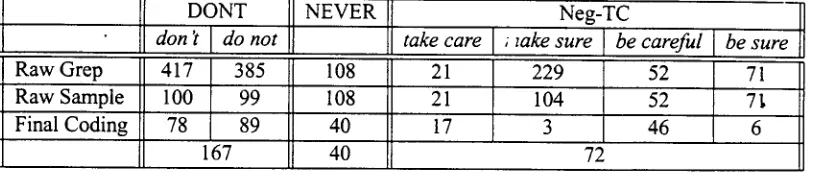
We broke the corpus texts into expressions us- ing a simple sentence breaking algorithm and then collected the negative imperatives by probing for expressions that contain the grammatical forms we were interested in (i.e., expressions contain- ing phrases such as don 7, never, and take care). The grammatical forms we found, 1283 occur- rences in all, constitute 2.7% of the expressions in the filll corpus. The first line in Table 1, marked "Raw Grep", indicates the quantity of each type.
We then filtered the results. When the probe re- turned more than 100 examples for a grammatical form, we randomly selected around 100 of those returned, as shown in line 2 of Table 1 (labelled "Raw Sample"). We then removed those exam- ples that, although they contained the desired lex- ical string, did not constitute negative imperatives (e.g., "If you don ~ like the colors of the file . . . . , use Binder to change them."), as shown in line 3, labelled "Final Coding".
Raw Grep Raw Sample Final Coding
DONT NEVER
~ n ~ ~ not
417 385
100 99
78 89
167
108 108 40 40
take care
21 21 17
Neg-TC ; take sure
229 104
be careful
52 52 46 72
be sure
71 71, 6
Table 1: Distribution of negative imperatives
Instruction type Corpus size # o f preventatives
Recipes Do-it-yourself Di Eugenio's thesis 2 Software instructions Administrative forms Other
Totals
1.7M 1.26M 336K 264K 317K 565K
4.5M
83 99 69 0 9 19
279
Table 2: Distribution of examples from sample
3.2 Form
Because of its syntactic nature, the form feature coding was very robust. The possible feature val- ues were: DONT - - for the do not and don forms discussed above; NEVER, for imperatives containing never; and neg-TC - - for take care, make sure, be careful, and be sure expressions with negative arguments. The two authors agreed on their coding of this feature in all cases.
3.3 Function Features
We will now briefly discuss three of the func- tion features we have coded: IINTENTIONALITY, AWARENESS, and SAFETY. W e illustrate them in turn using a to refer to the prevented action and using "agent" to refer to the reader and executer of the instructions.
Intentionality: This feature encodes whether or not the writer believes that the agent will con- sciously adopt the intention of performing a:
CON is used to code situations where the agent intends to perform a. In this case, the agent
2Note that we used a number of examples from Di Eu- genio's thesis (1993) which were included as excerpts. In this table we include only an estimate of the full size of that portion of the corpus.
must be aware that a is one of his or her possible alternatives.
UNC is used to code situations in which the agent doesn't realize that there is a choice involved (cf. Di Eugenio, 1993). It is used in two situations: when a is totally accidental, or the agent may not take into account a crucial feature of a.
Awareness: This feature captures whether or not the writer believes that the agent is aware that the consequences of ~ are bad:
AW is used when the agent is aware that a is bad. For example, the agent may be told "Be careful not to burn the garlic" when he or she is perfectly well aware that burning things when cooking them is bad.
UNAW is used when the agent is perceived to be unaware that a is bad.
Safety: This feature captures whether or not the author believes that the agent's safety is put at risk by performing a:
BADP is used when the agent's safety is put at risk by performing a.
[image:3.596.94.501.86.172.2] [image:3.596.163.427.200.314.2]3.4 I n t e r - c o d e r r e l i a b i l i t y
Each author independently coded each of the fea- tures for all the examples in the sample. The percentage agreement for each of the features is shown in the following table:
feature percent agreement
form 100%
intentionality 74.9%
awareness 93.5%
safety 90.7%
As advocated by Carletta (1996), we have used the Kappa coefficient (Siegel and Castellan, 1988) as a measure of coder agreement. For nominal data, this statistic not only measures agreement, but also factors out chance agreement.
If P(A) is the proportion of times the coders agree, and P(E) is the proportion of times that coders are expected to agree by chance, K is com- puted as follows:
P(A) - P(E) K =
1 - P ( E )
There are various ways of computing P(E)
according to Siegel and Castellan (1988); most researchers agree on the following formula, which we also adopted:
m
P i e ) =
j = l
where m is the number of categories, andpj is the proportion of objects assigned to category j.
The mere fact that K may have a value k greater than zero is not sufficient to draw any conclusion, however, as it must be established whether k is significantly different from zero. There are sug- gestions in the literature that allow us to draw general conclusions without these further com- putations. For example, Rietveld and van Hout (1993) suggest the correlation between K values and inter-coder reliability shown in the following table:
Kappa Value
.00 - .20 .21 - .40 .41 - .60 .61 - .80 .81 - 1.00
Reliability Level
slight fair moderate substantial almost perfect
For the form feature, the Kappa value is 1.0, indi- cating perfect agreement. The function features, which are more subjective in nature, engender more disagreement among coders, as shown by the K values in the following table:
feature K
INTENTIONALITY 0.46
AWARENESS 0.76
SAFETY 0.71
According to this table, therefore, the AWARE- NESS and SAFETY features show "substantial" agreement and the INTENTIONALITY feature shows "moderate" agreement. We have coded other functional features as well, but they have either not proven as reliable as these, or are not as useful in text planning.
In addition, Siegel and Castellan (1988) point out that it is possible to check the significance of K when the number of objects is large; this involves computing the distribution of K itself. Under this approach, the three values above are significant at the .000005 level.
4 Automated Learning
The corpus analysis results in a set of examples coded with the values of the function and form features. This data can be used to find correla- tions between the two types of features, correla- tions, which, in text generation, are typically im- plemented as decision trees or rule sets mapping from function features to forms.
In this study, we used 179 coded examples as input to the learning algorithm. These are the examples on which the two authors agreed on their coding of all the features. The distribution of the grammatical forms in these examples is shown in the following table:
form frequency
DONT 100
Neg-TC 57
NEVER 22
4.1 Data Mining
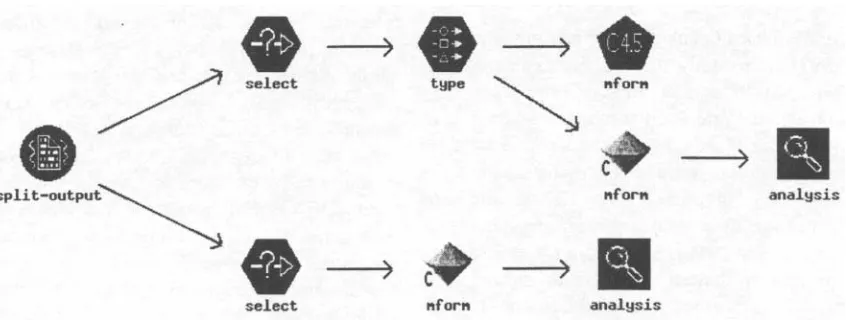
We have used Quinlan's C4.5 learning algorithm (1993) in this study; this algorithm can induce ei- ther decision trees or rules. To provide a more convenient learning environment, we have used Clementine (1995), a tool which allows rapid re- configuration o f various data manipulation facil- ities, including C4.5. Figure I shows the basic control stream we used for learning and testing de- cision trees. Data is input from the
split-output
file node on the left of the figure and is passed through filtering modules until it reaches the out- put modules on the right. The two select mod- ules (pointed to by the main input node) select the examples reserved for the training set and the testing set respectively. The upper stream pro- cesses the training set and contains a type mod- ule which marks the main syntactic form (i.e., DONT, NEVER, or Neg-TC) as the variable to be predicted and the AWARENESS, SAFETY, and INTENTIONALITY features as the inputs. Its out- put is passed to the C4.5 node, labelled reform, which produces the decision tree. We then use two copies of the resulting decision tree, repre- sented by the diamond shaped nodes marked with mform, to test the accuracy of the testing and the training sets.One run of the system, for example, gave the following decision tree:
a w a r e n e s s = A W : N E G - T C
a w a r e n e s s = U N A W :
] i n t e n t i o n = C O N : D O N T
] i n t e n t i o n = U N C :
] [ s a f e t y = B A D P : N E V E R
] 1 s a f e t y = N O T : D O N T
This tree takes the three function features and pre- dicts the DONT, NEVER, and Neg-TC forms. It confirms our intuitions that n e v e r imperatives are
used when personal safety may be endangered (coded as safety="BADP"), and that Neg-TC forms are used when the reader is expected to be aware of the danger that may arise (cf. Vander Linden and Di Eugenio, 1996). It accurately pre- dicts the grammatical form of 74.5% of the 161 training examples, and 83.3% of the 18 testing examples.
Because there are relatively few training exam- ples in our coded corpus, we have also performed
a 10-way cross-validation test. 3 None of the de- rived trees in this test were -emarkably different from the one just shown, although they did or- der the INTENTIONALITY and AWARENESS features differently. The average accuracy of the learned decision trees on the testing sets was 75.4%.
Note that although this level of accuracy is bet- ter than 55.9%, the score achieved by simply se- lecting DONT in all cases, there is still more work to be done. The current features must be refined, and more features may be need to be added. We are currently experimenting with a number of pos- sibilities. Note also that we have not distinguished between the various sub-forms of DONT and Neg- TC shown in Table l; this will require yet more features.
Clementine can also "balance" the input to C4.5 by duplicating training examples with under- represented feature values. We used this to in- crease the number of NEVER and Neg-TC exam- ples to match the number of DONT examples. Ul- timately, this reduced the accuracy of the learned trees to 68.0% in a cross-validation test. The resulting decision trees tended not to include all three features.
4.2 Integration
Because it is common for us to rebuild decision trees frequently during analysis, we implemented a routine which automatically converts the deci- sion tree into the appropriate KPML-style sys- tem networks with their associated choosers, in- quiries, and inquiry implementations (Bateman, 1995). This makes the network compatible with the DRAFTER micro-planner, a descendent of IM- AGENE (Vander Linden and Martin, 1995). The conversion routine takes the following inputs:
• the applicable language(s) - - C 4 . 5 produces its decision trees based on examples from a particular language, and KPML is capable of being conditionalised for particular lan- guages. Thus, we may perform separate cor- pus analyses of a particular phenomenon for various languages, and learn separate micro- planning trees;
0
split-output~
@
s e l e c t type
#
a f o r e
0
, #
,Ira
select afore analysis
, m
analysis
Figure 1: The Clementine learning environment
. the input feature(s) - - The sub-network be- ing built must fit into the overall categorisa- tions of the full micro-planner, and thus we must specify the text functions that would trigger entry to the new sub-network;
• the decision tree itself;
• a feature-value function - - To traverse the new sub-network, the KPML inquiries re- quire a function that can determine the value of the features for each pass through the net- work;
• grammatical form s p e c i f i c a t i o n s - The sub- network must eventually build sentence plan language (SPL) commands for input to KPML, and thus must be told the appropri- ate SPL terms to use to specify the required grammatical forms;
• an output file name.
For our example, the system sub-network shown in Figure 2 is produced based on the decision tree shown above. 4 It is important to note here that al- though the micro-planner is implemented as a sys- temic resource, the machine learning algorithm is no respecter of systemic linguistic theory. It sim- ply builds decision trees. This gives rise to three distinctly non-systemic features of these learned networks:
~Only the systems are shown in the KPML dump given in Figure 2. The realisation statements, choosers, ii,quiries, and inquiry implementations are not shown.
1. The realisation statements are included only at the leaf nodes of the network. We have built no intelligent facility for decomposing the realisation statements and filtering com- mon realisations up the tree.
2. The learning algorithm will freely reuse sys- tems (i.e., features) as various points in the tree. This did not happen in Figure 2, but occasionally one of the features is indepen- dently used in different sub-trees of the net- work. We are forced, therefore, to index the system and feature names with integers to disambiguate.
3. There is no meta-functional distinction in the network, but rather, all the features, regard- less of their semantic type, are included in the same tree.
[image:6.596.99.522.100.260.2]~ # , . , ~ . . . ~ , , ~ . r ~ _ o iii[(A W A R E - 1 j | C O N SCiOU SNE SS_SYSTE M_3iiij/CON SCIOU S - 4 ,)|SAF ETY_SYSTEM_611i~N O T - B A D P _ 7 'll XUNAWARE - 2 / ~ U l I \ U N C O N S C I O U S - 5 / ~ tlIJ~ADP~8 [ Figure 2: The micro-planner system network derived from the decision tree
appropriately. This same process could be done with any of the other procedural relations (e.g., purpose, precondition). This assumes, however, the existence of a core set of micro-plans which perform the procedural categorisation properly; these were built by hand. We have only just be- gun to experiment with the possibility of building the entire network automatically from a more ex- haustive corpus analysis.
5
A DRAFTER Example
Given the corpus analysis and the learned sys- tem networks discussed above, we will present an example o f how preventative expressions can be delivered in DRAFTER, an implemented text gen- eration application. DRAFTER is a instructional text authoring tool that allows technical authors to specify a procedural structure, and then uses that structure as input to a multilingual text gen- eration facility (Paris and Vander Linden, 1996). The instructions are generated in English and in French.
To date, our domain of application has been manuals for software user interfaces, but because this domain does not commonly contain preventa- tive expressions (see Table 2), we have extended DRAFTER's domain model to include coverage for do-it-yourself applications. Although this switch has entailed some additions to the domain model, DRAFTER's input and generation facilities remain as they were.
5.1 Input Specification
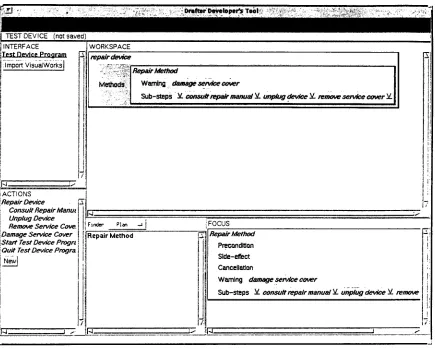
In DRAFTER, technical authors specify the content of instructions in a language independent manner using the DRAFTER specification tool. This tool al- lows the authors to specify both the propositional representations of the actions to be included, and the procedural relationships between those propo- sitions. Figure 3 shows the DRAFTER interface af- ter this has been done. We will use the procedure
shown there as an example in this section, details off how to build it can be found elsewhere (Paris and Vander Linden, 1996).
The INTERFACE and ACTIONS panes on the left of figure 3 list all the objects and actions de- fined so far. These are all shown in terms of a pseudo-text which gives an indication, albeit un- grammatical, of the nature of the action. For ex- ample, the main goal, "repair device", represents the action of the reader repairing an arbitrary de- vice. This node may be expressed in any number of different grammatical forms depending upon context.
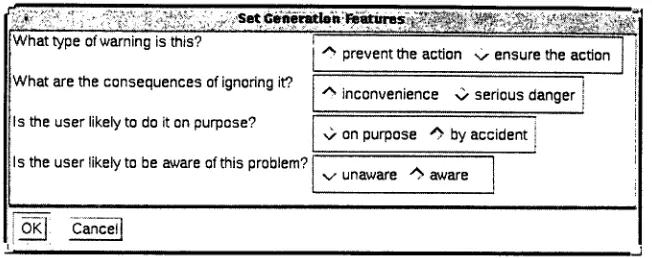
The WORKSPACE pane shows the procedure, represented in an outline format. The main user goal of repairing the device is represented by the largest, enclosing box. Within this box, there is a single method, called "Repair Method" which details how the repair should be done. There are three sub-actions: consulting the manual, unplug- ging the device, and removing the cover. There is also a waming slot filled with the action "[reader] damage service cover". This indicates that the reader should avoid damaging the service cover. 5 Neither the propositional nor the procedural in- formation discussed so far specify the three fea- tures needed by the decision network derived in the previous section (i.e., intentionality, aware- ness, and safety). At this point, we see no straight- forward way in which they could be determined automatically (see Ansari's discussion of this is- sue (1995)). We, therefore, rely on the author to set them manually. DR.AFTER allows authors to set generation parameters on individual actions using a dialog box mechanism. Figure 4 shows a case in which the author has marked the following four features for the warning action "damage service cover":
INTERFACE Test Device Prooram
"4 i.*"
ACTIONS
Repair Device Consul t Repair Manuz
WORKSPACE
I
Sub-steps .V_ con,,~,zffrepa~- manu# ~ unp/ug dev/ce .V_ remove serv/ce cover ~
Unplug Device I i'" "
Damage Service Cover
Start Test Device Progrz Quit Test Device Progra
I..4 I .-
Plan -a [
Repair Method
FOCUS
Repair Meth'od
Precond~on Slde-egect Cancellation
Warning damage.,~rvlce cover
Sub-steps ~ consuff repair manual ~ O l ~ u g device ~ remove
Figure 3: DRAFTER screen with the procedural structure for the example
• The action is to be prevented, rather than ensured;
• Performing the action would result in incon- venience, but not in personal danger;
• The user is likely to do the action acciden- tally, rather than consciously;
• The user is likely to be aware that performing the action would create problems;
5.2 Text Generation
Once the input procedure is specified, the author may initiate text generation from any node in the procedural hierarchy. When the technical author generates from the root goal node in Figure 3, for example, the following texts are produced:
English."
To
r e p a i r t h e device 1. Consult the repair manual. 2. Unplug the device. 3. Remove the service cover.Take care not to damage the service cover.
French."
R~paration du dispositif
1. Se reporter au manuel de r6paration. 2. D6brancher le dispositif.
[image:8.596.91.526.92.441.2]What type
o, warn,n u ` ' - is this? ~ prevent the action .~ ensure the action
What are the consequences of ignonng it?
Is the user likely to do it on purpose?
Is the user likely to be aware of this problem?
inconvenience ~ serious danger
on purpose ~ by accident
v unaware ~ aware 1
Figure 4: The DRAFTER dialog box for setting the local parameters
Note that the French version employs Oviter (avoid) rather than the less common prendre soin de ne pas (take care not). This is possible be- cause the French text is produced by a separate micro-planning sub-network. This sub-network was not based on a corpus study of French pre- ventatives, but rather was implemented by taking the leamed English decision tree, modifying it in accordance with the intuitions of a French speaker, and automatically constructing French systems from that modified decision tree. Clearly, a cor- pus study French of preventatives is still needed, but this does show DRAFTER'S ability to make use of KPML's language conditionalised resources.
Were we to replace the warning with other sorts of warnings, the expression would also change ac- cording to the learned micro-planning network. If authors, for example, wish to prevent the reader from performing the action of dismantling the frame of the device, and they decide that the reader is unaware of this danger, that the action is consciously performed and not unsafe, DRAFTER produces the following text:
Do not dismantle the frame. Ne pas d6monter l'armature.
If authors wish to prevent the reader from dis- connecting the ground connection, and they de- cide that the reader is unaware of this danger, that the action would be unconsciously performed, and that the consequences are indeed life-threatening, DRAFTER produces the following text:
Never disconnect the ground.
Ne jamais deconnecter la borne de terre.
6
Conclusion
In this paper we have discussed the use of ma- chine learning techniques for the automatic con- struction of micro-planning sub-networks. We demonstrated this for the case of preventative ex- pressions in instructional text.
We noted that because the automatic deriva- tion of useful, well-defined features for corpus analysis is beyond the current state of the art, the painstaking process of corpus analysis must still be performed manually. As an example of how this can be done, we presented an analysis of English preventative expressions. We intend to continue this part of the work by addressing more preventative forms, addressing ensurative forms, and by extending the analysis to other languages. Although the analysis cannot be fully auto- mated, we noted that the derivation of decision networks from coded corpus examples can. This greatly simplifies the tasks of building and testing text planning resources for new domains. We in- tend to continue this part of the work by applying the technique to larger portions of the planning resources.
Acknowledgements
[image:9.596.134.460.98.227.2]References
Ansari, D. (1995). Deriving procedural and warn- ing instructions from device and environ- ment models. Master's thesis, Department of Computer Science, University of Toronto. Bateman, J. A. (1995). KPML: The KOMET-
Penman (Multilingual) Development Envi- ronment. Technical report, Institut ftir In- tegrierte Publikations- und Informationssys- teme (IPSI), GMD, Darmstadt. Release 0.8. Carletta, J. (1996). Assessing agreement on clas- sification tasks: the kappa statistic. Compu- tational Lingustics, 22(2). to appear.
Clementine (1995). Clementine User Guide, Ver- sion 2.0. Integral Solutions Limited.
Di Eugenio, B. (1993). A Study of Negation in Instructions. In The Penn Review of Linguis- tics, Volume 17.
Di Eugenio, B. (1993). Understanding Natu- ral Language Instructions: A Computational Approach to Purpose Clauses. PhD thesis, University of Pennsylvania. also available as IRCS Report 93-52.
Horn, L. R. (1989). A Natural History of Nega- tion. University of Chicago Press, Chicago. Moore, J. D. and Paris, C. L. (1993). Planning
text for advisory dialogues: Capturing in- tentional and rhetorical information. Com- putational Linguistics, 19(4):651-694. Paris, C. and Vander Linden, K. (1996). Drafter:
An interactive support tool for writing mul- tilingual instructions. IEEE Computer. to appear.
Quinlan, J. R. (1993). C4.5: Programs for Ma- chine Learning. Morgan Kaufmann.
Rietveld, T. and van Hout, R. (1993). Statistical Techniques for the Study of Language and Language Behaviour. Mouton de Gruyter. Siegel, S. and Castellan, Jr., N. J. (1988). Non-
parametric statistics for the behavioral sci- ences. McGraw Hill.
Vander Linden, K. and Di Eugenio, B. (1996). An empirical study of negative imperatives in natural language instructions. In Proceed- ings of the 16th International Cont'erence on Computational Linguistics, August 5-9, Copenhagen, Denmark. To appear.