J
Domain-Specific Semantic Class Disambiguation Using WordNet
Li S h i u a n P e h D S O National Laboratories
20 Science P a r k Drive Singapore 118230 p l i s h i u a ~ d s o , org. sg
H w e e T o u N g D S O National Laboratories
20 Science P a r k Drive Singapore 118230 n h w e e t o u @ d s o , org. sg
A b s t r a c t
This paper presents an approach which ex- ploits general-purpose
algori.t~m~
and re- sources for domain-specific semantic class dis~mhiguation, thus facilitating the gen- eralization of semautic patterns fTom word-based to class-based representations. Through the mapping of the donza£u- specific semantic hierarchy onto Word- Net and the application of general-purpose word sense disambiguation and semantic distance metrics, the approach proposes a portable, wide-coverage method for disam- biguating semantic classes. Unlike exist- ing methods, the approach does not require annotated corpora. W h e n tested on the M U C - 4 terrorism domain, the approach is shown to outperform the most frequent heuristic substan~lly and achieve compa- rable accuracy with human judges. Its p~fo£~ance also compares favourably with two supervised learning algorithm.q.1 I n t r o d u c t i o n
The semantic classi~cation of words refers to the abstraction of ambiguous (surface) words to un- ambiguous concepts. These concepts m a y be ex- plicitly expressed in a pre-defmed taxonomy of classes, or implicitly derived through the clustering of sen~-ticany-related words. Semantic classifica- tion has proved useful in a range of application ar- eas, such as information extraction (Soderland et at., 1995), acquim'tion of domain knowledge (Mikheev and Finch, 1995) and improvement of parsing accu- racy through the speci~cation of selectional restric- tions (Grishman and Sterling, 1994; Gri~h,n~n aud Sterling, 1992).
In this paper, we address the problem of s~mantic class disambiguation, with a view towards applying
it to information extraction. The disambiguation of the semantic class of words in a particular context facilitates the generalization of semantic extraction patterns used in information extraction from word- based to class-based forms. This abstraction is effec- tively taFped by C R Y S T A L (Soderland et aL, 1995), one of the first few approaches to the automatic in-. duction of extraction patterns.
M a n y existing information extraction systems (MUC-6, lg96) rely on tedious knowledge engineer- ing approaches to hard-code semantic classes of words in a semantic lexicon, thus hampering the portability of their systems to di~erent domaln~. A notable exception is the approach taken by the Universi~ of Massachusetts. Its knowledge acquisi- tion framework, Kenmore, uses a case-based learn- ing mech--;am to learn domain knowledge automat- icaUy (Cardie, 1993). Kenmore, being a supervised algorithm, relies on an annotated corpus of domain- specific classes. Grishman et aL (1992) too ventured towards automatic semantic acquisition for informa- tion extraction. However, they expressed reserva- tions
regmrding
the use of WordNet to augment their semantic hierarchy automatically, citing examples of unintemded senses of words resulting in erroneous se- mantic cl~L~Sz~ation.To circumvent the ~notation bottleneck faced by Kenmore, our approach exploits general a~orithms and resources for the disambiguation of do,~i-- specific semantic classes. Unlike Grishmau et al.'s approach, our application of general word sense dis- ambiguation algorithms and semantic distance met- rics allows for an effective use of the Rue sense gran- ularity of WordNet. Experiments carried out on the M U C - 4 (1992) terrorism domain saw our approach outtperform~g supervised algorithms and matching b , ~ n judgements.
i
I
I
I
i
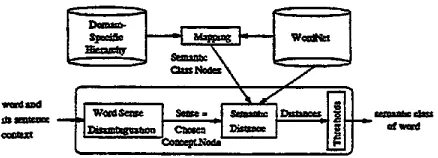
F i g u r e I : Semantic Class Dis~mhiguation.
2 O u r A p p r o a c h
As opposed to proponents of "domain-specific in- formation for domain-specific applications", our ap- proach veztures towards the application of general- purpose algor]t~,~ and resources to our dom~i,- specific s~rn~tic class disaznbiguation problem.
Our information source is the extensive seman- tic hierarchy WordNet (Miller, 1990) which was de- signed to capture the semantics of general nuances and uses of the English language. Our approach rec- onciles the domain-specific hierarchy with this ~ast network and exploits WordNet to uncover semantic ci~s~es, without the need of an ~ o t a t e d corpus.
Firstly, the domain-specific hierarchy is mapped onto the semantic network of WordNet, by manu- ally as.~zni~g corresponding WordNet node(s) to the classes in the do~,~-speci~c hierarchy. To disem- biguate a word, the sentence context of the word is first streamed through a general word sense dis- ambiguation module which assigns the appropriate sense of the word. The word sense disambiguation module hence effectively pinpoints a partic~l~r node in W o r d N e t that corresponds to the current sense of the word. Thereafter, this chosen concept node is piped througJa a semantic distance module which determines the s ~ m ~ c distances between this con- cept node and all the s~m~,~tic class nodes in the domain-speci~c hierarchy. If the distance between the concept node and a semantic class node is be- low some threshold, the semantic class node becomes a candidate class node. The nearest candidate eJ~ss node is then chosen as the semautic class of the word. If no such candidates exist, the word does not belong to any of the semantic classes in the hierarchy, and is usually labelled as the "entity" class. The flow of our approach is illustrated in Figure 1.
A walkthrough of the approach with a simple ex- ample w~l better illustrate it. Consider a domain- specit~c hierarchy with just 3 classes :- VEHICLE, AIRCRAFT and CAR, as shown in Figure 2(a).
Mapping this domainospeci~c hierarchy to Word- Net simply involves finding the specific sense(s) of
57
m r m o t o r _ v e h i c l e : 1
Figure 2 : (a) A simple domain-specific hier- archy (b) T h e classes o f t h e domain-specific hierarchy as m a p p e d onto W o r d N e t , t o g e t h e r w i t h t h e word to be dis~mhigtmted, " p l a n e ' .
the classes. In this case, all three classes correspond to their first sense in WordNet.
Then, given a sentence, say, "The plane win be taking off in 5 minutes time. ~, to dis~m~iguate the semantic class of the word "plane", the sentence is fed to the word sense disambiguation module. The module win determine the sense of this w o r & In this example, the correct sense of "plane" is sense 1, i.e. the sense of an aeroplane. Having identified the particular concept node in Word.Net that "plaue" corresponds to, the distances between this concept node and the three semantic class nodes are then cal- culated by the semantic distance module. Based on WordNet, the module will conclude that the concept node "plane:l" is nearer to the semantic class node
"aircraft:l" and should hence be cl~Lssified as AIR- CRAFT. Figure 2(b) shows the relative positions of the concept node ~plane:l ~ and the three semantic cl~q nodes in Word_Net.
2 . 1 Word Sense Dis~mhlguation
Word sense disambiguation is an active research area in natural language processing, with a great number of novel methods proposed. Methods can typically be delineated along two dimensions, corpns-based vs. dictionary-based approaches.
Corpus-based word sense disambignation algo- rjthm~ such as (Ng and Lee, 1996; Bruce and Wiebe, 1994; Yarowsky, 1994) relied on supervised learn- ing fzom annotated corpora. T h e main drawback of these approaches is their requirement of a sizable sense-tagged corpus. Attempts to alleviate this tag- bottleneck i~lude t m o t s t r ~ i a s (Te~ ot ill,, 1996; Hearst, 1991) and unsupervised a l g o r i t h ~
(Yarowsky,
199s)
[image:2.612.92.311.113.192.2]Thus far, two notable sense-tagged corpora, the semantic concordance of WordN'et 1.5 (Miller et al. ,1994) and the DSO corpus of 192,800 sense-tagged occtuTences of 191 words used by (Ng and Lee, 1996) are still insu~cient in scale for supervised algorithms to perform well on a wide range of texts.
Unsupervised algorit~m~ such as (Yarowsky, 1995) have reported good accuracy that rivals that of supervised algorithms. However, the algorithm was only tested on coarse-level senses and not on the refined sense distinctioas of WordNet, which is the required sense granularity of our approach.
We hence turn to dictionary-based approaches, fo- cusing on WordNet-based algorithms Since they fit in snugly with our WordNet-based semantic class disambiguation task.
I n f o r m a t i o n C o n t e n t
Resnik (1995) proposed a word sense disambigua- tion algorithm which d e t e r m ~ the senses of words in noun groupings. The sense of a word is disam- biguated b y choosing the sense which is most highly supported b y the other nouus of the noun group. The extent of support depends on the information content of the subsumers of the nouns in Word.Net, whereby information content is defined as negative
log 1;1~1.~hood -togp(c), and
p(c) is
the probability of encountering an instance of concept c.As mentioned in his paper, although his approach
was only reported on the disambiguation of words in related noun groupings, it can potentially be applied t o word sense disambiguation of nouns in r - ~ - ; ~ g text.
In our implementation of his approach, we applied the method to general word sense disambiguation. We used t h e surrounding nouns of a word in free
v m n ~ g t e x t as the "norm grouping" and followed his algorit~r~ without modifications ~.
C o n c e p t u a l D e n s i t y
Agirre and Rigau:s (1996) approach has a ~imilar motivation as Kesnik's. Both approaches hinge on the belief t h a t surrounding noun.~ provide strong clues as to the sense of a word.
The main difference lies in how they determine the extent of support offered by the surrounding nouns. Agirre and Rigau uses the conceptual density of the ancestors of the nouns in WordNet as their metric.
Our implementation foliow$ the pseudo-code pre-
ZThe pseudo-code of his algorithm is detailed in
(Res~ik,
x995).
=Surrounding nouns in the o ~ n a ] ResnJk's approach refers to the other nouns in the noun grouping.
umted in (Agirre and Rigan, 1996) s. For words which the algorithm failed to disambiguate (when no senses or more than one sense is returned), we relied on the most frequent heuristic.
2 . 2 S e m a n t i c D i s t a n c e
The task of the semantic distance module is to re- flect accurately the notion of "closeness" between the chosen concept node of the word and the seman- tic class nodes. It thus requires a metric which can effectively represent the semantic distance bet~veen two nodes in a taxonomy such as Word.Net.
C o n c e p t u a l D i s t a n c e
Rada et. al (1989) proposed such a metric termed as conceptual distance. Conceptual distance be- tween two nodes is defined as the m~.ir-mn num- ber of edges separating the two nodes. Take the example in Figure 2(b), the conceptual distance be- tween "plane:l" and "aircraft:I" is 1, t h a t between =plane:l" and "vehicle:l" is 2, and t h a t between =plane:l" and "car:l" is 44.
L i n k P r o b a b i l i t y
The 11~1~ probability metric is our variant of the conceptual distance metric. Instead of considering all edges as equi-distance, the probability of the 1.1n]¢
(or edge) is used to bias its distance. This metric is motivated by Resnik's use of the probability of in- stance occurrences of concepts, p(c) (Resnik, 1995). Link probability is defined as the difference between the probability of instance occurrences of the parent and child of the ]i.k~ Formally,
Lin&l'P(e, b) = p ( a ) - p ( b ) ,
SWe clarified with the authoz~ certain parts of the
algorithm which we find unclear. These axe the poin~ worth noting :-
(1) corrtpu%e.concephtaLdens/b 9 of Step 2 only computes
the conceptual density of concepts which are not ~-rked
inva~d;
(2) ex/%Ioop of Step 3 occurs whsu all senses subsumed by conce~ were already pzeviously disambiguatecl or when one or more senses of the word to be disambiguated are subsumed by con~elm~
(3) ~z~rLd~=r'n.5~r~zte&ser~ of Step 4 marks senses subsumed by concept as disambiguated, marks concept and its clfddren as invalid, and discards other senses of the wor~ wi~ sere(s) disambiguated by ¢ o n ~ ; (4) disambiguated se~es of 'words which form the con- text are n o t brought forward to the next window.
41.n Word.Net, these are 25 unique beginners of the taxonomy, instead of a c o ~ o n root. Hence, in our hn- plementation, we ~.ign a large conceptual distance of 999 to the virtual edges between two unique beginners.
I
I
i
i
I
i I
I
I
!
I
I
I
I
i
I
I
I
i
~ b . e r e ~©) ffi
~h,e.re wm,ds(©) i~ 'the ¢e¢ o,f ~,0~.~ ~ the ~orlm,~ w ~ h ~ r e a ~ b a ~ m e d b~ t h e ¢ ~ . . e ~ ©, ~ d 2V/# t h e ~o~Z ~ m b e e o f ~to~ffi~
o ¢ ~ r r ~ / n ~ e ¢ o r p ~ , ( ~ . e ~ / k , 1998) a m ~ r ~ t ~ o f t h e linJ~,
b m ¢dt//.d o. f t h e link.
T h e intuition behind this mewic is that the dis- tance between the parent and the child should be
"closer if the probability of the parent is close to that of the child, since that implies that whenever an instance of the parent occurs in the corpus, it is usually an instance of the child.
D e s c e n d a n t C o v e r a g e
In the same spirit, the descendant coverage met- tic attempts to tweak the constant edge distance assumption of the conceptual distance metric. In-
stead of relying on corpus statistics, static inforn~.-
tion from Word.Net is exploited. Descendant cov- erage of a l~nlc is defined as the difference in the percentage of descendants subsumed by the parent and that subsumed b y the child :-
D e s ~ e e ( a , b) ---- ~ ( a ) - - d(b),
T o t a l ~ u m b e r o f de~cet~d~,~ i ~ W o r d N e ¢ "
b ~ ~ o~ ~he iinJ#.
The same intuition underlies this metric; that the
distance between the parent and the child should be "nearer" if the percentage of descendants subsumed by the parent is close to that of the child, since it indic~es that most descendants of the pare~ are also descendants of the child.
T a x o n o m i c L i n k (IS-A)
All the metrics detailed above were designed to capture semantic similarity or closeness. The seman- tic class d i s a m b i ~ i o n problem, however, is essen- tially to identify membership of the chosen concept node in the semantic class nodes.
A simple implementation of the s~n~n~c distance module can thus be just a waversal of the taxonomic l~b~ (IS-A) of Word.Net. If the chosen concept node is s descendant of a s~n~=~ic class node, it should be classified as t h a t s ~ a ~ t i c class.
3 E v a l u a t i o n
T h e domain we worked on is the MUC-4 (1992) ter- rorism domaln. Nouns are extracted from the first 18
59
passages (dev-muc4-0001 to dev-muc4-0018) of the corpus of news wire art.ides to form our test corpus. The nouns extracted are the head nouns within noun phrases which are recognised by WordNet, including proper nouns such as "United States". These 1023 nouns are hand-tagged with their sense and seman- tic class in the particular context to form the answer keys for subsequent experiments.
3.1 M a p p i n g dom~,;~-specifi¢ h i e r a r c h y o n t o W o r d . N e t
The domain-specific hierarchy used in our work is that crafWd by researchers fzom the University of
Massachusetts for their information extraction sys- tem, which was one of the participants at MUC-4
(Riloff,
1994).
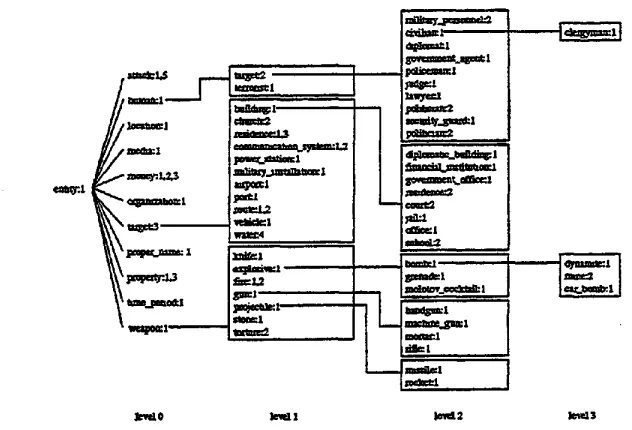
Mapping from the dom~,~-specific hierarchy to WordNer ~3rpically requires only the assignment of senses to the classes. For instance, the semantic class "human" is mapped onto its sense I node in WordNet, the uhuman:l" concept node. Classes can also be mapped onto more than one concept node in WordNet. The semantic class "attack", for e~ample, is mapped onZo both senses I and 5.
There are cases where the exact wording of a se- mantic class in the domain-specific hierarchy is not pre~mt in WordNet. Take for instance the seman- tic class ~goveroment..ot~.cia/" in the domain-specific hiermx:hy. Since the collocation is not in Word- Net, we mapped it to the concept node ~govern- ment.agent:l" which we felt is closest in meaning.
The set of m a p p e d semantic cl~-~Ses in WordNet is shown in Figure 3 s.
3.2
W o r d S e n s e D i s ~ m h i g z m t l o nWe ran our two/mplementstions of word sense dis- ambiguation algorithms, the information content al- gorithm and the conceptual density method, on our domain-specific rest set. For the information content algorithm, a window size of 10, i.e. 5 nouns to the lefz and right, was found to yield the best results; w~1~t for the conceptual density algorithm, the op- timum window size was found to be 30. For both algorithm% only the nouns Of the same passage are incorporated into the context window. If the noun to be disambiguated is the first noun of the passage, the window will include the subsequent .N nouns of the same passage.
The probability statistics required for Resuik's tneematton ¢ ~ u m ¢ algoctchm were eonecmd
sAs this hie~zchy is adopted, and not created by us,
I
I
•
~ p o ¢ l
w i ~ : l
. ~ , ~ . , ~ : 1 ~ 1
L _
,.. ~ J
m ~
F i g u r e 3 : M U C - 4 s e m a n t i c class h i e r a r c h y as m a p p e d o n t o W o r d N e t .
777,857 noun occurrences of the entire Brown cor- pus and Wall Street Jottrnal corpus.
T h e results are shown in Table I. The most fre- quent baseline is obtained by following the stxategy of always picking sense 1 of WordNet, since Word- Net orders its senses such that sense I is the most likely sense.
As both algofithm.q performed below the most fre- quent baseline, it prompted us to evaluate the in- dicativeness of surrounding nouns for word sense disambiguation. W e hence provided 2 h , m ~ judges with a randomly selected sample of 80 ex~wples from the 734 polysemic nouns of our test corpus of 1023 e~'~ples. T h e h u m a n judges are provided with the 10 nouns surrounding the word to be disambiguated. Based only on these clues, they have to select a sin- gle sense of the w o r d in the particular sentence con- text. Their responses are then tallied with the seuse- tagged test corpus.
Table 2 shows the accuracies attained by the hu- m a n judges. Both judges are able ¢o perform sub-- scantially b e t t e r than the most frequent heuristic baseline, despite the seeming)y impoverished knowl- edge source. Feedback from the)udges reveal possi- ble leverage for future improvements. Firstly, judges reflect that frequently, just one indicative surround- ing noun is enough to provide clear evidence for sense disambig~tion. The other nouns will just be glossed over and do not contribute to the decision. ALso, indicative nouns may not just hold is-a rela- tionships, which are the only relationships exploited by both algorithms. Rather, they are simply related
in some m~-ner to the noun to be disambiguated. For instance, a surzounding context including the word "church ~ will indicate a strong support for the "pastor" sense of ~m;~i~ter ~ as opposed 1;o its other se~.ses. These reflections of the human judges seem to point towards the need for an effective m e t h o d for selecting only particular nouns in the surround- ing context as evidence. Use of other relatiouships besides is-a m a y also help in d i s a m b i ~ t i o n , as is already expounded by (Sussna, lg93).
3.3 S e m a n t i c D i s t a n c e M e t r i c s
To evaluate the semantic distance metrics, we feed the s e ~ t i c distance m o d ~ e with the correct senses of the entire test corpus and observe the resultant
semantic c!~ss disambiguation accuracy.
The conceptual distance, link probability and de- SCend~mt coverage metrics all require trAversal of 11~1~ from one node to another. However, all of the metrics are commutative, i.e. distance from concept
a to b is the same as chat from b to ~ In seman- tic class d i s a m b i ~ t i o n , a distinction is necessary since the taxonomic links indicate membership re- lationships which are not commutative ("aircraft:l" is a "vehicle:l ~ but "vehicle:l ~ need not be an "air- c r a f t : l ' ) . We hence associate different weights to the upwards and downwards traversal of links, with the 25 unique b e ~ e r s of Word.Net being the top- most nodes. Upward traversal of links towards the unique beginners are weighted consistently at 0.3 whilst downward traversal of links towards the leaves
I
i
!
I
i
!
i
I
|
/
i
i
i
i
I
i
60 [image:5.612.155.471.111.326.2]I
I
i
I
I
I
|++
I
I
I
I
~ . e r ~ a t i ~ co=ent (po.t~ena¢)
Conceptual deasity (polysemic) ,
"C,o.cez~t-~a~ denS" +
.,,Most fzeque~.t heuristic (po]ysemlc) Most frequent heuristic (polysemlc) Information content (overall) .... Conceptual density (overall) Conceptroa.l density +
Most frequent headstic (overall)
Most, fre~ent heuz-~'tic (overaU)
~Examples # l ~ m ~ i g u a t e d I ~Correct I Accu~tcy
734 734 292 39.78 %
734 27~ 68 24.73 %
734 734 I 385 I 52.4,5 %
734 ' 734 464 63.22%
[o~ II I ,I¢ :H, --_.~gllv~
1023 107,3
102,3
1023
674
~3
65.88 % 73.61%T a b l e 1: W o r d sense d i s n m h i g u a t i o n r e s u l t s .
#Bxamples #Correct Accuracy
Human A 80 57 71.25 ~0
Human B 80 59 73.75 %
Most frequent heuristic 80 45 56.25 %
' l ~ b l e 2: W o r d sense d l s ~ m h i g u a t i o n u s i n g s u r r o u n d i n g n o u n s . are weighted at 1.7 s.
.Also, different thresholds axe used for different lev- els of the domain-specific hierarchy. Since higher level classes, such as the level 0 "human" class, encompasses at wider range of words, it is evident t h a t the thresholds for higher level classes-r~n-ot be stricter than that of lower level classes. For fair comparison of each metric, the best thresholds are arrived through exhaustive searching of a reasonable space 7. The results are detailed in Table 3.
Accuracy on specific se~,mtic classes refers to an exact match of the pcogram's response with the cor- pus answer. The general ~ n ~ t ; i c class disambigua- tion accuracy, on the other hand, considers a re- spouse correct as long as the response class is in the sub-hierarchy which originated, fz'om the same level 0 class as the answer. For example, if the program's reeponse is class = p o l i t i ~ " , whilst the answer is class =lawyer", since both e]~qses originated from the
same level 0 class = b - m ~ ~, this response is consid- ered correct w h e n calculating the general semantic class accuracy. T h e specific s e ~ t i c class disam- biguation accuracy is hence the stricter measure.
It m a y seem puzzling that semantic class disam- biguation does not achieve 100% accuracy even when supplied with the correct senses, i.e. even when the word sense d;~mhiguation module is able m attain 100~0 accuracy, the overall semantic class disam- biguation accuracy still lags behind the ideal. Since
SThese weights are found to be optimum for all three znetric$.
~Integral thresholds are searched for the conceptual
distance meetri~ whilst the thresholds of the other met- tics are searched in steps of 0.01.
61
the taxonomic 1~nlc~ in Word.Net are designed to cap- ture membership of words in classes, it may senn odd that the correct identification of the word sense coupled with the IS-A taxonomic 1 ~ still do not guarantee correct semantic class disambiguation.
The reason for this paradox is perceptive di~er- ences; that between the designers of the MUC-4 domain-specific hierarchy we adopted and the Word- Net hierarchy, and that between the a n - o r a t o r of the answer corpus and the WordNet designers.
Take for example the monosemic word "kidnap- ping". Its correct semantic class is =a~ack:5 s'. However, it is not a descendant of =attack:Y in Word.Net. T h e h y p e m y m s of "kidnapping" axe [cap-
ture ~ felony --~ crime --> evil-doing -+ wrong-doing --> activity .-+ act] and thatt of =attack:5" are [bakery --~ crime ~ evil.doing ~ wrong-doing ~ activity act]. Both perceptions of =kidnatpping" are correct.
"kidnapping" can be viewed as a form of =attack:Y and ~m+]~dy, it can be viewed as a form of =cap-
t ~ r e ~ .
A n effective semantic distance metric is hence needed here. T h e semantic distance module should infer the close distance between the two concept nodes "kidnapping" aud "attack:5" and thus col rectly classify "lddz~ppin~.
3.4 S e m a n t i c Class D i s ~ m T d g u a t i o n
After evaluation of the separate phases, we corn- blued the best algorithms of the two phases and evaluated the performance of our semantic class dis- ambiguattion approach. Hence, the most ftequent
[image:6.612.97.512.101.317.2]Disambiguation Accuracy Thresholds ~
Specific C]a.sses General CCla~es
Conceptual Distance .... 81.52 % . 87~10 % (3,2,2,1)
Link Probability 80.16 % 85.24 % ~ 10,1,0.01,0.01,0.01)
Co, e %
I
83.87 % i (}.02,0.01,0.01,0.01)Taxonomic L 79.67 % ! 85.14 %
L
Not applicableT a b l e 3: E f f e c t o f d i f f e r e n t s e m a n t i c d i s t a n c e m e t r i c s o n s e m a u t i c class d l s = m b l g u a t i o n . ( A s s - m ; ~ g p e r f e c t w o r d s e n s e dls=n'~higuation)
~Format :- (t~o, t~z, t~, t~s), where tz~ is the threshold that is applied to the ith level of the hierarchy. sense heuristic is used for the word sense disambigua-
tion module and the conceptual distance metric is adopted for the semantic distance m o d u l e
It should be emphasized, however, that our al>- proach to s~m~-tic class disambiguation need not be coupled with any specific word sense disambiguation algorithm. T h e most frequent Word.Net sense is cho- sen simply because current word sense disambigua- tion algofithm~ still cannot beat the most frequent baseline consistently for all words. Our approach, in effect, allows domain-specific s ~ - ~ i c class dis- ~mBiguation tO latch onto the improvements in the active research area of word sense disambiguation.
As a baseline, we again sought the most frequent heuristic, which is the occurrence probability of the most frequent senantic class "entity". 9
We compared our approach with supervised meth- ods ¢o contrast their reliance on annotated corpora with our r ~ n c e on WordNet. One of the fore- most semantic e.l~¢,S disambiguation system which employs machine learning is the Kenwore framework (Cardie, 1993). Huwever, as we are unable to report comparative tests with K ~ o r e z°, we adapted cwo other supervised algorithm% both successfully ap- plied to general word sense di~mhiguation, to the task of semantic class disambiguation.
The first is the L B X A S algorithm which uses an exemplar-based learning framework s ; m i l ~ - to the case-based reasoning foundation of Kenmore (Ng, 1997; Ng and Lee, 1996). L ~ was shown to achieve high accuracy as compared to other word sense disambiguation algorithms.
We also applied Teo et al's Bayesian word sense disambiguation algorithm to the task (Teo et al., 1996). The approach compares favourably with other methods in word sense disambiguation when tested on a common data set of the word "interest".
9This baseline is also used to evaluate the perfor- mance of K ~ o r e (Cardie, 1993).
Z°As work on one of the important input sources, the conceptu~ parser, is underway, per~.___ce results of Kenm~e on S~m~t~ic class dL~higuation cannot yet be reportecL
The features used for both supervised algorithms are the local collocations of the surrounding 4 words zz. Local collocation was shown to be the most indicative knowledge source for LBxA8 and these 7 features are the common features used in both LF~X.AS and Teo et al's Bayesian algorithm. Both algorithmg are used for learning the specific sema-- tic class of words.
For both algorithmg, the 1023-sentence test set is randomly partitioned into a 90% training set and a 10% testing set, in proportion with the overall class distribution. T h e algorithms are trained on the t r ~ ; n g set and then used to d i s ~ t d g u a t e the distinct testing set. This was averaged over 10 runs. As with K ~ m o r e , the t r ~ - ~ g set contains features of all the words in the training sentences, and the algorithms are to pick one s ~ - t i c class for each word in the testing set. A word in the testing set need not have occurred in the training set. This is --fflce word sense disambiguation, whereby the training set cont~-~ features of one word, and the algorithm picks one sense for each occurence of this word in the testing set.
To obtain a g~uge of human performance on this task, we sourced two independent human judge- ments. Two human judges are presented with a set of 80 sentences randomly selected from the 1023- example test corpus, each with a noun to be disam- biguated. Based on their understanding of the sen- tence, each noun is assigned a specific semantic cla.~ of the dom~n-specific hierarchy. Their responses are then compared a g ~ t the tagged answers of the test corpus.
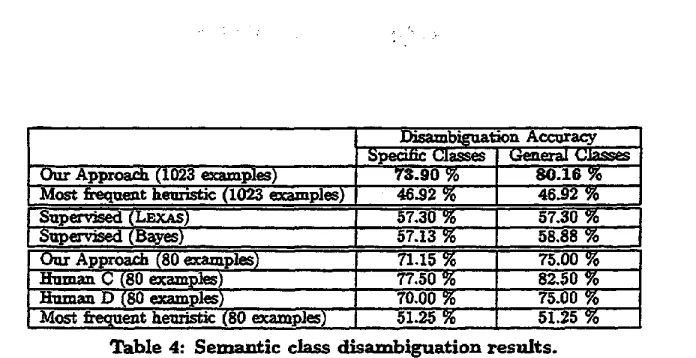
The s , ~ i c class disambiguation results are compiled and tabulated in Table 4. T h e definitions of general and s p e c i f i c semantic class disambigttation accuracy are detailed in Section 3.3.
As is evident, our approach outperforms the most frequent heuristic substantially. Also, the perfor-
zZGiven a word w i n the following sentence segment :-
12 12 w rz ~'=, the 7features used are 12-h, lz..rl, rl..r2,12, l~, r2 and ~'2, whereby the first 3 features are concatena- tions off t h e words.
6 2
I
I
I
I
I
I
i
I
I
i
i
I
I
I
[image:7.612.159.490.113.171.2]Our Approach (1.023 exm:~i'~les) Most fzequent heuristic (10233 examples)
f S~ervised :LZXAS) ST.a0 %
Supervised :Bayes)... s.7.:s %
Our Approac~h (80 examples) .... 71.15 % H I ~ C (80 examples) W.50% Hruman D (S,O,.examples) 70.00 % Most fzequent heur~c (80 example_ ) ~1.~ %
Table 4: Sem~mtic class dlsambiguation results. Disambiguation Accaracy Spedific Classes General Classes
7s.9o % 8o.16 46.92 % 46.92 %
57.30% 58.88%
75.00 % 82.50 % 75.00 % 51,25 %
mance of both supervised algorithms lag b-hl-d that of our approach. Comparable performance with the two h u m a n judges is also achieved.
It should be noted, though, that the amount of training data available to the supervised algorithms may not be sufficient. Ng and Lee (1996) found that train/rig sets of 1000-1500 e~mples per word are necessary for sense dJ-~mhiguation of one highly am- biguous word. The amount of
Er~ining
data needed for a supervised learning algorithm to achieve good performance on semantic class disambiguation m a y be larger than what we have used. Cardie (1993), for instance, used a larger 2056-instance case base in the evaluation of K ~ o r e .4 C o n c l u s i o n
We have presented a portable, wide-coverage ap- proach to domain-specific semantic d ~ disam- biguation which performs comparably with human judges. Our approach harnesses WordNet eHectively to outperform supervised methods which rely on an- nots~ed corpora. Unlike existing methods which re- quire h~d-cra.fting of lexicon or ~ - u a l annotation, the only human etfort involved in our approach is the mapping of the domain-specific semantic classes onto WordNeer. Through the use of general word sense disaznbiguation algorithms and semantic dis- tance metrics, our approach correlates the perfor- mance of semantic class disambiguation with the im- provemen~ in these actively researched fields.
R e f e r e n c e s
Eneko Agirre and Germ~- Rigau. 1996. Word Sense Disambiguation Using Conceptual Density.
In Proceedings of COLING-96.
Rebecca Bruce and Janyce Wiebe. 1994. Word Sense Disambiguation using Decomposable Mod-
eels. In Proceedings of A CL-94.
Claire Cardie. 1993. A Case-Based Approach to Knowledge Acquisition for Domain-Specific Sen- tence .Analysis. In
Proceedings of AAAI-9£
Ralph Grishman, John Sterling and Catherine Madeod. 1992. New York Univexs/ty Proteus System: MUC-4 Test Results and Analysis. In
Proceeding8 of MUG-J.
Ralph Grishman and John Sterling. 1992. Acqui- sition of Selecrional Pstterns. In
Proceedings of
COLING-9~.Ralph Grishman and John Sterling. 1994. Gener- alizing Automatically Generated Selectional Pat-
terns. In Proceedings of COLING-#4.
Marti A. Hearst. 1991. Noun Homograph Disam- biguation Using Local Context in Large Text Cor-
pora. In Using
Corpora, Univers/ty of Waterloo, Waterloo, Ontario.Alpha K. Luk. 1995. Statistical Sense Disambigua- tion with Relatively Small Corpora Using Dictio-
vary Definitions. In Proceedings of A CL-#5.
Andrei Mi~heev and Steven Finch. 1995. Towards a Wordbench for Acquis/tion of Domain Knowledge from Natural Language. In
Proceedings of EAUL-
g5.
George A. Miner. 1990. An On-Line Lexical Database. In
International Journal of Lezicogra
phy,
3(4):235-312, 1990.George A. Miller, Martin Chodorow, Shad Landes, Claudia Leacock, and Robert G. Thom~¢. 1994. Using a Semantic Concordance for Sense Identifi- cation. In
Proceedings of the
A R P AHuman
Lan- guageTechnology Workshop.
MUC-4 Proceedings. 1992.
Proceedings of
the Fourth Message Understanding Conference
(MUU-~),
San Msteo, CA: Morgan Ka,,Cm~,m. MUC-6 Proceedings. 1 9 9 6 .Proceedings of the
Sizth Message Understanding Conference (MUG-
6),
San Marco, CA: Morgan Kaufr-a-n. [image:8.612.147.495.60.239.2]Hwee Tou Ng and Hian Beng Lee. 1996. Integrat- ing Multiple Knowledge Sources to Disambiguste Word Sense: An Exemplar-Based Approach. In
Proceedings of ACL-96.
Hwee Tou Ng. 1997. Exemplar-Based Word Sense Dissmbiguation: Some Recent Improyements. In
Proceedings of the
Second
Conference on Empiri.cal Methods in Natural Language Proc~sing.
Roy Rad~ Hafedh Mill, Enen Bi&nell and Maria Bleumer. 1989. Development and Application of • a Metric on S~m~tic Nets. In IEEE Transactions
on Systems, Man, and Cybernetics, Vol. 19, No.
1, Jan/Feb.
Philip I:tesnik. 1995. Disarnbigua,ting Norm Group- ings with Respect to Word.Net Senses. In. Praceed-
ings of the Third Workshop on Very Large Cot- .pore.
Ellen M. Riloff. 1994. Informstion Extraction As a Basis for Portable Text Classification Systems. PhD t h e ~ , University of Massachmetts, Septem- ber 1994.
Stephen Soderland, David Fisher, Jonathan Aseltine and Wendy Lehnert. 1995. CRYSTAL: Inducing a Conceptual Dictionary= In Proceedings of IJCAI- 95.
Michael Sussna. 1993. Word Sense Disambiguation for Free-TexZ lude~:ing using a massive ,Se~tic Net~rork. In Proceedings of the Seoond Interna- tional Co~ferenoe on Information and Knowledge Management (CIKM-93).
Edward Teo, Chzistopher Ting, Li-Shiuan Peh and Hian-Beng Lee. 1996. Probabilistic Word-Sense Disambiguation and Bootstrapping with Unsuper- vised Gradient Descent. manuscript.
Jean Veronis and Nancy Ide. 1990. Word Sense Disambigustion with Very Large Neural Networks extrazted from Machine Readable Dictionaries. In
Procee.d: g6 of COLING-gO.
David Yarowsky. 1994. Decision Lists for Lexi- cal Ambiguity Resolution: Application to Accent Restoration in Spanish and French. In Proceed/rigs
oi ACL-g~.
David Yarowsky. 1995. Unsupervised Word Sense Disambiguation RivMi~g Supervised Methods. In
P~ocecedmgs of
A ~ 95.64
, ,