The
Pausanian
Notation:
a method for representing the structure and the content of
a hyperdocument
N i c k o l a s G o u r a r o s and W e n d y Hall D e p a r t m e n t o f Electronics and C o m p u t e r Science,
University of Southampton Email: [email protected], [email protected]
ABSTRACT
This paper introduces a new approach for improving hypermedia design, by providing the author with a tool to visualise, examine, and analyse the structure of documents containing hypermedia links. Our proposal is a new representation method the purpose of which is not to show the document structure in graphical form in order to enable the users to know where they are, where they can go next, or to give an overview of their environlncnt [12]. The purpose of our representation method is to depict what options the users are about to be offered, so that the author can examine the structure in order to better guide theln around the information space. Our representation is shown in the tbl'm of a map consisting of a proposed classification of elements that define the composition of a hyperdocument. To extract and classify those attributes we have analysed in detail all three dimensions of the hypermcdia cube: internal dynamics, external visual appearance and content synthesis.
After introducing our diagrammatic notation we give a brief example of how it could be applied to an existing hyperlnedia application. In the boundaries of this paper, we include the part of the method which represents the structure of just one hypermedia document and its linked branches. The paper concludes with. a brief description of how the lnethod is applied to represent groups of hyperlnedia documents, and a discussion of our plans for future work.
KEYWORDS: Hypermedia design, authoring tools,
representation methods, hyperlnedia maps. navigation, hypermedia writing.
1.0 INTRODUCTION
Models or methodologies such as OOHDM [30], RMM [17] and HDM, [10] have been applied very successfully in the process of hypermedia application design by expressing in a non-ambiguous way [28] the relationships among the interconnected objects. Their success solved many design problems and proved formally the need of structuring the design process.
Two-dimensional, three-dilnensional, n-dimensional, hierarchical and non-hierarchical structure representations of hyperlnedia networks, have been the subject of much research, as well as commercial products for many years. Generally. their main goal has been to provide 'the user'
with a tool which will solve problelns such as disorientation and being lost in hyperspace.
However, the questions we need to ask but which have not yet been suitably answered are: "what causes disorientation? why are users allowed to becolne lost in the hyperspace; why do we still, and how long we will be designing applications witll navigational errors?" The hypermedia field has produced some excellent representations -in the forms of overview diagrams or maps- but, 'to tell a multitude of little white lies; they suppress the truth to help the user see what needs to be seen' [23]. Most of those maps have been "system- generated means of reader orientation' [20].
2.0 THE PAUSANIAN NOTATION APPROACH
The need for another approach to the representation of hyperlnedia networks derived from our research and the development of the Pausanias 2000. a hypermedia library for the ancient Hellenic World (The Attica Region) based on the Microcosm hypermedia systeln [81. The application at its prototype stage, includes 140 content categories, including links between 300 text documents. 2000 pictures, 250 region maps, 3D graphics in a VR environlnent, video and sound sequences etc. As authors, during ilnplementation, we felt that we needed a tool which would allow us. to keep track of, and control the entire structure. A way to achieve this. is obviously to be able to visualise the hyperdocuments. Having exalnined CUl'rcnt representation inethods [5,7.9, I 1.12,13.18.22,24,25, 27,29,32] we realised that the majority, if not all of them. are implemented as an aid to users rather than the authors.
amount of design time by evaluating or examining the prototype in order to minimise the amount of serious • navigational and interaction errors that often occur [26]i
The name Pausanian derives from Pausanias, a Greek historian, traveller, and geographer. During the 2'" century AD he was travelling around Greece and describing all the sites and monuments he was seeing. His work was called the "Description of Greece" which gives a detailed a c c o u n t o f the m o n u m e n t s o f art and o f the legends cotznected with them.
Tile Pausanian notation is divided into two main sections. The first section represents one hypermedia document, and the second one represents a group of selected hypermedia docurnents. To visualise the structure of one hypermedia document we distinguish those elements that, we believe. characterise it (aspects of interest). These elements are drawn diagrammatically in what we call the "Pausanian Map fo," representing the structure of a single hypermedia document". To visualise the structure of a group of hypemedia documents, we define a set of variables (variables of interest) which are statistically represented in what we call the "Pausanian Charts for representing the structure of a group of hypernledia documents".
3.0 ASPECTS OF INTEREST
We call the characteristic elements that define the structure of a hypermedia document and are appropriate to the hypermedia author's interest, the aspects of i~uerest. The aspects of interest within a hyperdocument structure are classified into three main categories: The 'endogenous', which include aspects that characterise the internal structure or dynamics of the hypermedia document, tile "exogenous' which contain aspects that define its visual appearance and the 'auctorial" category which is concerned with aspects of interest on tile content's structure and composition. All aspects of interest are assigned with attributes graphically represented in the Pausanian map. Authors are provided with the pre-defined attributes, but there are cases where they are also given the opportunity to include their own.
3.1 ENDOGENOUS ASPECTS OF INTEREST
Tile representation of the endogenous aspects of interes{, on the Pausanian map. produces an 'x-ray' that depicts the internal structure and dynamics of a hypermedia document. By examining the map, the author can clearly perceive all objects that comprise the structure as well as the dynamics effecting it. At the top level we classify the endogenous aspects of interest as: types of nodes, types of links, types of anchors, location of anchors, status of traversal, status of direction and depth of path.
Each endogenous aspect of interest is characterised with a set of attributes acting as identification marks on the Pausanian Map. The classification of attributes for the en&~genous aspects ~f interest is as follows:
3.1.1 Type of Node
Tile 'type of node" justifies its role as an aspect of interest to the hypermedia author, because it defines the identity of all the different objects that comprise the structure of a hypermedia application i.e. text, picture, sound etc. Each type of node together with its attributes will be represented in the Pausanian map so that tile author will be able to clearly distinguish all information units and the way they are presented to the user. Since the Pausanian notation is currently implemented on Microcosm based hypermedia applications, eight categories have been assigned, as the types of nodes that can be currently viewed in Microcosm: Text, Graphic. Audio, Video. Animation, Graphic Menu. HTML( any HTML document, viewed by the Microcosm's Web viewer), VR (any virtual reality objects) viewed by the Microcosm's 3D viewer, External Object (any independent application linked with Microcosm). Since each type of node has different characteristics (in terms of comprising the structure of a hyperdocument), it has been assigned with attributes which identify it as an aspect of interest to the hypcrmedia author.
Type of Node: TEXT
Type of TEXT: includes Core Docmnent, Section. Supplement, Question - Answer (attrb - Interactive. Passive), Table (attrb - Dimensions). List-menu, Footnote. Reference, Glossary. Dictionary, Bibliography. Combination of (Type of Text + Type of Tcxt), other by tile author.
Type of Node: GRAPHIC
The type of node graphic is given two sets of attributes, one that identifies what type of graphic it is and another one that defines the semantic relation between the graphic and its source, when tile graphic is a picture and serves as a destination node.
Type of Graphic: includes Picture. Diagram, Graph-Chart. Graphic Combination.
Status of Semantic Relation when tile graphic serves as a destination node includes: Explanatory, Decorative. Allegorical I2].
Each of tile types of graphic attributes arc given an additional identification mark which represents on tile Pausanian Map the case of any text accompanying the graphic.
The type of node: AUDIO
The attributes that define an audio node and are appropriate to the hypennedia author's interest include: tile type of audio, which reveals the content of the particular audio file. For example, Verbal description, Music. Composite: the length of the sequence which represents the total playing time of the audio file; and the status of the audio player's (viewer) controls, which show whether they are available oz" not to tile user while they are listening to audio information.
The type of node: VIDEO, ANIMATION
interest include: the length of the sequence which represents the total playing time of a video or animation information unit; the status of the video and animation player's (viewer) controls, which show whether they are available or not to the user while viewing the particular video or animation; and the status o f interaction, which represents whether a sequence is interactive or passive.
The t37~e of node External Object is assigned two attributes: the type o f External Objcct which states its identity e.g. 'database', and the status of interaction representing whether that particular external object allows user interaction or appears passive. Attributes for the types of node Graphic Form- Menu, H T M L and VR are under research.
3,1.2 T y p e s of Links
One of the most important elements in the structure of a hypermedia document, is the different types of links provided by the hypermedia system. Microcosm includes, four associative types of links, one visible (button link - highlighted anchor) and three invisible (specific, local and generic - their anchors are not highlighted). At this point we do not consider other dynamically generated types of links (i.e. M i c r o c o s m ' s compute links).
Button
A link fl'om a visible anchor in a source node to a specific location in a target document. It is used in situations where the link should be obvious and the author wishes to indicate visibly its prescncc; for example a link from the anchor the first A t h e n i a n Coin, to the associated picture of the actual coin.
Specific
A link from an invisible anchor in a source node to a specific location on the target document. It is used in situations where the link provides detailed information about a particular subject "not strictly related' to the overall content of "the source node" but directly related to its anchor. Authors would use the specific link when they wish to offer the particular information but also allow the users to study the content without interrupting their cohesion; for example a link fi'om a reference: Aristotle's description of King A r c h o n ' s role, to the actual document is rclErred to as Aristotle's work "Athenaion Politeia" line 57. The user has already read the text block in the source node where the author discusses the King in ancient Athens and if they wish to examine the actual reference they can trace a question (select the text block and ask Micrososm to 'show' the link connected to that phrase) and follow the link to the Aristotle's work.
Local
A link from an invisible anchor(s) in a source document to a specific location in a target document. When a phrase or word has been linked as a local link, all occurrences of this particular anchor in the source node are linked to the same destination node. It is used to ensure that users can only reach certain documents by careful research, or to avoid
presenting thern with inappropriate intbrmation. Suppose the word harbour in a text node about the ancient harbour of Piraeus, is selected as the source anchor and a link is made to a picture painting o f the ancient harbour. If the link type local is selected when the link is made 'all" occurrences o f the word harbour "in the source document only" are linked to that painting.
Generic
A link from an invisible anchor to a specific location in a target document. When an anchored piece o f text has been linked as a generic link, all occurrences of this anchor in any document throughout the application, are linked to the same destination node. It is used in situations where the link should be available 'throughout the application': for example a link from the word 'archon" to its explanation in the ancient Greek-English dictionary.
Sequential
Another type of link included in the Pausanian notation is the sequential link. It is represented on the Pausanian map when a visible anchor (anchored text, anchored graphic object, or anchored graphic selection) leads the user to a single linear path of related nodes. It is therefore a navigational rather than an associative link. The hypertext author uses such links when he wishes to guide readers into a logical path in order to achieve a specific objective. A source node can include visible and invisible links as well as a sequential link(s) defining guided tours specifically created by the author. Sequential links provide a more limited version of what is available within the structure o f the particular node [15]. That linear-logical path consists o f nodes including a tEw or no button, specific or local links, only anchors indicating ' g o to Next' and ' g o to Previous" nodes. In the case when there is a sequential link starting a linear path fi'om a graphic type of node. then only the maximum depth of path will be represented on the map. (for the aspect of interest depth of path see later).
Three other attributes attached to each type of link are the Status of Travcrsal. Status of Direction and Target at the Destination document:
3.1.3 Status of Traversal One to One
The source anchor leads the user to only one destination node.
One to Many (Indirect)
The source anchor leads the user to a choice o f destination nodes, e.g. the source node is about the ancient Greek philosophers and in the tburth paragraph the name Plato is a visible anchor linked to a choice o f three different destinations: a document about his life. a picture o f a statue and another document about his works.
One to Many (Direct)
vase painting showing such scenes as friends preparing a bride for her wedding, a picture of a vase painting showing women applying perfume to themselves, and the third, a text node discussing embellishment in ancient Athenian Society.
3.1.4 Status of Direction
One way Link
The source anchor leads the user to a destination node from where they cannot return automatically, to the document o f departure.
Bi-directional Link
The source anchor leads the user to a destination node, from where they can 'reverse the link', or in other words return to the node of departure. In Microcosm this occurs either, when both the source and the destination node stay active on the screen so that the user can j u m p from B back to A. or when. the destination document has replaced the source node (in Microcosm terminology: the viewer starts unlocked) but includes an anchor that connects back to it. The 'target" at the destination node is an attribute mostly used in situations where the destination is a text type o f node. It represents the location within a text node, where the link points to: e.g. specific location, beginning of document. For example a link from the source anchor 'W. Thomson" to the specific location of a bibliographical reference in the bibliography type of text node.
3.1.5 Types of Anchors
The aspect of interest "Types of Anchors' is represented on the Pausanian map. in order to show what part of a node is linked to other information units.
Anchored Text
Any piece of text serving as a mark. emphasising (visible), or containing (invisible) a connection with another inRmnation unit; tier example the visible anchor 'Democracy" which links to a text node about the Constitution in Ancient Athens.
Anchored Graphic Object
An3,, graphic element serving as a link to another information unit: for example a navigation sign on the map of the Acropolis. a sound icon at the end of a text node which links to a musical reconstruction from the Orchestra in the Athenian Agora.
Anchored Graphic Selection
A link made on a particular selection within a picture or a graphic e.g. a link made on an ancient wine cup (being part of a picture presenting six red-figure wine cups) connecting to another picture consisting of the bottom of that cup which depicts an ancient potter sitting at his wheel, the speed o f which he controls with his knee and above him on a shelf there are some of his pots.
All three types of anchors are attached to another set o f attributes that represent the destination flag which is any possible indication at the source anchor for the type of the destination node.
Destination Flag
The destination flag will be shown on the Pausanian map when a source anchor is accompanied by any indication o f its destination e.g. an icon: a video camera icon situated next to an anchor showing that the destination node is a video sequence; or any other way of indicating the destination such as a label appearing after a mouse action: a label stating "animation" which appears when the mouse is over an anchor; or a link preview: where the source anchor includes a preview of the destination node such as the node type and a name such as a title or a brief summary of the content.
3.1.6 The Location of Anchors
The aspect of interest 'location of anchors' includes attributes that show in the map, the exact position of each anchor in the source document: Paragraph No. Beginning of Document. Middle of Document. End of Document. It is a very important aspect of interest because it shows clearly, the frequency or concentration o f links within a document.
3.1.7 The Depth of Path
The Depth of Path is an aspect o f interest represented on the Pausanian Map in the form o f steps. Those steps arc the attributes that identify the depth o f the linking path. from the "surface" of the hypermedia document (tile source anchor) to its "bed" (the last linked destination node). For example: [anchor A I ] in node A linked to Node B (1" Step) [anchor B3] in node B linked to node F (2"" Step) [anchor F3] in node F linkcd to node L (3'" Step), [anchor A2] etc.
The Pausanian Map includes a visual representation of links traversed up to the Iburth step. If a linking path "pulls" the user further than the fourth step. then only the location of that last destination node is shown but not the representation of its attributes.
3.2 EXOGENOUS ASPECTS OF INTEREST
The second category of aspects of interest to the hypermedia author is the exogenous. The e.rogenous aspects of interest define the visual appearance, o f a hypermedia document:
Length of Document. Scrolling document (more than one screen page), Non-Scrolling document (one screen page). If the document is scrolling, it is represented in the Pausanian Map by the number of pages. Further attributes that are being considered include: Width of Text Block, Alignment of Text Block, and Nurnber of Fonts used in the Document.
3.3. AUCTORIAL ASPECTS OF INTEREST
The final category of the aspects of interest to the hypermedia author, is the auctorial I. The auctorial aspects of interest are concerned with the content's structure and
ccmaposition. We have classified these as: the status of association, the arrangement of cognitive layers, the content kermatism and the level of content fragmentation.
3.3.1 The Status of Association
A very irnportant aspect of interest for the hypermedia author is the association between the source anchor and the destination text node. The Pausanian notation includes eight different attributes which define the status of the association. These attributes are offered as predefined to the author, ( as well as to the content expert or the evaluation team) of the application. As well as the status of association we are considering including in the notation, Trigg's links taxonomy [31] which is a very explicit classification of attributes defining the semantic relation between nodes.
Consecutive Association
A consecutive association is the smooth content transition from the source node to the destination document. For example, the source node is about sculpture in ancient Greece and it discusses the different types of Korai (female standing figures) The third paragraph of the document explains briefly their characteristic elements and the differences between the Kore o f the 6'" century BC and the Kore sculptured in tire 7" century BC. Within this paragraph there are two button links (visible) one on the anchor: "Kore of the 6'" century' and another on the anchor: "Kore of the 7'" century'. Both anchors lead the user to documents which discuss in detail the characteristics of each statue. If the user chooses to follow the link and read these documents they can easily compare their characteristics because tire source document has ah'eadv prepared them by irrtroducing the subject.
Therefore there has been a smooth transition from the destination nodes to the source node and vice versa. The content of the destination document succeeds the source node.
Renaissance Association
Authors create a renaissance relation between two nodes, when they make a link to a document, that 'revives' the user's enthusiasm.fi~r learning more information about the corresponding subject. For example, the source document discusses the sculpture of the Parthenon where the author talks about its fiieze and metopai. In the text block discussing the fiieze of the Parthenon, the author has made a link on the word 'frieze' that connects to a detailed docurnent containing a description. The same strategy has been chosen for the word 'metopai'. Both anchors are visible (button) links. Since the source document is about 'the sculpture of Parthenon' and includes links to information about the main architectural elements of the temple, it is building a renaissance relation where the author inclines the reader's mood to learn more about the anchored subjects.
The distinction between the two examples given for the attributes of content relevance: renaissance relation and consecutive relation, is that in the renaissance relation, the
destination nodes consist of information about different subjects that comprise the theme: Sculpture of Parthenon, (the user follows the link in order to learn more about the source subject), whereas in the consecutive relation the destination nodes consist of information on the same subjects (statues of Korai) but in different chronological periods. (the user-reader compares the information in the destination node, to the source node-a smooth transition from A to B)
Umbilical-Cord Association
An Umbilical-Cord relation is created when the destination node(s) complements the content of the source node. For example, the source document discusses the columns (kiones) of temples built in the Archaic period. The second paragraph of the text explains that the ancient temple's columns consist of parts such as the stylobate, the krepidoma, the capital and the entablature. All these words have been anchored by the hyperlnedia author as visible links, leading the user to destination nodes containing the description of each par! and its corresponding location on the column of an archaic temple. Since the destination documents complete the subject about the structu,'e of columns in the archaic temples, they create an umbilical- cord relation between the source node and its target docurnent(s).
Subversive Association
Hypermedia authors build a subversive relation when they connect two documents, and the destination document subverts the content of its source. For example the case where the source document is about the Parthenon's Frieze and its sculptured decor which represents the Panathenaic Procession. In the entire text the author concentrates on the interpretation of the sculptured representation and maintains the most popular theory which is the procession that accompanies the presentation of the robe of" the Goddess Athena. In the middle of this document, the author reports that there is another interpretation for the decor of the frieze, but it is not accepted by the experts. The words 'another interpretation" are visible links connecting to the text reporting this alternative explanation which however subverts the globally accepted theory in the source document. In this case the author has created a subversive relation between the source and the destination node.
Intrusive Association
east and west metopies and what they represent (the labors of Heracles ). All tile main characteristic elements of the temple are visible anchors ( 15 button links) linking to other documents with more detailed information for each part of the temple i.e, its columns. The user started to learn about tile sculptor Feidias and his master work the gold statue of Zeus and ended up reading very detailed information about the temple of Zeus where the statue was situated, having previously passed from a text about the representation on the decor of the west fi'ieze. In this case the destination document has suddenly interrupted the reader from the content of tile source document and created an intrusive association.
Magnetic Association
The characteristics of a magnetic relation could be the same as the renaissance relation with the difference that the former brings possible danger. Let us take the same example as in the renaissance relation where the source document discusses the Pheidias" sculptures of the Parthenon, specifically the gold statue of the goddess Athena. Somewhere in the middle of the description the author refers to Pheidias" students who contributed in the construction of that most important temple of the ancient Hellenic civilisation. The words 'Pheidias' students' are visible anchors linking t o documents of detailed information about each student. In this case the author has roused the reader's interest (magnetised) to learn about a subject completely different from the initial content. It is not a renaissance relation because there hasn't been any positive transition and the visible anchor leads the reader to a completely different context from the one in the source node.
Association of Superiority
A relation of superiority is created when the destination node is full of inlbrmation and overwhelms tile source document. For example the source document is about ceramic vase painting in the 7'" century BC, and discusses the Attic workshops and the technique for applying the decoration of the vases. In the third paragraph of the document the author reports a later technique (applied in the 6'" century BC). which was one of the two most common in the Attic workshops: the black-figure painting (the second most common technique was tile red-figure painting). The author explains that all vase-painting in the 6'" century was based on the black-figure technique. The words 'black-figure" technique are a visible anchor, which leads the reader to a document containing a well composed detailed description on the actual technique, including information about different painters and their vase paintings. In this case the author by providing a visible link to such important and detailed intbrmation, overwhelms the content of the source document.
Association of Discontinuity
Content discontinuity is created when there is no relation between the destination document and its source. For example, suppose the source document is about 'the temple of Poseidon in Sounion'. In the second paragraph of that document there is a very brief reference to the columns of
the Parthenon. The words 'columns of the Parthenon' are anchored as a visible link connecting to the document consisting of general information about the Parthenon. Since the source document is the temple of Poseidon and the destination node is about the Parthenon, there is no continuity in the content. If the destination document was about the columns of the Parthenon then there would be some continuity but not as much as in the umbilical-cord relation.
Each of the above attributes are represented in the Pausanian map together with another attribute which states if the destination node has been composed by the same or different author.
3.3.2 The Arrangement of Cognitive Layers
Hypermedia authors, build cognitive jumps in order to offer the user what he anticipates from possible questions. They offer the reader, anticipated solutions to possible questions which arise, while reading the source document. We call these cognitive jumps the layers which are created by the reader's transition fi'om the informative source document to the destination node which focuses attention to a particular point of information. The author invents cognitive solutions that comprise tile necessary channels to enable the reader to attain their anticipated target. In some cases the author's intention to offer the anticipated, could be perceived by the reader as "a present". However, there are times when the readers get exactly what they expect. but there are also other times where they are given little or nothing that would meet their expectation. The hypermedia author is obliged to know his readers very well and plays the role of an augur who knows both, the person who is asking for an oracle as well as their problem. In other words, the reader and what they anticipate from the content in a source document, and the provided linked information. The cognitive channels or layers created by the author, resemble the oracles given by the augur (author) to the applicant (user).
This mechanism of the creation of layers, if they have not been built carefully, will easily miss their target.
3.3.3 The Level of Content Kermatism
The kermatism of a hypermedia application is the segmentation and classification of the aggregate content into interrelated atomic subsets each of which comprise an individual subject. For example, the content of Athens in the Years of Perikles divided in chapters and sections such as The City, its structure and organisation, Social Organisation and day-to-day l(fe, Professions and Finance, The Athenian Constitution, Perikles, his life and mission, or
a documetlt about the daily life in Ancient Athens and the information linked from anchors located within that source document. The hypermedia author by segmenting the aggregate content, gives each subset -section or subsection- an entity. They consider it as something discrete or individual within the entity of the aggregate content. However, this does not imply that those subsets do not intersect with each other. In a hypermedia application, they could exist within the content, as self-subsistent or sell'- created but they can also interrelate (be semantically linked). Some of the subsets, being either chapters sections or subsections, can supplement and complete a notional aggregation. By segmenting the content, authors can offer their best writing capability and meet their targets more easily. One of those targets may be the effective interrelation (linking) of subsets in order to achieve content coherence and comprehension. It is much more likely, that such targets will be met by the kermatism of the content (linked chapters, sections, subsections), rather than it, being a whole single linear unit.
4.0 The Level of content Fragmentation
We describe the fragmemation of a single h3permedia document, as all the typographic and conceptual interruptions which lead the user to a path of cognitive jumps. Both the kermatism and the fragmentation map will help the author to experiment with different strategies in order to see if readership improves or inclines. Unfortunately. due to space limitations we can not include their representations in this paper. (For details of. the Pausanian Kcrmatism Map, Pausanian Fragmentation Map and Pausanian Generic Links Map see HT'97 poster presentation: The Pausanian Notation [ 14] ).
5.0 THE PAUSANIAN MAP, AN EXAMPLE
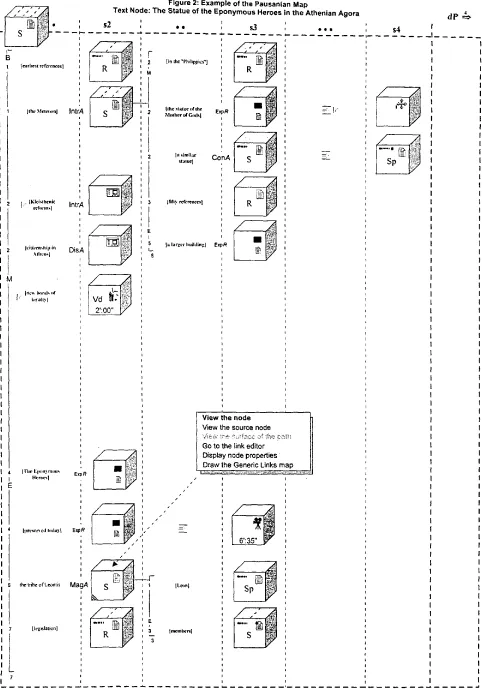
The Pausanian Map shown in figure 2, represents the structure of a hypermedia document about "the statue of the eponymous heroes" in the Athenian Agora.
From a first glance at the Pausanian Map of this particular document we can clearly see both the direction and
distance o.fmovement. The author has included information guiding the reader along a linking path up to the fourth step. Research studies have shown that if readers are guided along more than four steps there is significant possibility that they will loose track of their current position [16]. If we [bllow the linking path in reverse (from the fourth step to the first) we can see that the path started from the visible anchor "the Metroon'. The attributes of the destination node at the second step signify that the author has created an
intrusive association between the destination node and its source. The hypermedia author has chosen, to describe the association between, the sou,'ce node and its destination, as
intrusive. By definition, an intrusive association reveals a negative status. However, negative attributes between subsets, would not necessarily be negative for their hypermedia inclusion. This representation on the Pausanian Map, will help the author to visualise the thinking and structure of their ideas in order to examine how well they were composed within the hypermedia context. A suggestion in this particular example would be to avoid linking subsets that are not coherently associated. If the author particularly needs, to provide information about the Metroon, and make it available from that location (1" paragraph of the document, anchor: the Metroon), he could possibly change the selection of the visible Button
type of link and make it, say an invisible Specific link. (A Local type of link would be a good choice only when the author wishes to make the information available from all the occurrences of the anchor "Metroon' in that document. However, if the link is described with a negative status of association, a local type of link is not recommended).
The representation of the source document's linking structure shows the author that it contains six button links, two specific and one local (six visible and three invisible links). The length of the document is four screen-pages. If we consider its length, in combination with the number of links included, we can observe that there is no great level of fragmentation.
The second paragraph of the document contains two button links one on the anchor 'Kleisthenic Reforms" and another on the anchor "Citizenship in Athens'. As represented on the map both visible anchors lead the reader to two different Graphic -Menu type of nodes. This means that while the users read the second paragraph of a seven paragraph document, they are "'offered" the opportunity to stop themselves from completing the reading of its content and to jump to a graphic-menu that contains links to completely different subjects. Again in this situation the author should either not link visible anchors to graphic menus in the beginning of the document or choose a more appropriate, invisible type of link. It is recommended however that the hypermedia author should not use these links at all, because both the content interruption, and the transition to completely difl~rent subjects, could mean the reader looses information taken from the source and become disorientated.
Carrying on the examination of the structure in the fourth and fifth paragraphs respectively, two button links connect to pictures that complete the subject of the paragraph
video sequence. However, this anchored graphic object is not accompanied by a destination flag, which means that the reader is not being informed by the author that they should expect khwtic information. It is recommended that all anchors connecting to either sound or kinetic information such as animation, video or movement in a VR environment, should be accompanied by a destination flag (i.e. a video camera icon or mouse label) to indicate what type of object is linked to the anchor [19]. Moreover. that video node is relatively long (6":35"'). Especially with teaching material the length of video and animation sequences should be restricted in proper length. Such long video nodes (more than 4 minutes) might prevent users ['or comprehending the content, reduce the concentration and will to study and give much more complex operation of software tools [ 16].
6.0 VARIABLES OF INTEREST- PAUSANIAN CHARTS
Up to this point in the paper wc have introduced how the Pausanian notation could be used to represent a single hypcrmedia document in order to analyse its functionality or dynamics, and recommend possible improvements or alterations.
As mentioned in the introduction, to visualise the structure of a group of hypcrmedia documents, we have defined a set of variables, (derived from the aspects of interest), which we call the rariables of interesr These are statistically represented in what we call "PausaHia~ Charts for representing the structure of a group of hypermedia documents" (Figure 3). Such variables include: Total Number of Visible Links. Total number of Generic Links, Maximum Depth of Path started from Visible Links. Maximum Depth of Path started from Generic Links. Concentration of Visible Links. Number of Associations of Discontinuity. Numbcr of Graphic-Picture Nodes. etc. (all variables are applied per hypermcdia document)
Firstly. the author can select a group of documents lk)r investigation. (i.e. all the text nodes from the chapter Daily Life in the Pcriklcan Athens) , and then choose from our classification of the variables of interest, the ones they would like to represent on the Pausanian Charts, in order to examine their structure. Then a data table is generated and a series of provided types of charts, is recommended. The author can then choose one of the charts from which, the appropriate Pausanian Chart will be drawn, grouping together the selected variables and representing them statistically. By examining the Pausanian Chart, the author can visualise certain issues from the synthesis of all the selected documents, in order to perceive their structure at a glance. If they want to look more closely at a particular point in the chart they could apply the Pausanian Map on that particular node. This aspect of work is still under research.
CONCLUSION AND FUTURE WORK
By proposing the Pausanian notation we argue that it is time to start providing hypermedia authors with tools to help them find the problerns inherent in their designs themselves. By no means do we believe that a notation will
solve all the problems. What we argue is that by defining the attributes that play a key role in the synthesis of a hypermedia structure and making them visually available to the composers of the application, possible problems and causes can be revealed, and the overall design and the performance of the application can be improved.
In this paper we have introduced the Pausanian notation as well as its main features: the aspects of interest, the Pausanian Map, the variables of interest, and the Pausanian Chart. The major case study being used lbr evaluating and testing the notation, is Pausanias 2000, a h37)ermedia librao'for the ancient Hellenic WorM (The Attica Region). We are also currently evaluating our method on another six Microcosm and three Storyspace [6] applications. Due to space limitations, we cannot discuss in detail the results of our evaluation however, we have found that our approach has been justified and that. by using the Pausanian Notation, the author can quickly track and correct en'ors occurring throughout the structure.
Our plans for future work are directed as follows: in the very near future we would like to have completed the classification of aspects (!f interest and rariables of interest as well as to improve the paper representation of the Pausanian Maps. In parallel, we will be working in the implementation of the Pausanian Notation for representing, examining and analysing the structure of Web based applications. Having achieved that. we will start automating the process of creating the Pausanian maps tk~r Microcosm applications, by adding the appropriate functions to the Microcosm Make-Link feature. The fact that Microcosm keeps all the link information stored in a linkbase file, makes it much easier to extract any information needed for producing the different Pausanian Maps. The implementation of the Pausanian method for representing the structure of a Web application, will be based on WebCosm (the Web version of Microcosm [4] ).
REFERENCES
1. Bieber. M. & Kacmar. C. Designing hypertext support for computational applications. Communications of the ACM. 38(8), 1995.
2. Bolter. J. "Writing space, the computer, hypertext and the history of writing". Lawrence Erlbaum Associates, Inc., 199 I.
3. Card, S.K. Robertson, C.G. Mackinlay, J.D. "The information visualiser, an information workspace". In proceedings of CHI "91 New Orleans, April 27-May 2, 1991 181-188.
. Collier, G. H. Thoth II: hypertext with explicit semantics. Hypertext '87 Proceedings, pp. 269-290, New York, NY: ACM Press, 1987.
6. Eastgate Systems, Inc. STORYSPACE: A Hypertext
Tool for Writers and Readers,
I) ttI~:llwww.eastgate.com/Storyspace.hlml.
7. Dynamic Diagrams, Inc. Introducing MAPA,
I) ttp:/Iwww,dynamicdiagrams.com/producls.htm.
.
.
Davis, H. Hall, W. Heath. I. Hill, G. Wilkins, R. "'Towards an integrated information environment with open hypermedia systems". In ECHT'92: Proceedings of the Fourth ACM Conference on Hypertext, Milan, Italy (Nov.- Dec. "92), p. 181- 190, 1992.
Furnas, G . W . "Generalised fisheye views". In proceedings of CHI 1986, 16-23.
10. Garzotto. F. Schwabe, D and Paolini, P: 'HDM-A Model Based Approach to Hypermedia Application Design" ACM Transactions on Information Systems,
I 1 (1) Jan. 1993, pp. 1-26.
II. Ghedini Ralha, Cohn, A. "'Building maps of hypcrspace". WWW National Conference, Internet Muhimedia Information, July 6-8, Minho University, Portugal. 1995.
12. Gloor. P. Cybertrees: "Tree-Shaped overview maps". In elements of hypermedia design, techniques for navigation and visualisation in cyberspace, Gloor P. cd. Birkhauser, 1997.
13. Gloor. P. "Elements of hyperrnedia design : techniques for navigation and visualisation in cyberspace". Birkhaueser, Boston. 1997.
14. Gouraros, N. "'The Pausanian notation, a method for representing the structure of a hyperdoeument". Poster Presentation ACM Hypertext "97, Southampton 1997.
15. Grabinger, S. Dunlap, J. "'Links". In hypermedia learning environments: Instructional design and integration, Kommers, P. Grabinger, S. Dunlap, J. (eds). Lawrence Erlbaum Associates, Inc. 1996.
16. Haga, H. Nishino, M. "Guidelines for designing hypermedia teaching materials". In Proceedings of the Conference in Educational Multimedia ED'95, 1995.
17. Izakowitz, E, Stohr, E and Balasubramaniam, P: "RMM: A methodology for structured hypermedia design'. Comm. Of the ACM, October 1995, pp.34-44.
18. Johnson. B. Shneiderman, B. "Tree-maps: A space- filling approach to the visualisation of hierarchical information structures". In Proceedings tbr Visualisation "91. San Diego, CA, 1991 284-291.
19. Landow, G. "'The rhetoric of hypermedia: some rules lbr authors". In hypermedia and literary studies,
Delany, Landow (eds). MIT Press, 1990.
20. Landow, G. Hypertext 2.0: The Convergence of Contemporary Literary Theory and Technology Johns Hopkins University Press, 1997.
21. Mackinlay, J.D. Robertson. G.G. Card. S.K. "'The perspective wall: Detail and context smoothly integrated". In proceedings for CHI '91, New Orleans, April 27 - May 2, 1991, 173-179.
22. Maurer, H. Hyperwave: The Next Generation Web Solution. London: Addison-Wesley, 1996.
23. Monmonier, M. "How to lie with maps". University of Chicago Press, Chicago 199 I.
24. Mukherja, S. Folley, J.D. "Visualising the world wide web with the Navigational View Builder". In Proceedings for the Y" International World Wide Web Conference. Computer Networks and ISDN Systems 27, no 6, 1075-1987.
25. Mukherjea, S. Foley, J. Hudson. S. "Visualising complex hypermedia networks through multiple hierarchical views". In proceedings of CHI '95. Addison Wesley. 1995.
26. Newman, W. Lamning M. (eds), "'Interactive systems design". Addison-Wesley. 1995.
27. Robcrtson. G.G. Mackinlay, J.D. Card S.K. "Cone trees: Animated 3D visualisations of hierarchical information". In Proceedings lbr CHI "91, New Orleans, April 27 - May 2. 1991, 189 - 194.
28. Rossi, G. Schwabe. D. Garrido, A.: Design reuse in hypermedia applications developmcnt. In proceedings of the ACM International Conference on Hypertcxt (Hypertext "97) Southarnpton, UK April 1997.
29. Sarkar. M. Brown, M. "Graphical fish-eye views of graphs". In proceedings of CHI "92, Monterey, CA. May 3-7 1992, 83-9 I.
30. Schwabe, G. Rossi and Barbosa, S: "Systematic Hypermedia Design with OOHDM'. Procceedings of the ACM International Conference on Hypertext (Hypertcxt "96) Washington. Marcll 1996.
31. Trigg, R. A taxonomy of link types. In A network- based approach to text handling for the online scientific community. Pd.D. dissertation, Univeristy of Maryland Technical Report. TR-1346, November
1983.
32. Utting, K. Yankelovich, N. "Context and orientation in hypermedia networks". ACM Transactions on Office Information Systems 7, no. 1, January 1989, 58-54.
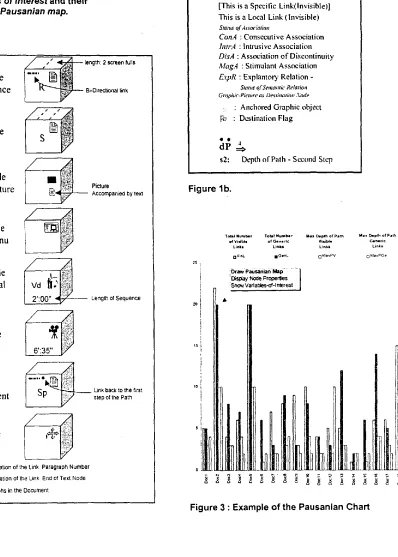
Figures la, l b : Examples of symbols used to
represent aspects of interest and their
attributes on the Pausanian map.
B
M
Type o f Node Text-Reference
[image:10.612.331.553.20.538.2]Type o f Node Text-Section
Type of Node Graphic-Picture
Type o f Node Graphic-Menu
[image:10.612.143.541.35.592.2]Type o f Node Audio-Verbal Description
Type of Node Video
Type o f Node Text-Suplement
Type o f Node VR-Object
•
- length: 2 screen h a l l s~ = ~ Bi-Directional link
~ Picture
Accompanied by text
@
Length of Sequence
- - ~ _ _ Link back to the first step of the Path
• e l - - Location of the Link• Paragraph Number
E ~ Location of the Link End of Text Node
I~ Number of paragraphs in t~e Document
Figure la.
Figure
IThis is a Button Link (Visible)l [This is a Specific Link(Invisible)] This is a Local Link (Invisible)
Slams qf Association
ConA : Consecutive Association
h~trA : intrusive Association
DisA : Association of Discontinuity
MagA : Stimulant Association
E . ~ R : Explantm~' Relation -
Stares qf Semantic Relation
Graphic-Picture as Destinatioa .\2>de
: : Anchored Graphic object :Dcstination Flag
s2: Depth of Path - Second Step
l b .
25 ~
Total N~bmr Total Number of vilabl* of Oe.. a¢
Links Links oV,~t. BG~L
iOraw Pa=~niafl Map ... i ; D R y Node Proper~es I Show VariaUes-of-lnterest
i"
Mal DQpth of Path Mal Oeplh of Path Vi=b¢. Gin.at Links Links CkqaxPV QMaxPGe
o .
Figure 3 : Example of the Pausanian Chart
[image:10.612.64.299.85.548.2]e- • -- --
B
~earlle~t references]
lih¢ M¢irl""ll InlrA
IKl¢i~lhcnk l n t r A
{; rcf.,+ns I
It'ili~i'll~ hll i in DisA .llllien~ I
M
{, Inc~ h(md,,if hi) all', I
H~'r,~'~l
6 ihe tribe o f L~ontis
[lcgislafioni
7
ExpR
ExpR ~ t ~l
/
MagA
F i g u r e 2: E x a m p l e o f the P a u s a n i a n M a p
T e x t N o d e : T h e Statue o f the E p o n y m o u s Heroes in t h e A t h e n i a n A g o r a
s2 : oo , s3 I o , °
2 [in Ihe "Phihppics']
[Ihe wtalu¢ of Ih¢ liillhCr lit Cixl~{ ~ R
I I I I I 2 la similar
NtalUel ConA
Iflfi) rcfi','coccs I
E
I
5 {~, hir~¢r iiuihiingl E~R
t
I
E l ,
View the node View the source node G o to the }ink editor
Display node properties Draw the Generic Links map
/ /
#
J
l . r -
I
E 3 3
IL~,n}
Imcmi~r~l
s4
d P =~
[image:11.612.59.541.25.714.2]