International Journal of Research in Advent Technology, Vol.2, No.9, September 2014
E-ISSN: 2321-9637
54
Study of Combined Renewable Power System for
Electricity Generation
Durga Shanker Menaria
1, Surendra Verma
2Electrical Department1, E&C Department2 Dungarpur College of Engg. Tech1, 2
Dungarpur (Raj.), RTU, Kota1, 2
[email protected]1, [email protected]2
Abstract- Global warming Earth's climate system and the continuous increase in the average temperature is clear.
Effects of global warming, prosperity and economic and statistical effect on the form to overcome dependency. We have solar photovoltaic and biogas for electricity generation are starting a coalition system. If the energy system in a high reliability, cost effective and can be used to improve the quality of the small town. We will redesign the electrical system with environment friendly. We in India can be produced that will show the larger market. Large-scale, system independently a stationary power source for small towns and will provide daily gas alliance. To increase the efficiency of the system and to increase the use of renewable energy mix of the electricity system.
KEYWORDS: PV System, Bio Gas, Methane, I. C. Engine, Combined System.
1. INTRODUCTION
The combined power systems usually wind turbines or generators running on diesel or bio-fuels are a combination of photovoltaic with / biogas is used. During the day PV The power generated by the array is a power manager that controls the whole system, is stored in the battery bank through. The resulting combined system thus provides an optimal solution at a much lower price. It is ideal for electrification of remote villages in India. Non-renewable photovoltaic power generation serves to reduce fuel consumption. Biogas is usually produced by the breakdown of organic matter in the absence of oxygen gases refers to the mix. Recycled waste such as biogas can be produced from raw materials available in the area. It is a renewable source of energy and in many cases exerts a much smaller carbon footprint.
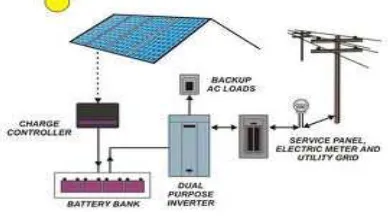
Fig.1.1 A Combined PV system
2. LITERATURE REVIEW
Several works are going on solar photovoltaic systems and biogas. Some of these are:
Janani Chakravarthi [1] presented a paper of biogas and energy production biogas.
Ajai Gupta, R. P. Saini, M. P. Sharma [2] presented a paper about Hybrid Energy System for Remote Area An Action Plan for Cost Effective Power Generation. Vicente Salas and Emilio Olias [3] Hybrid Powering System for Stand-Alone Remote Telecom Applications.
Ajai Gupta, R. P. Saini, and M. P. Sharma [4] Computerized Modeling of Hybrid Energy System. Zhanping You1, Shijun You1, [5] ;Biogas Power Plants Waste Heat Utilization.
Jiang Yao-hua, Xiong Shu-sheng, [6] in this paper Research of Biogas as Fuel for Internal Combustion Engine.
Zhang Yanning, Kang Longyun [7] The paper Renewable Energy Distributed Power System With Wind Power and Biogas Generator.
International Journal of Research in Advent Technology, Vol.2, No.9, September 2014
E-ISSN: 2321-9637
55 Mayank Aggarwal, Vijit Gupta [9] Title of the paper
Biogas as Future Prospect for Energy Dependency and Rural Prosperity in India.
S.Hasan Saeed, D.K.Sharma, [10]“Non Conventional Energy Resources” Publication kataria and sons [2006-2007]
3. BIO GAS
Biogas etc. animal and human manure, leaves, twigs, grass, anaerobic fermentation of organic materials such as industrial waste gas produced by the mixture of methane, carbon dioxide, hydrogen and many other gases i.e. sulphids .
The presence of methane in biogas for cooking, lighting, and prime movers for power, which makes it suitable property lends combustion.
3.1 Working of Bio gas plant
Slurry (a mixture of equal amounts of biomass and water) is prepared in the mixing tank. Preparation of slurry inlet pipe through the digester is fed into the chamber. The plant is left unused for about two months and the introduction of slurry is stopped. During this period, anaerobic fermentation of biomass takes place in the presence of water and produces biogas digester. Biogas being lighter rises up and starts collecting in the gas holder. The gas holder is now starts moving. Gas holder can not rise beyond a certain level. Starts collecting more and more gas, more pressure to be exerted on the slurry begins. Spent slurry is forced into the chamber now shop from the top of the chamber. The chamber is filled with slurry store expenses, additional overflow tank is forced out through the outlet pipe. The later is used as fertilizer for plants. Biogas supply store to get gas from the gas valve is opened. Begins to produce biogas, gas cost a steady supply of fresh slurry and the introduction of slurry can be ensured by regular removal. [14]
Methane production: Airtightnees : The breakdown
of organic material in the presence of oxygen to produce CO2 and methane in the absence of it creates.
Temperature: Temperature for fermentation will be 35oC-40oC.
This stage may be represented by the following overall reaction:
Thought reaction of methane bacteria nCH4+
(C6H10O5)n+H2O
3nCO2
Individual reaction include: 1. Acid breakdown into methane
2C3H7COOH + H2O 5CH4 + 3CO2
2. Oxidation of ethanol by CO2 to produce methane
and acetic acid.
2C3CH2OH + CO2 2CH3COOH +
CH4
3. Reduction with hydrogen of carbon dioxide to produce methane
CO2+4H2 CH4 + 2H2O
4. ECONOMIC AND STATISTICAL
ANALYSIS
Financial study of a biogas plant: We based on our calculations take into account the increase in cost over the years has taken the following assumptions. We have raw materials like cow dung, human waste and organic waste are values that are almost negligible cost.
(1) Total no of families in the rural area =100 or 400 person and 1 LPG cylinder used in 1 month.
(2) Out of these 100 families 40 families have more than 5 members where as 40 have less than 4 members and 20 families have more than 2 members on an average.
(3) Cooking gas from plant will be sold at Rs 375 to single families per month.
(4) The compost manure produced will be sold at rate of Rs.530 per ton.
(5) Each family with more than 5 members requires 3.5 m3 gas per day, families less than 4 members requires 2.8 m3 of gas per day where as families of 2 or less requires 1.25 m3 gas per day.
(6) We are analyzing for 2 biogas plants having combined capacity of 300 m3 each.
(7) Manure produced will be 52.5 tones / month. So gas required for all 100 families= (40x5) + (40x4) + (20x2) =400 member 280 m3.
Our gas production is (300x2) =600 m3
Total costs (Fixed + Variable) = Rs 24, 75,000+Rs 66,000+Rs 4,000=Rs 25, 45,000
Total revenues from used LPG = (100x325)x12=Rs 4,50,000 (save)
From selling manures = (52.5x12x530)=Rs 3,33,900 Total revenue per year=Rs 4,50,000 +Rs 3,33,900 =Rs 783900.
With a 3.7 year plant will run free of cost.
Money Requirement and Revenue Generation of Biogas Plant [9]
5. PROJECT MODEL
We have taken following assumptions for our calculations based on and taking into consideration the rise in costs over the years. We are assuming that the raw materials like cow dung.
1. Plant Capacity for Captive Power Generation 300 M3/day
2. Plant Model40 days HRT , Vertical KVIC
3. Total no of families in the campus =100 400 human
International Journal of Research in Advent Technology, Vol.2, No.9, September 2014
E-ISSN: 2321-9637
56 4. 5 members requires 3.5 m3gas per day[9]
3.5÷5=0.7m3
400 person required gas per day 400×0.7=280m3
5. Total costs (Fixed + Variable) = Rs 2400000 + Rs 75,000+Rs 66,000+Rs 4,000=Rs 25, 45,000
6. Total cost of the project
Rs. 25,45,000.00 7. SAVINGS:
• Cooking gas from plant will be sold at Rs 375 100 cylinder x Rs.375
to single families, per month =Rs.37500
12 months 32500×12
= Rs 4,50,000
Manure sale/use per year @ Rs. 530/ ton 630 x Rs. 500.00=Rs.3,33,900 • Net savings /year
Rs 4,50,000+ Rs.3,33,900=Rs 7,83,900
. • Pay Back
43 Months or 3 year 7 months Money Requirement and Revenue Generation of Biogas Plant [9]
6. PHOTOVOLTAIC SYSTEM
Photovoltaic is the direct conversion of light into electricity at the atomic level. Some materials absorb photons of light and release electrons that causes them to exhibit a property known as the photoelectric effect. These free electrons that electric current can be used as power results are captured. Photoelectric effect when first exposed to light certain materials would produce small amounts of electric current was found that in 1839 a French physicist, Edmund Becquerel, was noted by. In 1905, Albert Einstein nature of light and he later won the Nobel Prize in physics for which the photoelectric effect on which photovoltaic technology is based, is described. The first photovoltaic module was built by Bell Laboratories in 1954.
It was billed as a solar battery and was mostly just a eagerness as it was too expensive to gain widespread use. In the 1960s, the space industry technology to provide power aboard spacecraft first started to make serious use. Through the space programs, the technology was established its reliability, advanced, and began to decline in cost. During the energy crisis in the 1970s, photovoltaic technology as a source of power for non-space applications recognized. The picture above shows the operation of a basic photovoltaic cell, also called a solar cell.
Semiconductor materials such as silicon solar cells of the same type used in the microelectronics industry,
are made of. For solar cells, a thin semiconductor wafer especially on one side positive and the other negative an electric field, is used to form.
Fig. (1.2)Working principle of a PV cell Light energy strikes the solar cell, electrons are knocked loose from the atoms in the semiconductor material. Electrical conductor to an electrical circuit, are attached to the positive and negative sides, that an electric current of electrons, can be taken as electricity. This electricity can then be used to power a load. A PV system consists of many components. These include solar cells, mechanical and electrical connections and mountings and means of regulating or modifying the electrical output.
Fig. (1.3) A simple PV system
Due to the low voltage of an individual solar cell, multiple cells are then linked together into a photovoltaic array photovoltaic modules (solar panels usually called), are combined. Electricity generated, stored or used directly can be fed into a large electricity grid. Create a joint system for a PV system can be combined with domestic power generators. Solar power generation from solar radiation is taken into account. PV module efficiency of 14.3% is considered. The combined power system is completely used up for energy resources and healthy environment which gives a system. There are manifold benefits of biogas.
7. BIOGAS POWER GENERATION
Running I.C. Engines: Diesel Engines: Use of
[image:3.595.330.521.113.232.2] [image:3.595.329.523.380.492.2]International Journal of Research in Advent Technology, Vol.2, No.9, September 2014
E-ISSN: 2321-9637
57 run on dual fuel while still retaining the ability to use
diesel fuel only [11].
The following points should be considered while modifying the diesel engine:
• Compression ratio: Original compression ration should be retained, and advance injection angle should not be charged to ensure normal running of the engine on dual fuel and diesel and also facilities maintenance and repair.
• Modification of the intake: To provide biogas after the air filters into the inlet pipe, the intake should be modified. Some of the designs suggested for the introduction of biogas into the intake are shown below. In order to give the proper biogas/air mixture gas inlet devices are designed to suit different engine designs and inlet pipes.
Project models for power generation Project model-1
Biogas based Electricity Generation cum Composting (by NADEP method) can be installed and commissioned based on about 150–200cattle, 3000 human waste [9].
1. Salient features of the project are as follows: Power generation from human waste.
SR.NO. ITEM DETAILS
1. Plant Capacity for Captive Power Generation 85 M3/day
2. Plant Model
40 days HRT , Vertical KVIC 3. Daily human waste requirement for the plants
3000 human waste
4. Human waste of 200 person produce 5 m3 [10]
Producing of biogas by per person 5÷200 =0.025 m3
3000 human waste is produce 3000×0.025=75 m3 5. 5m3 biogas generate 12 kwhr [10] Generation of per m3
12÷5 =2.4 kwhr 75m3 biogas generate
75x2.4 =180kwhr 6. Total cost of the project
Rs. 20, 00,000.00
7. Recurring expenditure /annum (A) Rs. 1, 20,000
8. SAVINGS :
As electricity bill per year @ Rs. 4.50/unit (B) 65,000 units XRs.4.50 =Rs.2,92,500 Manure sale/use per year @ Rs. 530/ ton (C)
450 x Rs. 530=Rs.2,38,500 Net savings /year =[(B+C)-A]
Rs.4,11,000 Pay Back
55Months or 4 year 8 months Approximate
Project model-2 Salient features of the project are as
follows: Power generation from cattle waste. SR.NO. ITEM DETAILS
1. Plant Capacity for Captive Power Generation - 85 M3/day
2. Plant Model - 40 days HRT , Vertical KVIC 3. Daily cattle waste requirement for the plants
150-200 cattle waste
4.Cattle waste of 200 cattle produce 7.2 m3 7.2÷200 =0.036 m3
Producing of biogas by per cattle is produce 2100 kg x 0.036=75 m3
5.5m3 biogas generate 12 kwhr [10] 12 ÷ 5 =2.4 kwhr
Generation of per m3- 75m3 biogas generate 75 x 2.4 =180 kwhr
6.Total cost of the project Rs. 20, 00,000.00
7.Recurring expenditure /annum(A) Rs. 1, 20,000.00 8. SAVINGS :
As electricity bill per year @ Rs. 4.50/unit(B) 65,000units x Rs.4.50 =Rs.2,92,500 Manure sale/use per year @ Rs. 530/ ton(C)
850 x Rs. 530=Rs.4,50,500 Net savings /year =[(B+C)-A]
Rs.5,65,000.00 Pay Back
[image:4.595.347.513.444.567.2]48Months or 4year8months Approximate Let the Approximate demand of one day 1336 Kwh/day of connected consumers.
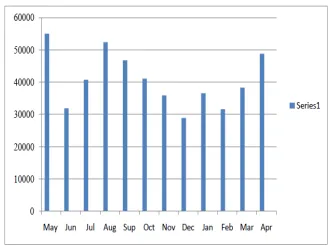
Fig. 1.1 the bar chart electricity consumption in main substation between May 2011 to April 2012 and take
International Journal of Research in Advent Technology, Vol.2, No.9, September 2014
E-ISSN: 2321-9637
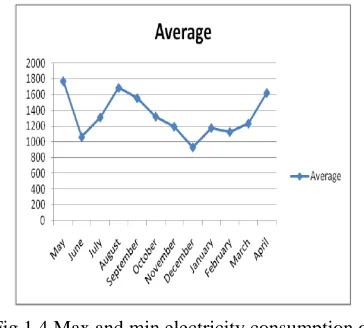
[image:5.595.91.272.72.199.2] [image:5.595.86.283.247.368.2]58 Fig 1.2 Average electricity consumption of the month.
Fig 1.3 Average of the month with consumption of electricity.
Fig 1.4 Max and min electricity consumption of months.
8. SOLAR-BIOGAS COMBINED POWER
GENERATION
Combination with biogas generation solar generation. Output is stored in the battery bank. This power inverter converts DC power into AC power, is drawn through the electrical load. Inverter short circuit, overheating, low battery voltage and has built-in protection against overload. Depending on the need of the battery bank system, a certain number of days with no biogas is designed to feed the load.
All installation of photovoltaic solar panels to power source. Photovoltaic (PV) produce electricity when exposed to light in the solid state, type of semi-conductor devices. The term photovoltaic actually
"means electricity from light." An example of this phenomenon would Calculators several hand-held power went off the room light. The technology for large power applications are also possible.
Prime over system is running by I.C. Engines use of biogas in diesel engines. Existing diesel engines can be modified to run on dual fuel while still retaining the ability to use diesel fuel only, Petrol engines: These engines can run on 100% biogas.
Biogas is a type of gas that is formed by the biological breakdown of organic matter in an oxygen deficient environment. It is counted as an eco-friendly bio-fuel. Biogas contains 60% methane and carbon dioxide. It can be employed for generating electricity and also as automotive fuel. Biogas can be used as a substitute for compressed natural gas (CNG) or liquid petroleum gas (LPG).
Biogas power plant are produce following generation;- Plant 1 is produce power generation 180 Kwh/Day Plant 2 to produce max power generation 180 Kwh/Day
Total power generation 360 Kwh/Day
Solar power plant are produce following generation;- The efficiency of the PV modules is considered to be 14.3%. The radiation data for the month of April has been taken as a sample.
The roof top PV systems will be considered in the different places of rural areas and total generated power is not fulfill the demand of one day 1336 Kwh/day so we are connect grid but some load sharing which is use full to reduce load from grid.
9. CONCLUSION
Meet with locally available renewable energy sources could supplement the energy needs of the people who promote efficient technologies. We will independently provide a stable power source solar / biogas are trying to develop a joint system. Biogas and solar energy combined system independently will provide a stable power source. We combined system for power generation are trying to evaluate the economic. Larger biogas plants generate and feed electricity into the power grid mainstream. Small biogas production units can support lighting and cooking needs.
REFERENCES
[1] Janani Chakravarthi “Biogas and energy production from cattle waste” IEEE Energy Conversion Engineering Conference, IECEC-97 32nd Intersociety pp:648 - 651 vol.1.1997. [2] Ajai Gupta, R. P. Saini, and M. P. Sharma
“Computerized Modelling of Hybrid Energy System Part I: Problem Formulation and Model Development” IEEE 5th International Conference on Electrical and Computer Engineering ICECE ,pp:7 - 12,2008.
[image:5.595.91.273.406.570.2]International Journal of Research in Advent Technology, Vol.2, No.9, September 2014
E-ISSN: 2321-9637
59 Energy Conference, IEEE INTELEC.
Twenty-second International pp: 311 - 316 .2000. [4] Ajai Gupta, R. P. Saini, and M. P. Sharma
“Computerized Modelling of Hybrid Energy System Part I: Problem Formulation and Model Development” IEEE Alternate Hydro Energy Centre, India 5th International Conference, ICECE 2008.
[5] Zhanping You, Shijun You1, Xianli Li, and Changsheng Hao “Biogas Power Plants Waste Heat Utilization Researches, IEEE Power Electronics and Motion Control Conference IPEMC 6th International pp:2478 – 2481, 2009. [6] JIANG Yao-hua, XIONG Shu-sheng*1, SHI Wei1,
HE Wen-hua1, ZHANG Tian1, LIN Xian-ke, GU Yun,LV Yin-ding, QIAN Xiao-jun, YE Zong-yin, WANG Chong-ming, Wang Bei “Research of Biogas as Fuel for Internal Combustion Engine” , IEEE power and Energy Engineering Conference, APPEEC . Asia-Pacific 2009 :1 - 4 , 2009 .
[7] Zhang Yanning, Kang Longyun, Cao Binggang, Huang Chung-Neng, Wu Guohong “Renewable Energy Distributed Power System With Wind Power and Biogas Generator” IEEE Transmission & Distribution Conference & Exposition: Asia and Pacific, 2009 pp:1 - 6 ,2009.
[8] Li Wang, Senior Member, IEEE, and Ping-Yi Lin “Analysis of a Commercial Biogas Generation System Using a Gas Engine–Induction Generator Set” IEEE Transactions on Energy Conversion, pp;230-239,Vol. 24, No. 1,2009.
[9] Mayank Aggarwal and Vijit Gupta, “Biogas as Future Prospect for Energy Dependency and Rural Prosperity in India: Statistical Analysis and Economic Impact” IEEE Systems and Information Engineering Design Symposium, SIEDS ' pp: 45 - 48, 2009.
[10] S.Hasan Saeed, D.K.Sharma “Non Conventional Energy Resources” Publication kataria and sons [2006-2007]
[11]http://www.hybridsynergydrive.com/en/petrol_eng ine.html
[12]http://www.ganesha.co.uk/Articles/Biogas%20Tec hnology%20in%20India.htm
[13] http://purkrt.net/p/Solar_land_area.png [14] www.tutorvista.com