Data Representation via Marker-Less Augmented Reality
Sukumaar Mane
1,Tejashree Khedekar
2, Mahesh Gudadari
3, Kshitija Chaple
4Department of Information technology1,2,3,4
Trinity College Of Engineering and Research,Pune University1,2,3,4 Pune, Maharashtra , India
Email: [email protected], [email protected], [email protected], [email protected]
Abstract-In the contemporary world the task of data representation still is widely done using the ancient way
like keeping in tables and displaying in simple textual format on some application or computer program. In modern era there is plenty of area where computer vision is practiced. Computer vision is also used to detect an object in real life and after detecting that object, computer augments the reality by wealth of digital information which is usually related to the detected object. So here let us assume a person’s face as real world object (to be detected by computer) and some vital information of the person as digital information. In this paper we are presenting a novel way to interpret vital information of a person with the help of augmented reality. In this novel approach we are proposing an algorithm which is as follows 1.Detect a face 2.Track the face 3.Recognition of face 4.Augment the reality with the layer of vital information of person.
Keywords:Augmented Reality, LBP, OpenCV, haar-cascade classifier,known face.
1. INTRODUCTION
Now-a-days computer has become an integral part of human life. We use computer for plenty of operations in day to day life. Computers around us have changed our way of living. In past several years computers have transformed our work and life. From the birth of modern computers software developers have striven to design and develop good software that will be advantageous to the end user or any normal computer user. From this the concept of augmented reality is developed.
Augmented reality is one of the concepts raised from constant efforts of computer engineers and scientists. In this real world is augmented by the digital information. Augmented reality (AR) makes digitally enhanced view of the real world surrounding us. Augmented reality can add layers of digital information on top of items in the world. We can also define Augmented reality as “the material/virtual nexus mediated through current technology with the information and code and enacted in specific and personalized space/time configurations” [1]. The process of augmenting the real world involves observation with the help of sensors, image recognition, human-computer interaction, computer vision, virtual reality and plenty of other areas [2].
Here in this paper we are proposing a novel way to interpret the vital information of a person and this information can be used in variety of way with the help of concept of augmented reality. Here if we want to augment the real world with addiction/increased
information of any object of real life then we should do detection of that object, recognition of that object and then finally tracking location of that object. Here in this paper we are assuming human’s face as real world’s object and some necessary/vital information of person as digital information. As augmented reality requires some hardware to show augmented world, we can use monitor of a personal computer or smartphone's screen. And to take input of real world we require sensors where we can use webcam or camera of smartphone. Augmented realty is possible with markers and without markers. Augmented reality with the help of marker is quite simple approach from programming point of view but marker less augmented reality's main challenge is detection recognition and tracking .Here we are proposing a method for this, in which we are following some steps as follows 1.Detect person’s face 2.Tracking of person’s face 3.Recognition of person’s face 4.Augment the reality with the layer of vital information of person on real world. Detection and tracking of face will be done by one of five haar-cascade classifier provided by well-known OpenCV framework [3][4], face recognition will be done by local binary pattern (LBP) texture feature[5] and layering of digital data by displaying it on hardware like screen of monitor or smartphone.
2. PROPOSED METHODOLOGY
section, for data representation via augmented reality we need to do following things:
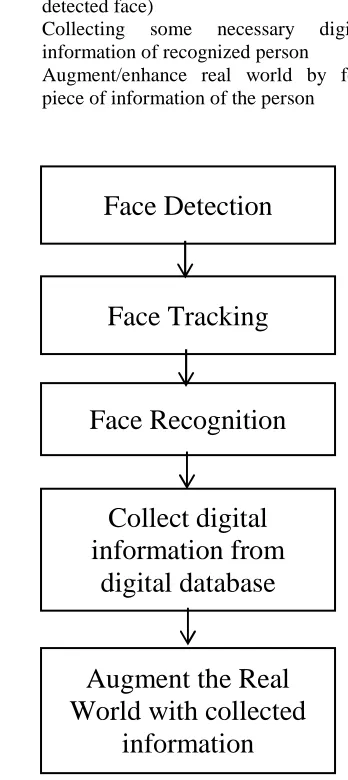
Fig. 1 will show overall architecture of proposed system which has following elements.
(1) Face Detection(of person)
(2) Face Tracking(Tracking of detected face) (3) Face Recognition(Recognition of
detected face)
(4) Collecting some necessary digital information of recognized person (5) Augment/enhance real world by few
piece of information of the person
Fig.1 Proposed System Architecture
2.1 Face Detection
Face detection is findingif the person’s face is in the whole picture/image. The image which we are using to detect the person’s face is taken by webcam of computer of the camera of smartphone but in this example we are using the image which is taken by
webcam. First of all we have to capture/ sense the real world and we are doing it by webcam as mentioned earlier. For this we are using OpenCV image processing framework [3]. In this, system will detect whether there is a face in input image or not. Here for fast detection of the faces from input image, before detection we are pre-processing it by converting color image to grayscale image and scaling the image.
For example assume input image is of 640 X 480 pixel dimension then for fast face detection we are scaling it with some scaling factor 640/a X 480/a where a=3 or a=4.
Then we will make use of haar cascade classifier provided by OpenCV framework [3] [4], OpenCV provides five classifiers are as follows:
• haarcascade_frontalface_default
• haarcascade_frontalface_alt
• haarcascade_frontalface_alt2
• haarcascade_frontalface_alt_tree
• haarcascade_profileface
We are using ‘haarcascade_frontalface_alt’. Main function of this module is to detect where the face is located in the input image (x, y dimension with height and width). Face detection does scanning of image at different scale and looks for simple patterns that identify the presence of human’s face [6]. While face detection there is chance of false positive outcome. There are possibilities that this haar-cascade classifier can detect a things in a picture which are not a human face. To overcome this issue we are not only detecting the face but also detecting an eye with ‘haarcascade_mcs_eyepair_small’ haar cascade classifier. This can be shown programmatically as follows:
If (dimensions of detected eyes belong to detected face)
Then
Detected object is a face Draw rectangle on that location
Else
Detected object is not a face
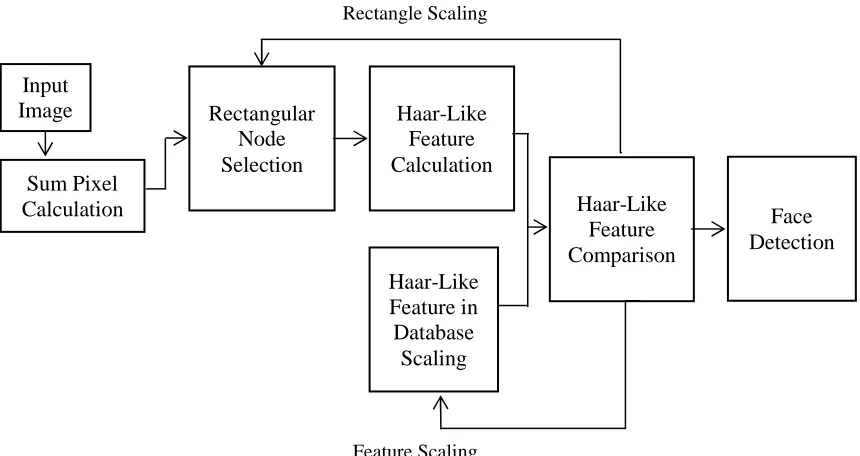
After getting information about face’s location draw rectangle outside it. Algorithm for detection of face [9] is shown in Fig 2.
Face Detection
Face Tracking
Face Recognition
Collect digital
information from
digital database
Augment the Real
World with collected
Rectangle Scaling
Feature Scaling
Fig.2 Block Diagram of face detection
Fig 3 will show face detection. Here detected face is surrounded by rectangle of blue color.
Fig.3 Detected Face
2.2 Face Tracking
In face detection we are locating face in image and then drawing rectangle outside it. Tracking of face means repeatedly updating face’s location in the picture or image as it moves. For this we are repeatedly scanning input image, preprocessing it and detecting face in it and then drawing rectangle around it. This will look like face rectangle is following the faces of human. Algorithms must be aware of change in location of the face in input image.
2.3 Face Recognition
Face recognition is comparing detected face with known faces in the database to decide who the person is. Knownfaces are the face images of the person
which are already stored digitally in database. For displaying information of person we have to recognize that person. Main function of this module is to identify the person. To recognize the person there should be some database already available in system with image database of person’s face. This is one of the challenging modules amongst other modules. Face recognition is difficult task for a computer as compared to humans. For recognizing the person we are using LBPHFaceRecognizer from FaceRecognizer algorithm which belongs to OpenCV framework [3] [5]. LBPHFaceRecognizer works on Local Binary Pattern (LBP) [5].There are some more methods for face recognition called PCA (Principal Component Analysis) an eigenface method, LDA (Linear Discriminant Analysis) a fisherface method. In some observations LBPH method surprisingly is better than these both. LBP operator was introduced by Ojalaet al. [7]. LBP considers both the things, shape and information about texture .LBP does a straightforward extraction of face feature vector i.e. histogram [8]. The image of face is divided into small regions called as facial regions from which the Local Binary Pattern (LBP) features are extracted and arranged in sequence to form single feature histogram [8].Fig.4 Illustrate the working of LBPH .Local Binary Pattern (LBP) is a texture operator which labels the each pixel of an image by thresholding the neighborhood and considers a result as a binary number.LBP works on the idea of collecting LBP codes into histogram. Here face image’s texture is considered by LBP to generate LBP codes.
For face recognition we are using OpenCV framework’s LBPHFaceRecognizer which make use of LBP to recognize face.
Input
Image
Sum Pixel
Calculation
Rectangular
Node
Selection
Haar-Like
Feature
Calculation
Haar-Like
Feature in
Database
Scaling
Haar-Like
Feature
Comparison
Fig.4 Face Image to Histogram Conversion
Before proceeding to face recognition algorithm input image must be preprocessed and here in preprocessing we are converting color image to grayscale image. ThisLBPHFaceRecognizer algorithm includes following:
(1) Training: Every LBPHFaceRecognizer needstraining. Due to this training it will get informed about known faces in database. (2) Prediction: Here algorithm will match input
image with the known faces and returns prediction value i.e. matching confidence(before prediction we have to extract detected face from image)
(3) Loading /Saving: Trained model can be saved to file storage for further usage from/to XML or YAML file.
After execution of the algorithm it will return name of matched know face from database and matching confidence. Illustrated in Fig. 5.
Fig.5 Recognized Face
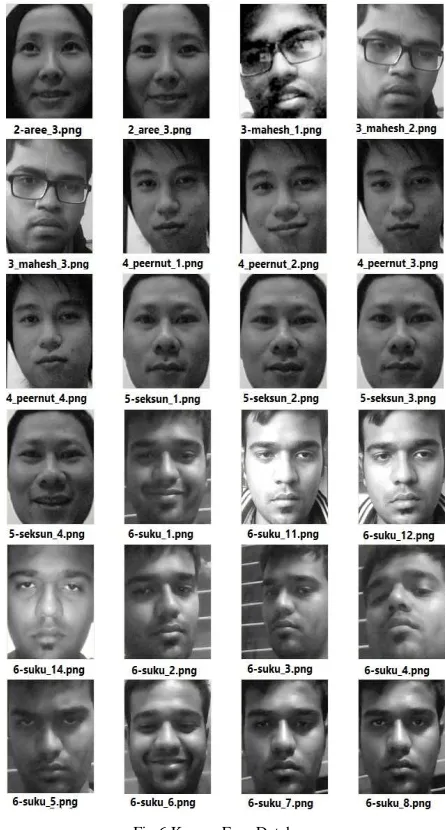
Fig.6 Known Face Database
In fig. 5 there is detected face which is surrounded by blue rectangle and on the right side of figure there is known name of recognized face i.e. 6-suku_8.png and it’s matching confidence 67.58536868701253 and there is grayscale known image below this name and confidence.
Fig 6 shows available known face database. There should be sufficient amount of known faces available in the database. We are using known face of dimension 124 X 150pixels. To recognize person correctly there should be sufficient amount of known faces where person’s face is posing straight, upward, downward, left side, right side.
2.4 Collecting digital information of recognized person
2.5 Augment the real world
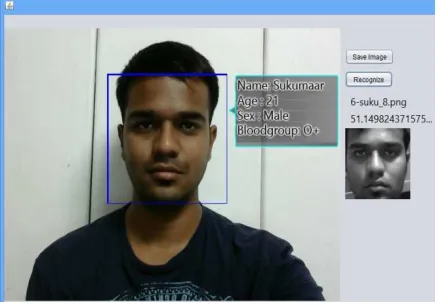
Fig. 7 shows how we can augment the reality with the help of a person’s information. Here it is a video and algorithm is detecting, recognizing person’s face and then augmenting the reality with the digital information which is actually related to person. Fig. 3 shows output without augmented reality. In Fig. 7 there is digital image which contain some information regarding person. Name, Age, Sex, Blood-group information is retrieved from the database with the help of some sort of id which is directly related to recognized person.
Fig.7 Augmented Reality
For augmenting reality, algorithm requires to know about current location of face because augmented information is layered / drawn near to it. This augmented information is moving as per the face in image moves. We can hide rectangle around a face and show/draw/layer only digital information to real world. doctor. Advantage of this technique is it doesn’t need markers to augment the information.
Schools / colleges can use this algorithm / approach to interpret student’s personal data, academic records.
4. CONCLUSION
We have demonstrated the novel approach to interpret data via marker-less augmented reality. Main challenge in this approach is to recognize the person here at some observation where input face image and
known face is same but matching confidence may differ or some time there is false positive in algorithm i.e. algorithm may identify a person incorrectly. In this situation multiple observations are helpful so that algorithm will choose only the known face which matched maximum times to the input faceimage. Future scope of the approach is to develop own haar-cascade classifier instead of using haar-haar-cascade classifier provided by OpenCV to detect face from image in lesser time with lesser overhead on processor of computer. The paper brings novel algorithm which has broader application in computer vision and image processing.
Acknowledgements
Authors remain thankful to Prof. Kshitija Chaple(Project Guide),for their useful suggestions and discussions while preparation of this paper and also thanks to Prof. SuhasPatil of KJCOEMRand staff of “Trinity College of Engineering and Research” for co-operation and encouragement during the work.
REFERENCES
[1] Graham, M., Zook, M., and Boulton, A. (2012): "Augmented reality in urban places: contested content and the duplicity of code", Transactions of the Institute of British Geographers, DOI: 10.1111/j.1475-5661.2012.00539.x 2012
[2] RuobingYang ; Media Sch., Linyi Univ., Linyi, China (2011) : “The study and improvement of Augmented reality based on feature matching” , Software Engineering and Service Science (ICSESS), 2011 IEEE 2nd International Conference, 15-17 July 2011
[3] S.V. Viraktamath, MukundKatti, Aditya Khatawkar&Pavan Kulkarni (2013) :“Face detection and tracking Using OpenCV” ,The SIJ Transactions on Computer Networks & Communication Engineering (CNCE), Vol. 1, No. 3, July-August 2013.
[5] TimoAhone ,AbdenourHadid , MattiPietikainen (2006): “Face Description with Local Binary Patterns: Application to Face Recognition” , Pattern Analysis and Machine Intelligence, IEEE Transactions on (Volume:28 , Issue: 12 ), Dec 2006
[6] P. Viola, M. Jones (2001): “Rapid object detection using boosted cascade of simple features” , IEEE Conference on Computer Vision and Pattern Recognition, CVPR, Hawaii, 2001
with classification based on feature distributions”. Pattern Recognition Volume 29,Issue 1,(1996) 51– 59
[8]TimoAhonen,AbdenourHadid,
MattiPietikäinen(2004) : “Face Recognition with Local Binary Patterns” , Computer Vision - ECCV 2004 ,Lecture Notes in Computer Science Volume 3021, 2004, pp 469-481