Dependency and relational structure in treebank annotation
Cristina BOSCO, Vincenzo LOMBARDODipartimento di Informatica, Universit`a di Torino Corso Svizzera 185
10149 Torino, Italia,
bosco,[email protected]
Abstract
Among the variety of proposals currently mak-ing the dependency perspective on grammar more concrete, there are several treebanks whose annotation exploits some form of Rela-tional Structure that we can consider a general-ization of the fundamental idea of dependency at various degrees and with reference to differ-ent types of linguistic knowledge.
The paper describes the Relational Structure as the common underlying representation of tree-banks which is motivated by both theoretical and task-dependent considerations. Then it presents a system for the annotation of the Rela-tional Structure in treebanks, called Augmented Relational Structure, which allows for a system-atic annotation of various components of lin-guistic knowledge crucial in several tasks. Fi-nally, it shows a dependency-based annotation for an Italian treebank, i.e. the Turin Univer-sity Treebank, that implements the Augmented Relational Structure.
1 Introduction
Different treebanks use different annotation schemes which make explicit two distinct but interrelated aspects of the structure of the sen-tence, i.e. the function of the syntactic units and their organization according to a part-whole paradigm. The first aspect refers to a form of
Relational Structure (RS), the second refers to its constituent or Phrase Structure (PS). The major difference between the two structures is that the RS allows for several types of rela-tions to link the syntactic units, whilst the PS involves a single relation ”part-of”. The RS can be seen as a generalization of the depen-dency syntax with the syntactic units instanti-ated to individual words in the dependency tree (Mel’ˇcuk, 1988). As described in many theo-retical linguistic frameworks, the RS provides a useful interface between syntax and a seman-tic or conceptual representation of
predicate-argument structure. For example, Lexical Func-tional Grammar (LFG) (Bresnan, 1982) collo-cates relations at the interface between lexicon and syntax, Relational Grammar (RG) (Perl-mutter, 1983) provides a description of the sen-tence structure exclusively based on relations and syntactic units not structured beyond the string level.
This paper investigates how the notion of RS has been applied in the annotation of tree-banks, in terms of syntactic units and types of relations, and presents a system for the definition of the RS that encompasses several uses in treebank schemata and can be viewed as a common underlying representation. The system, called Augmented Relational Struc-ture (ARS) allows for an explicit representa-tion of the three major components of linguistic structures, i.e. morpho-syntactic, functional-syntactic and semantic. Then the paper shows how a dependency-based annotation can de-scend on ARS, and describes the ARS-based an-notation of a dependency treebank for Italian, the Turin University Treebank (TUT), which is the first available treebank for Italian, with a few quantitative results.
The paper is organized as follows. The next section investigates both the annotation of RS in treebanks and the major motivations for the use of RS from language-specific issues and NLP tasks implementation; then we present the ARS system; finally, we show the dependency anno-tation of the TUT corpus.
2 Annotation of the Relational Structure
In practice, all the existing treebank schemata implement some form of relational structure. Annotation schemata range from pure (depen-dency) RS-based approaches to RS-PS combi-nations (Abeill´e, 2003).
The Prague Dependency Treebank ((Hajiˇcov´a and Ceplov´a, 2000), (B¨ohmov´a et al., 2003)) implements a three level annotation scheme where both the analytical (surface syntactic) and tectogrammatical level (deep syntactic and topic-focus articulation) are dependency-based; the English Dependency Treebank (Rambow et al., 2002) implements a dependency-based mono-stratal analysis which encompasses sur-face and deep syntax and directly represents the predicate-argument structure. Other projects adopt mixed formalisms where the sentence is split in syntactic subunits (phrases), but linked by functional or semantic relations, e.g. the Ne-gra Treebank for German ((Brants et al., 2003), (Skut et al., 1998)), the Alpino Treebank for Dutch (van der Beek et al., 2002), and the Lingo Redwood Treebank for English (Oepen et al., 2002). Also in the Penn Treebank ((Marcus et al., 1993), (Marcus et al., 1994)) a limited set of relations is placed over the constituency-based annotation in order to make explicit the (morpho-syntactic or semantic) roles that the constituents play.
The choice of a RS-based annotation schema can depend on theoretical linguistic motivations (a RS-based schema allows for an explicit, fine-grained representation of several linguistic phe-nomena), task-dependent motivations (the RS-based schema represents the linguistic informa-tion involved in the task(s) at hand), language-dependent motivations (the relational structure is traditionally considered as the most adequate representation of the object language).
Theoretical motivations for exploiting repre-sentations based on forms of RS was developed in the several RS-based theoretical linguistic frameworks (e.g. Lexical Functional Grammar, Relaional Grammar and dependency grammar), which allow for capturing information involved at various level (e.g. syntactic and semantic) in linguistic structures, and grammatical for-malisms have been proposed with the aim to capture the linguistic knowledge represented in these frameworks. Since the most immediate way to build wide-coverage grammars is to extract them directly from linguistic data (i.e. from treebanks), the type of annotation used in the data is a factor of primary importance, i.e. a RS-based annotation allows for the extraction of a more descriptive grammar1.
1See (Mazzei and Lombardo, 2004a) and (Mazzei and
Lombardo, 2004b) for experiments of LTAG extraction from TUT.
Task-dependent motivations rely on how the annotation of the RS can facilitate some processing aspects of NLP applications. The explicit representation of predicative structures allowed by the RS can be a powerful source of disambiguation. In fact, a large amount of ambiguity (such as coordination, Noun-Noun compounds and relative clause attachment) can be resolved using such a kind of information, and relations can provide a useful interface between syntax and semantics. (Hindle and Rooth, 1991) had shown the use of dependency in Prepositional Phrase disambiguation, and the experimental results reported in (Hock-enmaier, 2003) demonstrate that a language model which encodes a rich notion of predicate argument structure (e.g. including long-range relations arising through coordination) can significantly improve the parsing performances. Moreover, the notion of predicate argument structure has been advocated as useful in a number of different large-scale language-processing tasks, and the RS is a convenient intermediate representation in several applica-tions (see (Bosco, 2004) for a survey on this topic). For instance, in Information Extraction relations allows for recognizing different guises in which an event can appear regardless of the several different syntactic patterns that can be used to specify it (Palmer et al., 2001)2. In Question Answering, systems usually use forms of relation-based structured representations of the input texts (i.e. questions and answers) and try to match those representations (see e.g. (Litkowski, 1999), (Buchholz, 2002)). Also the in-depth understanding of the text, necessary in Machine Translation task, requires the use of relation-based representations where an accurate predicate argument structure is a critical factor (Han et al., 2000)3.
Language-dependent motivations rely on the fact that the dependency-based formalisms has been traditionally considered as the most ade-quate for the representation of free word order languages. With respect to constituency-based
2Various approaches to IE (Collins and Miller, 1997)
address this issue by using relational representations, that is forms of ”concept nodes” which specifies a trig-ger word (usually a Verb) and also forms of mapping between the syntactic and the semantic relations of the trigger.
3The system presented in (Han et al., 2000)
formalisms, free word order languages involves a large amount of discontinuous constituents (i.e. constituents whose parts are not contiguous in the linear order of the sentence). In practice, a constituency-based representation was adopted for languages with rather fixed word order patterns, like English (Penn Treebank), while a dependency representation for languages which allow variable degrees of word order freedom, such as Czech (see Prague Depen-dency Treebank) or Italian (as we will see later, TUT). Nevertheless, in principle, since the representation of a discontinuous constituentX
can be addressed in various ways (e.g. by in-troducing lexically empty elements co-indexed with the moved parts of X), the presence to a certain extent of word order freedom does not necessarily mean that a language has to be necessarily annotated according to a relation-based format rather than a constituency-relation-based one. Moreover, free word order languages can present difficulties for dependency-based as well as for constituency-based frameworks (e.g. non-projective structures). The development of dependency-based treebanks for English (see English Dependency Treebank) together with the inclusion of relations in constituency-based treebanks (see Penn Treebank) too, confirms the strongly prevailing relevance of motivations beyond the language-dependent ones.
The types of knowledge that many applica-tions actually need are RS-based representa-tions where predicate argument structure and the associated morphological and syntactic in-formation can operate as an interface to a semantic-conceptual representation. All these types of knowledge have in common the fact that they can be described according to the de-pendency paradigm, rather than according to the constituency paradigm. The many applica-tions (in particular those referring to the Penn Treebank) which use heuristics-based transla-tion schemes from the phrase structure to lexical dependency (”head percolation tables”) (Ram-bow et al., 2002) show that the access to com-prehensive and accurate extended dependency-based representations has to be currently con-sidered as a critical issue for the development of robust and accurate NLP technologies.
Now we define our proposal for the representa-tion of the RS in treebank annotarepresenta-tion.
3 The Augmented Relational Structure
A RS consists of syntactic units linked by re-lations. An Augmented Relational Structure (ARS) organizes and systematizes the informa-tion usually associated in existing annotainforma-tions to the RS, and includes not only syntactic , but also linguistic information that can be rep-resented according to a dependency paradigm and that is proximate to semantics and un-derlies syntax and morphology. Therefore the
eats
John the apple
[image:3.612.363.494.189.246.2]rel2 rel1
Figure 1: A simple RS.
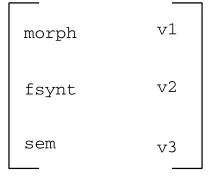
ARS expresses the relations and syntactic units in terms of multiple components. We describe the ARS as a dag where each relation is a feature structure including three components. Each component of the ARS-relations is
use-morph
fsynt
sem
v1
v2
v3
Figure 2: An ARS relation.
ful in marking both similarities and differences among the behavior of units linked by the de-pendency relations.
[image:3.612.375.481.361.450.2]present in the nominal variant too4.
The functional-syntactic component identifies the subcategorized elements, that is it keeps apart arguments and modifiers in the pred-icative structures. Moreover, this component makes explicit the similarity of a same predica-tive structure when it occurs in the sentence in different morpho-syntactic variants. In fact, the functional-syntactic components involved, e.g., in the transitive predicative structure ”some-one declares something”, are the same in both the nominal (dichiarazione [di innocenza]OBJ [di John]SUBJ - John’s declaration of innocence) and verbal realization ([John]SUBJ dichiara [la sua innocenza]OBJ - John declares his inno-cence) of such a predication, i.e. SUBJ and OBJ. The distinction between arguments and modifiers has been considered as quite problem-atic in the practice of the annotation, even if rel-evant from the applicative and theoretical point of view5, and is not systematically annotated in the Penn Treebank (only in clear cases, the use of semantic roles allows for the annotation of argument and modifier) and in the Negra Tree-bank. This distinction is instead usually marked in dependency representations, e.g. in the En-glish Dependency Treebank and in the Prague Dependency Treebank.
The semantic component of the ARS-relations specifies the role of words in the syntax-semantics interface and discriminates among different kinds of modifiers and oblique com-plements. We can identify at least three levels of generality: verb-specific roles (e.g. Runner, Killer, Bearer); thematic roles (e.g. Agent, In-strument, Experiencer, Theme, Patient); gener-alized roles (e.g. Actor and Undergoer). The use of specific roles can cause the loss of useful generalizations, whilst too generic roles do not describe with accuracy the data. An example of annotation of semantic roles is the tectogram-matical layer of the Prague Dependency Tree-bank.
ARS features a mono-stratal approach. By fol-lowing this strategy, the annotation process can be easier, and the result is a direct represen-tation of a complete predicate argument struc-ture, that is a RS where all the information (morpho-syntactic, functional-syntactic and se-mantic) are immediately available. An alterna-tive approach has been followed by the Prague
4This statistics does not take into consideration the
possible polysemic nature of words involved.
5See, for instance, in LFG and RG.
Dependency Treebank, which is featured by a three levels annotation. This case shows that the major difference between the syntactic (analytic) and the semantic (tectogrammatical) layer consists in the inclusion of empty nodes for recovering forms of deletion ((B¨ohmova et al., 1999), (Hajiˇcov´a and Ceplov´a, 2000)). But this kind of information does not necessarily re-quires a separated semantic layer and can be annotated as well in a mono-stratal represen-tation, like the English Dependency Treebank (Rambow et al., 2002) does.
corresponding to the garden plays the semantic role LOCATION in the ”eating” event stated by the sentence.
4 TUT: a dependency-based treebank for Italian
The TUT is the first available tree-bank of Italian (freely downloadable at http://www.di.unito.it/˜tutreeb/). The cur-rent release of TUT includes 1,500 sentences corresponding to 38,653 tokens (33,868 words and 4,785 punctuation marks). The average sentence length is of 22,57 words and 3,2 punctuation marks.
In this section, we concentrate on the major features of TUT annotation schema, i.e. how the ARS system can describe a dependency structure.
4.1 A dependency-based schema
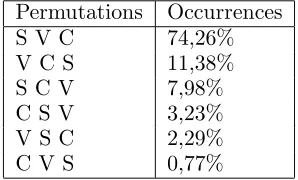
In Italian the order of words is fixed in non verbal phrases, but verbal arguments and mod-ifiers can be freely distributed without affect-ing the semantic interpretation of the sentence. A study on a set of sentences of TUT shows that the basic word order for Italian is Subject-Verb-Complement (SVC), as known in litera-ture (Renzi, 1988), (Stock, 1989), but in more than a quarter of declarative sentences it is vi-olated (see the following table6). Although the
[image:5.612.110.259.405.495.2]Permutations Occurrences S V C 74,26% V C S 11,38% S C V 7,98% C S V 3,23% V S C 2,29% C V S 0,77%
Table 1: Italian word order
SVC order is well over the others, the fact that all the other orders are represented quantita-tively confirms the assumption of partial con-figurationality intuitively set in the literature. The partial configurationality of Italian can be considered as a language-dependent motivation for the choice of a dependency-based annota-tion for an Italian treebank. The schema is similar to that of the Prague Dependency Tree-bank analytical-syntactic level with which TUT
6The data reported in the table refer to 1,200
anno-tated sentences where 1,092 verbal predicate argument structures involving Subject and at least one other Com-plement occur.
shares the following basic design principles typ-ical of the dependency paradigm:
• the sentence is represented by a tree where each node represents a word and each edge represents a dependency labelled by a grammatical relation which involves ahead
and a dependent,
• each single word and punctuation mark is represented by a single node, the so-calledamalgamated words, which are words composed by lexical units that can occur both in compounds and alone, e.g. Verbs with clitic suffixes (amarti (to love-you) or Prepositions with Article (dal (from-the)), are split in more lexical units7,
• since the constituent structure of the sen-tence is implicit in dependency trees, no phrases are annotated8.
If the partial configurationality makes the dependency-based annotation more adequate for Italian, other features of this language should be well represented by exploiting a Negra-like format where the syntactic units are phrases rather than single words. For instance, in Italian, Nouns are in most cases introduced by the Article: the relation between Noun and Determiner is not very relevant in a dependency perspective, while it contributes to the defini-tion of a clearer nodefini-tion of NP in Italian than in languages poorer of Determiners like, e.g., Czech. The major motivation of a dependency-based schema is therefore theoretical and, in particular, to make explicit in the treebank an-notation a variety of structures typical of the object language.
Moreover, in order to make explicit in cases of deletion and ellipsis the predicate argument structure, we annotate in the TUT null ele-ments. These elements allow for the annota-tion of a variety of phenomena: from the ”equi” deletion which affects the subject of infinitive Verb depending on a tensed Verb (e.g. John(1) vuole T(1) andare a casa - John(1) want to T(1) go home), to the various forms of gap-ping that can affect parts of the structure of the sentence (e.g. John va(1) a casa e Mario T(1) al cinema - John goes(1) home and Mario
7Referring to the current TUT corpus, we see that
around 7,7% words are amalgamated.
8If phrase structure is needed for a particular
dichiarava
In Sudja VERB,PREP
RMOD TIME
il VERB,NOUN
SUBJ AGENT
VERB,DET+DEF OBJ THEME
quei la PREP,DET+DEF
ARG #
fallimento NOUN,DET+DEF
APPOSITION DENOM
DET+DEF,NOUN ARG
#
giorni zingara DET+DEF,NOUN
ARG #
DET+DEF,NOUN ARG
[image:6.612.98.295.35.196.2]#
Figure 3: The TUT representation of In quei giorni Sudja la zingara dichiarava il fallimento
(In those days Sudja the gipsy declared the bankruptcy).
T(1) to the cinema), to the pro-dropped sub-jects typical of Italian (as well as of Portuguese and Spanish), i.e. the subject of tensed Verbs which are not lexically realized in the sentence (e.g. T Va a casa - T goes home). For phenom-ena such as equi and gapping TUT implements indexed traces, while it implements non co-indexed traces for phenomena such as the pro-drop subject.
4.2 An ARS-based schema
In TUT the dependency relations form the skeleton of the trees and the ARS tripartite fea-ture strucfea-tures which are associated to these re-lations resolve the interface between the mor-phology, syntax and semantics. The ARS al-lows for some form of annotation also of rela-tions where only parts of the features are spec-ified. In TUT this has been useful for under-specifying relations both in automatic analysis of the treebank (i.e. we can automatically ex-clude the analysis of a specific component of the relations) and in the annotation process (i.e. when the annotator is not confident of a specific component of a relation, he/she can leave such a component void).
In the figure 3 we see a TUT tree.
All the relations annotated in the tree in-clude the morpho-syntactic component, formed by the morphological categories of the words in-volved in the relation separated by a comma, e.g. VERB,PREP for the relation linking the root of the sentence with its leftmost child
(In). Some relation involves a morpho-syntactic component where morphological categories are composed by more elements, e.g. DET+DEF (in DET+DEF,NOUN) for the relation linking
quei withgiorni. The elements of the morpho-syntactic component of TUT includes, in fact, 10 ”primary” tags that represent morphologi-cal categories of words (e.g. DET for Deter-miner, NOUN for Noun, and VERB for Verb), and that can be augmented with 20 ”secondary” tags (specific of the primary tags) which further describe them by showing specific features, e.g. DEF which specifies the definiteness of the De-terminer or INF which specifies infiniteness of Verb. Valid values of the elements involved in TUT morpho-syntactic tags are 40.
By using the values of the functional-syntactic component, TUT distinguishes among a variety of dependency relations. In figure 3 we see the distinction between argument, e.g. the relation SUBJ linking the argumentSudja with the ver-bal root of the sentencedichiarava, and the rela-tion RMOD which represents a restrictive mod-ifier and links the verbal root dichiarava with
in quei giorni. The dependents of Prepositions and determiners are annotated as argument too, according to arguments presented in (Hudson, 1990). Another distinction which is exploited in the annotation of the sentence is that be-tween restrictive modifier (i.e. RMOD which links dichiarava with in quei giorni) and AP-POSITION (i.e. non restrictive modifier linking
different kinds of modifiers and oblique com-plements. The approach pursued in TUT has been to annotate very specific semantic roles only when they are immediately and neatly distinguishable. For instance, by referring to the prepositional dependents introduced byda9
(from/by), we find the following six different values for the semantic component:
- REASONCAUSE, e.g., in gli investitori sono impazziti dalle prospettive di guadagno (the in-vestors are crazy because of the perspectives of gain)
- SOURCE, e.g., in traggono benefici dalla bonifica ([they] gain benefit from the drainage) - AGENT, e.g., l’iniziativa `e appoggiata dagli USA(the venture is supported by USA) - TIME, e.g., dal ’91 sono stati stanziati 450 miliardi (since ’91 has been allocated 450 bil-lions)
- THEME, e.g., ci`o distingue l’Albania dallo Zaire (that distinguishes the Albany from Zaire)
- LOC, which can be further specialized in LOC+FROM, e.g., in da qui `e partito l’assalto
(from here started the attack), LOC+IN, e.g., in
quello che succedeva dall’altra parte del mondo
(what happened in the other side of the world), LOC+METAPH, e.g., inl’Albania `e passata dal lancio dei sassi alle mitragliatrici (the Albany has passed from the stone-throwing to the ma-chineguns).
In figure 3 the semantic component has been annotated only in four relations, which respec-tively represent the temporal modifier In quei giorni of the main Verb dichiarava, the appo-sition la zingara of the Noun Sudja, and the arguments of the Verb, i.e. the subjectSudja la zingara which plays the semantic role AGENT and the objectil fallimento which plays the se-mantic role THEME. In the other relations in-volved in this sentence a value for the semantic component cannot be identified10, e.g. the ar-gument of a Preposition or Determiner cannot be semantically specified as in the case of the verbal arguments.
5 Conclusions
The paper analyzes the annotation of the RS in the existing treebanks by referring to a notion of RS which is a generalization of dependency.
9In 1,500 TUT sentences we find 591 occurrences of
this Preposition.
10In figure 3, we marked the semantic component of
these cases with.
According to this notion, the RS includes types of linguistic knowledge which are different, but which have in common that they can be repre-sented by a dependency paradigm rather than to a constituency-based one.
The paper identifies two major motivations for exploiting RS in treebank annotation: language-dependent motivations that have de-termined the use of dependency for the repre-sentation of treebanks of free word order lan-guages, and task-dependent motivations that have determined a wider use of relations in tree-banks.
In the second part of the paper, we show a sys-tem for the annotation of RS, i.e. the ARS, and how the ARS can be used for the an-notation of a dependency-based treebank, the TUT whose schema augments classical depen-dency (functional-syntactic) relations with mor-phological and semantic knowledge according to the above mentioned notion of RS.
References
A. Abeill´e, editor. 2003. Building and using syntactically annotated corpora. Kluwer, Dor-drecht.
A. B¨ohmova, J. Panevov´a, and P. Sgall. 1999. Syntactic tagging: procedure for the transi-tion from analytic to the tectogrammatical treestructures. InProc. of 2nd Workshop on Text, speech and dialog, pages 34–38.
A. B¨ohmov´a, J. Hajiˇc, E. Hajiˇcov´a, and B. Hladk´a. 2003. The Prague Dependency Treebank: A three level annotation scenario. In Abeill´e (Abeill´e, 2003), pages 103–127. C. Bosco. 2004. A grammatical
rela-tion system for treebank annotation. Ph.D. thesis, University of Torino. http://www.di.unito.it/˜bosco/.
T. Brants, W. Skut, and H. Uszkoreit. 2003. Syntactic annotation of a German newspaper corpus. In Abeill´e (Abeill´e, 2003), pages 73– 87.
J. Bresnan, editor. 1982. The mental represen-tation of grammatical relations. MIT Press, Cambridge.
S. Buchholz. 2002. Using grammatical rela-tions, answer frequencies and the World Wide Web for TREC Question Answering. InProc. of TREC 2001, pages 502–509.
E. Hajiˇcov´a and M. Ceplov´a. 2000. Deletions and their reconstruction in tectogrammatical syntactic tagging of very large corpora. In
Porc. of COLING 2000, pages 278–284. C. Han, B. Lavoie, M. Palmer, O. Rambow,
R. Kittredge, T. Korelsky, N. Kim, and M. Kim. 2000. Handling structural diver-gences and recovering dropped arguments in a Korean/English machine translation system. In Proc. of AMTA 2000, pages 40–54. D. Hindle and M. Rooth. 1991. Structural
am-biguity and lexical relations. InProc. of ACL 91, pages 229–236.
J. Hockenmaier. 2003. Parsing with generative models of predicate-argument structure. In
Proc. of ACL 2003.
R. Hudson. 1990. English Word Grammar. Basil Blackwell, Oxford and Cambridge. K.C. Litkowski. 1999. Question-answering
us-ing semantic relation triples. In Proc. of TREC-8, pages 349–356.
M. Marcus, B. Santorini, and M.A. Marcinkiewicz. 1993. Building a large annotated corpus of English: The Penn Treebank. Computational Linguistics, 19:313–330.
M. Marcus, G. Kim, M.A. Marcinkiewicz, R. MacIntyre, A. Bies, M. Ferguson, K. Katz, and B. Schasberger. 1994. The Penn Tree-bank: Annotating predicate argument struc-ture. In Proc. of HLT-94.
A. Mazzei and V. Lombardo. 2004a. Building a large grammar for Italian. InProc. of LREC 2004, pages 51–54.
A. Mazzei and V. Lombardo. 2004b. A com-parative analysis of extracted grammars. In
Proc. of ECAI 2004.
I.A. Mel’ˇcuk. 1988. Dependency Syntax: theory and practice. SUNY, Albany.
S. Montemagni, F. Barsotti, M. Battista, and N. Calzolari. 2003. Building the Ital-ian syntactic-semantic treebank. In Abeill´e (Abeill´e, 2003), pages 189–210.
S. Oepen, K. Toutanova, S. Shieber, C.D. Man-ning, D. Flickinger, and T. Brants. 2002. The LinGO Redwoods treebank: motivation and prliminary applications. InProc. of COLING 2002, pages 1253–1257.
M. Palmer, J. Rosenzweig, and S. Cotton. 2001. Automatic predicate argument analysis of the Penn Treebank. InProc. of HLT 2001. D.M. Perlmutter. 1983. Studies in Relational
Grammar 1. University of Chicago Press.
O. Rambow, C. Creswell, R. Szekely, H. Taber, and M. Walker. 2002. A dependency tree-bank for English. In Proc. of LREC 2002, pages 857–863.
L. Renzi, editor. 1988. Grande grammatica italiana di consultazione, vol. I. Il Mulino, Bologna.
W. Skut, T. Brants, B. Krenn, and H. Uszkor-eit. 1998. A linguistically interpreted corpus of German in newspaper texts. In Proc. of LREC 98, pages 705–713.
O. Stock. 1989. Parsing with flexibility, dy-namic strategies, and idioms in mind. Com-putational Linguistics, 15(1):1–17.