Abstraction Summarization for Managing the Biomedical
Research Literature
Marcelo Fiszman
Thomas C. Rindflesch
Halil Kilicoglu
Lister Hill National Center for Biomedical Communications
National Library of Medicine
Bethesda, MD 20894
{fiszman|tcr|halil}@nlm.nih.gov
Abstract
We explore a semantic abstraction approach to automatic summarization in the biomedical domain. The approach relies on a semantic processor that functions as the source inter-preter and produces a list of predications. A transformation stage then generalizes and condenses this list, ultimately generating a conceptual condensate for a disorder input topic. The final condensate is displayed in graphical form. We provide a set of principles for the transformation stage and describe the application of this approach to multidocument input. Finally, we examine the characteristics and quality of the condensates produced.
1
Introduction
Several approaches to text-based information manage-ment applications are being pursued, including word-based statistical processing and those depending on string matching, syntax, or semantics. Statistical sys-tems have enjoyed considerable success for information retrieval, especially using the vector space model (Sal-ton et al., 1975). Since the SIR system (Raphael, 1968), some have felt that automatic information management could best be addressed using semantic information. Subsequent research (Schank, 1975; Wilks, 1976) panded this paradigm. More recently, a number of ex-amples of knowledge-based applications show considerable promise. These include systems for ma-chine translation (Viegas et al., 1998), question answer-ing, (Harabagiu et al., 2001; Clark et al., 2003), and information retrieval (Mihalcea and Moldovan, 2000).
In the biomedical domain, the MEDLINE®
biblio-graphic database provides opportunities for keeping abreast of the research literature. However, the large size of this online resource presents potential challenges to the user. Query results often include hundreds or thousands of citations (including title and abstract). Automatic summarization offers potential help in man-aging such results; however, the most popular approach, extraction, faces challenges when applied to multi-document summarization (McKeown et al., 2001).
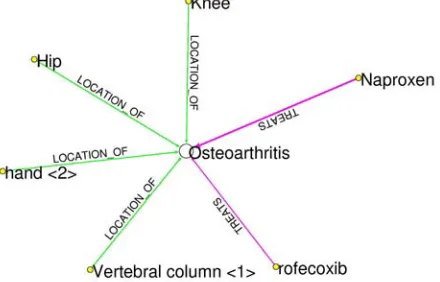
[image:1.612.318.538.538.679.2]Abstraction summarization offers an attractive alter-native for managing citations resulting from MEDLINE searches. We present a knowledge-rich abstraction ap-proach that depends on underspecified semantic inter-pretation of biomedical text. As an example, a graphical representation (Batagelj, 2003) of the semantic predica-tions serving as a summary (or conceptual condensate) from our system is shown in Figure 1. The input text was a MEDLINE citation with title “Gastrointestinal tolerability and effectiveness of rofecoxib versus naproxen in the treatment of osteoarthritis: a random-ized, controlled trial.”
Our semantic interpreter and the abstraction sum-marizer based on it both draw on semantic information from the Unified Medical Language System® (UMLS),®
a resource for structured knowledge in the biomedical domain. After introducing the semantic interpreter, we describe the transformation phase of our paradigm, dis-cussing principles that depend on semantic notions in order to condense the semantic predications represent-ing the content of text. Initially, this process was applied to summarizing single documents. We discuss its adap-tation to multidocument input, specifically to the set of citations resulting from a query to the MEDLINE data-base. Although we have not yet formally evaluated the effectiveness of the resulting condensate, we discuss its characteristics and possibilities as both an indicative and informative summary.
2
2.1
2.2
Background
Lexical Semantics
Research in lexical semantics (Cruse, 1986) provides insight into the interaction of reference and linguistic structure. In addition to paradigmatic lexical phenomena such as synonymy, hypernymy, and meronymy, diathe-sis alternation (Levin and Rappaport Hovav, 1996), deep case (Fillmore, 1968), and the interaction of predi-cational structure and events (Tenny and Pustejovsky, 2000) are being investigated. Some of the consequences of research in lexical semantics, with particular attention to natural language processing, are discussed by Puste-jovsky et al. (1993) and Nirenburg and Raskin (1996). Implemented systems often draw on the information contained in WordNet (Fellbaum, 1998).
In the biomedical domain, UMLS knowledge pro-vides considerable support for text-based systems. (Burgun and Bodenreider (2001) compare the UMLS to WordNet.) The UMLS (Humphreys et al., 1998) con-sists of three components: the Metathesaurus,®
Seman-tic Network (McCray, 1993), and SPECIALIST Lexicon (McCray et al., 1994). The Metathesaurus is at the core and contains more than 900,000 concepts com-piled from more than sixty controlled vocabularies. Many of these have hierarchical structure, and some contain meronymic information in addition to hy-pernymy. Editors combine terms in the constituent vo-cabularies into a set of synonyms (cf. WordNet’s synsets), which constitutes a concept. One term in this set is called the “preferred name” and is used as the concept name, as shown in (1).
(1) Concept: Dyspnea Synonyms:
Breath-lessness, Shortness of breath, Breathless, Diffi-culty breathing, Respiration diffiDiffi-culty, etc.
In addition, each concept in the Metathesaurus is as-signed at least one semantic type (such as ‘Sign or Symptom’ for (1)), which categorizes the concept in the biomedical domain. The semantic types available are drawn from the Semantic Network, in which they are organized hierarchically in two single-inheritance trees, one under the root ‘Entity’ and another under ‘Event’.
The Semantic Network also contains semantic predications with semantic types as arguments. The predicates are semantic relations relevant to the bio-medical domain and are organized as subtypes of five classes, such as TEMPORALLY_RELATED_TO and FUNCTIONALLY_RELATED_TO. Examples are shown in
(2).
(2) ‘Pharmacologic Substance’ TREATS ‘Disease or Syndrome’, ‘Virus’ CAUSES ‘Disease or Syndrome’
Lexical semantic information in the UMLS is dis-tributed between the Metathesaurus and the Semantic Network. The Semantic Network stipulates permissible argument categories for classes of semantic predica-tions, although it does not refer to deep case relations. The Metathesaurus encodes synonymy, hypernymy, and meronymy (especially for human anatomy). Synonymy is represented by including synonymous terms under a single concept. Word sense ambiguity is represented to some extent in the Metathesaurus. For example dis-charge is represented by the two concepts in (3), with different semantic types.
(3) Discharge,Body Substance: ‘Body Substance’
PatientDischarge: ‘Health Care Activity’ The SPECIALIST Lexicon contains orthographic formation (such as spelling variants) and syntactic in-formation, including inflections for nouns and verbs and sub-categorization for verbs. A suite of lexical access tools accommodate other phenomena, including deriva-tional variation.
SemRep
The categorial analysis enhanced with Metathesau-rus concepts and associated semantic types provides the basis for semantic interpretation, which relies on two components: a set of “indicator” rules and an (under-specified) dependency grammar. Indicator rules map between syntactic phenomena (such as verbs, nominali-zations, and prepositions) and predicates in the Seman-tic Network. For example, such rules stipulate that the preposition for indicates the semantic predicate TREATS
in sumatriptan for migraine. The application of an indi-cator rule satisfies the first of several necessary condi-tions for the interpretation of a semantic predication.
Argument identification is controlled by a partial dependency grammar. As is common in such grammars, a general principle disallows intercalated dependencies (crossing lines). Further, a noun phrase may not be used as an argument in the interpretation of more than one semantic predication, without license. (Coordination and relativization license noun phrase reuse.) A final principle states that if a rule can apply it must apply.
Semantic interpretation in SemRep is not based on the “real” syntactic structure of the sentence; however linear order of the components of the partial parse is crucial. Argument identification rules are articulated for each indicator in terms of surface subject and object. For example, subjects of verbs are to the left and objects are to the right. (Passivization is accommodated before final interpretation.) There are also rules for preposi-tions and several rules for arguments of nominaliza-tions.
The final condition on the interpretation of an asso-ciative semantic predication is that it must conform to the appropriate relationship in the Semantic Network. For example, if a predication is being constructed on the basis of an indicator rule for TREATS, the syntactic
ar-guments identified by the dependency grammar must have been mapped to Metathesaurus concepts with se-mantic types that conform to the sese-mantic arguments of
TREATS in the Semantic Network, such as
‘Pharma-cologic Substance’ and ‘Disease or Syndrome’. Hy-pernymic propositions are further controlled by hierarchical information in the Metathesaurus (Rind-flesch and Fiszman, 2003).
In processing the sentence in (4), SemRep first con-structs the partial categorical representation given schematically in (5). This is enhanced with semantic information from the Metathesaurus as shown in (6), where the corresponding concept for each relevant noun phrase is shown, along with its semantic type. The final semantic interpretation for (4) is given in (7).
(4) Mycoplasma pneumonia is an infection of the lung caused by Mycoplasma pneumoniae
(5) [[Mycoplasma pneumonia] [is] [an infection] [of the lung] [caused] [by Mycoplasma pneumo-niae]]
(6) “Mycoplasma pneumonia”–‘Disease or Syn-drome’
”Infection”–‘Disease or Syndrome’ ”Lung”–‘Body Part, Organ, or Organ Compo-nent’
”Mycoplasma pneumoniae”–‘Bacterium’
(7) Mycoplasma Pneumonia ISA Infection Lung LOCATION_OF Infection
Lung LOCATION_OF Mycoplasma Pneumonia Mycoplasma pneumoniae CAUSES Infection Mycoplasma pneumoniae CAUSES My-coplasma Pneumonia
3
3.1
Automatic Summarization
Automatic summarization is “a reductive transformation of source text to summary text through content reduc-tion, selecreduc-tion, and/or generalization on what is impor-tant in the source” (Sparck Jones, 1999). Two paradigms are being pursued: extraction and abstraction (Hahn and Mani, 2000). Extraction concentrates on cre-ating a summary from the actual text occurring in the source document, relying on notions such as frequency of occurrence and cue phrases to identify important in-formation.
Abstraction, on the other hand, relies either on lin-guistic processing followed by structural compaction (Mani et al., 1999) or on interpretation of the source text into a semantic representation, which is then condensed to retain only the most important information asserted in the source. The semantic abstraction paradigm is attrac-tive due to its ability to manipulate information that may not have been explicitly articulated in the source docu-ment. However, due to the challenges in providing se-mantic representation, sese-mantic abstraction has not been widely pursued, although the TOPIC system (Hahn and Reimer, 1999) is a notable exception.
Semantic Abstraction Summarization
We are devising an approach to automatic summariza-tion in the semantic abstracsummariza-tion paradigm, relying on SemRep for semantic interpretation of source text. The transformation stage that condenses these predications is guided by principles articulated in terms of frequency of occurrence as well as lexical semantic phenomena.
arti-cles on treatment of disease) and then consider its ex-tension to multidocument input in the form of biomedi-cal scientific abstracts directed at clinibiomedi-cal researchers.
The transformation stage takes as input a list of Sem
3.2 Transformation
In the semantic abstraction paradigm the transformation
b. Connectivity: Also include “useful” additional
c. Novelty: Do not include predications that the
d. Saliency: Only include the most frequently
oc-Alth urrence (saliency) plays a rol
(relevance), a condensation process, identi-fies
ders}
{Disorders}
isorders}
ders} s of sem
a generalization process and
ovelty) provides further condensation by elim
tion phase and
n these principles are applied to the semantic pre
Rep predications and a seed disorder concept. The output is a conceptual condensate for the input concept. Before transformation begins, predications are subjected to a focused word sense disambiguation filter. Branded drug names such as Advantage (Advantage brand of Imidacloprid) and Direct (Direct type of resin cement), which are ambiguous with the more common meaning of their names, are resolved to their non-pharmaceutical sense.
stage condenses and generalizes, and in our approach these processes are based on four general principles:
a. Relevance: Include predications on the topic of the summary
predications
user already knows
curring predications ough frequency of occ
e in determining predications to be included in the summary, the other three principles depend crucially on lexical semantic information from the UMLS. These four principles guide the phases involved in creating a summary.
Phase 1
predications on a given topic (in this study, disor-ders) and is controlled by a semantic schema (Jacquelinet et al., 2003) for that topic. The schema is represented as a set of predications in which the predi-cate is drawn from a relation in the UMLS Semantic Network and the arguments are represented as a “do-main” covering a class of concepts in the Metathesaurus (Disorders, for example).
{Disorders} ISA {Disor {Etiological process} CAUSES {Treatment} TREATS {Disorders} {Body location} LOCATION_OF {D {Disorders} OCCURS_IN {Disorders} {Disorders} CO-OCCURS_WITH {Disor Each domain for the schema is defined in term
antic categorization in the Semantic Network. For example {Disorders} is a subset of the semantic group Disorders (McCray et al., 2001) and contains the
fol-lowing semantic types: ‘Disease or Syndrome’, ‘Neo-plastic Process’, ‘Mental or Behavioral Dysfunction’, and ‘Sign or Symptom’. Although the schema is not complete, it represents a substantial amount of what can be said about disorders. Predications produced by Sem-Rep must conform to this schema in order to be in-cluded in the conceptual condensate; such predications are called “core predications.”
Phase 2 (connectivity) is
identifies predications occurring in neighboring semantic space of the core. This is accomplished by retrieving all the predications that share an argument with one of the core predications. For example, from Naproxen TREATS Osteoarthritis, non-core predica-tions such as Naproxen ISA NSAID are included in the condensate.
Phase 3 (n
inating predications that have a generic argument, as determined by hierarchical depth in the Metathesau-rus. Arguments occurring less than an empirically de-termined distance from the root are considered too general to be useful, and predications containing them are eliminated. For example Pharmaceutical Prepara-tions TREATS Migraine is not included in the conden-sate for migraine because “Pharmaceutical Preparations” was determined to be generic.
Phase 4 (saliency) is the final transforma
its operations are adapted from TOPIC’s (Hahn and Reimer, 1999) saliency operators. Frequency of occur-rence for arguments, predicates, and predications are calculated, and those occurring more frequently than the average are kept in the condensate; others are elimi-nated.
Whe
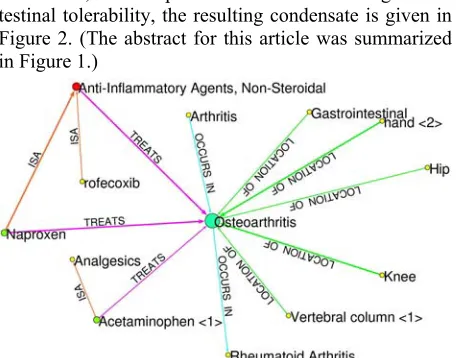
dications produced by SemRep for a full-text article with 214 sentences (Lisse et al., 2003) concerned with comparing naproxen and rofecoxib for treating os-teoarthritis, with respect to effectiveness and gastroin-testinal tolerability, the resulting condensate is given in Figure 2. (The abstract for this article was summarized in Figure 1.)
[image:4.612.314.542.507.686.2]4
Multidocument Summarization
The MEDLINE database, developed and maintained by
the N than 12
million citations (dating from the 1960’s to the present)
d at the same time retaining differences that
ramework for de-term
Th
results for
Eval ation, especially for mult ev et al., 2003). It is usually classified as intrinsic (measures the quality
nd marked the predica-tion
h set
ational Library of Medicine, contains more
drawn from nearly 4,600 journals in the biomedical do-main. Access is provided by a statistical information retrieval system. Due to the size of the database, searches often retrieve large numbers of items. For ex-ample, the query “diabetes” returns 207,997 citations. Although users can restrict searches by language, date and publication type (as well as specific journals), re-sults can still be large. For example, a query for treat-ment (only) for diabetes, limited to articles published in 2003 and having an abstract in English finds 3,621 items; limiting this further to articles describing clinical trials still returns 390 citations. We describe the adapta-tion of our abstracadapta-tion summarizaadapta-tion process to multi-document input for managing the results of searches in MEDLINE.
Extending summarization to multidocument input presents challenges in removing redundancies across documents an
might be important. One issue is devising a frame-work on which to compute similarities and differences across documents. Radev (2000) defines twenty-four relationships (such as equivalence, subsumption, and contradiction) that might apply at various structural lev-els across documents. Sub-events (Daniel et al., 2003) and sub-topics (Saggion and Lapalme, 2002) also con-tribute to the framework used for comparing documents in multidocument summarization.
A particular challenge to multidocument summariza-tion in the extracsummariza-tion paradigm is determining what parts of documents conform to the f
ining similarities and differences. A recent study (Kan et al., 2001) uses topic composition from text headers, but other studies in the extraction paradigm (Goldstein et al., 1999), extraction coupled with rhetori-cal structural identification (Teufel and Moens, 2002), and syntactic abstraction paradigms use different meth-odologies (Barzilay et al., 1999; McKeown et al., 1999).
Our semantic abstraction summarization system naturally extends to multidocument input with no modi-fication from the system designed for single documents.
e disorder schema serves as the framework for identi-fying sub-topics, and predications retrieved across sev-eral documents must conform to its structure. Informational equivalence (and redundancy) is com-puted on this basis. For example, all predications that conform to the schema line {Treatment} TREATS {Disorders} constitute a representation of a subtopic in the disorder domain. Exact matches in this set constitute redundant information, and other types of relationships can be computed on the basis of partial matches.
Al-though we concentrate on similarities across documents, differences could be computed by examining predica-tions that are not shared among citapredica-tions.
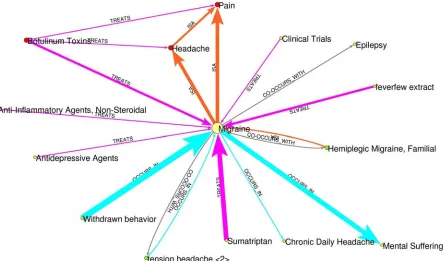
We have begun testing our system applied to the re-sults of MEDLINE searches on disorders, concentrating on the most recent 300 citations retrieved. The
migraine are represented graphically in Figure 3. Traversing the predicates (arcs) in this condensate pro-vides an informative summary of these citations.
5
Evaluation and Results
uation in automatic summariz idocument input, is daunting (Rad
of the summary as related to the source documents) or extrinsic (how the summary affects some other task). Since we do not have a gold standard to compare the final condensates against, we performed a linguistic evaluation on the quality of the condensates generated for four diseases: migraine, angina pectoris, Crohn’s disease, and pneumonia. The input for each summary was 300 MEDLINE citations.
Table 1 presents evaluation results. The first author (MF) examined the source sentence that SemRep used to generate each predication a
s as either correct or incorrect. Precision was calcu-lated as the total number of correct predications divided by the total number of predications in the condensate.
We also measured the reduction (compression) for each of the four disorder concepts. In Table 1, “Base” is the number of predications SemRep produced from eac
of 300 citations. “Final” is the number of predica-tions left after the final transformation. Therefore, this is a compression ratio on the semantic space of predica-tions, and is different from text compression in the tradi-tional sense.
Concept Base Final C I Precision
Migraine 2485 102 72 30 71%
A 3 8
ia
ngina 2989 41 3 80% Crohn’s 3077 135 71 64 53% Pneumon 2694 28 27 1 96% Total 11245 306 203 103 66%
Table 1. ts the f di se
r = r
In Crohn’s disease (with lowest precision) a single Sem
for 52% of th ocessing the sen
Resul for our sea concepts C = Co rect, I Incor ect
Rep error type in argument identification accounts e mistakes. For example in pr
incor-rectly returned “Inflammatory Bowel Diseases CO- OCCURS_WITH Ulcerative Colitis” and “Ulcerative Colitis predicate CO-OCCURS_WITH Crohn’s Dis-ease.” Word sense ambiguity also contributed to a large number of errors.
6
Content Characterization
We sformation stage
has and predications during the summarization process. SemRep produced
S_IN; and
pes in the final con
he fin
nitially parsed, only 63 are represented in the
o far do not accommodate. Some of the
lusion and Future Directions
We raction
summarization that produces conceptual condensates for
condensate to the text that produced them. We als
ional Library of Medicine Re
01. Effective mapping of biomedical LS Metathesaurus: The MetaMap
pro-Ba
edi-Ba
e context of multi-document
summa-Bu
and semantic classes in WordNet and the
Cl
to text meaning processing.
Pro-Cr
ge. examined the effect that the tran
on the distribution of predicates
2,485 predications from 300 citations retrieved for mi-graine. Of these, 1,638 are distributed over four predi-cates in the disorder schema (327–TREATS; 148–ISA; 180–LOCATION_OF; 54–CAUSES; 720– OCCURS_IN; and 209–CO-OCCURS_WITH).
After phases 1, 2, and 3 of the transformation proc-ess, 311 predications remain (134–TREATS; 41–ISA; 12–LOCATION_OF; 5–CAUSES; 68–OCCUR
51–CO-OCCURS_WITH). This reduction is largely due to hierarchical pruning in phase 3.
Phase 4 operations, based on frequency of occur-rence pruning (saliency), further condensed the list, and the top three TREATS predication ty
densate are (13–Sumatriptan TREATS Migraine; 6– Botulinum Toxins TREATS Migraine; and 6–feverfew extract TREATS Migraine). This list represents the fact that Sumatriptan is a popular treatment for migraine.
Besides frequency, another way of looking at the predications is typicality (Kan et al., 2001), or distribu-tion of predicadistribu-tions across citadistribu-tions. Looking at t
al condensate for migraine and focusing on TREATS, the most widely distributed predications are “Sumatrip-tan TREATS Migraine,” which occurs in ten citations; “Botulinum Toxins TREATS Migraine” (three cita-tions); and “feverfew extract TREATS Migraine” (two citations).
One can also view the final condensate from the per-spective of citations, rather than predications. Of the 300 citations i
final condensate, one with six predications, one with five predications, three with four predications, and so on. It is tempting to hypothesize that more highly rele-vant citations will have produced more predications, but this must be formally tested in the context of the user’s retrieval objective.
An informal examination of the citations that con-tributed to the final condensate for migraine revealed differences that we s
se, such as publication and study type, could be ad-dressed outside of natural language processing with MEDLINE metadata. Others, including medication de-livery system and target population of the disorder topic, are amenable to current processing either through
extension of the disease schema or enhancements to SemRep.
7
Conc
propose a framework based on semantic abst
disorder topics that are both indicative and informative. The approach uses a biomedical semantic processor as the source interpreter. After semantic interpretation, a series of transformations condense the predications pro-duced, and a final condensate is displayed in graphical form.
In the future, we would like to link the predications in the
o plan to evaluate the effectiveness of this approach in retrieving useful articles for clinical researchers. Fi-nally, we would like to investigate additional ways of visualizing the condensates.
Acknowledgements The first author was supported
by an appointment to the Nat
search Participation Program administered by the Oak Ridge Institute for Science and Education through an inter-agency agreement between the U.S. Department of Energy and the National Library of Medicine.
References
Aronson AR. 20 text to the UM
gram. Proceedings of the AMIA Symp, pp 17-21. tagelj AM. 2003. Pajek - Analysis and Visualization of Large Networks. In M. Jünger and P. Mutzel, tors, Graph Drawing Software. Springer Verlag, Ber-lin, pp 77-103.
rzilay R, McKeown KR, Elhadad M. 1999. Informa-tion fusion in th
rization. Proceedings of the 37th Annual Meeting of
the Association of Computational Linguistics, pp
550-557.
rgun A, Bodenreider O. 2001. Comparing terms, concepts,
Unified Medical Language System. Proceedings of the NAACL Workshop on WordNet and Other Lexical Resources: Applications, Extensions and Customiza-tions, pp 77-82.
ark P, Harrison P, Thompson J. 2003. A knowledge-driven approach
ceedings of the HLT-NAACL Workshop on Text Meaning, pp 1-6.
Cutting D, Kupiec J, Pedersen J, Sibun P. 1992. A prac-tical part-of-speech tagger. Proceedings of the Third
Da
marization. Proceedings of
HLT-Fi
.
Fe
trac-Ha
6.
erators for
Ha
Hu
System:
Ja
eux P. 2003. Developing the
Ka
on for
Le
ment realization. unpublished ms.
B, M
M
d Intelligent Systems.
Law-M
ts.
M
hniruk A, Pate V,
M
tion
Man-M
. Proceedings of the Annual Symp Comput
M
t 1):216-20.
w Mexico State
Univer-Pu
Linguistics, 19:331-58.
e, pp 33-145.
st ACL
Ra
Celebi A, Liu D, Drabek E. 2003. Evaluation
chal-Conference on Applied Natural Language Process-ing, pp 133-40.
niel N, Radev D, Allison T. 2003. Sub-event based multi-document sum
NAACL Workshop on Text Summarization, pp 9-16.
llmore CJ. 1968. The case for case. In E. Bach and RT. Harms, editors, Universals in Linguistic Theory
Holt Rinehart and Winston, New York, pp 1-88. llbaum C. 1998. WordNet: An Electronic Lexical
Da-tabase. The MIT Press, Cambridge, MA
Goldstein J, Mittal V, Carbonell J, Kantrowitz M. 2000. Multi-document summarization by sentence ex tion. Proceedings of the ANLP/NAACL Workshop on
Automatic Summarization, pp 40-48.
hn U, Mani I. 2000. The challenges of automatic summarization. Computer, 33(11):29-3
Hahn U, Reimer U. 1999. Knowledge-based text sum-marization: salience and generalization op
knowledge base abstraction. In I. Mani and MT. Maybury, editors, Advances in Automatic Text Sum-marization. MIT Press, Cambridge, pp 215-32. rabagiu S, Moldovan D, Pasca M, Mihalcea R, Surdeanu M, Bunescu R; Girju R, Rus V, Morarescu P. 2001. The role of lexico-semantic feedback in open-domain textual question-answering. Proceed-ings of the 39th Annual Meeting of the Association for Computational Linguistics, pp 274-81.
mphreys BL, Lindberg DA, Schoolman HM, Barnett GO. 1998. The Unified Medical Language
An informatics research collaboration. J Am Med In-form Assoc, 5(1):1-11.
cquelinet C, Burgun A, Delamarre D, Strang N, Djab-bour S, Boutin B, Le B
ontological foundations of a terminological system for end-stage diseases, organ failure, dialysis and transplantation. Int J Med Inf, 70(2-3):317-28. n M, McKeown KR, Klavans JL. 2001. Domain-specific informative and indicative summarizati information retrieval. Workshop on Text Summariza-tion (DUC3).
vin B, Rappaport Hovav M. 1996. From lexical se-mantics to argu
Lisse JR, Perlman M, Johansson G, Shoemaker JR, Schechtman J, Skalky CS, Dixon ME, Polis A Mollen AJ, Geba GP. 2003. Gastrointestinal toler-ability and effectiveness of rofecoxib versus naproxen in the treatment of osteoarthritis: a random-ized, controlled trial. Ann Intern Med, 139(7):539-46.
ani I, Gates B, Bloedorn E. 1999. Improving summa-ries by revising them. Proceedings of the 37th An-nual Meeting of the Association of Computational Linguistics, pp 558-65.
cDonald DD. 1992. Robust partial parsing through incremental, multi-algorithm processing. In PS Ja-cobs, editor, Text-base
rence Erlbaum Associates, New Jersey, pp 83-99. cKeown KR, Klavans JL, Hazivassiloglou V,
Barzi-lay R., Eskin E. 1999. Towards multidocument sum-marization by reformulation: progress and prospec
Proceedings of the Sixteenth National Conference on Artificial Intelligence, pp 453-60.
cKeown HR, Chang, SF, Cimino J, Feiner SK, Friedman C, Gravano L, Hatzivassiloglou V, Johnson S, Jordan DA, Klavans JL, Kus
Teufel S. 2001. PERSIVAL, a system for personal-ized search and summarization over multimedia healthcare information. JCDL, pp 331-40.
cCray AT. 1993. Representing biomedical knowledge in the UMLS Semantic Network. High-Performance Medical Libraries: Advances in Informa
agement for the Virtual Era. Meckler Publishing, pp
45-55.
cCray AT, Srinivasan S, Browne AC. 1994. Lexical methods for managing variation in biomedical termi-nologies
Appl Med Care, pp:235-9.
cCray AT, Burgun A, Bodenreider O. 2001. Aggre-gating UMLS semantic types for reducing conceptual complexity. Medinfo, 10(P
Mihalcea R, Moldovan D. 2000. Semantic indexing using WordNet senses. Proceedings of the ACL
Workshop on IR and NLP.
Nirenburg S, Raskin V. 1996. Ten choices for lexical semantics. Memoranda in Computer and Cognitive
Science. MCCS-96-304. Ne
sity.
stejovsky J., Bergler S, Anick P. 1993. Lexical se-mantic techniques for corpus analysis. Computa-tional
Raphael B. 1968. SIR: Semantic information retrieval. In Minsky, M. (ed.) Semantic Information Process-ing. The MIT Press, Cambridg
Radev D. 2000. A Common theory of information fu-sion from multiple text sources, step one: cross-document structure. Proceedings of 1
SIGDIAL Workshop on Discourse and Dialogue.
lenges in large-scale multi-document summarization: the MEAD project. Proceedings of ACL.
Rindflesch TC, Bean CA, Sneiderman CA. 2000. Ar-gument identification for arterial branching predica-tions asserted in cardiac catheterization reports.
Proceedings of the AMIA Symp, pp 704-8.
:462-77.
Sal
Sri ring text mining
Sp tomatic summarizing: factors Sc
Publishing Co,
Amster-Te
Experiments with relevance and rhetorical
Te
di-Vi
icative Forms in
W
cs: An
in-Advances in Automatic Text Summarization. MIT
Press, Cambridge, pp 1-13.
hank RC. 1975. Conceptual information processing.
Amsterdam. North-Holland
dam,
ufel S, Moens M. 2002. Summarizing scientific articles
-Rindflesch TC, Fiszman M. 2003. The interaction of domain knowledge and linguistic structure in natural language processing: interpreting hypernymic propo-sitions in biomedical text. J Biomed Infor, 36
status. Computational Linguistics, 28(4):409-445. nny C, Pustejovsk J. 2000. A history of events in lin-guistic theory. In C. Tenny and J. Pustejovsky, e tors, Events as Grammatical Objects, CSLI Publications, Stanford, pp 3-37.
egas E, Mahesh K, Nirenburg S. 1998. Semantics in action. In P. St. Dizier, editor, Pred
Saggion H, Lapalme G. Generating indicative-informative summaries with SumUM. 2002. Compu-tational Linguistics, 28(4):497-526.
ton G, Wong A, Yang CS. 1975. A vector space
Natural Language and in Lexical Knowledge Bases.
Kluwer Academic Publishers, Dordrecht.
ilks YA. 1976. Parsing English II. In E. Charniak and Y. Wilks, editors, Computational semanti
model for automatic indexing. Communications of the ACM, (18):613-20.
nivasan P, Rindflesch T. 2002. Explo
from MEDLINE. Proceedings of the AMIA Symp, pp 722-6.
arck Jones K. 1999. Au
troduction to artificial intelligence and natural
lan-guage comprehension. North Holland Publishing
[image:8.612.85.530.373.634.2]Company, Amsterdam, pp 155-84. . and directions In I. Mani and MT. Maybury, editors,