Document Re-ranking Based on Automatically Acquired
Key Terms in Chinese Information Retrieval
Yang Lingpeng, Ji Donghong, Tang Li
Institute for Infocomm Research
21, Heng Mui Keng Terrace
Singapore, 119613
{
lpyang,dhji,tangli}@i2r.a-star.edu.sg
Abstract
For Information Retrieval, users are more concerned about the precision of top ranking documents in most practical situations. In this paper, we propose a method to improve the precision of top N ranking documents by reordering the retrieved documents from the initial retrieval. To reorder documents, we first automatically extract Global Key Terms from document set, then use extracted Global Key
Terms to identify Local Key Terms in a single
document or query topic, finally we make use of Local Key Terms in query and documents to reorder the initial ranking documents. The experiment with NTCIR3 CLIR dataset shows that an average 10%-11% improvement and 2%-5% improvement in precision can be achieved at top 10 and 100 ranking documents level respectively.
1
Introduction
Information retrieval (IR) is used to retrieve relevant documents from a large document set for a given query where the query is a simple description by natural language. In most practical situations, users concern more on the precision of top ranking documents than recall because users want to acquire relevant information from the top ranking documents.
Traditionally, IR system uses a one-stage or a two-stage mechanism to retrieve relevant documents from document set. For one stage mechanism, IR system only does an initial retrieval. For two-stage mechanism, besides the initial retrieval, IR system will make use of the initial ranking documents to automatically do query expansion to form a new query and then use the new query to retrieve again to get
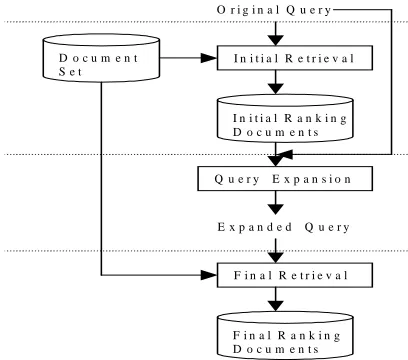
the final ranking documents. The effectiveness of query expansion mainly depends on the precision of top N (N<50) ranking documents in initial retrieval because almost all proposed automatic query expansion algorithms make use of the information in the top N retrieved. Figure 1 demonstrates the general processes of a two-stage IR system.
In this paper, we propose a method to improve the precision of top N ranking documents by reordering the initially retrieved documents in the initial retrieval. To reorder documents, we first automatically extract
Global Key Terms from the document set, then
use the extracted Global Key Terms to identify
Local Key Terms in a single document or query
topic, finally we make use of the Local Key
Terms in queries and documents to reorder the
initial ranking documents.
Although our method is general and can apply to any languages, in this paper we’ll only focus on the research on Chinese IR system.
F i g . 1 T r a d i t i o n a l P r o c e s s o f t w o - s t a g e s I R O r i g i n a l Q u e r y
E x p a n d e d Q u e r y I n i t i a l R e t r i e v a l
F i n a l R e t r i e v a l Q u e r y E x p a n s i o n D o c u m e n t
S e t
I n i t i a l R a n k i n g D o c u m e n t s
The rest of this paper is organized as following. In section 2, we give an overall introduction of our proposed method. In section 3, we talk about what are Global Key
Terms and what are Local Key Terms and how
to acquire them. In section 4, we describe how these terms apply to Chinese IR system to improve the precision and quality of IR system. In section 5, we evaluate the performance of our proposed method and give some result analysis. In section 6, we present the conclusion and some future work.
2
Overview of Document Reordering
in Chinese IR
For Chinese IR, many retrieval models, indexing strategies and query expansion strategies have been studied and successfully used in IR. Chinese Character, bi-gram, n-gram (n>2) and word are the most used indexing units. (Li. P. 1999) gives out many research results on the effectiveness of single Chinese Character as indexing unit and how to improve the effectiveness of single Chinese Character as indexing unit. (K.L. Kwok. 1997) compares three kinds of indexing units (single Character, bigram and short-words) and their effectiveness. It reports that single character indexing is good but not sufficiently competitive, while bi-gram indexing works surprisingly well and it’s as good as short-word indexing in precision. (J.Y. Nie, J. Gao, J. Zhang and M. Zhou. 2000) suggests that word indexing and bi-gram indexing can achieve comparable performance but if we consider the time and space factors, then it is preferable to use words (and characters) as indexes. It also suggests that a combination of the longest-matching algorithm with single character is a good method for Chinese and if there is unknown word detection, the performance can be further improved. Many other papers in literature (Palmer, D. and Burger, J, 1997; Chien, L.F, 1995) give similar conclusions. Although there are still different voices on if bi-gram or word is the best indexing unit, bi-gram and word are both considered as the most important top two indexing units in Chinese IR and they are used
in many reported Chinese IR systems and experiences.
There are mainly two kinds of retrieval models: Vector Space Model (G. Salton and M. McGill, 1983) and Probabilistic Retrieval (N. Fuhr, 1992). They are both used in a lot of experiments and applications.
For query expansion, almost all of the proposed strategies make use of the top N documents in initial ranking documents in the initial retrieval. Generally, query expansion strategy selects M indexing units (M<50) from the top N (N<25) documents in initial ranking documents according to some kind of measure and add these M indexing units to original query to form a new query. In such process of query expansion, it’s supposed that the top N documents are related with original query, but in practice, such an assumption is not always true. The Okapi approach (S.E. Roberson and S.Walker, 2001) supposes that the top R documents are related with query and it selects
N indexing unit from the top R documents to
form a new query, for example, R=10 and
N=25. (M. Mitra., Amit. S. and Chris. B, 1998)
did an experiment on different query topics and it is reported the effectiveness of query expansion mainly depends on the precision of the top N ranking documents. If the top N ranking documents are highly related with the original query, then query expansion can improve the final result. But if the top N documents are less related with the original query, query expansion cannot improve the final result or even reduces the precision of final result. These researches conclude that whether query expansion is successful or not mainly depends on the quality of top N ranking documents in the initial retrieval.
The precision of top N documents in the initial ranking documents depends on indexing unit and retrieval models and mainly depends on indexing unit. As discussed above, bi-gram and word both are the most effective indexing units in Chinese IR.
In this paper, we propose a new method to improve the precision of top N ranking documents in initial ranking documents by reordering the top M (M > N and M < 1000) ranking documents in initially retrieved documents. To reorder documents, we try to find long terms (more than 2 Chinese characters) that generally represent some complete concepts in query and documents, then we make use of these long terms to re-weight the top M documents in initial ranking documents and reorder them by re-weighted value. We adopt a two-stage approach to acquire such kinds of long terms. Firstly, we acquire Global Key Terms from the whole document set; secondly, we use Global Key
Terms to acquire Local Key Terms in a query
or a document. After we have acquired Local
Key Terms, we use them to re-weight the top M
documents in initial ranking documents. Figure 2 demonstrates the processes of an IR system that integrates with this new method.
F i g . 2 E n h a n c e d P r o c e s s o f I R O r i g i n a l Q u e r y
E x p a n d e d Q u e r y I n i t i a l R e t r i e v a l
F i n a l R e t r i e v a l Q u e r y E x p a n s i o n D o c u m e n t
S e t
I n i t i a l R a n k i n g D o c u m e n t s
F i n a l R a n k i n g D o c u m e n t s
D o c u m e n t R e - O r d e r K e y T e r m
E x t r a c t i o n
K e y T e r m s R e - O r d e r e d D o c u m e n t s
3
Global/Local Key Term Extraction
The Global /Local Key Term extraction concerns the problem of what is a key term.
Intuitively, key terms in a document are some conceptual terms that are prominent in document and play main roles in discriminating the document from other documents. In other words, a key term in a document can represent part of the content of the document. Generally, from the point of the view of conventional linguistic studies, Key
Terms may be some NPs, NP-Phrases or some
kind of VPs, adjectives that can represent some specific concepts in document content representation.
We define two kinds of Key Terms: Global
Key Terms which are acquired from the whole
document set and Local Key Terms which are acquired from a single document or a query.
We adopt a two-stage approach to automatically acquire Global Key Terms and
Local Key Terms. In the first stage, we acquire Global Key Terms from document set by using
a seeding-and-expansion method. In the second stage, we make use of acquired Global Key
Terms to find Local Key Terms in a single
document or a query.
3.1
Global Key Terms
Global Key Terms are terms which are
extracted from the whole document set and they can be regarded to represent the main concepts of document set.
Although the definition of Global Key
Terms is difficult, we try to give some
assumptions about a Global Key Term. Before we give these assumptions, we first give out the definition of Seed and Key Term in a document (or document cluster) d.
The concept Seed is given to reflect the prominence of a Chinese Character in a document (or document cluster) in some way.
Suppose r is the reference document set (reference document set including document set and other statistical large document collection), d is a document (or a document set), w is an individual Chinese Character in d, let Pr(w) and Pd(w) be the probability of w occurring in r and d respectively, we adopt 1),
relative probability or salience of w in d with
respect to r (Schutze. 1998), as the criteria for evaluation of Seed.
1) Pd(w) / Pr(w)
Now we give out the assumptions about a
Key Terms in document d.
i) a Key Term contains at least a Seed.
ii) a Key Term occurs at least N (N>1) times in d. iii) the length of a Key Term is less than L (L<30). iv) a maximal character string meeting i), ii) and iii) is a
Key Term.
v) for a Key Term, a real maximal substring meeting i), ii) and iiI) without considering their occurrence in all those Key Terms containing it is also a Key Terms.
Here a maximal character string meeting i), ii) and iii) refers to a adjacent Chinese character string meeting i), ii) and iii) while no other longer Chinese character strings containing it meet i), ii) and iii). A real maximal substring meeting i), ii) and iii) refers to a real substring meeting i), ii), and iii) while no other longer real substrings containing it meet i), ii) and iii). We use a kind of seeding-and-expansion-based statistical strategy to acquire Key Terms in document (or document cluster), in which we first identify seeds for a Key Term then expand from it to get the whole Key Term.
Fig. 3 describes the procedure to extract
Key Terms from a document (or document
cluster) d.
let Fd(t) represents the frequency of t in d;
let N is a given threshold (N>1);
K = {};
collect Seeds in d into S;
for all c∈S
{
let Q = {t: t contains c and Fd(t)≥N};
while Q ≠ NIL {
max-t ← the longest string in Q; K ← K + { max-t };
Remove max-t from Q; for all other t in Q
{
if t is a substring of max-t
{ Fd(t)← Fd(t)- Fd(max-t);
if Fd(t)<N
removing t from Q; }
} } }
return K as Key Terms in document d;
Fig. 3 Key Term Extraction from document d
To acquire Global Key Terms, we first roughly cluster the whole document set r into
K (K<2000) document clusters, then we regard
each document cluster as a large document and apply our proposed Key Term Extraction algorithm (see Fig. 3) on each document cluster and respectively get Key Terms in each document cluster. All these Key Terms from document clusters form Global Key Terms.
There are many document clustering approaches to cluster document set. K-Means and hierarchical clustering are the two usually used approaches. In our algorithm, we don’t need to use complicated clustering approaches because we only need to roughly cluster document set r into K document clusters. Here we use a simple K-Means approach to cluster document set. Firstly, we pick up randomly 10*K documents from document set r; secondly, we use K-Means approach to cluster these 10*K documents into K document clusters; finally, we insert every other document into one of the K document clusters. Fig. 4 describes the general process to cluster document set r into K document clusters.
let K is the number of documnet clusters to get;
T←10*K documents randomly pickuped from r; cluster T into K clusters {Kj} by using K-Means;
for any document d in {r-T} {
Ki← document cluster which has the maximal
similarity with d;
insert d to document cluster Ki;
}
return K document clusters {Kj|1<=j<=K};
Fig. 4 Cluster document set r into K clusters
Fig. 5 describes the procedure to acquire Global Key
Terms from document set r.
roughly cluster document set r to K document clusters {Kj|1<=j<=K} (See Fig. 4);
G = {}; for each Kj
{
extract Key Terms g from Kj ; (See Fig. 3)
G ← G + g; }
return G as Global Key Terms in document set r;
Fig. 5 Global Key Terms Acquisition
In the processing of Global Key Terms acquisition, the frequency of each Global Key
identifying Local Key Terms - terms in a single document or query.
3.2
Local Key Terms
Unlike Global Key Terms, Local Key Terms are not extracted by using Key Term extraction algorithm from single document or query, they are identified based on Global Key Terms and their frequencies.
Fig.6 describes the procedure of Local Key
Terms acquisition from a single document or
query d.
Given threshold M (M>10), N (N>100) and document d;
L = {};
return L as Local Key Terms in document d;
Fig. 6 Local Key Terms Acquisition
Following are some examples of Global Key
Terms and Local Key Terms in a query.
Example:
Query:
(Find information of the exhibition "Art and Culture of the Han Dynasty" in the National Palace Museum)
Global Key Terms occurred in Query and their
(Gu4 Gong1 Bo2 Wu4 Yuan4)– 727
(Xiang3 Guan3 Nei3 Rong2) – 148
(Nei3 Rong2) – 31165
Local Key Terms in Query:
(Han4 Dai4 Wen3 Wu4 Da4 Zhan3)
From the example, we can see the difference between Global Key Terms and Local Key initial ranking documents. Suppose q is a query, Fig. 7 is the algorithm to reorder top M documents in initial ranking documents where
w(t) is the weight assigned to Local Key Term t. w(t) can be assigned different value by
different measures. For example,
i) w(t) = the length of t;
iv) w(t) = square root of the number of Chinese Characters in t; (default)
for each document d in top M ranking documents sim ← similary value between d and q; w ← 0;
for each Local Key Term t in query q; { if t is a Local Key Term of d
w ← w + weight(t) }; if (w > 0)
{ sim ← sim * w;
set sim as the new similary between d and q }; reorder top M documents by their new similarity values with query q;
Fig. 7 Process of Document Reordering
5
Experience & Evaluation
We make use of the Chinese document set CIRB011 (132,173 documents) and CIRB20 (249,508 documents) and D-run type query topic set (42 topics) of CLIR in NTCIR3 (see
http://research.nii.ac.jp/ntcir-ws3/work-en.html
for more information) to evaluate our proposed method. We use vector space model as our retrieval model and use cosine to measure the similarity between document and query. For indexing units, we use bigrams and words respectively. To measure the effectiveness of IR, we use the same two kinds of relevant measures: relax-relevant and rigid-relevant. A document is rigid-relevant if it’s highly relevant or relevant with a query, and a document is relax-relevant if it is high relevant or relevant or partially relevant with a query. We also use PreAt10 and PreAt100 to represent the precision of top 10 ranking documents and top 100 ranking documents.
When we use our proposed method and algorithm to extract Global Key Terms from document set r, we set all kinds of algorithm parameters as following:
• 10000 documents from r to do initial document clustering; (Fig. 4)
• 1000 document clusters; (Fig. 4) • maximal length of Key Terms:30; (Fig. 3) • minimal occurrence of Key Terms:2; (Fig. 3) • minimum salience of seed:2; (Fig. 3) • reorder the top 1000 documents;
• We also set M =10, N= 100 for the algorithm to acquire Local Key Terms. (Fig. 6)
Table 1 lists the normal results and enhanced results based on bigram indexing. The
enhanced results are acquired by using our method to enhance the effectiveness. PreAt10 is the average precision of 42 queries in precision of top 10 ranking documents, while PreAt100 is the average precision of 42 queries in precision of top 100 ranking documents. Column 2 (normal) displays the precision of normal retrieval, column 3 (Enhanced) displays the precision of using our proposed approach, and column 4 (ratio) displays the ratio of column 3 (enhanced) compared with column 2 (normal). Table 2 lists the normal results and our enhanced results based on word indexing.
Normal Enhanced Ratio PreAt10(Relax) 0.3642 0.4052 1.11258 PreAt100(Relax) 0.1886 0.1926 1.02121 PreAt10(Rigid) 0.2595 0.2871 1.10636 PreAt100(Rigid) 0.1278 0.133 1.04069
Table 1 Precision (bigram as indexing unit)
Normal Enhanced Ratio
PreAt10(Relax) 0.3761 0.4119 1.09519
PreAt100(Relax) 0.1983 0.2074 1.04589
PreAt10(Rigid) 0.269 0.2952 1.0974
PreAt100(Rigid) 0.1381 0.1419 1.02752
Table 2 Precision (word as indexing unit)
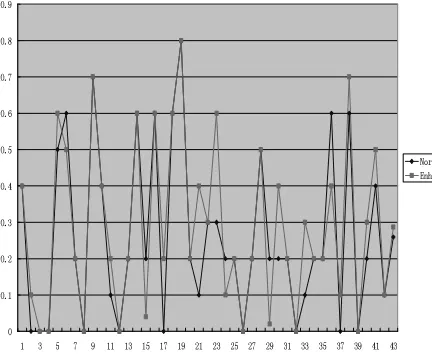
From table 1, we can see that compared with bigrams as indexing units, our proposed method can improve PreAt10 by 11% from 0.3642 to 0.4052 in relax relevant measure and improve 11% from 0.2595 to 0.2871 in rigid relevant measure. Even in PreAt100 level, our method can improve 2% and 4% in relax relevant and rigid relevant measure. Fig. 8 displays the PreAt10 values of each query in relax relevant measure based on bigram indexing where the red lines represent the precision enhanced with our method while the black lines represent the normal precision. Among the 42 query topics, there are only 5 queries whose enhanced precisions are worse than normal precisions, the precisions of other 37 queries are all improved.
and query), our method can improve PreAt10 by 10% from 0.3761 to 0.4119 in relax relevant measure and improve 10% from 0.269 to 0.2952 in rigid relevant measure. Even in PreAt100 level, our method can improve 3% and 5% in rigid and relax relevant measure.
Fig. 8 PreAt10 of all queries in relax judgment
In our experiments, compared with the most important and effective Chinese indexing units: bigram and words, our proposed method improves the average precision of all queries in top 10 measure levels for about 10%. What lies behind our proposed method is that in most case, proper long terms may contain more information (position and Chinese Character dependence) and such information can help us to focus on relevant documents. Our experiment also shows improper long terms may decrease the precision of top documents. So it’s very important to extract right and proper terms in documents and queries.
6
Conclusion
In this paper, we proposed a new method to improve the precision of top N initial ranking documents in Chinese IR. We try to find proper and important long terms in queries and documents, then we make use of these information to reweight the similarity between queries and documents and finally reorder the top M (M>N) documents by their new
similarities with query. Our experiences based on bigram as indexing and word as indexing both show that our method can improve the performance of Chinese IR by 10%-11% at top 10 documents measure level and 2%-5% at top 100 documents document measure level. For the further work, we will try to improve the quality of Global Key Terms and Local Key
Terms, and we will apply our method to
English IR and other languages IR systems.
References
Chien, L.F. Fast and quasi-natural language
search for gigabytes of Chinese texts. In: Proc.
18th ACM SIGIR Conf. On R&D in IR. Fox, E., Ingwersen, P. & Fidel, R. (eds.) ACM: NY, NY. Pp.112-120.
G. Salton and M. McGill. Introduction to Modern
Information Retrieval, McGraw-Hill, 1983.
H. Schutze. 1998. The hypertext concordance: a
better back-of-the-book index. Proceedings of
First Workshop on Computational Terminology. pp: 101-104.
J.Y. Nie, J. Gao, J. Zhang and M. Zhou. 2000. On
the Use of Words and N-grams for Chinese Information Retrieval. In Proceedings of the
Fifth International Workshop on Information Retrieval with Asian Languages, IRAL-2000, pp. 141-148
K.L. Kwok. 1997. Comparing Representation in
Chinese Information Retrieval. In Proceedings of
the ACM SIGIR-97, pp. 34-41.
Li. P. 1999.Research on Improvement of Single
Chinese Character Indexing Method, Journal of
the China Society for Scientific and Technical Information, Vol. 18 No. 5.
M. Mitra., Amit. S. and Chris. B. Improving
Automatic Query Expansion. In Proc. ACM
SIGIR’98, Aug. 1998.
N. Fuhr. Probabilistic Models in Information
Retrieval. The Computer Journal. 35(3), 1992.
Palmer, D. and Burger, J. Chinese Word
Segmentation and Information Retrieval. AAAI
Spring Symposium on Cross-Language Text and Speech Retrieval, 1997
Qu Y., Xu G. and Wang J. Rerank Method based on
Individual Thesaurus. In NTCIR Workshop 2.
S.E. Robertson and S. Walker. Microsoft Cambridge at TREC-9: Filtering track: In the