Example-based Acquisition of Fine-grained Collocational Resources
Sara Rodr´ıguez-Fern´andez
1, Roberto Carlini
1, Luis Espinosa-Anke
1, Leo Wanner
1,21NLP Group, Department of Information and Communication Technologies, Pompeu Fabra University
C/ Roc Boronat, 138, 08018 Barcelona (Spain)
2Catalan Institute for Research and Advanced Studies (ICREA)
sara.rodriguez.fernandez|roberto.carlini|luis.espinosa|[email protected]
Abstract
Collocations such asheavy rainormake [a] decision, are combinations of two elements where one (thebase) is freely chosen, while the choice of the other (collocate) is restricted, depending on the base. Collocations present difficulties even to advanced language learners, who usually struggle to find the right collocate to express a particular meaning, e.g., bothheavyandstrongexpress the meaning ‘intense’, but whilerainselectsheavy,wind selectsstrong. Lexical Functions(LFs) describe the meanings that hold between the elements of collocations, such as ‘intense’, ‘perform’, ‘create’, ‘increase’, etc. Language resources with semantically classified collocations would be of great help for students, however they are expensive to build, since they are manually constructed, and scarce. We present an unsu-pervised approach to the acquisition and semantic classification of collocations according to LFs, based on word embeddings in which, given an example of a collocation for each of the target LFs and a set of bases, the system retrieves a list of collocates for each base and LF.
Keywords:collocation retrieval, collocation semantic classification, collocation resources, second language learning, word em-beddings
1.
Introduction
Collocations of the kind make [a] suggestion, attend [a] lecture,heavy rain,deep thought, etc., are restricted lexical co-occurrences between two syntactically related lexical el-ements. One of these elements (thebase) is freely chosen, while the choice of the other (the collocate) depends on the base (Hausmann, 1984; Cowie, 1994; Mel’ˇcuk, 1995). For instance, in make [a] suggestion, the choice of sug-gestionis free, while the choice ofmakeis restricted; cf., e.g., *take [a] suggestion. Such collocations are by their nature idiosyncratic and therefore also language-specific. Thus, you make[a]suggestion, but you give[an]advice, you attend[a]lecture, but youassist[an]operation,rain is heavy while wind is strong. In English, you take [a] walk, while in Spanish you ‘give’ it (dar[un]paseo, and
in German you ‘make’ it ([einen] Spaziergang machen);
in English,rainisheavy, while in Spanish and German it is ‘strong’ (fuerte lluvia/starker Regen). And so on. The idiosyncrasy of such collocations makes them a real chal-lenge even for advanced second language learners (Haus-mann, 1984; Bahns and Eldaw, 1993; Granger, 1998; Lewis and Conzett, 2000; Nesselhauf, 2005; Alonso Ramos et al., 2010). Nesselhauf (2005) and Farghal and Obiedat (1995) report that learners of English paraphrase their discourse in order to avoid using collocations that they do not master. In other words, a learner knows the meaning they want to express, but they fail to do it by means of a collocation, which means that they fail to pick the collocate that ex-presses this meaning. Semantically annotated collocation resources would thus be of great aid. A number of collo-cation dictionaries already either group collocates semanti-cally (as, e.g., the Oxford Collocations Dictionary and BBI (Benson et al., 2010) for English) or use explicit semantic glosses (as, e.g., the MacMillan Collocations Dictionary for English, the LAF (Mel’ˇcuk and Polgu`ere, 2007) for French, and DiCE http://dicesp.com for Spanish). However, due to
the high cost of their compilation, such dictionaries are of-ten of limited coverage1and available only for a few
lan-guages.
In what follows, we present an unsupervised example-based approach to automatic compilation of semantically typed collocation resources. The typology that underlies our work are the glossedlexical functions(LFs) (Mel’ˇcuk, 1996), which are the most fine-grained semantic colloca-tion typology available to date. Using a state-of-the-art con-tinuous word representation, we take as input seed a single representative example of a specific LF to retrieve from a corpus the collocates that are of the same LF (i.e., type) for new bases. So far, we focused in our experiments on Spanish. In the next section, we introduce the LF typology; in Section 3., we describe our methodology for the acqui-sition of collocation resources. Section 4. outlines the ex-periments carried out to assess the performance of the im-plementation of the methodology, and Section 5. discusses their outcome. Section 6., finally, presents some conclu-sions we draw from the presented work.
2.
Lexical Functions: A Semantic
Collocation Typology
Collocation dictionaries, such as the Oxford Colloca-tions Dictionary or the MacMillan CollocaColloca-tions Dictionary group collocations in terms of semantic categories to facil-itate that language learners can easily retrieve the collocate that expresses the meaning they want to express. However, this categorization (or classification) is not always homo-geneous. For instance, in the MacMillan Dictionary, the entries for admiration and affinity contain the categories ‘have’ and ‘show’, each with their own collocates, while for other headwords, such as, e.g., ability, collocates with the meaning ‘have’ and ‘show’ are grouped under the same
category; in the entry for alarm,cause orexpressare not assigned to any category, while for other keywords the cat-egories ‘cause’ and ‘show’ are used (see e.g.,problemfor ‘cause’ oradmirationfor ‘show’); and so on. On the other hand, in the case of some headwords, the categories are very fine-grained (cf., e.g.,amount, which includes glosses like ‘very large’, ‘too large’, ‘rather large’, ‘at the limit’, etc.), while in the case of others, it is much more coarse-grained (cf., e.g.,analogy, for which collocates with differ-ent semantics are included under the same gloss, as, e.g., appropriate, apt, close, exact, good, helpful, interesting, obvious,perfect,simple,usefulthat all belong to the cate-gory ‘good’). This lack of uniformity may confuse learners, who will expect that collocates grouped together share sim-ilar semantic features. Still, the use of semantic categories that reveal a sufficient level of detail for the presentation of collocations in dictionaries is meaningful.
In computational lexicography, categories of different gran-ularity have been used for automatic classification of col-locations from given lists; cf., e.g., Wanner et al. (in print), who use 16 categories for the classification of verb+noun collocations and 5 categories for the classifica-tion of adj+noun collocaclassifica-tions; Moreno et al. (2013), who work with 5 broader categories for verb+noun collocations, or Chung-Chi et al. (2009), who also use very coarse-grained semantic categories of the type ‘goodness’, ‘heavi-ness’, ‘measures’, etc. But all of these categories have the disadvantage to bead hoc. Therefore, we follow a differ-ent approach. As already Wanner et al. (2006), Gelbukh and Kolesnikova. (2012) and also Moreno et al. (2013) in their second run of experiments, we use the semantic ty-pology of Lexical Functions (LFs) to classify collocations– assuming that once we obtained LF instances, they can be grouped by lexicographers into more generic coherent se-mantic categories. However, in contrast to these works, we acquire and classify the collocations simultaneously, while they classify only already given collocations.
As already mentioned above, LFs (Mel’ˇcuk, 1996) are a means to typify meanings of collocates in lexical colloca-tions. In total, about 60 “simple” types (including, e.g., ‘perform’, ‘cause’, ‘realize’, ‘terminate’, ‘intense’, and ‘positive’) are distinguished. The simple types can be com-bined to “complex” types; see (Kahane and Polgu`ere, 2001) for the mathematical apparatus of the combination. For the sake of brevity, each type is labeled by a Latin acronym: ‘perform’≡“Oper(are)”, ‘realize’≡“Real(is)”, ‘intense’
≡“Magn(us)”, etc. Formally, an LF can be interpreted as a function that provides, for a given base, the set of collo-cates that express the meaning of this LF. Consider a few examples:
Magn(‘intense’):
Magn(thought) = {deep,profound}
Magn(wounded) = {sorely,heavily}
Oper1(‘do’, perform’, ‘have’):2
Oper1(lecture) = {give,deliver}
Oper1(search) = {carry out,conduct,do,make}
2
The index indicates the syntactic structure of the collocation. Due to the lack of space, we do not enter here in further details; see (Mel’ˇcuk, 1996) for a detailed description.
Oper1(decision) = {make}
Oper1(idea) = {have}
Real1(‘realize/ do what is expected with B’)3
Real1(temptation) = {succumb[to∼],
yield[to∼]}
Real1(exam) = {pass}
Real1(piano) = {play}
IncepOper1(‘begin to do, begin to have B’)
IncepOper1(fireN) = {open}
IncepOper1(debt) = {run up,incur}
CausOper1(‘do something so that B is performed/done’)
CausOper1(opinion) = lead[to∼]
3.
Methodology for the Acquisition of
Collocation Resources
Taking as inspiration the Neural Probabilistic Model (Ben-gio et al., 2006), Mikolov et al. (2013c) proposed an ap-proach for computing continuous vector representations of words from large corpora by predicting words given their context, while at the same time predicting context, given an input word. The vectors computed following the ap-proaches described in (Mikolov et al., 2013a; Mikolov et al., 2013c) have been extensively used for semanti-cally intensive tasks, mainly because of the properties that word embeddings have to capture relationships among words which are not explicitly encoded in the training data. Among these tasks are: Machine Translation (Mikolov et al., 2013b), where a transition matrix is learned from word pairs of two different languages and then applied to unseen cases in order to provide word-level translation; Knowledge Base (KB) Embedding (transformation of structured infor-mation in KBs such as Freebase or DBpedia into continu-ous vectors in a shared space) (Bordes et al., 2011); Knowl-edge Base Completion (introduction of novel relationships in existing KBs) (Lin et al., 2015); Word Similarity, Syn-tactic Relations, Synonym Selection and Sentiment Anal-ysis (Faruqui et al., 2015); Word Similarity and Related-ness (Iacobacci et al., 2015); and taxonomy learning (Fu et al., 2014; Espinosa-Anke et al., 2016). From these exam-ples, we can deduce that word embeddings provide an ef-ficient semantic representation of words and concepts, and, therefore, may also be leveraged for the acquisition of col-locational resources. Hence, we examine this hypothesis by putting forward an unsupervised algorithm for collocation acquisition which strongly relies in relational properties of word embeddings for discovering semantic relations.
3.1.
Exploiting the Analogy Property
In what follows, we describe our unsupervised approach to the acquisition of (base,collocate) pairs for each individual LF within a given setLF of LFs.
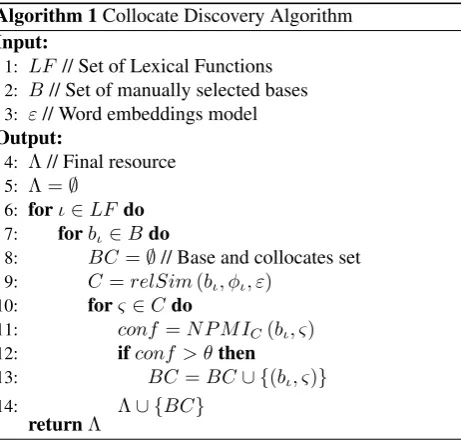
Our algorithm produces, for each LFι ∈LF, and a given basebι, a set BCof (bι, ςι)pairs, whereςι is a collocate
which has been retrieved from a corpus in two stages. In the first stage, the similarity between the relation thatςιholds
withbιand the relation held by the components of a
repre-sentative collocationφι(with the basebφι and the collocate
ςιφ) is computed. In the second stage, a filtering is applied,
3
based on the collocation-specific statistical independence metricN P M IC(Carlini et al., 2014).
Algorithm 1Collocate Discovery Algorithm
Input:
1: LF// Set of Lexical Functions
2: B// Set of manually selected bases
3: ε// Word embeddings model
Output:
Algorithm 1 outlines the two stages. The first stage (lines
4−9) consists, first, in retrieving a candidate set by means of the functionrelSim, which computes the similarity of the relation betweenbφ
ι andςιφ to the relation betweenbι
and a hidden word x. relSim can be thus interpreted as satisfying the well-known analogy “a is tob whatcis to x”, exploiting the vector space representation4ofa,b, andc
to discoverx(Zhila et al., 2013). Specifically, we compute vb−va+vcin order to obtain the set of vectors closest tovx
by cosine distance. To obtain the best collocate candidate set, we retrieve the ten most similar vectors to x, where xis the unknown collocate we aim to find. This is done over a model trained with word2vec5 on a 2014 dump of the Spanish Wikipedia, preprocessed and lemmatized with Freeling (Atserias et al., 2006).
The second stage (lines10−14) implements a filtering pro-cedure by applyingN P M IC, an association measure that
is based on pointwise mutual information, but takes into ac-count the asymmetry of the lexical dependencies between a base and its collocate. It is computed as:
N P M IC=
P M I(collocate, base) −log(p(collocate))
Following Carlini et al. (2014), we calculateN P M ICover
a 7M sentence corpus compiled from Spanish newspaper material, and set the association thresholdθto 0, such that all (bι,φι) collocation candidates belowθare discarded.
4.
Experiments
In what follows, we outline first the setup of our experi-ments and present then their outcome.
4.1.
Experimental Setup
For our experiments, we focus on eight of the most pro-ductive LFs in Spanish (see Table 1 for the list, along with
4
We denote the vector of a word asv, e.g.,va.
5
http://word2vec.googlecode.com/
LF Meaning Representative example
Magn ‘intense’ gran idea‘great idea’
AntiMagn ‘weak’ leve cambio‘slight change’
CausFunc0 ‘create’ crear[un]entorno‘create [an] environment’
LiquFunc0 ‘put an end’ romper[una]amistad‘break [a] friendship’
CausPredPlus ‘increase’ aumentar[el]precio‘increase [the] price
CausPredMinus ‘decrease’ disminuir[el]precio‘decrease [the] price
Bon ‘good’ d`ıa bueno‘good day’
Manif ‘show’ expresar afecto‘express affection’
Table 1: Seed examples for each LF
their meanings). As mentioned in Section 3., the algorithm requires a seed example as input to the acquisition of collo-cates of a given LF. Therefore, for each LF, we take a repre-sentative collocation, i.e., a collocation whose collocate has a general abstract meaning similar to that of the LF, such as crear[un]entorno‘create [an] environment’ for CausFunc0
(whose meaning is ‘cause that B begins to exist’, ‘create’), ordisminuir[el]precio‘reduce [the] price’ for CausPred-Minus (whose meaning is ‘decrease’. The seed examples that were chosen for each LF can be seen in Table 1. For each LF, 20 bases were selected for the use in the exper-iments. The retrieved candidates for each base and for each of the target LFs were tagged as correct or incorrect by an expert lexicographer, according to two criteria: (1) whether the candidate collocates with the base forming a correct col-location and, if criterium (1) is fullfilled, (2) whether the collocate correctly belongs to the particular LF.
4.2.
Outcome of the Experiments
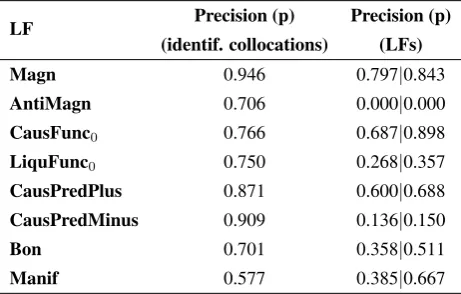
To assess the performance of our approach, we calculated its precision, taking into account: (1) the number of can-didates that correctly collocate with the base, and (2) the number of collocates that belong to the given LF. Tables 2 and 3 display the outcome of the experiments. Table 2 shows the number of collocate candidates obtained for each LF after the application of the N P M IC filter
(sec-ond column); the number of correct collocations formed by the given bases and the retrieved collocate candidates (third column), and the number of correctly typed retrieved col-locations with respect to each LF (fourth column). Table 3 shows the achieved precision during the identification of correct collocations and during the typification of the collo-cations calculated over all candidates of an LF from Table 2 (first value in the third column) and over the correctly identified collocations (second value in the third column). In what follows, we present a brief analysis of the results. Some of the collocates that were retrieved for each LF can be seen in Table 4.
5.
Discussion
LF Retrieved examples
Magn lluvia torrencial‘torrential rain’,viento huracanado‘hurricane-force winds’,
ruido ensordecedor‘deafening noise’,valor incalculable‘inestimable value’
CausFunc0
desatar[una]epidemia‘to spark [a] pandemic’,desencadenar[una]crisis‘to trigger [a] crisis’,
redactar[un]informe‘to draft [a] report’,promulgar[un]edicto‘to issue [an] edict
LiquFunc0
demoler[un]edificio‘to demolish [a] building’,apagar[un]fuego‘to extinguish [a] fire’,
resolver[un]problema‘to solve [a] problem’,anular[un]acuerdo‘to nullify [an] agreement’
CausPredPlus
mejorar[la]estabilidad‘to improve stability’,incrementar[la]cobertura‘to increase coverage’,
fortalecer[el]liderazgo‘to strengthen leadership’,
estimular[la]econom´ıa‘to stimulate [the] economy’
CausPredMinus minimizar[un]valor‘to minimize [a] value’,reducir[una]tasa‘to reduce [a] rate’,
reducir[un]salario‘to reduce [a] salary’,minimizar[un]coste‘to minimize costs’
Bon posici´on excelente‘excellent position’,carrera impecable‘impeccable career’
resultado satisfactorio‘satisfactory result’,forma perfecta‘perfect shape’
Manif manifestar[una]preocupaci´on‘to manifest [a] concern’,reflejar alegr´ıa‘to reflect joy’,
evidenciar[una]mejor´ıa‘to show improvement’
Table 4: Examples of correctly retrieved collocates for each LF
LF #candidates #collocations #correct LFs
Magn 74 70 59
AntiMagn 17 12 0
CausFunc0 64 49 44
LiquFunc0 56 42 15
CausPredPlus 70 61 42
CausPredMinus 44 40 6
Bon 67 47 24
Manif 26 15 10
Table 2: Number of collocations found for each LF
LF Precision (p)
(identif. collocations)
Precision (p)
(LFs)
Magn 0.946 0.797|0.843
AntiMagn 0.706 0.000|0.000
CausFunc0 0.766 0.687|0.898
LiquFunc0 0.750 0.268|0.357
CausPredPlus 0.871 0.600|0.688
CausPredMinus 0.909 0.136|0.150
Bon 0.701 0.358|0.511
Manif 0.577 0.385|0.667
Table 3: Performance of the acquisition and classification of collocations with respect to LFs
from their antonyms (as, e.g., m´ınimo‘minimal’). How-ever, the fact that starting fromgran idea‘great idea’ we obtained such Magn-collocations aslluvia torrencial ‘tor-rential rain’, viento huracanado ‘hurricane-force winds’,
ruido ensordecedor ‘deafening noise’ or valor incalcula-ble‘inestimable value’, etc. shows the potential of our ap-proach.
In the case of CausFunc0, several free combinations were
judged as collocations; cf., e.g., unificar [un] sistema‘to unify [a] system’ oridear[un]sistema‘to design [a] sys-tem’. Still, almost 70% of the obtained candidates are cor-rectly typified as CausFunc0; cf., e.g., desatar [una]
epi-demia‘to spark [a] pandemic’,desencadenar[una]crisis, ‘to trigger [a] crisis’, redactar [un] informe, ‘to draft [a] report’ orpromulgar[un]edicto, ‘to issue [an] edict’, etc. In the case of CausPredPlus, the system performs well when detecting collocations among all the possible word combinations retrieved in the first stage. Among the
col-locations with the correct meaning, we obtained
mejo-rar[la]estabilidad‘to improve stability’,incrementar[la] cobertura‘to increase coverage’,fortalecer[el]liderazgo ‘to strengthen leadership’, and estimular, reactivar [la] econom´ıa‘to stimulate, revive [the] economy’. However, the number of collocates that do not convey the target meaning is considerably higher for CausPredPlus. Unsur-prisingly, most of them convey exactly the opposite mean-ing (‘decrease’), which can be easily explained by the se-mantic similarity that antonyms show when represented by word embeddings.
As with CausFunc0, with Bon and Manif, a handful of free
the approach: that the chosen seed example is not suffi-ciently common or general, and therefore not representative enough for the LF, or that these LFs present a wider mean-ing, and are thus more difficult to attain. Further research is needed to assess these issues.
Finally, as far as AntiMagn, LiquFunc0and
CausPredMi-nus, whose meanings are opposite to Magn, CausFunc0and
CausPredPlus, respectively, are concerned, the number of candidates retrieved by the system that are correct collo-cates remains high. However, the precision of the classi-fication with respect to the target LFs drops significantly when compared to theirpositivecounterparts. This occurs because, as stated above, word embeddings fail to distin-guish between antonyms, considering words with opposite meanings as actual synonyms. Most of the collocates found for AntiMagn, LiquFunc0 and CausPredMinus are correct
instances of Magn, CausFunc0and CausPredPlus. For
in-stance, we obtainedluz cegadora‘blinding light’ andda˜no severo ‘severe damage’ for AntiMagn; levantar[un] edi-ficio‘to erect a building’ andencender[un]fuego‘to light [a] fire’ were found for LiquFunc0; and for CausPredMinus
cases such asincrementar[un]salario‘to increase wages’ oraumentar[el]valor‘to increase [a] value’ were obtained.
6.
Conclusions
We presented a language-independent approach to auto-matic acquisition and fine-grained semantic classification of collocation resources with respect to Lexical Functions. Such resources are crucial for second language learning as well as for computational applications related to language production, e.g., natural language generation (Smadja and McKeown, 1990; Wanner, 1992) or machine translation (Mel’ˇcuk and Wanner, 2001). Although there has been a large body of work on automatic retrieval of collocations (Choueka, 1988; Church and Hanks, 1989; Smadja, 1993; Kilgarriff, 2006; Evert, 2007; Pecina, 2008; Bouma, 2010), and also some works on the semantic classification of col-locations (Wanner et al., 2006; Gelbukh and Kolesnikova., 2012; Moreno et al., 2013; Wanner et al., in print), to the best of our knowledge, this is the first proposal to retrieve and classify collocations simultaneously in an unsuper-vised manner. In our future work, we will aim to improve the precision of the classification procedure with respect to the “difficult” LFs such as AntiMagn,CausPredMinus, LiquFunc0, etc.
7.
Acknowledgements
The present work has been partially funded by the Span-ish Ministry of Economy and Competitiveness (MINECO), through a predoctoral grant (BES-2012-057036) in the framework of the project HARenES (FFI2011-30219-C02-02), by the European Commission under the contract num-ber H2020-RIA-645012, and by the ICT PhD program of Universitat Pompeu Fabra through a travel grant.
8.
Bibliographical References
Alonso Ramos, M., Wanner, L., Vincze, O., Casamayor, G., V´azquez, N., Mosqueira, E., and Prieto, S. (2010). Towards a Motivated Annotation Schema of Collocation
Errors in Learner Corpora. In Proceedings of the 7th International Conference on Language Resources and Evaluation (LREC), pages 3209–3214.
Atserias, J., Casas, B., Comelles, E., Gonz´alez, M., Padr´o, L., and Padr´o, M. (2006). Freeling 1.3: Syntactic and semantic services in an open-source nlp library. In Pro-ceedings of LREC, pages 48–55.
Bahns, J. and Eldaw, M. (1993). Should we teach EFL students collocations? System, 21(1):101–114.
Bengio, Y., Schwenk, H., Sen´ecal, J.-S., Morin, F., and Gauvain, J.-L. (2006). Neural probabilistic language
models. In Innovations in Machine Learning, pages
137–186. Springer.
Benson, M., Benson, E., and Ilson, R. (2010). The BBI
Combinatory Dictionary of English: Your guide to col-locations and grammar, Third Edition. Benjamins Aca-demic Publishers, Amsterdam.
Bordes, A., Weston, J., Collobert, R., and Bengio, Y. (2011). Learning structured embeddings of knowledge bases. InAAAI.
Bouma, G. (2010). Collocation extraction beyond the
independence assumption. In Proceedings of the ACL
2010, Short paper track, Uppsala.
Carlini, R., Codina-Filba, J., and Wanner, L. (2014). Improving Collocation Correction by ranking sugges-tions using linguistic knowledge. InProceedings of the 3rd Workshop on NLP for Computer-Assisted Language Learning, Uppsala, Sweden.
Choueka, Y. (1988). Looking for needles in a haystack or locating interesting collocational expressions in large textual databases. InProceedings of the RIAO, pages 34– 38.
Chung-Chi, H., Kao, K. H., Tseng, C. H., and Chang, J. S. (2009). A thesaurus-based semantic classification of En-glish collocations. Computational Linguistics and Chi-nese Language Processing, 14(3):257–280.
Church, K. and Hanks, P. (1989). Word Association Norms, Mutual Information, and Lexicography. In Pro-ceedings of the 27th Annual Meeting of the ACL, pages 76–83.
Cowie, A. (1994). Phraseology. In R.E. Asher et al., edi-tors,The Encyclopedia of Language and Linguistics, Vol. 6, pages 3168–3171. Pergamon, Oxford.
Espinosa-Anke, L., Saggion, H., Ronzano, F., and Navigli, R. (2016). Extasem! extending, taxonomizing and se-mantifying domain terminologies. InAAAI.
Evert, S. (2007). Corpora and collocations. In A. L¨udeling et al., editors, Corpus Linguistics. An International Handbook. Mouton de Gruyter, Berlin.
Fu, R., Guo, J., Qin, B., Che, W., Wang, H., and Liu, T. (2014). Learning semantic hierarchies via word embed-dings. InACL (1), pages 1199–1209.
Gelbukh, A. and Kolesnikova., O. (2012). Semantic
Analysis of Verbal Collocations with Lexical Functions. Springer, Heidelberg.
Granger, S. (1998). Prefabricated patterns in advanced EFL writing: Collocations and Formulae. In A. Cowie, editor,Phraseology: Theory, Analysis and Applications, pages 145–160. Oxford University Press, Oxford. Hausmann, F.-J. (1984). Wortschatzlernen ist
Kolloka-tionslernen. Zum Lehren und Lernen franz¨osischer
Wortwendungen. Praxis des neusprachlichen
Unter-richts, 31(1):395–406.
Iacobacci, I., Pilehvar, M. T., and Navigli, R. (2015). Sensembed: learning sense embeddings for word and relational similarity. InProceedings of ACL, pages 95– 105.
Kahane, S. and Polgu`ere, A. (2001). Formal foundation of lexical functions. InProceedings of the ACL ’01 Work-shop COLLOCATION: Computational Extraction, Anal-ysis and Exploitation.
Kilgarriff, A. (2006). Collocationality (and how to mea-sure it). InProceedings of the 12th EURALEX Interna-tional Congress.
Lewis, M. and Conzett, J. (2000). Teaching Collocation. Further Developments in the Lexical Approach. LTP, London.
Lin, Y., Liu, Z., Sun, M., Liu, Y., and Zhu, X. (2015). Learning entity and relation embeddings for knowledge graph completion. InAAAI, pages 2181–2187.
Mel’ˇcuk, I. and Polgu`ere, A. (2007). Lexique actif du franc¸ais. de boeck, Brussels.
Mel’ˇcuk, I. and Wanner, L. (2001). Towards a lexico-graphic approach to lexical transfer in machine trans-lation (illustrated by the german-russian language pair). Machine Translation, 16(1):21–87.
Mel’ˇcuk, I. (1995). Phrasemes in Language and Phrase-ology in Linguistics. In M. Everaert, et al., editors, Id-ioms: Structural and Psychological Perspectives, pages 167–232. Lawrence Erlbaum Associates, Hillsdale. Mel’ˇcuk, I. (1996). Lexical functions: a tool for the
de-scription of lexical relations in a lexicon. Lexical func-tions in lexicography and natural language processing, 31:37–102.
Mikolov, T., Yih, W.-T., and Zweig, G. (2013a). Linguistic regularities in continuous space word representations. In HLT-NAACL, pages 746–751.
Mikolov, T., Le, Q. V., and Sutskever, I. (2013b). Ex-ploiting similarities among languages for machine trans-lation.CoRR, abs/1309.4168.
Mikolov, T., Sutskever, I., Chen, K., Corrado, G. S., and Dean, J. (2013c). Distributed representations of words
and phrases and their compositionality. In Advances
in neural information processing systems, pages 3111– 3119.
Moreno, P., Ferraro, G., , and Wanner, L. (2013). Can we determine the semantics of collocations without using
se-mantics? In I. Kosem, et al., editors,Proceedings of the eLex 2013 conference.
Nesselhauf, N. (2005). Collocations in a Learner Corpus. Benjamins Academic Publishers, Amsterdam.
Pecina, P. (2008). A machine learning approach to multi-word expression extraction. InProceedings of the LREC 2008 Workshop Towards a Shared Task for Multiword Expressions (MWE 2008), pages 54–57.
Smadja, F. and McKeown, K. (1990). Automatically ex-tracting and representing collocations for language gen-eration. InProceedings of the Annual ACL Conference, pages 252–259.
Smadja, F. (1993). Retrieving collocations from text: X-tract. Computational Linguistics, 19(1):143–177. Wanner, L., Bohnet, B., and Giereth, M. (2006). Making
sense of collocations. Computer Speech and Language, 20(4):609–624.
Wanner, L., Ferraro, G., and Moreno, P. (in print). Towards distributional semantics-based classification of colloca-tions for collocation dictionaries. International Journal of Lexicography.
Wanner, L. (1992). Lexical choice and the organization of lexical resources in text generation. In Proceedings of the European Conference on Artificial Intelligence. Zhila, A., Yih, W.-T., Meek, C., Zweig, G., and Mikolov, T.