TimeML Events Recognition and Classification:
Learning CRF Models with Semantic Roles
Hector Llorens, Estela Saquete, Borja Navarro-Colorado
Natural Language Processing Group University of Alicante
{hllorens,stela,borja}@dlsi.ua.es
Abstract
This paper analyzes the contribution of se-mantic roles to TimeML event recognition and classification. For that purpose, an approach using conditional random fields with a variety of morphosyntactic features plus semantic roles features is developed and evaluated. Our system achieves an F1 of 81.4% in recognition and a 64.2% in classification. We demonstrate that the application of semantic roles improves the performance of the presented system, es-pecially for nominal events.
1 Introduction
Event recognition and classification has been pointed out to be very important to improve com-plex natural language processing (NLP) applica-tions such as automatic summarization (Daniel et al., 2003) and question answering (QA) (Puste-jovsky, 2002). Natural language (NL) texts often describe sequences of events in a time line. In the context of summarization, extracting such events may aid in obtaining better summaries when these have to be focused on specific happenings. In the same manner, the access to such information is crucial for QA systems attempting to address questions about events.
The analysis of events as well as the classifica-tion of the different forms they adopt in NL text is not a new issue (Vendler, 1967). It relates not only to linguistics but different scientific areas such as philosophy, psychology, etc.
In NLP, different definitions of event can be found regarding the target application.
On the one hand, in topic detection and track-ing (Allan, 2002), event is defined as an instance of a topic identified at document level describing something that happen (e.g., “wars”). The aim of
this task is to cluster documents on the same topic, that is to say, the same event.
On the other hand, information extraction (IE) provides finer granularity event definitions. IE proposes standard schemes to annotate the indi-vidual events within the scope of a document. STAG scheme (2000) was aimed to identify events in news and their relationship with points in a tem-poral line. More recently, TimeML (Pustejovsky et al., 2003a) presented a rich specification for an-notating events in NL text extending the features of the previous one.
This paper is focused on the TimeML view of events. TimeML defines events as situations that happen or occur, or elements describing states or circumstances in which something obtains or holds the truth. These events are generally ex-pressed by tensed or untensed verbs, nominaliza-tions, adjectives, predicative clauses or preposi-tional phrases. TimeML guidelines define seven classes of events:
• Reporting. Action of a person or organization
declar-ing or narratdeclar-ing an event (e.g., “say”)
• Perception. Physical perception of another event (e.g.,
“see”, “hear”)
• Aspectual. Aspectual predication of another event (e.g., “start”, “continue”)
• I Action. Intensional action (e.g., “try”)
• I State. Intensional state (e.g., “feel”, “hope”)
• State. Circumstance in which something holds the truth (e.g., “war”, “in danger”)
• Occurrence. Events that describe things that happen
(e.g., “erupt”, “arrive”)
The following sentence shows an example of an occurrence event and a state event.
The automatic annotation of events has been addressed with different data-driven approaches. Current approaches are mainly based on mor-phosyntactic information. Our hypothesis is that semantic roles, as higher language level analysis information, may be useful as additional feature to improve the performance of such approaches.
Within this setting, the main objective of this paper is to analyze (1) the contribution of seman-tic roles, as additional feature, and (2) the influ-ence of conditional random fields (CRFs), as ma-chine learning (ML) technique, in the events auto-matic recognition and classification task.
This paper is structured as follows. Firstly, related work in the task is reviewed in Section 2. The next section provides a detailed descrip-tion of our proposal to address event recognidescrip-tion and classification. After that, Section 4 includes an evaluation of the proposal, and a comparative analysis of the results. Finally, conclusions are drawn in Section 5.
2 Related Work
There is only one corpus available annotated with TimeML events: TimeBank (Pustejovsky et al., 2003b). Hence, all the approaches regarding TimeML events extraction have been evaluated using this corpus.
EVITA system (Saur´ı et al., 2005) recognizes events by combining linguistic and statistical tech-niques. The main features used to manually encode event recognition rules are the follow-ing: part-of-speech (PoS) tagging, lemmatizing, chunking, lexical lookup and contextual pars-ing. Furthermore, WordNet information com-bined with Bayesian learned disambiguation was used to identify nominal events. EVITA obtained 74.03% precision, 87.31% recall, and 80.12% Fβ=1in event recognition over TimeBank.
Boguraev and Ando (2005) present an evalu-ation on automatic TimeML events annotevalu-ation. They set out the task as a classification prob-lem and used a robust risk minimization (RRM) classifier to solve it. The Fβ=1 results obtained by a 5-fold cross validation over TimeBank were 78.6% for recognition and 61.3% for classifica-tion. Moreover, they evaluated the impact of plying word-profiling techniques over their
ap-proach to exploit unannotated data. Using this ad-ditional information, the Fβ=1results improved to 80.3% and 64.0%. In this evaluation, neither pre-cision nor recall were given.
STEP (Bethard and Martin, 2006) is a system for TimeML event recognition and classification. This approach uses a rich set of textual, morpho-logical, dependency and WordNet hypernymy fea-tures to build a Support Vector Machine (SVM) model. The model was trained using 9/10 of the TimeBank. The test, carried out using the remain-ing 1/10 of the corpus, obtained a 82.0% preci-sion, 70.6% recall and 75.9% Fβ=1for recognition and a 66.7% precision, 51.2% recall and 57.9% Fβ=1for classification.
Finally, March and Baldwin (2008) present an evaluation on event recognition using a multi-class multi-classifier (BSVM). The main features used to train the classifier are word and PoS context window, stop words removal and feature general-ization through words grouping (numbers, named entities, etc.). The result for the best feature com-bination in a 10-fold cross validation over Time-Bank was 76.4% Fβ=1.
It is worth mentioning that there are two ver-sions of the TimeBank corpus, 1.1 and 1.2. The latest version is the current gold standard. Both versions consist of the same documents1, mainly
news articles and transcribed broadcast news from different domains. EVITA is the only reference which used TimeBank 1.2 while the rest of re-viewed references used TimeBank 1.1.
3 Our proposal: semantic roles
enhancing a CRF model
In this section, the motivation for our proposal, and our specific approach are presented.
3.1 Motivation
The next two subsections describe the main feature (semantic roles) and the ML algorithm (CRFs) we selected to address event recognition and classification; and the reasons why we think they could be useful in that task.
1
3.1.1 Semantic roles
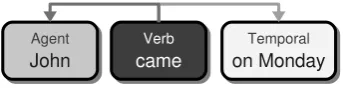
[image:3.595.95.267.245.289.2]Semantic role labeling (SRL) has achieved im-portant results in the last years (Gildea and Juraf-sky, 2002). For each predicate in a sentence, se-mantic roles identify all constituents, determining their arguments (agent, patient, etc.) and their ad-juncts (locative, temporal, etc.). Currently, there exist different role sets aimed to cover opposed re-quirements. They range from more specific, such as FrameNet (Baker et al., 1998), to more general like PropBank (Palmer et al., 2005). Figure 1 il-lustrates a semantic role labeled sentence.
Figure 1: Semantic roles example
Many research efforts into the application of se-mantic roles demonstrated that this information is useful for different NLP purposes (Melli et al., 2006). Focusing on TimeML, semantic roles have been applied to temporal expressions recognition (Llorens et al., 2009), and temporal links classi-fication (Hag`ege and Tannier, 2007). However, they have not been used to recognize and classify TimeML events.
Semantic roles provide structural relations of the predicates in which events may participate. Beyond syntactic relations expressed by means of the different types of phrases, semantic roles give further information about semantic relations be-tween the arguments of a predicate. Therefore, as richer information, roles may better distinguish tokens to be candidate events. In addition, differ-ent semantic role settings may represdiffer-ent specific event classes.
Example 1 shows four sentences annotated with PropBank semantic roles (in square brackets) in which the noun “control” participates. In the sen-tences 1 and 2, “control” does not represent an event, while in the sentences 3 and 4, it repre-sents an state event. It can be seen that the noun “control”, when it is contained by A1 role it may represent an event. However, it is not an event when contained by A0 or AM-MNR roles. The analysis may also take into account the governing
verb. In the example, we could specify that “con-trol” represents an event when contained by A1 role of “seek” and “obtain” verbs; and the oppo-site for the A0 role of “emerge” and the AM-MNR of “had”.
(1) 1. “[Control procedures A0] will emerge”
2. “[Iraq A0] had [thousands of Americans A1] [under its control AM-MNR]”
3. “[Crane Co. A0] may obtain [control of Milton Roy Corp. A1]”
4. “[Pattison’s A0] decided to seek [control A1]”
Our hypothesis is that semantic roles, as ad-ditional information, may help in the recogni-tion and classificarecogni-tion of events. The informarecogni-tion about the role of a token and the verb it depends on, or the set of roles of the sentence, could be useful for determining whether a token or a se-quence of tokens is an event or not. Due to the fact that roles represent high level information in NL text, they are more independent from word to-kens. Hence, roles may aid in learning more gen-eral models that could improve the results of ap-proaches focused on lower level information.
3.1.2 CRF probabilistic model
Conditional Random Fields is a popular and ef-ficient ML technique for supervised sequence la-beling (Lafferty et al., 2001). CRFs are undirected graphical models, a special case of conditionally-trained finite state machines. A key advantage of CRFs is their flexibility to include a wide variety of arbitrary, non-independent features of the input. We see the task set out in this paper as a se-quence labeling problem. AssumeXis a random variable over data sequences to be labeled, andY
is a random variable over the corresponding label sequences (hidden), being allY components (Yi) members of a finite label alphabet γ. X might range over NL sentences and Y range over event annotations of those sentences, withγ the set of possible event IOB22 labels. The following ex-ample illustrates the event recognition problem.
(2) X Y
was ?
another ? B-EVENT
bad ? ? = I-EVENT
week ? O
2
The variablesX and Y are jointly distributed over both label and observation sequences. How-ever, unlike Hidden Markov Models (generative) in which p(X, Y), CRFs (discriminative) con-struct a conditional model from paired observa-tion and label sequences: p(Y|X). Graphically, CRFs are represented by undirected graphs,G = (V, E) such that Y = (Yv), v V, so that Y is indexed by the vertices of G. Then (X, Y) is a conditional random field ifYv variables obey the Markov property with respect to the graph when conditioned onX:
P(Yv|X, Yw, v=w) =P(Yv|X, Yw, v ∼w), wherev∼wmeans thatYvandYware connected neighbors inG.
To extend the problem to event classification, the alphabet γ must be extended with the event classes (state, aspectual, etc.).
CRFs have been successfully applied to many sequence labeling tasks (Sha and Pereira, 2003; McCallum and Li, 2003).
From our point of view, the task addressed in this paper is well suited for this ML technique. Events may depend on structural properties of NL sentences. Not only the word sequence, but mor-phological, syntactic and semantic information is related with the event structure (Tenny and Puste-jovsky, 2000).
For example, sequences of verbs may represent i action+occurrence or aspectual+occurrence events (see Example 3).
(3) “The president will <EVENT class="i action"> try </EVENT> to <EVENT class="occurrence"> assist </EVENT> to the <EVENT class="occurrence"> conference </EVENT>”
“Saddam will <EVENT class="aspectual"> begin </EVENT> <EVENT class="occurrence"> withdrawing </EVENT>troops from Iranian territory on Friday”
In addition, for instance, many state event in-stances are represented by “to be” plus a variable quality (see Example 4).
(4) “It is <EVENT class="occurrence"> turning </EVENT> out to be another <EVENT class="state"> bad </EVENT>financial week.”
Given this analysis, our hypothesis is that CRFs will be useful in the recognition of events in which the sequential and structural properties are rele-vant.
3.2 Approach description
This paper proposes CRFs as learning method to infer an event recognition and classification model. Our system includes CRF++ toolkit3 for
training and testing our approach. The learning process was done using CRF-L2 algorithm and hyper-parameterC=1.
The definition of the features is crucial for the architecture of the system. The features used in our approach are grouped in two feature sets. On the one hand, general features, which comprise morphosyntactic and ontological information. On the other hand, semantic roles features, which are the main focus of this paper.
The general features used to train our CRF model are described regarding each language analysis level.
• Morphological: The lemma and PoS
con-text, in a 5-window (-2,+2), was employed. This basic linguistic feature showed good re-sults in different NLP tasks, as well as in event recognition and classification (March and Baldwin, 2008). Tokenization, PoS and lemmatization were obtained using TreeTag-ger (Schmid, 1994).
• Syntactic: Different events are contained in
particular types of phrases and syntactic de-pendencies. This feature tries to tackle this by considering syntactic information. Char-niak parser (CharChar-niak and Johnson, 2005) was used to obtain the syntactic tree.
• Lexical semantics: WordNet (Fellbaum, 1998) top ontology classes have been widely used to represent word meaning at ontologi-cal level, and demonstrated its worth in many tasks. We obtained the four top classes for each word.
The specific semantic roles features used to en-hance the training framework of the CRF model were developed considering PropBank role set. PropBank was applied in our system due to the high coverage it offers in contrast to FrameNet. In order to get PropBank semantic roles, the CCG
3
SRL tool (Punyakanok et al., 2004) was used for labeling the corpus.
• Role: For each token, we considered the role
regarding the verb the token depends on. Se-mantic roles information may be useful for distinguish particular lemmas that are events only when appearing under a precise role.
• Governing verb: The verb to which the
cur-rent token holds a particular role. This may distinguish tokens appearing under the influ-ence of different verbs.
• Role+verb combination: The previous two
features were combined to capture the rela-tion between them. This introduces new clas-sification information by distinguishing roles depending on different verbs. The impor-tance of this falls especially on the numbered roles of PropBank (A0, A1, ...) holding dif-ferent meanings when depending on difdif-ferent verbs.
• Role configuration: This consists of the set
of roles depending on the verb the token de-pends on. This may be particularly useful for distinguish different sentence settings and thus, whether a token denotes an event in a particular sentence type.
The system consists of two main processes. Firstly, given TimeML annotated text, it obtains the defined features plus the IOB2 tags of the an-notated events. Then, using this data the system learns (trains) a model for event recognition and a model for event classification. Secondly, given plain text, it automatically gets the defined fea-tures using the described tools. With this data, the system applies the learned models to recog-nize and classify TimeML events.
4 Evaluation
In this section, firstly, the corpus, criteria and mea-sures are defined. Secondly, the results obtained by our approach are presented. After that, the con-tribution of our approach is measured through dif-ferent experiments: (1) general contribution, (2) semantic roles contribution, and (3) CRFs contri-bution. And finally, our approach is compared to the state of the art systems.
4.1 Corpus, criteria and measures
For the evaluation, the TimeBank 1.2 corpus (7881 events) was used without modification. All the results reported in this evaluation were ob-tained using a 5-fold cross validation. The n-fold train-test sets were built sorting the corpus files alphabetically and then sequentially select each set regarding the documents size. It is important to highlight the latter because if the n-folds were made regarding the number of documents, the sets had not been homogeneous due to the differences in TimeBank document sizes.
Only annotations matching the exact event span were considered as correct in recognition and classification, requiring also the class matching in the second case.
The following measures were used to score the evaluated approaches.
• Precision total approach annotationscorrect annotations
• Recall total corpus annotationscorrect annotation
• Fβ=1 2precision∗precision+∗recallrecall
4.2 Our approach results
Table 1 shows the results obtained by our ap-proach for both recognition and classification of events. The last column (BF) indicates the best Fβ=1results obtained in the individual folds.
Precision Recall Fβ=1 BF
Recognition 83.43 79.54 81.40 82.43
Classification 68.84 60.15 64.20 69.68
Table 1: Our approach (CRF+Roles) results
The results show a high Fβ=1 score in both recognition and classification, showing a good balance between precision and recall. This indi-cates that our approach is appropriate to address this task.
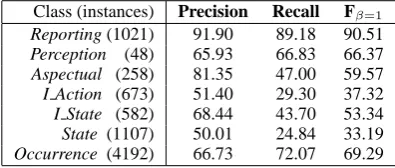
Focusing on classification task, Table 2 shows the detailed scores for each event class.
Class (instances) Precision Recall Fβ=1 Reporting (1021) 91.90 89.18 90.51
Perception (48) 65.93 66.83 66.37
Aspectual (258) 81.35 47.00 59.57
I Action (673) 51.40 29.30 37.32
I State (582) 68.44 43.70 53.34
State (1107) 50.01 24.84 33.19
[image:6.595.81.279.71.155.2]Occurrence (4192) 66.73 72.07 69.29
Table 2: CRF+Roles 5-fold detailed results
Although perception and aspectual are quite re-stricted to some lemmas, they obtained results be-low reporting. This is due to the fact that Time-Bank contains very few examples of these classes. I action and state show poorer results. In the case of the former, this is because some non-intensional verbs (e.g., “look”) appear in the cor-pus as i action under certain conditions, for exam-ple, when there is modality or these verbs appear in conditional sentences. This suggests the neces-sity of incorporating a word sense disambiguation (WSD) technique. Our approach did not take into account this information and thus the results are lower for this event class. In the case of state, the reasons for the low performance are the richness of this event class by means of lemmas, PoS, and phrases.
Finally, Table 3 shows the results of our ap-proach by word class.
Precision Recall Fβ=1 Verb 91.56 92.15 91.33 Recognition Noun 72.67 48.26 58.42
Adj. 66.78 38.09 48.35
Verb 73.86 74.21 73.51 Classification Noun 62.73 41.33 49.53
Adj. 55.69 31.12 40.41
Table 3: CRF+Roles 5-fold word class results
It may be seen that the best results in both recognition and classification are obtained in verb events, followed by noun and adjective.
4.3 Contribution analysis
This subsection details the contribution of each as-pect of our approach through three comparative experiments.
First experiment: general contribution
This experiment measures the general
contribu-tion of our approach by comparing its results with a baseline. TimeBank was analyzed to find a ba-sic general rule to annotate events. The events are mainly denoted by verbs, pertaining to occurrence class. Hence, we propose a baseline that annotates all verbs as occurrence events. Table 4 shows re-sults obtained by this baseline for both recognition and classification of events.
Prec. Recall Fβ=1
Our approach Recog. 83.43 79.54 81.40
Class. 68.84 60.15 64.20 Baseline Recog. 72.50 65.20 68.60
Class. 46.01 53.19 49.34
Table 4: Our approach vs Baseline results
Given the simplicity of the baseline, the results obtained are quite high. However, our approach Fβ=1 significantly improves baseline by 19% for recognition and 30% for classification.
Second experiment: roles contribution
The main objective of this paper is to determine the impact of semantic roles in this task. To quan-tify it, a non-roles version of our approach was evaluated. This version only uses the general fea-tures described in section 3. Table 5 shows the results obtained.
Precision Recall Fβ=1
Our approach Recog. 83.43 79.54 81.40
Class. 68.84 60.15 64.20
Non-roles Recog. 82.96 74.81 78.67
Class. 67.53 54.80 60.50
Table 5: Our approach vs Non-roles results
Comparing these results with the ones obtained by our full featured approach, the application of roles improved especially the recall. Specifi-cally, recall improved by 6% and 10% for recog-nition and classification respectively. The main improvement was achieved by state and occur-rence classes (60% of the total improvement), es-pecially, nominal events of that classes that con-centrate around the 70% of the total contribution.
non-roles. In the examples, the TimeML events annotation and below the semantic roles annota-tion is reported.
(5) “There are still few buyers and the mood is <EVENT class=STATE>gloomy</EVENT>”
“[ThereA0] are [stillAM-TMP] [few buyersA1] and [the moodA0] is [gloomyAM-MNR]”
“Security is now<EVENT>better</EVENT>” “[SecurityA0] is [nowAM-TMP] [betterAM-MNR]”
In these cases,AM-MNRrole information lead to a correct state event recognition.
Third experiment: CRFs contribution
In order to measure the CRFs contribution to this task, an extra experiment was carried out. This consisted of comparing, under the same setting, CRFs with a popular learning technique: support vector machines (SVM). As in Bethard and Mar-tin (2006), YamCha4software was used (parame-ters: C=1 and polynomial degree=2).
Table 6 shows the results obtained by the SVM-based approach in recognition and Table 7 reports the improvement (CRFs over SVM) distribution in the different word classes.
Precision Recall Fβ=1 Our approach (CRF) 83.43 79.54 81.40
SVM 80.00 75.10 77.40
Table 6: Our approach (CRF) vs SVM results
Verb Noun Adj. Adv. Prep.
General 22% 71% 5% 1% 1%
Table 7: CRF improvement distribution among the word classes
These results verify that CRF improves SVM Fβ=1 by 5% in this task. Furthermore, especially noun events take advantage of using CRF.
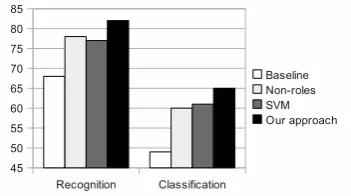
Finally, Figure 2 illustrates the results of our ap-proach over the described experiments.
4.4 Comparison with the state of the art
Most systems found in the literature are data-driven approaches using morphosyntactic fea-tures. SVM based approaches (Bethard and Mar-tin, 2006; March and Baldwin, 2008) achieved,
4
[image:7.595.326.502.72.170.2]http://chasen.org/˜taku/software/YamCha/
Figure 2: Fβ=1Results
approximately, 76% and 58% Fβ=1 in event recognition and classification respectively. Bogu-raev and Ando (2005) used a robust risk mini-mization classifier to address this task and ob-tained 78.6% and 61% (without exploiting unan-notated data). These results are very similar to the ones obtained by our non-roles approach. This suggests that using, apart from morphosyntactic features, additional features based on semantic roles could improve the approaches.
EVITA system (Saur´ı et al., 2005) combines linguistic and statistical techniques. On the one hand, it consists of a set of manually encoded rules based on morphosyntactic information. On the other hand, it includes a Bayesian learned disam-biguation module to identify nominal events. The later was trained and tested using the whole cor-pus, therefore, the results could be inflated by this fact. For that reason, Bethard and Martin (2006) presented an EVITA implementation (Sim-Evita) to compare the results. Sim-Evita obtains an 73% and 51% Fβ=1in event recognition and classifica-tion respectively. These results suggest that data-driven improve rule-based approaches.
recog-nize unseen nominal event instances as long as they share, with the seen instances, some semantic roles features.
5 Conclusions and Further Work
This paper presented an approach for the recogni-tion and classificarecogni-tion of TimeML events consist-ing of a CRF model learned usconsist-ing semantic roles as main feature. In addition to morphosyntactic features, the model was enhanced including ex-tra semantic information, semantic role labeling, used for other applications with satisfactory re-sults, but never employed before for this purpose. Our proposal was evaluated using the gold stan-dard corpus, TimeBank 1.2, and the results ob-tained were analyzed and compared to measure the impact of both semantic roles and CRFs in the described task.
The obtained Fβ=1 results demonstrated that semantic roles are useful to recognize (81.43%) and classify (64.20%) TimeML events, improv-ing the presented baseline by 19% for recogni-tion and 30% for classificarecogni-tion. Specifically, Se-mantic roles employed as additional feature im-proved the recall of the non-roles version by 6% and 10% for recognition and classification respec-tively. This indicates that roles features led to more general models capable of better annotat-ing unseen instances. The roles contribution was more significant in state and occurrence classes of noun events, concentrating around the 70% of the improvement.
Furthermore, it was verified that CRFs achieve higher results than models learned using other ML techniques such as SVM (5% improvement), contributing especially to nominal events. This demonstrated that CRF models are appropriate to face the task.
Finally, to the extent our results are compara-ble to state of the art evaluations, ours outper-form the Fβ=1scores in both recognition and clas-sification. Especially, our approach showed bet-ter performance than related works in state (32% improvement) and nominal events (44% improve-ment). Hence, the extension of the current ap-proaches with semantic roles features could bene-fit their performance.
The main difficulties found in the task
ad-dressed in this paper are related to i action and state events. In the former, we detected that modality and the word senses are important and must be treated to distinguish such events. In the later, although they were improved by our approach, state events are still the most com-plex class of events due to their richness in con-trast to the reduced size of the training data. We agree with related literature that event classifi-cation results are still below other tasks perfor-mance, which indicates that this task is inherently complex and more training data may lead to sig-nificant improvements.
As further work we propose, firstly, improv-ing the i action results by takimprov-ing into account the modality considering the AM-MOD role, and the word senses using a WSD technique. Secondly, the application of FrameNet role set (finer granu-larity) to determine which kind of roles are better to improve the current event annotation systems.
Acknowledgments
This paper has been supported by the Spanish Government, projects TIN-2006-15265-C06-01, TIN-2009-13391-C04-01 and PROMETEO/2009/119, where Hector Llorens is funded (BES-2007-16256).
References
Allan, James. 2002. Topic Detection and Tracking: Event-Based Information Organization. Kluwer Academic Publishers, Norwell, MA, USA.
Baker, Collin F., Charles J. Fillmore, and John B. Lowe. 1998. The Berkeley FrameNet Project. In COLING-ACL, pages 86–90.
Bethard, Steven and James H. Martin. 2006. Identi-fication of event mentions and their semantic class. In EMNLP: Proceedings of the Conference on Em-pirical Methods in NLP, pages 146–154. ACL.
Boguraev, Branimir and Rie Kubota Ando. 2005. Ef-fective Use of TimeBank for TimeML Analysis. In Annotating, Extracting and Reasoning about Time and Events 05151.
Charniak, Eugene and Mark Johnson. 2005. Coarse-to-fine n-best parsing and maxent discriminative reranking. In 43rd Annual Meeting of the ACL.
summariza-tion. In HLT-NAACL Text summarization workshop, pages 9–16. ACL.
Fellbaum, Christiane. 1998. WordNet: An Electronic Lexical Database (Language, Speech, and Commu-nication). MIT Press.
Gildea, Daniel and Daniel Jurafsky. 2002. Automatic labeling of semantic roles. Computational Linguis-tics, 28(3):245–288.
Hag`ege, Caroline and Xavier Tannier. 2007. XRCE-T: XIP temporal module for TempEval campaign. In TempEval (SemEval), pages 492–495, Prague, Czech Republic. ACL.
Lafferty, John D., Andrew McCallum, and Fernando C. N. Pereira. 2001. Conditional random fields: Probabilistic models for segmenting and labeling sequence data. In Proceedings of the 18th ICML, pages 282–289. Morgan Kaufmann.
Llorens, Hector, Borja Navarro, and Estela Saquete. 2009. Using Semantic Networks to Identify
Tem-poral Expressions from Semantic Roles. In VI
RANLP, pages 219–224.
March, Olivia and Timothy Baldwin. 2008. Auto-matic event reference identification. In ALTA 2008, pages 79–87, Australia.
McCallum, Andrew and Wei Li. 2003. Early results for named entity recognition with conditional ran-dom fields, feature induction and web-enhanced lex-icons. In HLT-NAACL, pages 188–191.
Melli, G., Y. Liu Z. Shi, Y. Wang, and F. Popowich. 2006. Description of SQUASH, the SFU Question Answering Summary Handler for the DUC-2006 Summarization Task. In DUC.
Palmer, Martha, Daniel Gildea, and Paul Kingsbury. 2005. The Proposition Bank: An Annotated Corpus of Semantic Roles. Computational Linguistics, 31.
Punyakanok, Vasin, Dan Roth, W. Yih, D. Zimak, and Y. Tu. 2004. Semantic role labeling via generalized inference over classifiers. In HLT-NAACL (CoNLL), pages 130–133. ACL.
Pustejovsky, James, Jos´e M. Casta˜no, Robert Ingria, Roser Saur´ı, Robert Gaizauskas, Andrea Setzer, and Graham Katz. 2003a. TimeML: Robust Specifica-tion of Event and Temporal Expressions in Text. In IWCS-5.
Pustejovsky, James, Patrik Hanks, Roser Saur´ı, A. See, Robert Gaizauskas, Andrea Setzer, Dragomir R. Radev, Beth Sundheim, David Day, Lisa Ferro, and M. Lazo. 2003b. The TIMEBANK Corpus. In Cor-pus Linguistics, pages 647–656.
Pustejovsky, James. 2002. TERQAS: Time and Event Recognition for Question Answering Systems. In ARDA Workshop.
Saur´ı, Roser, Robert Knippen, Marc Verhagen, and James Pustejovsky. 2005. Evita: A robust event recognizer for qa systems. In HLT/EMNLP. ACL.
Schmid, Helmut. 1994. Probabilistic part-of-speech tagging using decision trees. In Proceedings of the International Conference on New Methods in Lan-guage Processing, pages 44–49.
Setzer, Andrea and Robert Gaizauskas. 2000.
Annotating Events and Temporal Information in Newswire Texts. In LREC 2000, pages 1287–1294.
Sha, Fei and Fernando C. N. Pereira. 2003. Shal-low parsing with conditional random fields. In HLT-NAACL.
Tenny, Carol and James Pustejovsky. 2000. Events as Grammatical Objects. The Converging Perspectives of Lexical Semantics and Syntax. CSLI.
Vendler, Zeno, 1967. Linguistics and philosophy,
chapter Verbs and times, pages 97–121. Cornell