A n E a r l e y - t y p e r e c o g n i z e r for d e p e n d e n c y g r a m m a r
Vincenzo Lombardo and Leonardo Lesmo
Dipartimento di lnformatica and Centro di Scicnza Cognitiva
Universith di Torino
c.so Svizzcra 185, 10149 Torino, Italy
e-mail: {vincenzo, lesmo}@di.unito.it
Abstract
The paper is a first attempt to fill a gap in the dependency literature, by providing a mathematical result on the complexity of recognition with a dependency grammar. The paper describes an improved Earley-type recognizer with a complexity O(IGl2n3). The improvement is due to a precompilation of the dependency rules into parse tables, that determine the conditions of applicability of two primary actions, predict and scan, used in recognition.
1 Introduction
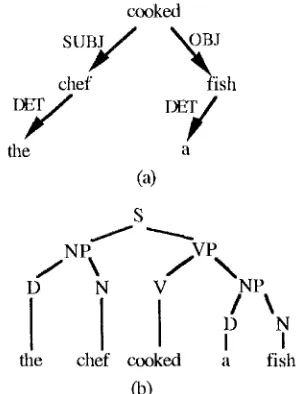
Dependency and constituency frameworks define different syntactic structures. Dependency grammars describe the structure of a sentence in terms of binary head-modifier (also called dependency) relations on the words of the sentence. A dependency relation is an asymmetric relation between a word callexl head (governor, parent), and a word called modifier (dependent, daughter). A word in the sentence can play the role of the head in several dependency relations, i.e. it can have several modifiers; but each word can play the role of the modifier exactly once. One special word does not play the role of the modifier in any relation, and it is named the root. The set of the dependency relations that can be defined on a sentence form a tree, called the dependency tree (fig. la).
Although born in the same years, dependency syntax (Tesniere 1959) and constituency, or phrase structure, syntax (Chomsky 1956) (see fig.lb), have had different impacts. The mainstream of formalisms consists a h n o s t e x c l u s i v e l y of c o n s t i t u e n c y approaches, but some of the original insights of the dependency tradition have found a role in the constituency formalisms: in particular, the concept of head of a phrase and the use of grammatical relations. The identification of the head within a phrase has been a major point of all the recent frameworks in linguistics: the X-bar theory (Jackendoff 1977), defines phrases as projections of (pre)terminal symbols, i.e. word categories; in GPSG (Gazdar et al, 1985) and HPSG (Pollard, Sag 1987), each phrase structure rule identifies a head and a related subcategorization within its right-hand side; in HG (Pollard 1984) the head is involved in the so-called h e a d - w r a p p i n g o p e r a t i o n s , which allow the formalism to go beyond the context-free power (Joshi et al. 1991).
Grmmnatical relations are the primitive entities of relational grammar (Perhnutter 1983) (classified as a dependency-based theory in (Mercuk 1988)):
cooked
SUBJ
chef t i s h
T ~ r /
, ,
the a
(a)
S/ N P \ / V k
D N V NP
I I
DI
"
NI
the dlef cooked a fishFigure 1. A dependency tree (a) and a p.s. tree (b) for the sentence "The chef cooked a fish". The leftward or rightward orientation of the arrows in the dependency tree represents the order constraints: the modifiers that precede the head stand on its left, the modifiers that follow the head stand on its right.
subject, object, xcomplement .... label the dependency relations when the head is a verb. Grainmatical relations gained much popularity within the unification formalisms in early 1980%. FUG (Kay 1979) and LFG (Kaplan, Bresnan 1982) exhibit mechanisms for producing a relational (or functional) structure of the sentence, based on the merging of feature representations.
All the r e c e n t c o n s t i t u e n c y f o r m a l i s m s acknowledge the importance of the lexicon, and reduce the amount of information brought by the phrasal categories. The "lexicalization" of context- free grmnmars (Schabes, Waters 1993) points out m a n y similarities between the two paradigms (Rainbow, Joshi 1992). Dependency syntax is an extremely lexicalized framework, because the phrase structure component is totally absent. Like the other lexicalized frameworks, the dependency approach does not produce spurious grammars, and this facility is of a practical interest, especially in writing realistic grammars. For instance, there are no heavily a m b i g u o u s , i n f i n i t e l y a m b i g u o u s or cyclic dependency grammars (such as S ~ SS; S ~ a; S --* ~; see (Tomita 1985), pp. 72-73).
[image:1.596.324.477.188.385.2]Dependency syntax is attractive because of the immediate mapping of dependency structures on the predicate-argmnents structure (accessible by the semantic interpreter), and because of the treatment of free-word order constructs (Sgall et al. 1986) (Mel'cuk 1988) (Hudson 1990). A number of parsers h a v e been d e v e l o p e d f o r some d e p e n d e n c y frameworks (Fraser 1989) (Covington 1990) (Kwon, Yoon 1991) (Sleator, Temperley 1993) (Hahn et al. 1994) (Lai, Huang 1995): however, no result of algorithmic efficiency has been published as far as we know. The theoretical worst-case analysis of O(n 3) descends from the (weak) equivalence between projective dependency grammars (a restricted of dependency grammars) and context-free grammars (Gaifman 1965), and not from an actual parsing algorithm,
This paper is a first attempt to fill a gap in the literature between the linguistic merits of the dependency approach (widely debated) and the mathematical properties of such formalisms (quite negleted). We describe an improved Earley-type recognizer for a projective dependency formalism. As a starting point we h a v e adopted a restricted dependency formalism with context-free power, that, for the sake of clearness, is described in the notation introduced by Gaifman (1965). The dependency grammar is translated into a set of parse tables that determine the conditions of applicability of the primary parser operations. Then the recognition algorithm consults the parse tables to build the sets of items as in Earley's algorithm for context-free grammars.
2 A d e p e n d e n c y f o r m a l i s m
In this section we introduce a dependency formalism. We express the dependency relations in terms of rules that are very similar to their constituency counterpart, i.e. context-free grammars. The formalism has been adapted from (Gaiflnan 1965). Less constrained dependency formalisms exist in the literature (Mel'cuk 1988) (Fraser, Hudson 1992), but no mathematical studies on their expressive power exist.
A dependency grammar is a quintuple <S, C, W, L, T>, where
W is a finite set of symbols (vocabulary of words of a natural language),
C is a set of syntactic categories (preterminals, in constituency terms),
S is a non-empty set of root categories (C _ S), L is a set of category assignment rules of the form X:
x, where XCC, x@W, and
X
YI Y2 ... Yi-1 Yi+l ... Ym Figure 2 - A dependency rule: X is the governor, and Y1 ... Ym are the dependent of X in the given order (X is in # position).
T is a set of dependency rules of the form X(Y1 Y2 ... Yi-1 # Y i + l ... Y m ) , where X G C , Y1GC, .... Ym@C, and # is a special symbol that does not belong to C. (see fig. 2).
The modifier symbols Yj can take the form Yj*: as usual, this means that an indefinite number of Yj's (zero or more) may appear in an application of the rule 1 . In the sample grammar below, this extension allows for several prepositional modifiers under a single verbal or nominal head without introducing intermediate symbols; the predicate-arguments structure is immediately represented by a one-level (flat) dependency structure.
Let x=al a2...ap ~ W * be a sentence. A dependency tree of x is a tree such that:
1) the nodes are the symbols a i ~ W (l<i<p);
2) a node ak,j has left daughters ak,1 ... ak,j-1 occurring in this order and right daughters ak,j+l, .... ak,q in this order if and only if there exist the roles Ak,l: ak,1 ... Akj: akj ... Ak,q: ak,q in L and the rule Ak,j(Ak,1 ... Akj-I # A k j + l ... Ak,q) in T. We say that ak,1 ... akj-1, ak,j+l ... ak,q directly depend on ak,j, or equivalently that ak,j directly governs ak, 1 ... ak,j.1, akj+l ... ak, q. akj and ak, h (h = 1 . . . j - l , j + l . . . q) are said to be in a dependency relation, where ak,j is the head and ak,h is the modifier, if there exists a sequence of nodes ai, ai+l . . . aj-l, aj such that ak directly depends on ak-1 for each k such that i+l~k-~j, then we say that ai depends' on aj;
3) it satisfies the condition ofprojectivity with respect to the order in x, that is, if ai depends directly on aj and ak intervenes between them (i<k<j or j<k<i), then either ak depends on a i or ak depends on aj (see fig. 3);
4) the root is a unique symbol as such that As: as E L and As~S.
The condition of projectivity limits the expressive power of the formalism to be equivalent to the context-free power. Intuitively, this principle states
aj
ai
Aik
i' ak
i | i | | i i i i
aj
ai
Figure 3. The condition of projectivity.
1 The use of the Kleene star is a notational change with respect to Gaifman: however, it is not uncommon to allow the symbols on the right hand side of a rule to be regular expressions in order to augment the perspicuity of the syntactic representation, but not the expressive power of the grammar (a similar extension appears in the context-free part of the LFG formalism (Kaplan, Bresnan 1982)).
that a dependent is never separated from its governor b y anything other than another d e p e n d e n t , together with its subtree, or by a dependent o f its own.
As an example, consider the g r a m m a r G I = <iV},
i V , N , P, A, D},
{I, saw, a, tall, old, man, in, the, park, with, telescope}, {N: I, V: saw, D: a, A: tall, A: old, N: man, P: in, D: the,
N: park, P: with, N: telescope} TI>,
where T1 is the following set o f dependency rules: t. V(N # P*); 2. V(N # N P*);
3. N(A*#P*); 4. N(DA* # P*); 5. P(# N); 6. A(#); 7. D(#).
F o r instance, the two rules for the r o o t c a t e g o r y V(erb) specify that a verb (V) can d o m i n a t e one or two nouns and some prepositions (*).
3 Recognition with a d e p e n d e n c y
g r a m m a r
~[he recognizer is an improved E a r l e y - t y p e algorithm, where the predictive component has been c o m p i l e d in a set o f parse tables. W e use two p r i m a r y actions:
predict, that corresponds to the top-down guessing o f
a category, and scan, that corresponds to the scanning
o f the current input word. In the subsection 3.1 we d e s c r i b e the data structures and the a l g o r i t h m s for
translating the dependency rules into the parse tables:
the d e p e n d e n c y r u l e s for a c a t e g o r y a r e f i r s t
t r a n s l a t e d into a transition graph, and then the
transition graph is m a p p e d onto a parse table. In the subsection 3.2 we present the E a r l e y - t y p e recognizer, that equals the most efficient recognizers for context- tree grmnmar.
3,1 Transition graphs and parse tables
A transition graph is a pair (V, E), where V is a set o f
vertices called states, and E is a set of directed edges
l a b e l l e d with a syntactic c a t e g o r y or the s y m b o l #. G i v e n a g r a m m a r G = < S , C, W , L , T>, a state o f the transition graph for a c a t e g o r y Cat ~ C is a ' s e t o f dotted slxings of the I b r m ". 13", w h e r e Cat(c~13) C T
# *
and et, [~ E (C U { }) ; an edge is a triple <si, sj, Y>, w h e r e si, sj C V and Y G C U {#}. A state that
contains the dotted string "." is called final; a final
state signals that the r e c o g n i t i o n o f one or m o r e d e p e n d e n c y rules has been completed. The f o l l o w i n g a l g o r i t h m constructs the t r a n s i t i o n g r a p h for the category Cat:
lSull.c.ti~ graph (('.at, G):
initialization
s 0 := O;
each rule in G of the iorm Cat(a) do s o := s 0 U {star ( .a )}
V := is0}; E := ~ ;
expansion
mllcat
take a non-marked state s from V; mark s;
each eatcgory Y G C U {#} do S' : : ~ ;
each dotted string r = .Y[5 in s do
i[ Y is starred
s' := s' U star(.Y[~)
e , l ~ s ' : = s ' u {.F};
endfor each dotted string;
V := V U is'};
E := E U {<s, s', Y>}
each category until all states in V are marked; graph := <V,E>.
star (dotted-string): set-of strings:= {dotted-string}; rsW~a~t
take a non-marked dotted string ds from set-of-strings; mark ds;
if ds has the form ".Y[V' and Y is starred then set-of-strings := set-of-strings U {".f~"}
all dotted strings in set-of-strings are marked star:= set-of-strings.
The initial set o f states consists o f a single state so, that contains all the p o s s i b l e strings " . a " , such that Cat(c0 is a d e p e n d e n c y rule. E a c h string is prefixed with a dot. The m a r k e d states are the states that were expanded in a previous step. The expansion of a state s takes into account each s y m b o l Y that ilmnediately f o l l o w s a dot (Y C C U {#}). Y is a p o s s i b l e continuation to a new state s', that contains the dotted string ".[3", where ".Y[5" is a dotted string in s. s' is added to the set o f states, and a new edge from s to s' labelled with Y is added to the set o f edges. A dotted string of the form .Y'13 is treated as a pair o f dotted strings {.Y'13, .[3}, so to allow a n u m b e r of iterations (one or m o r e Y's follow) or no iteration (the first s y m b o l in [~ follows) in the next step. The function
"star" takes into account these cases; the repeat loop
accounts for the case when the first s y m b o l o f 13 is starred too.
T h e t r a n s i t i o n g r a p h s o b t a i n e d for the f i v e categories of G1 are in fig. 4. C o n v e n t i o n a l l y , we indicate the non-final states as h and the final states as Sk, where h and k are integers.
The total n u m b e r o f states o f all the transition graphs for a g r a m m a r G is at most O(IGI), where IGI is the sum o f the lengths o f the dependency rules. The length of a dependency rule Cat(c0 is the length o f (~. Starting from the transition graph for a category Cat,
we can build the parse table for C a t , i.e. PTCa t.
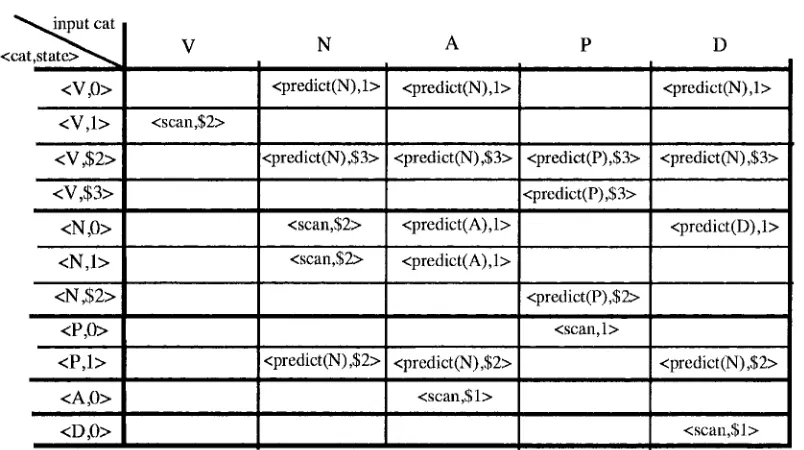
VI'Ca t is an array h x k, where h is the n u m b e r o f states o f the transition graph and k is the nmnber o f syntactic categories in C. Each row is identified b y a pair <Cat, State>, where State is the label of a state o f the corresponding transition graph; each column is a s s o c i a t e d with a s y n t a c t i c c a t e g o r y . In o r d e r to i m p r o v e the t o p - d o w n a l g o r i t h m w e introduce the c o n c e p t o f "first" o f a c a t e g o r y . The first o f the c a t e g o r y Cat is the set o f categories that appear as leftmost node of a subtree h e a d e d b y Cat. The first o f a category X is c o m p u t e d b y a s i m p l e procedure that
we omit here. The function parse_table computes the
parse tables of the various categories. E ( t - g r a p h c a t ) returns the set o f the edges o f the graph t - g r a p h c a t. The contents o f the entries in the parse tables are sets
( p o s s i b l y e m p t y ) o f p r e d i c t and s c a n . T h e
initialization step consists in setting all entries o f the table to the empty set.
0 1 $2 $3
(a) category V P
0 $1
@ '
-<D
(d) category A
0 1 $2 0 $1
(c) category P (e) category D
" •
cat <cat,state> ' ~<V,0>
<V,I>
<V,$2>
<V,$3>
<N,0>
Fig. 4 - The transition graphs obtained for the grammar G 1.
V N A p
<scan,S2>
<predict(N),l>
D
<predict(N),l>
<predict(N),$3> <predict(P),$3> <predict(N),$3>
<predict(P),$3>
<scan,S2> <predict(D),l>
<N,I> <scan,S2>
<N,$2>
<P,O>
<predict(N),$2> <P,I>
<A,0>
<D,0>
<predict(N),l>
<predict(N),$3>
<predict(A),l>
<predict(A),l>
<predict(N),$2>
<scan,S1>
<predict(P),$2>
<scan, l>
<predict(N),$2>
[image:4.596.121.497.80.294.2]<scan,S1 >
Figure 5 - The parse tables for the grammar G 1
although this does not happen for our simple grammar G 1.
3-2 A dependency recognizer
The dependency recognizer exhibits the same data structures of Earley's recognizer (Earley 1970), but improves the performance of that algorithm because of the precompilation of the predictive component into the parse tables.
In order to recognize a sentence of n words, n+l sets Si of items are built. An item is a quadruple
<Category, State, Position, Depcat>
where the first two elements (Category and State) correspond to a row of the parse table PTCategory, the third element (Position) gives the index i of the set Si where the recognition of a substructure began, and the fourth one (Depcat) is used to request the completion of a substructure headed by Depcat, parse-table (Cat, t-graphcat):
initialize PTCat;
for each edge <s, s', Y> in E(t-graphcat) do if Y E C t h e n
for each category Z ~ first(Y) 0sa
PTCat(<Cat, s>, Z) := PTCat(<Cat, s>, Z) U I~Cat(<Cat, ~ , Z) U {<predict(Y), s'>} elseif Y =#then
PTCat(<Cat, s>, Cat) := PTCat(<Cat, s>, Cat) U {<scan, s'>} endif:
endfor
parse-table := PTCa t.
The parse tables for the grammar G 1 are reported in fig. 5. The firsts are: first(V)=first(N)={N, A, D}; first(P)={P}; first(A)={A}; first(D)={D}. Note that an entry of a table can contain more than one action,
[image:4.596.107.509.315.540.2]before continuing in the recognition o f the larger slructure headed by Category (Depcat = "_" means that the item is not waiting for any completion).
Sentence: w 0 w 1 ... Wn. 1
initialization
each root category V do INSERT <V, 0, 0, > into SO ~a~dfor
body
l ~ i fix/m0 ~ n do
each item P=<Cat, State, j, > in Si do
completer:
if final(State) then
.f.0Z each item <Cat', k, j', Cat> in S i d~ INSERT <Cat', k, j', > i n t o S i "
predictor:
if <predict(Cat'), State'>C l~l'Cat(<Cat, State> × lnputcat)
• r - , ) ,
INSERT <Cat ,0, ~, > tntc Si. INSERT <Cat, State" j, Cat'>il]to S i mdif
s c a I l t I t ; F . "
if <scan, State'> C lrFCat(<Cat, State> × Inputcat) t h ~ INSERT <Cat, State', j, _> into Si+l
e, n d ~ each item
ternfination
j~ <V,$k, O, > is in S n l h ~ accept g]~reject
'File external loop of the algorithm cycles on the sets Si (0 < i < n); tile inner loop cycles on the items of the set Si of the form <Cat, State, j, > . At each step of the inner hoop, the action(s) given by the entry "<Cat, State> x lnputcat" in the parse table PTCa t is(are) executed (where l n p u t c a t is one o f the categories of the current word). Like in Earley's
parser there are three phases: completer, predictor
and scanner.
completer: When an item is in a final state (of the form $h), the algorithm looks for the items which represent the beginning o f tile input portion just analyzed: they are the l:i)ur-element items contained in the set referred by j. These items are inserted into Si after having set to "null" the fourth element (_).
predictor: "<predict(Cat'), State'>" corresponds to a prediction o f the category Cat' as a modifier of the category Cat and to the transition to State', in case a substructure headed by Cat' is actually found. This is modeled by introducing two new items in the set: a) <Cat', 0, i, > , which represents the initial state of
the transition graph of the category Cat' which will
span a portion of the input starting at i. In F, arley's terms, this item corresponds to all the dotted rules of the form Cat'(. cz).
b) <Cat, State', j, Cat'>, which represents the arc of the transition graph of the category Cat, entering the state State' and labelled Cat'. In Earley's terms, this item corresponds to a dotted rule o f the form Cat(~z . Cat' l~). The items including a non-null Depcat are just passive receptors waiting to be re- activated later when (and ii) the recognition of the h y p o t h e s i z e d s u b s t r u c t u r e has s u c c e s s f u l l y completed.
scanner: "<scan, State'>" results in inserting a new item <Cat, State', i, __> into the set Si+l.
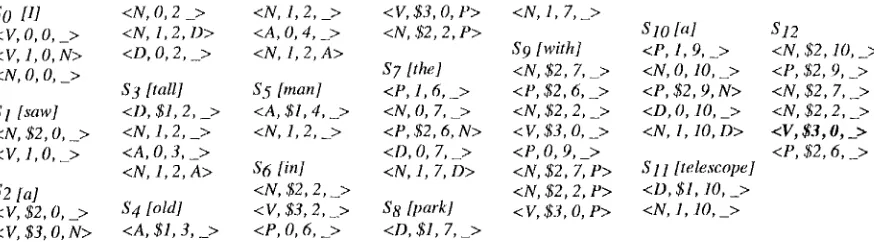
Let us trace the recognition of the sentence "I saw a tall old man in the park with a telescope". The first set SO (fig. 6) includes three items: the first one, <V, 0, 0, > , is produced by the initialization; the next two, <V, 1 , 0 , N> arid <N, 0, 0, _> are produced by the predictor (a N-headed subtree beginning in position 0 must be recognized and, in case such a recognition occurs, the governing V can pass to state
1).
In S1 the first item <N, $ 2 , 0 , > is produced by tire scanner: it is the result o f advancing on the input string according to the item <N, 0, 0, > in SO with an input noun "I" (the entry in the parse table PTN <N, 0> x N contains <scan,S2>). The next item, <V, 1 , 0 , _ > is produced by applying the completer to the item in S 0 <V, 1,0, N>.
$2 contains the item <V, $ 2 , 0 , _>, obtained by the scanner, that advances on the verb "saw". The other four items are the result of a double application of the predictor, which, in a sense, builds a "chain" that consists of a noun governed by the root verb and of a determiner governed by that noun; this is the only way, according to the grammar, to accomodate an incoming determiner when a verb is under analysis. The subsequent steps can easily be traced by the reader. The input sentence is accepted because of the appearance in the last set of the item <V, $ 3 , 0 , > , encoding that a structure headed by a verb (i.e. a root category), ending in a final state ($3), and covering all the words from the beginning of the sentence has been successfully recognized.
The space complexity of the recognizer is O(IGI n2). Each item is a quadruple <Cat, State, Position, Depcat>: Depcat is a constant of the grammar; the pairs of Cat and State are bounded by O(IGI);
S O [1] <N, O, 2 _> <N, 1, 2, _> <V, $3, O, P> <N, 1, 7, >
<V,O,O,_> <N, 1,2, D> <A,O, 4,_> <N,$2,2,P> S l o l a ] S12
<V, 1, O, N> <D, O, 2, _> <N, 1, 2, A> S 9 [with] <P, 1, 9, _> <N, $2, 10, _> <N, O, O, _> $7 ltlw] <N, $2, 7, > <N, O, 10, > <P, $2, 9, >
$3 [tall] S 5 #nan] <P, 1, 6, _> <P, $2,6, > <P, $2,9, N> <N, $2,7, > S 1 [saw] <D,$1,2,_> <A,$1,4, > <N,O, 7, > <N,$2,2,_> <D,O, 10,_> <N,$2,2, > <N,$2,0, > <N, 1,2,_> <N, 1,2, > <P,$2,6, N> <V,$3,0,_> <N,I, IO, D> <V,$3,0,_> <V, 1, O, > <A, O, 3, _> <D, O, 7, > <P, O, 9, _> <P, $2,6, _>
<N, 1, 2, A> $6 lin] <N, 1, 7, D> <N, $2,7, P> S11 [telescope] $2 [a] <N, $2,2, > <N, $2,2, P> <D, $1,10, _> <V, $2, O, _> S 4 [old] <V, $3, 2, _> $8 [park] <V, $3, O, P> <N, 1, 10, _> <V, $3, O, N> <A, $1,3, _> <P, O, 6, > <D, $1,7, >
Figure 6. Sets of items generated in recognizing "I saw a tall old man in the park with a telescope".
[image:5.596.65.502.632.753.2]Position is bounded by O(n). The number of such quadruples in a set of items is bounded by O(IGI n) and there are n sets of items.
The time complexity of the recognizer is O(IGI 2 n3). The phases scanner and predictor execute at most O(IGI) actions per item; the items are at most O(IGI n 2) and the cost of these two phases for the whole algorithm is O(IGl2n2). The phase completer executes at most one action per pair of items. The variables of such a pair of items are the two states (O(IGI2)), the two sets that contain them (O(n2)), and the two positions (O(n2)). But the pairs considered are not all the possible pairs: one of the sets has the index which is the same of one of the positions, and the complexity of the completer is O(IGI 2 n3). The phase completer prevails on the other two phases and the total complexity of the algorithm is O(IGI 2 n3). Even if the O-analysis is equivalent to Earley's, the phase of precompilation into the parse tables allows to save a lot of computation time needed by the predictor. All the possible predictions are precomputed in the transition to a new state. A similar device is presented in (Schabes 1990) for context-free grammars.
4
Conclusion
The paper has described a recognition algorithm for dependency grammar. The dependency formalism is translated into parse tables, that determine the conditions of applicability of tile parser actions. The recognizer is an improved Earley-type algorithm, whose performances are comparable to the best recognizers for the context-free grammars, the formalism which is equivalent to the dependency formalism described in this paper. The algorithm has been implemented in Common Lisp and runs under the Unix operating system. The next step in our research will be to relax the condition of projectivity in order to improve the expressive power and to deal with phenomena that go beyond the context-free power. These changes imply the restructuring of some parts of the recognizer, with a plausible increment of the complexity.
References
Chomsky N., Three models for the description of language, IRE Transactions on Information Theory, IT-2, 1956, 113-124.
Covington M. A., Parsing Discontinuous C o n s t i t u e n t s in D e p e n d e n c y G r a m m a r , Computational Linguistics 16, 1990, 234-236.
Covington M. A., An Empirically Motivated Reinterpretation of Dependency Grammar, Res. Rep. AI-1994-01, Univ. of Georgia (also on CompLing Server), 1994.
Earley J., An Efficient Context-free Parsing Algorithm. Comm. of the ACM 13,1970, 94-102.
Fraser N.M., Parsing and Dependency Grammar, UCL Working Papers in Linguistics, 1989, 296-319.
Fraser N.M., Hudson R. A., Inheritance in Word Grammar, Computational Linguistics 18, 1992, 133- 158.
Gaifman H., Dependency Systems and Phrase Structure Systems, Information and Control 8, 1965, 304-337.
Gazdar G., Klein E., Pullum G., Sag I., Generalized Phrase Structure Grammars, Basil Blackwell, Oxford, 1985.
Graham S. L., Harrison M. A., Ruzzo W. L., An improved Context-Free Recognizer, ACM Trans. on Programming Languages and Systems 2, 1980, 415- 462.
Hahn U., Schacht S., Broker N., Concurrent, Object-Oriented Natural Language Parsing: The ParseTalk Model, CLIF Report 9/94, Albert- Ludwigs-Universitat, Freiburg, Germany.
Hudson R., English Word Grammar, Basil Blackwell, Oxford, 1990.
Jackendoff R., X-bar Syntax: A Study of Phrase Structure, MIT Press, 1977.
Jacobs P.S., Rau L. F., Innovations in Text Interpretation, Artificial Intelligence Journal 63/1-2, 1993, 143-191.
Joshi A.K., Vijay-Shanker K., Weir D., The Convergence of Mildly Context-sensitive grammatical formalisms, in Sells P., Shieber S., Wasow T. (eds.), Foundational Issues in Natural Language Processing, MIT Press, 1991.
Kaplan R., Bresnan J., Lexical-Functional Grammar: A Formal System for Grammatical Representation, in Bresnan J. (ed.), The mental representation of grammatical relations, MIT Press,
1982.
Kay M., Functional Grammar, Proc. 5th Meeting of the Berkeley Linguistic Society, 1979, 142-158.
Kwon H., Yoon A., Unification-Based Dependency Parsing of Governor-Final Languages, Proc. IWPT 91, 1991, 182-192.
Lai B.Y.T., Huang C., Dependency Grammar and the Parsing of Chinese Sentences, Unpublished Manuscript on CompLing Server, 1995.
Mel'cuk I., Dependency Syntax: Theory and Practice, SUNY Press, Albany, 1988.
Perlmutter 1983, Studies in Relational Grammar 1, Univ. of Chicago Press, Chicago, 1983.
Pollard C.J., Generalized Phrase Structure Grammars, Head Grammars, and Natural Language, Ph.D. Thesis, Stanford Univ., 1984.
Pollard CJ., Sag I., An Information Based Syntax and Semantics, vo1.1, Fundamentals, CSLI Lecture Note 13. CSLI, Stanford, 1987.
Rambow O., Joshi A., A Formal Look at Dependency Grammars and Phrase-Structure Grammars, with Special Consideration of Word- Order Phenomena, Proc. of the Int. Workshop on the Meaning-Text Theory, Darmstadt, 1992.
Schabes Y., Polynomial Time and Space Shift- Reduce Parsing of Arbitrary Context-Free Grammars, Proc. ACL 90, Pittsburgh (PA), 1990, 106-113.
Schabes Y., Waters R. C., Lexicalized Context- Free Grammars, Proc. ACL 93, 121-129.
Sgall P., Haijcova E., Panevova J., The Meaning of Sentence in its Semantic and Pragmatic Aspects, D.Reidel Publ. Co., Dordrecht, 1986.
Sleator D. D., Temperley D., Parsing English with a Link Grammar, Proc. oflWPT 93, 1993, .277-291.
Tesniere L., Elements de Syntaxe Structurale, Kliensieck, Paris, 1959.
Tomita M., Efficient Parsing for Natural Language, Kluwer Acad. Publ., 1985.