Effect of Domain-Specific Corpus
in Compositional Translation Estimation for Technical Terms
Masatsugu Tonoike†, Mitsuhiro Kida†, Takehito Utsuro†
†Graduate School of Informatics, Kyoto University
Yoshida-Honmachi, Sakyo-ku, Kyoto 606-8501 Japan
(tonoike,kida,takagi,sasaki, utsuro)@pine.kuee.kyoto-u.ac.jp
Toshihiro Takagi†, Yasuhiro Sasaki†,
and Satoshi Sato‡
‡Graduate School of Engineering, Nagoya University
Furo-cho, Chikusa-ku, Nagoya 464-8603 JAPAN [email protected]
Abstract
This paper studies issues on compiling a bilingual lexicon for technical terms. In the task of estimating bilingual term correspondences of technical terms, it is usually quite difficult to find an exist-ing corpus for the domain of such tech-nical terms. In this paper, we take an approach of collecting a corpus for the domain of such technical terms from the Web. As a method of translation estimation for technical terms, we pro-pose a compositional translation esti-mation technique. Through experimen-tal evaluation, we show that the do-main/topic specific corpus contributes to improving the performance of the compositional translation estimation.
1 Introduction
This paper studies issues on compiling a bilingual lexicon for technical terms. So far, several tech-niques of estimating bilingual term correspon-dences from a parallel/comparable corpus have been studied (Matsumoto and Utsuro, 2000). For example, in the case of estimation from compa-rable corpora, (Fung and Yee, 1998; Rapp, 1999) proposed standard techniques of estimating bilin-gual term correspondences from comparable cor-pora. In their techniques, contextual similarity between a source language term and its transla-tion candidate is measured across the languages, and all the translation candidates are re-ranked ac-cording to the contextual similarities. However,
collecting terms of specific domain/topic (language S)
XSU(# of translations
is one)
compiled bilingual lexicon process data
collecting corpus (language T)
domain/topic specific
corpus (language T) sample terms
of specific domain/topic (language S)
XSTU, XSTM,YST
estimating bilingual term correspondences language pair (S,T) term set
(language S)
XTU
(lang. T) translation set (language T)
web (language S)
web (language S)
existing bilingual lexicon
XSM(# of translations
is more than one) YS(# of translations
is zero)
web (language T)
web (language T) looking up
bilingual lexicon
validating translation candidates
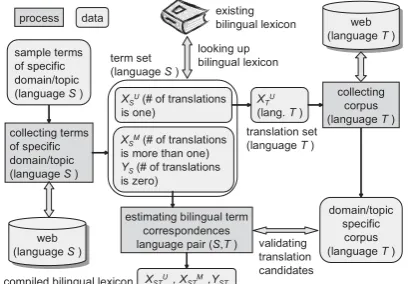
Figure 1: Compilation of a Domain/Topic Spe-cific Bilingual Lexicon
there are limited number of parallel/comparable corpora that are available for the purpose of es-timating bilingual term correspondences. There-fore, even if one wants to apply those existing techniques to the task of estimating bilingual term correspondences of technical terms, it is usually quite difficult to find an existing corpus for the domain of such technical terms.
Considering such a situation, we take an ap-proach of collecting a corpus for the domain of such technical terms from the Web. In this ap-proach, in order to compile a bilingual lexicon for technical terms, the following two issues have to be addressed: collecting technical terms to be listed as the headwords of a bilingual lexicon, and estimating translation of those technical terms. Among those two issues, this paper focuses on the second issue of translation estimation of technical terms, and proposes a method for translation es-timation for technical terms using a domain/topic specific corpus collected from the Web.
compiling a bilingual lexicon from the Web can be illustrated as in Figure 1. Suppose that we have sample terms of a specific domain/topic, techni-cal terms to be listed as the headwords of a bilin-gual lexicon are collected from the Web by the re-lated term collection method of (Sato and Sasaki, 2003). Those collected technical terms can be di-vided into three subsets according to the number of translation candidates they have in an existing
bilingual lexicon, i.e., the subsetXSU of terms for
which the number of translations in the existing
bilingual lexicon is one, the subsetXSM of terms
for which the number of translations is more than
one, and the subset YS of terms which are not
found in the existing bilingual lexicon.
(Hence-forth, the union XSU ∪XSM is denoted as XS.)
The translation estimation task here is to estimate
translations for the terms ofXSM andYS. For the
terms of XSM, it is required to select an
appro-priate translation from the translation candidates found in the existing bilingual lexicon. For ex-ample, as a translation of the Japanese technical
term “ ”, which belongs to the logic
cir-cuit field, the term “register” should be selected but not the term “regista” of the football field. On
the other hand, for the terms ofYS, it is required
to generate and validate translation candidates. In this paper, for the above two tasks, we use a
do-main/topic specific corpus. Each term ofXSU has
the only one translation in the existing bilingual lexicon. The set of the translations of terms of
XSU is denoted as XTU. Then, the domain/topic
specific corpus is collected from the Web using
the terms in the setXTU. A new bilingual lexicon
is compiled from the result of translation
estima-tion for the terms of XSM andYS, as well as the
translation pairs which consist of the terms ofXSU
and their translations found in the existing bilin-gual lexicon.
For each term ofXSM, from the translation
can-didates found in the existing bilingual lexicon, we select the one which appears most frequently in the domain/topic specific corpus. The experimen-tal result of this translation selection process is de-scribed in Section 5.2.
As a method of translation
genera-tion/validation for technical terms, we propose a compositional translation estimation technique. Compositional translation estimation of a term
can be done through the process of composi-tionally generating translation candidates of the term by concatenating the translation of the constituents of the term. Here, those translation candidates are validated using the domain/topic specific corpus.
In order to assess the applicability of the com-positional translation estimation technique, we randomly pick up 667 Japanese and English tech-nical term translation pairs of 10 domains from
existing technical term bilingual lexicons. We
then manually examine their compositionality, and find out that 88% of them are actually com-positional, which is a very encouraging result. Based on this assessment, this paper proposes a method of compositional translation estimation for technical terms, and through experimental evaluation, shows that the domain/topic specific corpus contributes to improving the performance of compositional translation estimation.
2 Collecting a Domain/Topic Specific Corpus
When collecting a domain/topic specific corpus of
the languageT, for each technical termxUT in the
setXTU, we collect the top 100 pages with search
engine queries includingxUT. Our search engine
queries are designed so that documents which
de-scribe the technical termxUT is to be ranked high.
For example, an online glossary is one of such documents. Note that queries in English and those in Japanese do not correspond. When
collect-ing a Japanese corpus, the search engine “goo”1
is used. Specific queries used here are phrases with topic-marking postpositional particles such
as “xUT ”, “xUT ”, “xUT ”, and an
ad-nominal phrase “xUT ”, and “xUT”. When
col-lecting a English corpus, the search engine
“Ya-hoo!”2 is used. Specific queries used here are “xUT
AND what’s”, “xUT AND glossary”, and “xUT”.
3 Compositional Translation Estimation for Technical Terms
3.1 Overview
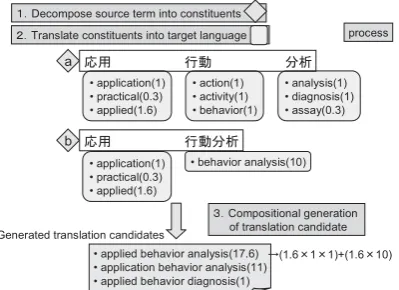
An example of compositional translation estima-tion for the Japanese technical term “
1
http://www.goo.ne.jp/
• application(1) • practical(0.3) • applied(1.6)
• action(1) • activity(1) • behavior(1)
• analysis(1) • diagnosis(1) • assay(0.3)
• behavior analysis(10)
䋳䋮Compositional generation of translation candidate • applied behavior analysis(17.6)
• application behavior analysis(11) • applied behavior diagnosis(1)
䋱䋮Decompose source term into constituents
䋲䋮Translate constituents into target language process
ᔕ↪ ⴕേ ಽᨆ
a
ᔕ↪ ⴕേಽᨆ
b
Generated translation candidates
㸢(1.6㬍1㬍1)+(1.6㬍10) • application(1)
• practical(0.3) • applied(1.6)
Figure 2: Compositional Translation Estimation
for the Japanese Technical Term “ ”
” is shown in Figure 2. First, the Japanese
tech-nical term “ ” is decomposed into
its constituents by consulting an existing
bilin-gual lexicon and retrieving Japanese headwords.3
In this case, the result of this decomposition can be given as in the cases “a” and “b” (in Fig-ure 2). Then, each constituent is translated into the target language. A confidence score is as-signed to the translation of each constituent. Fi-nally, translation candidates are generated by con-catenating the translation of those constituents
without changing word order. The confidence
score of translation candidates are defined as the product of the confidence scores of each con-stituent. Here, when validating those translation candidates using the domain/topic specific cor-pus, those which are not observed in the corpus are not regarded as candidates.
3.2 Compiling Bilingual Constituents Lexicons
This section describes how to compile bilingual constituents lexicons from the translation pairs of the existing bilingual lexicon Eijiro. The under-lying idea of augmenting the existing bilingual lexicon with bilingual constituents lexicons is il-lustrated with the example of Figure 3. Suppose that the existing bilingual lexicon does not
in-clude the translation pair “applied : ”, while
it includes many compound translation pairs with the first English word as “applied” and the first
3Here, as an existing bilingual lexicon, we use
Ei-jiro(http://www.alc.co.jp/) and bilingual constituents lexi-cons compiled from the translation pairs of Eijiro (details to be described in the next section).
applied mathematics :
applied science :
applied robot :
..
. frequency
⇓
applied : : 40
Figure 3: Example of Estimating Bilingual Con-stituents Translation Pair (Prefix)
Table 1: Numbers of Entries and Translation Pairs in the Lexicons
lexicon # of entries # of translation
English Japanese pairs
Eijiro 1,292,117 1,228,750 1,671,230
P2 232,716 200,633 258,211
BP 38,353 38,546 112,586
BS 22,281 20,627 71,429
Eijiro : existing bilingual lexicon
P2 : entries of Eijiro with two constituents in both languages
BP : bilingual constituents lexicon (prefix)
BS : bilingual constituents lexicon (suffix)
Japanese word “ ”.4 In such a case, we align
those translation pairs and estimate a bilingual constituent translation pair, which is to be col-lected into a bilingual constituents lexicon.
More specifically, from the existing bilingual lexicon, we first collect translation pairs whose English terms and Japanese terms consist of two
constituents into another lexiconP2. We compile
“bilingual constituents lexicon (prefix)” from the
first constituents of the translation pairs inP2and
compile “bilingual constituents lexicon (suffix)” from their second constituents. The numbers of entries in each language and those of translation pairs in those lexicons are shown in Table 1.
In the result of our assessment, only 27% of the 667 translation pairs mentioned in Section 1 can be compositionally generated using Eijiro, while the rate increases up to 49% using both Eijiro and
“bilingual constituents lexicons”.5
4Japanese entries are supposed to be segmented into a
sequence of words by the morphological analyzer JUMAN (http://www.kc.t.u-tokyo.ac.jp/nl-resource/juman.html)
5In our rough estimation, the upper bound of this rate
3.3 Score of Translation Pairs in the Lexicons
This section introduces a confidence score of translation pairs in the various lexicons presented in the previous section. Here, we suppose that
the translation pairs, tof termssandtis used
when estimating translation from the language of
the term sto that of the termt. First, in this
pa-per, we assume that translation pairs follow cer-tain preference rules and can be ordered as below:
1. Translation pairs s, t in the existing
bilin-gual lexicon Eijiro, where the termsconsists
of two or more constituents.
2. Translation pairs in the bilingual constituents
lexicons whose frequencies inP2are high.
3. Translation pairs s, t in the existing
bilin-gual lexicon Eijiro, where the termsconsists
of exactly one constituent.
4. Translation pairs in the bilingual constituents
lexicons whose frequencies in P2 are not
high.
As the definition of the confidence score
q(s, t)of a translation pair s, t, in this paper,
we use the following:
q(s, t) =
wherecompo(s)denotes the word (in English) or
morpheme (in Japanese) count ofs,fp(s, t)the
frequency of s, t as the first constituent in P2,
andfs(s, t)the frequency ofs, tas the second
constituent inP2.6
3.4 Score of Translation Candidates
Suppose that a translation candidate yt is
gener-ated from translation pairs s1, t1,· · ·,sn, tn
by concatenating t1,· · ·, tn as yt = t1· · ·tn.
Here, in this paper, we define the confidence score
ofytas the product of the confidence scores of the
6It is necessary to empirically examine whether this
def-inition of the confidence score is optimal or not. However, according to our rough qualitative examination, the results of the confidence scoring seem stable when without a do-main/topic specific corpus, even with minor tuning by incor-porating certain parameters into the score.
collecting terms of specific domain/topic (language S)
XSU(# of translations
is one)
compiled bilingual lexicon process data
of specific domain/topic (language S)
XSTU, XSTM,YST
estimating bilingual term correspondences (language S)
existing bilingual lexicon
XSM(# of translations
is more than one) YS(# of translations
is zero)
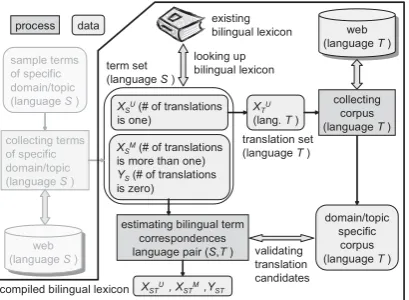
Figure 4: Experimental Evaluation of Translation Estimation for Technical Terms with/without the Domain/Topic Specific Corpus (taken from Fig-ure 1)
If a translation candidate is generated from more than one sequence of translation pairs, the score of the translation candidate is defined as the sum of the score of each sequence.
4 Translation Candidate Validation using a Domain/Topic Specific Corpus
It is not clear whether translation candidates which are generated by the method described in Section 3 are valid as English or Japanese terms, and it is not also clear whether they belong to the domain/topic. So using a domain/topic specific corpus collected by the method described in Sec-tion 2, we examine whether the translaSec-tion candi-dates are valid as English or Japanese terms and whether they belong to the domain/topic. In our validation method, given a ranked list of trans-lation candidates, each transtrans-lation candidate is checked whether it is observed in the corpus, and one which is not observed in the corpus is re-moved from the list.
5 Experiments and Evaluation
5.1 Translation Pairs for Evaluation
Fig-Table 2: Number of Translation Pairs for Evaluation
dictionaries categories |XS| |YS| S= English S= Japanese
|XU
S| |XSM| C(S) |XSU| |XSM| C(S)
Electromagnetics 58 33 36 22 82% 32 26 76%
McGraw-Hill Electrical engineering 52 45 34 18 67% 25 27 64%
Optics 54 31 42 12 65% 22 32 65%
Iwanami Programming language 55 29 37 18 86% 38 17 100%
Programming 53 29 29 24 86% 29 24 79%
Dictionary of
(Computer) 100 100 91 9 46% 69 31 56%
Computer
Anatomical Terms 100 100 91 9 86% 33 67 39%
Dictionary of Disease 100 100 91 9 74% 53 47 51%
250,000 Chemicals and Drugs 100 100 94 6 58% 74 26 51%
medical terms Physical Science and Statistics 100 100 88 12 64% 58 42 55%
Total 772 667 633 139 68% 433 339 57%
McGraw-Hill : Dictionary of Scientific and Technical Terms Iwanami : Encyclopedic Dictionary of Computer Science
C(S): forYS, the rate of including correct translations within the collected domain/topic specific corpus
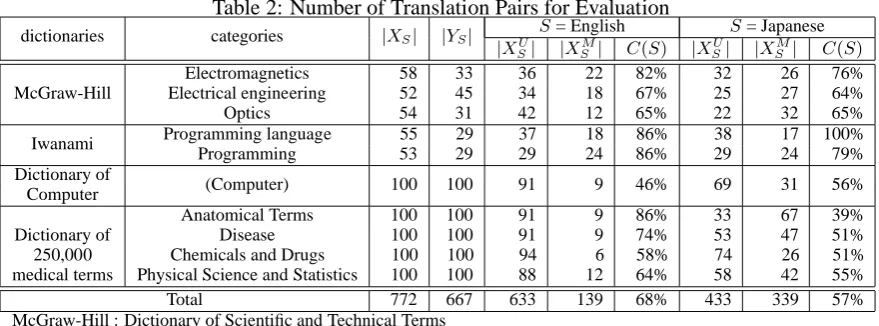
ure 4. In the evaluation of this paper, we sim-ply skip the evaluation of the process of collecting technical terms to be listed as the headwords of a bilingual lexicon. In order to evaluate the transla-tion estimatransla-tion part, from ten categories of exist-ing Japanese-English technical term dictionaries listed in Table 2, terms are randomly picked up
for each of the set XSU, XSM, and YS. (Here, as
the terms of YS, these which consist of the only
one word or morpheme are excluded.) As
de-scribed in Section 1, the terms of XTU (the set
of the translations for the terms of XSU) is used
for collecting a domain/topic specific corpus from the Web. Translation estimation evaluation is to
be done against the setXSM andYS. For each of
the ten categories, Table 2 shows the sizes ofXSU,
XSM andYS, and forYS, the rate of including
cor-rect translation within the collected domain/topic specific corpus, respectively.
5.2 Translation Selection from Existing Bilingual Lexicon
For the terms ofXSM, the selected translations are
judged by a human. The correct rates are 69% from English to Japanese on the average and 75% from Japanese to English on the average.
5.3 Compositional Translation Estimation for Technical Terms without the Domain/Topic Specific Corpus
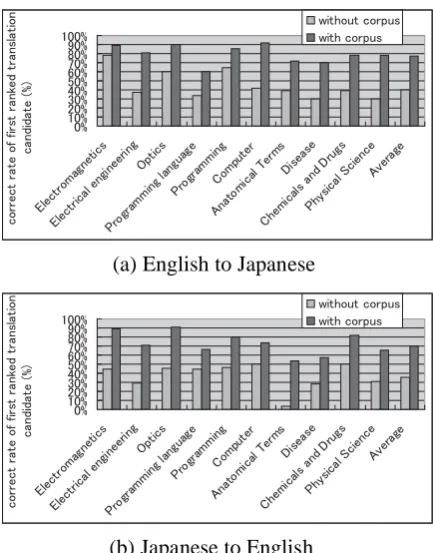
Without the domain specific corpus, the cor-rect rate of the first ranked translation candidate is 19% on the average (both from English to
Japanese and from Japanese to English). The
rate of including correct candidate within top 10 is 40% from English to Japanese and 43% from Japanese to English on the average. The rate of compositionally generating correct translation us-ing both Eijiro and the bilus-ingual constituents
lex-icons (n=∞) is about 50% on the average (both
from English to Japanese and from Japanese to English).
5.4 Compositional Translation Estimation for Technical Terms with the
Domain/Topic Specific Corpus
With domain specific corpus, on the average, the correct rate of the first ranked translation candi-date improved by 8% from English to Japanese and by 2% from Japanese to English. However, the rate of including correct candidate within top 10 decreased by 7% from English to Japanese, and by 14% from Japanese to English. This is be-cause correct translation does not exist in the cor-pus for 32% (from English to Japanese) or 43% (from Japanese to English) of the 667 translation pairs for evaluation.
For about 35% (from English to Japanese) or 30% (from Japanese to English) of the 667 trans-lation pairs for evaluation, correct transtrans-lation does exist in the corpus and can be generated through the compositional translation estimation process. For those 35% or 30% translation pairs, Fig-ure 5 compares the correct rate of the first ranked translation pairs between with/without the do-main/topic specific corpus. The correct rates
in-crease by 34∼37% with the domain/topic specific
do-㪇㩼
(a) English to Japanese
㪇㩼
(b) Japanese to English
Figure 5: Evaluation against the Translation Pairs whose Correct Translation Exist in the Corpus and can be Generated Compositionally
main/topic specific corpus is effective in transla-tion estimatransla-tion of technical terms.
6 Related Works
As a related work, (Fujii and Ishikawa, 2001) proposed a technique of compositional estima-tion of bilingual term correspondences for the purpose of cross-language information retrieval. In (Fujii and Ishikawa, 2001), a bilingual con-stituents lexicon is compiled from the translation pairs included in an existing bilingual lexicon in the same way as our proposed method. One of the major differences of the technique of (Fujii and Ishikawa, 2001) and the one proposed in this pa-per is that in (Fujii and Ishikawa, 2001), instead of the domain/topic specific corpus, they use a cor-pus of the collection of the technical papers, each of which is published by one of the 65 Japanese associations for various technical domains. An-other important difference is that in (Fujii and Ishikawa, 2001), they evaluate only the perfor-mance of cross-language information retrieval but not that of translation estimation.
(Cao and Li, 2002) proposed a method of
com-positional translation estimation for compounds. In the proposed method of (Cao and Li, 2002), translation candidates of a term are composition-ally generated by concatenating the translation of the constituents of the term and are re-ranked by measuring contextual similarity against the source language term. One of the major differ-ences of the technique of (Cao and Li, 2002) and the one proposed in this paper is that in (Cao and Li, 2002), they do not use the domain/topic spe-cific corpus.
7 Conclusion
This paper proposed a method of compositional translation estimation for technical terms using the domain/topic specific corpus, and through the experimental evaluation, showed that the do-main/topic specific corpus contributes to improv-ing the performance of compositional translation estimation.
Future works include the followings: first, in order to improve the proposed method with re-spect to its coverage, for example, it is desir-able to extend the bilingual constituents lexicons and to introduce constituent reordering rules with prepositions into the process of compositional translation candidate generation. Second, we are planning to introduce a mechanism of re-ranking translation candidates based on the frequencies of technical terms in the domain/topic specific cor-pus.
References
Y. Cao and H. Li. 2002. Base noun phrase translation using Web data and the EM algorithm. In Proc. 19th COLING, pages 127–133.
Atsushi Fujii and Tetsuya Ishikawa. 2001. Japanese/english cross-language information retrieval: Exploration of query translation and transliteration. Computers and the
Humanities, 35(4):389–420.
P. Fung and L. Y. Yee. 1998. An IR approach for translating new words from nonparallel, comparable texts. In Proc.
17th COLING and 36th ACL, pages 414–420.
Y. Matsumoto and T. Utsuro. 2000. Lexical knowledge ac-quisition. In R. Dale, H. Moisl, and H. Somers, editors, Handbook of Natural Language Processing, chapter 24, pages 563–610. Marcel Dekker Inc.
R. Rapp. 1999. Automatic identification of word transla-tions from unrelated English and German corpora. In
Proc. 37th ACL, pages 519–526.