Leveraging Multiple MT Engines for Paraphrase Generation
Shiqi Zhao†‡, Haifeng Wang†, Xiang Lan‡, and Ting Liu‡ †Baidu Inc.
‡HIT Center for Information Retrieval, Harbin Institute of Technology {zhaoshiqi, wanghaifeng}@baidu.com,
{xlan, tliu}@ir.hit.edu.cn
Abstract
This paper proposes a method that lever-ages multiple machine translation (MT) engines for paraphrase generation (PG). The method includes two stages. Firstly, we use a multi-pivot approach to acquire a set of candidate paraphrases for a source
sentenceS. Then, we employ two kinds
of techniques, namely the selection-based technique and the decoding-based tech-nique, to produce a best paraphraseT for Susing the candidates acquired in the first
stage. Experimental results show that: (1) The multi-pivot approach is effective for obtaining plenty of valuable candi-date paraphrases. (2) Both the selection-based and decoding-selection-based techniques can make good use of the candidates and pro-duce high-quality paraphrases. Moreover, these two techniques are complementary. (3) The proposed method outperforms a state-of-the-art paraphrase generation ap-proach.
1 Introduction
This paper addresses the problem of paraphrase generation (PG), which seeks to generate para-phrases for sentences. PG is important in many natural language processing (NLP) applications. For example, in machine translation (MT), a sentence can be paraphrased so as to make it more translatable (Zhang and Yamamoto, 2002; Callison-Burch et al., 2006). In question answer-ing (QA), a question can be paraphrased to im-prove the coverage of answer extraction (Duboue and Chu-Carroll, 2006; Riezler et al., 2007). In
natural language generation (NLG), paraphrasing can help to increase the expressive power of the NLG systems (Iordanskaja et al., 1991).
In this paper, we propose a novel PG method. For an English sentence S, the method first ac-quires a set of candidate paraphrases with a multi-pivot approach, which uses MT engines to auto-matically translateSinto multiple pivot languages and then translate them back into English. Fur-thermore, the method employs two kinds of
tech-niques to produce a best paraphraseT forS
us-ing the candidates, i.e., the selection-based and decoding-based techniques. The former selects a best paraphrase from the candidates based on Minimum Bayes Risk (MBR), while the latter trains a MT model using the candidates and gen-erates paraphrases with a MT decoder.
We evaluate our method on a set of 1182 En-glish sentences. The results show that: (1) al-though the candidate paraphrases acquired by MT engines are noisy, they provide good raw ma-terials for further paraphrase generation; (2) the selection-based technique is effective, which re-sults in the best performance; (3) the decoding-based technique is promising, which can generate paraphrases that are different from the candidates; (4) both the selection-based and decoding-based techniques outperform a state-of-the-art approach SPG (Zhao et al., 2009).
2 Related Work
2.1 Methods for Paraphrase Generation
MT-based method is the mainstream method on PG. It regards PG as a monolingual machine trans-lation problem, i.e., “translating” a sentence S
Quirk et al. (2004) first presented the MT-based method. They trained a statistical MT (SMT) model on a monolingual parallel corpus extracted from comparable news articles and applied the model to generate paraphrases. Their work shows that SMT techniques can be extended to PG. How-ever, its usefulness is limited by the scarcity of monolingual parallel data.
To overcome the data sparseness problem, Zhao et al. (2008a) improved the MT-based PG method by training the paraphrase model using multi-ple resources, including monolingual parallel cor-pora, monolingual comparable corcor-pora, bilingual parallel corpora, etc. Their results show that bilin-gual parallel corpora are the most useful among the exploited resources. Zhao et al. (2009) further
improved the method by introducing a usability
sub-modelinto the paraphrase model so as to gen-erate varied paraphrases for different applications. The main disadvantage of the MT-based method is that its performance heavily depends on the fine-grained paraphrases, such as paraphrase phrases and patterns, which provide paraphrase options in decoding. Hence one has to first ex-tract fine-grained paraphrases from various cor-pora with different methods (Zhao et al., 2008a; Zhao et al., 2009), which is difficult and time-consuming.
In addition to the MT-based method, re-searchers have also investigated other methods for paraphrase generation, such as the pattern-based methods (Barzilay and Lee, 2003; Pang et al., 2003), thesaurus-based methods (Bolshakov and Gelbukh, 2004; Kauchak and Barzilay, 2006), and NLG-based methods (Kozlowski et al., 2003; Power and Scott, 2005).
2.2 Pivot Approach for Paraphrasing
Bannard and Callison-Burch (2005) introduced the pivot approach to extracting paraphrase phrases from bilingual parallel corpora. Their ba-sic assumption is that two English phrases aligned with the same phrase in a foreign language (also called a pivot language) are potential paraphrases. Zhao et al. (2008b) extended the approach and used it to extract paraphrase patterns. Both of the above works have proved the effectiveness of the pivot approach in paraphrase extraction.
Pivot approach can also be used in paraphrase generation. It generates paraphrases by translating sentences from a source language to one (single-pivot) or more (multi-(single-pivot) pivot languages and then translating them back to the source language. Duboue et al. (2006) first proposed the multi-pivot approach for paraphrase generation, which was specially designed for question expansion in QA. In addition, Max (2009) presented a single-pivot approach for generating sub-sentential para-phrases. A clear difference between our method and the above works is that we propose selection-based and decoding-selection-based techniques to gener-ate high-quality paraphrases using the candidgener-ates yielded from the pivot approach.
3 Multi-pivot Approach for Acquiring Candidate Paraphrases
A single-pivot PG approach paraphrases a
sen-tence S by translating it into a pivot language
P L with a MT engine M T1 and then
translat-ing it back into the source language with M T2.
In this paper, a single-pivot PG system is repre-sented as a triple (M T1, P L, M T2). A
multi-pivot PG system is made up of a set of single-multi-pivot systems with various pivot languages and MT
en-gines. Given m pivot languages and n MT
en-gines, we can build a multi-pivot PG system con-sisting ofN (N ≤ n∗m∗n) single-pivot ones,
whereN = n∗m ∗n iff all the nMT engines
can perform bidirectional translation between the source and each pivot language.
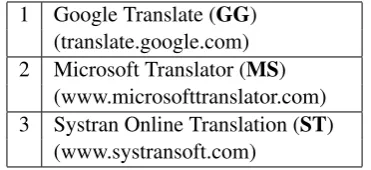
In this work, we experiment with 6 pivot lan-guages (Table 1) and 3 MT engines (Table 2) in the multi-pivot approach. All the 3 MT engines are off-the-shelf systems, in which Google and Microsoft translators are SMT engines, while Sys-tran Sys-translator is a rule-based MT engine. Each MT engine can translate English to all the 6 pivot languages and back to English. We thereby con-struct a multi-pivot PG system consisting of 54 (3*6*3) single-pivot systems.
Source Sentence he said there will be major cuts in the salaries of high-level civil servants . (GG,G,M S) he said thereare significantcuts in the salaries of high-levelofficials.
(GG,F,GG) he said there will besignificantcuts in the salaries oftop civil level.
(M S,C,M S) he saidthatthere will bea major senior civil service pay cut.
(M S,F,ST) he said there will begreatcuts in thewagesof thehigh level civils servant.
(ST,G,GG) he saidthattherearemajor cuts in the salaries ofsenior government officials.
Table 3: Examples of candidate paraphrases obtained using the multi-pivot approach.
1 French (F) 4 Italian (I)
2 German (G) 5 Portuguese (P)
3 Spanish (S) 6 Chinese (C)
Table 1: Pivot languages used in the approach.
1 Google Translate (GG)
(translate.google.com)
2 Microsoft Translator (MS)
(www.microsofttranslator.com) 3 Systran Online Translation (ST)
(www.systransoft.com)
Table 2: MT engines utilized in the approach.
4 Producing High-quality Paraphrases using the Candidates
Table 3 shows some examples of candidate para-phrases for a sentence. As can be seen, the can-didates do provide some correct and useful para-phrase substitutes (in bold) for the source sen-tence. However, they also contain quite a few er-rors (in italic) due to the limited translation qual-ity of the MT engines. The problem is even worse when the source sentences get longer and more complicated. Therefore, we need to com-bine the outputs of the multiple single-pivot PG systems and produce high-quality paraphrases out of them. To this end, we investigate two tech-niques, namely, the selection-based and decoding-based techniques.
4.1 Selection-based Technique
Given a source sentenceS along with a setDof
candidate paraphrases {T1, T2, ..., Ti, ...TN}, the
goal of the selection-based technique is to select the best paraphrase Tˆi for S fromD. The
para-phrase selection technique we propose is based on
Minimum Bayes Risk (MBR). In detail, the MBR based technique first measures the quality of each
candidate paraphrase Ti ∈ D in terms of Bayes
risk (BR), and then selects the one with the min-imum BR as the best paraphrase. In detail, given
S, a candidate Ti ∈ D, a reference paraphrase
T1, and a loss functionL(T, Ti)that measures the
quality of Ti relative to T, we define the Bayes
risk as follows:
BR(Ti) =EP(T,S)[L(T, Ti)], (1)
where the expectation is taken under the true dis-tributionP(T, S) of the paraphrases. According
to (Bickel and Doksum, 1977), the candidate para-phrase that minimizes the Bayes risk can be found as follows:
ˆ
Ti = arg min Ti∈D
∑
T∈T
L(T, Ti)P(T|S), (2)
where T represents the space of reference
para-phrases. In practice, however, the collection of reference paraphrases is not available. We thus construct a setD′ =D∪{S}to approximateT2.
In addition, we cannot estimateP(T|S)in Equa-tion (2), either. Therefore, we make a simplifica-tion by assigning a constantctoP(T|S)for each T ∈D′, which can then be removed:
ˆ
Ti= arg min Ti∈D
∑
T∈D′
L(T, Ti). (3)
Equation (3) can be further rewritten using a gain functionG(T, Ti)instead of the loss function:
1Here we assume that we have the collection of all
possi-ble paraphrases ofS, which are used as references.
ˆ
Ti = arg max Ti∈D
∑
T∈D′
G(T, Ti). (4)
We define the gain function based on BLEU:
G(T, Ti) = BLEU(T, Ti). BLEU is a
widely used metric in the automatic evaluation of MT (Papineni et al., 2002). It measures the sim-ilarity of two sentences by counting the overlap-pingn-grams (n=1,2,3,4 in our experiments):
BLEU(T, Ti) =BP·exp(
4
∑
n=1
wnlogpn(T, Ti)),
wherepn(T, Ti)is then-gram precision ofTiand
wn = 1/4. BP (≤ 1) is a brevity penalty that
penalizesTiif it is shorter thanT.
In summary, for each sentence S, the MBR
based technique selects a paraphrase that is the most similar to all candidates and the source sen-tence. The underlying assumption is that correct paraphrase substitutes should be common among the candidates, while errors committed by the single-pivot PG systems should be all different. We denote this approach asS-1hereafter.
Approaches for comparison.In the experiments, we also design another two paraphrase selection approaches S-2 and S-3 for comparison with S-1.
S-2: S-2 selects the best single-pivot PG
system from all the 54 ones. The selection
is also based on MBR and BLEU. For each single-pivot PG system, we sum up its gain function values over a set of source sentences (i.e., ∑S∑TS∈D′
SG(TS, TSi)). Then we
se-lect the one with the maximum gain value as
the best single-pivot system. In our
experi-ments, the selected best single-pivot PG system is (ST, P, GG), the candidate paraphrases acquired by which are then returned as the best paraphrases in S-2.
S-3: S-3 is a simple baseline, which just ran-domly selects a paraphrase from the 54 candidates for each source sentenceS.
4.2 Decoding-based Technique
The selection-based technique introduced above has an inherent limitation that it can only select a paraphrase from the candidates. That is to say, it
major cuts high-level civil servants
significant cuts senior officials
major cuts* high-level officials
important cuts senior civil servants big cuts
great cuts
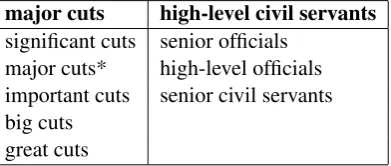
Table 4: Extracted phrase pairs. (*This is called a self-paraphrase of the source phrase, which is generated when a phrase keeps unchanged in some of the candidate paraphrases.)
can never produce a perfect paraphrase if all the candidates have some tiny flaws. To solve this problem, we propose the decoding-based tech-nique, which trains a MT model using the can-didate paraphrases of each source sentenceSand
generates a new paraphrase T for S with a MT
decoder.
In this work, we implement the decoding-based technique using Giza++ (Och and Ney, 2000) and Moses (Hoang and Koehn, 2008), both of which are commonly used SMT tools. For a sentence
S, we first construct a set of parallel sentences
by pairing S with each of its candidate
para-phrases: {(S,T1),(S,T2),...,(S,TN)} (N = 54).
We then run word alignment on the set using Giza++ and extract aligned phrase pairs as de-scribed in (Koehn, 2004). Here we only keep the phrase pairs that are aligned≥3 times on the set, so as to filter errors brought by the noisy sentence pairs. The extracted phrase pairs are stored in a phrase table. Table 4 shows some extracted phrase pairs.
Note that Giza++ is sensitive to the data size. Hence it is interesting to examine if the alignment can be improved by augmenting the parallel sen-tence pairs. To this end, we have tried augmenting the parallel set for each sentenceSby pairing any
two candidate paraphrases. In this manner, CN2
sentence pairs are augmented for eachS. We con-duct word alignment using the (N+CN2) sentence
pairs and extract aligned phrases from the original
N pairs. However, we have not found clear
Using the extracted phrasal paraphrases, we
conduct decoding for the sentenceSwith Moses,
which is based on a log-linear model. The default setting of Moses is used, except that the distortion model for phrase reordering is turned off3. The
language model in Moses is trained using a 9 GB English corpus. We denote the above approach as
D-1in what follows.
Approach for comparison. The main advantage of the decoding-based technique is that it allows us to customize the paraphrases for different re-quirements through tailoring the phrase table or tuning the model parameters. As a case study, this paper shows how to generate paraphrases with variedparaphrase rates4.
D-2: The extracted phrasal paraphrases
(in-cluding self-paraphrases) are stored in a phrase ta-ble, in which each phrase pair has 4 scores mea-suring their alignment confidence (Koehn et al., 2003). Our basic idea is to control the paraphrase rate by tuning the scores of the self-paraphrases. We thus extend D-1 to D-2, which assigns a
weight λ (λ > 0) to the scores of the
self-paraphrase pairs. Obviously, if we set λ < 1,
the self-paraphrases will be penalized and the de-coder will prefer to generate a paraphrase with more changes. If we setλ > 1, the decoder will
tend to generate a paraphrase that is more similar to the source sentence. In our experiments, we set
λ= 0.1in D-2.
5 Experimental Setup
Our test sentences are extracted from the paral-lel reference translations of a Chinese-to-English
MT evaluation5, in which each Chinese sentence
chas 4 English reference translations, namelye1, e2,e3, ande4. We usee1as a test sentence to
para-phrase ande2,e3,e4 as human paraphrases ofe1
for comparison with the automatically generated paraphrases. We process the test set by manually filtering ill-formed sentences, such as the ungram-matical or incomplete ones. 1182 out of 1357
3We conduct monotone decoding as previous work
(Quirk et al., 2004; Zhao et al., 2008a, Zhao et al., 2009).
4The paraphrase rate reflects how different a paraphrase
is from the source sentence.
52008 NIST Open Machine Translation Evaluation:
Chi-nese to English Task.
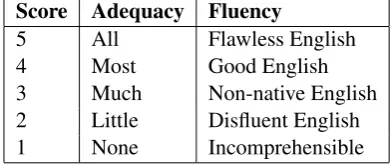
Score Adequacy Fluency
5 All Flawless English
4 Most Good English
3 Much Non-native English
2 Little Disfluent English
1 None Incomprehensible
Table 5: Five point scale for human evaluation.
test sentences are retained after filtering. Statistics show that about half of the test sentences are from news and the other half are from essays. The aver-age length of the test sentences is 34.12 (words).
Manual evaluation is used in this work. A para-phraseTof a sentenceSis manually scored based on a five point scale, which measures both the
“ad-equacy” (i.e., how much of the meaning ofS is
preserved inT) and “fluency” ofT (See Table 5). The five point scale used here is similar to that in the human evaluation of MT (Callison-Burch et al., 2007). In MT, adequacy and fluency are eval-uated separately. However, we find that there is a high correlation between the two aspects, which makes it difficult to separate them. Thus we com-bine them in this paper.
We compare our method with a
state-of-the-art approach SPG6 (Zhao et al., 2009), which
is a statistical approach specially designed for PG. The approach first collects a large volume of fine-grained paraphrase resources, including para-phrase para-phrases, patterns, and collocations, from various corpora using different methods. Then it generates paraphrases using these resources with a statistical model7.
6 Experimental Results
We evaluate six approaches, i.e., S-1, S-2, S-3, D-1, D-2 and SPG, in the experiments. Each ap-proach generates a 1-best paraphrase for a test sentenceS. We randomize the order of the 6
para-phrases of eachSto avoid bias of the raters.
6SPG: Statistical Paraphrase Generation.
7We ran SPG under the setting of baseline-2 as described
0 0.5 1 1.5 2 2.5 3 3.5 4 4.5
score 3.92 3.52 2.78 3.62 3.36 3.47 S-1 S-2 S-3 D-1 D-2 SPG
Figure 1: Evaluation results of the approaches.
6.1 Human Evaluation Results
We have 6 raters in the evaluation, all of whom are postgraduate students. In particular, 3 raters major in English, while the other 3 major in com-puter science. Each rater scores the paraphrases of 1/6 test sentences, whose results are then com-bined to form the final scoring result. The av-erage scores of the six approaches are shown in Figure 1. We can find that among the selection-based approaches, the performance of S-3 is the worst, which indicates that randomly selecting a paraphrase from the candidates works badly. S-2 performs much better than S-3, suggesting that the quality of the paraphrases acquired with the best single-pivot PG system are much higher than the randomly selected ones. S-1 performs the best in all the six approaches, which demonstrates the effectiveness of the MBR-based selection tech-nique. Additionally, the fact that S-1 evidently outperforms S-2 suggests that it is necessary to ex-tend a single-pivot approach to a multi-pivot one.
To get a deeper insight of S-1, we randomly sample 100 test sentences and manually score all of their candidates. We find that S-1 successfully picks out a paraphrase with the highest score for 72 test sentences. We further analyze the remain-ing 28 sentences for which S-1 fails and find that the failures are mainly due to the BLEU-based gain function. For example, S-1 sometimes se-lects paraphrases that have correct phrases but in-correct phrase orders, since BLEU is weak in eval-uating phrase orders and sentence structures. In the next step we shall improve the gain function by investigating other features besides BLEU.
In the decoding-based approaches, D-1 ranks the second in the six approaches only behind S-1.
0 0.5 1 1.5 2 2.5 3 3.5 4 4.5 5
S-1 S-2 S-3 D-1 D-2 SPG
r1 r2 r3 r4 r5 r6
Figure 2: Evaluation results from each rater.
We will further improve D-1 in the future rather than simply use Moses in decoding with the de-fault setting. However, the value of D-1 lies in that it enables us to break down the candidates and generate new paraphrases flexibly. The per-formance decreases when we extend D-1 to D-2 to achieve a larger paraphrase rate. This is mainly because more errors are brought in when more parts of a sentence are paraphrased.
We can also find from Figure 1 that S-1, S-2, and D-1 all get higher scores than SPG, which shows that our method outperforms this state-of-the-art approach. This is more important if we consider that our method is lightweight, which makes no effort to collect fine-grained paraphrase resources beforehand. After observing the results, we believe that the outperformance of our method can be mainly ascribed to the selection-based and decoding-based techniques, since we avoid many errors by voting among the candidates. For in-stance, an ambiguous phrase may be incorrectly paraphrased by some of the single-pivot PG sys-tems or the SPG approach. However, our method may obtain the correct paraphrase through statis-tics over all candidates and selecting the most credible one.
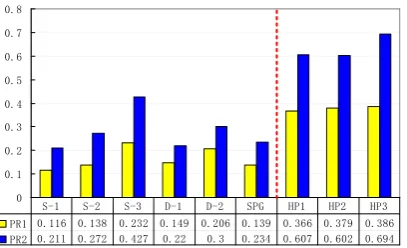
0 0.1 0.2 0.3 0.4 0.5 0.6 0.7 0.8
PR1 0.116 0.138 0.232 0.149 0.206 0.139 0.366 0.379 0.386 PR2 0.211 0.272 0.427 0.22 0.3 0.234 0.607 0.602 0.694 S-1 S-2 S-3 D-1 D-2 SPG HP1 HP2 HP3
Figure 3: Paraphrase rates of the approaches.
6.2 Paraphrase Rate
Human evaluation assesses the quality of para-phrases. However, the paraphrase rates cannot be reflected. A paraphrase that is totally transformed from the source sentence and another that is al-most unchanged may get the same score. There-fore, we propose two strategies, i.e., PR1 and PR2, to compute the paraphrase rate:
P R1(T) = 1−OL(S, T)
L(S) ; P R2(T) =
ED(S, T)
L(S) .
Here, PR1 is defined based on word overlapping rate, in which OL(S, T) denotes the number of
overlapping words between a paraphraseTand its
source sentence S, L(S) denotes the number of
words inS. PR2 is defined based on edit distance,
in whichED(S, T) denotes the edit distance
be-tween T andS. Obviously, PR1 only measures
the percentage of words that are changed from
S to T, whereas PR2 further takes word order
changes into consideration. It should be noted that PR1 and PR2 not only count the correct changes
between S and T, but also count the incorrect
ones. We compute the paraphrase rate for each of the six approaches by averaging the paraphrase rates over the whole test set. The results are shown in the left part of Figure 3.
On the whole, the paraphrase rates of the ap-proaches are not high. In particular, we can see that the paraphrase rate of D-2 is clearly higher than D-1, which is in line with our intention of de-signing D-2. We can also see that the paraphrase rate of S-3 is the highest among the approaches. We find it is mainly because the paraphrases
gen-erated with S-3 contain quite a lot of errors, which contribute most of the changes.
7 Analysis
7.1 Effectiveness of the Proposed Method
Our analysis starts from the candidate paraphrases acquired with the multi-pivot approach. Actu-ally, the results of S-3 reflect the average qual-ity of the candidate paraphrases. A score of 2.78 (See Figure 1) indicates that the candidates are unacceptable according to the human evaluation metrics. This is in line with our expectation that the automatically acquired paraphrases through a two-way translation are noisy. However, the re-sults of S-1 and D-1 demonstrate that, using the selection-based and decoding-based techniques, we can produce paraphrases of good quality. Es-pecially, S-1 gets a score of nearly 4, which sug-gests that the paraphrases are pretty good accord-ing to our metrics. Moreover, our method out-performs SPG built on pre-extracted fine-grained paraphrases. It shows that our method makes good use of the paraphrase knowledge from the large volume of bilingual data underlying the multiple MT engines.
7.2 How to Choose Pivot Languages and MT Engines in the Multi-pivot Approach
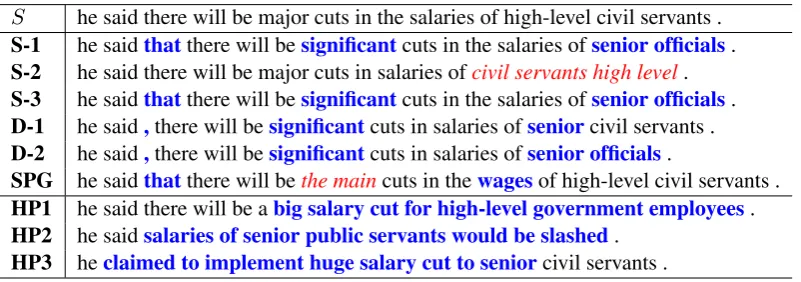
S he said there will be major cuts in the salaries of high-level civil servants . S-1 he saidthatthere will besignificantcuts in the salaries ofsenior officials.
S-2 he said there will be major cuts in salaries ofcivil servants high level.
S-3 he saidthatthere will besignificantcuts in the salaries ofsenior officials.
D-1 he said,there will besignificantcuts in salaries ofseniorcivil servants .
D-2 he said,there will besignificantcuts in salaries ofsenior officials.
SPG he saidthatthere will bethe maincuts in thewagesof high-level civil servants .
HP1 he said there will be abig salary cut for high-level government employees.
HP2 he saidsalaries of senior public servants would be slashed.
HP3 heclaimed to implement huge salary cut to seniorcivil servants .
Table 6: Comparing the automatically generated paraphrases with the human paraphrases.
7.3 Comparing the Selection-based and Decoding-based Techniques
It is necessary to compare the paraphrases gener-ated via the selection-based and decoding-based techniques. As stated above, the selection-based technique can only select a paraphrase from the candidates, while the decoding-based technique can generate a paraphrase different from all can-didates. In our experiments, we find that for about 90% test sentences, the paraphrases gener-ated by the decoding-based approach D-1 are out-side the candidates. In particular, we compare the paraphrases generated by S-1 and D-1 and find that, for about 40% test sentences, S-1 gets higher scores than D-1, while for another 21% test sen-tences, D-1 gets higher scores than S-18. This
indicates that the selection-based and decoding-based techniques are complementary. In addition, we find examples in which the decoding-based technique can generate a perfect paraphrase for the source sentence, even if all the candidate para-phrases have obvious errors. This also shows that the decoding-based technique is promising.
7.4 Comparing Automatically Generated Paraphrases with Human Paraphrases
We also analyze the characteristics of the gener-ated paraphrases and compare them with the hu-man paraphrases (i.e., the other 3 reference trans-lations in the MT evaluation, see Section 5, which are denoted as HP1, HP2, and HP3). We find that, compared with the automatically generated para-phrases, the human paraphrases are more
com-8For the rest 39%, S-1 and D-1 get identical scores.
plicated, which involve not only phrase replace-ments, but also structure reformulations and even inferences. Their paraphrase rates are also much higher, which can be seen in the right part of Fig-ure 3. We show the automatic and human para-phrases for the example sentence of this paper in Table 6. To narrow the gap between the automatic and human paraphrases, it is necessary to learn structural paraphrase knowledge from the candi-dates in the future work.
8 Conclusions and Future Work
We put forward an effective method for para-phrase generation, which has the following con-tributions. First, it acquires a rich fund of para-phrase knowledge through the use of multiple MT engines and pivot languages. Second, it presents a MBR-based technique that effectively selects high-quality paraphrases from the noisy candi-dates. Third, it proposes a decoding-based tech-nique, which can generate paraphrases that are different from the candidates. Experimental re-sults show that the proposed method outperforms a state-of-the-art approach SPG.
References
Colin Bannard and Chris Callison-Burch. 2005.
Para-phrasing with Bilingual Parallel Corpora. In
Pro-ceedings of ACL, pages 597-604.
Regina Barzilay and Lillian Lee. 2003. Learning to Paraphrase: An Unsupervised Approach Using
Multiple-Sequence Alignment. In Proceedings of
HLT-NAACL, pages 16-23.
Peter J. Bickel and Kjell A. Doksum. 1977.
Mathe-matical Statistics: Basic Ideas and Selected Topics. Holden-Day Inc., Oakland, CA, USA.
Igor A. Bolshakov and Alexander Gelbukh. 2004. Synonymous Paraphrasing Using WordNet and
In-ternet. InProceedings of NLDB, pages 312-323.
Chris Callison-Burch, Cameron Fordyce, Philipp Koehn, Christof Monz and Josh Schroeder. 2007.
(Meta-) Evaluation of Machine Translation. In
Pro-ceedings of ACL-2007 Workshop on Statistical Ma-chine Translation, pages 136-158.
Chris Callison-Burch, Philipp Koehn, and Miles Os-borne. 2006. Improved Statistical Machine
Trans-lation Using Paraphrases. In Proceedings of
HLT-NAACL, pages 17-24.
Pablo Ariel Duboue and Jennifer Chu-Carroll. 2006. Answering the Question You Wish They Had Asked: The Impact of Paraphrasing for Question
Answering. InProceedings of HLT-NAACL, pages
33-36.
Hieu Hoang and Philipp Koehn. 2008. Design of the Moses Decoder for Statistical Machine Translation. In Proceedings of ACL Workshop on Software en-gineering, testing, and quality assurance for NLP, pages 58-65.
Lidija Iordanskaja, Richard Kittredge, and Alain Polgu`ere. 1991. Lexical Selection and Paraphrase in a Meaning-Text Generation Model. In C´ecile L. Paris, William R. Swartout, and William C. Mann (Eds.): Natural Language Generation in Artificial Intelligence and Computational Linguistics, pages 293-312.
David Kauchak and Regina Barzilay. 2006.
Para-phrasing for Automatic Evaluation. InProceedings
of HLT-NAACL, pages 455-462.
Philipp Koehn. 2004. Pharaoh: a Beam Search De-coder for Phrase-Based Statistical Machine Transla-tion Models: User Manual and DescripTransla-tion for Ver-sion 1.2.
Philipp Koehn, Franz Josef Och, and Daniel Marcu.
2003. Statistical Phrase-Based Translation. In
Pro-ceedings of HLT-NAACL, pages 127-133.
Raymond Kozlowski, Kathleen F. McCoy, and K.
Vijay-Shanker. 2003. Generation of
single-sentence paraphrases from predicate/argument structure using lexico-grammatical resources. In
Proceedings of IWP, pages 1-8.
Aur´elien Max. 2009. Sub-sentential Paraphrasing by
Contextual Pivot Translation. InProceedings of the
2009 Workshop on Applied Textual Inference, ACL-IJCNLP 2009, pages 18-26.
Franz Josef Och and Hermann Ney. 2000. Improved
Statistical Alignment Models. In Proceedings of
ACL, pages 440-447.
Bo Pang, Kevin Knight, and Daniel Marcu. 2003. Syntax-based Alignment of Multiple Translations: Extracting Paraphrases and Generating New
Sen-tences. InProceedings of HLT-NAACL, pages
102-109.
Kishore Papineni, Salim Roukos, Todd Ward, Wei-Jing Zhu. 2002. BLEU: a Method for Automatic
Eval-uation of Machine Translation. InProceedings of
ACL, pages 311-318.
Richard Power and Donia Scott. 2005. Automatic
generation of large-scale paraphrases. In
Proceed-ings of IWP, pages 73-79.
Chris Quirk, Chris Brockett, and William Dolan. 2004. Monolingual Machine Translation for Paraphrase
Generation. InProceedings of EMNLP, pages
142-149.
Stefan Riezler, Alexander Vasserman, Ioannis
Tsochantaridis, Vibhu Mittal and Yi Liu. 2007. Statistical Machine Translation for Query
Expan-sion in Answer Retrieval. InProceedings of ACL,
pages 464-471.
Yujie Zhang and Kazuhide Yamamoto. 2002.
Para-phrasing of Chinese Utterances. InProceedings of
COLING, pages 1163-1169.
Shiqi Zhao, Xiang Lan, Ting Liu, and Sheng Li. 2009. Application-driven Statistical Paraphrase
Genera-tion. InProceedings of ACL-IJCNLP 2009, pages
834-842.
Shiqi Zhao, Cheng Niu, Ming Zhou, Ting Liu, and Sheng Li. 2008a. Combining Multiple Resources to
Improve SMT-based Paraphrasing Model. In
Pro-ceedings of ACL-08:HLT, pages 1021-1029.
Shiqi Zhao, Haifeng Wang, Ting Liu, and Sheng Li. 2008b. Pivot Approach for Extracting Paraphrase
Patterns from Bilingual Corpora. InProceedings of