Exploring the Data-Driven Prediction of Prepositions in English
Anas Elghafari Detmar Meurers Holger Wunsch Seminar f¨ur Sprachwissenschaft
Universit¨at T¨ubingen
{aelgafar,dm,wunsch}@sfs.uni-tuebingen.de
Abstract
Prepositions in English are a well-known challenge for language learners, and the computational analysis of preposition us-age has attracted significant attention. Such research generally starts out by de-veloping models of preposition usage for native English based on a range of fea-tures, from shallow surface evidence to deep linguistically-informed properties.
While we agree that ultimately a com-bination of shallow and deep features is needed to balance the preciseness of ex-emplars with the usefulness of generaliza-tions to avoid data sparsity, in this paper we explore the limits of a purely surface-based prediction of prepositions.
Using a web-as-corpus approach, we in-vestigate the classification based solely on the relative number of occurrences for tar-get n-grams varying in preposition usage. We show that such a surface-based ap-proach is competitive with the published state-of-the-art results relying on complex feature sets.
Where enough data is available, in a sur-prising number of cases it thus is possible to obtain sufficient information from the relatively narrow window of context pro-vided by n-grams which are small enough to frequently occur but large enough to contain enough predictive information about preposition usage.
1 Introduction
The correct use of prepositions is a well-known difficulty for learners of English, and correspond-ingly the computational analysis of preposition usage has attracted significant attention in re-cent years (De Felice and Pulman, 2007; De Fe-lice, 2008; Lee and Knutsson, 2008; Gamon et al., 2008; Chodorow et al., 2007; Tetreault and Chodorow, 2008a, 2008b).
As a point of reference for the detection of preposition errors in learner language, most of the research starts out by developing a model of preposition usage for native English. For this purpose, virtually all previous approaches em-ploy a machine learning setup combining a range of features, from surface-based evidence to deep linguistically-informed properties. The overall task is approached as a classification problem where the classes are the prepositions and the in-stances to be classified are the contexts, i.e., the sentences with the prepositions omitted.
A focus of the previous literature is on the ques-tion which linguistic and lexical features are the best predictors for preposition usage. Linguistic features used include the POS tags of the sur-rounding words, PP attachment sites, WordNet classes of PP object and modified item. Lexical features used include the object of the PP and the lexical item modified by the PP. Those syntactic, semantic and lexical features are then extracted from the training instances and used by the ma-chine learning tool to predict the missing preposi-tion in a test instance.
with the usefulness of generalizations to avoid data sparsity problems, in this paper we want to explore the limits of a purely surface-based pre-diction of prepositions. Essentially, our ques-tion is how much predictive informaques-tion can be found in the immediate distributional context of the preposition. Is it possible to obtain n-gram contexts for prepositions which are small enough to occur frequently enough in the available train-ing data but large enough to contain enough pre-dictive information about preposition usage?
This perspective is related to that underlying the variation-n-gram approach for detecting errors in the linguistic annotation of corpora (Dickin-son and Meurers, 2003; Dickin(Dickin-son and Meurers, 2005; Boyd et al., 2008). Under that approach, er-rors in the annotation of linguistic properties (lexi-cal, constituency, or dependency information) are detected by identifying units which recur in the corpus with sufficient identical context so as to make variation in their annotation unlikely to be correct. In a sense, the recurring n-gram contexts are used as exemplar references for the local do-mains in which the complex linguistic properties are established. The question now is to what ex-tent basic1 n-gram contexts can also be success-fully used to capture the linguistic properties and relations determining preposition usage, explor-ing the trade-off expressed in the question endexplor-ing the previous paragraph.
To address this question, in this paper we make use of a web-as-corpus approach in the spirit of Lapata and Keller (2005). We employ the Yahoo search engine to investigate a preposition classifi-cation setup based on the relative number of web counts obtained for target n-grams varying in the preposition used. We start the discussion with a brief review of key previous approaches and the results they obtain for the preposition classifica-tion task in native English text. In secclassifica-tion 2, we then describe the experimental setup we used
1While Dickinson and Meurers (2005) also employ
dis-continuous grams, we here focus only on contiguous n-gram contexts. Using discontinuous n-n-gram contexts for preposition prediction could be interesting to explore in the future, once, as a prerequisite for the effective generation of discontinuous n-grams, heuristics have been identified for when which kind of discontinuities should be allowed to arise for preposition classification contexts.
for our exploration and discuss our results in sec-tion 3.
1.1 Previous work and results
The previous work on the preposition prediction task varied in i) the features selected, ii) the num-ber of prepositions tackled, and iii) the training and testing corpora used.
De Felice (2008) presents a system that (among other things) is used to predict the correct prepo-sition for a given context. The system tackles the nine most frequent prepositions in English:of, to, in, for, on, with, at, by, from. The approach uses a wide variety of syntactic and semantic features: the lexical item modified by the PP, the lexical item that occurs as the object of the preposition, the POS tags of three words to the left and three words to the right of the preposition, the grammat-ical relation that the preposition is in with its ob-ject, the grammatical relation the preposition is in with the word modified by the PP, and the Word-Net classes of the preposition’s object and the lex-ical item modified by the PP. De Felice (2008) also used a named entity recognizer to extract general-izations about which classes of named entities can occur with which prepositions. Further, the verbs’ subcategorization frames were taken as features. For features that used lexical sources (WordNet classes, verbs subcategorization frames), only par-tial coverage of the training and testing instances is available.
The overall accuracy reported by De Felice (2008) for this approach is 70.06%, testing on sec-tion J of theBritish National Corpus (BNC)after training on the other sections. As the most exten-sive discussion of the issue, using an explicit set of prepositions and a precisely specified and pub-licly accessible test corpus, De Felice (2008) is well-suited as a reference approach. Correspond-ingly, our study in this paper is based on the same set of prepositions and the same test corpus.
on Encarta encyclopedia and Reuters news text. It operates in two stages: The presence/absence classifier predicts first whether a preposition needs to be inserted at a given location. Then, the choice classifier determines which preposition is to be in-serted. The features that are extracted for each possible insertion site come from a six-token win-dow around the possible insertion site. Those fea-tures are the relative positions, POS tags, and sur-face forms of the tokens in that window. The choice classifier predicts one of 13 prepositions:
in, for, of, on, to, with, at, by, as, from, since, about, than,andother. The accuracy of the choice classifier, the part of the system to which the work at hand is most similar, is 62.32% when tested on text from Encarta and Reuters news.
Tetreault and Chodorow (2008a) present a sys-tem for detecting preposition errors in learner text. Their approach extracts a total of 25 features from the local contexts: the adjacent words, the heads of the nearby phrases, and the POS tags of all those. They combine word-based features with POS tag features to better handle cases where a word from the test instance has not been seen in training. For each test instance, the system predicts one of 34 prepositions. In training and testing performed on the Encarta encyclopedia, Reuters news text and additional training material an accuracy figure of 79% is achieved.
Bergsma et al. (2009) extract contextual fea-tures from the Google 5-gram corpus to train an SVM-based classifier for predicting prepositions. They evaluate on 10 000 sentences taken from the New York Times section of the Gigaword corpus, and achieve an accuracy of 75.4%.
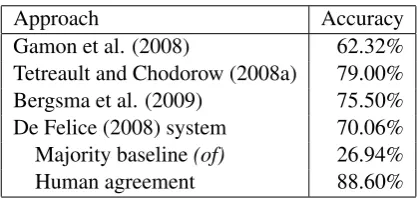
Following De Felice (2008, p. 66), we summa-rize the main results of the mentioned approaches to preposition prediction for native text in Fig-ure 1.2 Since the test sets and the prepositions tar-geted differ between the approaches, such a com-parison must be interpreted with caution. In terms of the big picture, it is useful to situate the results with respect to the majority baseline reported by De Felice (2008). It is obtained by always choos-ingof as the most common preposition in section J of the BNC. De Felice also reports another inter-2The Gamon et al. (2008) result differs from the one
re-ported in De Felice (2008); we rely on the original paper.
esting figure included in Figure 1, namely the ac-curacy of the human agreement with the original text, averaged over two English native-speakers.
Approach Accuracy
Gamon et al. (2008) 62.32%
Tetreault and Chodorow (2008a) 79.00%
Bergsma et al. (2009) 75.50%
De Felice (2008) system 70.06% Majority baseline(of) 26.94%
Human agreement 88.60%
Figure 1: Preposition prediction results
2 Experiments
2.1 Data
As our test corpus, we use section J of the BNC, the same corpus used by De Felice (2008). Based on the tokenization as given in the corpus, we join the tokens with a single space, which also means that punctuation characters end up as sep-arate, white-space separated tokens. We select all sentences that contain one or more prepositions, using the POS annotation in the corpus to iden-tify the prepositions. The BNC is POS-annotated with the CLAWS-5 tagset, which distinguishes the two tagsPRFforof andPRPfor all other preposi-tions.3 We mark every occurrence of these prepo-sition tags in the corpus, yielding one prediction task for each marked preposition. For example, the sentence (1) yields four prediction tasks, one for each of the prepositionsfor, of, from,andinin the sentence.
(1) But forthe young, it is rather a question ofthe scales falling fromtheir eyes, and having nothing to believeinany more.
In each task, one preposition is masked using the special marker -*-MASKED-*-. Figure 2 shows the four marked-up prediction tasks result-ing for example (1).
Following De Felice (2008), we focus our ex-periments on the top nine prepositions in the BNC: of, to, in, for, on, with, at, by, from. For
But -*-MASKED-*-for the young , it is rather a question of the scales falling from their eyes , and having nothing to believe in any more .
But for the young , it is rather a question -*-MASKED-*-of the scales falling from their eyes , and having nothing to believe in any more .
But for the young , it is rather a question of the scales falling
-*-MASKED-*-from their eyes , and having nothing to believe in any more .
But for the young , it is rather a question of the scales falling from their eyes , and having nothing to believe -*-MASKED-*-in any more .
Figure 2: Four prediction tasks for example (1)
each occurrence of these nine prepositions in sec-tion J of the BNC, we extract one predicsec-tion task, yielding a test set of 522 313 instances.
Evaluating on this full test set would involve a prohibitively large number of queries to the Ya-hoo search engine. We therefore extract a ran-domly drawn subset of 10 000 prediction tasks. From this subset, we remove all prediction tasks which are longer than 4000 characters in length, as Yahoo only supports queries up to that length. Finally, in a web-as-corpus setup, the indexing of the web pages performed by the search engine es-sentially corresponds to the training step in a typi-cal machine learning setup. In order to avoid test-ing on the traintest-ing data, we thus need to ensure that the test cases are based on text not indexed by the search engine. To exclude any such cases, we query the search engine with each complete sen-tence that a prediction task is based on and remove any prediction task for which the search engine re-turns hits for the complete sentence. The final test set consists of 8060 prediction tasks.4
2.2 Experimental Setup
Recall that the general issue we are interested in is whether one can obtain sufficient information from the relatively narrow distributional window of context provided by n-grams which are small enough to occur frequently enough in the training data but large enough to contain enough
predic-4For a copy of the test set, just send us an email.
tive information about preposition usage for the instances to be classified. By using a web-as-corpus approach we essentially try to maximize the training data size. For the n-gram size, we ex-plore the use of a maximum order of 7, containing the preposition in the middle and three words of context on either side.
For each prediction task, we successively insert one of the nine most frequent prepositions into the marked preposition slot of the 8060 n-grams obtained from the test set. Thus, for each pre-diction task, we get a cohort consisting of nine different individual queries, one query for each potential preposition. For example, the second prediction task of Figure 2 yields the cohort of nine queries in Figure 3 below, where the candi-date prepositions replace the location marked by
-*-MASKED-*-of. The correct preposition of
is stripped off and kept for later use in the evalua-tion step.
1. rather a question of the scales falling
2. rather a question to the scales falling
3. rather a question in the scales falling
.. .
9. rather a question from the scales falling
Figure 3: Cohort of nine queries resulting for the second prediction task of Figure 2
In cases where a preposition is closer than four words to the beginning or the end of the corre-sponding sentence, a lower-order n-gram results. For example, in the first prediction task in Fig-ure 2, the preposition occurs already as the sec-ond word in the sentence, thus not leaving enough context to the left of the preposition for a sym-metric 7-gram. Here, the truncated asymsym-metric 5-gram “But <prep> the young ,” includ-ing only one word of context on the left would get used.
JSON interface supporting straightforward auto-mated queries. As part of its response to a query, the BOSS service includes thedeephitsfield, which gives an “approximate count that reflects duplicate documents and all documents from a host”.5 In other words, this number is an approx-imate measure of how many web pages there are that contain the search pattern.
With the counts for all nine queries in a cohort retrieved from Yahoo, we select the preposition of the query with the highest count. For the cases in which none of the counts in a 7-gram cohort is greater than zero, we use one of two strategies:
In thebaselinecondition, for all n-gram cohorts with zero counts (5160 out of the 8060 cases) we predict the most frequent preposition of, i.e., the majority baseline. This results in an overall accu-racy of 50%.
In the full back-off condition, we explore the trade-off between the predictive power of the n-gram as context and the likelihood of having seen this n-gram in the training material, i.e., finding it on the web. In this paper we never abstract or generalize away from the surface string (e.g., by mapping all proper names to an abstract name tag; but see the outlook discussion at the end of the pa-per), so the only option for increasing the number of occurrences of an n-gram is to approximate it with multiple shorter n-grams.
Concretely, if no hits could be found for any of the queries in a cohort, we back off to the sum of the hits for the two overlapping 6-grams con-structed in the way illustrated in Figure 4.
[rather a questionofthe scales falling]
⇓
[rather a questionofthe scales]
[a questionofthe scales falling]
Figure 4: Two overlapping 6-grams approximate a 7-gram for back-off.
If still no hits can be obtained after backing off to 6-grams for any of the queries in a cohort, the system backs off further to overlapping 5-grams, and so on, down to trigrams.6
5Cited from http://developer.yahoo.com/ search/boss/boss_guide/ch02s02.html
6When backing off, the left-most and the right-most
tri-3 Results
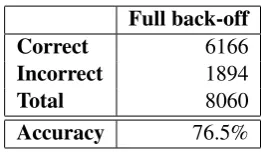
Figure 5 shows the results of the full back-off approach. Compared to the baseline condition, accuracy goes up significantly to 76.5%. Thus, the back-off strategy is effective in increasing the amount of available data using lower-order n-grams. This increase of data is also reflected in the number of cases with zero counts for a cohort, which goes down to none.
Full back-off Correct 6166 Incorrect 1894
Total 8060
Accuracy 76.5%
Figure 5: Overall results of our experiments.
Figure 6 provides a detailed analysis of the back-off experiment. It lists back-off sequences separately for each maximum n-gram order. The prediction tasks for which a full 7-gram can be extracted are displayed in the third column, with back-off orders of 6 down to 3. Prediction tasks for which only asymmetric 6-grams can be ex-tracted follow in column 4, and so on until 4-grams. There are no predictions tasks that are shorter than four words. Therefore, n-grams with a length of less than 4 do not occur.
The “sum” column shows the combined results of the full 7-gram prediction tasks and the pre-diction tasks involving truncated, asymmetric n-grams of lower orders.
There are 6999 prediction tasks for which full 7-grams can be extracted. The remaining 1061 of the 8060 prediction tasks are the cases where the system extracts only asymmetric lower-order n-grams, for the reasons explained in section 2.2.
sum 7-grams 6-grams 5-grams 4-grams
(3 + prep + 3) (truncated 7-gram) (truncated 7-gram) (truncated 7-gram)
Total 8060 6999 656 182 223
Predictions 2900 2195 379 119 207
correct 2495 1931 326 91 147
incorrect 405 264 53 28 60
Requiring back-off 5160 4804 277 63 16
Precision 86% 88% 86% 76.5% 71%
Recall 32.6% 28.7% 79.6% 59.1% 90.2%
Back-off order 6
Predictions 2028 2028
correct 1620 1620
incorrect 408 408
Still requiring back-off 2776 2776
Predict. orders 7+6 4223 4223
correct 3551 3551
incorrect 672 672
Precision 84.1% 84.1%
Recall 56.1% 56.1%
Back-off order 5
Predictions 2180 2020 160
correct 1542 1411 131
incorrect 638 609 29
Still requiring back-off 873 756 117
Predict. orders 7 – 5 6782 6243 539
correct 5419 4962 457
incorrect 1363 1281 82
Precision 79.9% 79.5% 84.8%
Recall 86.1% 86.8% 79.6%
Back-off order 4
Predictions 905 743 106 56
correct 488 382 68 38
incorrect 417 361 38 18
Still requiring back-off 31 13 11 7
Predict. orders 7 – 4 7806 6986 645 175
correct 5998 5344 525 129
incorrect 1808 1642 120 46
Precision 76.8% 76.5% 81.4% 73.7%
Recall 99.5% 99.8% 97.9% 94.9%
Back-off order 3
Predictions 47 13 11 7 16
correct 21 5 7 3 6
incorrect 26 8 4 4 10
Still requiring back-off 0 0 0 0 0
Predict. orders 7 – 3 8060 6999 656 182 223
correct 6166 5349 532 132 153
incorrect 1894 1650 124 50 70
Precision 76.5% 76.4% 81.1% 72.5% 68.6%
Recall 100% 100% 100% 100% 100%
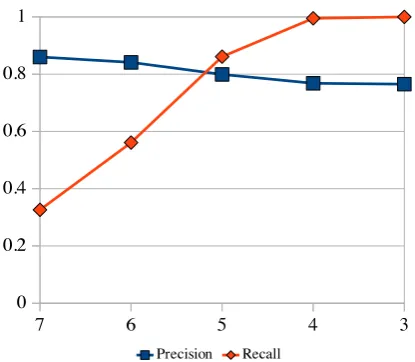
Figure 7: Development of precision and recall in relation to back-off order
Approximating 7-grams with two overlapping 6-grams as the first back-off step provides the evidence needed to correctly predict 1620 addi-tional prepositions, with 408 addiaddi-tional false pre-dictions. The number of correctly solved predic-tion tasks thus rises to 3551, and the number of incorrect predictions rises to 672. This back-off step almost doubles recall (56.1%). At the same time, precision drops to 84.1%. For 2776 pre-diction tasks, a further back-off step is necessary since still no evidence can be found for them. This pattern repeats with the back-off steps that fol-low. To summarize, by adding more data using less restricted contexts, more prediction tasks can be solved. The better coverage however comes at the price of reduced precision: Less specific con-texts are worse predictors of the correct preposi-tion than more specific contexts.
Figure 7 visualizes the development of preci-sion and recall with full and truncated 7-grams counted together as in the “sum” column in Fig-ure 6. With each back-off step, more prediction tasks can be solved (as shown by the rising recall curve). At the same time, the overall quality of the predictions drops due to the less specific con-texts (as shown by the slightly dropping precision curve). While the curve for recall rises steeply, the curve for precision remains relatively flat. The back-off approach thus succeeds in adding data while preserving prediction quality.
As discussed above, we use the same set of prepositions and test corpus as De Felice (2008), but only make use of 8060 test cases. Figure 8 shows that the accuracy stabilizes quickly after about 1000 predictions, so that the difference in the size of the test set should have no impact on the reported results.
Figure 8: The accuracy of the n-gram prediction stabilizes quickly.
4 Conclusions and Outlook
In this paper, we explored the potential and the limits of a purely surface-based strategy of pre-dicting prepositions in English. The use of surface-based n-grams ensures that fully specific exemplars of a particular size are stored in train-ing, but avoiding abstractions in this way leads to the well-known data sparsity issues. We showed that using a web-as-corpus approach maximizing the size of the “training data”, one can work with n-grams which are large enough to predict the oc-currence of prepositions with significant precision while at the same time ensuring that these specific n-grams have actually been encountered during “training”, i.e., evidence for them can be found on the web.
approach which uses the same set of prepositions and the full BNC section J as test set. In broader terms, the result of our surface-based approach is competitive with the state-of-the art results for preposition prediction in English using machine learning to combine sophisticated sets of lexical and linguistically motivated features.
In this paper, we focused exclusively on the impact of n-gram size on preposition prediction. Limiting ourselves to pure surface-based informa-tion made it possible to maximize the “training data” by using a web-as-corpus approach. Return-ing from this very specific experiment to the gen-eral issue, there are two well-known approaches to remedy the data sparseness problem arising from storing large, specific surface forms in train-ing. On the one hand, one can use smaller ex-emplars, which is the method we used as back-off in our experiments in this paper. This only works if the exemplars contain enough context for the linguistic property or relation that we need to capture the predictive power. On the other hand, one can abstract parts of the surface-based train-ing instances to more general classes. The cru-cial question this raises is which generalizations preserve the predictive power of the exemplars and can reliably be identified. The linguistically-informed features used in the previous approaches in the literature naturally provide interesting in-stances of answers to this question. In the fu-ture, we intend to compare the results we ob-tained using the web-as-corpus approach with one based on the Google-5-gram corpus to study us-ing controlled, incremental shallow-to-deep fea-ture development which abstractions or linguistic generalizations best preserve the predictive con-text while lowering the demands on the size of the training data.
Turning to a linguistic issue, it could be use-ful to distinguish between lexical and functional prepositions when reporting test results. This is an important distinction because the information needed to predict functional prepositions typically is in the local context, whereas the information needed to predict lexical prepositions is not nec-essarily present locally. To illustrate, a competent human speaker presented with the sentenceJohn is dependent his brother and asked to fill in
the missing preposition, would correctly pickon. This is a case of a functional preposition where the relevant information is locally present: the ad-jectivedependent selectson. On the other hand, the sentence John put his bag the table is more problematic, even for a human, since both
on and under are reasonable choices; the infor-mation needed to predict the omitted preposition in this case is not locally present. In line with the previous research, in the work in this paper we made predictions for all prepositions alike. In the future, it could be useful to annotate the test set so that one can distinguish functional and lex-ical uses and report separate figures for these two classes in order to empirically confirm their dif-ferences with respect to locality.
References
Bergsma, Shane, Dekang Lin, and Randy Goebel. 2009. Web-scale n-gram models for lexical disam-biguation. InIJCAI’09: Proceedings of the 21st in-ternational jont conference on Artifical intelligence, pages 1507–1512, San Francisco, CA, USA. Mor-gan Kaufmann Publishers Inc.
Boyd, Adriane, Markus Dickinson, and Detmar Meur-ers. 2008. On detecting errors in dependency tree-banks. Research on Language and Computation, 6(2):113–137.
Chodorow, Martin, Joel Tetreault, and Na-Rae Han. 2007. Detection of grammatical errors involv-ing prepositions. InProceedings of the 4th ACL-SIGSEM Workshop on Prepositions, pages 25–30, Prague, Czech Republic, June.
De Felice, Rachele and Stephen Pulman. 2007. Au-tomatically acquiring models of preposition use. In
Proceedings of the 4th ACL-SIGSEM Workshop on Prepositions, pages 45–50, Prague, Czech Republic, June. Association for Computational Linguistics.
De Felice, Rachele. 2008. Automatic Error Detection in Non-native English. Ph.D. thesis, St Catherine’s College, University of Oxford.
Dickinson, Markus and W. Detmar Meurers. 2003. Detecting errors in part-of-speech annotation. In
Proceedings of the 10th Conference of the Euro-pean Chapter of the Association for Computational Linguistics (EACL-03), pages 107–114, Budapest, Hungary.
anno-tation. In Proceedings of the 43rd Annual Meet-ing of the Association for Computational LMeet-inguistics (ACL’05), pages 322–329.
Gamon, Michael, Jianfeng Gao, Chris Brockett, Alexander Klementiev, William Dolan, Dmitriy Be-lenko, and Lucy Vanderwende. 2008. Using con-textual speller techniques and language modeling for esl error correction. InProceedings of IJCNLP, Hyderabad, India.
Lapata, Mirella and Frank Keller. 2005. Web-based models for natural language processing. ACM Transactions on Speech and Language Processing, 2(1):1–30, February.
Lee, John and Ola Knutsson. 2008. The role of pp attachment in preposition generation. In Gelbukh, A., editor,Proceedings of CICLing 2008.
Tetreault, Joel and Martin Chodorow. 2008a. Na-tive judgments of non-naNa-tive usage: Experiments in preposition error detection. In Proceedings of COLING-08, Manchester.