Proceedings of the 22nd International Conference on Computational Linguistics (Coling 2008),pages 1065–1072
An Integrated Probabilistic and Logic Approach to Encyclopedia Relation
Extraction with Multiple Features
∗Xiaofeng YU Wai LAM
Information Systems Laboratory
Department of Systems Engineering & Engineering Management The Chinese University of Hong Kong
Shatin, N.T., Hong Kong
{xfyu,wlam}@se.cuhk.edu.hk
Abstract
We propose a new integrated approach based on Markov logic networks (MLNs), an effective com-bination of probabilistic graphical models and first-order logic for statistical relational learning, to ex-tracting relations between entities in encyclopedic articles from Wikipedia. The MLNs model en-tity relations in a unified undirected graph col-lectively using multiple features, including contex-tual, morphological, syntactic, semantic as well as Wikipedia characteristic features which can cap-ture the essential characteristics of relation extrac-tion task. This model makes simultaneous statisti-cal judgments about the relations for a set of related entities. More importantly, implicit relations can also be identified easily. Our experimental results showed that, this integrated probabilistic and logic model significantly outperforms the current state-of-the-art probabilistic model, Conditional Random Fields (CRFs), for relation extraction from encyclo-pedic articles.
1 Introduction
Relation extraction is a growing area of research that discovers various predefined semantic relations (e.g., visited, associate, and executive) between en-tity pairs in text. As a subtask in Information Ex-traction (IE), this problem has generated much in-terest and has been formulated as part of Message Understanding Conferences (MUC) and Automatic Content Extraction (ACE) Evaluation.
Reliably extracting relations between entities in natural-language documents is still a difficult, un-solved problem. A large number of engineered systems were developed for identifying relations of interest. Recent approaches to this problem
in-∗
The work described in this paper is substantially sup-ported by grants from the Research Grant Council of the Hong Kong Special Administrative Region, China (Project Nos: CUHK4193/04E and CUHK4128/07) and the Direct Grant of the Faculty of Engineering, CUHK (Project Codes: 2050363 and 2050391). This work is also affiliated with the Microsoft-CUHK Joint Laboratory for Human-centric Computing and Interface Technologies.
∗c
2008. Licensed under the Creative Commons Attribution-Noncommercial-Share Alike 3.0 Unportedlicense (http://creativecommons.org/licenses/by-nc-sa/3.0/). Some rights reserved.
clude statistical parsing (Miller et al., 2000), lo-gistic regression (Kambhatla, 2004), feature-based methods (Zhou et al., 2005; Toru et al., 2007), and kernel methods (Zelenkoet al., 2003; Culotta and Sorensen, 2004; Bunescu and Mooney, 2005, 2006).
In text, this usually amounts to examining pairs of entities in a document and determining whether a relation exists between them. In general, the above approaches to relation extraction suffer from the following three difficulties: (1) enumerating all pairs of entities, even when restricted to pairs within a sentence, results in a low density of pos-itive relation examples, (2) these approaches as-sume that relations only exist within document, and classify them independently without considering dependencies between entities. However, this as-sumption does not hold in practice, and ignoring dependencies between entities may lead to reduced performance, and (3) implicit relations can hardly be discovered in these models since they generally exist in cross document and they are only implied by the text. And these are the sorts of relations on which current extraction models perform most poorly.
in which the value of a variable for one instance is highly correlated with the value of the same able on another instance. We show how a vari-ety of well-engineered features can be easily and concisely formulated as first-order logic and incor-porated into MLNs, and we show how implicit re-lations can be easily discovered in this modeling. We apply Gibbs sampling, a widely used Markov chain Monte Carlo (MCMC) algorithm, to perform collective inference in MLNs. Experimental re-sults showed that this model yields substantially better results on encyclopedia relation extraction over the current state-of-the-art probabilistic rela-tion extracrela-tion model, such as Condirela-tional Random Fields (CRFs).
2 Wikipedia
Wikipedia1is the world’s largest free online
ency-clopedia, representing the outcome of a continuous collaborative effort of a large number of volunteer contributors. Virtually any Internet user can cre-ate or edit a Wikipedia webpage, and this “freedom of contribution” has a positive impact on both the quantity (fast-growing number of articles) and the quality (potential mistakes are quickly corrected within the collaborative environment) of this online resource. Currently Wikipedia has approximately 9.25 million articles in more than 200 languages.
We investigate the task of discovering seman-tic relations between entity pairs from Wikipedia’s English encyclopedic articles. The basic entry in Wikipedia is anarticle, which mainly defines and describes an entity (also known as principal en-tity) or an event, and consists of a hypertext docu-ment with hyperlinks to other pages within or out-side Wikipedia. This document mentions some other entities as secondary entities related to the principal entity (Culotta et al., 2006). All the entities are hyper-linked within the text, and the topic of an article usually defines the principal en-tity. Moreover, Wikipedia has the category hier-archy structure which is used to classify articles according to their content. All these characteris-tics make Wikipedia an appropriate resource for the task of relation extraction. In this paper, we predict only relations between the principal entity and each mentioned secondary entity.
An illustrative example of Wikipedia article is shown in Figure 2, where the principal entity Albert Einstein is boxed and in italic font, and
sec-1http://www.wikipedia.org/
Albert Einstein
Albert Einstein (March 14, 1879-April 18, 1955) was a the-oretical physicist. He was born inGermany. His father was
Hermann Einstein, asalesmanandengineer, and his mother wasPauline Einstein. In 1880, the family moved toMunich. Albert attended aCatholic elementary school and finally he was enrolled in the mathematics program atETH Zurich. Ein-stein received theNobel Prize in Physicsfor his services to Theoretical Physics in 1921.
Figure 1: An example of Wikipedia article for rela-tion extracrela-tion. The principal entity is boxed and in italic font, and secondary entities are in italic font.
ondary entities are in italic font. Our goal is to predict what relation, if any, each secondary entity has to the principal entity. For example, there is a job titlerelation between theoretical physicistand Albert Einstein and afatherrelation between Her-mann Einsteinand Albert Einstein, but no relation betweensalesmanand Albert Einstein.
3 Relation Extraction as Sequence Labeling: A Baseline Approach
4 Markov Logic Networks for Collective Relation Extraction
Markov logic networks (MLNs) conduct statisti-cal relational learning(SRL) by incorporating the expressiveness of first-order logic into the flexibil-ity of probabilistic graphical models under a single coherent framework (Richardson and Domingos, 2006). An MLN consists of a set of weighted for-mulae and provides a way of softening first-order logic by making situations, in which not all for-mulae are satisfied, less likely but not impossible. More formally, the probability distribution of a par-ticular truth assignment x to X specified by the ground Markov networkML,C2is given by
P(X =x) = Z1exp Xwini(x)
!
= Z1 Yφi x{i}ni(x) (1)
where X is the set of all propositions describing a world x (i.e. all gliterals formed by grounding the predicates with the constants in the domain),
F is the set of all clauses in the MLN, wi is the
weight associated with clauseFi ∈ F,ni(x)is the
number of true groundings ofFi inx, x{i} is the
true value of the atoms appearing in Fi, Z is the
normalizing partition function, φi is a real-valued
potential function andφi x{i}=ewi.
MLNs model the relation extraction task in a collective manner and take into account the rela-tion types of related entities. Note that this is dif-ferent from other relation extraction methods that predict relations independently without consider-ing the relationship between entities. Attributes can be represented in MLNs as predicates of the form A(x, v), whereAis an attribute,xis an entity, and v is the value of A inx. The relation is a desig-nated attributeC, representable byC(x, v), where visx’s relation. The relations of different entities depend on each other. Classification is now simply the problem of inferring the truth value ofC(x, v)
for allxandvof interest given all knownA(x, v). In this collective modeling, the Markov blanket of C(xi, v)includes otherC(xj, v), even after
condi-tioning on the knownA(x, v). Relations between entities are represented by predicates of the form R(xi, xj).
2The graphical structure ofML,Cis that: there is an edge
between two nodes of ML,C iff the corresponding ground atoms appear together in at least one grounding of one first-order formula.
4.1 Weight Learning
Given a relational database and a set of first-order logic, the weight of each clause can in principle be learned very efficiently by maximizing the pseudo-log-likelihood of this database on the closed world assumption using the limited-memory BFGS algo-rithm (Liu and Nocedal, 1989). These weights re-flect how often the clauses are actually observed in the training data.
To estimate the weights, we maximize the loga-rithm of the conditional likelihood of the training data
X
(xh,xo)∈T
log
p(Xh=xh|Xo =xo)
(2)
whereXh is a list of possible variables andxh are
the corresponding values in the observation. Xh
contains all variables referring to possible ground atoms of entity relations. Xois the set of variables
corresponding to all possible instantiations of the predicates. T is the set of training observations
(xh, xo). For relation extraction, Equation 2 can
be rewritten as
p(Xh =xh|Xo=xo) =
Y
Entity pairs(p,q)
p
Xe(p,q)=xe(p,q)|Xg(p,q)=xg(p,q)
(3) where Xe(p,q) corresponds to the ground atoms, andXg(p,q) is a list of all variables corresponding
to predicates.
With Equation 3, the conditional likelihood in Equation 2 simplifies to
X
(xh,xo)∈T
X
Entity pairs(p,q) log
p xe(p,q)|xg(p,q).
(4) wherep(x|y)is the abbreviation forp(X=x|Y =
y). To calculate the conditional likelihood, we have
p xe(p,q)|xg(p,q)= p xe(p,q), xg(p,q)
p 1, xg(p, q)+p 0, xg(p, q)
4.2 Inference
In order to perform inference over a given MLN, one needs to ground it into its corresponding Markov network (Pearl, 1988). A large number of efficient inference techniques are applicable and the most widely used approximate solution to prob-abilistic inference in MLNs is Markov chain Monte Carlo (MCMC) (Gilks et al., 1996). One such al-gorithm to perform collective inference is called Gibbs sampling. Gibbs sampling starts by assign-ing a truth value to each query gliteral (a ground literal, i.e. one that contains only ground terms). It then proceeds in rounds to re-sample a value for gliteral X, given the truth values of its Markov blanket MBX (i.e. the nodes with which it
par-ticipates in ground clauses).
5 Feature Set
We describe the features used in our model. These features have been shown to be very effective for relation extraction.
Contextual features: Bag-of-words consisting of 4 words to the left and right of the target entity. Part-of-Speech: Part-of-speech tags are obtained using the Stanford POS Tagger3, which used rich
knowledge sources and features in a log-linear model. POS tags with a window size of 4 around the target entity are used.
Morphological features: Such as whether the en-tity is capitalized or contains digits or punctuation, whether the entity ends in some suffixes such as -eerand-ician, etc.
Syntactic features: Syntactic information can lead to significant improvements in extraction accuracy (e.g., Culotta and Sorensen (2004), Bunescu and Mooney (2005)). The POS-tagged corpus is submitted to the Stanford Lexicalized Dependency Parser4 which generates a dependency parse tree
for each sentence and assigns word positions to each word. This parser can also output grammati-cal relations (typed dependency). The grammatigrammati-cal relations are of the form relation(reli, wi, wj),
where reli is one of the fixed set of relations
assigned by the parser, and wi and wj are two
words. The dependency paths, which contain the relevant terms describing the relations between the entity pairs, can be easily extracted. We design a set of first-order formulae that captures some of the most important syntactic phenomena for relation
[image:4.595.312.537.93.383.2]3http://nlp.stanford.edu/software/tagger.shtml 4http://nlp.stanford.edu/software/lex-parser.shtml
Table 1: Representative relation types and corre-sponding keywords.
Relation Keywords
job title secretary, writer, novelist, captain, cartoon-ist, actor, actress, physiccartoon-ist, mathematician, singer, naturalist, architect, musician, physi-cian, professor, journalist, banker, business-man, producer, philosopher, worker
visited from, to, in, at, near, along, visited
associate work for, along with, together with, perform with, work with, colleague, struck with
member of member of, serve in, serve at, serve with, se-lect to, campaign for, ese-lection to, involve in, captain with, play for, fellow of, enter
opus sitcom, picture, film, teleplay, novel, essay, comedy, autobiography, show, movie, plot, drama, painting, book, cartoon, song, music
education university, academy, school, college, insti-tute
executive lead, head, leader, president, chairman, com-mittee, executive, officer, mayor, prince, chair, governor
birth place born in, born at, birth
death place bury in, died in, died at, pass away, inter
nationality American, English, Irish, French, Italian, Australian, Canadian, Jewish, Russian
award award, medal, fellowship, prize, pennant, scholarship
participant during, through
extraction.
Entity features: Important entities are hyper-linked within the text, but they are not classified by type. Entity type is very helpful for relation extrac-tion. For instance, the relation between a person and a location should be visited, birth place, death place, etc., but cannot beexecutive,founder, etc. We identify named entities (person, location and organization) by applying the Stanford Named Entity Recognizer5, a CRF based sequence
label-ing model coupled with well-engineered features including additional distributional similarity fea-tures. The model is trained on data from CoNLL, MUC-6, MUC-7, and ACE, making it fairly robust in practice. Types of other entities (e.g., date, year, and month) can be well classified by rule-based approach due to their relatively fixed forms. Keyword features: Some keywords provide crucial clues for relationships between entity pairs. Consider the following sentence:
Bill Gates is the founder of theMicrosoft Corpo-ration.
If Bill Gates is the principal entity andMicrosoft is the secondary entity, the keyword founder im-plies that there is afounderrelation between them. Similarly, theexecutiverelation may be implied by
keywordslead,head,leader,president,chairman, executive officer, director, and administrator. Moreover, it is particularly interesting that some entities indicate their relation types to correspond-ing principal entities. Entities containcorrespond-ing keywords such assecretary,writer,novelistoractorshow a job titlerelation to their principal entities. We ex-ploit tf-idf approach to co-occurrence (collocation) analysis for keyword extraction. Tf-idf is used to measure the relevance of words with a window size of 8 to each relation between entity pairs. And then we rank the relevance scores with respect to each relation and choose keywords with scores higher than the user-defined threshold.
Semantic features: Due to data sparseness, tf-idf model might be unsatisfactory to extract sufficient keywords. We employ WordNet (Fellbaum, 1998), an online lexical database, to extend and enrich each keyword candidate to its synonyms (synsets). For example, the keyword university for relation education is extended to the set {university, academy, college, institute}. Table 1 shows some representative relation types and keywords using tf-idf method and semantic extension.
Wikipedia characteristic features: Relations only exist between principal entities and secondary entities. There is no relation between any two principal entitiesp,qor two secondary entitiesx,y.
6 First-Order Logic Representation
All the features described in Section 5 can be eas-ily and concisely represented by first-order for-mulae, which are used during the MLN learning. First-order formulae are recursively constructed from atomic formulae using logical connectives and quantifiers. Atomic formulae are constructed using constants, variables, functions, and predi-cates. We give a couple of examples here.
For contextual features, it is common to see two secondary entities x and y occur consecu-tively, accompanied by conjunctions such as “and” or punctuation such as “,”, then probably the two entities may have the same relation to the principal entity p. This can be written in first-order logic form as occur conse(x,y) ⇒
same relation(x,y). For morphological features, suffixes such as -eer and -ician may probably show a job title relation to the princi-pal entity p. We therefore can easily write down the logic person(p) ∧ job suffix(x) ⇒
job title(x,p) to capture this information.
Entity features can be represented using some first-order formulae such as:
person(p)∧location(x)⇒visited(x, p)∨birth place(x,p)∨death place(x ,p)
person(p)∧location(x)⇒!executive (x,p)∧!founder(x,p). The formulafound er key(x,p)⇒ founder relation(x,p) can be used for keyword features. And Wikipedia characteristic features can be well and easily expressed by the logicprincipal(p)
∧ principal(q) ⇒ no relation(p,q) and secondary(x) ∧ secondary(y) ⇒
no relation(x,y).
It is worth noticing that some features can be combined in first-order logic formulation. For ex-ample,person(p)∧organization(x)∧f ounder key(x,p)⇒founder relation( x,p)means if there is afounderkeyword between a person and an organization, probably there is a founderrelation between them.
7 Implicit Relation Extraction
Implicit relations are those that do not have direct contextual evidence. Implicit relations generally exist in different paragraphs, or even across doc-uments. They require additional knowledge to be detected. Notably, these are the sorts of relations that are likely to have significant impact on per-formance. A system that can accurately discover knowledge that is implied by the text will effec-tively provide access to the implications of a cor-pus. Unfortunately, extracting implicit relations is challenging even for current state-of-the-art rela-tion extracrela-tion models.
We show that MLNs can enable this technol-ogy. By employing the first-order logic formalism, the implicit relations can be easily discovered from text. Since these formulae will not always hold, we would like to handle them probabilistically by estimating the confidence of each formula. One
Table 2: Examples of first-order logic for implicit relation extraction.
wife(x,y)⇒husband(y,x)
of the benefits of the MLN probabilistic extraction model is that confidence estimates can be straight-forwardly obtained.
Consider the following 2 sentences in Wikipedia articles:
1. On November 4, 1842 Abraham Lincoln marriedMary Todd.
2. Abraham Lincoln had a son named Robert Todd Lincolnand he was born in Springfield, Illinois on 1 August 1843.
State-of-the-art extraction models may be able to detect the wife relation between Mary Todd and Abraham Lincoln, and the son relation between Robert Todd Lincoln and Abraham Lincoln suc-cessfully from local contextual clues. However, in the descriptive article of Robert Todd Lincoln in Wikipedia, Robert Todd Lincoln becomes the principal entity, and the mother relation between Mary Todd and Robert Todd Lincoln is only im-plied by the text and it is an implicit relation. First-order formalism allows the representation of deep and relational knowledge. Using the logic wife(x,y)∧son(z,y) ⇒ mother(x,z), the relational knowledge in the above example can be easily captured to infer the implicit relation. These formulae are generally simple, and capture important knowledge for implicit relation extrac-tion. Examples of first-order logic to infer implicit relations are listed in Table 2.
8 Experiments
8.1 Data
We use the same dataset as in (Culottaet al., 2006) to conduct our experiments. This dataset consists of 1127 paragraphs from 441 pages from the on-line encyclopedia Wikipedia with 4701 relation in-stances and 53 relation types labeled. Table 3 shows the relation types and corresponding fre-quencies of this dataset.
This dataset was split into training and testing sets (70%-30% split), attempting to separate the en-tities into connected components. There are still occasional paths connecting entities in the training set to those in the testing set, and we believe this methodology reflects a typical real-world scenario.
8.2 Results and Discussion
[image:6.595.309.530.104.332.2]We design 38 first-order logic formulae (15 for-mulae are used for implicit relation extraction) to
Table 3: Statistics of relation types and correspond-ing frequencies.
Relation Frequency Relation Frequency job title 379 daughter 35 visited 368 husband 33 birth place 340 religion 32 associate 326 influence 31 birth year 287 underling 27 member of 283 sister 20 birth day 283 grandfather 20 opus 267 ancestor 19 death year 210 grandson 18 death day 199 inventor 15 education 185 cousin 13 nationality 148 descendant 11 executive 127 role 10 employer 111 nephew 9 death place 93 uncle 6 award 86 supported person 6 father 84 granddaughter 6 participant 81 owns 4 brother 71 great grandson 4
son 68 aunt 4
associate competition 58 supported idea 3 wife 57 great grandfather 3 superior 54 gpe competition 3 mother 50 brother in law 2 political affiliation 44 grandmother 1 friend 43 discovered 1 founder 43 Overall 4701
construct the structure of MLNs. Using the fea-tures described in Section 5, we train MLNs using a Gaussian prior with zero mean and unit variance on each weight to penalize the pseudo-likelihood, and with the weights initialized at the mode of the prior (zero). The features specify a ground Markov network (e.g., ground atoms) containing one feature for each possible grounding of a first-order formula. Inference is performed for answer-ing the query predicates, given the evidence pred-icates and other relations that can be deterministi-cally derived. We apply Gibbs sampling to predict relations of entity pairs simultaneously.
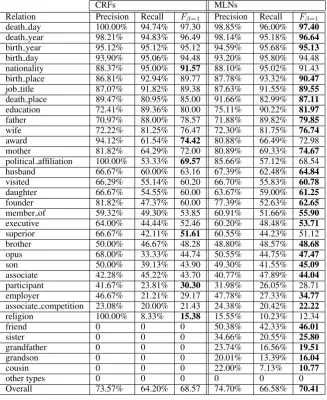
Table 4 presents the performance of our rela-tion extracrela-tion system based on MLNs compared to CRFs for different types of relations. We use the same set of features for both MLNs and CRFs. For MLNs, all the features are represented using first-order logic. It shows that the MLN system per-forming collective relation prediction and integrat-ing implicit relation extraction yields substantially better results, leading to an improvement of up to 1.84% on the overall F-measure over the current state-of-the-art CRF model. The improvement is statistically significant (p <0.05with a 95% con-fidence interval) according to McNemar’s paired tests.
Table 4: Comparative relation extraction performance. Both CRFs and MLNs are tested on the same set of features in Section 5.
CRFs MLNs
Relation Precision Recall Fβ=1 Precision Recall Fβ=1
death day 100.00% 94.74% 97.30 98.85% 96.00% 97.40
death year 98.21% 94.83% 96.49 98.14% 95.18% 96.64
birth year 95.12% 95.12% 95.12 94.59% 95.68% 95.13
birth day 93.90% 95.06% 94.48 93.20% 95.80% 94.48
nationality 88.37% 95.00% 91.57 88.10% 95.02% 91.43
birth place 86.81% 92.94% 89.77 87.78% 93.32% 90.47
job title 87.07% 91.82% 89.38 87.63% 91.55% 89.55
death place 89.47% 80.95% 85.00 91.66% 82.99% 87.11
education 72.41% 89.36% 80.00 75.11% 90.22% 81.97
father 70.97% 88.00% 78.57 71.88% 89.82% 79.85
wife 72.22% 81.25% 76.47 72.30% 81.75% 76.74
award 94.12% 61.54% 74.42 80.88% 66.49% 72.98
mother 81.82% 64.29% 72.00 80.89% 69.33% 74.67
political affiliation 100.00% 53.33% 69.57 85.66% 57.12% 68.54
husband 66.67% 60.00% 63.16 67.39% 62.48% 64.84
visited 66.29% 55.14% 60.20 66.70% 55.83% 60.78
daughter 66.67% 54.55% 60.00 63.67% 59.00% 61.25
founder 81.82% 47.37% 60.00 77.39% 52.63% 62.65
member of 59.32% 49.30% 53.85 60.91% 51.66% 55.90
executive 64.00% 44.44% 52.46 60.20% 48.48% 53.71
superior 66.67% 42.11% 51.61 60.55% 44.23% 51.12
brother 50.00% 46.67% 48.28 48.80% 48.57% 48.68
opus 68.00% 33.33% 44.74 50.55% 44.75% 47.47
son 50.00% 39.13% 43.90 49.30% 41.55% 45.09
associate 42.28% 45.22% 43.70 40.77% 47.89% 44.04
participant 41.67% 23.81% 30.30 31.98% 26.05% 28.71
employer 46.67% 21.21% 29.17 47.78% 27.33% 34.77
associate competition 23.08% 20.00% 21.43 24.38% 20.42% 22.22
religion 100.00% 8.33% 15.38 15.55% 10.23% 12.34
friend 0 0 0 50.38% 42.33% 46.01
sister 0 0 0 34.66% 20.55% 25.80
grandfather 0 0 0 23.74% 16.56% 19.51
grandson 0 0 0 20.01% 13.39% 16.04
cousin 0 0 0 22.00% 7.13% 10.77
other types 0 0 0 0 0 0
Overall 73.57% 64.20% 68.57 74.70% 66.58% 70.41
Since these relations can be easily identified us-ing the distinct contextual evidence. However, some relations (e.g., role, owns, etc.) can hardly be extracted. One possible reason is the lack of training data (these relations occur rarely in the dataset). Among all the 53 relation types in the dataset, MLNs successfully extract 34 relations, while CRFs can only detect 29. For all the 34 rela-tions listed in Table 4, MLNs outperform CRFs on 27 types of them. It is particularly interesting that MLNs can successfully predict relationsfriend, sis-ter, grandfather, grandson, and cousin, whereas CRFs cannot. CRFs perform relation extraction sequentially without considering connections be-tween entities. This may lead to the label incon-sistency problem. For example, CRF sometimes fails to label thefatherrelation betweenGeorge H. W. Bush and George W. Bush. Implicit relations can hardly be investigated in this sequence
label-ing model. These disadvantages limit the ability of CRFs for relation extraction to a large extent.
9 Related Work
from the Wikipedia structure and by the analysis of Wikipedia text. In this approach, a syntactic tree that reflects the relation between a given entity pair was built, and a tree-mining algorithm was used to identify the basic elements of syntactic structure of sentences for relations. This approach mainly relies on syntactic structures to extract relations. Syntac-tic structures are important for relation extraction, but insufficient to extract relations accurately. The obtained F-measure was only 37.76, which shows that there is a large room for improving. To the best of our knowledge, our approach is the first at-tempt at using MLNs for relation extraction from Wikipedia which achieves state-of-the-art perfor-mance.
We mention some other related work. Bunescu and Mooney (2007) presented an approach to ex-tract relations from the Web using minimal super-vision. Rosenfeld and Feldman (2007) presented a method for improving semi-supervised relation extraction from the Web using corpus statistics on entities. Our work is different from these research work. We investigate supervised relation extraction from Wikipedia based on probabilistic and logic in-tegrated graphical models.
10 Conclusion
We summarize the contribution of this paper. First, we propose a new integrated model based on MLNs, which provide a natural and systematic way by modeling entity relations in a coherent undi-rected graph collectively and integrating implicit relation extraction easily, to extract relations in en-cyclopedic articles from Wikipedia. Second, we design multiple features which can be concisely formulated by first-order logic and exploit the col-lective inference algorithm (Gibbs sampling) to predict relations between entity pairs simultane-ously. Third, our system achieved significantly bet-ter results compared to the current state-of-the-art probabilistic model for relation extraction from en-cyclopedic articles.
Having established this relation extraction model, our next step will be to evaluate it on larger datasets, where we expect collective relation ex-traction and implicit relation discovery to be even more interesting.
References
Razvan C. Bunescu and Raymond J. Mooney. A shortest path dependency kernel for relation extraction. InProceedings of HLT-EMNLP 2005, pages 724–731, Vancouver, British Columbia, Canada, 2005.
Razvan C. Bunescu and Raymond J. Mooney. Subsequence kernels for relation extraction. In Y. Weiss, B. Sch¨olkopf, and J. Platt, editors,Advances in Neural Information Pro-cessing Systems 18, pages 171–178. MIT Press, Cam-bridge, MA, 2006.
Razvan C. Bunescu and Raymond J. Mooney. Learning to extract relations from the Web using minimal supervision. InProceedings of ACL-07, pages 576–583, Prague, Czech Republic, June 2007.
Aron Culotta and Jeffrey Sorensen. Dependency tree ker-nels for relation extraction. In Proceedings of ACL-04, Barcelona, Spain, 2004.
Aron Culotta, Andrew McCallum, and Jonathan Betz. Inte-grating probabilistic extraction models and data mining to discover relations and patterns in text. InProceedings of HLT-NAACL 2006, pages 296–303, New York, 2006. Christiane Fellbaum, editor. WordNet: An Electronic Lexical
Database. The MIT Press, 1998.
W.R. Gilks, S. Richardson, and D.J. Spiegelhalter. Markov chain Monte Carlo in practice. Chapman and Hall, Lon-don, UK, 1996.
Nanda Kambhatla. Combining lexical, syntactic, and semantic features with maximum entropy models for extracting rela-tions. InProceedings of ACL-04, Barcelona, Spain, 2004. John Lafferty, Andrew McCallum, and Fernando Pereira.
Conditional random fields: Probabilistic models for seg-menting and labeling sequence data. In Proceedings of ICML-01, pages 282–289. Morgan Kaufmann, San Fran-cisco, CA, 2001.
Dong C. Liu and Jorge Nocedal. On the limited memory BFGS method for large scale optimization. Mathematical Programming, 45:503–528, 1989.
Scott Miller, Heidi Fox, Lance Ramshaw, and Ralph Weischedel. A novel use of statistical parsing to extract in-formation from text. InProceedings of NAACL-2000, pages 226–233, Seattle, Washington, 2000.
Dat P. T. Nguyen, Yutaka Matsuo, and Mitsuru Ishizuka. Re-lation extraction from Wikipedia using subtree mining. In
Proceedings of AAAI-07, pages 1414–1420, Vancouver, British Columbia, Canada, 2007.
Dat P. T. Nguyen, Yutaka Matsuo, and Mitsuru Ishizuka. Sub-tree mining for relation extraction from Wikipedia. In Pro-ceedings of HLT-NAACL 2007, pages 125–128, Rochester, New York, 2007.
Judea Pearl. Probabilistic reasoning in intelligent systems: Networks of plausible inference. Morgan Kaufmann Pub-lishers Inc., San Francisco, CA, 1988.
Matthew Richardson and Pedro Domingos. Markov logic net-works.Machine Learning, 62(1-2):107–136, 2006. Benjamin Rosenfeld and Ronen Feldman. Using corpus
statis-tics on entities to improve semi-supervised relation extrac-tion from the Web. InProceedings of ACL-07, pages 600– 607, Prague, Czech Republic, June 2007.
Hirano Toru, Matsuo Yoshihiro, and Kikui Genichiro. Detect-ing semantic relations between named entities in text usDetect-ing contextual features. InProceedings of ACL-07, pages 157– 160, Prague, Czech Republic, June 2007.
Dmitry Zelenko, Chinatsu Aone, and Anthony Richardella. Kernel methods for relation extraction.Journal of Machine Learning Research, 3:1083–1106, 2003.