Thesis by Wen Kuan Lin
In Partial Fulfillment of the Requirements For the Degree of
Doctor of Philosophy
California Institute of Technology Pasadena, California
1969
ACKNOWLEDGMENTS
I would like to thank the faculty and the staff of Kellogg Radi-ation Laboratory for the efforts that have made this work possible. In particular, special thanks must go to Professor R. W. Kavanagh who has led the interest of studying these reactions and has given me his continued guidance and encouragement, and also to Professor T. A. Tombrello for his constant interest and his close supervision during the period when Professor Kavanagh was away in France. The author is particularly grateful to Dr. F. Scheibling for his active participation in these experiments and for his introduction to some of the useful computing techniques. The part on the theoreti-cal interpretations has profited from the discussions with Dr. K. Nagatani and Dr. K. Kolltveit.
Extra special thanks must go to my wife, Bella, for her patience and confidence and to my mother who is always a source of inspiration.
ABSTRACT
The a-particle energy spectra from the bombardment of 7Li with 9. 1-MeV protons have been obtained at 2. 5° ::S 6 ::S 120°. The
a
high-energy ends of the spectra are interpreted as due to the 1S p
+
3H final-state interaction through the first excited state of 4He at 20. 06 MeV. The factored-wave-function method is used to de-duce the resonance parameters of this state. Consistency in the use of this method is obtained by a PWBA calculation based on the triton-transfer mechanism to account for the forward-peaking in the angular distribution. Coincidence measurements between a-particles and the other charged a-particles give additional evidence for the 0+
assignment to the state, and indicate that the a+
3H and a+
H final-state interactions are important as the 4He excitation energy gets higher. To reduce the effects of these final-state in-teractions, the reaction D(3He, p), at a 3He bombarding energy of 16. 5 MeV, has been investigated. The protons emitted from the reaction have been measured ate
=
30° in coincidence with thep
other charged particles. Angular correlations have been obtained for 6. 6 Me V ::S E ::S 8. 6 Me V, and compared with a modified Born
p
PART
I.
II.
III.
IV.
TABLE OF CONTENTS
TITLE
INTRODUCTION
EXPERIMENTAL DISCUSSIONS A. The Reaction 7Li(p, a)
1. Target Preparation 2. Particle Spectra 3. Target Thickness
4. 7Li(p, a 0 ) Angular Distribution
5. Single a-Particle Energy Spectra 6. Coincidence Measurements
B. The Reaction D(3He, p) 1. Target Preparation
2. Particle Spectra 3. Angle Cali bra ti on
4. Coincidence Measurements
KINEMATICS AND DA TA REDUCTION
A. Three -body Kinematics
B. Normalization
THEORETICAL INTERPRETATION
A. Interaction in the Final State of a Reaction B. Resonance Parameters of the First Excited
State of ~e
C. Triton-transfer Reaction Mechanism in the Reaction 7Li(p, a)
D. A Modified Born Approximation Calculation for the Reaction D(3He, p)
PART TITLE PAGE
V. DISCUSSION OF RESULTS
62
APPENDIX A. PARAMETRIZATION OF THE PHASE SHIFTS 68 APPENDIX B. A SEARCH FOR THE LEAST SQUARE BY
ITERATIONS 74
APPENDIX C. THE SPIN-ISOSPIN OVERLAPS AND THE
SPACE INTEGRALS IN THE MODIFIED BORN
AP-PROXIMATION CALCULATION FOR THE REACTION
D(3He, p)
REFERENCES
TABLES
FIGURES
77 85
90
The question of the existence of excited states of the
a-parti-cle was first raised by Crane, Delsasso, Fowler and Lauritsen (1935)
A series of very energetic y-rays with energies as high as 16 MeV
were detected in a cloud chamber, when a 7Li target was bombarded with 1-Me V protons. Those y-rays were attributed to the decay of
a-particles produced in excited states. Using a sum-rule argument,
Feenberg ( 1936), Bethe and Bacher ( 1936) pointed out that the
a-particle may possess excited states. An upper energy limit of 20
MeV was proposed. As was shown later by Austern (1960), these
calculations suffer from the fact that the a-particle radius and the
nature of nuclear forces were inadequately known in early 1935.
When the appropriate corrections are made, the upper limit rises
to 50 Me V, indicating that the existence of an excited bound state is
not probable.
One of the first indications of an excited state of 4He at about
20 MeV was suggested by Frank and Gammel ( 1955), who considered
a 1S resonance at 20.44 MeV to be necessary to explain the energy dependence of the p+3H elastic-scattering cross section. In agree-ment with this, Bergman et al. (1958) also found a 1S resonance at
20. 1 MeV essential to account for the observed departure of the
3
He(n, p)3H reaction cross section from a l/v law. Stronger evi-dence for such a resonance was later given by Werntz (1962) in
his analysis of the neutron energy spectra from the reaction 3H(d,n) [Lefevre et al., 1962; Poppe et al., 1963]. A strong 1S p+3H inter-action in the final state gives a maximum as required by the data at
the high-energy end of the neutron energy spectra. Interpreting the
interaction as a resonance, the resonance energy was found at
concerned is a state of definite isobaric spin.
The assignment of an isobaric spin to this resonance
stimu-lates various interesting experimental and theoretical efforts and
yields useful knowledge about the mass-four system. If the
reso-nance was a T
=
1 state, the analog 4Li should be seen also as an s-wave resonance at about 0. 36 MeV (c.m.) in the p+3He system and4
H would be stable against neutron emission by about 0. 18 Me V. The experiments of 4H(i)- ii)4He [Spicer, 1963, Nefkens et al., 1964],
4H(i)-ii)4
He':'[Janecke, 1965] and 3H(d,p)4H [Rogers et al., 1964] failed to establish any particle stable 4H state. The phase-shift analysis of the n+3H elastic scattering cross section and polariza-tion data by Tombrello (1966) also indicated that 4H neither possesses particle-stable states nor low...-lying resonances except for two broad
p-wave resonances at higher energies (3. 4 MeV and 5. 1 MeV).
Similar results from the p+3He elastic scattering were obtained for
the 4Li system. They include Frank and Gammel' s original work,
and the phase-shift analyses of Tombrello (1962, 1965) and Kavanagh
and Parker (1966). The two corresponding p-wave resonances were
also found by Tombrello at 4. 7 MeV and 6. 2 MeV in the p+3He
sys-tem. Taking the coulomb interaction into account, Tombrello's
results suggested that the first T
=
1 state in 4He should appear asa p-wave resonance with an excitation energy higher than 24 MeV.
The recent phase-shift analyses by Meyerhof and McElearney
(1965) and by Balashko, Kurepin and Barit (1966) also confirmed the
1
S resonance and showed an increase in p-wave phase shift with
energy. One therefore believes that this 1S resonance at 20 MeV
has isobaric spin T
=
0 [assuming isobaric-spin conservation, areported by Hungerford et al.
U
968) from the reaction 4He( a, a)4He':'],and that the T = 1 states may exist at higher excitation energies in
p-wave states. This speculation was also supported by the theoretical
shell-model calculations of deShalit and Walecka ( 1966) and Kramer
and Moshinsky ( 1966). The calculation, however, predicts a series
of-T = 0 negative-parity states around 22 MeV. Whether the
ob-served increase in p-wave phase shift corresponds to a T
=
0 orT
=
1 state is still a question requiring further investigations.Besides the reaction 3H(d,n), the excited states of 4He were
studied by many other three - body reactions. Young and Ohlsen ( 1964),
using 6 to l 0 MeV deuteron beams and 3He gas targets, obtained the
proton energy spectra from the mirror reaction 3He(d, p) over
labor-atory angles from 14° to 30°. The peak close to the highest-energy
end of the spectra was also identified as due to the 0 +resonance of
the p+3H final-state interaction. Using a deuterated polyethylene
foil target and a 3He beam from a 60-in cyclotron, Donovan (1965)
and Parker et al., ( 1965) measured the protons rn coincidence with
the 3H or the 3He. Another excited state in 4He at 21. 2 Me V of 1. 1
width was found, in addition to the
o+
resonance discussed previously.Taking these results, Cerny et al. (1965) were able to resolve a
third small peak at 22. 5 MeV in the 3He energy spectra from the
reaction 6Li(p, 3He). The state that gives rise to this peak, however,
is not certain, since no such peak was seen also in Cerny's
a-particle energy spectra from the 7Li(p, a) reaction.
The present work started with the purpose of re-examining
the reaction 7Li(p, a) by using the tandem electrostatic accelerator
and the 61-cm magnetic spectrometer. With better energy resolution
and particle identification, it was believed possible to deduce the
+
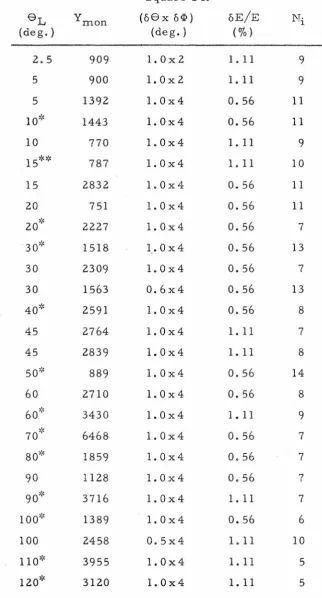
22 MeV, if any. The a-particle energy spectra taken at 9.1-MeV
bombarding energy at various angles ranging from 2. 5° to 120°
show consistent evidence of the existence of the 0 + state in the 4He
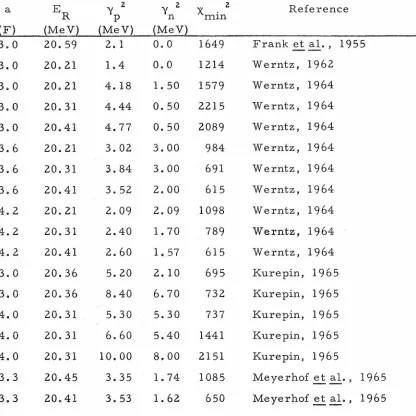
system. The obtained resonance parameters and therefore the 1S
p+3H scattering phase shifts are in good agreement with the published
values derived from other reactions.
The angular distribution of the a-particle group leading to this
+
0 state, in contrast to Cerny's results obtained at 43. 7-MeV proton
bombarding energy, turns out to be very different from that for the
ground state a-particle group. The forward peaking in the angular
distribution indicates the importance of the triton-pick-up process.
Other peaks which may contribute evidence for the existence
of higher excited 4He states were also seen in the spectra taken at
smaller angles. But as the coincidence measurements to be de
-scribed have shown, the strong a+3H, a+H and possibly a+N
final-state interactions become important as the energy of the detected
a-particles gets smaller. These make the deduction of any useful
information about the p+3H or n+3He interaction very difficult.
The coincidence measurements give the angular correlations
of the a-particle and other charged particles from the reaction, e.g.,
between a-particle and 3He in 7Li+p-->- a+3He+n. When the a-particle
momentum was chosen such that there was 20. 014.,.MeV excitation
energy in the recoil 4He system, the correlations obtained can be
interpreted as if the recoil 4He system were decaying isotropically
+
in its center-of-mass system. This strongly confirms the 0
assign-ment of the first excited state of 4He. But when the a-particle
momentum was chosen such that the excitation energy of the recoil
4He system was 21. 272 MeV, the protons were found to be very
This corresponds to the situation that the third particle, i.e., the
triton, is interacting strongly with the a-particle through the 4. 63-MeV excited state of 7Li. Similarly the a+H final-state interaction via the ground state of 5Li and possibly the a+N final-state interaction through the ground state of 5He were also seen in the a-3H and a-3 He correlations, respectively.
To reduce the effects of such competing final-state inter-actions, the reaction D(3He, p) was then investigated. Because the phase shifts of the singlet two-nucleon system stay relatively small at low energies, it was believed that the final-state interactions in
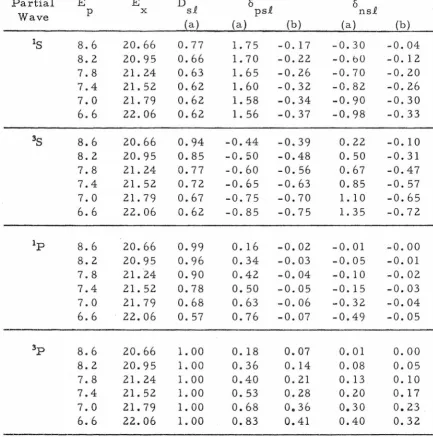
the diproton and singlet deuteron system are not as strong as those of interest. Using 16. 5-MeV 3He bombarding energy, the protons were detected at 30° with respect to the beam. The angular correla-tions of the other charged particles were obtained at proton energies ranging from 6. 6 MeV to 8. 6 MeV in steps of 0. 4 MeV. They all had an axis of symmetry along the momentum _of the re coil 4He sys -tern and suggested the importance of the 3He stripping reaction mechanism. A modified Born approximation calculation [Yu and Meyerhof, 1966] based on this mechanism was made to estimate the relative amplitudes of producing the final-state interacting pair of particles ins-wave and p-wave states. It was found that both the angular and energy correlations and the ratio of the contributions from p+3H to n+3He interaction can be reasonably well reproduced, if the p+3H phase shifts of Meyerhof and McElearney (1965) and the n+3He phase shifts of Bransden et aL (1956) were used to describe the respective final-state interactions.
Very recently, assuming the isobaric spm invariance, Werntz and Meyerhof ( 1968) have made a R-matrix analysis of the 4He system
cross section and the neutron polarization data from the reaction
3
H(p, n)3He. The 0 and 2 assignments to the second and third
T
=
0 excited states are also consistent with p-wave interactionsobserved in this work.
In Part II the experimental details and the data obtained are
discussed. The data reduction along with the kinematics involved is
described in Part III. The assumptions of the Watson-Midgal
ap-proximation in treating the interaction in final state of a three-body
reaction and the applications of such an approximation for
data-analyse s are discussed in Part IV. A summary and discussion of
the results is presented in Part V. The appendices are included to
II. EXPERIMENTAL DISCUSSIONS
The 61- cm double -focusing magnetic spectrometer employed
in the present experiments is used in conjunction with the ONR-CIT
tandem accelerator. It has been described in detail by Groce (1963).
With the installation of a nuclear magnetic resonance (NMR)
magneto-meter, the spectrometer was carefully calibrated by McNally (1966)
in his Q-value measurements. When a particle of mass M and of
charge Z passes through the magnet, its kinetic energy E, as a
function of the magnetometer frequency f is given by
M
E
=
k f 2 Z 2_p_ (
1 - E ) ,M 2Mc2
where M is the proton mass and k is a parameter to be determined
p
experimentally. Because of the location of the magnetometer and the
dependence of the magnetic field profile on the field strength, k was
found to increase by 0. 88% as the frequency changes from 20 MHZ
to 44 MHZ. A conversion table from frequency to energy,
con-structed by using two measured k values for two separate frequency
ranges, was used in all the energy measurements of these expe
ri-ments. A correction to this table, which is less than 30 keV for
both protons and a-particles, was made at the frequencies around
33. 8 MHZ. This is the frequency where the division into two
sepa-rate frequency ranges occurs.
Disregarding the relativistic correction, particles of the
same kinetic energy and of the same Z2 /M will correspond to one
magnetometer frequency. Another measurement, usually the energy
loss of the particle in certain stopping material, is needed to remove
this ambiguity for proper particle identification. This is done by
E-counter on the focal plane of the magnetic spectrometer. As the energy loss is roughly inversely proportional to the particle kinetic energy, the conditions, such as the bias on the 6E-counter or the stopping-foil thickness, must be suitably adjusted as the energy changes from one range to another. To make these adjustments more manageable, a single surface-barrier counter (200 mm2,
140µ thick at 50-volts maximum bias) was used. Using thin nickel foil as the stopping material, a-particles of energy as low as 900 keV could be separated out from the protons. As seen from Figure 2, the measurement of low energy a-particles by the spectrometer was limited by the presence of continuously distributed pulses be-low 600 ke V. From the width of proton group, the over all ele c-tronic noise was estimated to be less than 250 keV. Those continu-ously distributed pulses probably come from the randomly
scattered particles by the wall of the spectrometer. The energy resolution oE/ E of the spectrometer, controlled by a slit of adjust-able size in front of the counter, was set either at 1. 11
%
or 0. 56%. The entrance slits, target chamber, and target holder used have been discussed in detail in Groce 1 s work, and no further descriptionwill be given he re.
A. The Reaction 7Li(p, a).
In order to investigate the effects of p+3H and n+3He
final-state interactions on the a-particle energy spectra, a high
bom-barding energy is desirable. The a-particles can then escape from
the recoil pair of particles with large relative velocity without
inter-acting with either particle of the pair. Without knowing anything
about the reaction mechanism beforehand, one wishes, however, to
choose a beam energy such that the compound system of the target 7Li
nucleus plus the incident proton may have a resonance (for increased
yield). Thus the proton bombarding energy was chosen to be 9. 1 MeV,
corresponding to the 2 + 25. 2-MeV excited state of 8Be [Lauritsen and
Ajzenberg-Selove, 1966].
The 9. 1-MeV proton beam was obtained from ONR-CIT
tan-dem accelerator. A negative proton beam - 20 µA was extracted
from the negative ion source and was stripped to a positively charged
beam at the center terminal of the tandem. It was then analyzed by
a 86. 3-cm uniform 90° -rnagnet. When the object and image slits were
set at 3. 81 mm, and the beam-defining slits in front of the target
chamber were set at 1. 53 mm along the horizontal and vertical
di-rection, a beam of - 1 µA was normally obtainable on target.
In the target chamber, there was an additional surface-barrier
counter. Except in the coincidence measurements, it was fixed at
145° with respect to the beam direction and measured the flux x
tar-get density of the reaction. An accurate integration was thus not
re-quired except for the runs during which the target thickness was
being measured.
1. Target preparation.
metal in the target-chamber furnace illustrated by Groce ( 1963). The lithium metal in a tantalum boat was preheated to eliminate the kerosene in which the lithium had been stored. As the current through the boat increases, the pressure of the target chamber will rise suddenly when one of the compounds in the target material starts to evaporate. A compound, presumedly the lithium hydroxide which has a boiling point considerably lower than that of the lithium metal, was found to evaporate first. The preheating process is finished, if
the pressure stays at norma)_ value - 1. 5 x 1
o-
6 mm Hg as long as the currer,t is kept below the value at which the lithium metal would start to evaporate.The gold backing foils - 80µg/cm2 , mounted on the target
holder are now lowered down to the level of 'the tantalum boat. To evaporate the lithium onto the foil, the temperature should be built up gradually to avoid breaking the foils.
From the time duration of the evaporation, or from the color that the foils appeared, the amount of the lithium deposited on the foils is roughly known. It can be checked by measuring the yields from the reaction 7Li(p, u0 ) with the monitor-counter in the target
chamber.. Additional evaporations can be done easily without opening the vacuum system.
2. Particle spectra.
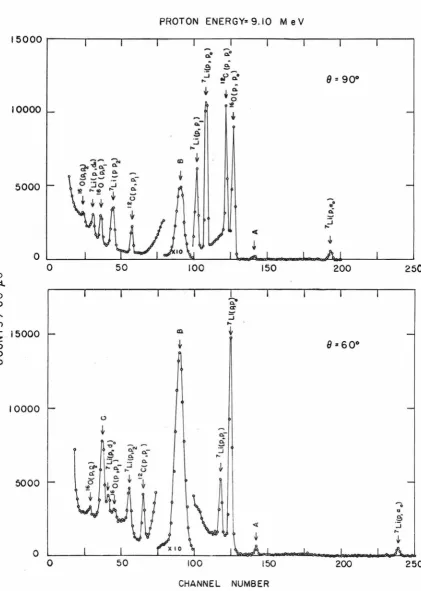
The monitor-counter (50 mm2 , 300µ thick at 85-volts maxi-mum bias) located in the target chamber provided quick surveys of the particles emitted from the reaction. Figure 3 shows the spectra
In the energy region where the contribution due to the
re-action 7Li(p, afHe:::' is expected, one finds the presence of strong competing processes, such as 160(p, p'), 12C(p, p1
) , 7Li(p, d0 ) and
possibly some other three-body reactions. The usefulness of
ap-plying the magnetic spectrometer to identify the particle species
is manifest.
3. Targetthickness.
In the first attempt to measure the target thickness, a gold
foil - 80µg/cm2 uniformly coated with a CaF2 layer - 20 tJ.g/cm2 was
prepared by vacuum-evaporation. The thickness of the 7Li,
evapora-ted later on top of the CaF2 layer in the target chamber, was
deter-mined by measuring the energy loss in 7Li of the 3. 85-MeV a-parti-cles produced from the reaction 19 F(p, a') with 5-MeV protons as
the bombarding particles. The energy loss was then converted into
the number of 7Li atoms per cm2 by using the atomic stopping cross
sections given by Dernirlioglu and Whaling ( 1962). The results are
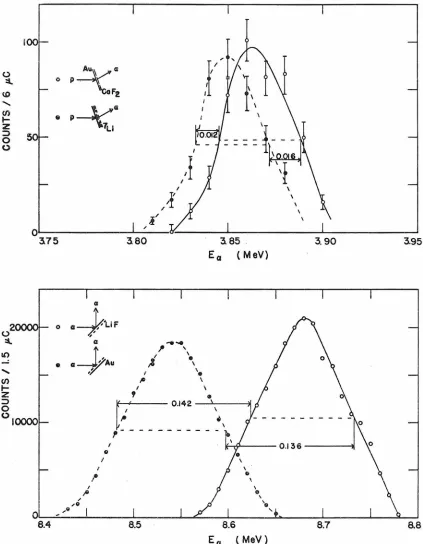
shown in Figure 4 and the differential cross section of 7Li(p, a0 ) at 30° was found to be 1. 39 ± 0. 35 mb/sr. This is considerably lower
than the 2. 33 ± 0. 43 mb/sr calculated from the coefficients of the
Legendre polynomials published by Mani et al. (1964). The
uncer-tainty in the oxygen and carbon contamination leads to an
underesti-mation in the actual average stopping cross section.
A target of some lithium compound with known chemical
com-position should be preferable. Also by vacuum-evaporation a LiF
target - 80tJ.g/cm2 on gold backing was then prepared. Its thickness was determined by measuring the energy loss of a 9. 1-Me V
a-particle beam from the tandem accelerator. Without including the
a-particle and the assumption on the LiF chemical composition, the
differential cross section of 7Li(p,a0 ) at 30° was found to be 1. 88 ±
O. 08 mb/sr. This value will be taken to convert the measured
rela-tive differential cross sections into the absolute ones.
4. 7Li(p, a0 ) angular distribution.
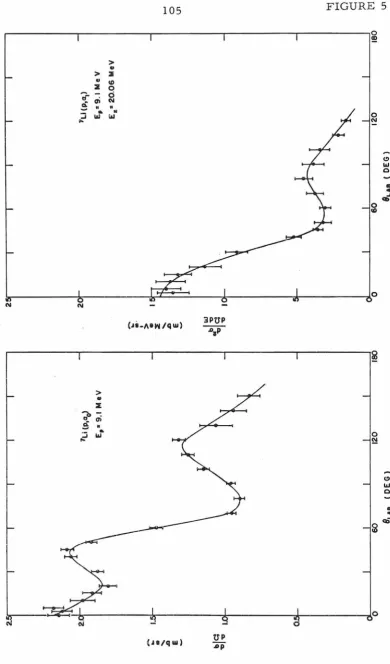
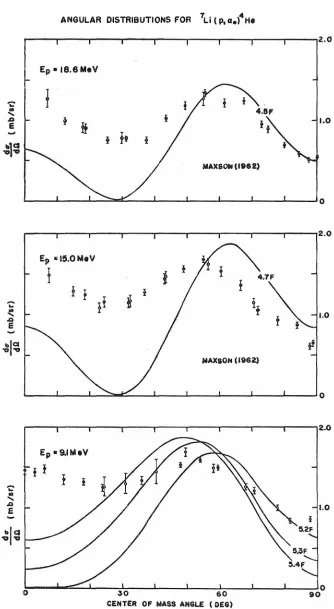
Be sides for checking the normalizations, the 7Li( p, a0)
angu-lar distribution is interesting for a comparison with that from the
reaction 7Li(p, a1 ). Since the first excited state of the a-particle was found to have the same spin and parity as the ground state of the
a-particle, it was expected that the two angular distributions
should bear some re semblance [Cerny et al. , 196 5]. As would be
anticipated for a reaction involving two identical bosons in the final
state, the angular distribution shown in Figure 6 has a 9 0° symmetry
in the center-of-mass system. The data obtained at higher
bom-barding energies by Maxson ( 1962) are also included for comparison.
The shapes and the absolute values of the angular distributions for
these bombarding energies appear approximately the same. This
confirms the direct triton-pick-up reaction mechanism that Maxson
has discussed in his analyses.
5. Single a-particle energy spectra.
In the three-body reaction 7Li
+
p--+-a+ p
+
3H, the excitation
energy of the p+3H system is fixed, if an a-particle of known energy is detected at a given angle. As a typical procedure in obtaining an
a-particle energy spectrum, the spectrometer frequency was first
set to a value such that an associated 4He of 20. 0-MeV excitation energy is expected to be formed. The protons having the same
stop-ping foil. For further assurance of detecting the correct group of
particles, the spectrometer frequency was then increased step by
step. If the group of particles was due to the a-particles emitted
from the reaction, the counting rate of the group should reduce to
zero when the magnetic field strength of the spectrometer reaches
a value such that the corresponding excitation energy of the recoil
4
He system crosses its p+3H threshold from above.
Once the a-particles group had been established, the change
in pulse height of the group could be followed as the spectrometer
frequency decreased when the lower-energy part of the spectra were
taken. Some adjustments on either the bias voltage or the stopping
foil thickness were necessary to keep the proton group away from
the a-particle group. The yield from 7Li(p, a0 ) was measured at
145° with the monitor-counter during each run for normalizing the
flux x density.
At the beginning it was considered to be interesting to
investi-gate the a-particle energy spectra over a wider energy range. Two
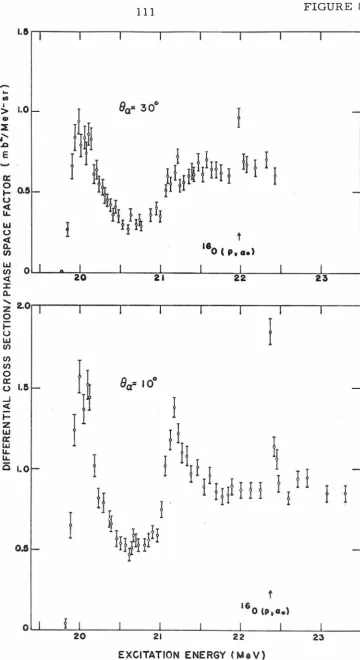
of these spectra are shown in Figure 7. When the phase space factor
has been taken out
[cf
.
,
equation (5) in Part III], the transitionprob-ability is plotted out in Figure 8 as a function of the 4He excitation
energies.
The contribution due to the second excited state of 4He appears
as a peak in the spectra near 21. 2 MeV in agreement with the value
that Parker~ al., (1965) and Cerny .s:..!_ al., (1965) have found. This
becomes less obvious and is masked by the contributions from other
final-state interacting pairs at larger angles. To unfold any useful
information about the second excited state would require a rather
Limiting the interest to study of the first excited state of He,
only the high-energy ends of the spectra were taken in the later stage
of the experiment. It includes the 4He excitation energies from the
p+3H threshold, 19. 814 MeV, up to 21 MeV. Figure 9 shows the spectra
obtained at the laboratory angles from 10° to 120°. 6. Coincidence measurements.
For a three-body reaction 1 + 2 -+ 3 + 4 + 5, nine variables
are required to describe the m omentum vectors of all particles in the final state. The conservation of total energy and momentum reduces this number to five. The range that these five independent variables
are allowed is ordinarily referred to as the phase space. Only three
out of the five variables were measured with known resolutions in the
measurements of energy spectra 'described in the previous section.
Except for the pair (4 + 5), the pair excitation energies were not fixed.
The coincidence measurements go one step further to measure these
energies and consequently are limited to a smaller region of phase
space. As will be explained in Part III, this is done by measuring the
direction along which the particle 4 is emitted.
If the pair interactions of (3 + 4) and (3 + 5) in the final state
of the reaction are not strong as compared with that of the pair (4 + 5)
over the kinematically allowed phase space region, the angular
cor-relation of particles 3 and 4 should include the same information about
the spin, parity and some other characters of the state that the pair
interaction (4 + 5) leads to.
From the single a-particle energy spectra of the reaction
7
Li(p, a)4He':', the p+3H final-state interaction is seen definitely to imply
a 4He first excited state. It would be interesting to check if the state
prepared in this way agrees with the 0
+
spin-parity assignment fromKeeping the incident proton energy still at 9. 1 Me V, the
a-particle s were detected also by the magnetic spectrometer at 30° rn
coincidence with other charged particles of the reaction products.
With 68
=
1 °, o<I>=
4° and oE/E=
1. 11% ,
the spectrometer was setto detect 5-Me V a-particles. Its exact field strength, depending on
the thickness of backing foil and that of target, was found and fixed
at the value that maximized the a-particles counting rate. Other
charged particles were detected by the monitor-counter in the
tar-get chamber. Its angular apertures were set at 3. 8° and 15. 5°
respectively along the polar and azimuthal directions.
Since the protons and tritons were detected around -110°,
the counting rate was not high, and a slow coincidence circuitry was
sufficient. Figure l 0 shows the electronic arrangements. Due to
the transit time of the a-particles through the vacuum box of the
spectrometer, the pulses from the counter in the target chamber
were delayed by O. 2 µs before entering the coincidence circuit. The
ORTEC Model 420 timing single-channel analyzer, having a 10-turn
control to delay its outputs up to 1 µs, provides this amount of delay.
The coincidence resolving time of the ORTEC Model 409 linear gate
and slow coincidence is equal to 1 µs (the sum of the two input-pulse
widths). The coincidence output gives enable pulses to open the
linear gate through which the pulses from the counter in the target.
chamber were directly put into the ADC of a multi-channel analyzer.
A 1. 7-µs delay to these pulses was necessary to assure the gate to
be opened at the right time. The coincidence outputs were also
used to gate another multi-channel analyzer in setting the window
of the single-channel analyzer for the pulses from the magnetic
The obtained coincidence spectra are shown in Figure 11.
They were taken with 7Li target facing the counter in the target
chamber. The a-particles have to pass through the gold backing
and suffer the spreadings in both the energy and the direction of
motion. The resolution in the coincidence spectra was found to
improve a little, if the target was rotated around by 180°. But the
kinematic dE/ d6 spreading, the most important one, cannot be
im-proved without cutting down the coincidence counting rate. No
at-tempt, the ref ore, was tried to separate out the tritons and protons
in the coincidence spectra.
A single spectrum was taken right after each of the
coinci-dence runs. From the counts in the coincicoinci-dence spectrum under the
proton peak from the elastic scattering by the gold backing, the
randoms per channel can be estimated. After these randoms were
subtracted, the sum of coincidences due to protons and tritons is
shown in Figure 12. The curve is the total coincidence efficiency
predicted by assuming an isotropic decay of the 4He system. The
· h
o+
·
agreement gives additional evidence to support t e assignment
for the first excited state of 4He.
When the spectrometer is set to detect a 4. 1-Me V u-particle,
more energies are then available for the decay of the recoil 4He
sys-tem. It is now excited above the n+3He threshold, so that among the
reaction products there are also neutrons and 3He 's. Carbon foils
-~ 20 fJ,g/ cm2 were tried to reduce the spreadings of both the energy
and angle due to the target backing. In this case larger angular
apertures for the counter in the target chamber are allowable,
be-cause dE/de is smaller. Keeping the same width in azimuthal
di-rection, the width along the polar direction was increased by a factor
co-incidence data after subtracting the randoms are plotted in Figure
14.
By detecting an a-particle at a certain momentum, the
excitation energy of the pair (p+3H) or (n+3He) is fixed regardless
of where the proton or 3H (neutron or 3He) is detected. The
rela-tive energy of the other two pairs of particles depends
symmetri-cally on where particles other than the a-particle are detected
[cf.,
Part III]. It has the same value on a cone determined by an axis
of revolution around the 4He recoil axis in the center-of-mass of
the entire system.
Because of the experimental arrangement, the particle 4
is always detected almost opposite to the direction of motion of the
particle 3, i.e., the a-particle, particle 4 escapes from the
a.-particle with higher relative velocity than the undetected particle
5 does. Since the final-state interaction is stronger for the pair
of particles having lower relative velocity, the a-H coincidences
are enhanced by the a+3H final-state interaction through the 4.
63-MeV excited state in 7Li at the two angles determined by the
inter-sections of the cone and the scattering plane. Similarly the effect
of the a+H final-state interaction through the_ ground state of 5Li
is also seen in the a-3H coincidences. The enhancement of this
kind, however, is not so obvious in the case of the a.-3He
coinci-dences shown in Figure 14.
B. The Reaction D(3He, p).
From the coincidence measurements described in Section
A6, it was found that the strong final-state interaction of pair (3
+
5)interest of this work. To overcome this difficulty, one may try to
change the beam energy or the angle where the particle 3 is detected.
Hopefully a phase~space region may be found, such that particle 3
won't interact as strongly as particle 4 with the particle 5 in the
final state of the reaction.
Instead of trying to search for such a phase space region,
the reaction D(3He, p) was investigated. The interactions that may
come in to mask the effects of the p+3H and n+3He final-state
inter-actions are respectively those for the diproton and the singlet
deuteron systems.
As mentioned in Part I, this reaction was studied before
by Donovan and Parker (
1965)
[cf.,
Ziirmuhle,1965].
Only thepo-sitions of the first two excited states were reported. It would be
interesting to look into the angular correlations of the decaying
particles to study some other properties of the states. From the
standpoint of studying the reaction mechanism, Yu and Meyerhof
(1966)
have analyzed the single-nucleon energy spectra from thereactions 3He(d, p) and 3H(d, n). From their modified Born
approxi-mation calculations, they concluded that the singles only cannot
distinguish between the different break-up modes and suggested
that the coincidence measurements would help to resolve this
difficulty.
To separate different groups of particles from one another
in the coincidence spectra, and also for the same reason described
at the beginning of Section A, it is better to use the 3He beam energy
as high as possible. However it was found that the tandem
accel-erator can give a more stable beam by using 5. 5 million volts as
the terminal voltage rather than 6 million volts (its nominal
A singly charged negative 3He beam was extracted from
the negative ion source and was stripped to a double positive charge
at the center terminal of the tandem. Using the same sizes of
ob-ject, image and beam defining slits as described in Section A of
this Part, a 16. 5-MeV 3He beam of 5 to 20 nA was obtained on
tar-get.
1. Target preparation.
In Donovan and Parker's experiment, a thin deuterated
polyethylene foil target - 1 mg/cm2 was used-. A solid target is
more convenient than a gas target, since for a coincidence
meas-urement a well defined beam spot is essential. At the time when
the present experiment was planned, the deuterated polyethylene
was not commercially available. A compound called the
deuter-ated dotriacontane, suggested and supplied by its manufacturer
(Merck, Sharp and Dohme of Canada), was used for the target
preparations.
To prevent loss of dotriacontane which would be incurred
during vacuum evaporation, it was instead put in carbon
tetrachlo-ride, stirred until it dissolved completely, and then the solution
was carefully transferred onto a mounted backing foil with a
medicine dropper. When the carbon tetrachloride had dried, the
target was ready to be used.
Using the heavier particle as projectile, reaction products
such as 3H' s and 3He' s are emitted in forward directions. It is
im-portant to choose a low-Z material as target backing in order to
reduce the contribution to the counting rate from the Rutherford
is only 68° C, and for better target stability against the heat deposited
as the beam particles go through, a metal with high thermal
conduc-tivity is preferred. Taking those factors into consideration, copper
- 50 µg/ cm2 was chosen.
The deuterated dotriacontane, CD3 (CD2h0 CD3 , was
indi-cated by the manufacturer to be 99. 7 atom% in D by mass analysis.
Use of the proton yields detected by spectrometer to normalize the
coincidence spectrum has the shortcomin~ that the target may
deteri-orate and pick up carbon during the run. Likely the protons could ·
. iz (3 )14N':'
come from the react10n C He, p . In the energy range of
inter-est, many excited states of 14N [Ajzenberg-Selove and Lauritsen,
1959] may contribute to the proton counts. The total number of
pro-ton counts is therefore proportional to some linear combination of
deuterium and carbon atoms in unit area of the target, while the
co-incidence counting rate is proportional only to the number of deuterium
atoms per unit area. It is all right to use the proton counts as
normal-izer, if the chemical composition of the target material does not
change
[cf.,
Section B, Part III].To check if the chemical composition of the target
materi-al changes, another surface-barrier counter was set up at 60° in
the target chamber in the last day of this experiment. It detected
the deuterons from the elastic scattering D(3He, d)3He and its yields
should be proportional to the number of deuterium atoms per unit
area. The number of protons counted by the spectrometer divided
by the number of deuterons counted by the additional counter was
plotted in Figure 15 against the total integrated charge on target.
The ratio, within a 10% deviation from its average, is reasonably
targets broke before they had accumulated this much of a charge.
Figure 15 also shows the ratio plotted out as a function of proton energies. These numbers were used to normalize the coincidence runs taken at different proton energies including an additional 10% deviation.
2. Particle spectra.
Due to the presence of carbon nuclei in the target material, the spectra shown in Figure 16 reflect a rather complicated struc-ture. The processes such as 12C(3He, 3He)12C':', 12C(3He,a)11C':', 12C(3He,p)14N':' and 12C(3He,d)13N':' are possible. All of these recoil
nuclei possess many excited states, and no attempt was made to identify each of these possible contributions. The limiting angle of detecting a 3He from the D+3He elastic scattering is 42°, therefore
no such group was seen in the particle spectrum at 46°. The recoiled deuteron from the elastic scattering was not obvious at 26 ° and
smaller angles.
3. Angle calibration.
In the coincidence measurement, one of the counters was set up to detect a particle at certain fixed momentum, while the
other counter was moved around. The angular correlation obtained in this way is essentially an angular distribution of the breakup of the recoil system. The conversion to the recoil center-of-mass
system will be explained in Section A, Part IlI. As will be noticed, both the cross-section conversion factor and the recoil center-of-mass angle are very rapidly varying functions of the laboratory
The precision of knowledge of the angles was therefore an important
consideration.
The polar angle of the counter in the target chamber could be set to an accuracy of ±0.1° [Groce, 1963]. It was controlled by a dial (36° per turn) attached to the lucite cover of the target chamber. Since the target chamber rotates with the spectrometer, the angle that a particular dial reading indicates also changes with the position of the spectrometer. Originally the dial was so adjusted that it
read 90°, when the counter was actually 90° with respect to the
beam and the spectrometer was set at 0°. The precision in meas-uring the polar angle of the counter in the target chamber, therefore depends on how well the lucite cover can be reproducibly set to the correct position. The following method provides a check to this
question.
For an elastic-scattering process such as D
+
3He ~ d+
3He, there exists a unique pair of angles on the scattering plane given bye = ± tan-1 c
where both the deuteron and 3He can be detected in coincidence with each other. Unless the spectrometer has been set a t e , the angles
c
that the counter in the target chamber should be set to detect deuter-on in coincidence with 3He in spectrometer and vice versa are dif-ferent. By measuring this difference, the absolute angle of either
of the counters can be calculated. Since
e
and the difference as ca function of the spectrometer angles shown in Figure 17 are
To begin with, the spectrometer with 68
=
O. 2°,o<I?
=
4°and
oE/E
= 1. 11%
was fixed at 37. 75° according its reading. TheNMR magnetometer frequency was respectively set to detect 3He's and deuterons from the elastic-scattering process. Figure 17 also shows the number of coincidences versus the dial readings, corre-sponding to different angles of the counter in the target chamber. Because the spectrometer was so closely set to 8 , the 3He- and
c
deuteron-coincidences almost peaked at the same position. The small difference in the positions of centroids was calculated to
be 2.4 ± O. 5 units of the dial reading (0. 24 ± 0. 05°). The actual angle of the spectrometer was then found to be 37. 62 ± 0. 04°, and a dial reading of 300 would imply that the counter in the target chamber was set at 38. 11 ± 0. 08°.
When the spectrometer was changed to 30° for the
cornc1-dence measurements of the reaction D(3He, p), the same reading of 300 became an angle of 45. 73 ± 0. 09°, which would be otherwise
taken as 45° if the lucite cover of the target chamber was assumed to be set at the correct position.
4. Coincidence measurements.
The protons produced in the reaction D(3He, p) were de -tected by the magnetic spectrometer at 30°. To separate the
a-particles that may be present from the protons, a 0. 25-mm thick aluminum sheet was put in front of the counter. The other charged particles from the reaction, namely protons, tritons and 3
slits within ±0. 5mm [Groce, 1963]. The angular apertures were 2° and 8° respectively along the polar and azimuthal direction. As discussed in a previous section, the counter in the target chamber had to be set at quite forward angles to permit coincidence counts. The Rutherford scattering from both the target and the backing then contribute most of the counting rate, and a fast-slow coinci-dence system [cf., Figure 18] was used to reduce the randoms.
As in the coincidence measurements for the 7Li(p, a) reaction, the pulses from the counter in the target chamber were delayed by 80ns before going into the fast-coincidence circuit to take account of the proton transit time in the vacuum box of the spectrometer. The
fast-coincidence output gives the enable pulses to open the linear gate for those pulses directly from the linear amplifier for the
counter in the target chamber (l.5µs delayed). The outputs from the linear gate were then put into a multi-channel analyzer which again was promptly gated by the stretched fast-coincidence outputs. The delays and the fast-coincidence resolving time (l lOns) were
checked by a coincidence measurement of the elastic scattering D(3He, d)3He at the beginning of each running day.
In all the coincidence runs, the resolutions of the magnetic spectrometer were set at 68
=
1 °, o<I>=
4° and oE/ E=
1. 11% .
By changing the detected proton energy with the counter in the targetchamber fixed at .,.. 20°, one has the coincidence spectra for the
en-ergy-correlation shown in Figure 19. Fixing the proton energy at 7. 8 Me V instead, those obtained f_or the angular correlation are
shown in Figure 20.
triton are emitted oppositely in the center-of-mass of the recoil "He system. By using the formula to be described in the next part, the p - 3H and p - 3He correlations shown in Figure 21 were normalized and converted to the recoil center-of-mass system. The randoms were subtracted in the same manner as described in Section A6.
If the final-state interaction of pair (3
+
5), i.e., the pair (p+
H) or (p+
N), was strong, its effect should show, de -pending on the energy of proton detected by the spectrometer, in the p-3H or p-3He angular correlation around eLAB=
30° (8RCM= -70°) where the excitation energy of the two-nucleon system was smaller. No enhancement, however, was seen at these positions.
When the angular correlations in the recoil center-of-mass system at E = 7. 8 Me V were analyzed by a least-square fit to an
p
even order of Legendre polynomials, the p-3H to p-3He branching ratio was found to be 7. 86 ± 0. 69. The other interesting feature about the correlations is that they all appear to have an axis of symmetry along the 4He recoil direction. As will be discussed in Section D, Part IV, it is possible to use this symmetric property to show that the mechanism representing the stripping of incident 3
III. KINEMATICS AND DATA REDUCTION
A. Three-body Kinematics.
If T . is the transition matrix element for a process from
fl
a certain initial state i to a certain final state f, then by the famous
golden rule the transition rate is given by
2"IT
I
1z
dNProb./Sec.
=
ti Tfi dE,where dN/dE is the density of final states per unit energy interval.
It is expressed as
1 dE
for an n-particle final state. A more symmetrical form can be
obtained [Feynman, 1962], if one adds a factor of
_,. n
dP
(z1Tti~3
(21Tti)3 o(:; -l
Pj)j
=
1n
and replaces l/ dE by o(E -
.l
E.), where":fr
and E are the total. 1 J J
=
momentum and energy available for the transition. Defined by
the experimental resolutions, the transition leads only to a
finite part of the phase space region AT. Let the corresponding
n n ~
Awif =
~1T
s
1Tfil2(21T11)3o(1t -~Pj)o(E
dP
m
( 21T11) 3
AT
j=lIf the initial continuum-state wave function is normalized to one
particle per unit volume, the flux is numerically equal to the
rela-tive velocity of the two particles in the initial state, and the
dif-ferential cross section is just 0.cr
=
A~f /flux.For a reaction leading to a three-particle final state,
the integration can be carried out easily. Let the particles
in-volved be labelled as l
+
2 _,,. 3+
4+
5, where 11111is the
born-barding particle, 11211 represents the target and 11311 is taken to
be the particle detected in the magnetic spectrometer. The
differential cross section for the three-body reaction is now
given as
1
SI
Tf. 12 6(..t-'1 .;:2:+
~ ~ ~
..1:-'z -..t-'3 - .t-'4 - 4-Ps)o( 2~
+
~
2+
l
m
1m
2AT
( 1 )
Q
In this expression, non-relativistic energy, i.e., Ei
=
Pi2/2mi+
m.c2, is used. v12 is the relative velocity of the particles 1l
and 2, and Q = (m1
+
m2 - m 3 - m4 .:. m 5 )c2
is the Q-value for
the reaction. After having integrated over
P
5 and P4 , theex-pression (1) becomes
with
(i12 -
P3 -i\ )
2=
02m5
(2b)
to represent the conservation of energy. Here ~E. and ~ri. are
J J
respectively the energy and angle resolutions of the detector that
particle j enters, and
P
4 is the unit vector in the direction ofi\.
The total and relative momenta of the particles i and j,
rt
..
andlJ
q
.
. ,
arelJ
~
1T ..
LJ
=
:P.
l +:P ..
~ q ..
=
J lJ
_,,
-2)
m.· m.
(pi
l J ~
=
m .. v ...m.+m. m. lJ lJ
l J l J
In the study of final-state interactions, the
q
45 are found more convenient to be used.relative momenta
q\
andThe vector
q.,
defined1 as
...,.
q.
=
l
m.(m.+mk)
1 J
m.+m.+mk
1 J
(
pi
-m .
1
where i, j and k are in cyclic order of (3, 4, 5), is the relative
momentum of particle i with respect to the recoil pair of particles
(j + k). In terms of these momenta, the expressions corresponding
to (2a) and (2b) are written as
~CT = 2Tim1g 1 ~E3 ~r23 ~r245 m3 P3JTfi12 m4s q45,
(21T1i)6
1i ql2 (3a)
and
s.L
+ Q --9.iL
m3 +mi +ms q32 = 0,2m12 2m45 2m3(m4 +ms)
where Ar245 is the angular resolution Ar24 seen in the recoil
center-of-mass system of particles 4 and 5. The ratio Ar24 / Ar24s is
ob-tained by equating the expressions (2a) and (3a), and is given by
~
=
~I
2 p 4 -~A ~
p 4 • ( lT lZ - . .J:-'~I
3 ) •Ar245 P 4 ms ( 4)
This is just the result that one would obtain in transforming an
elementary solid angle from one system to another, the vector
(ii
12 - F3}/ (m4 +ms) is the relative velocity of the two systems.~
In the laboratory system, the target is at rest, thus P2 = 0,
.;;."IZ
=
P1
and Ci'12 / m12=
P1 / m1.If only the single spectrum of particle 3 is measured,
such as in the measurements of a-particle energy spectra
dis-cussed in Section A5, Part II, the differential cross section has
to be integrated over all the directions that particle 4 may be
emitted. That is
( 5)
"
In the coincidence measurements, P4 is also fixed. The relative
energies for all pairs of particles in the final state, depending on
the squares of the relative momenta,
__ m_..1.._Tf_...12..._ __
+
m3+m4+m5
(6a)
and
_
k]
ms ( 6c)
are known. As is seen from the expression (3b), q45 is fixed
by q3 and is independent of where the particle 4 is detected. But
both
q
34 andq
35 depend linearly onq
45 , and each of them obtainsthe same value on a cone determined by an axis of revolution
q
3h " "
and t e angle between q3 and q45 •
For a specific example, the velocity vector diagram of
the reaction p + 7Li-+ a.+ 3H +pat E
=
9. 1 MeV is shown in pFigure 22. A 4.1-MeV a.-particle was detected at 30° with
res-pect to the beam axis, while the recoil system of (p + 3H) was
moving with the same speed in the opposite direction in the
center-of-mass system. This recoil direction was indicated by
q
3 • Theproton and triton, i.e., the particles 4 and 5, were emitted
op-positely in their center-of-mass system along the direction
q
45 •As long as the protons were detected on the cone determined by
q
3 andq
45 , the relative velocities v 34 and v35 , thus the relative energies of the corresponding pairs (3 + 4) and (3 + 5), remainedthe same. In the discussions of Section A7, Part II, the protons
and the a.-particles were found to be very strongly correlated when
the protons were detected at 26° with respect to the recoil axis
q
3 . Because the relative energy of the pair (a. + 3H) was equal to 1. 96MeV, the enhancement in the angular correlation was attributed to
the final-state interaction of the pair through the 4. 63-MeV
excited state of 7Li.
B. Normalization.
data. Those presented in Figures 7, 9 and l 5b are the energy
spectra. The data which were expressed in terms of the
particle-particle correlations belong to the second type, and are shown in
Figures 12, 14 and 21. The normalizations made in reducing the
data are explained in this section.
The yield of the magnetic spectrometer is expressed in
terms of the spectrometer resolutions and the differential cross
sections d2cr/dE3dS13 by
+
_d_2
_cr_c __ AN c) dE3dr23 ANt
(7)
where AN and AN are the numbers of the target nuclei and the
t c
contaminating nuclei per unit area. ANB is the total number of
beam particles that have struck the target.
For the reaction 7Li(p, a.), either d2cr /dE3dr23 or AN / ANt
c c
was small, so that the second term in the expression (7) was
ne-glected as compared with the first term. With the 7Li(p, a.0 } yield
Y monitored at 145° during the same run, Y was then
con-. mon spe
verted to differential cross section in a unit of mb/sr-MeV as
90 = 2.643x E
3
y
spe
xy
mon
x 0. 86 mb/sr-MeV,
where the first constant is the ratio of solid angle of the monitor
counter to that of the spectrometer, and AE3 = E3/90 is the energy
resolution of the spectrometer. The last constant is the 7Li(p,a.0 }
target thickness and the 7Li(p, a-()) angular distribution described in Sections A3 and A4, Part II, it was found to be 0. 86 ± O. 09 mb/sr.
The coincidence yield, with the randoms subtracted, is
related to the third order differential cross section derived from
the expression (2a) by
y
.
coin
The number of gates from the spectrometer, given also by Y
( 8)
spe in the expression (7), was a measure of the flux x density, i.e.,
~NB x ~Nt. For the coincidence measurements on the reaction
7
Li(p, a), the coincidence counts were normalized to l 000 gates
of the a-particles, and are plotted out versus the laboratory angles
in Figures 12 and 14.
The complications in the reaction D(3He, p), due to the
possibilities of the carbon and oxygen deposition and the
deteriora-tion in chemical composideteriora-tions of the deuterated dotriacontane during
the run, have been discussed in Section Bl, Part II. A direct
measurement of ~NB x ~Nt was made by using a third counter to
monitor the D(3He, d)3He elastic scattering yield at 60° in the last
day of this experiment. Since most of the coincidence spectra
were obtained without this counter, the number of gates was used
to normalize the corresponding coincidence spectrum. The number
of protons counted by the spectrometer normalized to l 04 of those
deuterons from the third counter, plotted in Figure l Sb, was used
to account for the energy-dependent factor of the expression (7).
center-of-mass angles given in Figure 21 is expressed in terms
of the various yields as
Relative yield = O. 0796 x
~~
x N(E3 ) x :coin x spewhere the first constant was chosen such that the product of the
first three factors is unity for the coincidence spectra taken at
E3 = 7. 8 Me V. The ratio t::;.0.4 / t::;.0.45 , given by the expression ( 4),
transforms the differential cross section from the laboratory
sys-tem to the recoil center-of-mass syssys-tem. The recoil 4He direction,
IV. THEORETICAL INTERPRETATION
The discussions carried on in Part II and Part III relate
the experimental data to some appropriate differential cross
sec-tions. Besides the kinematic factors, these differential cross
sections contain the squared modulus of some transition matrix
elements. In this part some assumptions will be made to construct
an approximate form for the transition matrix element T fi. The
object is to see if the data could be understood in terms of these
assumptions. Some parameters concerning the properties of the
final-state interactions will be discussed.
A. Interaction in the Final State of a Reaction.
The interaction between particles produced as a result of
a certain reaction may have a sizable effect on their distributions
in energy and in angle. This effect becomes particularly
notice-able when the reaction proceeds into a phase space region where
the relative velocity of the interacting pair of particles is small.
In case of a three-body reaction, this part of the phase space
region is usually reached by detecting the particle 3 near its
maxi-rnum possible energy.
Approximate treatments of final-state interactions are
found in the works by Migdal (1955), ·Watson (1952), Goldberger
(1964) and Gillespie (1964). Here only the basic idea of the
so-called factored-wave-function method or the Watson-Migdal
ap-proximation will be discussed.
By virtue of the short range nuclear interaction, the
of one another, and would escape from there in forms of plane
waves, if there were no final-state interactions acting among
themselves. Because of these interactions, the wave function
of the relative motion of a certain pair of particles may be
dis-torted. This distortion, in some sense, is a measure of the
final-state interaction between that particular pair of particles.
It becomes conspicuous especially when the relative velocity of
the pair is small, and the other particle, from energy
conserva-tion
[cf.,
expression (3b), Part III], can escape with a largerrelative velocity without distorting the wave function of the
rela-tive motion of the pair.
Under these assumptions, the transition rate of the
re-action is proportional to the probability that the pair of particles
are formed at their range of nuclear interaction, i.e. , at r :::::: a
apart [Fermi, 1951; Landau, 1965]. As was stated by Landau,
this is just the squared modulus of the wave function of the
parti-cles formed when they are in the 11reaction zone11 multiplied by the
size of the phase space region into which the reaction proceeds.
The statement can be also visualized by considering the inverse
reaction [Watson, 1952]. The probability, that the two
final-state-interacting particles be found in the vicinity of each other
such that the subsequent transition may occur, is proportional to
the squared modulus of the wave function of the pair at r :::::: a.
The actual form of the wave function at r :::::: a is not known,
but just for the purpose of estimating the dependence of the wave
continue inward the wave function from the region r
>
a to r :::::: a.As is always implied in the application of the zero-effective-range
approximation to the low-energy scattering problems, this is
per-missible when the energy of the relative motion is small. At low
energies, the Schroedinger equation in the region r ;f,, a is
essenti-ally energy independent, so the dependence of the wave function on
energy in this region is entirely determined by matching its value
and derivative to the solution in the external region.
Since the pair of particles is created in a state of
con-tinuous spectrum moving in a definite direction, t.he boundary
conditions for the wave function should be chosen in such a way
that it contains incoming waves and a plane wave in the asymptotic
region. The plane wave is replaced by a coulomb wave with only
incoming waves in the asymptotic region, if there is also coulomb
interaction acting between the pair of particles. This type of
solu-tion has bem used by Lane and Thomas (1958) in their treatment of
a three-body disintegration in terms of two successive two-body
disintegrations. Since only the final-state interactions at low
energies are of interest, one may disregard the contributions due
to the spin-orbit interaction and the possibility of rearrangement
scattering. The wave function in the external region was taken as
= c
1
k r
c
1-m
':<
( 0 - U ':' I ) x Y m
(k )
Y m ( ~)c.R.
ccs£ d. d. .R_ c 1( 1)
for a particular channel c. He re 0 d and Id are respectively the
outgoing and incoming wave solutions. The complex conjugate of
the scattering matrix element U n was taken, since the state
CCS..t
the ordinary scattering state. Because of the boundary conditions
just described, all of the outgoing waves should be coulomb waves
of the form [Messiah, 1962]
'IT
ik
--z
11c c W 1=
I'(l-i11 )e ec c
~ r
~ -+
F(i11 ,1,-i(k r +k r)),
c c c ( 2)
where Fis the confluent hypergeometric function, and 11 = z1z2e2/nv c
is the coulomb parameter. Comparing the expression (1) with the
spherical harmonics expansion of the expression (2), the
coeffi-cients xc/ s are found to be
1-1 x = 27ri e
d
-icr
co
where crd = arg I'(l + 1 + iric) is the 1-th wave coulomb phase shift.
If there is no nuclear interaction, i.e., U n
=
exp[2i(cr n - er )], CCS.x. C.x. cO'\Ir is reduced identically to
w '·
The factorc . c
2ir1')
c e - 1
is known as the coulomb correction (non-relativistically) in many
atomic and nuclear problems such as the photoelectric effect and
f3-decay where the electron produced in the final state is
inter-acting with the residual nucleus by the coulomb force between them.
If one writes
w
as'1f =WI+ c c
-2i(cr - er ) [e d co
( 3)
and evaluates it at r::::: a, one finds that the main contributions come from those terms containing l/ r. Since the square bracket in expression (3) :is just the partial-wave elastic-scattering ampli-tude, the transition rate can be also approximated as something
proportional to the scattering cross section of the interacting pair of particles [Watson, 1952; Migdal, 1955].
The approximations discussed so far amount to a factori-zation of the wave function of the relative motion from a complicated
three-body transition matrix element. The possibility of this factorization can also be rediscovered in making .some model cal-culation based on some reaction mechanisms. To the first order of the plane-wave Born approximation, it is found that the transition
matrix element, for each c