Classification of Learner’s Ability using Classification
Algorithm
R.Vijayalakshmi
1, Dr.L.Jayasimman
2,
Research Scholar1, Assistant Professor2
Department of Computer Science, Bishop Heber Colleg, Trichy [email protected] 1, [email protected]2
Abstract- The term Internet of things is the expected sign of today everywhere in interconnecting the physical objects by a network for real-time interaction to act in response instinctively for continuous monitoring and sharing of resources across the world in turn enhance the aptitude and success of learners. Many behavioral and environmental factors impact students learning across the world. Sensor data from the phone is used to identify how each student is different from each other in the utilization of the smart phone by classifying the learning ability of each learner. Identifying various behaviors from mobile sensors to classify learner’s ability by applying classification algorithm and identify the learner learning ability level using Weka tool.
Index Terms- IoT , Sensors, Learning; Classification Algorithm, learning ability, Weka, Classifier.
1. INTRODUCTION
Internet of things is the perspective indication where by interconnecting the physical objects through a network for coordinated communication to take action in response spontaneously for incessant monitoring and sharing of resources across the world at the present time which in turn enhance the capability and success of learner. Sensing technology enable present learning simple and secure. Sensors offer service to assess, gather and realize the context information from all the existing resources to learning contexts. The development of related gadget contribute to and exchange information, news or facts by actuating through interconnection of things in which sensors and actuators meld consistently with the surroundings and exchange the content from one place to the other so as to transcend boundaries or barriers.
Academic education today demands everlasting novelties to find the details regarding learner priorities, associations, competence and choices. Internet of things improves tutoring and learning actions by inducting sensors and actuators and diverse intelligence gadgets to a shrewd learning ambience.
Internet of Things based learning is a location and time independent personalized learning. Learning that happens across location whereby it decreases the limitations of learning location with the mobility of general portable devices. Internet of Things widens the access to learning and also used to enrich conventional learning by adding variety to learning content. Anytime, anywhere learning scenario offered in Smart Learning system enhances the student learning ability. The growth in smart technology has led to support learning Anytime, Anywhere, Anyplace, Anyone, and Anything.
As students share and communicate through devices learning is made easy. It also increases the flexibility of learning space as the learner need not be fixed in one place (as in PC e-learning) or depends upon power grid. Wide access helps in reducing social exclusion in learning. Learners use devices to gain knowledge through devices. Machine learning and online activity suggest learning tailored to user needs.
The growth of innovative gadgets share and exchange information, thoughts or ideas by actuating through connection of devices through Internet of Things in which sensors and actuators blend consistently with the environment and exchange the content from one place to the other so as to transcend boundaries or barriers. Many deportment and location factors impact student learning across the world. From the smart phone sensing data from student Smartphone sensor used to identify how each learner is different from one another in the usage of smart phone by classifying the learning ability of each learner. Learner’s ability is classified by identifying various behaviours from mobile sensor by applying classification algorithm using Weka tool.
2. RELATED WORK
learning. Smart learning face a lot of challenges like learning technology structures [4].
The description of the cost factor indicating open-type e-learning course promotion, expenditure factor for the institution, in the similar way as outlay of executing learning courses with the use of e-learning. The exploration of the responsibility of Ural Federal University on e-learning use to pass on the opportunity in the direction of further devise the effect as of the induction of e-learning in other educational establishment[8]. This paper cite several study on the restrictions of e-learning tools and classify the challenges faced by the educators and ideas for a victorious e-learning result moreover this paper reviews the effectiveness of e-learning skills in Middlesex University and a few problems they face[9].
3. METHODOLOGY
Student Life study [5] dataset is used to examine and predict learning performance of the learner by applying classification algorithm and implemented in weka tool. The Student Life dataset [6] is a large, longitudinal data used which is publicly available. The dataset is collected from 30 undergraduates and 18 graduate students over a 10-week term in spring 2013 [7]. Features sensed from the mobile sensor includes Physical activity, Location, Surroundings context information, Conversation information, Study Duration, Phone Usage etc.. Figure 1 below depicts the architecture proposed to identify the learning ability level of the learner through mobile sensing activity. Automatic continuous sensing is carried out through Accelerometer, Micro phone, Light Sensor, GPS /Wi-Fi /Bluetooth which detect physical activity, conversation duration, study duration and location information. Major advantage of using the Weka platform is the huge amount of supported machine learning algorithms.
Classification algorithm is commonly used by Data Mining and machine learning (ML) researchers. It comprises of foreseeing the estimation of a characteristic in view of the estimations of different attributes. There are different classification techniques, such as Bayes, Functions, Lazy, Rules and Trees. Classification algorithm can be applied to structured or unstructured data. Classification is a technique where data is classified into a required number of class labels. The main aim of classification technique is to detect the categorical values to which a given data items will be represented. Classification algorithm in weka tools are implemented to find out the accuracy for the given data items to identify the accuracy of learning ability. In machine learning, classifiers in weka are tested based on classification algorithm.
Sensing data from the student life study dataset is used for classifying the student learning ability. Mobile sensor is used to predict learner experience like phone usage, learner's movement, classifying learner's location using GPS or network and their surrounding contexts. Audio classifier detects when learner is talking, Physical Activity classification to determine walking, sitting, running etc. Server side sensing sense conversation, GPS and Physical Activity combines sources of data to classify location context. Data filtering and machine learning are used to process the data. Interpret the available data based on required context.
Supervised learning is used for manually annotate the data which improve machine learning. Unsupervised learning is unpredictable which require algorithms to infer classification. Accelerometer helps to classify physical activity, Microphone classify audio environments, light level classifies study duration, GPS classify location context etc. Thus Classification algorithm is applied to available dataset to identify the learning ability of learners using mobile sensors.
Classification algorithm suggests the procedure to predict the outcome of the new data instance. On the basis of the given input every node in the tree represent the output
Classification is a data mining algorithm that builds a step-by-step guide for ascertaining the result of a new data instance. It generates a tree whereby every node in the tree symbolize a mark where a conclusion must be arrived based on the input, and move to the next node and the next until leaf node is reached which tells the predicted output.
In Classification learning the model is operated under supervision by providing with the
actual result for each of the training instances is called as supervised learning..
The idea of the classification tree is the notion of using a "training set" to create the model. This obtains a data set with known output results and utilizes this data set to construct proposed model. Then, on every occasion the latest data point with an unidentified output results, place it through the model and produce the expected output similar to the regression model. It is an universal exercise to obtain an complete training set and separate it into two parts. After creating the model place 60-80 percent of data into training set which is used to create the model and remaining data into test data set to test the accuracy of the proposed model.
The data set used here is the automatic sensing data of Student Life study from the phones of a class of 48 Dartmouth students over a 10 week term to assess their sensing behavior which is publicly available is used to assess the learning ability of the student. The attributes in the data set taken for this study are Physical_activity, audio, conversation, Bluetooth, dark, gps, phone_charge, phone_lock, wifi, wifi_location etc sensed through mobile phone sensors.
Physical activity inference describes about Stationary, Walking, Running and unknown activity. Physical Audio inference describes Silence, Voice, Noise and unknown audio conversation information. GPS location file describes provider information, network type and travel state of the user. Light feature describes about the participant's dark environment (>=1 hour) context.
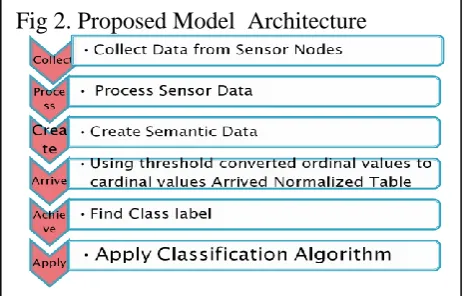
Created semantic for the sensor data and using threshold converted ordinal values to cardinal values. Arrived normalized distribution table. Finally using threshold class label is arrived for supervised learning. Class is identified through class label. Classification algorithm is applied for the above supervised learning. Figure 2 depicts the proposed model architecture.
Student data utilize an instance filter that discretizes a range of numeric attributes in the dataset into nominal attributes.
The levels and grades classification were rated by the students in a scale of 1 – 4, 4 being the lowest score and 1 being the highest. The rating is as follows: 1-Excellent, 2- Very Good, 3-Good 4- Average. Class label indicating the score is assigned to all the sample dataset. The learning attributes are used as the training input for the classifiers bayes Naive Bayes, functionsLogistic, Nearestneighbour Instance based Learning, rules OneR, and trees -J48 for predicting the learning ability.
Based on the available data set using WEKA tool learning ability is identified. Classification algorithms using Bayes, Functions, Nearest Neighbour, Rules and Trees are tested to build the required model to predict the learning ability. Different classification types and different classifiers is given in figure 3 below.
Naive Bayes:
Class for a Naive Bayes classifier by means of estimator classes. Numeric estimator accuracy values are preferred based on investigation of the training data. The NaiveBayesUpdateable classifier will use a default precision of 0.1 for numeric attributes when build Classifier is called with zero training instances [10].
Logistic:
Main aim of the Logistic function is to find the values for the coefficients that weight each input variable. Using non-linear function prediction of the results is transformed [11].
Instance Based Learning:
Nearest-neighbor classifier, uses normalized Euclidean distance to find the training instance closest to the given test instance, and predicts the same class as this training instance. If multiple instances have the same (smallest) distance to the test instance, the first one found is used [12].
OneR:
This algorithm is used for building and using a 1R classifier; in other words, uses the minimum-error
Classification
Bayes
Naive Bayes
Functions
Logistic
Lazy
IBL
Rules
OneR
Trees
[image:3.595.317.519.385.471.2]J48
Fig - 3 Different Classification algorithms
[image:3.595.68.301.619.767.2]attribute for prediction, discretizing numeric attributes for the given class label [13].
J48:
Class for generating a pruned or unpruned C4.5 decision tree [14].
Classification algorithm in weka tools are implemented to find out the accuracy for the given data items. Machine learning classifiers in weka are tested based on classification algorithm and results are shown below. Stratified tenfold cross-validation has become a common standard for estimating the error rate of a classification learning scheme.
[image:4.595.73.293.315.687.2]The 10 fold stratified cross validation results are summarized in table 1 below.
Table 1. Summary - Stratified cross-validation
Sl. No . Mode l Ka ppa Sta tisti c Me an abs olut e err or (M AE ) Ro ot me an squ are d err or (R MS E) Rela tive abso lute error %(R AE) Root relati ve squar ed error % (RRS E) Time taken to build mode l in secon ds
Acc urac y %
1. bayes
.Naiv eBay es 0 0.3 024 0.3 774 97.1 166 96.32 45
0.02 60
2. functi
ons.L ogisti c
0 0.2
133 0.4 443 68.5 006 113.3 948
0.02 60
3. lazy.I Bk 0.0 863 0.2 25 0.4 743 72.2 628 121.0 653
0 55
4. rules. OneR
0 0.2 0.4
472 64.2 336
114.1 414
0 60
5. trees. J48
0 0.2
972 0.3 924 95.4 582 100.1 627
0 60
Evaluation of classifier on full training data using 10 fold cross validation is carried out. This part of the output gives estimates of the predictive performance, generated by WEKA’s evaluation module. It outputs the listing of figures summarizing how exactly the classifier was capable to calculate
the accurate category of the instance under the chosen test unit. The estimations are got from the training information. In this case only 60% of 20 training instances have been classified correctly on four algorithms out of five algorithms tested. This indicates that the results obtained from the training data shows 60% accuracy. Of all the four algorithms OneR is better compared to other three algorithms because the time taken to build the model is zero. In addition to classification error, the evaluation output measurements derived from the class probabilities. More specifically, it outputs mean absolute error (0.2) of the probability estimates, the root mean squared error (0.4472) is the square root of the quadratic loss. The Relative absolute error calculated in a similar way by using the absolute instead of squared difference. The basis that the errors are not 1 or 0 is as not all training instances are classified appropriately. Exhaustive precision by Class demonstrate a comprehensive per class of the classifier’s prediction accuracy.
4. EVALUATION METRICS □
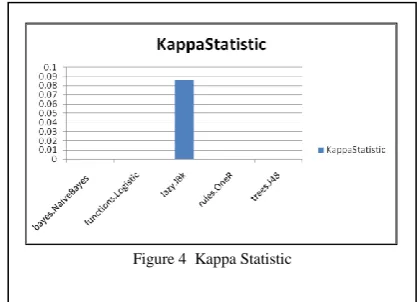
Kappa Statistic shown in the figure 4 shows the measurement of the categorical variable between the selected algortihms. All the algorithms tested shows 0 and instance based algorithms shows 0.0863 value measured on the basis of categorical variable between the selected algorithms.
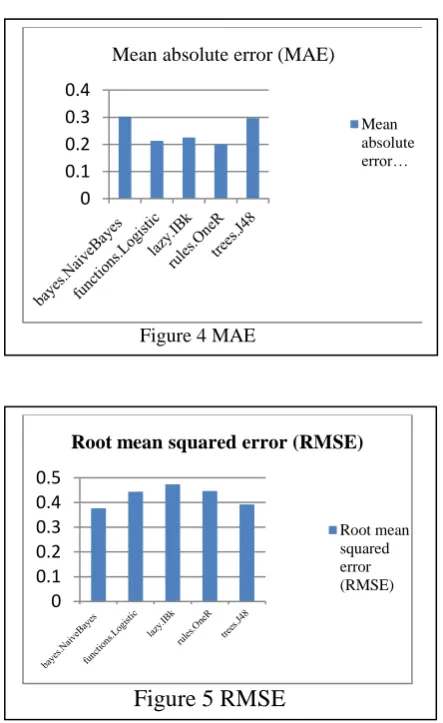
Mean Absolute error shown in figure 5 is measured by calculating the average differece between the given value and arrived value in the algorithms tested. oneR algorithm error rate is lower when compared to other algorithms. J48 and Naivebayes show higher error value compared to other algorithms.
[image:4.595.316.525.493.644.2][image:5.595.68.290.136.498.2]
Figure 5 shows the Root mean squared error (RMSE) is the square root of the quadratic loss. Naivebayes shows lower error rate of RMSE compared to other algorithms.
The time taken to build each model is depicted in the figure 6 for the algorithms tested. Naivebayes and Logistic algortihm takes 0.02 seconds and rest of the algorithms take 0 seconds to build the model.
5. CONCLUSION
Based on the implementation of results shown above it is evident that OneR algorithm performs well and gives 60% accuracy and also the weighted average accuracy also shows fairly well. Hence of the entire algorithms rule based algorithm OneR in weka performs well for these instances. In future more rule based algorithms like prism, ZeroR can be tested for more accuracy and error classification reduction.
REFERENCES
[1] X. L. Zhong, H. X. Li, S. Q. Song, “An intelligent platform for the multimedia instruction environment based on i-control, management and i-view,” 10th International Conference on Intelligent Environments (IE ’14), 30th June – 4th July 2014, Shanghai, PRC. [2] K. S. Wu, X. L. Zhong, “e-shi dai de jiao xue
huan jing [Instructional environments in the digital age],” Shi yan ji shu yu guan li, 2009, 03: 1-6, 24
[3] IoT Innovation Lab Blog:
http://blog.relayr.io/internet-of-things/using-the-iot-and-sensors-in education
[4] Zhu, ZT, Yu, MH, Riezebos, P. (2016) A research framework of smart education (DOI:10.1186/ s40561-016-0026-2) Springer Open Online Published 2016 Smart Learning Environment 3:4
[5] http://studentlife.cs.dartmouth.edu/dataset.html [6] Wang, Rui, Gabriella Harari, Peilin Hao, Xia
Zhou, and Andrew T. Campbell. 2015. “SmartGPA: How Smartphones Can Assess and Predict Academic Performance of College Students.” In Proceedings of the 2015 ACM International Joint Conference on Pervasive and Ubiquitous Computing - UbiComp ’15, 295– 306. New York, New York, USA: ACM Press. doi:10.1145/2750858.2804251.
[7] Wang, Rui, Fanglin Chen, Zhenyu Chen, Tianxing Li, Gabriella Harari, Stefanie Tignor, Xia Zhou, Dror Ben-Zeev, and Andrew T. Campbell. 2014. “StudentLife: Assessing Mental Health, Academic Performance and Behavioral Trends of College Students Using Smartphones.” In Proceedings of the 2014 ACM International Joint Conference on Pervasive and Ubiquitous Computing - UbiComp ’14 Adjunct, 3–14. New York, New York, USA: ACM Press. doi:10.1145/2632048.2632054.
[8] Islam, Nurul, Martin Beer, and Frances Slack. "E-learning challenges faced by academics in higher education: a literature review."Journal of Education and Training Studies3.5 (2015): 102-112.
Figure 4 MAE
0 0.1 0.2 0.3 0.4
Mean absolute error (MAE)
Mean absolute error…
Figure 5 RMSE
00.1 0.2 0.3 0.4 0.5
Root mean squared error (RMSE)
[image:5.595.77.289.617.759.2]Root mean squared error (RMSE)
Figure 6 Time Taken to build model 0
0.02 0.04
Time taken to build model in seconds
[9] George H. John, Pat Langley: Estimating Continuous Distributions in Bayesian Classifiers. In: Eleventh Conference on Uncertainty in Artificial Intelligence, San Mateo, 338-345, 1995.
[10]le Cessie, S., van Houwelingen, J.C. (1992). Ridge Estimators in Logistic Regression. Applied Statistics. 41(1):191-201.
[11]D. Aha, D. Kibler (1991). Instance-based learning algorithms. Machine Learning. 6:37-66. [12]R.C. Holte (1993). Very simple classification
rules perform well on most commonly used datasets. Machine Learning. 11:63-91.