Testing for a structural change of gradient in
regression modelling
Paul White1, Don J. Webber2and Angela Helvin3
1 Department of Mathematics and Statistics, University of the West of England, Bristol,
UK; Email: [email protected]
2 Department of Economics, Auckland University of Technology, Auckland, NZ;
Email: [email protected]
3 Department of Mathematics and Statistics, University of the West of England, Bristol,
UK; Email: [email protected]
We present a “broken stick” method to model structural changes of gradient in a regression model. The assessment of the
statistical significance of the nodes in the model is assessed using bootstrap techniques. The method is illustrated using output data across the EU but more generally applies when modelling changes of gradient in a regression model whilst fixing the change point and preserving continuity.
Keywords: Chow test; Broken stick regression
JEL Classification: C12; C22; E32
1. Introduction
In regression analyses the concept of lack-of-fit may be paraphrased as the “need to have different regression equations in different parts of the regression space to adequately model a response variable, Y”. The Chow test (Chow, 1960) is often used to determine whether a regression model can be improved upon by incorporating a structural break; if such a break is warranted then the analyst may choose to proceed with separate regression equations or incorporate a break in the model by a judicious use of dummy variables. Andrews (1993), Hansen (1992), Inder and Hao (1996) and Greene (1999) have suggested alternative methods to identify structural changes.
This paper presents an alternative approach to modelling structural breaks through the use of what may be termed a “broken stick” model and is applied to EU GDP per capita data. Broken stick regression is the modelling of two or more intersecting straight lines with the break points forming the piecewise linear regression. We consider the statistical significance of the parameters of a broken stick model both when the nodes (break points) are pre-specified based on prior reasoning and also when they identified from an examination of the data.
2. Broken Stick Models
Let denote an explanatory variable of a response Y. Define
and consider
where denotes a random error component. When the structural part of the above model reduces to . When the structural part of the model reduces to . If
, then in the limit as . This
model specification is piecewise continuous and indicates the rate of change of with Y for and indicates the rate of change of with Y for . If then the model reduces to a simple linear relationship between X and Y.
A model formulation allowing a double “break” at X= and at X=k2(with
) is
where
where denotes the rate of change of with Y for ; indicates the rate of change of with Y for and indicates the rate of change X with Y for X > . More generally a model comprising B broken sticks with break points ( ),
, is defined by
3. Data
Figure 1 GDP per capita in Euros for EU
Year
2010 2005
2000 1995
1990 1985
1980
G
D
P
(
E
u
ro
s)
20,000
19,000
18,000
17,000
16,000
15,000
14,000
13,000
4. Applying the Single Break Model
) for each OLS estimation for each possible single break point for the sample data. Under this approach the value of k that minimises the within sample error sum of squares is k=16, corresponding to the year 1996. Estimated parameters ( ; =79.4; =312.0) and a
summary of standard tests of significance ( ) is given in Table 2.
Table 1. R2s
Break Brea
k Break
1 0.829 0.823 10 0.850 0.838 19 0.900 0.892
2 0.831 0.818 11 0.865 0.855 20 0.893 0.884
3 0.832 0.819 12 0.880 0.871 21 0.885 0.876
4 0.832 0.819 13 0.893 0.884 22 0.878 0.869
5 0.832 0.819 14 0.903 0.896 23 0.868 0.858
6 0.833 0.820 15 0.909 0.902 24 0.863 0.852
7 0.834 0.821 16 0.911 0.905 25 0.856 0.845
8 0.837 0.824 17 0.910 0.904 26 0.849 0.837
9 0.841 0.829 18 0.906 0.899 27 0.840 0.828
Table 2: Summary of standard tests of significance
No Break One Break
(k = 16) (k1 = 9, k2 = 14)Two Break
Effect Coef t p Coef t p Coef t p
Intercept (b0) 13192 47.91 <0.001 14026 53.16 <0.001 13050 57.16 <0.001
Gradient b1 183.58 11.45 <0.001 79.4 3.27 0.003 296.9 7.91 <0.001
Gradient b2 312.0 10.89 <0.001 -250.1 -5.27 <0.001
Gradient b3 330.8 20.14 <0.001
5. Assessing Significance of the Single Break Model
Standard tests of significance, such as those reported in Table 2, do not state whether the inclusion of a single breakpoint provides a real improvement in overall fit compared with a simple linear specification. Such an
improvement would only be apparent if . Bootstrap procedures (Davidson and Hinkley, 1997) provide a means to validly answer this question.
A first stage in the bootstrap assessment of significance of a single break model is to fit a simple linear model and to obtain the predicted values ( ) and sample residuals ( ). A new bootstrap data set adhering to a simple linear specification is obtained by sampling the residuals with replacement to create bootstrap residuals and to form a new data set ( ), i=1,….,n. This newly created sample is used to fit the single break model and a measure of overall model fit ( ) is recorded. Repeating this process with B bootstrap samples produces an empiric distribution for which the corresponding observed sample statistic ( ) may be judged against.
To assess the statistical significance of the one-break model, two versions of the bootstrap algorithm have been implemented. In the first case (Case A1) we consider the breakpoint to be fixed at k=16 and in the second case we consider the value of k to be determined by the data (Case A2). Algorithmically, for Case A1,
(1a) generate a bootstrap sample using the simple linear (no break) model
(2a) for the given bootstrap sample fit the one break model with k=16 (3a) record the
In the second case, Case A2, the algorithm implemented has the form (1b) generate a bootstrap sample using the simple linear (no break) model
(2b) fit the single break model using the given bootstrap sample; let k be bootstrap sample dependent and choose the value of k to be that value which maximises the goodness-of-fit,
(3b) record the value
Steps (1b), (2b), (3b) are repeated B times. The proportion of times that the values from bootstrap samples exceed the corresponding value of for the sample data is recorded. This proportion gives a bootstrap estimate for testing against without a pre-specification of k.
Table 2 summarises the fitted simple linear regression model used to generate the bootstrap samples and also summarises the single break model using k=16 (corresponding to 1996). All effects are statistically significant; the positive sign for the coefficients indicates that under this formulation the rate of change up to 1996 is positive (79.39 euros per capita per year) and this increases to 311.83 euros per capita per year. Application of Case A1, using B=5,000 bootstrap samples, provides an estimated p-value of 0.019 (97 of the 5,000 bootstrap samples had values that exceeded the observed sample (91.1%) statistic). Application of Case A2, using B=5,000 bootstrap samples, provides an estimated p-value of 0.146 (approximately fifteen percent of the bootstrap samples produced an value that exceeded the observed sample value of =91.1%, when k was determined by maximizing the bootstrap sample of ).
6. Applying the Two Break Model
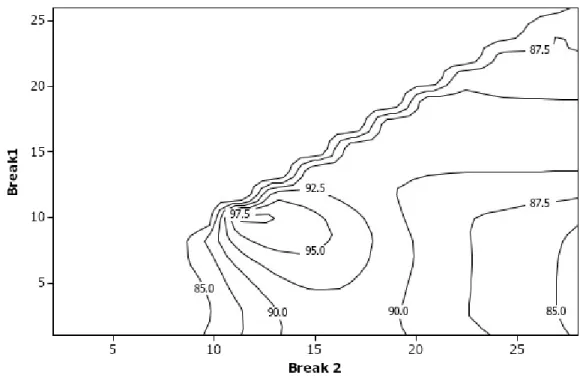
goodness-of-fit, are ( , , )=(10,11,98.1), ( , ,
)=(10,12,97.9), ( , , )=(10,13,97.4), ( , , )=(9,13,97.0) and ( , , )=(9,14,96.7). Taken at face value the differences in the values between these models seem quite minimal. From the possibilities listed a potential criticism of the first four models is the relatively small gap between breakpoints which may reflect local minima arising as chance random patterns in the data and on this basis the fifth model will tentatively be taken as a good two-break model.
Figure 2: Contour plot
The double break model Y= + + + reduces to the simple linear model when = = . Bootstrapping may be used to test the null hypothesis = = against :“At least two values of differ”.
If break points can be considered to be pre-specified then the bootstrap algorithm for these hypotheses would be:
(1c) generate a bootstrap sample using the simple linear (no break) model
(2c) for the bootstrap sample fit the double break model with =9 and =14
(3c) record the value
Steps (1c), (2c), (3c) are repeated B times. The proportion of times that the values from bootstrap samples exceed the corresponding value of is recorded. This proportion gives a bootstrap estimate for testing = = against :“At least two values of differ”.
The above bootstrap algorithms have been applied (B=5000 in both
instances). The derived values of R2 for the bootstrapped two break models
never exceeded the sample R2 value (96.7%) for the given two break model.
Accordingly, the two-break model provides a statistically significant improvement over the simple linear (no break) specification irrespective of whether k1 and k2 are considered fixed with value 9 and 14 respectively or
whether they are considered as values uncovered from the data under a position of ignorance.
Is the double break model an improvement on the single break model? The double break model Y= + + + reduces to the single break model when = or when = . Bootstrapping may be used to test the null hypothesis = or = against :
comparison of the given two break model (k1=9; k2=14) against similar two
break bootstrap models with the null hypothesis specified by the best one break model (k1=16) indicates that the given two break model is a
statistically significant improvement over the one break model (p<0.001). Similarly a comparison of the given two break model (k1=9; k2=14) against
the best possible two break model for each bootstrap sample with the null hypothesis specified by the best one break model (k1=16) has been
undertaken. In these cases 30 bootstrap samples out of 5000 bootstrap samples give a higher R2 than the given sample R2 value (96.7%),
suggesting that even after allowing for chance effects from “over analysing the data” the given two break model may be deemed to be a significant improvement over the one break model (p=0.0006).
8. Conclusion
The broken stick method has the property of retaining continuity and this may be advantageous when modelling a continuous process. Standard regression tests of significance do not directly assess whether gradient coefficients differ from one another, however these potential differences can be assessed using the bootstrap.
In some instances, prior reasoning or a theoretical position may suggest that a different rate of change in the dependent will occur at a pre-specified value of a predictor. In other cases, exploratory data mining may indicate a point for a different rate of change of a dependent variable with a predictor variable. The two possibilities (i.e. a pre-specified node, or a data
discovered node) reflect different research positions but the bootstrap is sufficiently flexible to adjust for these two positions and permit the construction of valid tests of significance.
appropriate in this case even after allowing for the data discovery of these breaks.
References
Andrews, D.W.K. 1993. Tests for parameter instability and structural change with unknown change point. Econometrica 61(4), 821-856 Chow, G.C. 1960. Tests of equality between sets of coefficients in two
linear regressions. Econometrica 28(3), 591-605.
Davidson, A.C. and D.V. Hinckley, 1997. Bootstrap methods and their applications. Cambridge University Press, Cambridge
Greene, C.A. 1999. Testing for a break at an unknown change-point: A test with known size in small samples. Economics Letters 64, 13-16
Hansen, B.E. 1992. Tests for parameter instability in regressions with I(1) processes. Journal of Business and Economic Statistics 10(3), 321-336 Inder, B. and Hao, K. 1996. A new test for structural change. Empirical