
Volume 2006, Article ID 56246, Pages1–7 DOI 10.1155/ASP/2006/56246
Structural Analysis of Single-Point Mutations Given an RNA
Sequence: A Case Study with RNAMute
Alexander Churkin1and Danny Barash1, 2
1Department of Computer Science, Ben-Gurion University, 84105 Beer-Sheva, Israel 2Genome Diversity Center, Institute of Evolution, University of Haifa, Israel
Received 2 May 2005; Revised 13 September 2005; Accepted 1 December 2005
We introduce here for the first time the RNAMute package, a pattern-recognition-based utility to perform mutational analysis and detect vulnerable spots within an RNA sequence that affect structure. Mutations in these spots may lead to a structural change that directly relates to a change in functionality. Previously, the concept was tried on RNA genetic control elements called “riboswitches” and other known RNA switches, without an organized utility that analyzes all single-point mutations and can be further expanded. The RNAMute package allows a comprehensive categorization, given an RNA sequence that has functional relevance, by exploring the patterns of all single-point mutants. For illustration, we apply the RNAMute package on an RNA transcript for which indi-vidual point mutations were shown experimentally to inactivate spectinomycin resistance inEscherichia coli. Functional analysis of mutations on this case study was performed experimentally by creating a library of point mutations using PCR and screening to locate those mutations. With the availability of RNAMute, preanalysis can be performed computationally before conducting an experiment.
Copyright © 2006 Hindawi Publishing Corporation. All rights reserved.
1. INTRODUCTION
The secondary structure of an RNA molecule is a represen-tation of the pattern complementary base pairings that are formed between nucleic acids, given an initial RNA sequence. The sequence, represented as a string of four letters, is a single strand consisting of nucleotides A, C, G, U that folds accord-ing to minimum energy consideration as a basic assumption. The secondary structure of RNAs is experimentally acces-sible, thus making its computational prediction a challeng-ing problem that can be tested in the laboratory. The foldchalleng-ing prediction problem of the secondary structure of RNAs has been an area of active research since the late 70’s (see [20] and other works, review available in [25]). Dynamic pro-gramming methods were developed in [15] (the Nussinov-Jacobson algorithm) for computing the maximum number of base pairings in an RNA sequence. Energy minimiza-tion methods by dynamic programming [23,24] have led to Zuker’smfoldprediction server [26] and the Vienna package [8]. An improvement in the success of these packages to pre-dict an accurate folding comes from incorporating expanded energy rules [13], derived from an independent set of exper-iments, into the folding prediction algorithm. For sequences that are longer than approximately 150 nt, energy mini-mization methods may fail to reliably predict a secondary
structure from sequence alone. In those cases, an approach called comparative modeling [6] is preferable if it can be used.
In this paper, we address the problem of predicting desired nucleotide mutations, which relies on the success of RNA folding prediction by energy minimization but is independent of the particular folding algorithm itself. The question being asked is which nucleotide substitu-tions/deletions/insertions, introduced to the initial RNA se-quence, will lead to a secondary structure rearrangement. The predictions are purely computational and can subse-quently be tested in laboratory experiments. In order to vali-date our approach, we begin with an experimental result [22] that already succeeded to identify several selective mutations, inducing a conformation rearrangement in the secondary structure of RNA transcripts that inactivates spectinomycin resistance in bacteria. As a result, a concept that was initially proposed in [1] with analogy to computer vision scales is ex-tended and applied for the inactivation of bacterial drug re-sistance. The method was previously tried to predict selective mutations in riboswitches and is here validated using results of an in vivo experiment performed independently.
occurring in nature to nucleic acid engineering, in which innovative methods are being developed to modify or cre-ate new functional nucleic acids, the potential contribution of small RNAs to biotechnology and medical applications is evident. The possibility of causing drug resistance by the di-rect binding of short RNA transcripts with antibiotics, re-cently investigated in bacteria by in vivo selection experi-ments [22], is another advance in this field. We use this ex-ample discussed in [22] as our case study.
Selection experiments such as [22] demand adequate re-sources. A large pool of synthetic molecules with varying se-quences needs to be created, before subjecting the pool to a desired selective pressure. Several repeated rounds of selec-tion and amplificaselec-tion cycles are then applied. Oftentimes, without relation to a selection experiment, an interesting structure is obtained and its response to mutations leading to structural rearrangements can yield useful information on the properties of the structure itself. In such cases, because selection experiments are not performed on a regular basis as they demand planning and resources, computational pre-diction methods can help guide which mutations are worth-while to explore further.
The paper is organized as follows. InSection 2, we in-troduce the notation and explain the motivation of using the Fiedler eigenvalue, or algebraic connectivity of trees, as a similarity measure between RNAfolds to locate structural rearrangements. We present some of the properties of the al-gebraic connectivity of trees that directly relate to the RNA mutation prediction problem. InSection 3, the general al-gorithm is presented for added layers of mutation (beyond single-point mutations). Section 4 provides numerical re-sults for the prediction using the RNAMute package, fol-lowed by validation of the method using data from the labo-ratory experiment. Finally,Section 5contains some conclud-ing remarks and directions for further research.
2. RNA SIMILARITY WITH HIERARCHICAL STRUCTURES USING GRAPH SPECTRA
A similar concept that is used in computer vision to treat hi-erarchical structures (e.g., as reported recently in [16]) can be used to predict the effect of nucleotide mutations on the wildtype RNA secondary structure.
Let us examine the predicted secondary structure in Figure 1, as a result of running mfold [26] using dynamic programming to perform the energy minimization on pJ697 RNA [22], with the optimal solution shown in the figure. The folding prediction of the wildtype was used in [22] as a model to analyze the system behavior. The problem we are concerned with here is to predict the location of a muta-tion leading to conformamuta-tional rearrangement. This can ei-ther be a single-point mutation, or if all single-point mu-tations are silent mumu-tations, the least amount of consecu-tive nucleotide single-point mutations that will cause a struc-tural transition. As a consequence of introducing the muta-tion, the new folded structure will assume a different shape from the wildtype secondary structure, signaling a structural transition that may disrupt or repair functional RNA motifs.
Subdomain 1
(a)
1 2 3 4 5
6 λ2=0.324869
Wildtype
(b)
For predicting selective mutations using the Laplacian second eigenvalue, as was suggested in [2], we use the al-gebraic connectivity of a tree as a similarity measure for comparing between the initial RNAfold and the folded structure of all possible mutants. The representation of RNA secondary structures as coarse-grained tree graphs was ini-tially explored in [7,11,17] and the effect of single-point mutations using a combination of RNA tree-graph represen-tation and string comparisons was addressed before in [12], without the reduction to eigenvalues with the methodology developed here. It should be noted that other similarity mea-sures can be used (e.g., [9,10,18]) that convey more infor-mation about the RNA secondary structure representation by trees. The reduction into a coarse-grain tree-graph repre-sentation quantified by the algebraic connectivity of trees is simple and efficient. Moreover, it is easy to use the algebraic connectivity as a first-order approximation for the purpose of classification and filtering of unwanted structures when the information is arranged in a table, because of the favor-able properties listed in the next section.
LetT=(V,E) be a tree with vertex setV=v1,v2,. . .,vn
and edge setE. Denote byd(v) the degree ofv, wherev∈V is a vertex ofT. The Laplacian matrix ofT(also known to be the difference of the diagonal matrix of vertex degreesD(T) and the adjacency matrixA(T) [3,5]) isL(T)=(ai j), where
ai j=
⎧ ⎪ ⎪ ⎨ ⎪ ⎪ ⎩
d(vi) ifi=j, −1 ifvi,vj∈E,
0 otherwise.
(1)
L(T) is a symmetric, positive semidefinite, and singular matrix. The lowest eigenvalue ofL(T) is always zero, since all rows and columns sum up to zero. Denote byλ1 ≥λ2 ≥ · · · ≥ λn = 0 the eigenvalues ofL(T). The second
small-est eigenvalue,λn−1, is called the algebraic connectivity [3]
ofT and labeled asa(T). Some properties ofa(T) that are relevant to the application presented here will be mentioned below, following the calculation ofa(T) for the pJ697 RNA secondary structure example depicted inFigure 1.
2.1. Laplacian representation of case study
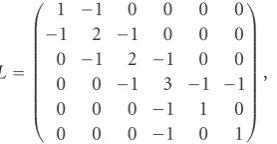
The eigenvalues of the Laplacian matrix are independent of the chosen labeling for the nodes in the tree graph, which only amounts to interchanges of rows and columns. For a particular labeling of the tree-graph example in the boxed part (subdomain 1) ofFigure 1, the corresponding Laplacian matrixL(T) becomes
L=
⎛ ⎜ ⎜ ⎜ ⎜ ⎜ ⎜ ⎜ ⎜ ⎝
1 −1 0 0 0 0
−1 2 −1 0 0 0 0 −1 2 −1 0 0 0 0 −1 3 −1 −1
0 0 0 −1 1 0
0 0 0 −1 0 1
⎞ ⎟ ⎟ ⎟ ⎟ ⎟ ⎟ ⎟ ⎟ ⎠
, (2)
wherea(T) corresponding to the treeTof the wildtype struc-ture inFigure 1is 0.324869, in between a star of 6 vertices and a linear tree of 6 vertices.
The algebraic connectivitya(T) possesses special proper-ties that are advantageous for the RNA secondary structure mutation prediction application presented here.
Properties of algebraic connectivity for trees
LetT=(V,E) be a tree onnvertices with algebraic connec-tivitya(T). Then:
(1) 0≤a(T)≤1,
(2) a(T)=0 if and only ifTis not connected,
(3) a(T)=1 if and only ifT=K1,n−1is a star onnvertices
(upper bound),
(4) a(T)=2(1−cos(π/n)) if and only ifT=Pnis a path
(lower bound),
The algebraic connectivity a(T), or the second eigenvalue of L(T), is smallest but positive when the RNA secondary structure assumes a linear shape (a path) and becomes iden-tically 1 when the RNA secondary structure assumes a star shape [3,4,14]. Although other possibilities exist to distin-guish between tree topologies, the second eigenvalues of the coarse-grain tree graphs are nonexpensive to calculate for the small-sized matrices we are dealing with and possess intuitive meanings supported by mathematical theorems.
3. METHOD AND IMPLEMENTATION USING RNAMUTE
We use the algebraic connectivitya(T) of a treeT to con-struct a stepwise procedure that attempts to locate the least number of mutations needed to disrupt an RNA motif, spec-ifying their positions in the wildtype sequence as the final output. We note that simply visualizing the new structures obtained by performing the allowed mutations is not feasible in practice, unless we devise a procedure that enables us to inspect the structure of only selective mutants.
(1) LetNbe the number of nucleotides in the given wild-type sequence. If N > 100, try subdividing the sequence into independently folded domains, such as subdomain 1 in Figure 1(the folding prediction of this subdomain by itself is the same as the folding prediction of the whole sequence in that region). The subdivision, if necessary, is performed only once and is based on prior knowledge of the wildtype struc-ture. Denote byNthe number of nucleotides in the artificial sequence, corresponding to the subdomain of interest.
Figure 2: RNAMute screen output of one table categorization. Eigenvalue table for the prediction of single-point deleterious muta-tions in the subdomain (boxed) of pJ697 RNA [22]. The clustering to discrete eigenvalues enables to discriminate redundant folding possibilities and concentrate on predicting candidates for secondary structure conformation rearrangements that can cause inactivation of spectinomycin resistance inE. coli. An asterix is marked whenever the same number of vertices as in the wildtype tree-graph struc-ture occurs. Furthermore, not shown here, clustering to different ranges of coarse-grained tree-edit distances is performed in RNA-Mute, based on Shapiro and Zhang [18].
described elsewhere, also calculates other distance informa-tion such as Shapiro and Zhang’s RNA tree distance [18] and the Vienna RNA distance [7].
(3) If allN×3 single-point mutants correspond to the same treeT of the wildtype, add additional layers of muta-tion by extracting the treeTand calculating the features in Step (2) for each one of the (N×3)2double-point
muta-tions, then (N×3)3triple-point mutations,. . ., (N×3)m
m-point mutations, as necessary (see stopping criterion in next step).
(4) Repeat the previous step untilm=m∗, wherem∗is the minimal number of mutations needed so that at least one of the mutants folds to a tree which is different thanTof the wildtype. Attempt to use prior information from stepi < j at stepj, using data from the biology experiment if available, such that at stepjonly (N×3)mj−mifolding calculations are
needed instead of (N×3)mj.
(5) Whenm=m∗, analyze the final eigenvalue table and in the case of RNAMute, interactively experiment with vari-ous eigenvalues that were calculated and stored. First, check the eigenvalues (i.e., visualize the predicted folded struc-ture of mutants leading to this eigenvalue) that are furthest from the eigenvalue corresponding to the treeTof the wild-type. Second, check eigenvalues with different number of vertices than the wildtype, especially those with peculiarities (extreme number of vertices, low frequency of occurrence). When finding an interesting conformation rearrangement, go back from the artificial sequence withN< Nnucleotides to the original sequence withN nucleotides and report the positions of the nucleotide mutations within the sequence, leading to that transition.
At the completion of these steps, we obtain predicted mu-tations that lead to conformation rearrangements and can
be tested in an experiment. The prescribed method is im-plemented using a computer package written in C and Java called RNAMute, which currently calculates all single-point mutations. In addition to eigenvalue information, RNA-Mute includes tables with distance measures available in the RNADistance module that is a part of the Vienna package [7,8].
4. RESULTS OF CASE STUDY
We concentrate on predicting single-point mutations that will cause structural rearrangements with respect to the wild-type structure of RNA transcripts from pJ697 [22] depicted inFigure 1. The six single-point mutations in subdomain 1 ofFigure 1, found by the selection experiment to inactivate spectinomycin resistance, are listed inTable 1. Another use-ful finding as a result of an in vitro experiment performed in [22] with radio-labeled transcripts corresponding to pJ697 and one of the inactivating point mutations (referenced as “mut 1”) is the ability of a single-point mutation to alter the distribution of RNA conformers. This supports the hypothe-sis that a single-point mutation can lead to a secondary struc-ture conformation rearrangement, which is responsible for a change in the function of the RNA. Therefore, if we predict possible mutations that are causing structural transitions in subdomain 1 ofFigure 1, it is likely that those mutations are serious candidates to inactivate spectinomycin resistance in E. coli. One such mutation was experimentally found in [22]. We implemented Step (1) of the algorithm (previous sec-tion) by verifying that the folding prediction of subdomain 1 (Figure 1) is the same as the folding prediction of the whole sequence in that particular domain. Furthermore, we note that the six mutations reported inFigure 4that alter the sub-domain conformation also alter the full RNA conformation as verified usingmfold. Thus, our assumption that the subdo-main ofFigure 1is an independently folded domain is likely to hold in the case study examined here. Consequently, our artificial structure for the purpose of mutation prediction consists only of the boxed segment inFigure 1which is 97 nt long. Performing Step (2), the RNAMute package automati-cally generates an eigenvalue table for all 97×3=291 single-point mutations, depicted inFigure 2. In this case, since there is a large amount of single-point mutations leading to struc-tural rearrangements, we stop the procedure described in the previous section atm∗=1.
4.1. Analysis with RNAMute
Table1: Six single-point mutations in the subdomain (boxed) of pJ697 RNA [22] that inactivate spectinomycin resistance inE. coli, obtained by a selection experiment. From the observations in [22] it is likely that a conformation rearrangement in the secondary struc-ture is associated with the inactivation. WT stands for the wildtype, the six nucleotide mutations are highlighted with the shaded boxes.
Mutation Sequence
WT
CCUCGGCCCAGGAAGCUAUGCAUGC CCCUGCCGUACCCGGGUCGAAUUCG ACCCCUUGUCUGGGGCGGAUGUAUU UUGGGAGGGUAGCUGGCGGAGG
1
CCUCGGCCCAGGAAGCUAUGCAUGC CCCUGCCGUACCCGGGUCGAAUUCG ACCCCUUGUC C GGGGCGGAUGUAUU UUGGGAGGGUAGCUGGCGGAGG
2
CCUCGGCCCAGGAAGCUAUGCAUGC CCCUGCCGUACCCGGGUCGAAUUCG ACCCCUUGUCUGG A GCGGAUGUAUU UUGGGAGGGUAGCUGGCGGAGG
3
CCUCGGCCCAGGAAGCUAUGCAUGC CCCUGCCGUACCCGGGUCGAAUUCG ACCCCUUGUCUGGGGCGGAUGUAUU U A GGGAGGGUAGCUGGCGGAGG
4
CCUCGGCCCAGGAAGCUAUGCAUGC CCCUGCCGUACCCGGGUCGAAUUCG ACCCCUUGUCUGGGGCGGAUGUAUU UUGGGAGGG A AGCUGGCGGAGG
5
CCUCGGCCCAGGAAGCUAUGCAUGC CCCUGCCGUACCCGGGUCGAAUUCG ACCCCUUGUCUGGGGCGGAUGUAUU UUGGGAGGGU G GCUGGCGGAGG
6
CCUCGGCCCAGGAAGCUAUGCAUGC CCCUGCCGUACCCGGGUCGAAUUC A ACCCCUUGUCUGGGGCGGAUGUAUU UUGGGAGGGUAGCUGGCGGAGG
inactivating mutations in an experiment. Selection experi-ments are biased and thus they are likely to miss interesting mutations that can potentially be predicted using computer simulations.
For each of the six inactivating mutations inFigure 4, we simulate a folding prediction usingmfold/Vienna (as was performed for “mut 1” in [22]). We then calculate the eigen-value associated with that folding.Figure 4captures the five distinct tree graphs corresponding to the six inactivating mu-tations and their associated eigenvalues. ExaminingFigure 2, it is noted that although the wildtype structure and mu-tations 1, 2, 5 fall into the same eigenvalue, their overall structure is different. For example, while mutations 1, 2 sess a multibranch loop and two hairpins, the wildtype pos-sesses a single hairpin, although their tree graph compactness (hence second eigenvalue) is the same. To relieve this ambi-guity, we further subdivide the tree-graphs associated with the same second eigenvalue into various groups according to their edit distances as suggested in Shapiro and Zhang [18]
(a)
(b)
Figure3: RNAMute screen output of one single-point mutation, U77A of the full sequence, used in our case study example. Infor-mation includes the minimal energies of the wildtype and mutant, their sequences, their secondary structure representation in the Vi-enna dot-bracket notation and Shapiro’s coarse-grain string nota-tion, and the distances between the two structures using Vienna’s RNAdistance and Shapiro’s tree-edit distance.
λ2=0.324869
(a)
λ2=0.324869
(b)
λ2=0.267949
(c)
λ2=0.260323
(d)
λ2=0.324869
(e)
λ2=0.225377
(f)
Figure4: The secondary structure of the six mutants fromTable 1, found in [22] to inactivate spectinomycin resistance inE. coliby a selection experiment. Their tree-graph representation and associ-ated eigenvalues are drawn.
corresponding to a tree graph surrounding mutation 5. Thus, our analysis includes various measures to estimate similar-ity of secondary structures, a strategy that is taken in RNA-Mute. Furthermore, from Figure 2we observe possibilities for peculiar mutant structures, such as a linear-shaped tree
graph with 8 vertices corresponding to λ2 = 0.166717. Its
low frequency of occurrences (two mutations out of any pos-sible single-point mutations) is not necessarily an indication for false positives; a selection experiment may have skipped these mutations that are highly interesting to try in addi-tional experiments. Such mutations are candidates for vul-nerable spots in the wildtype sequence, potentially triggering a conformational switch that will lead to even stronger inac-tivation of spectinomycin resistance. Thus, our analysis with RNAMute (seeFigure 3) can detect patterns that are worth exploring in additional laboratory experiments.
4.2. Other case studies
The case study reported in this paper [22] was the first we analyzed with RNAMute. Based on the gathered results, we have tried other test cases that require less assumptions to be made prior to predictions. A class of such test cases that will be reported in the future can potentially be used for the examination of phenotypic data available from hepatitis C virus (HCV) experiments [19,21]. For example, RNAMute was able to single out a conformational rearranging mutation in the 5BSL3.2 structure that was reported experimentally in [21]. These test cases are shorter in their sequence lengths (<100 nt), and they can be analyzed independently without further assumptions.
5. CONCLUSIONS
We have presented a method and its RNAMute package implementation for predicting nucleotide mutations that may intervene with RNA function through conformation rearrangements in the secondary structure. Admittedly, the method has several limitations, such as relying on the ac-curacy of energy minimization methods and the use of a coarse-grained measure. For longer sequences, this approach may fail, unless there are associated cases in which compar-ative modeling [6] can be used. Still, for some sequences it has already been shown to match experimental results (e.g., theleptomonas collosomamentioned in [2]) and our recent RNAMute implementation includes fine-grain measures as well. The method is demonstrated on a case study by match-ing the prediction results with known point mutations that inactivate spectinomycin resistance in bacteria, obtained by a selection experiment [22]. Comparison of predicted muta-tions with the ones found by the experiment demonstrates the potential of the method. Thus, it can be used on a variety of RNA structures before planning an in vivo experiment, to detect vulnerable spots and suggest mutations that are inter-esting for further exploration.
ACKNOWLEDGMENTS
REFERENCES
[1] D. Barash and D. Comaniciu, “A common viewpoint on broad kernel filtering and nonlinear diffusion,” inProceedings of the 4th International Conference on Scale-Space Theories in Com-puter Vision (Scale-Space ’03), vol. 2695 ofLecture Notes in Computer Science, pp. 683–698, Isle of Skye, UK, June 2003. [2] D. Barash, “Second eigenvalue of the Laplacian matrix for
pre-dicting RNA conformational switch by mutation,” Bioinfor-matics, vol. 20, no. 12, pp. 1861–1869, 2004.
[3] M. Fiedler, “Algebraic connectivity of graphs,”Czechoslovak Mathematical Journal, vol. 23, pp. 298–305, 1973.
[4] R. Grone and R. Merris, “Algebraic connectivity of trees,”
Czechoslovak Mathematical Journal, vol. 37, no. 4, pp. 660–670, 1987.
[5] R. Grone, R. Merris, and V. S. Sunder, “The Laplacian spec-trum of a graph,”SIAM Journal on Matrix Analysis and Appli-cations, vol. 11, no. 2, pp. 218–238, 1990.
[6] R. R. Gutell, J. C. Lee, and J. J. Cannone, “The accuracy of ri-bosomal RNA comparative structure models,”Current Opin-ion in Structural Biology, vol. 12, no. 3, pp. 301–310, 2002. [7] I. L. Hofacker, W. Fontana, P. F. Stadler, L. S. Bonhoeffer, M.
Tacker, and P. Schuster, “Fast folding and comparison of RNA secondary structures,”Monatshefte f¨ur Chemie, vol. 125, no. 2, pp. 167–188, 1994.
[8] I. L. Hofacker, “Vienna RNA secondary structure server,” Nu-cleic Acids Research, vol. 31, no. 13, pp. 3429–3431, 2003. [9] T. Jiang, G. Lin, B. Ma, and K. Zhang, “A general edit distance
between RNA structures,”Journal of Computational Biology, vol. 9, no. 2, pp. 371–388, 2002.
[10] J. Kitagawa, Y. Futamura, and K. Yamamoto, “Analysis of the conformational energy landscape of human snRNA with a metric based on tree representation of RNA structures,” Nu-cleic Acids Research, vol. 31, no. 7, pp. 2006–2013, 2003. [11] S.-Y. Le, R. Nussinov, and J. V. Maizel, “Tree graphs of RNA
secondary structures and their comparisons,”Computers and Biomedical Research, vol. 22, no. 5, pp. 461–473, 1989. [12] H. Margalit, B. A. Shapiro, A. B. Oppenheim, and J. V. Maizel,
“Detection of common motifs in RNA secondary structures,”
Nucleic Acids Research, vol. 17, no. 12, pp. 4829–4845, 1989. [13] D. H. Mathews, J. Sabina, M. Zuker, and D. H. Turner,
“Ex-panded sequence dependence of thermodynamic parameters improves prediction of RNA secondary structure,”Journal of Molecular Biology, vol. 288, no. 5, pp. 911–940, 1999. [14] R. Merris, “Characteristic vertices of trees,”Linear and
Multi-linear Algebra, vol. 22, pp. 115–131, 1987.
[15] R. Nussinov and A. B. Jacobson, “Fast algorithm for predicting the secondary structure of single-stranded RNA,”Proceedings of the National Academy of Sciences, vol. 77, no. 11, pp. 6309– 6313, 1980.
[16] A. Shokoufandeh, D. Macrini, S. Dickinson, K. Siddiqi, and S. W. Zucker, “Indexing hierarchical structures using graph spec-tra,”IEEE Transactions on Pattern Analysis and Machine Intel-ligence, vol. 27, no. 7, pp. 1125–1140, 2005, Special issue on syntactic and structural pattern recognition.
[17] B. A. Shapiro, “An algorithm for comparing multiple RNA sec-ondary structures,”Computer Applications in the Biosciences, vol. 4, no. 3, pp. 387–393, 1988.
[18] B. A. Shapiro and K. Zhang, “Comparing multiple RNA sec-ondary structures using tree comparisons,”Computer Applica-tions in the Biosciences, vol. 6, no. 4, pp. 309–318, 1990. [19] D. B. Smith and P. Simmonds, “Characteristics of nucleotide
substitution in the hepatitis C virus genome: constraints on se-quence change in coding regions at both ends of the genome,”
Journal of Molecular Evolution, vol. 45, no. 3, pp. 238–246, 1997.
[20] M. S. Waterman and T. F. Smith, “RNA secondary structure: a complete mathematical analysis,”Mathematical Biosciences, vol. 42, no. 3-4, pp. 257–266, 1978.
[21] S. You, D. D. Stump, A. D. Branch, and C. M. Rice, “Acis -acting replication element in the sequence encoding the NS5B RNA-dependent RNA polymerase is required for Hepatitis C virus RNA replication,”Journal of Virology, vol. 78, no. 3, pp. 1352–1366, 2004.
[22] J. M. Zimmerman and L. J. Maher III, “In vivo selection of spectinomycin-binding RNAs,”Nucleic Acids Research, vol. 30, no. 24, pp. 5425–5435, 2002.
[23] M. Zuker and P. Stiegler, “Optimal computer folding of large RNA sequences using thermodynamics and auxiliary informa-tion,”Nucleic Acids Research, vol. 9, no. 1, pp. 133–148, 1981. [24] M. Zuker and D. Sankoff, “RNA secondary structures and their
prediction,”Bulletin of Mathematical Biology, vol. 46, no. 4, pp. 591–621, 1984.
[25] M. Zuker, “Calculating nucleic acid secondary structure,” Cur-rent Opinion in Structural Biology, vol. 10, no. 3, pp. 303–310, 2000.
[26] M. Zuker, “Mfold web server for nucleic acid folding and hy-bridization prediction,”Nucleic Acids Research, vol. 31, no. 13, pp. 3406–3415, 2003.
Alexander Churkinreceived his B.S. degree with distinction from the Department of Computer Science at Ben-Gurion Univer-sity in 2004. Since September 2004, he has been a graduate student in the Department of Computer Science at Ben-Gurion Uni-versity. His research interests include bioin-formatics, RNA structure predictions, and scientific computing.
Danny Barashreceived his Ph.D. degree in applied science in 1999 from the University of California at Davis. From 1999 to 2001, he was employed at Hewlett Packard Lab-oratories in the Technion, Israel, pursuing research on image processing and computer vision. From 2001 to 2003, he was a Howard Hughes Medical Institute Postdoctoral Fel-low at New York University and a Research Fellow at the Institute of Evolution in the
![Figure 1: The predicted secondary structure of pJ697 RNA [22].Subdomain 1 (boxed) is the region of interest for investigating con-formation rearrangements that are thought to be responsible forthe inactivation of spectinomycin resistance in E](https://thumb-us.123doks.com/thumbv2/123dok_us/1153051.1144838/2.600.316.541.68.574/secondary-subdomain-investigating-rearrangements-responsible-inactivation-spectinomycin-resistance.webp)
![Figure 2: RNAMute screen output of one table categorization.Eigenvalue table for the prediction of single-point deleterious muta-tions in the subdomain (boxed) of pJ697 RNA [22]](https://thumb-us.123doks.com/thumbv2/123dok_us/1153051.1144838/4.600.54.290.69.204/figure-rnamute-categorization-eigenvalue-prediction-single-deleterious-subdomain.webp)
