Volume 2008, Article ID 570896,8pages doi:10.1155/2008/570896
Research Article
Teaching Challenge in Hands-on DSP Experiments for
Night-School Students
Hsien-Tsai Wu1and Sen M. Kuo2
1Department of Electrical Engineering, National Dong Hwa University, Da Hsuch Road, Shou-Feng, Hualien 97401, Taiwan 2Department of Electrical Engineering, Northern Illinois University, DeKalb, IL 60115, USA
Correspondence should be addressed to Hsien-Tsai Wu,[email protected]
Received 12 December 2007; Accepted 28 March 2008
Recommended by Mark Kahrs
The rapid increase in digital signal processing (DSP) applications has generated a strong demand for electrical engineers with DSP backgrounds; however, the gap between industry needs and university curricula still exists. To answer this challenge, a sequence of innovative DSP courses that emphasize hands-on experiments and practical applications were developed for continuing education in electrical and computer engineering. These courses are taught in the evening for night-school students having at least three years of work experience. These courses enable students to experiment with sophisticated DSP applications to augment the theoretical, conceptual, and analytical materials provided in traditional DSP courses. The inclusion of both software and hardware developments allows students to undertake a wide range of DSP projects for real-world applications. Assessment data concludes that the digital signal processor fundamentals course can increase learning interest and overcome the prerequisite problem of DSP laboratory experiments. This paper also briefly introduces representative examples of some challenging DSP applications.
Copyright © 2008 H.-T. Wu and S. M. Kuo. This is an open access article distributed under the Creative Commons Attribution License, which permits unrestricted use, distribution, and reproduction in any medium, provided the original work is properly cited.
1. INTRODUCTION
DSP technology is used in many electronic products from household equipment, industrial machinery, medical instru-ments, and computer peripherals to communication systems and devices. DSP has consistently derived its vitality from the interplay between theory and application. Correspond-ingly, DSP courses have increasingly incorporated computer exercises and laboratory experiments to assist students in better understanding DSP principles, and to experience the excitement of applying abstract mathematical concepts to the processing of real-world signals. Digital signal processors are the most popular for DSP applications. These devices are also widely used in classrooms for introducing real-time DSP to the students. Many educators have developed undergraduate courses that emphasize real-time DSP applications [1–6].
In Taiwan, most DSP courses are taught in the graduate curricula, and many practicing engineers have never been exposed to DSP. Many engineers now find themselves working on products that use digital signal processors. Although the DSP semiconductor industry is training
engi-neers through workshops and seminars, it focuses on the software and hardware development of processors only. It may also disrupt the engineer’s daily work schedule with additional travel costs. On the other hand, many univer-sities have already developed very good courses in DSP theory, implementation, and applications [4–8], but they are designed for regular full-time students. This paper presents DSP courses that are specifically designed for practicing engineers at night schools in Taiwan.
In addition to understanding the theory of DSP, it is very important for night-school students to design projects based on digital signal processors to learn both hardware interface and software programming techniques. This paper describes the integration of DSP technology, applications, and labora-tory experiments into the undergraduate courses offered at the night-school programs. A description of continuing DSP education is presented in Section 2. DSP courses offering [9,10], laboratory structures, supporting tools [11–14], and hands-on experiments are introduced inSection 3. Student assessments and evaluations are summarized inSection 4.
2. THE NIGHT-SCHOOL DSP EDUCATION AT STUT
In order to promote continuing education, the Department of Education in Taiwan allowed technical colleges to add night-school programs for part-time students in 1981. The university is located at the southern part of Taiwan, and the College of Engineering was established in July 1996. There are many engineers from industrial companies near campus who need continuing education at night.
Night-school program at the Department of Computer Science and Information Engineering (CSIE) aims at a balance between theory and practice. The curricula focus on molding students to meet the needs of the Southern Taiwan Science-Based Industrial Park, the Science Area in Southern Taiwan, and the Taiwan Technical City. Because of its solid foundation, the night school has developed rapidly. In addition to the full-time faculty members, several experienced experts were also hired as part-time faculty members. In this way, these courses met the needs of industrial engineers for continuing education.
Narrowing the university-industry gap is very important, and the university plans to achieve this goal by
(1) revising the courses and degree programs to meet requirements of different industries;
(2) inviting local industry to participate in the planning and reviewing of undergraduate and graduate curric-ula;
(3) improving the skills of students through better labo-ratory training and experiments.
Most companies in the university’s service area are involved with DSP, and this correlates with the main focus and strength of the department in applied DSP. In addition to hardware topics such as digital signal processors, strong software development, such as real-time DSP algorithms, and programming skills are also required. It is important to southern Taiwan industrial activities that we offer time DSP application courses. With this in mind, a real-time application course on DSP laboratory experiments was introduced into the CSIE undergraduate curriculum for night-school students. This course introduces TMS320C6x, TMS320C54x, and TMS320C55x digital signal processors for experiments. Through a sequence of lab experiments, students learn the concepts and skills of DSP programming to design and develop advanced DSP applications. This course is well received by undergraduate students because it emphasizes practical DSP aspects.
3. DSP COURSES
The major goal of DSP courses is using sophisticated DSP experiments to augment the theoretical, conceptual, and analytical materials provided in three DSP courses.Figure 1 illustrates the flow chart of DSP-related courses (Digital Signal Processing, Digital Signal Processors Fundamentals, and DSP Laboratory Experiments) for night-school students.
3.1. Digital signal processing
Basic DSP concepts are introduced in Digital Signal Process-ing (CSIE312). This theory-oriented course introduces the basic principles of sampling technique, discrete-time signals and systems, and digital filter design. It also includes fast computations of discrete Fourier transforms and discrete-time system structures. Topics covered in this course are summarized as follows:
(1) discrete-time signals and systems, (2) z-transform,
(3) sampling,
(4) transform analysis of linear time-invariant systems, (5) structures for discrete-time systems,
(6) digital filter design, (7) discrete Fourier transform,
(8) computation of discrete Fourier transform.
3.2. Digital signal processors fundamentals
As suggested by course assessment (that will be intro-duced in Section 4), there is a gap between CSIE312 and CSIE566. As a remedy, the new Digital Signal Processors Fundamentals (CSIE433) course was added to introduce fundamental concepts of digital signal processors. This course presents architectures, programming skills, block FIR filter implementations, on-chip peripherals, and DSP/BIOS of fixed-point digital signal processors (TMS320C54xx and TMS320C55xx). Therefore, CSIE433 is a processor-oriented design course. Topics covered in the course are summarized as follows:
(1) architecture overview,
(2) software development and code composer studio (CCS),
(3) addressing mode,
(4) internal memory and EMIF, (5) solving sum of products, (6) numerical issues,
Signals and systems Circuit systems
Digital signal processing (CSIE 312)
Speech signal processing Digital signal processors fundamentals
(CSIE 433)
Digital image processing
DSP laboratory experiments (CSIE 566)
New
Figure1: Flow chart of DSP-related courses [1].
Oscillator 100 MHz
5 V power supplyTPS767d301
3.3 & 1.8 V 13 IEEE 1149.1 JTAG Power/ground
TMS320VC5402
JTAG Reset CLKS
EMIF
INT /RST
McBSP HPI
Data bus
Memory
Address bus
Interface
INT
Buffer 16
20
Figure2: Functional blocks of the self-developed DSP platform.
Figure3: Laboratory workstation based on the self-developed DSP platform, which also shows PC, JTAG emulator and oscilloscope.
(12) managing interrupts,
(13) other peripherals,
(14) DSP/BIOS (optional: C54x/C55x Migration).
3.3. DSP laboratory experiments
This section describes the integration of DSP applications and laboratory experiments into the undergraduate DSP courses for continuing education. In addition to under-standing the theory of DSP, it is important for night-school students to design products based on digital signal processors in order to learn hardware interface skills and software pro-gramming. This class implements DSP algorithms on digital signal processors and introduces the following applications:
(1) self-developed DSP platform,
(2) active noise control using the self-developed DSP platform,
(3) multichannel DTMF detection using the self-devel-oped DSP platform,
(4) multifunctional automatic pulse wave analyzer using the self-developed DSP platform,
(5) image catching and processing system using the TMS320C6711 DSK.
(1) Self-developed DSP platform
As shown in Figures 2 and 3, a versatile, low-cost, and high-performance DSP platform based on Texas Instru-ments’ TMS320VC5402 fixed-point processor [11–14] was developed for the DSP lab experiments. The highly parallel instruction set of ’C54x includes a flexible mix of single-cycle, arithmetic, logic, and bit manipulation operations. A rich mix of peripherals and general-purpose input/output pins further enhances system flexibility. In addition to the emulation features described in the CPU core, scanning logic of the platform also includes boundary scan capability. The IEEE1149.1 interface can be used to test pin-to-pin conti-nuity between the TMS320VC5402 and other IEEE1149.1 compliant devices.
(2) Active noise control using the self-developed DSP platform
Figure 4: ANC laboratory workstation, which shows the self-developed DSP platform with JTAG emulator, a duct, and two loudspeakers.
x(n)
P(z)
S(z)
W(z) y(n) S(z)
Σ
+
− e(n)
LMS
Figure5: Block diagram of the FXLMS algorithm.
and opposite phase is generated and combined with a primary noise, resulting in the cancelation of both noises [15]. ANC is developing rapidly because it not only permits improvements in noise control, but also offers potential benefits in reducing size, weight, and cost. With the recent advent of adaptive signal processing and the introduction of powerful but relatively inexpensive DSP processors, ANC has become a practical reality.
Broadband feedforward ANC system is exemplified by controlling acoustic noise in a long, narrow duct, such as exhaust pipes and ventilation systems, as illustrated
in Figure 4. The undesired noise from a noise source is
measured by a reference microphone, processed by an adaptive filter, and the output is used to drive a secondary source (loudspeaker) to cancel the noise in the duct. The residual noise detected by an error microphone is used to update the adaptive filter coefficients to minimize the residual noise. Since the secondary path transfer function follows the adaptive filter, the input to the error correlator must be filtered by this secondary path estimate, to ensure the algorithm’s convergence. Figure 5 shows the filtered-X least-mean-square (FXLMS) algorithm [15].Figure 6shows the simulation results, where the undesired noise (top plot) was canceled by the antinoise generated by adaptive filter, resulting in small residual noise (bottom plot).
In general, ANC can be applied to air conditioning and exhaust ducts, noise within an enclosed space, personal hearing protection, and free-space noise where noise is radiated into three-dimensional space. With this basic setup and experiment, many challenging applications can be developed by students for solving real-world noise problems.
400 350 300 250 200 150 100 50 0
Number of iterations
−8
−6
−4
−2 0 2 4 6 8
A
m
plitude
Primary noise
(a)
200 180 160 140 120 100 80 60 40 20 0
Number of iterations
−5
−4
−3
−2
−1 0 1 2 3 4 5
A
m
plitude
Error plot-FXLMS algorithm
(b)
Figure6: Results of the FXLMS algorithm: (a) primary noise and (b) residual noise.
(3) Multichannel DTMF detection using the self-developed DSP platform
PC #1
JTAG interface CCS
development
software Cmd-Bus Emulated switch host
ST-Bus
DTMF signal detection card
JTAG
interfacedevelopmentCCS software
PC #2
Figure7: Development model for multichannel DTMF signal de-tection.
control of detection flow including (1) DSP assembly lan-guage call, (2) 32-channel PCM signal judgment at receipt, (3) algorithms execution, and (4) switch and detection command identification. The DSP assembly code is used for the HPI, McBSP, and DMA hardware controls and interfaces. All verification works are performed in real time with the DSP system development tools including CCS [14] and JTAG hardware emulators.
The new DTMF signal detection card satisfies the following requirements: (1) 32-channel function, (2) pro-grammable communication interface, (3) enhancement of DTMF signal generation and detection abilities, and (4) establishment of the development platform and testing model. To verify these functions, it is necessary to establish a good testing platform and development tools. As shown
inFigure 7, we used the CCS to integrate the development
and testing environments. The XDS510 hardware interface controller on the PC is connected to the JTAG interface on the DSP to facilitate PC monitoring, DSP execution, and buffer content modification from the PC. The CCS is installed on both PCs; one emulates the host card on the switch, and the other is the multichannel DTMF detection card. The ST-Bus cable and command/data cable (Cmd Bus) are connected independently. This allows students to test all multichannel DTMF detection functions without a physical switch.
(4) Multifunctional automatic pulse wave analyzer using the self-developed DSP platform
According to many studies, arterial stiffness is the main reason that causes several diseases. Atherosclerosis begins with the oxidation of low-density cholesterols in the blood which inflames the vessel wall. At the early stage of atherosclerosis, plaques are formed inside the vessel. When these plaques rupture or fester, the platelets coagulate in the damaged area, and eventually lead to thrombus or blood clots. Minor thrombus causes unstable angina. Large thrombus causes diseases such as myocardial infarction, stroke, and other coronary diseases. Therefore, frequent monitoring of the level of arterial stiffness not only assists to understand one’s personal coronary condition, but also improves one’s lifestyle and diet to stay away from these deadly atherosclerosis diseases.
Figure8: Screenshot of the Multifunctional Automatic Pulse Wave Analyzer [16,17].
How to effectively predict atherosclerosis-related diseases is important. The multifunctional automatic pulse wave analyzer supports early detection of atherosclerosis [16,17]. The analyzer is one of many portable medical applications using DSP platform. Power/battery management, control and data processing, amplification and analog-to-digital conversion of the sensor input, some type of display, and the sensor element(s) itself are all needed in the system. This system consists of portable photoplethysmography and easy-of-use interface software as shown inFigure 8.
The multifunctional automatic pulse wave analyzer makes great progress in the field of noninvasive measurement of atherosclerosis. It has great potential in both research and clinical applications. The system was used as a diagnostic tool by National Cheng Kung University Hospital, Buddhist Tzu Chi General Hospital, and Mennonite Christian Hospital. With this self-developed system, many useful experiments and applications can be conducted by students.
(5) Image catching and processing system using the TMS320C 6711 DSK
For the purpose of teaching floating-point digital signal processors, the TMS320C 6711 DSK was used in this experiment. In addition, the students must apply the same fundamental concepts of digital signal processors, for exam-ple, C compiler programming skills, on-chip peripherals, and DSP/BIOS, to the fifth application in the course.
This project offers both instructors and students an independent teaching tool that allows catching, processing, and designing of front and rear images. The system consists of a front image catching module for catching charge-coupled device (CCD) composite video signals, and a rear video processing platform, which consists of a digital signal processor and an SDRAM. The new system features image processing, compression, digital signal processing, SDRAM memory, and other associated technologies to support students in understanding theory and practice of image processing.
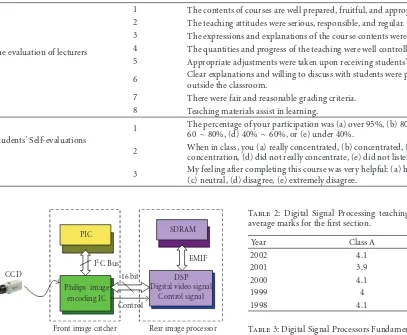
Table1: The teaching evaluation survey form.
The evaluation of lecturers
1 The contents of courses are well prepared, fruitful, and appropriate. 2 The teaching attitudes were serious, responsible, and regular.
3 The expressions and explanations of the course contents were very clear. 4 The quantities and progress of the teaching were well controlled. 5 Appropriate adjustments were taken upon receiving students’ feedback.
6 Clear explanations and willing to discuss with students were present inside and outside the classroom.
7 There were fair and reasonable grading criteria. 8 Teaching materials assist in learning.
Students’ Self-evaluations
1 The percentage of your participation was (a) over 95%, (b) 80∼95%, (c) 60∼80%, (d) 40%∼60%, or (e) under 40%.
2 When in class, you (a) really concentrated, (b) concentrated, (c) had average concentration, (d) did not really concentrate, (e) did not listen.
3 My feeling after completing this course was very helpful: (a) highly agree, (b) agree, (c) neutral, (d) disagree, (e) extremely disagree.
PIC
CCD
I2C Bus
Philips image encoding IC
16 bit
Control
Front image catcher Rear image processor SDRAM
EMIF DSP Digital video signal
Control signal
Figure9: Complete image catching and processing system.
program, which does not demonstrate how images are processed. In this study, a homemade digital image catching card is used to catch images without a computer. A high-speed DSP processor is then used for processing real-time images. These features motivate students to follow step-by-step image catching, while successfully learning how to improve their capability for using the image processing software and hardware.
Figure 9 shows the system’s hardware diagram. The
homemade front image catching module catches video signals from CCD, encodes images to digital video signals, and transmits them to the rear video processing platform for image processing. This hardware system uses the Agilent digital logic analyzer and digital oscillator.
A digital logic analyzer is needed to monitor the digital video signals. The rear image processing platform is the TMS320C 6711 DSP Start Kit (DSK) [2] with the processor clocked at 150 MHz, which is fast enough for image process-ing. In the homemade catching card, the video sampling rate is set at 13.5 MHz and the rear image processing platform completes digital video data using the high-speed DSP. The two subsystems are synchronized before they can transmit data. We use the vertical signals from the Philips video-encoding chip for interrupting high-speed DSP using image
Table2: Digital Signal Processing teaching feedback survey; the average marks for the first section.
Year Class A Class B
2002 4.1 4.1
2001 3.9 4.1
2000 4.1 4.2
1999 4 4
1998 4.1 4
Table3: Digital Signal Processors Fundamentals teaching feedback survey; the average marks for the first section.
Year Class A Class B
2002 4.2 4.3
2001 4.4 4.2
2000 4.1 4
1999 N/A N/A
1998 N/A N/A
Table4: DSP Laboratory Experiments teaching feedback survey; the average marks for the first section.
Year Class A Class B
2002 4.4 4.5
2001 4.3 4.2
2000 3.7 3.8
1999 3.4 3.6
sampling frequency, and DMA controller catches the image to the address in a designated memory.
4. EVALUATION AND ASSESSMENT
used as a reference for the faculty to improve and design courses. The survey is divided into two sections. The first section has eight questions that focus on students’ evaluation of the courses, instructors, and lecturers. Students make the following six choices for each question in the first section: highly agree, agree, average, disagree, extremely disagree, and not applicable. For statistical purpose, the first five choices are given the scores of 5, 4, 3, 2, and 1, and no score is given to the last one. The second section has three questions on students’ self-evaluation, which can be used as a reference. The teaching survey form is shown inTable 1.
Tables2,3, and4summarize the survey results of DSP courses during 1998–2002 for night-school students [1]. The number of students was around 40–50 per class. The statistics of DSP courses, as shown in Tables 2–4, indicate what follows.
(1) In 1998–2002, the Digital Signal Processing course was popular for night-school students [1].
(2) In 1999 and 2000, the feedback of DSP Laboratory Experiments course was below a score of 4 before the Digital Signal Processors Fundamentals course was offered. This shows a gap between the Digital Signal Processing and the DSP Laboratory Experiments courses. After the new Digital Signal Processors Fundamentals course was offered, the feedback of DSP Laboratory Experiments course reached 4.25. In 2002, the average score climbed up to 4.45. It showed that the Digital Signal Processors Fundamentals course really assists in bridging the gap between the Digital Signal Processing and the DSP Laboratory Experiments courses.
(3) After the Digital Signal Processors Fundamentals course was offered, the DSP Laboratory Experiments course became popular for night-school students, and the popularity is continuing to grow. This is because this course focuses on implementing DSP algorithms and software applications, which over-comes the problems of the insufficient time to self-study processor architectures, and increases learning interest.
(4) The third question in the evaluation form shows that after offering the Digital Signal Processors Funda-mentals course, students who favored the DSP Labo-ratory Experiments and the Digital Signal Processors Fundamentals courses also increased. Most students who took the DSP Laboratory Experiments and the Digital Signal Processors Fundamentals courses felt that these courses were helpful to become familiar with DSP processors, hardware platforms, and real-time DSP applications. The project flow in the course is similar to the R&D procedure of industries, which greatly assists night-school students with their daytime work.
5. CONCLUSIONS
The new Digital Signal Processors Fundamentals course introduced in the night-school curriculum focuses on DSP
concepts and algorithms. This course enables students to use DSP chips to design different DSP applications. These real-time DSP applications also prepare night-school students with respect to practical DSP system design and developments. The DSP courses presented in this paper met the needs of night-school students and assisted them significantly in their work and career development.
ACKNOWLEDGMENTS
The authors are grateful for the support of Texas Instru-ments, Taiwan, in sponsoring the DSP Code Composer Stu-dio and assisting in developing the DSP design courseware. This work was supported in part by the National Science Council under Grants no. NSC 96-2221-E-259-006 and no. NSC 95-2221-E-259-046, Taiwan, Republic of China.
REFERENCES
[1] H.-T. Wu and S. M. Kuo, “Continuing education courses emphasizing hands-on DSP experiments for night-school students,” inProceedings of the IEEE International Conference on Acoustics, Speech, and Signal Processing (ICASSP ’04), vol. 5, pp. 1017–1020, Montreal, Canada, May 2004.
[2] I. M. Abdel-Qader, B. J. Bazuin, H. S. Mousavinezhad, and J. K. Patrick, “Real-time digital signal processing in undergraduate curriculum,”IEEE Transactions on Education, vol. 46, no. 1, pp. 95–101, 2003.
[3] W.-S. Gan, “Teaching and learning the hows and whys of real-time digital signal processing,” IEEE Transactions on Education, vol. 45, no. 4, pp. 336–343, 2002.
[4] W.-S. Gan, Y.-K. Chong, W. Gong, and W.-T. Tan, “Rapid prototyping system for teaching real-time digital signal pro-cessing,”IEEE Transactions on Education, vol. 43, no. 1, pp. 19–24, 2000.
[5] S. M. Kuo and G. D. Miller, “An innovative course emphasizing real-time digital signal processing applications,”IEEE Transac-tions on Education, vol. 39, no. 2, pp. 109–113, 1996.
[6] J. Jackson, T. Barnwell, D. Williams, M. Hayes III, D. Anderson, and R. Schafer, “DSP for practicing engineers: an online course for continuing DSP education,” inProceedings of the IEEE Interntional Conference on Acoustics, Speech, and Signal Processing (ICASSP ’01), vol. 5, pp. 2721–2724, Salt Lake City, Utah, USA, May 2001.
[7] J. H. McClellan, R. W. Schafer, and M. A. Yoder, Signal Processing First, Prentice-Hall, Englewood Cliffs, NJ, USA, 2003.
[8] S. M. Kuo and B. H. Lee,Real-Time Digital Signal Process-ing: Implementations, Applications and Experiments with the TMS320c55x, John Wiley & Sons, New York, NY, USA, 2001. [9] H.-T. Wu and H.-D. Chang, “A first laboratory course on
digital signal processing,” inProceedings of the IEEE Interna-tional Conference on Engineering Education (ICEE ’00), Taipei, Taiwan, August 2000.
[10] H.-T. Wu, T.-C. Hsiao, C.-L. Chen, C.-M. Su, J.-C. Su, and J.-C. Jiang, “An integrated teaching and learning DSP lab. System,”Journal of Science and Technology, vol. 10, no. 1, pp. 29–36, 2001.
[11] Texas Instruments,TMS320C5402 Fixed-Point Digital Signal Processor, data sheet, SPRS079, 2000.
[13] Texas Instruments,TMS320C54x DSP Reference Set, Volume 5: Enhanced Peripherals, SPRU302, June 1999.
[14] Texas Instruments,TMS320C54x Code Composer Studio: Tuto-rial, SPRU327A, August 1999.
[15] S. M. Kuo and D. R. Morgan,Active Noise Control Systems: Algorithms and DSP Implementations, John Wiley & Sons, New York, NY, USA, 1996.
[16] H.-T. Wu, C.-C. Yang, and T.-C. Wu, “Clinical calibration study for arterial stiffness measuring instrument,” in Proceed-ings the 4th International Conference on Cybernetics and Infor-mation Technologies, Systems and Applications (CITSA ’07), vol. 1, pp. 228–233, Orlando, Fla, USA, July 2007.