Portions of this material have been previously copyrighted by:
Bell Telephone Laboratories, Incorporated, 1980
Western Electric Company, Incorporated, 1983
Regents of the University of California
Holders of a UNIX and U niPlus + software license are permitted to copy this docu, ment, or any portion of it, as necessary for licensed use of the software, provide< this copyright notice and statement of permission are included.
UNIX is a Trademark of AT&T Bell Laboratories, Inc.
This guide describes the C programming language supported by the UniPlus+* System V operating system. The user should have at least two years of specialized training in computer-related fields. The user is also expected to use UniPlus+ for system development.
This guide contains eight chapters:
• C INTERFACE NOTES
• C LANGUAGE • C LIBRARY • MA TH LIBRARY
• EFL: PROGRAMMING LANGUAGE • LINT: C PROGRAM CHECKER • UNIX IMPLEMENTATION
• UNIX 110
Chapter 1, C INTERFACE NOTES, describes the way in which the U niSoft 68000 C programming language represents data in storage and how that data is passed between functions.
Chapter 2, C LANGUAGE, provides a summary of the grammar and rules of the C programming language which was used to write most of the UNIX
t
operating system.Chapter 3, C LIBRARY, describes the functions and declarations that support the C Language and how to use these functions.
Chapter 4, MATH LIBRARY, describes the Math library that is sup-ported on UniPlus+.
Chapter 5, EFL: PROGRAMMING LANGUAGE, describes the pro-gramming language EFL. The reader should have a fair degree of fami-liarity with some procedural language.
Chapter 6, LINT: C PROGRAM CHECKER,- describes a program that attempts to detect compile-time bugs and non-portable features in C programs.
Chapter 7, UNIX IMPLEMENTATION, describes the implementation of the resident UNIX kernel which includes how the system views processes, users, and programs.
Chapter 8, UNIX 110 SYSTEM, gives an overview of the 110 system and guides writers of device driver routines. The reader should have a good knowledge of the overall structure of the file system.
Throughout this document, any reference of the form name OM), name (7), or name (8) refers to entries in the UniPlus+ System V
Chapter 1
Chapter 2
Chapter 3
Chapter 4
Chapter 5
Chapter 6
Chapter 7
Chapter 8
C INTERFACE NOTES
C LANGUAGE
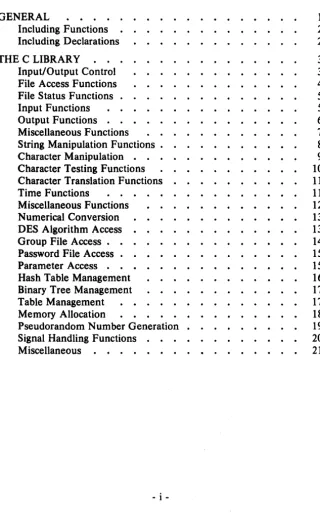
C LIBRARY
MATH LIBRARY
EFL: PROGRAMMING LANGUAGE
LINT: C PROGRAM CHECKER
UNIX IMPLEMENTATION
CONTENTS
INTRODUCTION
DATA REPRESENTATIONS. . PARAMETER PASSING IN C SETTING UP THE STACK
ALLOCATION OF LOCAL VARIABLES AND
REGISTERS . . . .
RETURNING FROM A FUNCTION OR SUBROUTINE SYSTEM CALLS • • . . . . .
OPTIMIZATIONS • . . .
USE OF REGISTER VARIABLES
1
2
3 5
6
7
8 8
C INTERFACE NOTES
INTRODUCTION
This chapter describes the way in which the U niSoft 68000 C program-ming language represents data in storage, and how that data is passed between functions. Also described is the environment of a function, and the calling mechanism for functions.
The information in this chapter is intended for programmers who have detailed knowledge of the interface mechanisms in order to match C code with the assembler. It is also intended for those who wish to write new system functions or mathematical functions.
When a C program is compiled and assembled, the program is split into three parts. These are:
.text The executable code of the program .
. data The initialized data area. This contains literal constants, character strings, and so on .
. bss The uninitialized data areas.
These three parts of the program appear in the above order. The compiler/assembler combination produces the first two. The loader actually generates the .bss area at load time.
The .bss area is cleared to zero (0) by the loader at load time. This is a feature of the system and can be relied upon.
DATA REPRESENTATIONS
In general, all data elements of whatever size are stored such that their least significan t bit is in the highest addressed byte and their most significant bit is in the lowest addressed byte. The list below describes the representation of data.
char 6 Values of type char occupy 8 bits. Such values can be aligned on any byte boundary.
short 6 Values of type short occupy 16 bits. Values of type short are aligned on word (16-bit) address boundaries.
long 6 Values of type long occupy 32 bits. A long value is the same as an int value in 68000 C. Values of this type are aligned on word (16-bit) boundaries.
float 6 Values of type float occupy 32 bits. All float values are automatically converted to type double for computation purposes. Values of this type are aligned on word (16-bit) boundaries. A float value consists of a sign bit, fol-lowed by an 8-bit biased exponent, folfol-lowed by a 23-bit mantissa.
double 6 Values of type double occupy 64 bits. Values of this type are aligned on word (16-bit) boundaries. A double value consists of a sign bit, followed by an 8-bit biased exponent, followed by a 55-bit mantissa.
pointers 6 All pointers are represented as long (32-bit) values. Pointers are aligned on word (16-bit) boundaries.
arrays 6 The base address of an array value is always aligned on a word (16-bit) address boundary.
Elements of an array are stored contiguously, one after the other. Elements of multi-dimensional arrays are stored in row-major order. That is, the last dimension of an array varies the fastest.
When a multi-dimensional array is declared, it is possible to omit the size specification for the last dimension. In such a case, what is allocated is actually an array of pointers to the elements of the last dimension.
structures and unions
rounding addresses up to 16-bit boundaries to accommo-date word-aligned elements.
This situation can best be demonstrated by an example. Consider the following structure:
struct {
int x; /* This is a 32-bit element */
};
char y; short z;
/* Takes up a single byte */ /* Aligned to a 16-bit boundary */
The total number of bytes declared above is seven: four for the int, one for the char, and two for the short. In reality, the "z" field which is a short will be aligned on a 16-bit boundary by the C compiler. In this case, the compiler inserts a hole after the char element "y", to align the short element "z". The net effect of these machinations is a structure that behaves like this:
struct {
int x'
,
/* This is a 32-bit element */ char y; /* Takes up a single byte */char dummy; /* Fills the structure */
short
z·
,
/* Aligned to a 16-bit boundary */ } ;The C compiler never reorders any parts of a structure. Similar considerations apply to arrays of structures or unions. Each element of an array (other than an array of char) begins on a 16-bit boundary.
For a detailed treatment of data storage, consult The C Programming Language by Kernighan and Ritchie.
PARAMETER PASSING IN C
Another unique feature of C is that parameters to functions are always passed by value. The C programming language has no concept of declaring parameters to be passed by reference, as there is in languages such as Pascal. In order to pass a parameter by reference in a C pro-gram, the programmer must explicitly pass the address of the parame-ter. The called function must be aware that it is receiving an address instead of a value, and the appropriate code must be present to handle that case.
When a function is called, its parameters (if any) are evaluated and are then pushed onto the stack in reverse order. All parameters are pushed onto the stack as 32-bit longs. If a parameter is shorter than 32 bits, it is expanded to a 32-bit value with sign-extension, if necessary. The calling procedure is responsible for popping the parameters off the stack.
Consider a C function call like this: ferry (charon, 7, &styx, 1« 10);
After evaluation, but just before the call, the stack looks like this:
Sp - value of variable 'charon'
7
address of variable 'styx'
1024
... previous stack contents ...
SP
-
Return address value of variable 'charon'7
address of variable 'styx'
1024
... previous stack contents ...
In each function, register A6 is used as a stack frame base. The stack location referenced by A6 contains the return address.
SETTING UP THE STACK
Upon entry into the function, the prolog code is executed. The prolog code allocates enough space on the stack for the local variables, plus enough space to save any registers that this function uses. The prolog code then ensures that there is enough stack space available for execut-ing the function. If there is not enough space, the system grows the stack to allot more space. The prolog code looks like this:
link tstb moveml
a6,#-.FI sp@ (-page_size) #.SI,a6@(-.FI)
The ".FI" constant is the size of the stack frame for the local vari-ables, plus four bytes for each register variable.
The "page_size" constant is an implementation dependent constant. It is used to probe the stack region at some place below the current stack top. If the probe generates a trap, the system grows the stack by an amount sufficient to include the probe address.
ALLOCATION OF LOCAL VARIABLES AND REGISTERS
A total of nine registers are available for register variables. Five of these are the 68000 data (D) registers, and four are the 68000 address (A) registers. The available A registers are A2 through AS. The avail-able D registers are D3 through D7.
Any variable declared as a pointer variable is always allocated to an address register. Non-pointer variables are assigned to data registers. Register variables are allocated to registers in the order in which they are declared in the C source program, starting at the high end (AS or D7) of the appropriate type of register.
If there are more register variables of either kind than there are regis-ters to accommodate them, the remaining variables are allocated on the stack as local variables, just as if the register attribute had never been given in the declaration.
...
Register Save Area
SP -
...
...
Local Variables
...
A6 - Old A6
Return Address
value of variable 'charon'
7
address of variable 'styx'
1024
... previous stack contents ...
RETURNING FROM A FUNCTION OR SUBROUTINE
Upon reaching a "return" statement, either explicit or implicit, the function executes the epilog code. If the function has a return value, generated from a
return (expression);
statement, the value of the expression (which is synonymous with the value of the function) is placed in register DO. The epilog code is then executed to effect a return from the function:
moveml unlk rts
a6@(-.Fl),#.Sl a6
function is then exited via the "rts" instruction, which pops the stack to the state it was in prior to the original call, and then returns to the function that called it.
SYSTEM CALLS
The C compiler generates code for system calls in the following way:
• The system call number is placed in register DO.
• The first parameter is placed in register AO; the second parameter goes in register D 1; the third parameter is placed in register AI; and the fourth parameter is placed in register D2.
• A "TRAP #0" instruction is executed.
The C compiler sometimes generates code which uses register D2, so if your code uses D2, you must save it before executing the system call. On return from the system call, errors are signaled by the carry flag being set. The C interface to the system calls typically returns a -Ion error as the carry flag cannot be tested from C.
OPTIMIZATIONS
This section describes some of the ways in which the programmer can optimize the use of the C language.
The C compiler can be run to optimize the code it generates, making that code both compact and fast. Using a C command line as follows:
cc -0 file
generates optimized code. The option for optimized code generation is an upper-case "0".
If a C program contains a "do" loop of the form: register short x;
x
=
10; do {Such a loop is optimized to use the "dbra" instruction, resulting in fas-ter execution.
USE OF REGISTER VARIABLES
CONTENTS
LEXICAL CONVENTIONS . Comments
Identifiers (Names) . . • . .
Keywords . . . • . •
Constants . . . .
Integer Constants . Explicit Long Constants . Character Constants . . Floating Constants Enumeration Constants
Strings . • . . . .
Hardware Characteristics SYNTAX NOTATION NAMES
Storage Class
Type . . . .
OBJECTS AND LVALUES . . . . CONVERSIONS . • . . .
Characters and Integers .
Float and Double . . . . Floating and Integral . . . . Pointers and Integers. . . . Unsigned. . . . .
Arithmetic Conversions . EXPRESSIONS
Primary Expressions . .
U nary Operators . . . . Multiplicative Operators .
Additive Operators . . . . Shift Operators . . . .
Relational Operators . . . . .
Equality Operators. . . .
Bitwise AND Operator . . . . Bitwise Exclusive OR Operator
Logical OR Operator .
Conditional Operator . . . . Assignment Operators . . . . Comma Operator . .
DECLARATIONS
Storage Class Specifiers . . . . . Type Specifiers . . .
D.eclarators . . . . Meaning of Declarators . . . . Structure and Union Declarations
Enumeration Declarations Initialization .
Type Names. Typedef . . STATEMENTS
Expression Statement . . .
Compound Statement or Block
Conditional Statement . . . .
While Statement . . . .
Do Statement . . . . .
For Statement . . . .
Switch Statement . . .
Break Statement
Continue Statement . . . •
Return Statement . • . . . .
Goto Statement . . . .
Labeled Statement . . . • .
Null Statement . . . EXTERNAL DEFINITIONS. .
External Function Definitions . . . . External Data Definitions . . . . • . • . . SCOPE RULES . . . •
Lexical Scope Scope of Externals
COMPILER CONTROL LINES . Token Replacement
File Inclusion . • • • . . . . Conditional Compilation. .
TYPES REVISITED Structures and Unions
Functions . • • •
Arrays, Pointers, and Subscripting
Explicit Pointer Conversions . . • • . . CONST ANT EXPRESSIONS
PORTABILITY CONSIDERATIONS . SYNTAX SUMMARY
Expressions •
Declarations. • . . Statements
External definitions Preprocessor
LIST OF FIGURES
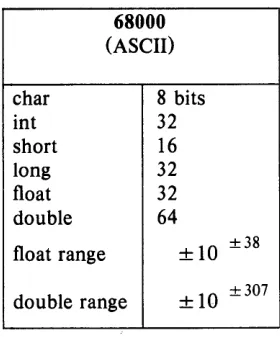
Figure 2.1. 68000 Hardware Characteristics
53 53 54 55 56
57
58
59 60
62
65 65 66C LANGUAGE
LEXICAL CONVENTIONS
There are six classes of tokens - identifiers, keywords, constants, strings, operators, and other separators. Blanks, tabs, new-lines, and comments (collectively, "white space") as described below are ignored except as they serve to separate tokens. Some white space is required to separate otherwise adjacent identifiers, keywords, arid constants.
If the input stream has been parsed into tokens up to a given character, the next token is taken to include the longest string of characters which could possibly constitute a token.
Comments
The characters 1* introduce a comment which terminates with the
characters *1. Comments do not nest.
Identifiers (Names)
An identifier is a sequence of letters and digits. The first character must be a letter. The underscore (_) counts as a letter. Uppercase and lowercase letters are different. Although there is no limit on the length of a name, only initial characters are significant: at least eight characters of a non-external name, and perhaps fewer for external names. Moreover, some implementations may collapse case distinctions for external names. The external name sizes include:
Keywords
The following identifiers are reserved for use as keywords and may not be used otherwise:
auto do for return typedef
break double goto short union
case else if sizeof unsigned
char enum int static while
continue external long struct
default float register switch
Some implementations also reserve the words fortran and asm.
Constants
There are several kinds of constants. Each has a type; an introduction to types is given in "NAMES." Hardware characteristics that affect sizes are summarized in "Hardware Characteristics" under "LEXICAL CONVENTIONS."
Integer Constants
An integer constant consisting of a sequence of digits is taken to be octal if it begins with 0 (digit zero). An octal constant consists of the digits 0 through 7 only. A sequence of digits preceded by Ox or OX (digit zero) is taken to be a hexadecimal integer. The hexadecimal digits include a or A through f or F with values 10 through 15. Otherwise, the integer constant is taken to be decimal. A decimal constant whose value exceeds the largest signed machine integer is taken to be long; an octal or hex constant which exceeds the largest unsigned machine integer is likewise taken to be long. Otherwise, integer constants are into
Explicit Long Constants
Character Constants
A character constant is a character enclosed in single quotes, as in 'x'. The value of a character constant is the numerical value of the character in the machine's character set.
Certain nongraphic characters, the single quote (') and the backslash (\), may be represented according to the following table of escape sequences:
new-line NL (LF) \n
horizontal tab HT \t
vertical tab VT \v
backspace BS \b
carriage return CR \r
form feed FF \f
backs lash
\
\\
single quote
\'
bit pattern
ddd
\ddd
The escape
\ddd consists of the backslash followed by 1, 2, or 3 octal
digits which are taken to specify the value of the desired character. A special case of this construction is \0 (not followed by a digit), which indicates the character NUL. If the character following a backslash is not one of those specified, the behavior is undefined. A new-line character is illegal in a character constant. The type of a character constant is intoFloating Constants
Enumeration Constants
Names declared as enumerators (see "Structure, Union, and Enunleration Declarations" under "DECLARATIONS") have type into
Strings
A string is a sequence of characters surrounded by double quotes, as
in n ••• n. A string has type "array of char" and storage class static
(see "NAMES") and is initialized with the given characters. The compiler places a null byte (\0) at the end of each string so that programs which scan the string can find its end. In a string, the double quote character (n ) must be preceded by a \; in addition, the same escapes as described for character constants may be used.
A \ and the immediately following new-line are ignored. All strings, even when written identically, are distinct.
Hardware Characteristics
68000 (ASCII)
char 8 bits
int 32
short 16
long 32
float 32
double 64
float range ±10 ±38
double range ± 10 ±307
SYNTAX NOTATION
Syntactic categories are indicated by italic type and literal words and characters in bold type. Alternative categories are listed on separate lines. An optional terminal or nonterminal symbol is indicated by the subscript "opt," so that
{expression t} op
indicates an optional expression enclosed in braces. The syntax is summarized in "SYNTAX SUMMARY".
NAMES
Storage Class
There are four declarable storage classes:
• Automatic • Static • External • Register.
Automatic variables are local to each invocation of a block (see "Compound Statement or Block" in "STATEMENTS") and are discarded upon exit from the block. Static variables are local to a block but retain their values upon reentry to a block even after control has left the block. External variables exist and retain their values throughout the execution of the entire program and may be used for communication between functions, even separately compiled functions. Register variables are (if possible) stored in the fast registers of the machine; like automatic variables, they are local to each block and disappear on exit from the block.
Type
The C language supports several fundamental types of objects. Objects declared as characters (char) are large enough to store any member of the implementation's character set. If a genuine character from that character set is stored in a char variable, its value is equivalent to the integer code for that character. Other quantities may be stored into character variables, but the implementation is machine dependent. In particular, char may be signed or unsigned by default.
The properties of enum types (see "Structure, Union, and Enumeration Declarations" under "DECLARATIONS") are identical to those of some integer types. The implementation may use the range of values to determine how to allot storage.
Unsigned integers, declared unsigned, obey the laws of arithmetic modulo 2n where n is the number of bits in the representation.
Single-precision floating point (float) and double precision floating point (double) may be synonymous in some implementations.
Because objects of the foregoing types can usefully be interpreted as numbers, they will be referred to as arithmetic types. Char, int of
all sizes whether unsigned or not, and enum will collectively be called integral types. The float and double types will collectively be
called floating types.
Besides the fundamental arithmetic types, there is a conceptually infinite class of derived types constructed from the fundamental types in the following ways:
• Arrays of objects of most types
• Functions which return objects of a given type • Pointers to objects of a given type
• Structures containing a sequence of objects of various types • Unions capable of containing anyone of several objects of
various types.
OBJECTS AND LVALUES
An object is a manipulatable region of storage. An Ivalue is an
expression referring to an object. An obvious example of an lvalue expression is an identifier. There are operators which yield lvalues: for example, if E is an expression of pointer type, then *E is an lvalue expression referring to the object to which ~ points. The name "lvalue" comes from the assignment expression El = E2 in which the left operand El must be an lvalue expression. The discussion of each operator below indicates whether it expects lvalue operands and whether it yields an lvalue.
CONVERSIONS
A number of operators may, depending on their operands, cause conversion of the value of an operand from one type to another. This part explains the result to be expected from such conversions. The conversions demanded by most ordinary operators are summarized under "Arithmetic Conversions." The summary will be supplemented as required by the discussion of each operator.
Characters and Integers
A character or a short integer may be used wherever an integer may be used. In all cases the value is converted to an integer. Conversion of a shorter integer to a longer preserves sign. Whether or not sign-extension occurs for characters is machine dependent, but it is guaranteed that a member of the standard character set is non-negative.
On machines that treat characters as signed, the characters of the ASCII set are all non-negative. However, a character constant specified with an octal escape suffers sign extension and may appear negative; for example, \377' has the value -1.
Float and Double
All floating arithmetic in C is carried out in double precision. Whenever a float appears in an expression it is lengthened to double by zero padding its fraction. When a double must be converted to float, for example by an assignment, the double is rounded before truncation to float length. This result is undefined if it cannot be represented as a float.
Floating and Integral
Conversions of floating values to integral type are' rather machine dependent. In particular, the direction of truncation of negative numbers varies. The result is undefined if it will not fit in the space provided.
Conversions of integral values to floating type are well behaved. Some loss of accuracy occurs if the destination lacks sufficient bits.
Pointers and Integers
An expression of integral type may be added to or subtracted from a pointer; in such a case, the first is converted as specified in the discussion of the addition operator. Two pointers to objects of the same type may be subtracted; in this case, the result is converted to an integer as specified in the discussion of the subtraction operator.
Unsigned
Whenever an unsigned integer and a plain integer are combined, the plain integer is converted to unsigned and the result is unsigned. The value is the least unsigned integer congruent to the signed integer (modulo 2wordsize). In a 2's complement representation, this conversion is conceptual; and there is no actual change in the bit pattern.
Arithmetic Conversions
A great many operators cause conversions and yield result types in a similar way. This pattern will be called the "usual arithmetic conversions."
1. First, any operands of type char or short are converted to int, and any operands of type unsigned char or unsigned short are converted to unsigned into
2. Then, if either operand is double, the other is converted to double and that is the type of the result.
3. Otherwise, if either operand is unsigned long, the other is converted to unsigned long and that is the type of the result.
4. Otherwise, if either operand is long, the other is converted to long and that is the type of the result.
5. Otherwise, if one operand is long, and the other is unsigned int, they are both converted to unsigned long and that is the type of the result.
6. Otherwise, if either operand is unsigned, the other IS converted to unsigned and that is the type of the result.
EXPRESSIONS
The precedence of expression operators is the same as the order of the major subsections of this section, highest precedence first. Thus, for example, the expressions referred to as the operands of
+
(see "Additive Operators") are those expressions defined under "Primary Expressions", "Unary Operators", and "Multiplicative Operators". Within each subpart, the operators have the same precedence. Left-or right-associativity is specified in each subsection fLeft-or the operatLeft-ors discussed therein. The precedence and associativity of all the expression operators are summarized in the grammar of "SYNTAX SUMMARY".Otherwise, the order of evaluation of expressions IS undefined. In particular, the compiler considers itself free to compute subexpressions in the order it believes most efficient even if the subexpressions involve side effects. The order in which subexpression evaluation takes place is unspecified. Expressions involving a commutative and associative operator (*, +, &, I, A) may be rearranged arbitrarily even in the presence of parentheses; to force a particular order of evaluation, an explicit temporary must be used.
The handling of overflow and divide check in expression evaluation is undefined. Most existing implementations of C ignore integer overflows; treatment of division by 0 and all floating-point exceptions varies between machines and is usually adj ustable by a library function.
Primary Expressions
primary-expression: identifier constant string
( expression)
primary-expression [ expression
1
primary-expression (expression-list t) primary-expression. identifier op primary-expression -> identifier
expression-list: expression
expression-list, expression
An identifier is a primary expression provided it has been suitably declared as discussed below. Its type is specified by its declaration. If the type of the identifier is "array of ... ", then the value of the identifier expression is a pointer to the first object in the array; and the type of the expression is "pointer to ... ". Moreover, an array identifier is not an lvalue expression. Likewise, an identifier which is declared "function returning ... ", when used except in the function-name position of a call, is converted to "pointer to function returning
"
A constant is a primary expression. Its type may be int, long, or double depending on its form. Character constants have type int and floating constants have type double.
A string is a primary expression. Its type is originally "array of char", but following the same rule given above for identifiers, this is modified to "pointer to char" and the result is a pointer to the first character in the string. (There is an exception in certain initializers; see "Initialization" under "DECLARATIONS.")
A primary expression followed by an expression in square brackets is a primary expression. The intuitive meaning is that of a subscript. Usually, the primary expression has type "pointer to ... ", the subscript expression is int, and the type of the result is " ... ". The expression El[E2] is identical (by definition) to *( (El )+(E2». All the clues needed to understand this notation are contained in this subpart together with the discussions in "Unary Operators" and "Additive Operators" on identifiers,
*
and +, respectively. The implications are summarized under "Arrays, Pointers, and Subscripting" under "TYPES REVISITED."A function call is a primary expression followed by parentheses containing a possibly empty, comma-separated list of expressions which constitute the actual arguments to the function. The primary expression must be of type "function returning ... ," and the result of the function call is of type " ... ". As indicated below, a hitherto unseen identifier followed immediately by a left parenthesis is contextually declared to represent a function returning an integer; thus in the most common case, integer-valued functions need not be declared.
Any actual arguments of type float are converted to double before the call. Any of type char or short are converted to into Array names are converted to pointers. No other conversions are performed automatically; in particular, the compiler does not compare the types of actual arguments with those of formal arguments. If conversion is needed, use a cast; see "Unary Operators" and "Type Names" under "DECLARATIONS."
and the identifier must name a member of the structure or union. The value is the named member of the structure or union, and it is an lvalue if the first expression is an lvalue.
A primary expression followed by an arrow (built from - and> ) followed by an identifier is an expression. The first expression must be a pointer to a structure or a union and the identifier must name a member of that structure or union. The result is an lvalue referring to the named member of the structure or union to which the pointer expression points. Thus the expression El->MOS is the same as (*El ).MOS. Structures and unions are discussed in "Structure, Union, and Enumeration Declarations" under "DECLARATIONS."
Unary Operators
Expressions with unary operators group right to left.
un ary -expression:
*
expression & lvalue - expression ! expression expression++
lvalue --lvalue lvalue++
lvalue
--( type-name) expression sizeof expression
sizeof ( type-name)
The unary * operator means indirection; the expression must be a
pointer, and the result is an lvalue referring to the object to which the expression points. If the type of the expression is "pointer to ... ," the type of the result is " ... ".
The result of the unary - operator is the negative of its operand. The usual arithmetic conversions are performed. The negative of an unsigned quantity is computed by subtracting its value from 2n
where n is the number of bits in the corresponding signed type.
There is no unary
+
operator.The result of the logical negation operator! is one if the value of its operand is zero, zero if the value of its operand is nonzero. The type of the result is into It is applicable to any arithmetic type or to pointers.
The - operator yields the one's complement of its operand. The usual arithmetic conversions are performed. The type of the operand must be integral.
The object referred to by the lvalue operand of prefix ++ is incremented. The value is the new value of the operand but is not an lvalue. The expression ++x is equivalent to x=x+ 1. See the discussions "Additive Operators" and "Assignment Operators" for information on conversions.
The lvalue operand of prefix prefix ++ operator.
is decremented analogously to the
When postfix ++ is applied to an lvalue, the result is the value of the object referred to by the lvalue. After the result is noted, the object is incremented in the same manner as for the prefix ++ operator. The type of the result is the same as the type of the lvalue expression.
When postfix -- is applied to an lvalue, the result is the value of the object referred to by the lvalue. After the result is noted, the object is decremented in the manner as for the prefix -- operator. The type of the result is the same as the type of the lvalue expression.
The size of operator yields the size in bytes of its operand. (A byte is undefined by the language except in terms of the value of sizeof. However, in all existing implementations, a byte is the space required to hold a char.) When applied to an array, the result is the total number of bytes in the array. The size is determined from the declarations of the objects in the expression. This expression is semantically an unsigned constant and may be used anywhere a constant is required. Its major use is in communication with routines like storage allocators and I/O systems.
The sizeof operator may also be applied to a parenthesized type name. In that case it yields the size in bytes of an object of the indicated type.
The construction sizeof(type) is taken to be a unit, so the expression sizeof(type )-2 is the same as (sizeof(type »-2.
Multiplicative Operators
The multiplicative operators *, /, and % group left to right. The usual arithmetic conversions are performed.
multiplicative expression: expression
*
expression expression / expression expression % expressionThe binary
*
operator indicates multiplication. The*
operator is associative, and expressions with several multiplications at the same level may be rearranged by the compiler. The binary / operator indicates division.The binary % operator yields the remainder from the division of the first expression by the second. The operands must be integral.
Additive Operators
The additive operators
+
and - group left to right. The usual arithmetic conversions are performed. There are some additional type possibilities for each operator.addi ti ve-expression:
expression
+
expression expression - expressionThe result of the
+
operator is the sum of the operands. A pointer to an object in an array and a value of any integral type may be added. The latter is in all cases converted to an address offset by multiplying it by the length of the object to which the pointer points. The result is a pointer of the same type as the original pointer which points to another object in the same array, appropriately offset from the original object. Thus if P is a pointer to an object in an array, the expression P+ 1 is a pointer to the next object in the array. No further type combinations are allowed for pointers.The
+
operator is associative, and expressions with several additions at the same level may be rearranged by the compiler.The result of the - operator is the difference of the operands. The usual arithmetic conversions are performed. Additionally, a value of any integral type may be subtracted from a pointer, and then the same conversions for addition apply.
Shift Operators
The shift operators « and » group left to right. Both perform the usual arithmetic conversions on their operands, each of which must be integral. Then the right operand is converted to int; the type of the result is that of the left operand. The result is undefined if the right operand is negative or greater than or equal to the length of the object in bits.
shift-expression:
expression < < expression expression > > expression
The value of El«E2 is El (interpreted as a bit pattern) left-shifted E2 bits. Vacated bits are 0 filled. The value of El»E2 is
El right-shifted E2 bit positions. The right shift is guaranteed to be logical (0 fill) if El is unsigned; otherwise, it may be arithmetic.
Relational Operators
The relational operators group left to right.
relational-expression:
expression < expression expression > expression expression < = expression expression > = expression
Equality Operators
equality-expression:
expression == expression expression != expression
The == (equal to) and the != (not equal to) operators are exactly analogous to the relational operators except for their lower precedence. (Thus a<b == c<d is 1 whenever a<b and c<d have the same truth value).
A pointer may be compared to an integer only if the integer is the constant
o.
A pointer to which 0 has been assigned is guaranteed not to point to any object and will appear to be equal too.
In conventional usage, such a pointer is considered to be null.Bitwise AND Operator
and-expression:
expression & expression
The & operator is associative, and expressions involving & may be rearranged. The usual arithmetic conversions are performed. The result is the bitwise AND function of the operands. The operator applies only to integral operands.
Bitwise Exclusive OR Operator
excl usi ve-or-expression: expression expression
The operator is associative, and expressions involving A may be
Bitwise Inclusive OR Operator
inclusive-or-expression: expression 1 expression
The 1 operator is associative, and expressions involving 1 may be rearranged. The usual arithmetic conversions are performed; the result is the bitwise inclusive OR function of its operands. The operator applies only to integral operands.
Logical AND Operator
logical-and-expression:
expression && expression
The && operator groups left to right. It returns 1 if both its operands evaluate to nonzero, 0 otherwise. Unlike &, && guarantees left to right evaluation; moreover, the second operand is not evaluated if the first operand is
o.
The operands need not have the same type, but each must have one of the fundamental types or be a pointer. The result is always into
Logical OR Operator
logical-or-expression:
expression II expression
The II operator groups left to right. It returns 1 if either of its operands evaluates to nonzero, 0 otherwise. Unlike I, II guarantees left to right evaluation; moreover, the second operand is not evaluated if the value of the first operand is nonzero.
Conditional Operator
condi tionaJ-expression:
expression ? expression : expression
Conditional expressions group right to left. The first expression is evaluated; and if it is nonzero, the result is the value of the second expression, otherwise that of third expression. If possible, the usual arithmetic conversions are performed to bring the second and third expressions to a common type. If both are structures or unions of the same type, the result has the type of the structure or union. If both pointers are of the same type, the result has the common type. Otherwise, one must be a pointer and the other the constant 0, and the result has the type of the pointer. Only one of the second and third expressions is evaluated.
Assignment Operators
There are a number of assignment operators, all of which group right to left. All require an lvalue as their left operand, and the type of an assignment expression is that of its left operand. The value is the value stored in the left operand after the assignment has taken place. The two parts of a compound assignment operator are separate tokens.
assignmen t-expression: Ivalue = expression Ivalue += expression
Ivalue -= expression Ivalue *= expression Ivalue /= expression Ivalue % = expression Ivalue > > = expression
Ivalue < < = expression Ivalue &= expression Ivalue A = expression
Ivalue 1= expression
preparatory to the assignment. Second, both operands may be structures or unions of the same type. Finally, if the left operand is a pointer, the right operand must in general be a pointer of the same type. However, the constant 0 may be assigned to a pointer; it is guaranteed that this value will produce a null pointer distinguishable from a pointer to any object.
The behavior of an expression of the form El op = E2 may be inferred by taking it as equivalent to El = El op (E2); however, El is evaluated only once. In += and -=, the left operand may be a pointer; in which case, the (integral) right operand is converted as explained in "Additive Operators." All right operands and all nonpointer left operands must have arithmetic type.
Comma Operator
comma-expression:
expression, expression
A pair of expressions separated by a comma is evaluated left to right, and the value of the left expression is discarded. The type and value of the result are the type and value of the right operand. This operator groups left to right. In contexts where comma is given a special meaning, e.g., in lists of actual arguments to functions (see "Primary Expressions") and lists of initializers (see "Initialization" under "DECLARATIONS"), the comma operator as described in this subpart can only appear in parentheses. For example,
f(a, (t=3, t+2), c)
DECLARATIONS
Declarations are used to specify the interpretation which C gives to each identifier; they do not necessarily reserve storage associated with the identifier. Declarations have the form
declaration:
decl-specifiers declarator-list t; op
The declarators in the declarator-list contain the identifiers being declared. The decl-specifiers consist of a sequence of type and storage class specifiers.
decl-specifiers:
type-specifier decl-specifiers t sc-specifier decl-specifiers °t'P
op
The list must be self-consistent in a way described below.
Storage Class Specifiers The sc-specifiers are:
sc-specifier:
auto static extern register typedef
The typedef specifier does not reserve storage and is called a "storage class specifier" only for syntactic convenience. See "Typedef" for more information. The meanings of the various storage classes were discussed in "Names."
A register 'declaration is best thought of as an auto declaration, together with a hint to the compiler that the variables declared will be heavily used. Only the first few such declarations in each function are effective. Moreover, only variables of certain types will be stored in registers. One other restriction applies to register variables: the address-of operator & cannot be applied to them. Smaller, faster programs can be expected if register declarations are used appropriately, but future improvements in code generation may render them unnecessary.
A t most, one sc-specifier may be given in a declaration. If the sc-specifier is missing from a declaration, it is taken to be auto inside a function, extern outside. Exception: functions are never automatic.
Type Specifiers The type-specifiers are
type-specifier:
struct-or-union-specifier typedef-name
enum-specifier basic-type-specifier:
basic-type
basic-type basic-type-specifiers basic-type:
char short int long unsigned float double
Otherwise, at most on type-specifier may be given in a declaration. In particular, adjectival use of long, short, or unsigned is not permitted with typedef names. If the type-specifier is missing from a declaration, it is taken to be into
Specifiers for structures, unions, and enumerations are discussed in "Structure, Union, and Enumeration Declarations." Declarations with typedef names are discussed in "Typedef."
Declarators
The declarator-list appearing in a declaration is a comma-separated sequence of declarators, each of which may have an initializer.
declara tor-list: init-declarator
init-declarator, declarator-Jist
ini t-declara tor:
declarator initializer t op
Initializers are discussed in "Initialization". The specifiers in the declaration indicate the type and storage class of the objects to which the declarators refer. Declarators have the syntax:
declarator: identifier
( declarator)
*
declarator declarator ()declarator [constant-expression t
J
opMeaning of Declarators
Each declarator is taken to be an assertion that when a construction of the same form as the declarator appears in an expression, it yields an object of the indicated type and storage class.
Each declarator contains exactly one identifier; it is this identifier that is declared. If an unadorned identifier appears as a declarator, then it has the type indicated by the specifier heading the declaration.
A declarator in parentheses is identical to the unadorned declarator, but the binding of complex declarators may be altered by parentheses. See the examples below.
Now imagine a declaration
TDl
where T is a type-specifier (like int, etc.) and Dl is a declarator. Suppose this declaration makes the identifier have type "... T ," where the" ... " is empty if Dl is just a plain identifier (so that the type of x in 'int x" is just int). Then if Dl has the form
*D
the type of the contained identifier is " ... pointer to T ."
If D 1 has the form
DO
If D 1 has the form
D[ constan t-expression]
or
D[]
then the contained identifier has type" array of T." In the first case, the constant expression is an expression whose value is determinable at compile time, whose type is int, and whose value is positive. (Constant expressions are defined precisely in "Constant Expressions.") When several "array of" specifications are adjacent, a multidimensional array is created; the constant expressions which specify the bounds of the arrays may be missing only for the first member of the sequence. This elision is useful when the array is external and the actual definition, which allocates storage, is given elsewhere. The first constant expression may also be omitted when the declarator is followed by initialization. In this case the size is calculated from the number of initial elements supplied.
An array may be constructed from one of the basic types, from a pointer, from a structure or union, or from another array (to generate a multidimensional array).
Not all the possibilities allowed by the syntax above are actually permitted. The restrictions are as follows: functions may not return arrays or functions although they may return pointers; there are no arrays of functions although there may be arrays of pointers to functions. Likewise, a structure or union may not contain a function; but it may contain a pointer to a function.
As an example, the declaration
int i, *ip, fO, *fipO, (*pfi)O;
*(fipO). The declaration suggests, and the same construction in an expression requires, the calling of a function fip. Using indirection through the (pointer) result to yield an integer. In the declarator (*pfi)O, the extra parentheses are necessary, as they are also in an expression, to indicate that indirection through a pointer to a function yields a function, which is then called; it returns an integer.
As another example,
float fa[17], *afp[17];
declares an array of float numbers and an array of pointers to float numbers. Finally,
static int x3d[3][5][7];
declares a static 3-dimensional array of integers, with rank 3x5x7. In complete detail, x3d is an array of three items; each item is an array of five arrays; each of the latter arrays is an array of seven integers. Any of the expressions x3d, x3d[i], x3d[i][j], x3d[i][j][k] may reasonably appear in an expression. The first three have type "array" and the last has type into
Structure and Union Declarations
A structure is an object consisting of a sequence of named members. Each member may have any type. A union is an object which may, at a given time, contain anyone of several members. Structure and union specifiers have the same form.
struct-or-union-specifier:
struct-or-union { struct-decl-list }
struct-or-union identifier { struct-decl-Jist } struct-or-union identifier
The struct-decl-list is a sequence of declarations for the members of the structure or union:
struct-decl-Jist:
struct-declara tion
struct-declaration struct-decl-list
struct-declaration:
type-specifier struct-declarator-list ;
struct-declarator-list: struct-declarator
struct-declarator ~ struct-declarator-list
In the usual case, a struct-declarator is just a declarator for a member of a structure or union. A structure member may also consist of a specified number of bits. Such a member is also called a field; its length, a non-negative constant expression, is set off from the field name by a colon.
struct-declara tor: declarator
declarator: constant-expression : constant-expression
Within a structure, the objects declared have addresses which increase as the declarations are read left to right. Each nonfield member of a structure begins on an addressing boundary appropriate to its type; therefore, there may be unnamed holes in a structure. Field members are packed into machine integers; they do not straddle words. A field which does not fit into the space remaining in a word is put into the next word. No field may be wider than a word.
o
specifies alignment of the next field at an implementation dependant boundary.The language does not restrict the types of things that are declared as fields, but implementations are not required to support any but integer fields. Moreover, even int fields may be considered to be unsigned.
It is strongly recommended that fields be declared as unsigned. In all implementations, there are no arrays of fields, and the address-of operator & may not be applied to them, so that there are no pointers to fields.
A union may be thought of as a structure all of whose members begin at offset 0 and whose size is sufficient to contain any of its members. At most, one of the members can be stored in a union at any time.
A structure or union specifier of the second form, that is, one of
struct identifier { struct-decl-list } union identifier { struct-decl-list }
declares the identifier to be the structure tag (or union tag) of the structure specified by the list. A subsequent declaration may then use the third form of specifier, one of
struct identifier union iden tifier
Structure tags allow definition of self-referential structures. Structure tags also permit the long part of the declaration to be given once and used several times. It is illegal to declare a structure or union which contains an instance of itself, but a structure or union may contain a pointer to an instance of itself.
pointer to a structure or union is being declared and when a typedef name is declared to be a synonym for a structure or union. This, for example, allows the declaration of a pair of structures which contain pointers to each other.
The names of members and tags do not conflict with each other or with ordinary variables. A particular name may not be used twice in the same structure, but the same name may be used in several different structures in the same scope.
A simple but important example of a structure declaration is the following binary tree structure:
struct tnode
t.
J'
char tword[20]; int count;
struct tnode *left; struct tnode *right;
which contains an array of 20 characters, an integer, and two pointers to similar structures. Once this declaration has been given, the declaration
struct tnode s, *sp;
declares s to be a structure of the given sort and sp to be a pointer to a structure of the given sort. With these declarations, the expression
sp->count
refers to the count field of the structure to which sp points;
refers to the left subtree pointer of the structure s; and
s.right->tword[O]
refers to the first character of the tword member of the right
subtree of s.
Enumeration Declarations
Enumeration variables and constants have integral type.
enum-specifier:
enum { enum-list }
enum identifier { enum-list }
enum identifier
enum-list:
enumerator
enum-Jist, enumerator
enumerator: identifier
identifier = constant-expression
The identifiers in an enum-list are declared as constants and may appear wherever constants are required. If no enumerators with = appear, then the values of the corresponding constants begin at 0 and increase by 1 as the declaration is read from left to right. An enumerator with = gives the associated identifier the value indicated; subsequent identifiers continue the progression from the assigned value.
The names of enumerators in the same scope must all be distinct from each other and from those of ordinary variables.
enum color { chartreuse, burgundy, claret=20, winedark };
enum color *cp, col;
col = claret; cp = &col;
if (*cp == burgundy) ...
makes color the enumeration-tag of a type describing various colors, and then declares cp as a pointer to an object of that type, and col as an object of that type. The possible values are drawn from the set {0,1,20,21} .
Ini tializa tion
A declarator may specify an initial value for the identifier being declared. The initializer is preceded by = and consists of an expression or a list of values nested in braces.
ini ti alizer:
= expression
= { initializer-list }
= { initializer-list , }
initializer-list: expression
initializer-list, initializer-list
{ initializer-list } { initializer-list, }
Static and external variables that are not initialized are guaranteed to start off as zero. Automatic and register variables that are not initialized are guaranteed to start off as garbage.
When an initializer applies to a scalar (a pointer or an object of arithmetic type), it consists of a single expression, perhaps in braces. The initial value of the object is taken from the expression; the same conversions as for assignment are performed.
When the declared variable is an aggregate (a structure or array), the initializer consists of a brace-enclosed, comma-separated list of initializers for the members of the aggregate written in increasing subscript or member order. If the aggregate contains subaggregates, this rule applies recursively to the members of the aggregate. If there are fewer initializers in the list than there are members of the aggregate, then the aggregate is padded with zeros. It is not permitted to initialize unions or automatic aggregates.
Braces may in some cases be omitted. If the initializer begins with a left brace, then the succeeding comma-separated list of initializers initializes the members of the aggregate; it is erroneous for there to be more initializers than members. If, however, the initializer does not begin with a left brace, then only enough elements from the list are taken to account for the members of the aggregate; any remaining members are left to initialize the next member of the aggregate of which the current aggregate is a part.
A final abbreviation allows a char array to be initialized by a string. In this case successive characters of the string initialize the members of the array.
For example,
int x[1 = { 1, 3, 5 };
float y[413] = {
};
{ 1, 3, 5 }, { 2, 4, 6 }, { 3, 5, 7 },
is a completely-bracketed initialization: 1, 3, and 5 initialize the first row of the array y[O], namely y[O][O], y[OIl], and y[OI2]. Likewise, the next two lines initialize y[l] and y[2]. The initializer ends early and therefore y[3] is initialized with
o.
Precisely, the same effect could have been achieved byfloat y[4I3] = {
1, 3, 5, 2, 4, 6, 3, 5, 7 };
The initializer for y begins with a left brace but that for y[O] does not; therefore, three elements from the list are used. Likewise, the next three are taken successively for y[l] and y[2]. Also,
float y[413] = f
l
{ 1 }, { 2 }, { 3 }, { 4 } };
initializes the first column of y (regarded as a two-dimensional array) and leaves the rest
o.
Finally,
char msg[] = " Syntax error on line %s\n";
Type Names
In two contexts (to specify type conversions explicitly by means of a cast and as an argument of sizeof), it is desired to supply the name of a data type. This is accomplished using a "type name", which in essence is a declaration for an object of that type which omits the name of the object.
type-name:
type-specifier abstract-declarator
abstract-declarator: empty
( abstract-declarator)
*
abstract-declarator abstract-declarator ()abstract-declarator [constant-expression t] op
To avoid ambiguity, in the construction
( abstract-declarator)
the abstract-declarator is required to be nonempty. Under this restriction, it is possible to identify uniquely the location in the abstract-declarator where the identifier would appear if the construction were a declarator in a declaration. The named type is then the same as the type of the hypothetical identifier. For example,
int int
*
int *[3]int (*)[3]
int *() int (*)() int (*[3])()
returning an integer," and "array of three pointers to functions returning an integer."
Typedef
Declarations whose "storage class" is typedef do not define storage but instead define identifiers which can be used later as if they were type keywords naming fundamental or derived types.
typedef-name: identifier
Within the scope of a declaration involving typedef, each identifier appearing as part of any declarator therein becomes syntactically equivalent to the type keyword naming the type associated with the identifier in the way described in "Meaning of Declarators." For example, after
typedef int MILES, *KLICKSP;
typedef struct { double re, im; } complex;
the constructions
MILES distance;
extern KLI CKSP metricp; complex z, *zp;
are all legal declarations; the type of distance is int, that of metricp is "pointer to int, " and that of z is the specified structure. The zp is a pointer to such a structure.
STATEMENTS
Except as indicated, statements are executed in sequence.
Expression Statement
Most statements are expression statements, which have the form
expression ;
Usually expression statements are assignments or function calls.
Compound Statement or Block
So that several statements can be used where one is expected, the compound statement (also, and equivalently, called "block") is provided:
compound-statement:
{declaration-list t statement-list t}
op op
declaration-list: declaration
declaration declaration-list
statement-list: statement
statement statement-list
If any of the identifiers in the declaration-list were previously declared, the outer declaration is pushed down for the duration of the block, after which it resumes its force.
Conditional Statement
The two forms of the conditional statement are
if ( expression) statement
if ( expression) statement else statement
In both cases, the expression is evaluated; and if it is nonzero, the first substatement is executed. In the second case, the second substatement is executed if the expression is
o.
The "else" ambiguity is resolved by connecting an else with the last encountered else-less if.While Statement
The while statement has the form
while ( expression) statement
The substatement is executed repeatedly so long as the value of the expression remains nonzero. The test takes place before each execution of the statement.
Do Statement
The do statement has the form
do statement while ( expression) ;
For Statement
The for statement has the form:
for (exp-l t; exp-2 t; exp-3 t) statement op op op
Except for the behavior of continue, this statement is equivalent to
exp-l;
while ( exp-2) {
statement exp-3 ;
Thus the first expression specifies initialization for the loop; the second specifies a test, made before each iteration, such that the loop is exited when the expression becomes
o.
The third expression often specifies an incrementing that is performed after each iteration.Any or all of the expressions may be dropped. A missin