Volume 2006, Article ID 81729, Pages1–15 DOI 10.1155/ASP/2006/81729
Iterative Pilot-Layer Aided Channel Estimation with Emphasis
on Interleave-Division Multiple Access Systems
Hendrik Schoeneich and Peter Adam Hoeher
Information and Coding Theory Lab, Faculty of Engineering, University of Kiel, Kaiserstrasse 2, 24143 Kiel, Germany
Received 1 June 2005; Revised 22 May 2006; Accepted 4 June 2006
Channel estimation schemes suitable for interleave-division multiple access (IDMA) systems are presented. Training and data are superimposed. Training-based and semiblind linear channel estimators are derived and their performance is discussed and compared. Monte Carlo simulation results are presented showing that the derived channel estimators in conjunction with a su-perimposed pilot sequence and chip-by-chip processing are able to track fast-fading frequency-selective channels. As opposed to conventional channel estimation techniques, the BER performance even improves with increasing Doppler spread for typical sys-tem parameters. An error performance close to the case of perfect channel knowledge can be achieved with high power efficiency.
Copyright © 2006 H. Schoeneich and P. A. Hoeher. This is an open access article distributed under the Creative Commons Attribution License, which permits unrestricted use, distribution, and reproduction in any medium, provided the original work is properly cited.
1. INTRODUCTION
Spread-spectrum multiple access is a popular technique al-lowing several users to share the same bandwidth at the same time. Spread spectrum is often equated with direct-sequence codivision multiple access (DS-CDMA), where data de-tection is based on orthogonal or near-orthogonal spread-ing sequences. In [1–3], a spread-spectrum technique with-out the need for spreading sequences has been proposed. In this technique, data separation is based on chip-level interleavers. Therefore we refer to it as interleave-division multiple access (IDMA) [3, 4]. Processing is done on a chip-level basis. No orthogonal design is necessary. Accord-ing to the results in [5,6], the power and bandwidth effi -ciency of DS-CDMA can theoretically be maximized when devoting the entire bandwidth expansion (spreading) to FEC coding and removing the spreading sequences. IDMA fulfills this requirement and still allows for user separa-tion. In conjunction with an optimized power allocation scheme, IDMA is able to reach the channel capacity—even when binary antipodal signaling is applied [7]. Like DS-CDMA, IDMA is well suited to make use of the diversity that is introduced by frequency-selective fading, as will be shown by the subsequent numerical results. IDMA is cur-rently discussed as a candidate for upcoming 4G systems [8– 11].
In this paper, channel estimation schemes for IDMA are proposed. Parts of this paper are published in [12]. Robust
channel estimation is especially important for spread-spec-trum systems with iterative receiver structures, where chan-nel estimation is performed before despreading, as in this case the signal-to-noise ratio is typically very low due to low-rate encoding. This is especially true for IDMA, where the despreading is completely done in the decoder and the de-tector works on a chip-level basis. Frequency-selective fading channels additionally pose a challenge to the channel esti-mator as the performance of the channel estimates typically degrades when the number of channel coefficients to be esti-mated increases and the correlation of neighboring channel coefficients decreases due to fading.
One training sequence, the so-called pilot layer, is super-imposed per user. The scheme is referred to as pilot-layer aided channel estimation (PLACE). PLACE is well suited for semiblind channel estimation [19,20], which allows for power and bandwidth efficient transmission, and is especially useful for multilayer IDMA, where the data of one user is transmitted using multiple data layers, as proposed in [8] for adaptive IDMA. PLACE is a generalization of the scheme in [4], where one layer is assigned to each user and channel es-timation is performed by a simple correlation operation. In this paper, the number of layers per user is arbitrary and we concentrate on optimal and suboptimal joint channel esti-mators.
The rest of this paper is organized as follows. InSection 2, the system model is described. A short introduction to IDMA and the multilayer concept is provided. Section 3 intro-duces the iterative receiver structure. A detailed considera-tion of the channel estimaconsidera-tion scheme under investigaconsidera-tion in Section 4is followed by a short description of the Gaussian multilayer detector inSection 5, which is used to obtain the numerical results inSection 6.
2. SYSTEM MODEL
Throughout this paper, the discrete-time complex baseband notation is used. The received sample at chip index k, 1 ≤ k≤Kc, can be written as
y[k]=U
u=1
L
l=0
hu,l[k]
pu[k−l] + Mu
m=1
xu,m[k−l]
+n[k],
(1)
where Kc is the block length in chips, U is the number of active users. The downlink case can be treated as U = 1. The Gaussian-distributed channel coefficientshu,l[k] ∼ NC(0,σh2u,l) describe the physical channel, pulse shaping, and
sampling. The effective memory length is denoted byL. The average power of the channel of user uis denoted as σh2u. Channel coefficients with different delays and/or user indices are assumed to be statistically independent. Channel coeffi -cients of different blocks are also assumed to be statistically independent. The M = Uu=1Mu sequences of interleaved
chipsxu,m[k] are referred to as data layers. TheMudata
lay-ers and the associated chips of the pilot layer,pu[k], form the transmitted signal of useru. The average power of the pilot layer of useruisPp,uand the total power of all pilot layers
isPp =Uu=1Pp,u. The noise samplesn[k] ∼NC(0,σn2) are
statistically independent realizations of a zero-mean complex Gaussian process of varianceσ2
n.
The chips are assumed to be out of the set{±au,mejϕu,m},
whereau,m is the amplitude of themth layer of useruand
ϕu,mis a uniformly distributed phase, that is, in every layer
BPSK modulation with a layer-specific phase offset is ap-plied. This results in a fixed data rate per layer. Any useru can be assigned multiple layersMu, so that the data rate of one particular user is proportional to the number of layers that is assigned to this user [8].
Though it may seem inefficient to use a binary modula-tion scheme at first glance, this is actually not true due to the layer-specific phase offsets. A system load near 4 bit/s/Hz is reported in [21] using this scheme. It is shown in [7] that IDMA with superimposed binary sequences (BPSK map-ping) is actually capacity-approaching in combination with a suitable power allocation scheme—even for a moderate number of layers. The combination of BPSK and layer-specific phase offsets can itself be interpreted as a modulation scheme. For an even number of data layers, equivalence to QPSK is obtained. Therefore, binary modulated layers with uniformly distributed phase offsets do not lead to a perfor-mance loss nor to a complexity increase compared to QPSK. The main reason to use BPSK instead of QPSK is that the quantization of the system load is halved compared to QPSK (code rateRinstead of 2R), and that therefore the granularity is minimized. This is an important aspect when adjusting the system load close to capacity and/or in a system with many users.
The amplitudesau,minclude power control. For
simplic-ity, all amplitudes are assumed to be the same throughout this paper. Further performance improvements can be ob-tained by an optimized power allocation as shown in [22].
Equation (1) can also be written in matrix form:
y=P+X·h+n, (2)
whereXis the stacked data matrix of allM data layers and Pis the stacked data matrix of all pilot layers and his the stacked channel vector of lengthU·Kc·(L+ 1). All vectors
in this paper are column vectors. Vectors and matrices are denoted as boldface small and capital letters, respectively.
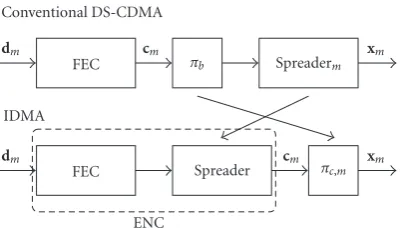
IDMA can be interpreted as conventional DS-CDMA with interleaver and spreader in exchanged order, which is illustrated in Figure 1for one data layer. The spreader be-comes part of the encoder (ENC) and has no special mean-ing anymore. Note that no spreadmean-ing sequences are applied. Nevertheless, the interleaved code symbols can be transmit-ted at a rate up to 1/Rtimes higher than the info bit rate, whereRis the code rate of the encoder. Therefore the terms code symbolandchipare interchangeable with each other for IDMA. We will use the term chip throughout the rest of this paper. The bit load of useruis bu = RMu and the overall bit load (referred to as system load throughout this paper) is b=Uu=1bu.
If not stated otherwise, a binary (1/R, 1) code with ran-dom code bits is used throughout this paper, that is, every info bit is mapped to a random binary sequence of length 1/R. This code is equivalent to a repetition code with subse-quent random scrambling. Therefore no coding gain can be achieved, but as shown in [21] a robust transmission with very high system loads near 4 bit/s/Hz can be achieved.
3. ITERATIVE RECEIVER STRUCTURE
Conventional DS-CDMA
dm
FEC
cm
πb Spreaderm xm
IDMA
dm
FEC ENC
Spreader cm πc,m xm
Figure 1: IDMA can be interpreted as conventional DS-CDMA with interleaver and spreader in exchanged order.
cross-layer multilayer chip detection (MLD)—thereby ignor-ing the code constraints—and layer-wise channel decodignor-ing (DEC)—thereby ignoring the channel interferences.Figure 2 depicts an iterative receiver structure for layerm, 1 ≤m ≤ Mu, of useru, 1 ≤u ≤U. The received samples of (1) are
fed into the MLD and PLACE unit. One iteration consists of an estimation ofhbased onPand the extrinsic information from the last decoding in the PLACE unit, a detection of all data layers in the MLD unit, and the MAP decoding in the DEC unit. A detailed description of the PLACE and the MLD units is given inSection 4andSection 5, respectively.
For each layer, the decoder performs chip-by-chip maxi-mum a posteriori (MAP) decoding, for example, by means of the well-known BCJR algorithm, to obtain extrinsic soft in-formation about the chips. This soft inin-formation can be rep-resented in different equivalent forms—as probabilities, log-likelihood ratios, or soft chips.1 Since the subsequent
pro-cessing is based on the reinterleaved soft chips, we concen-trate on the latter, and denote the reinterleaved soft chip of useruand layermat chip indexkin iterationiasx(ui,)m[k].
The soft chips of iterationican be stacked together to form the soft chip matrixX(i). The iteration number is indicated
by a superior number in brackets throughout this paper.
4. PILOT-LAYER AIDED CHANNEL
ESTIMATION (PLACE)
The task of the PLACE unit inFigure 2is to find an estimate h(i+1)of the channel coefficientshbased on the received data
y, the perfectly known pilot data matrixP, and the reinter-leaved extrinsic information represented by the soft chip ma-trixX(i) that is obtained by the previous decoding step. By
taking the soft chips properly into account, the channel es-timates improve from iteration to iteration, which in turn improves chip detection.
There exist three major channel estimation concepts in this context: (1) training-based channel estimation (tb), (2) semiblind channel estimation (sb), and (3) blind channel estimation. For tb, channel estimation is only based on the knowledge of the pilot layer, which is illustrated in
1Soft chipsandsoft code symbolsare the same for IDMA.
Figure 3(a). As the updated soft chips are not used, this type of channel estimation can be taken out of the iterative pro-cess. The channel estimation is performed only once before the first detection and the resulting channel estimates are used without change in all detection steps. Therefore, the computational complexity of tb is the lowest of all channel estimation concepts listed above. Beside this advantage tb has two disadvantages. Firstly, without any knowledge about the data, the interference from data (due to the superposi-tion) leads to a high noise level and consequently to unreli-able channel estimates. A solution to this problem is to par-tially cancel the interference from data based on the soft chips from the decoder before tb (tb-IC) (cf.Figure 3). Note that in this case, channel estimation is still training-based, but the received data samples are modified before tb is performed:
y(i)=y−X(i)h(i). (3)
This modification depends on the decoder output of theith iteration. Therefore the channel estimates obtained by tb-IC also depend on the iteration number, that is, tb-IC has to be performed once per iteration and cannot be taken out of the iterative process as tb.
The second disadvantage of tb is that the performance of the channel estimator is limited by the power of the pi-lot layer. Even if the data interference cancelation of (3) is perfect, the modified received data is still noisy. Note that the quality of the channel estimates depends on the train-ing power and the noise power. Therefore, the quality of the channel estimates can be improved by making constructively use of the soft chips from the decoder for channel estimation. For sb, channel estimation is based on the knowledge of the pilot layer as for tb, but additionally based on the knowledge of the soft chips (cf.Figure 3). The data is not considered as interference, which has to be canceled as done for tb-IC—it is rather used as “virtual” training in combination with the pi-lot layer, which can improve the training power significantly. As tb-IC, sb is performed once every iteration between de-coding and multilayer chip detection.
Blind channel estimation is treated as a special case of sb withP=0throughout this paper.
In the following, we focus on linear channel estimation schemes and present a detailed description of tb, tb-IC, and sb suitable for IDMA. Note that nonlinear channel estima-tion schemes can easily be used in the PLACE unit in a simi-lar way as the PLACE structure is independent of the channel estimator type.
4.1. Pilot layers
Throughout this paper, the “consecutive roots-of-unity phase difference” training sequences are used as pilot layers. In caseU=1, the pilot layer is (cf., e.g., [23])
p[k]=Pp·ej(2π/KCE)kr, 1≤k≤K
c, (4)
where r is relatively prime to the observation length KCE.
All subsequences of lengthKCE exhibit perfect
dm
ENC πm h
MLI +
n
MLD
h
PLACE
Extrinsic information
π 1 m
πm Extrinsic information
DEC dm
Figure2: Iterative receiver structure for layerm. The user index is skipped. The layer-specific interleaver is denoted byπm.
h(i+1)
Received
datay tb CE
tb
Extrinsic information from the latest decoding step
X(i)
(a)
h(i+1)
Received
datay tb CE IC
tb-IC
Extrinsic information from the latest
decoding step
X(i)
(b)
h(i+1)
Received
datay sb CE
sb
Extrinsic information from the latest
decoding step
X(i)
(c)
Figure3: Illustration of training-based channel estimation (tb), training-based channel estimation with partial data interference cancelation (tb-IC), and semiblind channel estimation (sb) in theith iteration. The PLACE unit inFigure 2corresponds to one of these three.
cross-correlations are needed. We can construct a training sequence with observation length UKCE based on (4) and
sample this sequence with a sampling distanceUand a user-specific sampling delayu−1. The resulting pilot layer for user ucan be expressed as
pu[k]=
Pp,u·ej(2π/UKCE)(Ukr+u−1)
=Pp,u·ej(2π/KCE)kr·e(2π/UKCE)(u−1)
=p[k]·e(2π/UKCE)(u−1), 1≤k≤K
c, 1≤u≤U,
(5)
whereris relatively prime toU·KCE. The only difference to
(4) is a user-specific phase offset. Note that (4) and (5) agree forU=1. The latter result exhibits a perfect autocorrelation and a perfect cross-correlation property. It is used to obtain the numerical results with multiple users inSection 6.
4.2. Joint least-squares channel estimation (JLSCE)
4.2.1. Training-based JLSCE with and without partial data cancelation (tb-LS and tb-LS-IC)
The aim of tb-LS is to minimizeE{y−Pti·htb - LS2F}, where
Fdenotes the Frobenius norm. The channel estimates can be calculated as follows [24]:
htb - LS=(PHti ·Pti)−1PHti
P†ti
·y. (6)
The mean-squared error (MSE) can be calculated as
vtb - LS=Ehti−htb - LS2F
= σ2 n+ U
u=1
Mu·σh2u
·traceP†tiHP†ti. (7)
Note that for M = 0, this result collapses to the standard result for pure training. Note also that forM > 0, the MSE depends on the power profile of the estimated channel, which is not the case if the transmitted signal is perfectly known to the receiver.
In the case of partial data cancelation, the least-squares channel estimates can be calculated as
h(tb - LS - ICi+1) =P†ti·y(i) (8)
with MSE,
v(i+1) tb - LS - IC
=Ehti−h(tb - LS - ICi+1) 2 F = σ2 n+ U
u=1
Mu·
σ2
hu·σ
2
x(i)
u +v
(i) tb - LS - IC·
1−σ2
x(i)
u
·traceP†tiHP†ti,
(9)
whereσ2
x(i)
u ≤1 is the variance of the soft chips of useruin
iteration i. Note that tb-LS and tb-LS-IC agree in the case that we have no information about the data, that is, all soft chips equal zero andσx2(i)
u =1. Different from (7), the MSE of
tb-LS-IC depends on the variances of the soft chips.
In both cases, the trace ofP†tiHP†tishould be minimized to
obtain optimal MSE. This can be achieved if the pseudoin-verseP†ti is unitary up to a scalar factor (P†tiHP†ti ∼ I). Then
the trace can be calculated (see [23,25]) as
traceP†tiHP†ti
=UK·(L+ 1)
CE·Pp
, (10)
whereKCEis the training window length, which isKc−Lin
the case of block fading.
With (7) and (10), we can get a lower bound for the MSE with tb-LS as
vtb - LS≥
σ2
n+
U
u=1
Mu·σh2u
·UK·(L+ 1)
CE·Pp
=vLB,tb - LS
(11) ≈ Rσ2 n+ U
u=1
bu·σh2u
·U·(L+ 1)
Kb·Pp , (12)
whereKbis the block length in info bits. The latter approxi-mation holds ifKcL, which is usually the case. The right-hand side of (11) is the Cramer-Rao lower bound (CRLB) for a training-based unbiased estimator [19].
Combining (9) and (10) leads us to the MSE lower bound for tb-LS-IC:
v(i+1) tb - LS - IC
≥ σ2 n+ U
u=1
Mu·
σ2
hu·σ
2
x(i)
u +v
(i) tb - LS - IC·
1−σ2
x(i)
u
·UK·(L+ 1)
CE·Pp =v (i+1) LB,tb - LS - IC
(13) ≥ σ2 n+ U
u=1
Mu·σh2u·σ
2
x(i)
u
·UK·(L+ 1)
CE·Pp
=v(i+1) LLB,tb - LS - IC
(14) ≈ Rσ2 n+ U
u=1
bu·σh2u·σ
2
x(i)
u
·UK·(L+ 1)
b·Pp . (15)
The loose lower boundv(LLB,tb - LS - ICi+1) is the MSE in case that the previous channel estimates are perfect. The lower bound v(i+1)
LLB,tb - LS - ICtakes the MSE of the previous channel estimates
into account.
We compare the MSE of both training-based approaches by calculating the ratio
vtb - LS
v(i+1) tb - LS - IC
=
σ2
n+Uu=1Mu·σh2u
·traceP†tiHP†ti
σ2
n+Uu=1Mu·
σ2
hu·σ
2
x(i)u +v
(i) tb - LS - IC·
1−σ2
x(i)u
·traceP†tiHP†ti
= σ
2
n+Uu=1Mu·σh2u·1
σ2
n+Uu=1Mu·(σh2u·σ
2
x(i)u +v
(i)
tb - LS - IC·(1−σx2(i) u))
≥1,
where the latter inequality holds becauseσ2
x(i)u ≤1 (which is
the case fori ≥ 1) andv(tb - LS - ICi) ≤ σ2
hu is assumed. In the
very first iteration (i=0) tb-LS and tb-LS-IC agree:σx2(0)
u =
1 ⇒ vtb - LS/vtb - LS - IC(1) = 1. The MSE of tb-LS and tb-LS-IC
is also the same in the case thatvtb - LS - IC(i) =σh2u. We conclude from this comparison that tb-LS-IC outperforms tb-LS in-dependent of the pilot data matrix Pti, that is, vtb - LS - IC(i+1) ≤
vtb - LS. As this conclusion is independent of the pilot data,
it is especially true if the pilot data matrix is optimized to reach the MSE lower bound, that is, we can conclude that v(i+1)
LLB,tb - LS - IC≤v (i+1)
LB,tb - LS - IC≤vLB,tb - LS.
4.2.2. Semiblind JLSCE (sb-LS)
It is shown in [26] that for blind channel estimation, the least-squares channel estimates can be obtained by using soft data symbols instead of perfectly known pilot data. If we ex-tend the result to joint estimation of multiple channels with a combined knowledge of pilot data and soft chips (which can be interpreted as “virtual” training), we obtain semib-lind joint least-squares channel estimates as
h(sb - LSi+1) =X(tii)+Pti
H
X(tii)+Pti
−1
X(tii)+Pti
H
(X(tii)+Pti)†
·y.
(17)
The MSE can be calculated as
v(i+1) sb - LS=E
hti−h(sb - LSi+1) 2 F = σ2 n+ U
u=1
Mu·σh2u·σ
2
x(i)
u
·traceX(tii)+Pti
†H
X(tii)+Pti
†.
(18)
A lower bound of the MSE is obtained in the case where (X(tii)+Pti)†is unitary up to a scaling factor, which leads to
v(i+1) sb - LS≥
σ2
n+
U
u=1
Mu·σh2u·σ
2
x(i)
u
· U·(L+ 1) KCE·
Pp+Uu=1Mu·x (i)
u 2
(19)
=v(i+1)
LB,sb - LS (20)
≈ Rσ2 n+ U
u=1
bu·σh2u·σ
2
x(i)u
· U·(L+ 1) Kb·
Pp+Uu=1(bu/R)·x (i)
u 2
.
(21)
Note that in the very first iteration,Xti(0)=0holds so that
sb-LS reduces to tb-sb-LS ((17) equals (6) and consequently (18) equals (7)) and the same conclusions for the choice of the pilot data matrix hold, especially the lower bound of (11) and its approximation (12).
A comparison of the lower bounds for tb-LS-IC and sb-LS,
v(i+1) LLB,tb - LS - IC
v(i+1) LB,sb - LS
= Pp+ U
u=1Mu·x (i)
u 2
Pp ≥1, (22)
reveals that sb-LS outperforms tb-LS-IC if v(LB,sb - LSi+1) is reached. For the training-based approaches, the MSE lower bounds can easily be reached by an optimal choice of the pi-lot sequence, for example, as proposed in [23]. In the case of semiblind channel estimation, such a design is impossible as the data is random. Even in the case of optimal pilot se-quences, that is,P†tiis unitary up to a scalar factor, the lower bound cannot be reached due to the random data. Therefore it is interesting to investigate the MSE performance of sb-LS with random data and to compare it to the lower bound.
4.2.3. Comparison of MSE performances
As a conclusion to the discussion above, we can state that v(i+1)
LB,sb - LS≤v (i+1)
LB,tb - LS - IC≤vLB,tb - LSand thatv(tb - LS - ICi+1) ≤vtb - LS.
In this subsection, we illustrate the results obtained so far. To concentrate on the main aspects, we chooseU = 1 and skip the user index. We assume a frequency-flat channel (L=0) so that the overall number of channel coefficients is U·(L+ 1)=1. The data is modeled as Gaussian-distributed noise with zero mean and variance 10, that is,M=10. The average channel powerσ2
h, the system loadb, the noise
vari-anceσ2
n, and the pilot layer powerPpare chosen to be 1, that
is, the code rate is R = b/M = 1/10. Simulated MSE re-sults for the different channel estimators and the correspond-ing lower bounds are depicted inFigure 4for an observation length ofKCE = 10 (or equivalentlyKb = 1). Optimal
pi-lot sequences are used. We can see that all curves match if the channel estimator does not have any information about the data (M· |x|2 = 0). The tb-LS cannot make use of the
information about the data, its MSE is constant. The tb-LS-IC outperforms tb-LS and sb-LS outperforms tb-LS-tb-LS-IC in all cases, which coincides with the discussion above. The MSE of tb-LS-IC depends on the MSE of the previous channel es-timates, which is also shown inFigure 4. But even in the best case withv(tb - LS - ICi) =0, sb-LS significantly outperforms tb-LS-IC. Due to the choice of the pilot sequence, the training-based schemes both reach the lower bound. This is not the case for sb-LS, because the random data does not lead to an optimal matrixX(tii)+Pti.
100
10 1
10 2
10 3
v
(
i
+1)
0 2 4 6 8 10
Mx(i) 2 v(i+1)
tb - LS v(i+1)
tb - LS - IC,vtb - LS - IC(i) =0.5 v(i+1)
tb - LS - IC,vtb - LS - IC(i) =0 v(i+1)
sb - LS
Figure4: MSE versus soft chip power for training-based and semi-blind LS channel estimators with optimal pilot data matrix. Results forU =1,R =1/10,b=1,σ2
n =1,σh2 =1,Pp =1,KCE=10. Symbols show the simulated MSE values and lines show the corre-sponding lower bounds using (11), (13), (14), and (19), respectively.
100
10 1
10 2
10 3
v
(
i
+1)
sb
-L
S
0 2 4 6 8 10
M x(i) 2 KCE=5
KCE=10 KCE=20
KCE=30 KCE=40
Figure5: MSE versus soft chip power for sb-LS with optimal pilot data matrix. Results forU=1,R=1/10,b=1,σ2
n =1,σh2 =1, Pp=1. Symbols show the simulated MSE values and lines show the corresponding lower bounds using (19).
4.2.4. Sliding-window JLSCE (sw-LS)
As mentioned before, JLSCE is only suitable for time-invariant channels. However, our goal is to estimate fast-fading channels. If we still want to apply JLSCE, we have to
make sure that the channel is approximately invariant over the observation lengthKCE. This is actually possible if we can
assume the fading rate of the channel to be upper-limited. Let us assume that the length of each chipxu,m[k] isTc. Let
fCdenote the carrier frequency. Let furthermorevbe the ve-locity of the mobile user, and letc0be the speed of light in
vacuum. Then the maximum possible frequency shift due to the Doppler effect normalized by the chip rate is
fD,max·Tc= fC·cv
0 ·Tc.
(23)
In the case thatKCE (fD,max·Tc)−1, the channel can
ap-proximately be assumed to be invariant over the observa-tion lengthKCE. Therefore, the derived LS channel
estima-tors can be applied to a window of the received sequence. The estimated channel coefficients of a window are of course only valid for this particular window. Therefore, we have to shift the window and perform JLSCE for every shifted win-dow to obtain channel estimates for the complete received se-quences. We refer to this as sliding-window JLSCE (sw-LS). This approach can be used for tb-LS(-IC) and sb-LS and we will refer to it as sw-tb-LS(-IC) and sw-sb-LS, respectively. Note that the results obtained in the discussion above are also valid for sw-LS.
Another alternative is to take the fading characteristics of the channel properly into account, which is optimally done inSection 4.3. The drawback of doing this is the high com-putational complexity compared to sw-LS, which keeps the sliding-window method attractive from a practical point of view.
4.3. Semiblind joint minimum mean-squared error channel estimation (sb-MMSE)
In the following, the optimal semiblind linear joint channel estimator is derived in the sense of minimizing the mean-squared error of the channel estimates. This optimization criterion is different from the LS approach inSection 4.2.2 and allows us to take the statistical fading characteristics properly into account. Due to its linearity, the derived chan-nel estimator is optimal in the MMSE sense if and only if the channel coefficients to be estimated are Gaussian distributed. As we concentrate on Rayleigh fading channels, this assump-tion is fulfilled throughout this paper. For other distribu-tions, a nonlinear approach might be necessary to find the MMSE solution. This issue is out of the scope of this paper. However, as already mentioned in the beginning of this sec-tion, the channel estimator type does not influence the gen-eral PLACE structure proposed in this paper.
The iteration number is skipped throughout this sub-section to enhance the readability. Let h[k] consist of the U·(L+1) elements ofhwith chip indexkand leth[k] denote its MMSE estimate, which is the solution to the well-known Wiener-Hopf equation:
hsb−MMSE[k]=Rhy[k]·R−yy1
W[k]
The matrices in (24) are calculated as follows:
Rhy[k]=Eh,y
h[k]·yH
=Eh,Xh[k]·hH·(X+P)H
=Ehh[k]·hH·EXXH+PH =Rhh[k]·XH+PH
,
(25)
Ryy=Ey
y·yH
=EX,h(X+P)·h·hH·(X+P)H+σn2I
=EX(X+P)·Rhh·(X+P)H
+σn2I =EXX·Rhh·XH
+X·Rhh·PH
+P·Rhh·XH+P·Rhh·PH+σn2I,
(26)
whereX=X+Xis the sum of the fixed soft chip matrix
Xbased on the decoder output values andX, which is a random variable. The remaining term in (26) is
EXX·Rhh·XH
=EXX·Rhh·XH+X·Rhh· XH
+X·Rhh·XH+X·Rhh· XH
=X·Rhh·XH+EXX·Rhh· XH
=X·Rhh·XH+Γ,
(27)
whereΓis a diagonal matrix with entries
U
u=1
Mu
m=1
L
l=0
σ2
hu,l·σ
2
xu,m[k−l], L≤k≤Kc. (28)
LetΓ=. Γ+σ2
nIbe the diagonal noise matrix. Then (26) and
(27) can be combined to obtain
Ryy−Γ=X·Rhh·XH+X·Rhh·PH
+P·Rhh·XH+P·Rhh·PH
=X+P·Rhh·X+P
H .
(29)
Combining the intermediate results from (24) to (29), the MMSE channel estimates are obtained as
hsb−MMSE[k]=W[k]·y=Rhh[k]XH+PH
·X+PRhhX+P
H
+Γ−1·y. (30)
Equation (30) corresponds to the optimal semiblind chan-nel estimator. The computational complexity of this esti-mator is dominated by the inversion of a matrix with a row/column length growing linearly with the number of chips per layer. Note that the computational complexity of sw-LS (cf.Section 4.2.4) is also dominated by a matrix in-version, but with a row/column length only growing lin-early with the channel memory. Therefore, the computa-tional complexity is typically much lower for sw-LS.
Note that in the case that no information about the data is used, the result degenerates to purely training-based joint MMSE channel estimation. The MSE performance of
training-based joint MMSE channel estimation can be im-proved by partially canceling the data interference before channel estimation—just like for tb-LS-IC. We refer to this as training-based joint MMSE channel estimation with par-tial data interference cancelation (tb-MMSE-IC).
Letvh[k]=E{h[k]h∗[k]}—wheredenotes the scalar product—be a vector containing the channel variances at chip indexk. Then the MSE of the channel coefficients ob-tained by MMSE channel estimation can easily be shown to be
vsb−MMSE[k]=vh[k]−diagRhy[k]·R−yy1·RHhy[k]
(31)
and the overall MSE of the channel estimates at chip indexk is
vsb−MMSE[k]=E
h[k]−h[k]2F
=
U
u=1
L
l=0
σ2
hu,l
σ2 h
−traceRhy[k]·R−yy1·RHhy[k]
.
(32) In case of block fading, the channel coefficients agree for all time indices and (30) can be rewritten as
hsb−MMSE=IX+P
H
·Xti+Pti
IXti+Pti
H
+Γti
−1
·y =Xti+Pti
H
Γ−1
ti Xti+Pti
+I−1 ×Xti+Pti
HΓ−1 ti ·y,
(33)
where we applied the matrix inversion lemma to obtain the last equation. The latter expression has significantly lower computational complexity than the former one as the size of the inverse matrix is significantly lower but it can only be applied to estimate time-invariant channels. For the expres-sion with time-varying channel coefficients (30), the appli-cation of the matrix inversion lemma does not lead to de-creased computational complexity, which makes sb-MMSE rarely attractive from a complexity point of view if the block lengths are not short. Its significance rather lies in its opti-mality and we will use sb-MMSE to verify the performance of the suboptimal but low-complexity sw-LS inSection 6.
5. MULTILAYER DETECTION (MLD): INTERFERENCE CANCELATION AND DETECTION
same as if only one single layer would access the channel. The single-layer bit error probability (single-layer perfor-mance, SLP) therefore provides a lower bound. As the in-terference cancelation is not perfect, some remaining inter-ference still disturbs the detection. This remaining interfer-ence may be modeled as Gaussian-distributed noise, which is the so-called Gaussian assumption. The computational com-plexity of this suboptimal MLD grows only linearly with the number of layersMand the number of channel coefficients L+ 1. Note that the computational complexity of the opti-mal MLD in the MAP sense grows exponentially with both parameters which is infeasible and makes a suboptimal MLD inevitable.
5.1. Interference cancelation and Gaussian assumption
The estimated received value for chip indexkin iterationi+1 is
y(i+1)[k]=U
u=1
L
l=0
h(i+1)
u,l [k]·
Mu
m=1
x(i)
u,m[k−l]
+
U
u=1
L
l=0
h(i+1)
u,l [k]·pu[k−l].
(34)
The task of the interference canceler (IC) is to subtract inter-ference from the received signal. Which part of the received signal is to be interpreted as interference depends on the de-tector. Throughout this paper, we concentrate on the low-complexity soft rake detector [4]. The derivations of ICs for other detector types are similar.
If the soft rake detector is used, the detector input for layerμof userυwith delayλat chip indexkin iterationi+ 1 is
ˇ y(i+1)
υ,μ,λ[k]=y[k]−
y(i+1)[k]−h(i+1)
υ,λ [k]·x(υi,)μ(k−λ)
=hυ,λ[k]·xυ,μ[k−λ] +η(υi,+1)μ,λ[k],
(35)
whereη(υi,+1)μ,λ[k] is the noise at the detector input. Let further-moreσ2
xu,m(i)[k] denote the variance of the soft chip x
(i)
u,m[k],
which in our case can be calculated as 1− |x(i)
u,m[k]|2, and let
P(i+1)
hu,l [k]
. = |h(i+1)
u,l [k]|2be the power estimate of the channel
coefficienthu,l[k] in iterationi+ 1. If we assume the channel
estimates to be perfect, the expectation and variance of the noise at the detector input can be calculated as
Eη(i+1)
υ,μ,λ[k]
=0,
Eη(i+1)
υ,μ,λ[k]2
=U
u=1
L
l=0
P(i+1)
hu,l [k]· Mu
m=1
σ2
x(i)u,m[k−l]
−P(i+1)
hυ,λ [k]·σ
2
x(i)
υ,μ[k−λ] +σ
2
n.
(36)
5.2. Soft rake detection
Based on the remaining signal after IC, the soft detec-tor calculates the log-likelihood ratios (LLRs) of the chips given the Gaussian assumption (i.e., the remaining interfer-ence is modeled as Gaussian noise) and the channel knowl-edge/estimates. For soft rake detection,L+ 1 log-likelihood ratios per chip are calculated (one for each received sample influenced by this chip) and summed up to obtain the LLR of the chip. The LLR of the chip in layermof useruat chip indexkin iterationi+ 1 is
L(i+1)
u,m [k]=.
L
l=0
L(i+1)
l,u,m[k]
. =L
l=0
L(i+1)
l
Xu,m[k]|yˇu(i,+1)m,l[k+l],hu,l[k+l]
=
L
l=0
4·Re h
∗(i+1)
u,l [k+l]·yˇ (i+1)
u,m,l[k+l]
Eη(i+1)
u,m,l[k+l]
2 .
(37)
6. NUMERICAL RESULTS
In this section, the performance of the iterative MLD intro-duced in Section 5 with the channel estimators derived in Section 4is investigated by means of Monte Carlo bit error rate simulations. Results for perfect channel knowledge serve as a reference. The channel codewords and the layer-specific interleavers are chosen randomly as described inSection 2. All results in this section are obtained by performing 10 it-erations. If not stated explicitly, the ratio of power per info bit and noise power is fixed toEb/N0 = 10 dB and a block
length ofKb =20 is used. We concentrate on a fully loaded system (b=1) with a code rate ofR=1/10. This results in Kc =200 chips per layer andM·Kc·R=200 info bits are
transmitted per block. This very short block length is partic-ularly interesting in systems asking for low latency, for exam-ple, link adaptation [8]. Note that iterative detection, decod-ing, and channel estimation for such short block lengths are only possible if the interleaver length is long enough to break the correlations between the soft information that is shuffled between the receiver stages. A unique feature of IDMA is that the interleaver length is maximized, that is, the interleaver length is equal toKc. Note that a comparable DS-CDMA sys-tem with the same syssys-tem load uses an interleaver length of Kc·R, which would be only 20 in our example. Such a small
interleaver length leads to high correlations in the iterative receiver and is therefore not suitable, which motivates IDMA for low-latency transmissions.
100 10 1 10 2 10 3 10 4 10 5 10 6
Bi
t
er
ror
ra
te
0 1 2 3 4 5
10 3 fD,maxTc
L=0,U=1 L=0,U=M L=4,U=1 L=4,U=M
Analytical result for block fading,M=1 (SLP)
Bloc
k
fading
M
o
der
at
e
fading
F
ast
fading
V
er
y
fast
fading
Figure6: Bit error rates with perfect channel knowledge versus fad-ing rate atEb/N0 = 10 dB with 10 receiver iterations. The block length isKb =20, the code rate isR=1/10, and the system load isb=1. Time, frequency, and multiuser diversity effects improve the bit error performance. The maximum Doppler frequency is nor-malized to the chip rate. The thick lines show the SLP (upper line for frequency-flat (L =0), and lower line for frequency-selective (L=4) fadings).
method, we choose a window length of 1/10· fD,max·Tc.
In case of block fading, the window length equals the block length in chipsKc.
Firstly, we investigate different diversity effects with per-fect channel knowledge. Afterwards, we turn to results with the high-complexity MMSE channel estimator derived in Section 4.3. Finally, we investigate the performance of the low-complexity suboptimal sliding-window channel estima-tor fromSection 4.2.4.
6.1. Perfect channel knowledge
Let us first consider perfect channel knowledge. The follow-ing results lead us to some interestfollow-ing conclusions regardfollow-ing the impact of different diversity effects on the bit error per-formance. InFigure 6, the bit error rates for different fad-ing rates of different fading channels are depicted. The max-imum Doppler frequency is normalized with respect to the chip rate. The analytical result for the bit error probability of BPSK transmission over a Rayleigh block fading channel is also depicted for comparison.
It can clearly be seen that the performance improves with the fading rate, which can be explained by the time diversity effect. Due to the chip-by-chip processing, reliable chip deci-sions help to improve weak chip decideci-sions in subsequent iter-ations. This effect is even stronger when transmitting over a
frequency-selective channel. In this case, the iterative receiver can make use of diversity in time and in frequency.Figure 6 also shows the result for the case of independent fading chan-nels (U = M,Mu = 1 for allu) with different memory lengths. The independency of the channel coefficients of the single users (multiuser diversity) can be interpreted as space diversity, which improves the error performance compared to the case of a common channel.
Note that single-layer performance (SLP) is obtained in all depicted cases with multiple users, that is, there is virtu-ally no loss in power efficiency compared to the case without MAI. We therefore obtain a quasiorthogonal multiple access without the need for orthogonal design—even for frequency-selective fading channels.
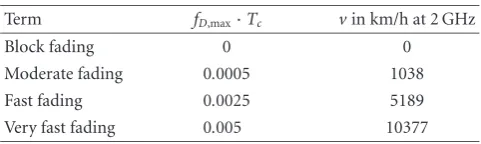
For convenience, we refer to some fading rates with the terms given inTable 1. The velocities are calculated assum-ing a chip duration ofTc ≈260 nanoseconds like that used in UMTS [18] and a carrier frequency of fC=2 GHz using (23). These velocities are interpretations of the normalized maximum Doppler frequency for typical 3G system param-eters in use today. We use these high values to demonstrate that the proposed semiblind scheme is not only able to track fast-fading channels and make use of the inherent diversity, but also to show the limits of the different channel estimators under consideration. An alternative interpretation are trans-missions with a significantly higher carrier frequency and/or shorter chip duration. If we increase the carrier frequency to fC =50 GHz and decrease the chip duration by a factor of 4, the resulting velocities are 100 times lower than in the example above. This would allow for mobile radio with mm-waves. Another example is acoustical underwater communi-cation, where the speed of light (≈3·108m/s) has to be
ex-changed by the speed of sound, which is typically≈1500 m/s and therefore much less. This also leads to significantly re-duced velocities in combination with typical values for the carrier frequency and the chip duration.
6.2. MMSE channel estimation
Let us now turn to MMSE channel estimation. Numerical bit error results for frequency-flat and frequency-selective Rayleigh fading channels are depicted in Figure 7 for tb-MMSE-IC and inFigure 8for sb-MMSE and sw-sb-LS, re-spectively. In both plots, the bit error rates for perfect chan-nel knowledge are depicted as well, which serve as a lower bound of the bit error rates with channel estimation. To al-low for a fair comparison, the power loss due to the pilot layer is considered in these and all the following results for perfect channel knowledge.
As observed before, the bit error performance again im-proves for higher fading rates. Note that the bit error perfor-mance degrades for higher pilot-layer power. This is due to the constantEb/N0. When assuming a constant noise level,
Table1: Normalized maximum Doppler frequencies and corre-sponding velocities. A chip duration ofTc ≈260 nanoseconds and a carrier frequency offC=2 GHz is assumed.
Term fD,max·Tc vin km/h at 2 GHz
Block fading 0 0
Moderate fading 0.0005 1038
Fast fading 0.0025 5189
Very fast fading 0.005 10377
lead to a local optimum of the bit error rate in all results with channel estimation.
Both MMSE estimators reach the performance with per-fect channel knowledge, but sb-MMSE is significantly more power-efficient. The optimum is reached at 0.4 dB loss.
The results for the case of frequency-selective Rayleigh fading show that tb-MMSE-IC only gets close to the perfor-mance with perfect channel knowledge for block fading and a power loss of more than 2 dB. On the other hand, sb-MMSE is able to track even the fast channel virtually perfectly with a power loss of less than 0.4 dB.
6.3. LS channel estimation
As mentioned in Section 4.3, the computational complex-ity of sb-MMSE limits its practical usabilcomplex-ity—especially for larger block lengths. Therefore we apply sw-sb-LS and com-pare the resulting bit error performance on a Rayleigh fading channel inFigure 8.
For the frequency-flat block fading channel and also for the fast-fading channel, the bit error performance with MMSE and sw-LS is very similar. For very fast fading, sb-MMSE outperforms sw-sb-LS. The sliding-window channel estimator suffers from a short observation/window length of onlyKCE=20, which leads to suboptimal pilot data matrices
(cf.Section 4) and additionally to a reduced training power. However, the difference of the power loss compared to sb-MMSE is only about 0.3 dB.
For a frequency-selective channel, sw-sb-LS is competi-tive to sb-MMSE in case of block fading. For fast fading, a loss of less than 1 dB occurs. Very fast training cannot be tracked. We conclude from this comparison that sb-MMSE out-performs sw-sb-LS in terms of bit error probability and that sw-sb-LS is a competitive channel estimator for reduced re-quirements regarding fading rate and/or channel memory. We observe a tradeoffbetween performance and complexity.
6.4. Block length and number of users
By increasing the block length toKb = 200 or equivalently Kc=2000 and assuming the same fading rates as before, one
obtains the results depicted inFigure 9. Results for sb-MMSE are not depicted due to its computational complexity.
Even very fast frequency-flat fading channels can be tracked with marginal loss by sw-sb-LS. As observed for Kb = 20, in case of frequency-selective fading a loss of less
than 1 dB occurs for fast fading, and very fast fading can not be tracked. For moderate fading, sw-sb-LS leads to virtually the same performance as perfect channel knowledge. Note that “moderate” still means more than 1000 km/h and that for fast fading, the bit error rates are significantly decreased compared to the results with shorter block length due to the improved time diversity.
Figure 10 shows the bit error rates for independent frequency-flat block fading channels and different block lengths. We consider the caseU = M, that is, every user is assigned one data layer. This is the worst case from the view-point of channel estimation as the number of channels is maximized. The bit error performance improves for larger block lengths. For block fading, the window length agrees with the block lengthKc. Therefore, the MSE of the initial es-timate decreases reciprocally (cf. (18)) with the block length when fixing the power loss.
6.5. Channel coding
The numerical results presented so far are for a (10,1) ran-dom channel code without coding gain. In this section, ad-ditional results for a rate 1/2 convolutional code with gen-erators{5, 7}followed by a rate 1/5 repetition code are pre-sented, referred to as{5, 7} × {5, 5}code. The generators are given in octal notation. The overall rate of both codes is 1/10, that is, the system load is stillb = 1. As done in [27], the chip sequences are scrambled before transmission to ensure zero-mean receive samples.
Figure 11shows the improvements due to coding com-pared to the{5, 7} × {5, 5}code, which provides no coding gain. It can be observed that the loss compared to the case of perfect channel knowledge is negligible in both depicted cases provided thatEb/N0is high enough.
7. CONCLUSIONS
100
10 1
10 2
10 3
10 4
Bi
t
er
ror
ra
te
0 0.5 1 1.5 2 2.5
Power loss due to pilot layer (dB) tb-MMSE-IC, block fading
tb-MMSE-IC, fast fading tb-MMSE-IC, very fast fading
(a) Frequency-flat channel (U=1,L=0)
100
10 1
10 2
10 3
10 4
Bi
t
er
ror
ra
te
0 0.5 1 1.5 2 2.5
fD,maxTc
Power loss due to pilot layer (dB) tb-MMSE-IC, block fading
tb-MMSE-IC, fast fading tb-MMSE-IC, very fast fading
(b) Frequency-selective channel (U=1,L=4)
Figure7: tb-MMSE-IC for common Rayleigh fading channel with block lengthKb =20. The degraded performance to the right is due to the data layer power loss that results from the increase of pilot layer power for constantEb/N0=10 dB. Thick lines are for perfect channel knowledge. The bit error rate for perfect channel knowledge decreases with the fading rate.
.
100
10 1
10 2
10 3
10 4
Bi
t
er
ror
ra
te
0 0.5 1 1.5 2 2.5
Power loss due to pilot layer (dB) sb-MMSE, block fading
sb-MMSE, fast fading sb-MMSE, very fast fading sb-LS, block fading sw-sb-LS, fast fading sw-sb-LS, very fast fading
(a) Frequency-flat channel (U=1,L=0)
100
10 1
10 2
10 3
10 4
Bi
t
er
ror
ra
te
0 0.5 1 1.5 2 2.5
Power loss due to pilot layer (dB) sb-MMSE, block fading
sb-MMSE, fast fading sb-MMSE, very fast fading sb-LS, block fading sw-sb-LS, fast fading sw-sb-LS, very fast fading
(b) Frequency-selective channel (U=1,L=4)
100
10 1
10 2
10 3
10 4
Bi
t
er
ror
ra
te
0 0.5 1 1.5 2 2.5
Power loss due to pilot layer (dB) sb-LS, block fading
sw-sb-LS, fast fading sw-sb-LS, very fast fading
(a) Frequency-flat channel (U=1,L=0)
100
10 1
10 2
10 3
10 4
10 5
Bi
t
er
ror
ra
te
0 0.5 1 1.5 2 2.5
Power loss due to pilot layer (dB) sb-LS, block fading
sw-sb-LS, moderate fading sw-sb-LS, fast fading sw-sb-LS, very fast fading
(b) Frequency-selective channel (U=1,L=4)
Figure9: sw-sb-LS for common Rayleigh fading channel with block lengthKb=200. Thick lines are for perfect channel knowledge. The bit error rate for perfect channel knowledge decreases with the fading rate.
100
10 1
10 2
Bi
t
er
ror
ra
te
0 0.5 1 1.5 2 2.5
Power loss due to pilot layer (dB) Kb=20
Kb=50 Kb=200
Figure10: sw-sb-LS for independent frequency-flat block fading channels (U=M=10,L=0). The thick line is for perfect channel knowledge.
Numerical results motivate the use of IDMA/PLACE for transmission systems with short latency if semiblind channel estimation is performed. The capability of IDMA/PLACE to track channels with high Doppler spread offers possible
ap-100 10 1 10 2 10 3 10 4 10 5 10 6 10 7
Bi
t
er
ror
ra
te
0 2 4 6 8 10
Eb/N0(dB) (10, 1) random code
5, 7 5, 5
Figure11: sw-sb-LS for common fast frequency-flat Rayleigh chan-nel with block lengthKb =1000. Thick lines are for perfect chan-nel knowledge. The power loss due to pilot layer isM+Pp/M ≈ 0.414 dB.
today’s 3G systems. A further possible application is acousti-cal underwater communications.
ACKNOWLEDGMENT
This work has been supported by the German Research Foundation (DFG) under Contract no. Ho2226/2.
REFERENCES
[1] P. Frenger, P. Orten, and T. Ottosson, “Code-spread CDMA using maximum free distance low-rate convolutional codes,”
IEEE Transactions on Communications, vol. 48, no. 1, pp. 135– 144, 2000.
[2] R. H. Mahadevappa and J. G. Proakis, “Mitigating multiple access interference and intersymbol interference in uncoded CDMA systems with chip-level interleaving,”IEEE Transac-tions on Wireless CommunicaTransac-tions, vol. 1, no. 4, pp. 781–792, 2002.
[3] P. Li, L. Liu, K. Wu, and W. Leung, “A unified approach to multiuser detection and space-time coding with low complex-ity and nearly optimal performance,” inProceedings of the 40th Annual Allerton Conference on Communication, Control and Computing, pp. 170–179, Monticelli, Ill, USA, October 2002. [4] P. Li, L. Liu, K. Wu, and W. Leung, “Interleave-division
multiple-access (IDMA) communication systems,” in Proceed-ings of the 3rd International Symposium on Turbo Codes & Re-lated Topics, pp. 173–180, Brest, France, September 2003. [5] S. Verdu and S. Shamai, “Spectral efficiency of CDMA with
random spreading,”IEEE Transactions on Information Theory, vol. 45, no. 2, pp. 622–640, 1999.
[6] A. J. Viterbi, “Very low rate convolutional codes for maximum theoretical performance of spread-spectrum multiple-access channels,”IEEE Journal on Selected Areas in Communications, vol. 8, no. 4, pp. 641–649, 1990.
[7] P. A. Hoeher and H. Schoeneich, “Interleave-division multiple access from a multiuser theory point of view,” inProceedings of 4th International Symposium on Turbo Codes & Related Top-ics in Connection with the 6th International ITG-Conference on Source and Channel Coding, Munich, Germany, April 2006. [8] H. Schoeneich and P. A. Hoeher, “Adaptive interleave-division
multiple access—a potential air interface for 4G bearer ser-vices and wireless LANs,” inProceedings of the 1st IFIP Inter-national Conference on Wireless and Optical Communications Networks (WOCN ’04), pp. 179–182, Muscat, Oman, June 2004.
[9] S. Zhou, Y. Li, M. Zhao, X. Xu, J. Wang, and Y. Yao, “Novel techniques to improve downlink multiple access capacity for Beyond 3G,”IEEE Communications Magazine, vol. 43, no. 1, pp. 61–69, 2005.
[10] J. C. Fricke, H. Schoeneich, and P. A. Hoeher, “An interleave-division multiple access based system proposal for the 4G up-link,” inProceedings of 14th IST Mobile & Wireless Communi-cations Summit, Dresden, Germany, June 2005.
[11] H. Schoeneich, J. C. Fricke, and P. A. Hoeher, “Adaptive 4G up-link proposal based on interleave-division multiple access,” in
Proceedings of General Assembly of International Union of Radio Science (URSI ’05), New Delhi, India, October 2005.
[12] H. Schoeneich and P. A. Hoeher, “Semi-blind pilot-layer aided channel estimation with emphasis on interleave-division mul-tiple access systems,” inProceedings of IEEE Global
Telecommu-nications Conference (GLOBECOM ’05), vol. 6, pp. 3513–3517, St. Louis, Mo, USA, November-December 2005, WC34-22. [13] M. T¨uchler, R. Otnes, and A. Schmidbauer, “Performance of
soft iterative channel estimation in turbo equalization,” in
IEEE International Conference on Communications (ICC ’02), vol. 3, pp. 1858–1862, New York, NY, USA, April-May 2002. [14] A. Kocian, B. Hu, C. Rom, P. Sørensen, B. H. Fleury, and E. K.
Poulsen, “Iterative joint data detection and channel estimation of DS/CDMA signals in multipath fading using the SAGE al-gorithm,” inConference Record of the Asilomar Conference on Signals, Systems and Computers, vol. 1, pp. 443–447, Pacific Grove, Calif, USA, November 2003.
[15] J. Wehinger, C. F. Mecklenhr¨auker, R. R. M¨uller, T. Zemen, and M. Lonˇcar, “On channel estimators for iterative CDMA mul-tiuser receivers in flat Rayleigh fading,” inProceedings of IEEE International Conference on Communications (ICC ’04), vol. 5, pp. 2497–2501, Paris, France, June 2004.
[16] P. A. Hoeher and F. Tufvesson, “Channel estimation with su-perimposed pilot sequence,” in Proceedings of IEEE Global Telecommunication Conference (GLOBECOM ’99), vol. 4, pp. 2162–2166, Rio de Janeiro, Brazil, December 1999.
[17] A. J. Weiss and B. Friedlander, “Channel estimation for DS-CDMA downlink with aperiodic spreading codes,”IEEE Transactions on Communications, vol. 47, no. 10, pp. 1561– 1569, 1999.
[18] H. Holma and A. Toskala, Eds.,WCDMA for UMTS, John Wi-ley & Sons, New York, NY, USA, 2000.
[19] E. De Carvalho and D. T. M. Slock, “Cramer-Rao bounds for semi-blind, blind and training sequence based channel esti-mation,” in1st IEEE Signal Processing Workshop on Signal Pro-cessing Advances in Wireless Communications (SPAWC ’97), pp. 129–132, Paris, France, April 1997.
[20] E. De Carvalho and D. T. M. Slock, “Blind and semi-blind FIR multichannel estimation: (global) identifiability conditions,”
IEEE Transactions on Signal Processing, vol. 52, no. 4, pp. 1053– 1064, 2004.
[21] H. Schoeneich and P. A. Hoeher, “A hybrid multiple access scheme delivering reliability information,” in Proceedings of 5th International ITG Conference on Source and Channel Cod-ing, pp. 437–442, Erlangen, Germany, January 2004.
[22] L. Ping and L. Liu, “Analysis and design of IDMA systems based on SNR evolution and power allocation,” inIEEE Vehic-ular Technology Conference (VTC ’04), vol. 2, pp. 1068–1072, Los Angeles, Calif, USA, September 2004.
[23] J. C. L. Ng, K. B. Letaief, and R. D. Murch, “Complex opti-mal sequences with constant magnitude for fast channel esti-mation initialization,”IEEE Transactions on Communications, vol. 46, no. 3, pp. 305–308, 1998.
[24] P. A. Ranta, A. Hottinen, and Z.-C. Honkasalo, “Co-channel interference cancelling receiver for TDMA mobile systems,” in
Proceedings of the IEEE International Conference on Communi-cations (ICC ’95), vol. 1, pp. 17–21, Seattle, Wash, USA, June 1995.
[25] G. Caire and U. Mitra, “Training sequence design for adaptive equalization of multi-user systems,” inConference Record of the Asilomar Conference on Signals, Systems and Computers, vol. 2, pp. 1479–1483, Pacific Grove, Calif, USA, November 1998. [26] S. Badri-Hoeher,Digitale Empf¨angeralgorithmen f¨ur
[27] P. K. Frenger, P. Orten, and T. Ottosson, “Code-spread CDMA with interference cancellation,”IEEE Journal on Selected Areas in Communications, vol. 17, no. 12, pp. 2090–2095, 1999.
Hendrik Schoeneichreceived his Dipl.-Ing. degree in electrical and information engi-neering from the University of Kiel in 2001 for a Diploma thesis on cochannel inter-ference cancelation in the GSM system. In 2000, he joined the Communications Re-search Centre (CRC) Canada during an in-ternship on multiuser detection. Since 2001, he is with the Information and Coding The-ory Lab (ICT), where he is currently
work-ing as a Research Assistant. His research interests include multiple access techniques, iterative multiuser detection, turbo equalization, semiblind channel estimation, and adaptive transmission.