Ring-Opening Metathesis Polymerization
Thesis by
Isaac Michael Rutenberg
In Partial Fulfillment of the Requirements
for the Degree of
Doctor of Philosophy
California Institute of Technology
Pasadena, California
2005
c
2005
Isaac Michael Rutenberg
Acknowledgements
I would like to thank the following people, all of whom have played important
roles in my journey through Caltech.
Professor Robert H. Grubbs (i.e., ”Bob”) has provided the opportunity and the
support (moral and financial!) that have allowed me to pursue my own path in
becoming a competent research chemist. I am also grateful to Bob for showing me
that serious chemistry need not always be taken so, well, seriously. In addition to
Bob, I thank the remaining members of my Committee - Prof. William A. Goddard
III (Chairman), Prof. Dennis Dougherty, and Prof. James Heath.
Dr. (now Professor) Zhenan Bao and Professor Chad Mirkin have been
extremely supportive, and have allowed me to gain experience in a variety of fields
that may not have otherwise been accessible. Good luck to Prof. Bao with her new
position on the faculty of Stanford.
For their invaluable friendship and generosity over the past four years, I would
especially like to thank Oren A. Scherman and his wife, Cora Iberkleid.
Collaborating students have been particularly kind and helpful; many thanks
to Tae-Lim Choi and Weirong Jiang. Xiaogang ”Bruno” Liu has been very helpful
in seeing that the collaboration with the Mirkin group at Northwestern University
runs smoothly. I am grateful to have him as a colleague and for his continued
updates on the SI-ROMP project!
The following people have been instrumental in helping me to learn ”tools of
the trade”: Dr. Hyunjin Kim, Dr. Andreas Killbinger, Dr. Steve Goldberg, Dan
Sanders, Dr. Stu Cantrill, Dr. Choon Woo Lee, Dr. Todd Younkin, Dr. J.P Morgan,
I thank many people for their thoughtful and insightful comments, and for
proofreading my papers, proposals, and thesis. These people include Dr. Brian
Connell, Andy Hejl, Dan Sanders, Dr. Anna Wenzel, and Dr. Anatoly Chlenov.
There are many other people with whom I’ve interacted over the past four
years, and I would be remiss if I did not pay my respects to the Grubbs group at
large. Thank you all for helping, being patient, and teaching me. I could not have
asked for a more friendly environment in which to work, and this is in large part
due to the students and postdocs. Logistical support provided by Dian Buchness,
Anne Penney, Joe Drew, Steve Gould, and Larry Martinez is appreciated.
On a personal note, I would like to thank Bill and Delores Bing (Band and
Chamber music directors, respectively), and Robert Dirks (for teaching me bridge,
keeping me ”well-rounded” with numerous game nights, and simply being a great
friend). Special thanks to the Diener family for welcoming me into their lives
without reservation. Having a surrogate family here has allowed California to
become comfortable, as a home should be. Donna, Jim, Josh, Joe and the extended
family have been simply amazing, and I would not have wanted to live here
without them. Thank you, and may the future be bright for each of you! My
sincere appreciation also goes to the Kamau family for welcoming me as a son.
My brother and sister, Ben and Naomi Rutenberg, and my soon-to-be
sister-in-law, Nguyen Vu, each deserve many thanks for helping me to remember that
I have a place, not too far from here, where I can always go and fit in just like a
member of the family (because that’s what I am!).
Most importantly, and in no particular order, I thank Wanjiru, whom I will
marry on August 21st, my mother, who has become my best friend, my father,
who has shaped me in so many ways, and Murray, who is all of the above in one
amazing package. These individuals I thank for their unconditional love, support,
and tolerance. Emphasis on the ”tolerance” part.
Abstract
The research presented in this thesis focuses on the preparation of
functional-ized polymers using olefin metathesis polymerization methods. A portion of this
research is also devoted to the development of applications for metathesis-derived
polymers.
Three distinct types of olefin metathesis polymerizations can be recognized
within this work. Ring-opening metathesis polymerization (ROMP) is the most
prevalent type, followed by acyclic diene metathesis (ADMET) polymerization
and a hybrid of the ROMP and ADMET mechanisms known as
ring-opening-insertion metathesis polymerization (ROIMP).
Many of the concepts that appear throughout this thesis are introduced in
Chapter 1. Olefin metathesis occupies a central role in each of the subsequent
chapters; detailed descriptions of the mechanism and important olefin metathesis
catalysts are provided. The chapter also includes background information
regard-ing polymers, polymer properties and the application of ROMP in the construction
of electronic devices.
Although the utility of ADMET does not yet seem to match that of ROMP,
valuable information can be obtained from ADMET polymerizations. In an effort
to elucidate catalytic activity, Chapter 2 details a comparison of the ADMET
polymerizations of terminal and non-terminal dienes.
Experimental investigations involving ROIMP, a novel method for the
produc-tion of A,B-alternating copolymers, is presented in Appendix A. The mechanism of
or chain growth polymerizations. Efforts toward understanding the mechanism of
ROIMP using a mathematical model are discussed in Chapter 3.
Polymeric chain transfer agents (PCTAs) suitable for ROMP reactions are
poly-mers that contain a single, metathesis-active olefin. These polypoly-mers are the focus
of Chapter 4 and can be used in the preparation of novel block copolymers. As an
example, Appendix B presents the preparation of block copolymers consisting of
polyacetylene and various commodity polymers.
Finally, the development of applications for surface-initiated ROMP (SI-ROMP)
is discussed in Chapter 5 and Appendix C. Polymer films prepared using
SI-ROMP are shown to be viable dielectric layers in thin-film transistors, and research
is presented involving microcontact printing and dip pen nanolithography as
Contents
Acknowledgements iii
Abstract v
1 Introduction 1
1.1 Polymers and Polymer Properties . . . 2
1.2 Olefin Metathesis . . . 3
1.3 Polymerizations . . . 5
1.4 Electronic devices . . . 8
References Cited . . . 10
2 Acyclic Diene Metathesis (ADMET) Polymerization Using a Ruthenium Olefin Metathesis Catalyst Coordinated with a N-Heterocyclic Carbene Ligand 12 2.1 Abstract . . . 13
2.2 Introduction . . . 13
2.3 Experimental . . . 15
2.4 Results and Discussion . . . 16
2.5 Conclusion . . . 19
References Cited . . . 20
3.2 Introduction . . . 22
3.3 Results and Discussion . . . 25
3.4 Conclusions . . . 31
References Cited . . . 32
4 Development of Polymeric Chain Transfer Agents for Use in Ring-Opening Metathesis Polymerizations 33 4.1 Abstract . . . 34
4.2 Introduction . . . 34
4.3 Results and Discussion . . . 37
4.3.1 Synthesis of Asymmetric PCTAs . . . 37
4.3.2 Synthesis of Symmetric PCTAs . . . 37
4.3.2.1 Coupling of Pre-formed Polymers . . . 38
4.3.2.2 Generating Symmetric PCTAs in situ . . . 40
4.3.3 The Use of PCTAs in ROMP . . . 46
4.4 Conclusions . . . 50
4.5 Experimental . . . 51
References Cited . . . 53
5 Patterned Polymer Layers Using Surface-Initiated Ring-Opening Me-tathesis Polymerization 55 5.1 Abstract . . . 56
5.2 Introduction . . . 56
5.3 Results and Discussion . . . 59
5.3.1 Electronic Devices Using SI-ROMP . . . 59
5.3.2 Patterning of SI-ROMP Layers . . . 66
5.4 Conclusions . . . 71
5.5 Experimental Section . . . 71
References Cited . . . 75
A Synthesis of A,B-Alternating Copolymers by Ring-Opening-Insertion
Metathesis Polymerization 76
A.1 Abstract . . . 77
A.2 Introduction . . . 77
A.3 Results and Discussion . . . 79
A.4 Conclusion . . . 83
A.5 Experimental . . . 83
References Cited . . . 86
B Direct Synthesis of Soluble, End-Functionalized Polyenes and Poly-acetylene Block Copolymers 87 B.1 Abstract . . . 88
B.2 Introduction . . . 88
B.3 Results and Discussion . . . 91
B.3.1 Synthesis of Soluble Polyenes . . . 91
B.3.1.1 Characterization of Soluble Polyenes . . . 94
B.3.2 Synthesis of PA-containing Block Copolymers . . . 98
B.3.2.1 Characterization of Block Copolymers . . . 101
B.4 Conclusions . . . 106
B.5 Experimental Section . . . 107
B.6 Acknowledgements . . . 110
References Cited . . . 111
C Synthesis of Polymer Dielectric Layers for Organic Thin-Film Transistors via Surface-Initiated Ring-Opening Metathesis Polymerization 113 C.1 Abstract . . . 114
C.2 Introduction . . . 114
C.3 Acknowledgements . . . 120
List of Figures
1.1 Olefin metathesis – a carbon-carbon double bond shuffling reaction . . 3
1.2 Reactivity of metals used in olefin metathesis . . . 4
1.3 Ruthenium olefin metathesis catalysts . . . 4
1.4 Types of olefin metathesis reactions . . . 5
1.5 Schematic diagrams of electronic devices . . . 9
2.1 Ruthenium olefin metathesis catalysts . . . 14
2.2 Plot of molecular weight vs. time . . . 18
3.1 Definitions used for ROIMP model . . . 26
3.2 Insertion polymerization mechanisms . . . 26
3.3 Degree of polymerization vs. conversion for M1 . . . 27
3.4 Plots of molecular weight distribution at various conversions for mechanism M1 . . . 29
3.5 Important reactions for mechanism M2 . . . 30
4.1 Ruthenium olefin metathesis catalysts . . . 36
4.2 Preparation of a symmetric polymer using ring-opening polymerization 38 4.3 Preparation of symmetric PCTA: coupling . . . 39
4.4 Formation of polystyrene dimer . . . 45
4.5 ROMP of cyclooctene with PCTA . . . 46
4.6 ROMP of cyclooctadiene PCTA . . . 47
5.1 Example I/V diagrams for an FET . . . 58
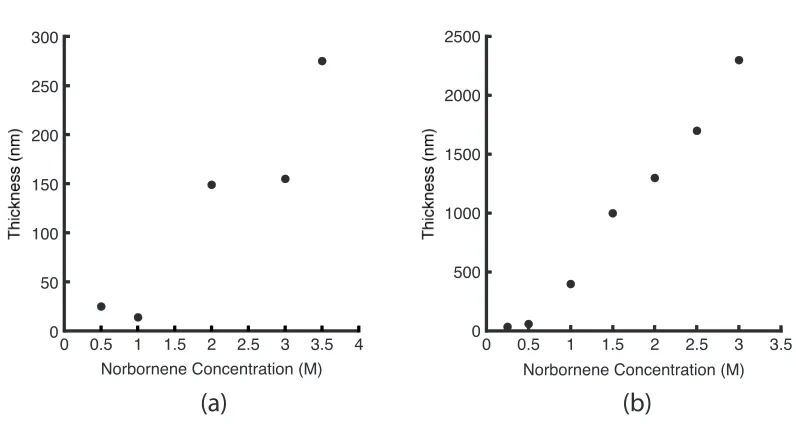
5.3 Variation in polynorbornene film thickness with monomer solution
concentration . . . 61
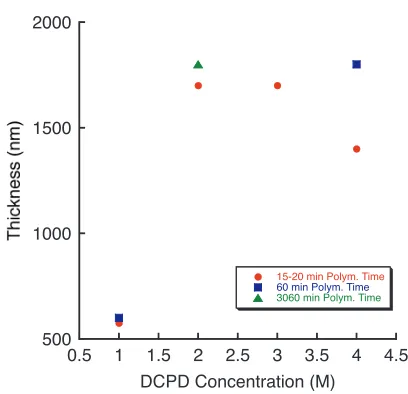
5.4 Secondary metathesis reaction producing non-surface-bound polymer 62 5.5 Variation in poly(DCPD) film thickness with monomer solution con-centration and polymerization time . . . 63
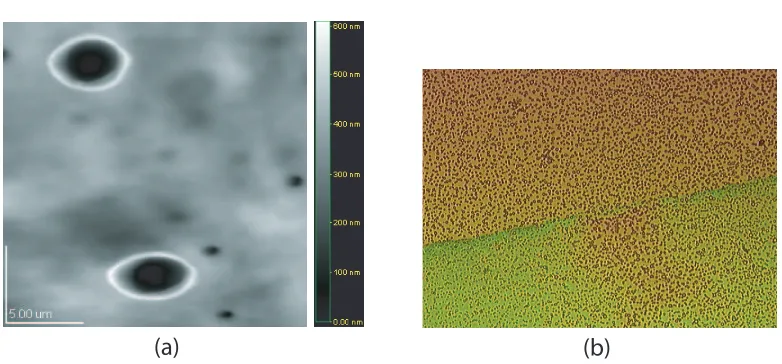
5.6 Polynorbornene films as produced by SI-ROMP . . . 64
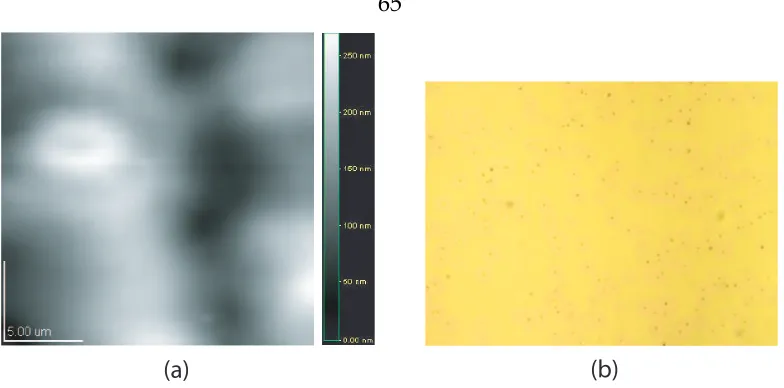
5.7 Polynorbornene films after annealing . . . 65
5.8 AFM images of patterned polynorbornene layers produced byµCP . . 68
5.9 AFM images of polymer patterns produced byµCP . . . 69
5.10 AFM images of poly(COT) patterns produced by DPN . . . 70
A.1 Ruthenium olefin metathesis catalyst . . . 78
A.2 NMR data for a ROIMP product . . . 81
B.1 Ruthenium olefin metathesis catalysts . . . 90
B.2 Chain transfer agents . . . 93
B.3 1H NMR spectrum of telechelic polyene . . . 95
B.4 UV-Vis spectrum of telechelic polyene . . . 96
B.5 FT-IR of telechelic polyenes . . . 97
B.6 MALDI-TOF MS spectrum of telechelic polyene . . . 97
B.7 Olefin-terminated polymers . . . 99
B.8 UV-vis spectra of PA-containing block copolymers in CH2Cl2solution 102 B.9 FT-IR spectra PA-b-PMMA block copolymer and PMMA . . . 103
B.10 Tapping Mode AFM images . . . 106
C.1 Catalysts and linkers for SI-ROMP . . . 115
C.2 Current-voltage characteristics of an FET produced by lamination . . . 118
List of Schemes
1.1 Chauvin mechanism of olefin metathesis . . . 4
2.1 ADMET polymerizations with a ruthenium olefin metathesis catalyst 15
4.1 Preparation of a symmetric PCTA using ATRP . . . 41
4.2 Preparation of a symmetric polymer using LAP . . . 42
4.3 Attempted preparation of a symmetric PCTA using LAP . . . 42
4.4 Competing reaction in LAP of styrene using 1,1-diphenylethylene . . 43
A.1 Proposed mechanism for ROIMP . . . 78
List of Tables
2.1 Comparison of ADMET results between catalysts1and2 . . . 17
2.2 ADMET polymerizations for various catalyst loadings . . . 17
2.3 Temperature effects in ADMET polymerizations . . . 18
4.1 Symmetric polystyrene PCTAs . . . 45
A.1 Examples of ROIMP products, their A,B-alternations, molecular weights, and distributions. . . 80
B.1 Polyene yields vs. monomer/CTA and monomer/catalyst ratios . . . 92
Chapter 1
1.1
Polymers and Polymer Properties
Polymer science is a field of chemistry that has had significant influence on the
development of humankind throughout the past century. Today, millions of tons of
plastic materials are produced each year, and the number of applications suitable
for polymers (and polymers suitable for applications) continues to increase at a
high rate.
The enormous investments of time and money that are made each year in
polymer materials research demonstrate the importance that is placed upon
tech-nological advancements. Emerging fields such as nanotechnology, bioengineering,
and ”green” manufacturing rely heavily on advancements in polymer science,
and there is seemingly no end to the scope of applications for which polymers
are being investigated. For example, throughout the first half of the twentieth
century, polymers were though to exist exclusively as electrical insulators. The
development of conducting polymers such as polyacetylene proved this to be
untrue, and conducting polymers are beginning to find widespread use in a variety
of electronic applications. Such is the importance of electrically active polymers
that the pioneers in the field were recently awarded a Nobel Prize for their work.1 The unique material properties of polymers accounts for the widespread
inter-est in their development and application. For structural applications, polymers are
often attractive because they are lightweight, moldable, flexible, and recyclable.
Although these characteristics can also be found individually in traditional
ma-terials such as metals and ceramics, polymers display them all in one material
that can also be relatively inexpensive. For more specialized applications, such
as drug delivery and food storage, polymers are attractive often for these same
properties, as well as being non-toxic and chemically inert. The wide diversity of
attractive properties, from the processability of thermoplastic elastomers to the
light emissivity of poly(phenylene vinylene)s, stems from an ability to control
and vary the chemical and architectural composition of polymeric materials. This
and materials that are used in the preparation of polymers. Further advances in
the next decades will undoubtedly carry polymeric materials into a wide range of
heretofore unimaginable applications.
1.2
Olefin Metathesis
Metal-catalyzed reactions constitute an important class of the large number
of known organic chemical transformations. Many of these reactions were
discovered within the last 50 years, and research into their development continues
apace. Olefin metathesis reactions are an example of this, and substantial progress
has been made since their first literature reports in the 1950s.2, 3The development and improvement of catalysts and substrates for olefin metathesis have resulted in
many new scientific and industrial applications.
CH CH R2
R1 R1CH CH R1 R2CH CH R2
2 +
Figure 1.1: Olefin metathesis – a carbon-carbon double bond shuffling reaction.
Olefin metathesis,2 simply a rearrangement of carbon-carbon double bonds, can be represented by Figure 1.1.3 Initially, metal catalysts for the reaction were poorly defined metal salts often combined with alkylating agents (e.g., WCl6/Bu4Sn
or MoO3/SiO2), and the mechanisms for reactions using these catalysts were
not well understood. Furthermore, these systems often suffered from a limited
substrate scope and the necessity of harsh reaction conditions.
The development of homogeneous, well-defined catalyst systems for olefin
metathesis has been key to the popularity of the reaction. As shown in Figure 1.2,
the reactivity of the metal strongly influences the characteristics of the catalyst.
Although initial metathesis catalysts were highly active, the oxophilic, early
transition metals utilized for these catalysts were again limiting due to their
incompatibility with many chemical functionalities. Catalysts based on late
Acids Alcohols, Water Aldehydes Ketones Esters, Amides Olefins Acids Alcohols, Water Aldehydes Ketones Esters, Amides Olefins Acids Alcohols, Water Aldehydes Ketones Esters, Amides Olefins Acids Alcohols, Water Aldehydes Ketones Esters, Amides Olefins
Titanium Tungsten Molybdenum Ruthenium
Increasing Functional Group Tolerance
Increasing Catalyst Reactivity
Increasing Reactivity
Figure 1.2: Reactivity of metals used in olefin metathesis.
promise in promoting olefin metathesis reactions in the presence of a variety of
functionalities. Unfortunately, catalyst1suffers from decreased reactivity relative
to early-transition metal based systems. The lower reactivity of ruthenium based
systems, however, has recently been addressed with the development of catalysts
such as2, which utilize N-heterocyclic carbene ligands.5In many cases, the activity of catalyst2rivals or exceeds that of catalysts based on early transition metals.6
Cl Ru PCy3 Cl N N Ph Cl Ru PCy3 Cl Ph Cy3P
1 2
Figure 1.3: Ruthenium olefin metathesis catalysts.
Scheme 1.1: Chauvin mechanism of olefin metathesis.
The generally accepted mechanism for olefin metathesis is shown in Scheme
1.1.2, 7 It is an equilibrium reaction, proceeding through a metallacyclobutane intermediate, that results in the interconversion of an olefin and a metal alkylidene.
Through the use of different olefin geometries and reaction conditions, numerous
olefin metathesis reactions are possible (Figure 1.4).8–13 For example, at low concentrations,α,ω-dienes can be used in ring-closing metathesis (RCM) reactions,
while use of the same substrate in higher concentrations results in acyclic diene
metathesis (ADMET) polymerization. The basis for much of the work reported in
this thesis, ring-opening metathesis polymerization (ROMP) is a widely studied,
highly versatile method of polymerization that utilizes strained, cyclic olefins.
R
R
R
n ROMP
ROM RCM
ADMET
Figure 1.4: Types of olefin metathesis reactions.
1.3
Polymerizations
According to Gibbs Law (equation 1.1, where∆H,∆S, and∆G are the changes
in enthalpy, entropy, and Free Energy, respectively), a reaction will proceed only
when∆G is negative.
Regardless of mechanism, all polymerization reactions link a large number of
small molecules into a smaller number of larger molecules. This process is
endoentropic (∆S>0), because it decreases the number of degrees of freedom that
are present in the system. Typically, the bond-forming reactions associated with
a polymerization reaction are energetically favorable (i.e., exothermic, ∆H<0),
and provide sufficient driving force to overcome the loss in entropy. Indeed,
many polymerization reactions are so exothermic that heat dissipation becomes
an important consideration upon scale-up of the reaction.
In the case of metathesis polymerizations, however, the polymerization
reac-tion is simply an equilibrium-controlled rearrangement of carbon-carbon double
bonds. The energy of the bonds that are formed in the polymerization is roughly
equivalent to the energy of the bonds that are lost. As a result, released bond
energy cannot account for the success of these polymerization. In the case of
ROMP, the release of ring strain provides the driving force necessary to overcome
the entropic barrier toward polymerization. This limits the monomer scope for
ROMP reactions, as many cycloolefins (especially five-, six-, and seven-member
rings) contain insufficient ring-strain to force the equilibrium of the reaction
toward the ring-opened product.
Since ADMET polymerizations utilize cross-metathesis reactions between
ter-minal olefins, the removal of the ethylene byproduct from the reaction vessel is
typically used to shift the equilibrium of the reaction toward polymer product.
This can be done via reduced pressure (i.e., the application of vacuum), which
often precludes the use of solvent in the reaction. High viscosity due to the absence
of solvent can be a limiting factor, as the efficiency of ethylene removal is critical
toward the success and extent of polymerization. As a result, the products from
ADMET polymerizations are typically limited to molecular weights of less than
30,000 g/mol, with corresponding limitations in their properties.
While ADMET polymerizations typically have physical limitations (e.g.,
vis-cosity and efficiency of ethylene removal), the success of ROMP reactions are
catalyst, monomer, and reaction conditions. Advancements in catalyst design,
therefore, frequently result in corresponding advancements in the scope of ROMP
with respect to new monomers or architectures. For example, catalyst2combines the functional group tolerance of other ruthenium-based metathesis catalysts with
the high level of activity that is typified by early transition metal catalysts. As
a result, the development of 2 not only allows, for example, the polymerization
of cyclooctadiene at monomer:catalyst ratios of 100,000:1, but also allows such
polymerizations to be carried out in the presence of numerous functional groups
(present either in the monomer or in additives such as chain-transfer agents).6 Since it was first reported in 1999, numerous published journal articles indicate
the wide variety of monomers and polymer architectures that can be produced
with catalyst2.
The high activity of catalyst 2 toward propagation is unfortunately accomp-anied by relatively slow initiation.14 This is undesirable since control over the molecular weight distribution of the polymer product is best achieved by the
reverse situation: fast initiation of the catalyst relative to the propagation step.
Although there is little catalyst-derived control in polymerizations using 2, the products from such reactions can be influenced by a number of other factors.
For example, the addition of chain transfer agents allows for control over the
molecular weight, as well as the endgroups of the polymer product.15 Such an approach has been used previously with small-molecule chain transfer agents
to prepare potentially commercially important materials such as novel
hydroxy-terminated poly(butadiene)s.16 This methodology is advanced further in Chapter 4, which describes recent efforts to develop polymeric analogues of traditional
ROMP chain transfer agents, as well as in Appendix B, which describes a study
into the synthesis of end-functionalized polyacetylene.
Exploitation of the activity and stability of 2 are further discussed in Chapter 3 and Appendix A, which describes the development of a highly generalized
method for the preparation of alternating copolymers via ROMP. Unlike earlier
-unsaturated olefins. Furthermore, such olefins are able to insert into the olefins
of certain cycloalkenes. By allowing this insertion reaction to occur between an
α,ω-diene and a polyalkenamer (formed via ROMP either in situ or in a separate
reaction), ring-opening-insertion metathesis polymerization (ROIMP) generates
highly alternating copolymers in good yield. The mechanism of ROIMP is a
unique hybrid of the more traditional step growth and chain growth
polymer-ization methods. As such, it displays some of the advantages of each of these
methods, and efforts to describe the ROIMP mechanism with a mathematical
model are described in Chapter 3.
The decreased reactivity of the methylidene, relative to the benzylidene or
alkylidene form of catalyst2, prompted a study into the ADMET polymerization of terminal and non-terminal dienes. The results of this study are presented in
Chapter 2.
1.4
Electronic devices
Within the past 20 years, there has been rapid growth in both diversity and
functionality of portable electronic devices. This growth has been supported
by developments in the materials that are used in the electronics industry, and
reciprocates by promoting further advancements in materials science. Although
the size and material composition of electronic devices have changed considerably
over the past several decades, the underlying principles of their operation have
remained constant.
Perhaps the simplest of electronic devices, the parallel plate capacitor consists
of two conductive plates separated by an insulating dielectric layer (Figure 1.5a).
The device is used primarily for the storage of electrical charge; storage capacity
(referred to as the device’s capacitance) is determined by equation 1.2, where A
represents the surface area of the plates,trepresents their separation,krepresents
the dielectric constant of the dielectric material, and ǫ0 represents a constant
Electrode Electrode
Dielectric Layer Dielectric Layer
Gate Electrode Semiconductor
Drain Electrode
Substrate
Source Electrode
(a)
(b)
Figure 1.5: (a) Schematic diagram of a capacitor. (b) Schematic diagram of a top contact field-effect transistor.
plates of a capacitor, charges accumulate on the plates until the bias between them
is equal to the applied voltage. After removing the voltage source, the capacitor
can be discharged by placing a load across the plates. Conduction through the
dielectric layer (a process known as ”breakdown”) occurs if the voltage between
the capacitor plates exceeds the breakdown voltage of the dielectric material.
To avoid this scenario, it is important for the breakdown voltage of a dielectric
material to be higher than the working voltage of the capacitor.
Capacitance= ǫ0∗k∗A
t (1.2)
Equation 1.2 implies that a larger capacitance can be obtained by increasing the
surface area of the plates, or by decreasing their separation. In cases where device
geometry is constrained, however, capacitance can be affected only by changing
the dielectric constant of the dielectric layer. This is typically done by changing the
material itself; a wide range of dielectric materials are available, including metal
oxides, organic polymers, paper, and air.
Transistors are solid-state devices that were first developed in 1947 at Bell
Laboratories. Although a number of different transistor geometries are known,
they are all primarily used to regulate or modify current flows in electronic circuits.
Field-effect transistors (FETs) accomplish this task using an electric field to modify
shown in Figure 1.5b.∗ In the operation of an FET, a voltage is applied between the
gate and source electrodes. The dielectric layer allows transmission of the electric
field that results from this voltage, while preventing electrical conduction between
the electrodes. The electric field increases the charge density at the top and bottom
of the (doped) semiconducting layer, and it is this concentration of charges that
allows conduction between the drain and source electrodes.
In thin-film transistors (TFTs), each component layer is present as a thin layer
of material. Most commonly used in flat-panel displays, TFTs can be constructed
using a variety of conducting, semiconducting, and insulating materials. Recent
research has allowed the preparation of transparent TFTs.17
Frequently, polymers are used as the dielectric layer in electronic devices such
as capacitors and TFTs.18 Materials including polymethacrylates and polyimides have been incorporated and characterized. Relative to inorganic materials such as
silicon dioxide, polymers are superior for their mechanical flexibility, low weight,
and low cost. The standard approach for depositing polymer dielectric layers is by
spin-coating a solution of the polymer in an organic solvent.
Chapter 5 and Appendix C are concerned mainly with the development
of ROMP reactions using surface-bound catalyst. These surface-initiated
ring-opening metathesis polymerization (SI-ROMP) reactions allow for the formation
of polymer layers that are covalently tethered to surfaces. The covalent attachment
methodology produces more robust films in comparison to film-forming processes
that rely on polymer adsorption through weaker bonding schemes. Advantages
of the SI-ROMP polymer films include stability toward temperature and solvent;
these properties will be discussed as they relate to the use of the films as
component layers in electronic devices.
References Cited
[1] Shirakawa, H. Angew. Chem.-Int. Edit.,2001,40, 2575–2580. [2] Trnka, T. M.; Grubbs, R. H. Acc. Chem. Res.,2001,34, 18–29. [3] Anderson, A.W.; Merkling, N.G. Chem. Abstr.,1955,50, 3008.
[4] Schwab, P.; Grubbs, R. H.; Ziller, J. W. J. Am. Chem. Soc.,1996,118, 100–110. [5] Scholl, M.; Ding, S.; Lee, C. W.; Grubbs, R. H. Org. Lett.,1999,1, 953–956. [6] Bielawski, C. W.; Grubbs, R. H. Angew. Chem.-Int. Edit.,2000,39, 2903–2906. [7] Herisson, J. L.; Chauvin, Y. Makromol. Chem.,1971,141, 161–167.
[8] Grubbs, R. H., Ed. Handbook of Metathesis. Wiley, Weinheim, 2003.
[9] Ivin, K.J.; Mol, J.C. Olefin Metathesis and Metathesis Polymerization. Academic Press, London, 1997.
[10] Ivin, K.J. NATO Science Series, II: Mathematics, Physics and Chemistry,2002,56, 1–15.
[11] Tindall, D.; Pawlow, J.H.; Wagener, K.B. Top. Organomet. Chem., 1998,1, 183– 198.
[12] Morgan, J. P.; Morrill, C.; Grubbs, R. H. Org. Lett.,2002,4, 67–70. [13] Connon, S. J.; Blechert, S. Angew. Chem.-Int. Edit.,2003,42, 1900–1923.
[14] Sanford, M. S.; Love, J. A.; Grubbs, R. H. J. Am. Chem. Soc., 2001, 123, 6543– 6554.
[15] Benedicto, A. D.; Claverie, J. P.; Grubbs, R. H. Macromolecules, 1995,28, 500– 511.
[16] Bielawski, C. W.; Scherman, O. A.; Grubbs, R. H.Polymer,2001,42, 4939–4945. [17] Masuda, S.; Kitamura, K.; Okumura, Y.; Miyatake, S.; Tabata, H.; Kawai, T. J.
Appl. Phys.,2003,93, 1624–1630.
Chapter 2
Acyclic Diene Metathesis (ADMET)
Polymerization Using a Ruthenium
Olefin Metathesis Catalyst
2.1
Abstract
The use of non-terminal dienes in acyclic diene metathesis (ADMET)
polymer-izations is investigated. In terms of the maximum attainable molecular weight
and the overall rate of reaction, non-terminal dienes are found to impart no
advantages over terminal dienes. In addition, the general reactivity of the
well-defined ruthenium olefin metathesis catalyst
(1,3-dimesityl-4,5-dihydroimidazol-2-ylidene)(PCy3)Cl2Ru=CHPh (2) in ADMET polymerizations is investigated.
With catalyst 2, very low catalyst loadings (up to monomer:catalyst ratios of
10,000:1), and short reaction times (ca. 24 hours) are possible. Compared with
standard ADMET conditions for previous ruthenium catalysts (monomer:catalyst
ratios of 400:1, and reaction times of 48-72 hours), these findings demonstrate the
high level of activity of catalyst2.
2.2
Introduction
Acyclic diene metathesis (ADMET) is a step-growth polycondensation reaction
that has attracted considerable attention in recent years.1 High molecular weight, unsaturated polymers that contain various functional groups in the backbone are
accessible via ADMET.2 Synthesis of low molecular weight telechelic polymers3–5 as well as fully conjugated oligomers6 have further shown the versatility of the reaction.
A variety of olefin metathesis catalysts have been shown to facilitate ADMET
polymerization. In particular, molybdenum- and tungsten-based catalysts7, 8 have been of interest for their high levels of activity and ability to produce polymers of
high molecular weight, and the ruthenium catalyst 1 has been investigated for
its tolerance of functional groups.9–11 However, these catalysts have significant drawbacks. Early transition metal catalysts require stringent reaction conditions,
and suffer from a lack of functional group tolerance, while late transition metal
as disubstituted olefins12 and conjugated monomers.∗ Furthermore, ADMET
polymerizations using these catalysts typically require long reaction times (48-72
hours) and high temperatures to yield high molecular weight polymers.
Ru Cl PCy3 PCy3 Cl Ph Ru Cl PCy3 N N Cl Ph
1
2
2a
Ru Cl PCy3 CH2 N N Cl
Figure 2.1: Ruthenium olefin metathesis catalysts.
Recently, the development of catalyst 2has been reported, substituting an N-heterocyclic carbene for a phosphine ligand in1.13The high level of activity, as well as functional group tolerance of 2, has been documented.14, 15 The first reported use of catalyst2in ADMET polymerizations demonstrated its ability to form
well-defined graft copolymers.16 An increase in the rate of ADMET depolymerization has also been found using catalyst 2.†18 Considering the advantages of 2 over previous metathesis catalysts, further investigations into the use of 2 in ADMET polymerizations are warranted, and are discussed herein.
At ambient temperature, previous investigations have shown that 2a, the phosphine-bound, methylidene form of 2, is a poor catalytic species for olefin
metathesis.15 For ADMET polymerizations of monomers with terminal olefins, each turnover in the catalytic cycle has the potential to form 2a.1, 15 If 2a is unable or slow to re-enter the catalytic cycle, the amount of active catalyst would
decrease as conversion increases. ADMET has been shown to follow typical
polycondensation-type kinetics,1 yielding high molecular weight polymer only at high conversion. This suggested to us that monomers with non-terminal olefins
may be better substrates for ADMET using catalyst2. We report here a comparison
∗Unpublished results from this lab
of ADMET polymerizations between 1,9-decadiene (3) and 2,10-dodecadiene (4) to form polyoctenylene (Scheme 2.1).
Scheme 2.1: ADMET of3and4with a ruthenium olefin metathesis catalyst.
x
x evolution of CH2=CH2
1 or 2, ∆
evolution of
1 or 2, ∆ 3
4
2.3
Experimental
Materials and characterization. 1,9-decadiene (98%) (3) was purchased from TCI and used as received. 2,10-dodecadiene (4) was prepared by a modified
literature procedure.19 Toluene, methanol, diethyl ether, and hexane were ob-tained from EM Science and used as received. (PCy3)2(Cl)2Ru=CHPh (1)20 was
prepared according to literature procedures. (IMesH2)(PCy3)(Cl)2Ru=CHPh (2)21
was prepared according to literature procedures, and further purified to remove
residual 1by flash column chromatography on silica gel 60 (230–400 mesh) from TSI Scientific, eluting with 9:1 hexane/diethyl ether.
NMR spectra were recorded on a Varian Mercury 300 (299.817 MHz for 1H and 74.45 MHz for13C). All NMR spectra were recorded in CDCl
3 and referenced
to residual protio species. Gel permeation chromatography (GPC) was carried
out on two PLgel 5mm Mixed-C columns connected in series with a DAWN EOS
multi angle laser light scattering (MALLS) detector and an Optilab DSP differential
refractometer (both from Wyatt Technology). No calibration standards were used
and dn/dc values were obtained for each injection assuming 100% mass elution
from the columns.
would proceed as follows: a dry Schlenk tube, purged with argon, was charged
with 0.2184 g (1.580 mmol) monomer3and a magnetic stir bar. Three
freeze-pump-thaw cycles were carried out to degas the monomer. Under an argon atmosphere,
1.4 mg (0.0017 mmol) of catalyst2was then added. The tube was heated to 50◦C,
and pulsed with high vacuum (approximately 60 mTorr) every 10-15 minutes to
remove volatiles. The reaction mixture solidified after approximately one hour, at
which time dynamic vacuum was applied for the remainder of the reaction. For
reactions done at 70 or 95 ◦C, the temperature was increased from 50 ◦C upon
solidification of the reaction mixture. After the prescribed reaction time, heat was
removed and the reaction exposed to air. The product was dissolved in a minimal
amount of boiling toluene, precipitated into an excess of ice-cold methanol, filtered
and dried under high vacuum overnight.
2.4
Results and Discussion
ADMET with catalysts 1 and 2. Table 2.1 displays a comparison between ADMET polymerizations using catalysts 1 and 2. With 1 as catalyst, monomer
3polymerizes to much higher molecular weight than does monomer4. This result is expected, considering the lower reactivity of 1 for this type of disubstituted
olefin.12 However, catalyst 2 does not appear to favor 4 over 3, as had been ex-pected. Under typical ADMET conditions (i.e.,50-70◦C in the bulk),3polymerizes
at least as well as4. It is likely that the high concentration of monomer relative to phosphine precludes large-scale formation of phosphine-bound2a, or that2ais in
fact an active catalytic species under ADMET conditions. We speculate that the
improbability of forming2a under ADMET conditions allows the terminal olefin
monomer to polymerize to high molecular weight.
Furthermore, the cis/trans ratios for polyoctenylene obtained with 1 and
rxn monomer catalyst [M]/[C] time (hrs) Mn (103) (GPC) PDI
1 3 1 480 69 11.5 2.1
2 4 1 340 69 2.6 1.5
3 3 2 400 71 14.8 2.0
4 4 2 410 71 14.4 1.7
Table 2.1: Comparison of ADMET results between catalysts1and2.
from polymerizing monomer 3 with catalyst 2 was found to have a high trans
content of 80% by13C NMR.
Activity of catalyst 2. Having shown that the reactivity of the terminal diene
monomer is comparable to that of the non-terminal diene monomer with catalyst
2, commercially available 3 was chosen to investigate the reactivity of 2 under
ADMET conditions. Table 2.2 shows that the molecular weight of the resulting
polymer is virtually independent of monomer:catalyst ratios, unlike ADMET of
monomer 3 with catalyst 1.9 In addition, lower catalyst loadings do not require longer reaction times as is evident by rxn 9 (monomer:catalyst of 10000:1).
rxn [3]/[2] time (hrs) yield (%)a Mn (103) (GPC) PDI
5 420 26 36 11.3 1.8
6 960 23 27 14.7 1.4
7 2600 23 42 10.2 1.6
8 4700 23 47 12.9 1.6
9 10000 23 60 13.4 2.0
Table 2.2: ADMET of 3 with catalyst 2; areported yields are based on mass
of recovered product, and do not account for the lost mass of condensation byproducts.
Previously, reaction times of 2-3 days have been standard for ADMET
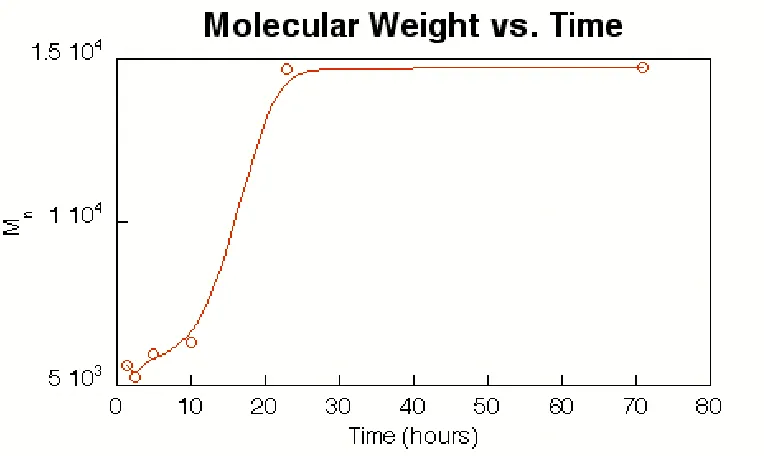
poly-merizations.9, 16 Figure 2.2 shows that long reaction times are unnecessary with catalyst 2. The maximum number average molecular weight for a given set of
conditions (i.e., temperature and monomer:catalyst ratio) is reached within 24
hours; polydispersity remains fairly constant throughout this time (Mw/Mn =
1.6-2.1). Thus, given sufficient reaction time of approximately 24 hours, molecular
weight for bulk polymerizations seems to be most influenced by changes in
the maximum percent conversion is apparently limited by diffusion of monomer
or oligomer to the active catalyst end of a growing polymer chain. Accordingly,
Table 2.3 shows that higher temperatures allow polymerization to proceed to
higher molecular weight.
Figure 2.2: Plot of molecular weight vs. time for ADMET of 3 with catalyst 2. Reaction conditions: [3]/[2] = 1000, 50◦C, 50 mTorr.
rxn [3]/[2] time (hrs) Temp (◦C) yield (%)a M
n (103) (GPC) PDI
10 960 23 50 60 2.9 1.7
11b 960 23 70 27 14.7 1.4
12 990 23 95 22 23.7 1.6
13 2500 23 50 57 4.3 1.7
14c 2600 23 70 42 10.2 1.6
15 2600 23 95 46 27.8 1.8
Table 2.3: Temperature effects in ADMET polymerizaitons of3with catalyst2;asee Table 2.2,bsame as reaction 6;csame as reaction 7.
Finally, given that backbiting22, 23 and depolymerization24 reactions are known to occur with catalyst2, and that monomer4is fairly volatile under ADMET
condi-tions, it is conceivable that “chain clipping” (i.e., depolymerization of the terminal
the tables.‡ However, only 2-butene was found in the volatile materials lost during
polymerization of4. The lack of monomer suggests both that dimerization of the
monomer (forming less volatile species) is rapid, and that chain clipping is not
occurring to any appreciable extent. The low reported yields probably result from
the small scale of the reactions, and inefficient workup procedures.
2.5
Conclusion
We have demonstrated that, with the highly-active catalyst 2, ADMET
poly-merizations produce high molecular weight polymer with shorter reaction times
relative to standard ADMET conditions. Catalyst 2rapidly polymerizes terminal
dienes, even with very low catalyst loadings. In terms of molecular weight and
rate of polymerization, no significant advantage is gained by using non-terminal
olefins over terminal olefins. The ability of2 to polymerize disubstituted olefins as readily as terminal olefins suggests that high molecular weight, telechelic
polymers may be accessible using2. Studies are currently under way to investigate the ability of2to form high molecular weight telechelic polymers under ADMET
conditions.
References Cited
[1] Tindall, D.; Pawlow, J. H.; Wagener, K. B. Top. Organomet. Chem., 1998, 1, 183–198.
[2] Wagener, K. B.; Brzezinska, K.; Anderson, J. D.; Younkin, T. R.; Steppe, K.; DeBoer, W. Macromolecules,1997,30, 7363–7369.
[3] Brzezinska, K.; Deming, T. J. Macromolecules,2001,34, 4348–4354.
[4] Brzezinska, K. R.; Wagener, K. B.; Burns, G. T. J. Polym. Sci. Pol. Chem., 1999,
37, 849–856.
[5] Tamura, H.; Maeda, N.; Matsumoto, R.; Nakayama, A.; Hayashi, H.; Ikushima, K.; Kuraya, M. J. Macromol. Sci. Pure Appl. Chem., 1999, 36, 1153– 1170.
[6] Tao, D.; Wagener, K. B. Macromolecules,1994,27, 1281–1283.
[7] Patton, J. T.; Boncella, J. M.; Wagener, K. B. Macromolecules,1992,25, 3862–7. [8] Blosch, L. L; Gamble, A. S.; Boncella, J. M. J. Mol. Catal.,1992,76, 229–37. [9] Brzezinska, K.; Wolfe, P. S.; Watson, M. D.; Wagener, K. B. Macromol. Chem.
Phys.,1996,197, 2065–2074.
[10] Valenti, D. J.; Wagener, K. B. Macromolecules,1998,31, 2764–2773. [11] Wolfe, P. S.; Wagener, K. B. Macromolecules,1999,32, 7961–7967.
[12] Blackwell, H. E.; O’Leary, D. J.; Chatterjee, A. K.; Washenfelder, R. A.; Bussmann, D. A.; Grubbs, R. H. J. Am. Chem. Soc.,2000,122, 58–71.
[13] Scholl, M.; Ding, S.; Lee, C. W.; Grubbs, R. H. Org. Lett., 1999,1, 953–956. [14] Bielawski, C. W.; Grubbs, R. H. Angew. Chem.-Int. Edit.,2000,39, 2903–2906. [15] Sanford, M. S.; Love, J. A.; Grubbs, R. H. J. Am. Chem. Soc., 2001, 123, 6543–
6554.
[16] O’Donnell, P. M.; Brzezinska, K.; Powell, D.; Wagener, K. B. Macromolecules,
2001,34, 6845–6849.
[17] Lehman, S. E. Jr.; Wagener, K. B. Macromolecules,2002,35, 48–53.
[18] Craig, S. W.; Manzer, J. A.; Coughlin, E. B. Macromolecules,2001,ASAP. [19] Moeller, K. D.; Tinao, L. V. J. Am. Chem. Soc.,1992,144, 1033–41.
[20] Schwab, P.; Grubbs, R. H.; Ziller, J. W. J. Am. Chem. Soc.,1996,118, 100–110. [21] Sanford, M. S.; Ulman, M.; Grubbs, R. H. J. Am. Chem. Soc.,2001,123, 749–750. [22] Bielawski, C. W.; Grubbs, R. H. Macromolecules,2001,34, 8838–8840.
[23] Bielawski, C. W.; Benitez, D.; Morita, T.; Grubbs, R. H. Macromolecules, 2001,
34, 8610–8618.
Chapter 3
Understanding
Ring-Opening-Insertion Metathesis
Polymerization: Mathematical
3.1
Abstract
Initial results toward the development of a mathematical model for
ring-opening-insertion metathesis polymerization (ROIMP) are reported. Two
ap-proaches at simplifying the mathematical description of the ROIMP mechanism
are discussed. The first approach involves the one-step insertion of monomer
units into polymer chains that contain a specified number of insertion sites. The
second approach is more representative of the ROIMP mechanism, separating the
insertion process into two steps.
3.2
Introduction
Beginning in the 1920s, statistical treatments of polymerization reactions were
developed. These mathematical models describe the progression of the reaction,
taking into account the mechanism of polymerization, and the presence of various
reacting species. Equations have been derived that describe changes in the average
degree of polymerization and molecular weight distribution, as well as the effects
of relative reaction rates and the inclusion of various additives. Theoretical
treatments have proven valuable in helping to understand and control various
polymerization systems upon scale-up and commercialization. This is particularly
true for two types of polymerizations: step growth and chain growth.1, 2
Step growth polymerizations involve repeated coupling reactions of α,ω
-difunctionalized monomers. The coupling reaction often involves the loss of a
small molecule such as H2O or HCl, and so the process is historically (and still
frequently) referred to as condensation polymerization.3 The extent of reaction conversion is typically defined as the proportion of chain ends that remain.
Because of this definition, and since each coupling reaction forms a product species
containing two reactive chain ends, it is possible to observe complete consumption
of monomer at less than 100% conversion. In step growth polymerizations,
conversions are reached. As a result, it is statistically most likely for reactions to
occur between monomers, or at least between a monomer and a species of higher
order.
In 1936, Carothers determined that the average degree of polymerization (DP)
is an inverse function of the reaction conversion, p (equation 3.1).4
DP = 1
1−p (3.1)
The average degree of polymerization of the reactants increases very slowly until
the reaction has reached well over 90% conversion. This approach is therefore
only useful for polymerization reactions that are extremely high yielding, such
as condensation type reactions where the equilibrium can be driven toward the
formation of polymer by the removal of condensation byproducts.
As opposed to the geometric growth observed for step growth polymerizations,
chain growth mechanisms involve the sequential, linear addition of monomers
to a growing polymer chain. Three (and sometimes four) separate reactions can
typically be recognized in the chain growth process: initiation, propagation, chain
transfer (in some systems), and termination. The extent of conversion of the
reaction is directly related to the consumption of monomer. However, polymer
chains initiate, propagate, and are terminated throughout the reaction. Therefore,
to a first approximation, initiation, propagation, and termination occur
indepen-dently of monomer conversion. Polymer chain length is determined largely by the
relative rates of propagation and termination, and is largely unaffected by reaction
conversion.
A number of disadvantages limit the applicability of these methods. In
partic-ular, for step growth polymerizations, extremely pure reagents, high monomer
concentration, and high-yielding coupling reactions are required to form high
molecular weight polymer. Side reactions must be suppressed, and it is often
necessary to remove and dispose of condensation byproducts. In addition, control
Chain growth polymerizations suffer less from these drawbacks, although many
polymer compositions and architectures are most easily accessed by step growth
methods. Both processes, therefore, remain important for many commercial
applications.
The unique mechanism of ring-opening-insertion metathesis polymerization
(ROIMP) combines many of the aspects of step growth and chain growth
poly-merizations (see Appendix A). Ring-opening metathesis polymerization (ROMP)
of the cycloolefin, a chain growth process, is very quick and occurs almost entirely
uninterrupted. The diene subsequently inserts into the olefins in the backbone
of the polycycloolefin. Normally, terminal dienes (although not α,β-unsaturated
terminal dienes) polymerize via ADMET, a step growth polymerization process.
The insertion portion of ROIMP, however, displays marked differences from a
normal step growth mechanism. In particular, a driving force for the insertion step
is the thermodynamically favored formation of α,β-unsaturated internal olefins.
This driving force is strong, and as a result, ROIMP can be carried out in solvent
and without the need for rigorously purifying the reagents.
Another consequence of the combination of different polymerization
mech-anisms in ROIMP is that the overall reaction likely does not conform to the
mathematical models that have been developed for either step growth or chain
growth polymerizations. During the ROMP portion of the reaction, molecular
weight distribution and degree of polymerization most likely behave as for normal
ROMP reactions. However, the insertion portion of the reaction also affects these
variables. Conversion cannot be measured by monomer consumption, as there
are typically two monomers which are consumed at drastically different rates.
Average degree of polymerization most likely is not monotonically increasing, but
rather decreases in the early stages of the insertion portion of the reaction. The
relative rates of various reactions, including ring-opening and cross metathesis
between the numerous species present must certainly play a role in the molecular
weight distribution at different stages of the reaction. Experimental work
reaction would be useful for understanding the influence of variables such as
monomer identity, monomer ratio and extent of reaction. Initial work toward the
development of such a model is presented here.
3.3
Results and Discussion
In a ROIMP reaction involving a cycloolefin and an α,β-unsaturated terminal
diene, nearly 30 different reactions are possible between reactants and catalyst.
This necessitates a number of simplifying assumptions. The experimental data
indicates that the ROMP portion of the reaction occurs much faster than the
insertion portion (see Appendix A). It seems reasonable, therefore, to ignore the
ROMP portion of the reaction, and assume that the insertion of the diene monomer
occurs with a pre-formed polyalkenamer.
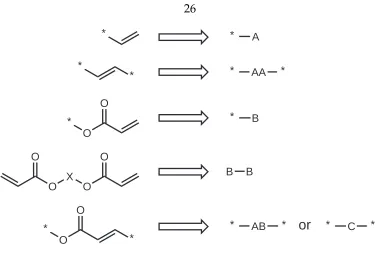
For simplicity in the following discussion, a terminal olefin (which is defined
to be equivalent to one-half of an internal olefin) will be referred to as ”A,” so
that an internal olefin can be represented by ”AA.” In addition, a terminal α,β
-unsaturated olefin will be referred to as ”B,” and a diacrylate monomer will thus
be represented by B–B. An internal α,β-unsaturated olefin will be referred to as
”C,” although note that it is equivalent to ”AB.” See Figure 3.1 for clarification of
this nomenclature.
Each metathesis reaction must be facilitated by the ruthenium catalyst. This
adds a further level of complication, since each metathesis reaction involving
the catalyst can lead to two distinct products (depending upon the connectivity
of the metallacyclobutane). Certain connectivities are more likely than others,
depending upon the sterics and electronics of the reactants and resulting products.
In this initial treatment of the ROIMP reaction, the action of the catalyst has been
completely ignored. Coupling of A and B groups occurs without consideration of
the orientation of the reactants or the catalyst.
Although terminal acrylates are observed to dimerize during ROIMP reactions,
AA A
O O
O X O
O O
O O
B
B B
AB
or
C*
* *
* *
*
*
* *
*
* * * *
Figure 3.1: Definitions used for ROIMP model.
involving two B groups are therefore ignored in order to further simplify the
calculations.
Figure 3.2 shows M1 and M2, the different mechanisms by which an insertion
polymerization can occur. In the simplest mechanism, M1, each BB monomer is
inserted in one step into an AA group. Although this mechanism is not realistic for
ROIMP, it represents a simplified version of insertion polymerizations from which
to begin the development of a mathematical model. The end product is identical
to that of the more complicated mechanism, M2, in which each B group must react
individually with an A group. Initial calculations were therefore performed using
the simplified insertion mechanism, M1.
M1: Concerted Mechanism
M2: Step-Wise Mechanism
AA B B AB BA
AA B B AB B + A AB BA
In calculating the average degree of polymerization (DP), it was decided to first
consider only polymer molecules present in the reaction. Given NAA (the number
of AA groups initially present) and NP (the number of initial polymer chains), the
initialDP is NAA/NP. Then, defining NBB as the number of B-B monomer units
initially present, and p as the fractional conversion of B-B monomer units at any
point in the reaction,DP is defined by
DP = (N AA+p∗N BB) N P
This indicates that, for mechanism M1, DP increases linearly with conversion
when conversion is defined as the number of reacted B-B monomers units (or,
equivalently, the number of reacted AA groups).
An alternative method for calculating DP is to consider all species present in
the reaction. Degree of polymerization is then given by equation 3.2.
DP = (N AA+N BB)
(N P +N BB−p∗N BB) (3.2)
Note that, because of the definition used for p, equation 3.2 is applicable under
conditions where NAA ≥ NBB, but not when NBB >NAA. As with traditional
step growth polymerizations,DP as defined by equation 3.2 increases very rapidly
only at high values of conversion (Figure 3.3).
p
DP
1 0.5
0.25 0.75
40
30
20
10 50
Determination of molecular weight distribution as a function of conversion of
B-B units (p) for mechanism M1 requires the initial distribution of polymer chains
to be defined. Let gp(y) be a function that defines the number of polymer chains
with y repeat units (i.e., either AA groups or C groups) at p conversion. For
example, gp(10) represents the number of chains containing a total of 10 AA and/or
C groups. Then, g0(y) represents the initial distribution of chains. Although any
distribution can be chosen for g0(y), a normal distribution is used in the present
study. Therefore, by the definition of the normal distribution,
g0(y) = num∗(2∗pi∗s2)(−1/2) ∗e
(−(y−m)2 (2∗s2))
where m represents the mean, s represents the standard deviation, and num is
a scaling factor that accounts for the number of initial polymer chains. For the
calculations performed here, m = 50, s = 5, and num = 500.
The probability of a B-B unit inserting into a given polymer chain is determined
by the number of unreacted AA units that are present in that chain relative to the
total number of unreacted AA units left in the reaction. This is determined by the
chain’s initial number of AA units as well as the number of insertion reactions
that have occurred for that chain. Furthermore, the number of polymer chains of
overall length y (i.e., with the sum of the number of AA units and the number of
inserted B-B units equal to y) is equal to the sum of chains where the initial number
of AA groups and the number of insertion reactions sum to equal y. For example,
at any conversion p, gp(4) is equal to the number of chains that initially contained
two AA groups and have undergone two insertion reactions, plus the number of
chains that initially contained three AA groups and have undergone one insertion
reaction, plus the number of chains that initially contained four AA groups and
have undergone no insertion reactions. This summation can be represented by
equation 3.3, given that p is also equal to the probability that an insertion reaction
gp(y) = l X
y=l/2
g0[y]∗p(l−y)∗(1−p)(2∗y−l)
(3.3)
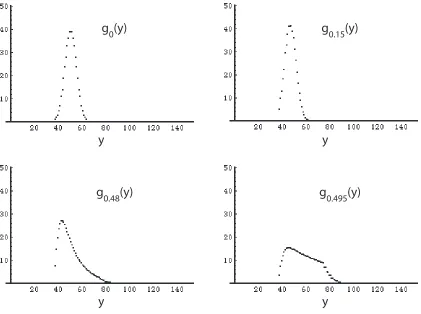
Plots of gp(y) for various values of p<0.5 are given in figure 3.4. Interestingly,
the original distribution is distorted as conversion nears 50%. It appears that
polyolefins with larger numbers of initial AA groups are more prone to insertion
reactions, and thereby increase their molecular weight faster than polyolefins with
fewer initial AA groups. This seems reasonable, as the probability of a B-B unit
inserting into a chain is directly related to the number of AA groups that are
present in that chain.
g
0(y)
g
0.15(y)
g
0.48(y)
g
0.495(y)
y
y
y
y
Figure 3.4: Plots of gp(y) vs. y for mechanism M1 at various levels of reaction
conversion (vertical axes units represent an arbitrary number of chains).
Currently, due to problems in rounding and the handling of even/odd integers,
5.0.0.0) are invalid for conversions greater than 50%. One would expect, however,
that the evolution of the distribution for values of p >0.5 would be similar to the
evolution for values of p < 0.5. Indeed, by modifying the equation to calculate
gp(y) only for even values of y, this behaviour is observed for values of p>0.5.
A mathematical model for mechanism M2 is far more complex than the model
for mechanism M1. The significant difference between the two mechanisms is
that the molecular weight of a polymer chain can decrease for M2, whereas it
is strictly increasing for M1. Therefore, for M2, the number of polymer chains
containing a given number of monomer units is dependent not only upon the
number of insertion reactions that have occurred, but also upon the location within
the polyolefins that those insertions occur.
For the M2 mechanism, three key reactions can be identified: R1, R2, and R3
(Figure 3.5). At any given conversion p, the molecular weight distribution andDP
will be dependent upon the number of each of these reactions that have occurred.
For example, since the number of molecules remains constant, reactions of type R1
do not changeDP (assuming thatDP is defined to include all species present in
the reaction). In addition, the molecular weight of a chain can either increase or
decrease upon undergoing an R1 reaction, whereas it can only increase as a result
of R2 and R3 reactions.
AA B
A
A A
A
AA
B C
+
+
+
+
C
R1
R2
R3
Figure 3.5: Important reactions for mechanism M2.
As a further complicating factor, the order in which reactions occur must also be
considered. In achieving 100% conversion, the fewest number of overall reactions
will occur if R3 reactions are completely suppressed. However, every two reactions
if R1 reactions occur much faster than R2 reactions, there will be a buildup of
terminal A groups and R3 reactions will become more probable.
Due to the complexity of the M2 mechanism, suitable equations for calculating
the molecular weight distribution andDP of the reaction as a function of
conver-sion have yet to be derived. However, it may be possible to simplify the model
using statistical distributions of chain fragments, with the number of fragments
determined by the conversion. This, and other possible simplifying methods,
await further investigation.
3.4
Conclusions
Initial attempts to model the ROIMP reaction have been successful only using
highly simplified models. Further work is necessary in order to extend this work
References Cited
[1] Flory, P. J.Principles of Polymer Chemistry. Cornell University Press, Ithaca, N.Y., 2nd edition, 1953.
[2] Odian, G. Principles of Polymerization. Wiley, Hoboken, NJ, 4th edition, 2004. [3] Carothers, W. H. J. Am. Chem. Soc.,1929,51, 2548–2559.
Chapter 4
Development of Polymeric Chain
Transfer Agents for Use in
4.1
Abstract
Ring-opening metathesis polymerization (ROMP) of cyclic olefins in the
pres-ence of polymeric chain transfer agents (PCTAs) resulted in the formation of block
copolymers. Suitable PCTAs include a variety of commodity polymers, although
chain transfer is most effective for PCTAs with low molecular weight (below 10,000
g/mol). For well-defined block copolymers products, the PCTA must contain
only a single olefin. Reactivity of the PCTA is influenced by the substitution
and location of the olefin; PCTAs containing terminal olefins are more highly
active than those containing internal olefins. Herein is reported the synthesis of
symmetric PCTAs containing an internal olefin, as well as the use of symmetric
PCTAs in controlling molecular weight in ROMP reactions.
4.2
Introduction
Numerous advances over the past century have aided the development of
chain growth polymerization processes. The highly reactive nature of the active
species in some chain growth polymerizations (particularly those involving free
radicals) necessitates the use of methods for controlling polymer growth. One
approach to limiting polymer molecular weight is through the use of chain transfer
agents (CTAs). A propagating polymer chain reacts with a CTA by transferring
the active species. The original polymer chain is terminated (either reversibly
or irreversibly) and a new polymer chain begins to propagate. By adjusting
the ratio of CTA to monomer or initiator, the frequency of chain transfer can be
affected. Alternatively, the relative activity of the chain transfer agent can be
modified. Through the manipulation of these variables polymer molecular weight
and structure can often be finely controlled.
Ring-opening metathesis polymerization (ROMP) is a chain growth
propagation characteristics. The use of CTAs has afforded control in both polymer
molecular weight and endgroups. Molecular weight, which in the absence of a
CTA is influenced mostly by the nature of the catalyst and by the ratio of monomer
to catalyst, is determined by the ratio of monomer to CTA. Typically a linear
relationship is observed between the amount of added CTA and the molecular
weight of the resulting polymer. Such systems are limited, however, by the
reactivity of the catalyst and the identity of the CTA.
In general, CTAs for ROMP reactions are small organic molecules containing
acyclic olefins. Both symmetric and asymmetric olefins have been employed, and
the resulting polymer products are influenced by the structure of the CTA. Given
sufficient reaction time and temperature, the chain transfer process results in a
statistical distribution of CTA groups and catalyst initiator fragments at the
poly-mer chain ends. Thus, telechelic polypoly-mers (i.e., polypoly-mers that are functionalized
at the chain ends) can be produced using symmetric CTAs if the CTA is present in
significantly greater quantities than the catalyst. For example, if 200 equivalents
(relative to catalyst1 or2) of a symmetric CTA are used, phenyl endgroups from
the catalyst will statistically be present on only 0.25% of polymer chain ends, with
the remaining 99.75% of polymer endgroups originating from the CTA.
The formation of telechelic polymers using a chain transfer process in ROMP
reactions can be aided if the catalyst is able to undergo secondary metathesis
reactions with the backbone olefins of the polymer. These “backbiting” reactions
work best for polymers containing metathesis-active olefins. Thus, chain transfer
is most effective with monomers such as cyclooctadiene and cyclooctene, which
generate less bulky backbone olefins. In addition, the functionality of the CTA
is limited to groups that are not reactive with the metathesis catalyst. For these
reasons, much recent attention has been focused in the employment of catalyst 2
in ROMP reactions using CTAs. The high level of activity of catalyst 2 has been documented, and allows chain transfer reactions with more sterically demanding
Cl Ru
PCy3 Cl N N
Ph Cl
Ru
PCy3 Cl
Ph Cy3P
1 2
Figure 4.1: Ruthenium olefin metathesis catalysts.
Although in the majority of cases, CTAs are well-defined, small organic
molecules, the use ofpolymersas CTAs has been documented in a few cases.7–9For example, thiol-containing polymers function as CTAs in radical polymerizations.
This method results in grafted, comb-type polymer architectures. In general,
polymeric chain transfer agents (PCTAs) remain an underdeveloped method for
controlling chain growth polymerizations.
A suitable PCTA for ROMP reactions must contain an acyclic olefin. As with
traditional CTAs, the olefin can be either symmetric or asymmetric. The former
is necessarily an internal olefin, while the latter is most conveniently (but not
necessarily) a terminal olefin. The active portion of the PCTA is then a single olefin
that may be extensively surrounded by the inert polymer portion of the molecule.
It is expected, therefore, that effective reaction conditions and PCTA compositions
will be different from those that have been developed for small molecule CTAs.
The first report of the use of PCTAs in ROMP reactions is reproduced as
Appendix B of this thesis. Recently, Emrick and coworkers published the first
reported use of a symmetric PCTA.10 In Emrick’s work, the PCTA was composed of a pair of benzyl ether dendrons connected by a short, olefin-containing linear
segment. Cyclooctadiene was used as monomer, and triblock copolymers with
end-functionalization in excess of 95% were obtained. These examples of the
use of PCTAs in ROMP reactions begin to demonstrate the utility, but fail to
address the scope of the method. In addition, an understanding of the variables
asymmetric, would aid in the development of suitable applications. Herein is
reported preliminary work toward expanding the scope and understanding of
metathesis-active PCTAs.
4.3
Results and Discussion
4.3.1
Synthesis of Asymmetric PCTAs
Asymmetric PCTAs (i.e., polymers containing terminal olefins) can be easily
synthesized using