Dynamic Hand Gesture Recognition Using
the Skeleton of the Hand
Bogdan Ionescu
University “Politehnica”, LEU, Complex-Room B135A, 1–3 Liliu Maniu Boulevard, Bucharest, Romania Email:[email protected]
Didier Coquin
Laboratoire d’Informatique, Syst`emes, Traitement de l’Information et de la Connaissance (LISTIC), Universit´e de Savoie, 74016 Annecy Cedex, France
Email:[email protected]
Patrick Lambert
Laboratoire d’Informatique, Syst`emes, Traitement de l’Information et de la Connaissance (LISTIC), Universit´e de Savoie, 74016 Annecy Cedex, France
Email:[email protected]
Vasile Buzuloiu
University “Politehnica”, LEU, Complex-Room B135A, 1–3 Liliu Maniu Boulevard, Bucharest, Romania Email:[email protected]
Received 10 February 2004; Revised 2 December 2004
This paper discusses the use of the computer vision in the interpretation of human gestures. Hand gestures would be an intuitive and ideal way of exchanging information with other people in a virtual space, guiding some robots to perform certain tasks in a hostile environment, or interacting with computers. Hand gestures can be divided into two main categories: static gestures and dynamic gestures. In this paper, a novel dynamic hand gesture recognition technique is proposed. It is based on the 2D skeleton representation of the hand. For each gesture, the hand skeletons of each posture are superposed providing a single image which is the dynamic signature of the gesture. The recognition is performed by comparing this signature with the ones from a gesture alphabet, using Baddeley’s distance as a measure of dissimilarities between model parameters.
Keywords and phrases:hand gesture recognition, skeleton, orientation histogram, Baddeley distance.
1. INTRODUCTION
The goal of the dynamic hand gesture recognition technique proposed in this paper is to offer a method of guiding robots from a distance using hand gestures. It is obvious that we can use the hand gesture recognition techniques to control a computer or a hi-fi device, as well. In order to command a robot, we have to “send” some information to it, some-how. This information will be “encapsulated” in the hand gesture. Our task is to translate the information into a com-mand which can be sent to the robot.
To perform the hand gesture recognition, we have to cre-ate a model of the gestures and to use it to do the recognition task.
1.1. Hand gesture modeling
From the initial intention to the final performance, a ges-ture follows a characteristic motion pattern in space and time
[1]. Kendon distinguishes three motion phases that a single gesture is made of: preparation, stroke, and retraction [2]. The properties of this pattern are universal and permanent, and can, therefore, be used to describe any particular gesture. The following question arises: “Is every hand movement a gesture?” The answer is given by Quek who developed a set of rules for the distinction of real gestures from other hand movements [3].
(1) Gestures are contained in movements that start with a slow initial move from the rest position, continue with a phase with substantially increased speed (the stroke), and end by returning to the rest position.
(2) The hand assumes a particular configuration during the stroke.
(4) Hand gestures should be constrained within a certain volume space.
(5) Static hand gestures require a finite period of time to be recognized.
(6) Repetitive movements can be gestures.
From the rules above, one can infer that hand gestures could be classified asstatic hand gestures(characterized by the hand posture which is determined by a particular finger-thumb-palm configuration) anddynamic hand gestures (character-ized by the initial and final stroke hand configuration and the general stroke motion) [1].
1.2. Hand gesture analysis
There are three main approaches in the hand gesture analy-sis:glove-based analysis,vision-based analysis, andanalysis of drawing gestures[1].
Vision-based analysis of hand gestures is probably the most natural way of constructing a human-computer gesture interface. Yet it is also the most difficult one to implement in a satisfactory manner because of the limitations in machine vision today. The vision-based analysis is performed by us-ing one or more cameras. The visual information about a person in some visual environment is acquired and the nec-essary gesture is extracted. However, there are some diffi-cult problems: the segmentation of the moving hand from a sometimes complex environment, the analysis of hand mo-tions, the tracking of hand positions relative to the environ-ment, and finally the recognition of hand postures. To facil-itate these operations, some use markers, marked gloves, or restrictive setups: uniform background, very limited gesture vocabulary, or just a simple posture analysis.
The work related in this paper is a part of the vision-based analysis techniques. The most common visual-vision-based hand gesture recognition techniques are3D hand model anal-ysis,analysis using markers and marked gloves, and image-property-based analysis [1]. The technique proposed here uses the properties of the images in order to perform the ges-ture recognition.
1.3. A classification of hand gesture recognition techniques
There is a growing literature on hand gesture recognition. An overview has been proposed by Pavlovic et al. in [1]. The process of hand gesture recognition can be divided into two main tasks as follows.Feature extractionwhere low-level in-formation from the raw data is analyzed to produce higher-level semantic information. Once the features are collected, the second phase of hand gesture recognition is the classifi-cationwhen the data collected will be used to detect a hand gesture.
The features are built on distance, velocity and acceler-ation informacceler-ation, energy measurements, or angle informa-tion and are based on techniques such as active shape models, principal component analysis, linear fingertip models, and spatiotemporal vector analysis [4,5,6].
As classification techniques, we can mention the tem-plate-based approach, statistical methods (hidden Markov
model [7, 8]), and miscellaneous algorithms (neural net-works [7,9], causal analysis). In general, a template-based approach creates data records for each posture and gesture in the set and uses them to classify new postures and gestures. There are several types of template-based classification meth-ods:conventional template matching,instance-based learning [10],the linguistic approach[11], andappearance-based mo-tion analysis[12].
Conventional template matching, which is generally the simplest way, is performed in two steps. In the first part, the templates are created by collecting data values for each pos-ture in the pospos-ture set; generally each pospos-ture is performed a number of times and the average of the raw data for each sensor (camera, glove) is taken and stored as the template. The second part consists in comparing the current sensor readings with the given set of templates to find the posture template most closely matching the current data record. The dynamic gesture recognition technique proposed in this pa-per uses as classification method the conventional template matching approach.
2. GENERAL PRESENTATION OF THE
PROPOSED APPROACH
In this paper, a new dynamic hand gesture recognition tech-nique is proposed. Our algorithm is a vision-based algo-rithm. Images of hand gestures are captured with a single digital video camera and then processed by a computer. The images are 2D grey-level images. To simplify the hand seg-mentation, a restrictive context is used:
(i) the hand gestures are performed against an approxi-mately uniform background,
(ii) the distance between the camera and the hand is nearly constant and the gesture is performed in ana priori known region of the space,
(iii) the gesture alphabet isa prioriknown.
This does not affect the generality of the recognition process. In order to preserve the generality of the method, no markers or special gloves are used.
Because of the efficiency in terms of computation time, the simple feature extraction techniques are used for the ex-traction of the gesture features. Dealing directly with pixel intensities is less time-consuming than training some neu-ral networks or extracting the statistics from the gesture. The features extracted in this manner represent the physical and spatial properties of the gesture. Based on that, computing a certain distance between these features is the fastest way to compare them.
Also the classification step requires a veryminimal train-ing stage consisttrain-ing in a set of examples for each gesture. As classification method, the conventional template matching will be used. All these considerations lead to fast and efficient hand recognition techniques.
Recognition of dynamic gesture
Yes Recognition of stop image ?
ork < kmax
No Sequence memorization
kk+ 1
Image acquisition
k=1 Yes Recognition of start image ? No
Acquisition
Figure1: Gesture recognition process.
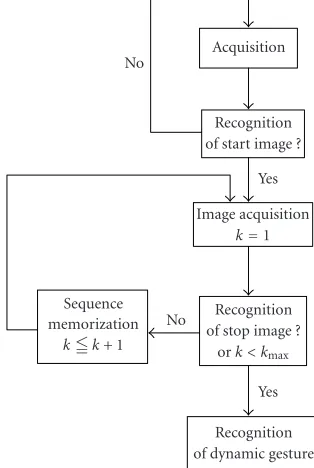
within the gesture (hand movement). The recognition of a gesture is performed using the fusion of a static and a dy-namic recognition technique. The static recognition is used to detect the start and end positions of the hand during the gesture (denoted asstartandstopimages or start and end sig-natures, in the following). The dynamic recognition is only performed between thestartandstopimages.
The gesture frames are sequentially given by the digital camera and processed. When a beginning gesture signature is recognized, the dynamic signature is computed as the frames arrive. If the end signature is recognized, the recognition pro-cess is ended, else the recognition propro-cess will stop afterkmax
acquisitions. Typicallykmax =50, which corresponds to the
maximum duration of the gesture. Static gestures can be rec-ognized if thestartand theendstatic signatures are the same and the dynamic signature does not present any hand skele-ton movements. In order to prove the efficiency of the pro-posed dynamic gesture recognition algorithm, only dynamic gestures were used in our tests. The diagram of the dynamic gesture recognition system is presented inFigure 1.
As such, the general process of the proposed method is composed of four main parts.
(i) A preprocessing stepto focus on the gesture.
(ii) A feature extraction step where two techniques are used.
(1) The first one, dedicated to static recognition, uses histograms of local orientationsin the gesture image (by computing the local gradient on the image). It is based on an algorithm proposed by Freeman and Roth [13]. The orientation histogram will act as the feature set of the gesture.
(2) The second one, used for dynamic gesture recog-nition, extracts “the dynamic signature” and is
Gesture Classification Features
Feature training set
Feature set Feature extraction
Orientation histogram Hand region skeleton
Hand region images Image preprocessing
Binarization Enhancement Hand region extraction
Image Digital camera
Figure2: The gesture recognition process diagram.
defined using a new original method which gives a compact and efficient representation of the ges-ture. The dynamic signature is a binary image which represents the superposition of all the skele-tons of the hand region for all images (hand pos-tures) within the gesture image sequence. It reflects the motion information of the gesture and also the hand spatial configuration during the gesture mo-tion. Using the proposed dynamic signature, the gesture can be segmented into its constitutive steps such as the preparation and the stroke [3]. Each gesture will be represented by a particular dynamic signature.
(iii) A training step.In order to perform the gesture classifi-cation, the gesture alphabet has to be known. A train-ing stage is required. Ustrain-ing a set of samples for each gesture, a training set of data is generated for both the static and the dynamic recognition. Using different representations in space of the same gesture gives in-variance to small translations and rotations. The influ-ence of the size of this set will be studied inSection 5.3. (iv) A classification step.The unknown gesture features will be compared with the features stored in the training data. The best match will lead to the recognition of the unknown gesture.
The gesture recognition process diagram is illustrated in Figure 2. The hand region obtained after the preprocessing stage will be used as the primary input data for the feature extraction step of the gesture recognition algorithm.
3. IMAGE PREPROCESSING FOR FEATURE
EXTRACTION
(a) (b)
(c) (d)
Figure3: Hand region extraction: (a) original grey-level image, (b) binary image after histogram segmentation, (c) binary image after morphological enhancement and hole filling, and (d) hand region.
computation,binary image enhancement,andhand region ex-traction. The background is considered almost uniform and darker than the hand region. This restriction is used to fo-cus our attention on the performance of dynamic hand ges-ture recognition. The enhancement operation is done by ap-plying morphological operations (opening, closing, and hole filling). The detection of the biggest convex region of white pixels in the binary image can also be used as a hand presence detector. The results can be seen inFigure 3.
4. STATIC HAND GESTURE RECOGNITION
A static hand gesture is represented by a single grey-level im-age consisting of a particular finger-palm-thumb hand con-figuration. The static hand gesture recognition is performed by using thelocal orientation histograms.
4.1. Local orientation histograms
Computing the local orientation histogram is a simple and fast technique which can easily run in real time on a work-station. It is also robust in the case of illumination changes in the input images. The technique used is based on a method proposed by Freeman and Roth [13].
The orientation histograms are used as features for the gestures. For each gesture image, the binary image will be computed and preprocessed as shown inSection 3in order to obtain the hand region. Based on that, the original pixel intensities are retrieved from the initial image. The result is a grey-level image which contains the hand posture against a black background (the original background is erased).
The local orientation histograms are based on local pixel orientations which are described by directions of the local gradients. The gradient amplitudes and orientations are ob-tained using the Sobel operator only for the pixels within the hand region.
In order to take into account only the pixels with a sig-nificant local variation, the pixels with a gradient amplitude
0 50 100 150 200 250 300 350
0 10 20 30 40 50 60 70 80 90
i(degrees)
hor
ient
(
i
)
(a)
0 50 100 150 200 250 300 350
0 20 40 60 80 100 120 140
i(degrees)
hor
ient
(
i
)
(b)
Figure4: Orientation histograms of sequence “GET” ((a)startof the gesture; (b)endof the gesture).
smaller than the mean gradient amplitude multiplied by a coefficient (the optimal experimental value is 1.5) are elim-inated. The orientation histogram is computed as a statistic of gradient orientations for the remaining pixels.
horient(i)=
M
m=1 N
n=1
δfgrad orient(m,n)−i
, (1)
where i is the angle in degrees (from 0 to 359 degrees),
fgrad orientis the matrix of the gradient orientations,M×N
is the image dimension andδ(x) is set to 1 ifx=0 and set to 0 otherwise.
Start signature End signature
1 2 3 4 5 6
Number of training samples used for each gesture 0
10 20 30 40 50 60 70 80 90 100
R
ec
o
gnition
rat
e
(%)
Figure5: Recognition rates for static signatures.
4.2. Static gesture recognition
The Euclidean distance is used as a measure of distance be-tween different orientation histograms.
The training stage of the static hand gesture recognition algorithm consists in recording the mean orientation his-togram in order to get a set of samples for each gesture within the gesture alphabet. The new gesture orientation histogram is computed and compared (using the Euclidean distance) with all the histograms from the training set. The minimum Euclidean distance gives the recognized static gesture.
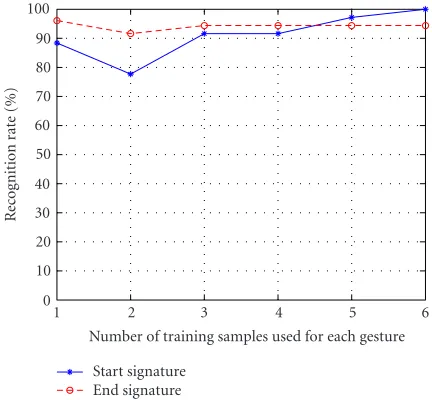
The method was tested on a small hand gesture alpha-bet, containing ten different gestures in order to determine its performance. Thirty-six sequences were used for the tests. The local orientation histogram training set was computed using the mean of three samples for eachstartand eachend image of the gestures in order to increase the robustness of the recognition process.
Figure 5shows the recognition rate for the static signa-tures (start and end signasigna-tures) versus the number of training sequences. The recognition rate remains between 77% and 100%. However, these errors consist always in some confu-sions between different start and stop image signatures. So, in many cases, the dynamic gesture will be correctly delim-ited. A higher number of training sequences lead to a higher recognition rate.
5. DYNAMIC HAND GESTURE RECOGNITION
A dynamic gesture consists of a particular movement of the hand which encapsulates a particular piece of information (the gesture purpose is to transmit meaningful information). The dynamic gestures are represented by a sequence of grey-level images (typically between 40 or 50 images in our case).
5.1. Dynamic signature
The dynamic signature is the fusion of all the hand region skeletons for all the frames between the start and end ges-tures.
(a) (b)
(c) (d)
Figure 6: Skeleton extraction: (a) hand region (binary image), (b) chamfer distance image (white corresponds to the greatest dis-tance), (c) the skeleton obtained after connecting the centers of maximal discs, and (d) the skeleton obtained after spurious hole filling, pruning, and beautifying the previous skeleton.
A skeleton is a compact representation of an object (hand region in our case). The desired properties of the skele-ton are preserving the topology of the object (the same number of connected components and the same number of holes), robust against translation, rotation, and scaling, and thin (no more than 2 pixels in width) [14]. The extraction of the hand region skeleton is performed using a distance transformation-based method: the chamfer distance trans-formation [15]. The distance transtrans-formation is computed to extract the median axis of the hand region (local maxima). Then the resulting set is connected in order to preserve the object topology. For more information on computing skele-ton using chamfer distance, see [16].Figure 6shows the dif-ferent steps to extract a hand region skeleton from a binary image.
The dynamic signature is the binary image composed by the superposition of all the skeletons calculated within the dynamic sequence. It is used to capture the motion of the gesture.Figure 7shows examples of dynamic signatures for “GET” and “SLOW” gestures.
We can see that on a dynamic signature the three stages of a gesture [2] are very clearly illustrated: the preparation (at the beginning of the gesture a lot of skeletons are over-laid forming a thicker skeleton), the stroke (the skeletons are apart because the hand movement is fast), and the resting position (the skeletons are also overlaid).
(a) (b)
Figure7: Dynamic signatures for (a) “GET” and (b) “SLOW” se-quences.
The used technique requires that operator positions be nearly always the same in the field of the camera. Dynamic gesture recognition depends on the position of the gestrure in the image. To improve the robustness of our method against translation, we have determined the extreme-left point and the extreme-low point of the superposed skele-tons, and a normalization is carried out so that the super-posed skeletons images have always the extreme-left point on the same abscissa and the extreme-low point on the same or-dinate.
If this technique limits the sensitivity to translation, the proposed method remains sensitive to rotation. A certain in-variance to rotation is obtained using in the training stage different representations in space of the same gesture (each gesture is performed using different angles and positions). However, the gesture alphabet supposes that all the gestures are performed with an almost similar angle position of the arm.
5.2. Recognition process
The diagram of the dynamic gesture recognition system is presented inFigure 2. For each gesture, the static (orienta-tion histograms) and the dynamic (binary image of the su-perposition of the hand postures skeletons) signatures are computed.
The recognition process is performed by comparing the obtained signatures with some references obtained from the training stage. The static signature recognition is dealt with as presented inSection 4. The comparison is performed on binary images and used the Baddeley’s distance which is less sensitive to object translation and rotation than the Eu-clidean distance. This distance [17,18] is defined as follows.
IfSis a reference system (S⊂Z2) on which our images
are digitized, a binary image can be seen as a function fI : S → {0, 1}. If the two images to be compared areI1andI2,
Baddeley’s distance is defined as
dB
I1,I2
=
1
N×M
p∈S
dI
1(p)−dI2(p)
q
1/q
, (2)
whereN×Mis the total number of pixels fromS,dIj(p) is the distance from point pto the binary object contained in the imageIj with j =1, 2, andqis an exponent controling
the weight of the distance magnitude. Hereqis set to 2.
To compare two dynamic signatures, we have computed Baddeley’s distance within the smallest frame containing the skeletons. We can notice that Baddeley’s distance is an av-erage measure. Hence, it is less sensitive than the Hausdorff distance to small and localized distortions.
In order to perform the classification step of the gesture recognition process, a training set of features is computed. For each gesture from the gesture alphabet, a set of sample signatures is used. Instead of using the mean binary image of the dynamic signatures as a training feature for each gesture (which is irrelevant in the case of binary images),msample signatures are used.
In conclusion, the training set consists ofmtraining se-quences (dynamic signatures) for each hand gesture within the gesture alphabet (see Figure 8). Usingngestures in the gesture alphabet and havingmsets of example signatures for each one, there aren×msample signatures for the training sequence.
5.3. Performance of the gesture recognition system
The hand gesture recognition system was tested on an alpha-bet of 10 gestures representing robot commands (gestures: whap-whap, behind, get, throw, left, right, slow, stop, turn, and go). The gesture alphabet is shown inFigure 8.
Using a set of samples for each gesture varying from one sample to six samples (for each gesture from the gesture al-phabet, there is a set of sample signatures in the training set), the recognition system performed very well and achieved a high recognition rate (see below).
InFigure 9, the recognition rates for each dynamic signa-ture are shown. Experiments have been performed with 40 gestures (10 different gestures and 4 tests for each gesture). A 100% recognition rate was achieved using 2 to 6 training samples. Even using only one training sequence, the recogni-tion rate was greater than 95%. Because the dynamic signa-ture reflects the motion of the gessigna-ture, it is likely to be diff er-ent for different gestures.
5.4. Computation time
Finally, the proposed dynamic gesture recognition algorithm consists in the computation of two types of signatures: the static signatures (for the beginning and the ending of the ges-ture) and the dynamic signature.
The static signatures are the local orientation histograms for thestartand theendimages of the gesture. The computa-tion of an orientacomputa-tion histogram is very fast and only requires a conventional workstation in order to be performed in real time. The image is only scanned once in order to compute the gradient orientation of the pixels. The static gesture recogni-tion using the orientarecogni-tion histograms can be performed in real time [13].
(a) (b)
(c) (d)
(e) (f)
(g) (h)
(i) (j)
Figure8: Dynamic alphabet of ten hand gestures: (a) whap-whap, (b) behind, (c) get, (d) throw, (e) left, (f) right, (g) slow, (h) stop, (i) turn, and (j) go.
Actually, the proposed gesture recognition system is working on a 2 GHz Pentium 4 CPU, equipped with a video acquisition and processing system (Matrox card). The over-all system over-allows to reach a 12 images per second processing [19]. Some other experiments have been successfully realized to control a robot in real time by using five gestures (stop, forward, backward, left, and right).
6. CONCLUSION
In this paper, we have proposed a gesture recognition method using both static signatures and an original dynamic signa-ture.
The static signature, based on the method proposed by Freeman and Roth (seeSection 4.1) [13], uses the local ori-entation histograms in order to classify the hand gestures.
It is a fast method due to the easiness of the orientation his-togram computation, which works in real time on a work-station and is also relatively robust to illumination changes. This approach would not be appropriate to make inferences about occluded data. A little training is required, the mean orientation histograms are computed for a training set of a minimum of three samples for each gesture within the ges-ture alphabet. The current gesges-ture orientation histogram is compared with the training set.
Dynamic signature
1 2 3 4 5 6
Number of training samples used for each gesture 0
10 20 30 40 50 60 70 80 90 100
R
ec
o
gnition
rat
e
(%)
Figure9: Recognition rates for dynamic signatures.
alphabet, a set of sample signatures is computed. The algo-rithm performed very well on a ten-gesture alphabet leading to a recognition rate of 100% in simplified conditions (uni-form background, limited alphabet) in order to facilitate the hand region extraction. A general hand region segmentation could be done by detecting the skin color in the hand gesture images (skin detection algorithms [20])
REFERENCES
[1] V. I. Pavlovic, R. Sharma, and T. S. Huang, “Visual interpreta-tion of hand gestures for human-computer interacinterpreta-tion: a re-view,”IEEE Trans. Pattern Anal. Machine Intell., vol. 19, no. 7, pp. 677–695, 1997.
[2] A. Kendon, “Current issues in the study of gesture,” inThe Biological Foundations of Gestures: Motor and Semiotic Aspects, J.-L. Nespoulous, P. Perron, and A. R. Lecours, Eds., pp. 23– 47, Lawrence Erlbaum Associates, Hillsdale, NJ, USA, 1986. [3] F. K. H. Quek, “Toward a vision-based hand gesture
inter-face,” inProc. Virtual Reality Software and Technology Confer-ence (VRST ’94), pp. 17–29, Singapore, Republic of Singapore, August 1994.
[4] H.-S. Yoon, J. Soh, Y. J. Bae, and H. S. Yang, “Hand gesture recognition using combined features of location, angle and velocity,”Pattern Recognition, vol. 34, no. 7, pp. 1491–1501, 2001.
[5] S. Nayaga, S. Seki, and R. Oka, “A theoretical consideration of pattern space trajectory for gesture spotting recognition,” inProc. 2nd IEEE International Conference on Automatic Face and Gesture Recognition (FGR ’96), pp. 72–77, Killington, Vt, USA, October 1996.
[6] B. Raytchev, O. Hasegawa, and N. Otsu, “User-independent online gesture recognition by relative motion extraction,” Pat-tern Recognition Letters, vol. 21, no. 1, pp. 69–82, 2000. [7] C. W. Ng and S. Ranganath, “Real-time gesture recognition
system and application,”Image and Vision Computing, vol. 20, no. 13-14, pp. 993–1007, 2002.
[8] F.-S. Chen, C.-M. Fu, and C.-L. Huang, “Hand gesture recog-nition using a real time tracking method and hidden Markov models,”Image and Vision Computing, vol. 21, no. 8, pp. 745– 758, 2003.
[9] R. Kjeldsen and J. Kender, “Toward the use of gesture in tra-ditional user interfaces,” inProc. IEEE International Confer-ence on Automatic Face and Gesture Recognition (FGR ’96), pp. 151–156, Killington, Vt, USA, October 1996.
[10] F. Quek, “Unencumbered gestural interaction,”IEEE Multi-media, vol. 4 , no. 3, pp. 36–47, 1996.
[11] H. Chris, I. Sexton, and M. Mullan, “A linguistic approach to the recognition of hand gestures,” inProc. Designing Future Interaction Conference, University of Warwick, Coventry, UK, April 1994.
[12] J. Davis, J. William, and M. Shah, “Gesture recognition,” Tech. Rep. CS-TR-93-11, Department of Computer Science, Uni-versity of Central Florida, Orlando, Fla, USA, 1993.
[13] W. T. Freeman and M. Roth, “Orientation histograms for hand gesture recognition,” Tech. Rep. TR-94-03a, Mitsubishi Electric Research Laboratories, Cambridge Research centre, Cambridge, Mass, USA, 1995.
[14] C. Arcelli and G. Sanniti di Baja, “Euclidean skeleton via centre-of-maximal disc extraction,”Image and Vision Com-puting, vol. 11, no. 3, pp. 163–173, 1993.
[15] G. Borgefors, “Distance transformations in digital images,” Computer Vision, Graphics and Image Processing, vol. 34, no. 3, pp. 344–371, 1986.
[16] Y. Chehadeh, D. Coquin, and H. Bolon, “A skeletonization algorithm using chamfer distance transformation adapted to rectangular grids,” inProc. 13th IEEE International Conference on Pattern Recognition (ICPR’96), vol. 2, pp. 131–135, Vienna, Austria, August 1996.
[17] A. J. Baddeley, “An error metric for binary images,” inRobust Computer Vision, pp. 59–78, Wichmann, Karlsruhe, Germany, 1992.
[18] D. Coquin and Ph. Bolon, “Applications of Baddeley’s dis-tance to dissimilarity measurement between gray scale im-ages,”Pattern Recognition Letters, vol. 22, no. 14, pp. 1483– 1502, 2001.
[19] B. Ionescu, D. Coquin, and P. Lambert, “Reconnaissance de gestes dynamiques de la main,” inProc. 19eme Colloque sur le traitement du signal et des images (GRETSI ’03), pp. 22–25, Paris, France, September 2003.
[20] L. Gu and D. Bone, “Skin colour region detection in MPEG video sequences,” inProc. IEEE International Conference on Image Analysis and Processing (ICIAP ’99), pp. 898–903, Venice, Italy, September 1999.
Bogdan Ionescu received an Engineer’s degree in applied electronics (2002) and an M.S. degree in computing systems (2003) both from University “Politehnica” of Bucharest, Romania. Since 2003, he has been a Ph.D. student in image process-ing and informatics with Image Process-ing and Analysis Laboratory (LAPI), Uni-versity “Politehnica” Bucharest and Labora-toire d’Informatique, Syst´emes, Traitement
Didier Coquinreceived the Ph.D. degree in signal processing and telecommunica-tion from University of Rennes I, France, in 1991. He is currently an Assistant Pro-fessor of telecommunication and network engineering at the Savoie University (Tech-nological Academic Institute) and works in the Informatics, Systems, Information and Knowledge Processing Laboratory (LIS-TIC), Annecy, France. His research interests
include image processing, pattern recognition, image and video in-dexation, data fusion, and fuzzy logic.
Patrick Lambert gratuated with a major in electrical engineering from the Greno-ble National Polytechnic Institute (INPG), Grenoble, France, in 1978. He received the Ph.D. degree in signal processing in 1983. He is currently an Assistant Professor of electrical engineering at the Savoie Univer-sity (Technological Academic Institute) and works in the Informatics, Systems, Informa-tion and Knowledge Processing Laboratory
(LISTIC), Annecy, France. His research interests include image and video indexation, data fusion, and fuzzy logic.
Vasile Buzuloiuis a Professor with the De-partment of Applied Electronics and In-formation Engineering. He also heads the Image Processing and Analysis Laboratory, University “Politehnica” of Bucharest, Ro-mania, and is a Research Associate with CERN Geneva, Switzerland. His scientific interests cover mathematical modeling, sta-tistical decisions, encryption, digital signal processing, image processing and analysis