Knowledge sharing for distributed professionals:
Methodologies for experimentation of concept mapping
LinLin Pei
Prof. dr. Betty Collis, Chair
Dr. Joachim Wetterling, Mentor
Content
LIST OF FIGURES... 3
LIST OF TABLES... 4
1 INTRODUCTION... 5
1.1 STATEMENT OF THE PROBLEM... 5
1.2 RESEARCH QUESTION... 6
1.3 OVERVIEW OF THE THESIS... 7
2 CONCEPTUAL BACKGROUND ... 9
2.1 TACIT AND EXPLICIT KNOWLEDGE... 9
2.2 KNOWLEDGE SHARING... 11
2.3 CONCEPT MAPPING PRINCIPLE... 12
2.4 NETWORKED CONCEPT MAPS... 13
3 DESIGN DECISIONS ... 15
3.1 CONTEXT OF THE PROBLEM... 15
3.2 RESEARCH METHOD AND STRATEGY... 16
3.3 INTRODUCTION OF THE CONCEPT MAPPING TOOL... 17
3.3.1 Meaningful concepts and their relationships... 18
3.3.2 A client-server architecture ... 18
3.3.3 Communication and collaboration facilitations ... 20
3.4 THE PRELIMINARY METHODOLOGY... 20
4 PILOT EXPERIMENT ... 26
4.1 PILOT STUDY PROCESS... 26
4.1.1 Task/topic for knowledge sharing... 26
4.1.2 Preparation activities ... 27
4.1.3 Individual phase ... 27
4.1.4 Group stage ... 28
4.2 EVALUATION OF THE PILOT EXPERIMENT... 31
4.2.1 Data collection process ... 31
4.2.2 Concept maps results... 32
4.2.3 Questionnaire response analysis ... 34
4.2.4 Notes analysis... 41
4.3 EXPERIENCE LEARNED FROM THE FIRST EXPERIMENT... 41
5 THE SECOND EXPERIMENT ... 43
5.1 THE SECOND EXPERIMENT PROCESS... 43
5.2 EVALUATION OF THE SECOND EXPERIMENT... 47
5.2.1 Concept maps results... 47
5.2.2 Questionnaire response analysis ... 49
5.3 SUMMARY FOR THE SECOND EXPERIMENT... 55
6 CONCLUSION ... 56
6.1 LIMITATION OF THE STUDY... 56
6.2 REVIEW OF THE RESEARCH QUESTIONS... 56
6.3 CONSEQUENCE FOR MYSELF... 57
6.4 RECOMMENDATION AND FUTURE WORK... 58
REFERENCE ... 59
APPENDIX 2: QUESTIONNAIRE VERSION 2 ... 65
APPENDIX 3: INDIVIDUAL MAP 1 (PILOT EXPERIMENT)... 70
APPENDIX 4: INDIVIDUAL MAP 2 (PILOT EXPERIMENT)... 71
APPENDIX 4: INDIVIDUAL MAP 1 (SECOND EXPERIMENT) ... 72
APPENDIX 5: INDIVIDUAL MAP 2 (SECOND EXPERIMENT) ... 73
APPENDIX 6: INDIVIDUAL MAP 3 (SECOND EXPERIMENT) ... 74
List of figures
Figure 1: SECI model (Nonaka and Takeuchi,1995, pp. 71)... 10Figure 2: An example of a concept map generated with Cmap (IHMC Cmaptools , n.d.) ... 18
Figure 3: The client_server architecture of Cmap tool (Cañas et al., 2003)... 19
Figure 4: Individual concept map ... 28
Figure 5: The group map generated during the pilot experiment ... 30
Figure 6: Experiment with data collection process... 32
Figure 7: Questionnaire response analysis 1... 35
Figure 8: Questionnaire response analysis 2... 36
Figure 9: Questionnaire response 3... 37
Figure 10: Questionnaire response analysis 4... 38
Figure 11: Questionnaire response analysis 8... 38
Figure 12: Questionnaire response analysis 9... 39
Figure 13: Questionnaire response analysis 10... 40
Figure 14: Questionnaire response analysis 11... 40
Figure 15: Cmap screendump illustrating the collaboration mode... 45
Figure 16: Final group concept map ... 46
Figure 17: Individual map... 49
Figure 18: Face-to-face meetings... 50
Figure 19: Chatting and real-time collaboration... 51
Figure 20: Threaded discussion ... 51
Figure 21: Facilitation function rank ... 52
Figure 22: Attitude for concept mapping... 53
Figure 23: Tacit knowledge transfer... 53
Figure 24: Attitude about the methodology... 54
Figure 25: About Cmap tool ... 54
List of tables
Table 1: Working individually... 21
Table 2: Working in a group... 22
Table 3: The checklist for completing a concept map ... 23
Table 4: Enrichment result... 33
Table 5: Creativity result ... 34
Table 6: Notes from the first experiment... 41
Table 7: The process for the second experiment ... 43
Table 8: Enrichment result... 48
1 Introduction
This document presents the final thesis of the Master of Science program ‘Technology Applications in Education and Training’, from the Faculty of Behavioral Sciences of the University of Twente. This paper describes the project, which is part of “Multimodal e-learning System based on Simulations, Role-Playing, Automatic Coaching and Voice Recognition Interaction for Affective Profiling” (Myself) project (sponsored by the EU-CRAFT programme). A reference link is made between this Master’s project and the Myself project. This Master’s project contributes to the Myself project by identifying methodology for experimenting with the concept mapping principle for knowledge sharing among professions.
One of successful key factors for an organization is to have knowledge-based teamwork of well-educated professionals. There is an old saying “one and one makes three”. This saying probably has one of its values in education. When two or more professionals learn together the effect on the knowledge, skills and attitudes of the individual learners is perceived more than just an addition. Specific attention in the project is given to methodological aspects in the
implementation process. This means the definition of tasks, the specification of output criteria and the control of procedural conditions during knowledge sharing activities. This study will focus on methods to implement concept mapping principles in knowledge sharing tasks.
This chapter gives an introduction into the topic of the thesis and presents the problem statement and goals of the project which it reflects.
• Section 1.1 presents the statement of the problem.
• Section 1.2 refines the research question of this master project that will be answered in this thesis.
• Section 1.3 gives an overview of the content of the subsequent chapters.
1.1
Statement of the Problem
Sharing and documenting knowledge in knowledge-based teamwork of well-educated
in relation to each other to form meaningful constructs. The implementation of concept mapping in knowledge communities is not always an easy task (Schau, Mattern, Zeilik, Teague, & Weber, 2001).
Most of the developments related to use Knowledge Management (KM) to share knowledge have been undertaken by large organizations. These full scale KM systems, which normally require data mining tools, intelligent agent technology and expert systems, are difficult to afford and maintain. In these knowledge sharing settings, the professionals are often considered as domain experts in their fields. The knowledge sharing forms as a “question and answer” format. For those cases, the professionals provide certain solutions for a specific question. The knowledge sharing is mainly transferred from the experts’ side to the non-experienced employees’ side. The
mainstream of knowledge sharing is bi-directional. However, it is questionable if this type of KM can be successfully used by well-educated professionals who are in distributed locations but lack expertise resources. In these cases, it is hard to get a direct answer from a domain expert. Instead, knowledge sharing and discussing certain interesting topics among professionals would be more suitable. In addition, professionals may need more communication to inspire innovative thinking instead of being provided a simple solution. The shared knowledge requires more in depth thinking and analysis. Given this context, research questions are presented in section 1.2.
1.2
Research question
Given this situation, this study focuses on identifying a methodology for a knowledge-sharing process which can facilitate knowledge capture and utilization among professionals. The methodology developed in this study should include detailed steps and activities of using the concept mapping principle for knowledge sharing purposes. Special attention is paid on how to utilize the concept mapping principle into the knowledge sharing process for highly educated professionals. This requires that the knowledge sharing process should not be simply resource exchange, but also foster creating new knowledge by collaboration among professionals. The project is based on the following research questions:
the individual level and knowledge exchange activities at group level. In addition, the relationship and consequences of these activities are investigated as well.
• How can tacit knowledge be captured and made explicit when used for knowledge sharing purposes?
Tacit and explicit knowledge are analyzed in the literature review section, which brings a better understand of how knowledge is presented and exchanged among professionals. In this section, the research questions are focused on what the formats of tacit and explicit
knowledge are, in which kind of situations, how the different knowledge can be transferred, and how the value can be added.
• How can the capturing process of tacit knowledge be instrumentalized by means of tools based on concept mapping principles? What are the necessary activities and facilities from tools? It is interesting to figure out the mechanisms of using a concept mapping tool to promote tacit knowledge capture at both individual and group levels.
Evaluation of the methodology focuses on three areas: the value of transition from tacit to explicit knowledge within the knowledge management process, the value of concept mapping tools for this transition, and the characteristics of the group involved in the knowledge sharing activity.
The project will deliver methodologies for applying concept mapping in knowledge sharing activities. The setting for the project will be higher education graduate students. A pilot
experiment will be set up with a small size group of graduate students to evaluate methodologies. Experiences from these pilots are used as input for (iterative) refinement. Section 1.3 gives an overview of this thesis.
1.3
Overview of the Thesis
The following chapters will be presented in the structure of this thesis:
Chapter 2 is the theoretical framework of the thesis, which focuses on knowledge categories. The connection of knowledge sharing and the concept mapping principle is made as well.
Chapter 3 presents the design decisions and research strategy of this study. The introduction of the tool used in this study is given.
2 Conceptual Background
This chapter presents the results of a literature study about knowledge transaction. The connection of knowledge sharing and the concept mapping principle are made as well.
• In section 2.1, categories of knowledge and how knowledge transfers into different formats are discussed.
• In section 2.2, the concept mapping principle is introduced.
• In section 2.3 network enabled concept maps are presented. The possibilities of such a concept mapping principle for knowledge sharing among professionals is discussed.
2.1
Tacit and explicit knowledge
Knowledge is identified as both explicit and tacit knowledge (Nonaka and Takeuchi,1995, pp. 63-69). According to Nonaka and Takeuchi explicit knowledge (1995) is that which “can be
expressed in words and numbers and can be easily communicated and shared in the form of hard data, scientific formulae, codified procedures or universal principles”, whereas tacit knowledge is “highly personal and hard to formalize. Subjective insights, intuitions and hunches fall into this category of knowledge”(Nonaka and Takeuchi,1995, pp. 63-69). Zack further emphasized that
Tacit knowledge is the form of knowledge that is subconsciously understood and applied, difficult to articulate, developed from direct experience and action and usually shared through highly interactive conversation, storytelling and shared experience. Explicit knowledge, on the other hand, is easy to articulate, capture and distribute in different formats, since it is formal and systematic (Zack, 1999).
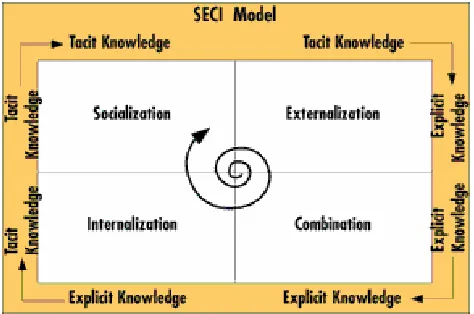
Figure 1: SECI model (Nonaka and Takeuchi,1995, pp. 71)
Four forms of transactions were identified: tacit to tacit, explicit to explicit, tacit to explicit and explicit to explicit. The SECI model also points out the channels for each transaction:
• Tacit to tacit – acquiring and sharing someone else’s knowledge through observation, imitation and practice.
• Explicit to explicit – combining an individual’s pieces of explicit knowledge together to form new explicit knowledge.
• Tacit to explicit – conversion of acquired tacit knowledge into specifications.
• Explicit to tacit – internalizing new explicit organizational knowledge, when it is shared by staff members.
among professionals. In addition, because tacit knowledge is more difficult to pin down, how to transfer tacit knowledge into explicit knowledge is also the focus of this study. A literature review is presented in section 2.1, which connects knowledge sharing and knowledge transaction.
2.2
Knowledge Sharing
Constructing a shared knowledge environment is a significant factor in the SECI process, which can act as a shared framework of understanding and contribute to ‘knowledge stickiness’ (Gherardi, 2000; Inkpen, 2001). Becker (2001) argued that knowledge sharing, while significantly depending on ‘explicit’ procedures and processes, also depends on strategies of personal interaction to address ‘tacit’ issues of uncertainty and integration.
Consider the context of knowledge sharing among professionals, their knowledge has high value, which is also difficult to understand and obtain by others. The expertise knowledge can easily be lost if the professionals retire or leave the institution. Consequently, knowledge sharing is critical. The challenge of sharing and capturing expertise knowledge is how to encourage professionals to share both their explicit and tacit knowledge.
While capturing both tacit knowledge and explicit knowledge is important, a more valuable aspect of knowledge sharing among professionals is that it stimulates creation of new knowledge (Nonaka and Takeuchi, 1995). Nonaka and Takeuchi argued that the interaction between explicit and tacit knowledge, called the “knowledge spiral,” is a key source for creating new knowledge. This interaction of knowledge transfer can be achieved by knowledge sharing among individuals.
To summarize, Nonaka and Takeuch (Nonaka and Takeuchi, 1995) gave the foundation of the knowledge categories (tacit and explicit) and explains how the knowledge can be added value. Later researchers found out that the knowledge sharing process can foster new knowledge by the transition of tacit and explicit knowledge. Moreover, according to the characteristics of the professionals, it is recommended that capturing tacit knowledge is essential for them. However, no clear answers were given as how to provide a suitable solution for high educated professionals, which can be used to
• exchange newest information • capture the tacit knowledge,
• inspire creative thinking
In section 2.3, the possibility of using the concept mapping principle for the given problems is discussed.
2.3
Concept mapping principle
One of the principles used for knowledge management is concept mapping. Concept mapping, developed by Prof. Joseph D. Nonack of Cornell University (Novak, J. D. (1998), is a technique for visually representing the structure of information. It is about how concepts within a domain are interrelated. Knowledge in the domain is presented as a network of concepts.This network consists of certain nodes and links. Nodes are used to represent concepts, while links represent the relations between concepts. The links between the concepts can be one-way, two-way, or non-directional (Plotnick, 1997).
Concept mapping has a variety of applications within a broad range of domains. It can be used to (Plotnick, 1997; Gaines and Shaw,1995; Seaman, 1990; Williams,1997):
• generate ideas (brainstorming, etc.)
• design a complex structure (long texts, hypermedia, large web sites, etc.) • communicate complex ideas (can aid collaborative projects)
• aid learning by explicitly integrating new and old knowledge • assess understanding or diagnose misunderstanding
• enhance the problem-solving phases of generating alternative solutions and options • facilitate knowledge elicitation and management
• analyze organizational decision making processes • support reading comprehension
• encourage positive self-concept
brainstorming session. “As one puts ideas down on paper without criticism, the ideas become clearer and the mind becomes free to receive new ideas” Plotnick (1997). These new ideas may be linked to ideas already on a concept map, to represent the relationship between them, and they may also trigger new associations leading to new ideas.
We see value in using concept mapping to support tacit and explicit knowledge sharing. However, it is possible to use new information and communication technology to support the concept mapping principle? The answer is given in section 2.4.
2.4
Networked concept maps
As we know from the previous discussion, an overview of a domain of knowledge can be gained by adding new concepts and connecting them with other concepts. This brings the opportunity of providing a complete picture of a domain instead of unstructured and unrelated individual concepts. The concepts are not isolated anymore. Further, with matured information and
communication technologies, the meaning of “networked concept maps” has a more meaningful sense.
Traditionally, concept mapping was carried out using paper and pen, which caused some problems (Chiu, Huang,, Chang & Liang 1999): paper-based concepts maps are very time and effort consuming, which may require more time on revising and maintaining on concentrating on the knowledge. In addition, the concept maps generated by individuals are isolated. The
knowledge in this level is not sharable. However, with the fast development of personal computers and local area network technologies, it is possible to enable a group of people to cooperatively work on the concept maps together. Networked personal computers can facilitate sharing by groups of people in the construction of the concept maps. Moreover, with the integration with World-Wide Web (WWW) servers and browsers, the external resources from Internet can be hyperlinked to a concept map. Kommers and Lanzing (1997) proposed that the benefits of integrating WWW into concept mapping include:
• ease of recognition
• the possibility to quickly scan picture and find differences or keywords
• compactness of representation,
To summarize, research indicates that concept mapping can facilitate knowledge capture, especially transferring tacit knowledge to explicit. Networked enabled concept maps allow people to collaboratively work on one concept map. With the advantage of the WWW, external information can also be captured and stored. These advantages offer a great value to knowledge sharing among professionals.
3 Design decisions
The literature review identified the knowledge types and the importance of knowledge transition. How to design a methodology of using networked concept mapping to promote this transition? What are the design decisions of the experiment? These questions are answered in this chapter.
• Chapter 3.1 represents the context of the problem.
• Chapter 3.2 shows the research method and strategies used in this study.
• Chapter 3.3 introduces the tool used for the experiments.
3.1
Context of the problem
The MySelf project is meant to emphasise the experiential training by developing and validating a multimodal learning platform based on vocal recognition, role playing via web and collaborative learning. The innovation will be constituted by the use of the affective computing and recognition of the user's emotional state. In addition, the platform will be designed and validated for on-line fruition; the focus is on the enrichment of the simulations and the affective computing
methodologies traditionally carried out in didactic classroom with the recognition of user's emotions through his learning path and systematic distance learning based on Internet.
In an organization which is characterized by a strong diversity in backgrounds of professionals as well as technology support media such as in the MySelf project it is important within a working group to have a common understanding about the domain knowledge, the working process, the conditions, the methods, the resources and the outcomes. As part of the MySelf project, a
methodology of using concept mapping for knowledge sharing has been developed in this study.
student is doing his/her own project, they are relatively isolated for knowledge sharing. It can be valuable to let them share knowledge and experience related to conducting a master thesis with a platform: networked concept mapping tool. In section 3.2, further research decisions are
introduced.
3.2
Research method and strategy
Concept mapping can be seen as an effective strategy for both individuals and groups to structure their ideas, knowledge, and plans. When people do not have experience in preparing concept maps the beginning can be a bit difficult. To support our subjects in this study in structuring knowledge in concept maps a stepwise method is presented.
Moreover, promoting transaction of tacit to explicit knowledge is also the interest of this study. Concept mapping can be seen as an effective strategy for both individuals and groups to structure their ideas, knowledge, and plans. From literature study, it is recommended that the tacit
knowledge can be transferred by
• acquiring and sharing someone else’s knowledge through observation, imitation and practice,
• conversion of acquired tacit knowledge into specifications.
To support this, various group activities from subjects of using concept mapping for knowledge sharing are designed. The strategy is to combine individual and group processes to arrange ideas in a way that a graphical product is prepared about which consensus in the group is very
important.
The case study research method is used in this study, since the object of this study is to develop methodologies for knowledge sharing based on concept mapping among professionals. The proposed method is applied and tested by subjects while conducting a given task with concept mapping principles. This requires researchers carefully observing the characteristics of the subject’s actual behaviors when they use concept mapping tools to conduct certain tasks. The experience of using a stepwise method can be analyzed and summarized by researchers of this study. Afterwards recommendations can be made for a better performance.
they need to complete a concept map related to the given task individually. This process requires the individual’s structuring knowledge, which results an individual concept map and a collection of interesting information (research paper, web sites, documentation, etc). This stage is also a preparation step for group knowledge sharing.
To promote knowledge sharing especially of tacit knowledge, group activities are designed. At the group level, all group members need to have agreement with each other and present the group discussion results into a group concept map. To achieve this, group members need to actively communicate and collaborate with each other. The information and experience is shared at the group level. During conversion and practice, the tacit knowledge can be transferred into explicit knowledge, which is presented and shared by the group map. New ideas are inspired and generated are captured and presented in the group concept maps as well.
The main purpose of this research is to develop a methodology of using web-based concept mapping tool for knowledge sharing purpose. However, the comparison of different experiment groups was planned to improve validity of outcomes. The success factors may be found from different subject groups. These success factors and experiences can be utilized for better knowledge sharing performance.
To support the computer-based activities the tool CMAP is used. Section 3.3 gives an overview about the tool.
3.3
Introduction of the concept mapping tool
There are several concept mapping applications in the market, such as Inspiration, Semnet, MindManager, etc. Freely available concept mapping software has been around for some time from the Institute for Human and Machine Cognition (IHMC), University of West Florida. IHMC CmapTools version 3.6 was used for this study. For extended information about CMAP as well as documentation and research papers see http://cmap.ihmc.us/. The Cmap was chosen because
• Cmap provides complete functions to add meaningful concepts and their relationships,
• A client-server architecture enables shareable concepts between individuals,
• Communication and collaboration functions provide facilitations for the group activities for this study.
3.3.1 Meaningful concepts and their relationships
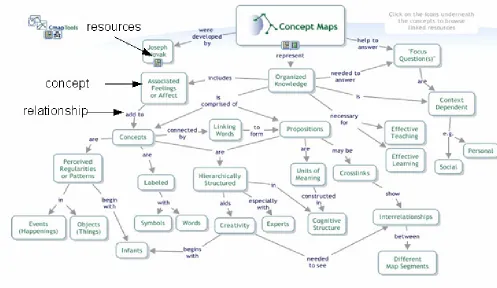
This tool allows users to represent meaningful concepts and their relationships in a knowledge domain. Figure 2 shows an example of a concept map generated with Cmap. The concepts are represented by nodes, which are labeled with keywords. The concepts can be enriched with icons under each concept, which indicate sources of information. The resources related to a concept can be Word-files, PDF-files, images, video and audio links to Web pages, etc. Concepts within a map are connected by linking words to form propositions. A concept map can be hierarchically structured from abstract concepts on the top to the detailed concepts. The concept maps generated by this tool also provide a browsing interface of hierarchical concepts and associated information resources.
Figure 2: An example of a concept map generated with Cmap (IHMC Cmaptools , n.d.)
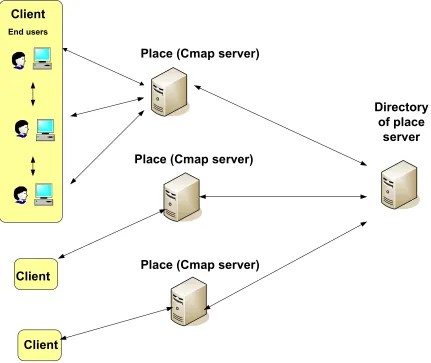
3.3.2 A client-server architecture
over different cities, countries and even continents. The users can store maps and resources on their local computers. In addition, these concept maps and resources can be shared through Places on the server. Figure 3 explains how this type of client-server architecture works with Cmap tool (Cañas, Hill, Granados, Pérez, & Pérez, 2003): On the client side, the Cmaptool is running on the local computer. Local Area Network (LAN) connects different clients with the server. The Place on the server side stores all the data (concept maps and resources) uploaded from clients. The authorized users can access the same Place concurrently, storing and retrieving concept maps (Cañas et al., 2003). Moreover, the Cmap server application can locate Places from different servers throughout the Internet. Different Cmap servers are connected by accessing the Directory of Places with their Internet address and other pertinent data, such as a server’s name (Place) and identifying information (Cañas et al., 2003).
3.3.3 Communication and collaboration facilitations
The users can easily share and collaborate in the construction of concept maps. Besides individual concept map building functions, Cmap provides several useful functions to facilitate knowledge sharing:
• Asynchronous collaboration: users can work on the same concept maps at different time • Threaded discussion: users can leave a message to discuss a particular concept,
relationship between concepts, structure of a map, etc.
• Synchronous collaboration: The Cmap tool enables concurrent editing of a concept map among authorized users. Any change made by a user appears at the same time on the screen with user ID.
• Real time chatting: During the synchronous collaboration session, the chatting function can be used with text-based messages for communication purpose.
To design the methodology of using concept mapping to support knowledge sharing, computer based interactions between subjects and concept mapping tools are involved. The Cmap tool serves basic requirements for meaningful concept mapping construction, as well as providing advanced communication and facilitation. In the following section, the preliminary methodology of using networked concept mapping to share knowledge among group members is presented.
3.4
The preliminary methodology
The methodology of using networked concept mapping to support knowledge sharing – the first version
Table 1: Working individually Stage 1: Working individually
1. “Identify a focus question that addresses the problem, issues, or knowledge domain you wish to map. This is something to be done individually by all group members. (Novak 1998)”
Add concepts:
2. “Guided by the question identify 10 to 20 concepts that are pertinent to the question and list these concepts on your computer in the Cmap client. Concept labels should be a single word, or at most two or three words. (Novak 1998)”
3. “Rank Order the concepts by placing the broadest and most inclusive idea at the top of the map. It is sometimes difficult to identify the broadest, most inclusive concept. It is helpful to reflect on you focus question to help decide the ranking of the concepts. Sometimes this process leads to modification of the focus question or writing a new focus question. (Novak 1998)”
4. “Work down the list and add more concepts as needed. (Novak 1998)”
5. “Begin to build your map by placing the most inclusive, most general concept(s) at the top. Usually there will be only one, two, or three most general concepts at the top of the map. (Novak 1998)”
6. “Next select the two, three, or four subconcepts to place under each general concept. Avoid placing more than three or four concepts under any other concept. If there seems to be six or eight concepts that belong under a major concept or subconcept, it is usually possible to identify some appropriate concept of intermediate inclusiveness, thus creating another level of hierarchy in your map. (Novak 1998)”
Add resources to a concept
7. Add useful URLs or files such as Word, PDF, JPG, etc, to different concepts. This is both for you as a reference about the deeper meaning of the concept and also for others, reusing your concept map, to find additional information or explanation.
Refine the concept map
words should define the relationship between the two concepts so that it reads as a valid statement or proposition. The connection creates meaning. When you hierarchically link together a large number of related ideas, you can see the structure of meaning for a given subject domain.
9. Look for crosslinks between concepts in different sections of the map and label these lines. Crosslinks can often help to see new creative relationships in the knowledge domain.
Finalize the concept map
10. Rework the structure of your map, which may include adding, subtracting, or changing super ordinate concepts. You may need to do this reworking several times, and in fact this process can go on indefinitely as you gain new knowledge or new insights.
11. Be creative in a constructive way through the use of colors, fonts, shapes, border thickness, etc.
12. Concept maps could be made in many different forms for the same set of concepts. There is no one way to draw a concept map. As your understanding of relationships between concepts changes, so will your maps.
Table 2: Working in a group
Stage 2: working in a group
The second part of the concept mapping activity is a group activity. The main purpose of building a group concept map is to share knowledge and foster new ideas among group members.
Peer review phase (in this phase group members still work on their own but the phase is already part of the group process):
1. Each individual concept map is reviewed by all members individually. In a group of three A reviews the maps from B and C, B reviews the map from A and C etc.
2. Make notes, to prepare for the group discussion.
Face –to face phase (Group members sit together and discuss the collection of concept maps) 1. Decide about the main focus to consider.
Remote phase
1. Group members work separately to add sublevel of concepts and their relationships. 2. Resources are added to different concepts. Client communication channels are used to
inform other group members about what each member is doing related to updating the common concept map.
Discussion phase
3. Decide a main structure of the concept map. 4. Decide concepts on each level.
5. The thread discussion and real time chatting are used to facilitate communication. The discussion and chatting files are saved.
Finalizing phase
6. Make an agreement for the final version of the concept map. Discuss if there are group members who wish to change the common concept map.
7. Read the checklist to make possible changes. See if he concept map meets criteria from the following checklist.
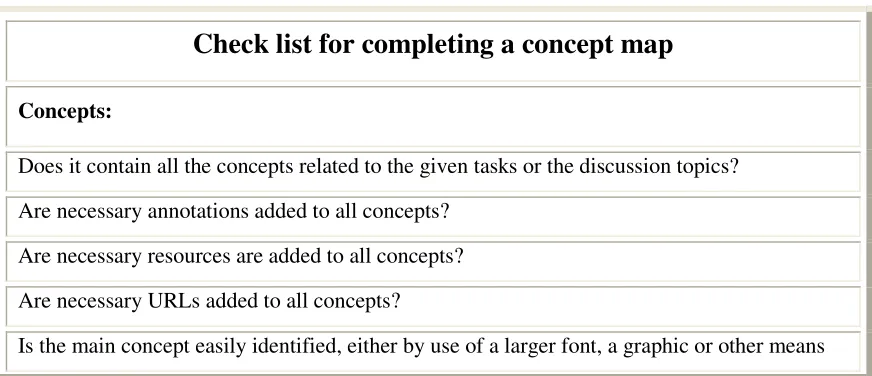
A checklist was also developed for the pilot to help subjects complete a concept map. The subjects were asked to go through concept maps with this checklist before they submit the concept maps.
Table 3: The checklist for completing a concept map
Check list for completing a concept map
Concepts:
Does it contain all the concepts related to the given tasks or the discussion topics? Are necessary annotations added to all concepts?
Are necessary resources are added to all concepts? Are necessary URLs added to all concepts?
of emphasis?
Links
Are all the relationships identified among concepts and presented by links?
Do all links show the correct and meaningful relationships between each connected concept, and have defensible directions?
All connections are labeled?
Do the labels accurately describe the relationship between concepts?
Are links established in the most economical way possible, without becoming too general in nature?
Logic flow
Are concepts well organized in a logical manner?
Does it present a level of familiarity and detail appropriate for given tasks or the discussion topics? But it does not overwhelm the learner with detail?
Is the concept map coherent?
Does the concept map show an understanding of how key ideas are linked together?
Layout
Is the text clear and easy to read; the font is neither too small nor too large? Is the amount of text appropriate for the intended audience?
Is the color effectively used for emphasis and increased comprehension? Are graphics used only when necessary to increase comprehension?
Overall
Is the concept map clear, legible, and focused?
Do the concepts reflect the essential information about the topic? Is information clear, accurate, and well organized?
This chapter gives the initial context of the study. The Cmap concept mapping tool was chosen to facilitate this study. The first version of the methodology was proposed. However, this
4 Pilot experiment
The pilot experiment was set up to apply the first version of the methodology of knowledge sharing activities. Experiences from this pilot are used as input for iterative refinement. The evaluation of the first version methodology was made as well. This chapter presents the process of the pilot study and what experience was obtained.
Section 4.1 introduces the detail phases of the pilot experiment. Section 4.2 explains the evaluation process for the pilot experiment. Section 4.2 discusses the experience learned from the pilot experiment.
4.1
Pilot study process
This section presents detailed steps for the pilot experiment, which include experiment task, experiment preparation, individual activities and group activities.
4.1.1 Task/topic for knowledge sharing
4.1.2 Preparation activities
After explaining the task, demo of how to use the Cmap tool to build a concept map was given. The step by step demo includes how to
• open and save a concept map,
• add and edit a concept,
• add a resource (Word, PDF, URL links, etc),
• add a relationship between concepts,
• adjust the layout.
Theses functions are basic steps to build a concept map at an individual level. Communication and collaboration functions would be explained later for the group activities. During the experiment, technical facilitation was given for the possible technical problems of using the Cmap tool. The difficulties that subjects had were recorded with notes by researcher.
4.1.3 Individual phase
The students were required to read through the instruction (see “The methodology of using networked concept mapping to support knowledge sharing – the first version” from chapter 3.) for developing a concept map at the individual level. The three subjects had to build their individual concept map on three computers, where the Cmap tool was installed. In order to make close observation, these three computers were located in one lab. However, at the individual experiment stage, the three subjects were not allowed to communicate with each other.
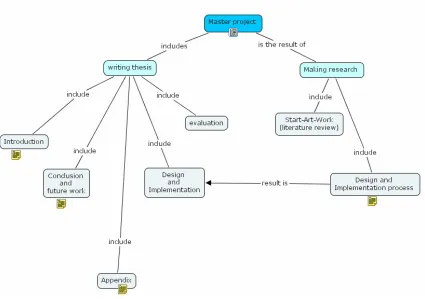
The Master students worked individually based on the defined stepwise method with the Cmap tool for 50 minutes. During this period of time, it was also possible for them to upload resources to the concept map they were building. They were able to get support from technicians in case of possible problems in using the Cmap tool. Direct observations were made during this session by the researcher and recorded with notes. All questions and problems the subjects had were
relationships, resources and extra comments are attached to some concepts, which can be reviewed by clicking or icons.
Figure 4: Individual concept map
After all subjects completed their concept maps, they exchanged and reviewed them with each other. They were recommended to make notes about differences among their maps and prepare questions for the next session, which is about building a concept map all three subjects together.
4.1.4 Group stage
mapping to support knowledge sharing – the first version” about group stage part, section 3.4) for group activities.
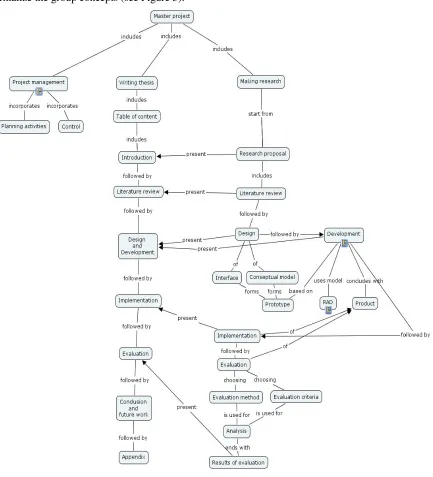
A 30-minute face-to-face meeting was carried out. The meeting started with discussing each individual map. The differences between maps were compared. Some agreements were made by three students for building a group concept map after the discussion. A direct observation was made during the meetings with notes by researchers. The main goal of the observation is to find out the behaviors characteristics when group members have to make an agreement with each other. Three students worked together with the Cmap tool to generate the first version of the group concept map. This concept map includes three layers concepts, which ranges from abstract to concrete. This concept map was saved on the server, which is accessible for all group
members.
After this face-to-face meeting, the subjects were asked to work “remotely” on the initial concept map they built together. The “remote” model was simulated by connecting client computers together with Cmap server, which means three students can “remotely” communicate with each other by networked computers. Although three students sat together in one lab, they are only allowed to “talk” to each other with Cmap communication facilitated functions. This “remote” environment imitates a real situation, where professions can locate at different places. In addition, this arrangement made it possible to closely observe experiment.
There are three functions from the Cmap tool to support knowledge sharing while building a group concept map:
• Threaded discussion • Synchronous collaboration • Real time chatting:
In the end of the group level phase, the subjects were asked to go through the checklist again and finalize the group concepts (see Figure 5).
Figure 5: The group map generated during the pilot experiment
4.2
Evaluation of the pilot experiment
The pilot experiment with the first version of the methodology went smoothly, however in order to include make evaluation process, more data needs to be collected and analyzed. This section presents the detailed procedure of the evaluation for the pilot experiment.
• Section 4.2.1 introduces the data collection process.
• Section 4.2.2 discusses the results of concept maps generated during the experiment.
• Section 4.2.3 presents the questionnaire response analysis.
• Section 4.2.4 gives an overview about notes made during the pilot experiment.
4.2.1 Data collection process
In order to make the evaluation more convincing, valid and accurate, multiple data collection methods were applied. The data were collected by observation, questionnaires and artifacts (concept maps generated by the subjects, chat and threaded discussion files).
Figure 6: Experiment with data collection process
The detailed results for each phase are presented in the following sections.
4.2.2 Concept maps results
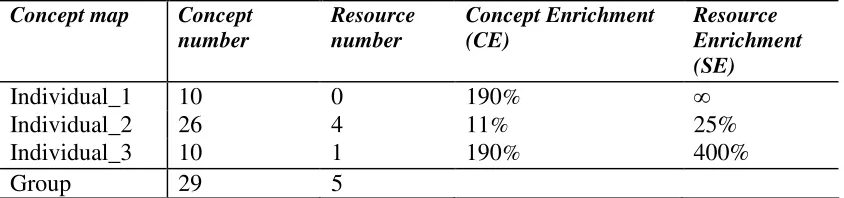
Concept Enrichment (CE) = (number of concepts from group map –individual’s)/ number of concepts from individual map*100%
Resource Enrichment (SE) = (number of resources from group map –individual’s)/ number of resources from individual map*100%
The result from individual and group concept maps (Table 4) shows both CE and SE rates from each subject are > 0. This means after the group level stage of constructing concept maps, each individual gets more knowledge (concepts and resources) from each other than before.
Table 4: Enrichment result Concept map Concept
number Resource number Concept Enrichment (CE) Resource Enrichment (SE)
Individual_1 10 0 190%
Individual_2 26 4 11% 25%
Individual_3 10 1 190% 400%
Group 29 5
As discussed in chapter 2, tacit knowledge is more difficult to capture and pin down than explicit knowledge. It can be hidden in the individual’s mind and experience. Knowledge sharing
processes when using the Cmap tool to construct a group map have a possibility to transfer individual’s tacit knowledge into explicit knowledge. Concept enrichment (CE) rates can be considered as one of the factors for tacit into explicit knowledge transition. In addition, from the number of new ideas inspired and generated during the group construction of concept maps, we also can see if the knowledge sharing process is successful. In this study, ‘new concepts’ are defined as those concepts generated in the group map that could not be found in any of the individual’s maps. A creativity factor is used to represent the formula below
Creativity (C) = number of new concepts from group map/ number of concepts from individual map*100%
Table 5: Creativity result Concept map Concept
number Creativity Influence
Individual_1 10 20% Individual_2 26 7.7% Individual_3 10 20%
Group 29 6.9%
The creativity factor for each subject is > 0. This means after group knowledge sharing, new ideas were inspired. These new ideas resulted in new concepts, which were generated by group
knowledge. In addition, the proposed methodology may have a positive effect on promoting creativity after knowledge sharing. However, because of characteristic of the tacit knowledge, it is difficult to measure the transaction rate from tacit knowledge into explicit knowledge. A questionnaire can be a useful instrument to know more about it from the subject’s experience.
4.2.3 Questionnaire response analysis
A questionnaire has been designed (Appendix 1), which aims at collecting data about the subject’s user experience of using the Cmap tool, the subject’s satisfaction about using concept mapping for knowledge sharing activities, as well as the subject’s opinions about the first version of methodology of this specific approach to use concept mapping in order to make tacit
knowledge more explicit. The questionnaire was distributed to the subjects right after they completed the group concept map.
The subjects completed the questionnaire questions at the end of the experiment. Since this study mainly focuses on the knowledge sharing topic, which was carried out mainly by the group construction session, thus the questionnaire questions also pay more attention to issues related to the construction of group maps. Other relevant topics such as subject’s satisfaction of using the Cmap tool for knowledge sharing and user experience with the tool are also covered in this questionnaire. The data analysis of the questionnaire response results is presented below:
Group activities for knowledge sharing questions: preparation sessions
Figure 7: Questionnaire response analysis 1
All subjects think that building their own individual concept maps is a useful step to prepare a group map (Figure 7). Some of them (one subject) consider an individual concept map is very important for later building a group map. Knowledge sharing is a process of collecting
individual’s ideas and experience. The individual session of building a concept map is the first step to organize and realize ideas into artifacts. In our first version of methodology, building an individual map was designed as a necessary step for a group map and important for knowledge sharing. This proposition is confirmed by the questionnaire response.
Group activities for knowledge sharing questions: face-to-face sessions
Figure 8: Questionnaire response analysis 2
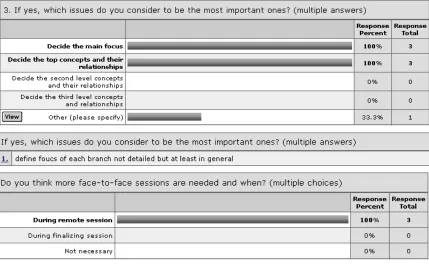
All subjects “strongly agree” that face-to-face session is very important. During the pilot experiment, only one face-to-face session was scheduled in the beginning of group activities. However, all subjects wish to have more face-to-face sessions for the group map construction. For topics that should be discussed during the first meeting, they consider deciding about the main focus for the map, as well as agreeing on top concepts and their relationships are very important. An extra comment was made by one subject: “define focus of each branch not detailed but at least in general”. She/he possibly means face-to-face meeting should stick on the main topics but not too detailed.
Group activities for knowledge sharing questions: remote activities
Figure 9: Questionnaire response 3
Share resources
Exchanging resources is one of the processes for knowledge sharing. During the first experiment, subjects could upload resources they considered interesting to the server, which then become available for all group members. The results from questionnaire show that two subjects think that the time for collecting and adding resource to the group map was too limited (Figure 10). This time issue should be taken into account for the next experiment.
Figure 10: Questionnaire response analysis 4
Subject’s opinions for constructing a group map for knowledge sharing purposes
There are questions that refer to the subject’s opinions about using concept mapping to share knowledge among group members (Figure 11). Two subjects consider building a group map is useful for knowledge sharing, however, 33.3% of subjects have a neutral attitude.
Figure 11: Questionnaire response analysis 8
Figure 12: Questionnaire response analysis 9
All subjects think exchanging resources is useful. Besides this, two subjects think group concept mapping helps capture new knowledge (by knowing new concepts from others) and foster creativity thinking (new ideas were generated during group session). In addition, two subjects also think group map construction is useful for pinning down tacit knowledge, which means ideas and experience can be captured and formatted by a group concept map. The results from these questions show that the first version of methodology of using concept mapping has a positive impact on knowledge sharing.
User experience with the tool
Figure 13: Questionnaire response analysis 10
In addition, the most difficult function for them is the real time collaboration (66.7 % of subjects), the rest are adding concepts, adding links, adding resources and chatting (33.3% of subject vote for each) functions. These results gave some useful information, which remind us we should pay more attention on these difficult issues during the tool instruction and demo.
Final remarks
The subjects were asked to give some comments about the concept mapping and the tool (Figure 14):
Figure 14: Questionnaire response analysis 11
These comments confirm the findings from this previous questions answers. Two main points are:
• It is important to explain clearly how to use the tool. The subjects felt difficulty for some functions, such as real time collaboration, which may cause them to consider these functions to be less important for knowledge sharing.
4.2.4 Notes analysis
Some notes were made during the whole process of the experiment, which are represented in Table 6.
Table 6: Notes from the first experiment
Number Content Individual session
1 All three subjects asked to clearly explain the given topic. 2 One subject had problems to add concepts and links to the map.
3 Time for collecting resources is too little according to all three subjects. Group session
4 The subjects often spent too much time on details, but hardly get an agreement. 5 Attention was paid on details while the main topic and structure was ignored. 6 2 subjects had problems to use the real-time collaboration function.
The notes reflect some problems found by questionnaire like resource time limitation and technical difficulties. Moreover, it is also interesting to realize subjects had difficulty to focus on the main issues of the group meeting; instead they often get stuck on details.
4.3
Experience learned from the first experiment
After analysis of the concept maps generated during the first experiment, together with the questionnaire response and notes, the general impression of the first version of the methodology is positive. However, some experience was gained as well about things to improve:
• More face-to-face sessions may be necessary, which can be scheduled at the beginning of the group activities, during the remote construction session and during the finalizing map session.
• Group members should stick to the main meeting topics during the face-to-face session.
• The group members should have a longer period available for collecting resources to share.
• The instruction and demo of the tool should be made more clearly, especially for some difficult functions like real time collaboration.
5 The second experiment
The previous chapter shows the success factors of the proposed methodology. To make the results more reliable and achieve a better performance, a second experiment was conducted. This
experiment will follow the main stepwise methods from the proposed methodology. However, some problems of the pilot experiment should be taken into account.
Section 5.1 presents the process of the second experiment. Section 5.2 discusses the evaluation process.
Section 5.3 gives the conclusion from the second experiment.
5.1
The second experiment process
The subjects for the second experiment are still three master students, who were different from the pilot experiment. Because of their common interests, the task, same as the pilot study, was set up to share knowledge about master project with concept mapping principle.
Due to the successful results from the pilot experiment, the main activities and their sequences developed from the first version methods were applied again in the second experiment. The main activities and their sequences are summarized in Table 7:
Table 7: The process for the second experiment
Preparation stage
I. Introduce concept mapping principle II. Introduce and demo how to use Cmap tool III. Assign task for all group members
Individual stage
I. Add concepts and their relationship II. Add resources
III. Adjust the layout and refine the concept map IV. Finalize the concept map with checklist Group stage
preparation Each individual concept map is reviewed by all members individually.
Group stage
I. Face-to-face meeting
II. Build an initial concept map together
a. threaded discussion b. real-time collaboration c. chatting , etc,
IV. The second face-to-face meeting is planned in between of the remote phase.
V. Finalize the concept map, possible with a third meeting.
The second experiment was conducted based on the steps described in the Table 7. In addition, some problems from the pilot experiment need to be addressed. Some adjustments were made during the second experiment.
The task for the experiment was intended to be clear for three subjects. To check whether subjects have a clear goal, they were asked to repeat and explain the tasks by themselves.
More face-to-face sessions were conducted, which were not only limited at the beginning of the group activities, but also during the remote construction session and during the finalizing map session.
• The topic of knowledge sharing should be made clear enough among all group members.
• The demo about how to use the tool was repeated twice, until the subjects confirmed it was clear for them.
• More face-to-face sessions may be necessary, which can be scheduled at the beginning of the group activities, during the remote construction session and during the finalizing map session.
• To make meetings more effective, the subjects were required to make the plan by themselves before a meeting. The topics and goals for the meeting should be decided before a meeting.
• A longer period of time was given to subjects for uploading resources.
The subjects can discuss with each other by the real time chatting function (see Figure 15 right side). Every subject on a collaboration session could see the chat window in Figure 15, through which they can exchange text messages and see the names of the other subjects connected to this session. In this experiment, there were 4 participants appeared on the chatting pane. “pc1” is username of the researcher, who uses the access rights only for monitor purpose. The rest users, “pc4”, “pc6”, and “pc7” are the usernames of three subjects. The left side of Figure 15 shows how three subjects simultaneously edited on the concept map. The highlighted concepts with different color show the moment action from a subject. This way enables each group member to be aware about what does each other doing.
To make a complete concept map, three subjects categorized concepts by different clusters with different color and shapes (See Figure 16). Figure 16 shows the final concept map generated by the second experiment. Each individual map is presented in the Appendix. Compared to the group map from the first experiment, this one has more clear hierarchy. However, more data needs to be collected and analyzed to make an evaluation.
5.2
Evaluation of the second experiment
The evaluation process follows the same procedure as the pilot experiment, which focuses on the analysis of the individual and group concept maps and questionnaire responses. Because of the similarity between data collection from two experiments, this section presents only the data analysis results.
5.2.1 Concept maps results
A comparison was made between individual and group maps. The terms of concept enrichment (CE) and Resource Enrichment were applied to check the knowledge sharing effectiveness from the second experiment.
Concept Enrichment (CE) = (number of concepts from group map –individual’s)/ number of concepts from individual map*100%
From the results from Table 8, it shows that the enrichment rates of both concepts and resources are >0 for each subject. This is the success factor for knowledge sharing.
Table 8: Enrichment result Concept map Concept
number Resource number Concept Enrichment (CE) Resource Enrichment (SE)
Individual_1 8 1 200% 600%
Individual_2 10 2 140% 250%
Individual_3 15 1 60% 600%
Group 24 7
A creativity factor was applied to check how new ideas and creativity thinking were inspired during the second experiment:
Creativity (C) = number of new concepts from group map/ number of concepts from individual map*100%
Four new concepts were found in the group map, which didn’t exist in any individual concept map. Four new concepts were found in the group map. The creativity results from this experiment session are shown in the Table 9:
Table 9: Creativity result Concept map Concept
number Creativity Influence
Individual_1 8 50% Individual_2 10 40% Individual_3 15 26.7%
Group 24 16.7%
5.2.2 Questionnaire response analysis
Due to some changes between the two experiments, some adjustments were made in the
questionnaire. More questions were added regarding to more frequent meetings during the second experiment. In addition, extra questions were added about tacit knowledge transfer issues, which were hard to measure from concept maps. The main goal for this questionnaire is to find out the three subjects’ opinions about applying the stepwise methods for knowledge sharing. Special attention was paid to the methodologies effect on tacit knowledge transfer. Three subjects completed the questionnaire right after they completed the group concept map. The results were processed by “survey monkey” (http://www.surveymonkey.com).
Same as the pilot experiment, all subjects consider building an individual concept map is useful for knowledge sharing (see Figure 17). These results confirm that individual map construction is a necessary step for building a group map, thus as a preparation for knowledge sharing as well.
Figure 17: Individual map
Figure 18: Face-to-face meetings
Figure 19: Chatting and real-time collaboration
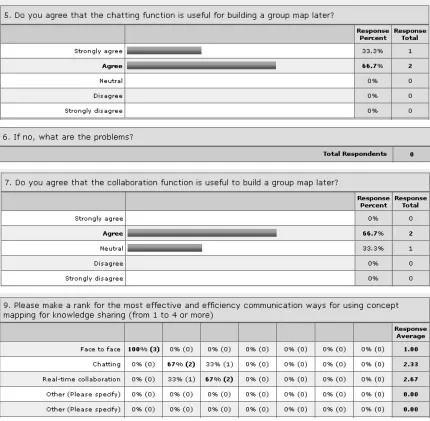
Different with previous functions, subjects have a neutral of negative attitude for the threaded discussion function (see figure 20). Some comments were made that threaded discussion is less effective compared to the real-time functions, which enable users to get quicker responses. Moreover, compared to other asynchronous applications, subjects chose e-mail instead.
The subjects were asked to make a rank of effective and efficiency facilitation of using concept mapping for knowledge sharing (Figure 21). All subjects consider face-to-face meeting to have the first position. Real-time collaboration and chatting have the second and third place
respectively. Threaded discussion is on the fourth place, and one subject chose e-mail as the fourth, which confirms the findings from the previous question.
Figure 21: Facilitation function rank
All subjects have a positive attitude about using concept mapping for knowledge sharing (see Figure 22). The most important factors are exchanging resources and helping pin down tacit knowledge. Other factors as “capture new knowledge” and “foster thinking” are also considered to be important. These results shows that subjects confirm the positive effects of using concept mapping for tacit knowledge transfer.
Figure 22: Attitude for concept mapping
The following questions further discuss details of the tacit knowledge sharing during the second experiment. All subjects agree that personal experience can be captured and shared by
constructing a group map with others. 66.7% subjects agree that useful information can be captured and organized during discussion of construction a group map.
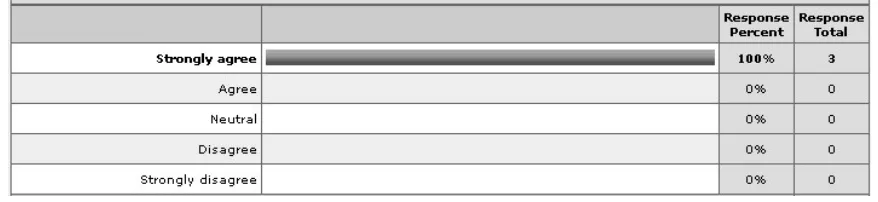
The next question is intended to find out the subjects’ opinions about the proposed stepwise methods. This methodology has been adjusted according to the experience learned from the pilot experiment. The response (see Figure 24) shows a positive attitude from all subjects.
Figure 24: Attitude about the methodology
The subjects all consider the Cmap tool to be easy to use (Figure 25). This may be due to the fact that more effort was made for tool instruction. However, because of some bugs that exist in the tool, some functionality is hard to use. These bugs were reported to the Cmap development team.
Figure 25: About Cmap tool
sequence for activities are good; the process promotes knowledge sharing among group members. However, some adjustments may be needed for different situations. The subjects also report the bugs and problems from the tool during the second experiment, which have been sent to the Cmap development team by researcher of this study.
Figure 26: Final remark
5.3
Summary for the second experiment
The second experiment was conducted based on the experience learned from the pilot experiment. The second experiment applied the proposed methodology from this study, followed designed activities and their sequence, some time issues were taken into account to achieve better performance. Some solutions were addressed due to problems found in the pilot experiment, which focus on the face-to-face meeting, tool instruction and time issues for collecting resources. The evaluation data analysis shows a positive result for the second experiment. Further
6 Conclusion
This chapter concludes the thesis. It gives an overview of the research questions and concluding comments. This chapter reflects the major conclusions of these research questions and gives the references to the sections.
• Section 6.1 will discuss the limitation of the study.
• Section 6.2 will review the research questions based on the results from the thesis.
• Section 6.1 will represent the consequence for Myself project.
• Section 6.2 discusses some issues for future work.
6.1
Limitation of the study
There are several limitations of this study that need to be noticed. The goal of this study is to build a methodology for professionals. However, it is hard to conduct the experiment within a real company. Instead, graduate Master’s students were chose for the experiment, because of the similarity between them and professionals. In addition, the experiment inside Twente University brings a close observation to subjects. Moreover, this study more focuses on the procedure of building a concept map for knowledge sharing. The tacit knowledge measurement issues have not been deeply studied because of the time and resource limitation.
6.2
Review of the research questions
As was mentioned in Section 1.2, the following questions need to be answered:
• What methodology can be used to implement the use of concept mapping in knowledge management at the individual level as well as in knowledge sharing in groups?
was based on the concept maps, questionnaires and observation notes. The evaluation results from sections 4.2 and 5.2 show a positive effect of this methodology.
• How can tacit knowledge be captured and made explicit when for knowledge sharing purposes?
In the section literature study part (Chapter 2), two types of knowledge, tacit and explicit knowledge was introduced. A comparison was made. Further, it identified the difficulty to capture tacit knowledge. The SECI modes could be used to promote knowledge transfer. In addition, from literature study, it is recommended that the tacit knowledge can be transferred by:
• acquiring and sharing someone else’s knowledge through observation, imitation and practice,
• conversion of acquired tacit knowledge into specifications.
• How can the capturing process of tacit knowledge be instrumentalized by means of tools based on concept mapping principles? What are the necessary activities and fasciations from tools?
The literature study about the concept mapping principle was given in section 2.3. The possibility of using concept mapping to share knowledge was identified. Special interests were paid to using concept mapping to promote tacit knowledge capture and transfer. Further, in chapter 3, the methodology of using concept mapping was defined, which contains a set of group activities. These group activities promote communication and collaboration between group members, which involves a lot of practice and conversation while constructing a group concept map. The
evaluation results from the questionnaire and concept map show a positive effect of using the proposed methodology to capture tacit knowledge.
6.3
Consequence for Myself
concept mapping for knowledge sharing with professionals among SMEs. It would be also good if the method can be evaluated in a pilot within the MySelf project, preferably within SME’s participating in the project.
6.4
Recommendation and future work
The designed methodology and checklist can be used as the general stepwise method for
knowledge sharing among professions. However, time allocated for each activity may need to be adjusted according to different situations. For instance, the face-to-face sessions should be planned more flexibly.
Reference
Becker, M (2001). Managing dispersed knowledge: Organizational problems, managerial strategies, and their effectiveness. Journal of Management Studies 38(7): 1037-51. Cañas, A. J., Hill, G., Granados, A., Pérez, C., & Pérez, J. D. (2003). The Network Architecture of
CmapTools(IHMC CmapTools Technical Report 2003-02). Retrieved May 15, 2005 from Institute for Human and Machine Cognition website:
http://cmaptools.coginst.uwf.edu/Publications/WhitePapers/The%20Network%20Archite cture%20of%20CmapTools.pdf.
Chiu, C.H., Huang, C.C., Chang, W.T. & Liang, T.H. (1999). Interaction processes in network supported collaborative concept mapping. Retrieved February 15, 2005 from ACM Portal website: http://portal.acm.org/citation.cfm?id=305786.305863.
Fourie, L.C.H., Schilawa, J., & Cloete, E. (2004). The value of concept maps for knowledge management in the banking and insurance industry: A German case study. Retrived November 25, 2004 from 1st International Conference on Concept Mapping, Pamplona, Spain Web site: http://cmc.ihmc.us/papers/cmc2004-237.pdf.
Gains, B., & Shaw, M. (1995). Concept maps as hypermedia components. Retrieved November 18, 2004 from http://ksi.cpsc.ucalgary.ca/articles/ConceptMaps/.
Gherardi, S. (2000). Practice-based theorizing on learning and knowing in organizations. Organization 7(2): 211-23.
IHMC Cmaptools (n.d.) Concept maps Retrieved December 3, 2004, from
http://65.212.118.148/servlet/SBReadResourceServlet?rid=1064009710027_1483270340 _27090&partName=htmltext.
Inkpen, A. (2000) Learning through joint ventures: A framework of knowledge acquisition. Journal of Management Studies 37(7): 1019-43.
Kommers, P., & Lanzing, J. (1997). Students’ concept mapping for hypermedia design: Navigation through World Wide Web space and self-assessment, Retrieved November 18, 2004 from Journal of Interactive Learning Research website:
http://roble.pntic.mec.es/~sblanco1/pagina_n3.htm#Students'%20Concept%20Mapping. Novak, J. D. (1998). Learning, creating, and using knowledge: concept maps as facilitative tools
Nonaka, I. & Takeuchi, H. (1995) The knowledge-creating company: How Japanese companies create the dynamics of innovation. New York, NY: Oxford University Press.
Plotnic, E. (1997). Concept mapping: a graphical system for understanding the relationship between concepts. Retrived Retrieved March 18, 2005 from
http://www.ericdigests.org/1998-1/concept.htm.
Schau, C., Mattern, N., Zeilik,M., Teague, K. W. & Weber, R. (2001). Select-and-fill-in concept map scores as a measure of students’ connected understanding of science. Educational and psychological measurement, 61, 136-158
Seaman, T. (1990). On the high road to achievement: Cooperative concept mapping. ERIC Digest ED335140.
Snowden, D. (1999). A framework for creating a sustainable knowledge management program, in J.W. Cortada and J.A. Woods (eds.). The Knowledge Management Yearbook 1999-2000. pp. 52-65, Boston: Butterworth/Heinemann.
Stoyanova, N., & Kommers, P. (2002). Special issues- Distributed cognition and educational practice - concept mapping as a medium of shared cognition in computer-supported collaborative problem solving, Journal of interactive learning research (Vol. 13, pp. 111-134).
Williams, D. (1997). Concept mapping: foundations, research, and implications for hyp