Fast Query for Large Treebanks
Sumukh Ghodke∗
∗Department of Computer Science
and Software Engineering, University of Melbourne
Victoria 3010, Australia
Steven Bird∗†
†Linguistic Data Consortium,
University of Pennsylvania 3600 Market Street, Suite 810
Philadelphia PA 19104, USA
Abstract
A variety of query systems have been devel-oped for interrogating parsed corpora, or tree-banks. With the arrival of efficient, wide-coverage parsers, it is feasible to create very large databases of trees. However, existing ap-proaches that use in-memory search, or rela-tional or XML database technologies, do not scale up. We describe a method for storage, indexing, and query of treebanks that uses an information retrieval engine. Several experi-ments with a large treebank demonstrate ex-cellent scaling characteristics for a wide range of query types. This work facilitates the cu-ration of much larger treebanks, and enables them to be used effectively in a variety of sci-entific and engineering tasks.
1 Introduction
The problem of representing and querying linguistic annotations has been an active area of research for several years. Much of the work has grown from efforts to curate large databases of annotated text such as treebanks, for use in developing and testing language technologies (Marcus et al., 1993; Abeill´e, 2003; Hockenmaier and Steedman, 2007). At least a dozen linguistic tree query languages have been developed for interrogating treebanks (see§2).
While high quality syntactic parsers are able to efficiently annotate large quantities of English text (Clark and Curran, 2007), existing approaches to query do not work on the same scale. Many exist-ing systems load the entire corpus into memory and check a user-supplied query against every tree. Oth-ers avoid the memory limitation, and use relational
or XML database systems. Although these have built-in support for indexes, they do not scale up ei-ther (Ghodke and Bird, 2008; Zhang et al., 2001)).
The ability to interrogate large collections of parsed text has important practical applications. First, it opens the way to a new kind of information retrieval (IR) that is sensitive to syntactic informa-tion, permitting users to do more focussed search. At the simplest level, an ambiguous query term like wind or park could be disambiguated with the help of a POS tag (e.g. wind/N,park/V). (Existing IR engines already support query with part-of-speech tags (Chowdhury and McCabe, 1998)). More com-plex queries could stipulate the syntactic category of apple is in subject position.
A second benefit of large scale tree query is for natural language processing. For example, we might compute the likelihood that a given noun appears as the agent or patient of a verb, as a measure of an-imacy. We can use features derived from syntactic trees in order to support semantic role labeling, lan-guage modeling, and information extraction (Chen and Rambow, 2003; Collins et al., 2005; Hakenberg et al., 2009). A further benefit for natural language processing, though not yet realized, is for a treebank and query engine to provide the underlying storage and retrieval for a variety of linguistic applications. Just as a relational database is present in most busi-ness applications, providing reliable and efficient ac-cess to relational data, such a system would act as a repository of annotated texts, and expose an expres-sive API to client applications.
A third benefit of large scale tree query is to support syntactic investigations, e.g. for
ing syntactic theories or preparing materials for lan-guage learners. Published treebanks will usually not attest particular words in the context of some in-frequent construction, to the detriment of syntactic studies that make predictions about such combina-tions, and language learners wanting to see instances of some construction involving words from some specialized topic. A much larger treebank allevi-ates these problems. To improve recall performance, multiple parses for a given sentence could be stored (possibly derived from different parsers).
A fourth benefit for large scale tree query is to support the curation of treebanks, a major enter-prise in its own right (Abeill´e, 2003). Manual selec-tion and correcselec-tion of automatically generated parse trees is a substantial part of the task of preparing a treebank. At the point of making such decisions, it is often helpful for an annotator to view existing an-notations of a given construction which have already been manually validated (Hiroshi et al., 2005). Oc-casionally, an earlier annotation decision may need to be reconsidered in the light of new examples, leading to further queries and to corrections that are spread across the whole corpus (Wallis, 2003; Xue et al., 2005).
This paper explores a new methods for scaling up tree query using an IR engine. In§2 we describe ex-isting tree query systems, elaborating on the design decisions, and on key aspects of their implementa-tion and performance. In§3 we describe a method for indexing trees using an IR engine, and discuss the details of our open source implementation. In
§4 we report results from a variety of experiments involving two data collections. The first collection contains of 5.5 million parsed trees, two orders of magnitude larger than those used by existing tree query systems, while the second collection contains 26.5 million trees.
2 Treebank Query
A tree query system needs to be able to identify trees having particular properties. On the face of it, this should be possible to achieve by writing simple pro-grams over treebank files on disk. The propro-grams would match tree structures using regular expression patterns, possibly augmented with syntax for match-ing tree structure. However, tree query is a more
complex and interesting task, due to several factors which we list below.
Structure of the data: There are many varieties of treebank. Some extend the nested bracketing syntax to store morphological information. Oth-ers store complex attribute-value matrices in tree nodes or have tree-valued attributes (Oepen et al., 2002), or store dependency structures ( ˇCmejrek et al., 2004), or categorial grammar derivations (Hock-enmaier and Steedman, 2007). Others store multiple overlapping trees (Cassidy and Harrington, 2001; Heid et al., 2004; Volk et al., 2007).
Form of results: Do we want entire trees, or matching subtrees, or just a count of the number of results? Do we need some indication of why the query matched a particular tree, perhaps by show-ing how query terms relate to a hit, cf. document snippets and highlighted words in web search re-sults? Do we want to see multiple hits when a query matches a particular tree in more than one place? Do we want to see tree diagrams, or some machine-readable tree representation that can be used in ex-ternal analysis? Can a query serve to update the tree-bank, cf. SQL update queries?
Number of results: Do we want all results, or the firstnresults in document order, or the “best”n re-sults, where our notion of best might be based on representativeness or distinctiveness.
at length elsewhere (Lai and Bird, 2004; M´ırovsk´y, 2008), and we will not consider them further here.
Performance: What performance is acceptable, especially as the data size grows? Do we want to optimize multiple reformulations of a query, for users who iteratively refine a query based on query results? Do we want to optimize certain query types? Are queries performed interactively or in batch mode? Is the treebank stable, or being actively revised, in which case indexes need to be easily up-datable? Do we expect logically identical queries to have the same performance, so that users do not have to rewrite their queries for efficiency? Key per-formance measures are index size and search times.
Architecture: Is the query system standalone, or does it exist in a client-server architecture? Is there a separate user-interface layer that interacts with a data server using a well-defined API, or is it a mono-lithic system? Should it translate queries into an-other language, such as SQL (Bird et al., 2006; Nakov et al., 2005), or XQuery (Cassidy, 2002; Mayo et al., 2006), or to automata (Maryns and Kepser, 2009), in order to benefit from the perfor-mance optimizations they provide
Indexing. The indexing methods used in individ-ual systems are usindivid-ually not reported. Many systems display nearly constant time for querying a database, regardless of the selectivity of a query, a strong in-dicator that no indexes are being used. For exam-ple, Emu performs all queries in memory with no indexes, and several others are likely to be the same (Cassidy and Harrington, 2001; K ¨onig and Lezius, 2001; Heid et al., 2004). TGrep2 (Rohde, 2005) uses a custom corpus file and processes it sentence by sentence at query execution time. Other tree query systems use hashed indexes or other types of in-memory indexes. However, a common drawback of these systems is that they are designed for treebanks that are at most a few million words in size, and do not scale well to much larger treebanks.
There are many positions to be taken on the above questions. Our goal is not to argue for a particu-lar data format or query style, but rather to demon-strate a powerful technique for indexing and query-ing treebanks which should be applicable to most of the above scenarios.
3 Indexing Trees
In this section we discuss two methods of stor-ing and indexstor-ing trees. The first uses a relational database and linguistic queries are translated into SQL, while the second uses an inverted index ap-proach based on an open source IR engine, Lucene.1 Relational databases are a mature technology and are known to be efficient at performing joins and accessing data using indexes. Information retrieval engines using term vectors, on the other hand, ef-ficiently retrieve documents relevant to a query. IR engines are known to scale well, but they do not sup-port complex queries. A common feature of both the IR and database approaches is the adoption of so-called “tree labeling” schemes.
3.1 Tree labeling schemes
Tree queries specify node labels (“value con-straints”) and structural relationships between nodes of interest (“structural constraints”). A simple value constraint could look for a wh noun phrase by spec-ifying the WHNP; such queries are efficiently im-plemented using indexes. Structural relationships cannot be indexed like node labels. A term in a sentence will have multiple relationships with other terms in the same sentence. Indexing all pairs of terms that exist in a given structural relationship re-sults in an explosion in the index size. Instead, the standard approach is to store position information with each occurrence of a term, using a table or a term vector, and then use the position information to find structural matches. Many systems use this approach, from early object databases such as Lore (McHugh et al., 1997), to relational representation of tree data (Bird et al., 2006) and XISS/R (Hard-ing et al., 2003), and native XML databases such as eXist (Meier, 2003). Here, the position is encoded via node labeling schemes, and is designed so it can support efficient testing of a variety of structural re-lations.
A labeling scheme based on pre-order and post-order labeling of nodes is the foundation for several extended schemes. It can be used for efficiently de-tecting that two nodes are in a hierarchical (or inclu-sion) relationship. Other labeling schemes are based on the Dewey scheme, in which each node contains
1
Figure 1: Generating node labels
a hierarchical label in which numbers are separated by periods (Tatarinov et al., 2002). A child node gets its label by appending its position relative to its sib-lings to its parent’s label. This scheme can be used for efficiently detecting that two nodes are in a hier-archical or sequential (temporal) relationship.
The LPath numbering scheme assigns four integer labels to each node (Bird et al., 2006). The genera-tion of these labels is explained with the help of an example. Figure 1 is the graphical representation of a parse tree for a sentence with 7 words,w1· · ·w7. Let A, B, C, D, E, and S represent the annotation tags. Some nodes at different positions in the tree share a common name.
The first step in labeling is to identify the sequen-tial positions between words, as shown beneath the parse tree in Figure 1. The left id of a terminal node is the sequence position immediately to the left of a node, while its right id is the one to its immediate right. The left id of a non-terminal node is the left id of its leftmost descendant, and the right id is the right id of its rightmost descendant. In most cases the ancestor-descendant and preceding-following re-lationships between two elements can be evaluated using the left and right ids alone. The sequential ids do not differentiate between two nodes where one is the lone child of the other. The depth id is therefore required in such cases and to identify the child node (depth values are shown on the left side of Figure 1). In order to check if two given nodes are siblings, the above three ids will not suffice. We therefore assign a common parent id label to siblings. These four identifiers together enable us to identify rela-tionships between elements without traversing trees.
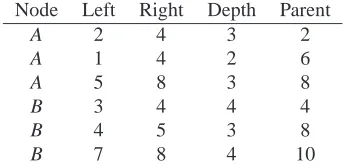
Node Left Right Depth Parent
A 2 4 3 2
A 1 4 2 6
A 5 8 3 8
B 3 4 4 4
B 4 5 3 8
B 7 8 4 10
Table 1: Node labels
Table 1 illustrates the node labels assigned to A and B nodes in Figure 1. We can see that the parent id of the third A and second B are equal because they are siblings.
Once these numbers are assigned to each node, the nodes can be stored independently without loss of any structural information (in either a relational database or an inverted index). At query execution time, the set of elements on either side of an opera-tor are extracted and only those node numbers that satisfy the operator’s specification are selected as the result. For example, if the operator is the child rela-tion, and the operands are A and B, then there are two matches: B{3,4,4,4}, child of A{2,4,3,2} and, B{7,8,4,10}, child of A{5,8,3,8}.2 This process of finding the elements of a document that match op-erators is nothing other than the standard join oper-ation (and it is implemented differently in reloper-ational databases and IR engines).
3.2 Relational database approach
Tree nodes can be stored in a relational database us-ing a table structure (Bird et al., 2006). Each tree-bank would have a single table for all nodes where each node’s information is stored in a tuple. The node name is stored along with other position infor-mation and the sentence id. Every node tuple also has a unique primary key. The parent id column is a foreign key, referencing the parent node’s id, speeding up parent/child join operations. In prac-tice, queries are translated from higher level linguis-tic query languages such as LPath into SQL auto-matically, allowing users to use a convenient syntax, rather than query using SQL.
Previous research on a similar database structure for containment queries in XML databases showed
2The node labels are represented as an ordered set here for
[image:4.612.84.292.64.202.2]that databases are generally slower than specialised IR indexes (Zhang et al., 2001). In that work, the authors provide results comparing their IR join algo-rithm, the multi-predicate merge join (MPMGJN), with two standard relational join algorithms. They consider the number of comparisons performed in the standard merge join and the index nested loop join, and contrast these with their IR join algorithm. They show that the IR algorithm performs fewer comparisons than a standard merge join but greater than the index nested loop join.
The multi-predicate merge join exploits the fact that nodes are encountered in document order (i.e. a node appears before its descendents). Search within a document can be aborted as soon as it is clear that further searching will not yield further results. Im-portantly, this IR join algorithm is faster than both relational join algorithms in practice, since it makes much better use of the hardware disk cache. Our own experiments with a large treebank stored in an Oracle database have demonstrated that this short-coming of relational query relative to IR query exists in the linguistic domain (Ghodke and Bird, 2008).
3.3 IR engine approach
We transform the task of searching treebanks into a conventional document retrieval task in which each sentence is treated as a document. Tree node labels are stored in inverted indexes just like words in a text index. We require two types of indexes, for fre-quency and position. The frefre-quency index for a node label contains a list of sentence ids and, for each one, a count indicating the frequency of the node label in the sentence. (Labels with a frequency of zero do not appear in this index.) The position index is used to store node numbers for each occurrence of the node label. The numbers at each position are read into memory as objects only when required (at other times, the byte numbers are skipped over for efficiency). During query processing, the frequency indexes are first traversed sequentially to find a doc-ument that contains all the required elements in the query. Once a document is found, the structural con-straints are checked using the data stored in the po-sition index for that document. The document itself does not need to be loaded.
Using an inverted index for searching structured data is not new, and several XML databases already
use this method to index XML elements (Meier, 2003). However, linguistic query systems are spe-cial purpose applications where the unit of retrieval is usually a sentence. A given tree may satisfy a query in multiple places, but we only identify which sentences are relevant. Finding all matches within a sentence requires further processing. 3
Our approach has been to process each sentence as a document. By fixing the unit of retrieval to be the sentence, we are able to greatly reduce the size of intermediate results when performing a series of joins. The task is then to simply check whether a sentence satisfies a query or not. This can be done using substantially less resources than is needed for finding sets of nodes, the unit of retrieval for rela-tional and XML databases. When processing a se-ries of joins, we use a single buffer to store the node positions required to perform the next join in the se-ries. After computing that join and processing an-other operator in the query, the buffer contents is re-placed with a new set of nodes, discarding the inter-mediate information.
4 Experiments with IR Engine
4.1 Data
We used two data collections in our experiments. The first collection is a portion of the English Giga-word Corpus, parsed in the Penn Treebank format. We used the TnT tagger and the DBParser trained on the Wall Street Journal section of the Penn Tree-bank to parse sentences in the corpus. The total size of the corpus is about 5.5 million sentences. The TGrep2 corpus file for this corpus is about 1.8 GB and the Lucene index is 4 GB on disk. The second data collection is a portion of English Wikipedia, again tagged and parsed using TnT tagger and DB-Parser, respectively. This collection contains 26.5 million parsed sentences. The TGrep2 corpus file corresponding to this collection is about 6.6 GB and the Lucene index is 14 GB on disk.
3
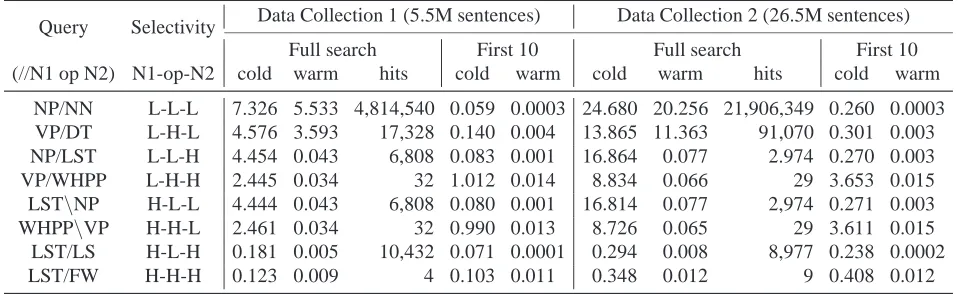
Query Selectivity Data Collection 1 (5.5M sentences) Data Collection 2 (26.5M sentences) Full search First 10 Full search First 10 (//N1 op N2) N1-op-N2 cold warm hits cold warm cold warm hits cold warm
[image:6.612.70.549.73.220.2]NP/NN L-L-L 7.326 5.533 4,814,540 0.059 0.0003 24.680 20.256 21,906,349 0.260 0.0003 VP/DT L-H-L 4.576 3.593 17,328 0.140 0.004 13.865 11.363 91,070 0.301 0.003 NP/LST L-L-H 4.454 0.043 6,808 0.083 0.001 16.864 0.077 2.974 0.270 0.003 VP/WHPP L-H-H 2.445 0.034 32 1.012 0.014 8.834 0.066 29 3.653 0.015 LST\NP H-L-L 4.444 0.043 6,808 0.080 0.001 16.814 0.077 2,974 0.271 0.003 WHPP\VP H-H-L 2.461 0.034 32 0.990 0.013 8.726 0.065 29 3.611 0.015 LST/LS H-L-H 0.181 0.005 10,432 0.071 0.0001 0.294 0.008 8,977 0.238 0.0002 LST/FW H-H-H 0.123 0.009 4 0.103 0.011 0.348 0.012 9 0.408 0.012
Table 2: Execution times (in seconds) for queries of varying selectivity
4.2 Types of queries
Query performance depends largely on the nature of the individual queries, therefore we present a de-tailed analysis of the query types and their corre-sponding results in this section.
Selectivity: A query term that has few correspond-ing hits in the corpus will be considered to have high selectivity. The selectivity of whole queries depends not only on the selectivity of their individual ele-ments, but also on how frequently these terms satisfy the structural constraints specified by the query.
Table 2 gives execution times for queries with varying selectivity, using our system. We assign a selectivity measure for the operator based on how often the two operands satisfy the structural condi-tion. It is clear that when elements are very common and they frequently satisfy the structural constraints of the operator, there are bound to be more run-time structural checks and the performance deteriorates. This is demonstrated by the time taken by the first query. Note the relatively small difference in the ex-ecution time between the second and third queries. The third query contains a high selectivity element and even returns fewer matches compared to the sec-ond, but takes almost as long. This may be due to the relative frequency of the tags within each sentence, which we have not controled in this experiment. If there are several LST tags in the sentences where it appears, there are likely to be greater number of searches within each sentence. A better join algo-rithm would improve the performance in such cases. A multiple regression analysis of the full search
(cold start) times for collection 2 shows that selectivity labels contribute 9.5 seconds, and a low-selectivity operator contributes 6.7 seconds, and that this accounts for most of the variability in the timing data (t =−1.53 + 9.51∗N1+ 6.72∗op+ 9.44∗
N2, R2 = 0.8976). This demonstrates that the dis-tribution of full search (cold start) times is mostly accounted for by the index load time, with the time for computing a large join being a secondary cost. The full search (warm start) times in Table 2 pay a lesser index loading cost.
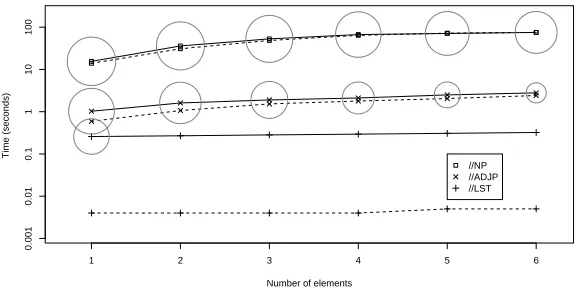
Query length: It is evident that the system must retrieve and process more term vectors as we in-crease the number of elements in a query. To find out exactly how the query length affects processing, we ran tests with three sets of queries. In each set we varied the number of elements in a dominance rela-tionship with another node of the same name. The number of terms in the dominance relationship was varied from 1 to 6, where the first case is equiva-lent to just finding all terms with that name. In the first set, queries search for nested noun phrases (NP), while the second and third look for adjective phrases (ADJP) and list elements (LST) respectively.
These terms have been chosen to simultaneously study the effects of selectivity and query length, with
//NP //ADJP //LST
Number of elements
Time (seconds)
1 2 3 4 5 6
0.001
0.01
0.1
1
10
[image:7.612.158.446.81.227.2]100
Figure 2: Variation of query execution time with query length in data collection 1
//NP //ADJP //LST
Number of elements
Time (seconds)
1 2 3 4 5 6
0.001
0.01
0.1
1
10
100
Figure 3: Variation of query execution time with query length in data collection 2
each step on thex-axis, a query will have an extra descendant node. For example, at position 3 for ele-mentA, the query would be//A//A//A.
The circles on the plot are proportional to the log of the result set size. The biggest circle is for//NP
which is of the order of 5.4 million, while there are only 4 trees in whichLSTis nested 4 times. LSTis not nested 5 or more times. Similarly,ADJPreturns 0 results for the 6th test query and hence there are no circles at these locations. The thick lines on the plot indicate the average cold start run time over three runs, while the dashed line shows the minimum av-erage run time of 4 sets, with the query executed 5 times in each set. Together, the pairs of unbroken and dashed lines indicate the variation in run time depending on the state of the system.4
4
We can observe from the results that the variation
be-4.3 Measurement techniques
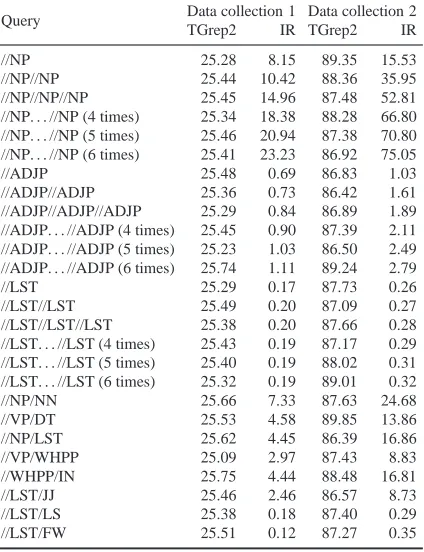
The measurement techniques vary for TGrep and the IR based approach. In TGrep the corpus file is loaded each time during query processing, but in the IR approach an index once loaded can operate faster than a cold start.
In order to understand the variations in the operat-ing speed we plot the variation in times from a cold start to a repeat query, as shown in Table 3.
[image:7.612.157.445.284.431.2]Query Data collection 1 Data collection 2 TGrep2 IR TGrep2 IR
//NP 25.28 8.15 89.35 15.53
//NP//NP 25.44 10.42 88.36 35.95 //NP//NP//NP 25.45 14.96 87.48 52.81 //NP. . . //NP (4 times) 25.34 18.38 88.28 66.80 //NP. . . //NP (5 times) 25.46 20.94 87.38 70.80 //NP. . . //NP (6 times) 25.41 23.23 86.92 75.05
//ADJP 25.48 0.69 86.83 1.03
//ADJP//ADJP 25.36 0.73 86.42 1.61 //ADJP//ADJP//ADJP 25.29 0.84 86.89 1.89 //ADJP. . . //ADJP (4 times) 25.45 0.90 87.39 2.11 //ADJP. . . //ADJP (5 times) 25.23 1.03 86.50 2.49 //ADJP. . . //ADJP (6 times) 25.74 1.11 89.24 2.79
//LST 25.29 0.17 87.73 0.26
[image:8.612.81.293.62.338.2]//LST//LST 25.49 0.20 87.09 0.27 //LST//LST//LST 25.38 0.20 87.66 0.28 //LST. . . //LST (4 times) 25.43 0.19 87.17 0.29 //LST. . . //LST (5 times) 25.40 0.19 88.02 0.31 //LST. . . //LST (6 times) 25.32 0.19 89.01 0.32 //NP/NN 25.66 7.33 87.63 24.68 //VP/DT 25.53 4.58 89.85 13.86 //NP/LST 25.62 4.45 86.39 16.86 //VP/WHPP 25.09 2.97 87.43 8.83 //WHPP/IN 25.75 4.44 88.48 16.81 //LST/JJ 25.46 2.46 86.57 8.73 //LST/LS 25.38 0.18 87.40 0.29 //LST/FW 25.51 0.12 87.27 0.35
Table 3: Comparison of TGrep2 and IR Engine cold start query times (seconds)
5 Conclusions
We have shown how an IR engine can be used to build a high performance tree query system. It outperforms existing approaches using indexless in-memory search, or custom indexes, or relational database systems, or XML database systems. We reported the results of a variety of experiments to demonstrate the efficiency of query for a variety of query types on two treebanks consisting of around 5 and 26 million sentences, more than two orders of magnitude larger than what existing systems sup-port. The approach is quite general, and not limited to particular treebank formats or query languages. This work suggests that web-scale tree query may soon be feasible. This opens the door to some in-teresting possibilities: augmenting web search with syntactic constraints, the ability discover rare exam-ples of particular syntactic constructions, and as a technique for garnering better statistics and more sensitive features for the purpose of constructing language models.
Acknowledgments
We gratefully acknowledge support from Microsoft Research India and the University of Melbourne.
References
Anne Abeill´e, editor. 2003. Treebanks: Building and
Using Parsed Corpora. Text, Speech and Language
Technology. Kluwer.
Shurug Al-Khalifa, H.V. Jagadish, Nick Koudas, Jig-nesh M. Patel, Divesh Srivastava, and Yuqing Wu. 2002. Structural joins: A primitive for efficient XML query pattern matching. In ICDE ’02: Proc. 18th Intl
Conf on Data Engineering, page 141. IEEE Computer
Society.
Steven Bird, Yi Chen, Susan B. Davidson, Haejoong Lee, and Yifeng Zheng. 2006. Designing and evaluating an XPath dialect for linguistic queries. In ICDE ’06:
Proc. 22nd Intl Conf on Data Engineering, page 52.
IEEE Computer Society.
Nicolas Bruno, Nick Koudas, and Divesh Srivastava. 2002. Holistic twig joins: optimal XML pattern matching. In SIGMOD ’02: Proc. 2002 ACM
SIG-MOD Intl Conf on Management of Data, pages 310–
321. ACM.
Steve Cassidy and Jonathan Harrington. 2001. Multi-level annotation of speech: an overview of the Emu Speech Database Management System. Speech
Com-munication, 33:61–77.
Steve Cassidy. 2002. Xquery as an annotation query lan-guage: a use case analysis. In Proc. 3rd LREC. John Chen and Owen Rambow. 2003. Use of deep
lin-guistic features for the recognition and labeling of se-mantic arguments. In Empirical Methods in Natural
Language Processing, pages 41–48.
Abdur Chowdhury and M. Catherine McCabe. 1998. Performance improvements to vector space informa-tion retrieval systems with POS. U Maryland. Stephen Clark and James R. Curran. 2007.
Wide-coverage efficient statistical parsing with CCG and log-linear models. Computational Linguistics,
33(4):493–552.
Michael Collins, Brian Roark, and Murat Saraclar. 2005. Discriminative syntactic language modeling for speech recognition. In Proc. 43rd ACL, pages 507– 514. ACL.
Sumukh Ghodke and Steven Bird. 2008. Querying lin-guistic annotations. In Proc. 13th Australasian
Docu-ment Computing Symposium, pages 69–72.
J¨org Hakenberg, Illes Solt, Domonkos Tikk, Luis Tari, Astrid Rheinl¨ander, Nguyen Quang Long, Graciela Gonzalez, and Ulf Leser. 2009. Molecular event extraction from Link Grammar parse trees. In Proc.
Philip J Harding, Quanzhong Li, and Bongki Moon. 2003. XISS/R: XML indexing and storage system us-ing RDBMS. In Proc. 29th Intl Conf on Very Large
Data Bases, pages 1073–1076. Morgan Kaufmann.
Ulrich Heid, Holger Voormann, Jan-Torsten Milde, Ul-rike Gut, Katrin Erk, and Sebastian Pado. 2004. Querying both time-aligned and hierarchical corpora with NXT search. In Proc. 4th LREC.
Ichikawa Hiroshi, Noguchi Masaki, Hashimoto Taiichi, Tokunaga Takenobu, and Tanaka Hozumi. 2005. eBonsai: An integrated environment for annotating treebanks. In Proc. 2nd IJCNLP, pages 108–113. Julia Hockenmaier and Mark Steedman. 2007.
CCG-bank: A corpus of CCG derivations and dependency structures extracted from the Penn Treebank.
Compu-tational Linguistics, 33:355–396.
Hiroshi Ichikawa, Keita Hakoda, Taiichi Hashimoto, and Takenobu Tokunaga. 2006. Efficient sentence re-trieval based on syntactic structure. In COLING/ACL, pages 399–406.
Stephan Kepser. 2003. Finite Structure Query: A tool for querying syntactically annotated corpora. In Proc.
10th EACL, pages 179–186.
Esther K¨onig and Wolfgang Lezius. 2001. The TIGER language: a description language for syntax graphs. part 1: User’s guidelines. Technical report, University of Stuttgart.
Catherine Lai and Steven Bird. 2004. Querying and up-dating treebanks: A critical survey and requirements analysis. In Proc. Australasian Language Technology
Workshop, pages 139–146.
Catherine Lai and Steven Bird. 2010. Querying linguis-tic trees. Journal of Logic, Language and Information, 19:53–73.
Quanzhong Li and Bongki Moon. 2001. Indexing and querying XML data for regular path expressions. In
VLDB ’01: Proc. 27th Intl Conf on Very Large Data Bases, pages 361–370. Morgan Kaufmann.
Mitchell P. Marcus, Beatrice Santorini, and Mary Ann Marcinkiewicz. 1993. Building a large annotated cor-pus of English: The Penn Treebank. Computational
Linguistics, 19(2):313–30.
Hendrik Maryns and Stephan Kepser. 2009. Monasearch: Querying linguistic treebanks with monadic second-order logic. In The 7th International
Workshop on Treebanks and Linguistic Theories.
Neil Mayo, Jonathan Kilgour, and Jean Carletta. 2006. Towards an alternative implementation of nxts query language via xquery. In Proc. 5th Workshop on NLP
and XML: Multi-Dimensional Markup in Natural Lan-guage Processing, pages 27–34. ACL.
J. McHugh, S. Abiteboul, R. Goldman, D. Quass, and J. Widom. 1997. Lore: A database management sys-tem for semistructured data. SIGMOD Rec., 26:54–66.
Wolfgang Meier. 2003. eXist: An open source native XML database. In Revised Papers from the NODe
2002 Web and Database-Related Workshops on Web, Web-Services, and Database Systems, pages 169–183.
Springer-Verlag.
Jiˇr´ı M´ırovsk ´y. 2006. Netgraph: a tool for searching in Prague Dependency Treebank 2.0. In Proc. 5th
Intl Conf on Treebanks and Linguistic Theories, pages
211–222.
Jiˇr´ı M´ırovsk ´y. 2008. PDT 2.0 requirements on a query language. In Proc. 46th ACL, pages 37–45. ACL. Preslav Nakov, Ariel Schwartz, Brian Wolf, and Marti
Hearst. 2005. Supporting annotation layers for natural language processing. In Proc. 43rd ACL, pages 65–68. Stephan Oepen, Kristina Toutanova, Stuart Shieber, Christopher Manning, Dan Flickinger, and Thorsten Brants. 2002. The LinGO Redwoods Treebank: Mo-tivation and preliminary applications. In Proc. 19th
COLING, pages 1253–57.
Petr Pajas and Jan ˇStˇep´anek. 2009. System for querying syntactically annotated corpora. In Proc. 47th ACL, pages 33–36. ACL.
Douglas L. T. Rohde, 2005. TGrep2 User Manual
Ver-sion 1.15. http://tedlab.mit.edu/ dr/TGrep2/tgrep2.pdf.
Igor Tatarinov, Stratis D. Viglas, Kevin Beyer, Jayavel Shanmugasundaram, Eugene Shekita, and Chun Zhang. 2002. Storing and querying ordered XML using a relational database system. In SIGMOD ’02:
Proc. 2002 ACM SIGMOD Intl Conf on Management of Data, pages 204–215. ACM.
M. ˇCmejrek, J. Cuˇr´ın, and J. Havelka. 2004. Prague czech-english dependency treebank: Any hopes for a common annotation scheme? In A. Meyers, editor,
HLT-NAACL 2004 Workshop: Frontiers in Corpus An-notation, pages 47–54. ACL.
Martin Volk, Joakim Lundborg, and Ma¨el Mettler. 2007. A search tool for parallel treebanks. In Proc.
Linguis-tic Annotation Workshop, pages 85–92. ACL.
Sean Wallis. 2003. Completing parsed corpora. In Anne Abeill´e, editor, Treebanks: Building and Using
Parsed Corpora, Text, Speech and Language
Technol-ogy, pages 61–71. Kluwer.
Naiwen Xue, Fei Xia, Fu-Dong Chiou, and Martha Palmer. 2005. The Penn Chinese TreeBank: Phrase structure annotation of a large corpus. Natural
Lan-guage Engineering, 11:207–238.
Chun Zhang, Jeffrey Naughton, David DeWitt, Qiong Luo, and Guy Lohman. 2001. On supporting contain-ment queries in relational database managecontain-ment sys-tems. In SIGMOD ’01: Proc. ACM SIGMOD
inter-national Conference on Management of Data, pages