NAACL-HLT Workshop on the Induction of Linguistic Structure, pages 64–80,
The PASCAL Challenge on Grammar Induction
Douwe Gelling and Trevor Cohn
Department of Computer Science University of Sheffield, UK
{d.gelling,t.cohn}@sheffield.ac.uk
Phil Blunsom
Department of Computer Science University of Oxford, UK [email protected]
Jo˜ao Grac¸a
L2F Spoken Language Systems Laboratory
INESC ID Lisboa, Portugal [email protected]
Abstract
This paper presents the results of the PASCAL Challenge on Grammar Induction, a compe-tition in which competitors sought to predict part-of-speech and dependency syntax from text. Although many previous competitions have featured dependency grammars or parts-of-speech, these were invariably framed as supervised learning and/or domain adaption. This is the first challenge to evaluate unsuper-vised induction systems, a sub-field of syntax which is rapidly becoming very popular. Our challenge made use of a 10 different treebanks annotated in a range of different linguistic for-malisms and covering 9 languages. We pro-vide an overview of the approaches taken by the participants, and evaluate their results on each dataset using a range of different evalua-tion metrics.
1 Introduction
Inducing grammatical structure from text has long been fundamental problem in Computational Lin-guistics and Natural Language Processing. In re-cent years interest has grown, spurred by advances in unsupervised statistical modelling and machine learning. The task has relevance to cognitive scien-tists and linguists attempting to gauge the learnabil-ity of natural language by human children, and also natural language processing researchers who seek syntactic representations for languages with few lin-guistic resources.
Grammar learning has been popular in previous challenges. For example the CoNLL shared tasks in 2006 and 2007 (Buchholz and Marsi, 2006; Nivre
et al., 2007) involved supervised learning of de-pendency parsers across a wide range of different languages. Our challenge has many similarities to these, in that we focus on dependency grammars, however we seek to evaluate unsupervised algo-rithms only using syntactically annotated data for evaluation and not for training. Additionally we also consider the related task of part-of-speech (POS) in-duction, and the next logical challenge: the joint task of POS and dependency induction. Other re-lated challenges can be found in the formal gram-mar community (e.g., the Omphalos1 competition) in which competitors seek to learn synthetic guages. In contrast we seek to model natural lan-guage text, which entails many different challenges. Research into unsupervised grammar and POS in-duction holds considerable promise, although cur-rent approaches are still a long way from solving the general problem. For example, the majority of recent research into dependency grammar induction has adopted the evaluation setting of Klein and Man-ning (2004) who learn grammars on strings of POS tags, rather than on words themselves. One aim of this challenge is to popularise the more difficult and ambitious task of inducing grammars directly from text, which can be viewed as integrating the POS and grammar induction tasks. A second aim is to foster grammar and POS induction research across a wider variety of languages, and improving the standard of evaluation.
We have collated data from existing treebanks in a variety of different languages, domains and lin-guistic formalisms. This gives a diverse range of
1
Seehttp://www.irisa.fr/Omphalos
data upon which to test induction algorithms, yield-ing a deeper insight into their strengths and short-comings. One key problem in grammar induction research is how to evaluate the models’ predictions given that often many different analyses are linguis-tically plausible, e.g., the choice of whether deter-miners or nouns should head noun phrases, or how to represent coordination. Simply comparing against a single gold standard often results in poor reported performance because the model has discovered a different analysis to that used when annotating the treebank. For this reason it has been popular to use lenient measures for comparing predicted trees to the treebank gold standard trees, such as undirected accuracy and the neutral edge distance (Schwartz et al., 2011). As well as evaluating using these popular metrics, we also propose a new method of evaluation which is also lenient in that it rewards different types of linguistically plausible output, but requires con-sistency in the output, something the previous meth-ods cannot do.
The paper is organised as follows. Section 2 de-scribes the tasks and our data format and section 3 outlines the different treebanks used for the chal-lenge. The baselines, our own benchmark systems and the competitors entries are described in section 5. In section 6 we present and analyse the results for the three different tracks. Finally we conclude in section 7.
2 Task Definition
The three tracks of the WILS challenge are de-scribed below. First we describe the data format for the submissions common to the three tracks (POS induction, Dependency induction, and jointly induc-ing both), and then the three tracks are described along with the respective evaluation metrics.
2.1 Data format
All datasets were presented in a file format similar to that used in the CoNLL tasks, but with slight mod-ifications. In particular the last two columns are re-moved, as no projective head or projective depen-dency relations were used, and an extra POS column was inserted at column 6 to accommodate the Uni-versal POS tagset (Petrov et al., 2011). Each line in a file then either consists of 9 columns, separated by a
tab character, or is an empty line. Empty lines sepa-rate sentences, and all other lines give the annotation for a single token in the sentence as follows:
1. ID: Token counter, gives the index of current word in the sentence. Indexing starts at 1.
2. FORM: Surface form of the token in the sen-tence.
3. LEMMA: Stemmed form of the word form if available.
4. CPOSTAG: Coarse-grained POS tag.
5. POSTAG: Fine-grained POS tag, or CPOSTAG again if not available.
6. UPOSTAG: Universal POS tag, based on the POSTAG and CPOSTAG.
7. FEATS: List of syntactic / morphological fea-tures, separated by a vertical pipe (|).
8. HEAD: Syntactic head of the token, with 0 in-dicating the root node.
9. DEPREL: The general type of the dependency relation, e.g., subject.
In this setup, the LEMMA, FEATS and DEPREL columns are optional, in which case an underscore ( ) will be used as a placeholder. Each treebank was split into training, development and testing par-titions. The HEAD and DEPREL entries were only supplied for the development and the final testing sets,2 but not for the training partition. The com-petitors were encouraged to develop their unsuper-vised entries on the union of the three partitions, and make sparse use of the development set, i.e., for san-ity checking more than model fitting in order to min-imise the extent of supervision.
2.2 POS induction
In the POS induction track, participants developed systems to induce the Part-of-Speech (POS) classes for each word in the testing corpus. In order to train the systems, the same training and development sets were used as for the other tracks. These corpora in-cluded manually supplied POS tags for each token,
2
which were not to be used for training, only evalua-tion. Participants submitted predicted tags for each token, which were scored against the gold-standard. For evaluation, we used 4 different metrics. The first is the many-to-one metric (M-1) (also known as cluster purity), which is widely used for cluster evaluation as well as evaluation of POS induction. This metric assigns each word cluster to its most common tag, and then measures the proportion of correctly tagged words. The second metric is the one-to-one mapping (1-1), a constrained version of Many-to-one mapping in which each predicted tag is associated with only one gold-standard tag and vice versa (Haghighi and Klein, 2006). Word clus-ters are assigned greedily to tags, and in the event of there being more word classes than tags, some word classes will be left unassigned. Another met-ric that was used is Variation of information (VI) (Meila, 2003), which is based the conditional en-tropy of between the two different clusterings (John-son, 2007). Lastly, we use the V-measure (VM) met-ric (Rosenberg and Hirschberg, 2007), which is an-other entropy-based measure, but defined in terms of aF score to balance precision and recall terms (we use equal weighting of the two factors). Please see Christodoulopoulos et al. (2010) for further details about these metrics.3 For these metrics, a higher score is better, with the exception of VI.
For all these metrics, the induced tags are eval-uated against the universal pos tags, as this means there are a consistent number of tags across the lan-guages. Using these metrics, the results will vary as a result of predicting a different number of tags (in particular, more tags will mean a higher score for M-1, and the converse is true for 1-1). However, using the universal POS tags, we think will make results less sensitive to large differences in POS inventory between languages (such as for the Dutch dataset).
2.3 Dependency induction
For the Dependency induction track, the training data consisted of the original treebank data, but without dependency annotations. A development set was also provided, which included the dependency annotations, but this was meant mainly as a way to
3
Thanks to Christos Christodoulopoulos for sharing his im-plementation of the POS induction metrics, which we have used in our evaluation.
verify systems, as we mean to minimise the amount of supervision in the task. The participants were later supplied with test sets for which the systems could generate predictions. Only after the predic-tions were submitted were the fully annotated test sets released.
The dependency inductions were evaluated on 3 metrics: directed accuracy, undirected accuracy and Neutral Edge Detection (NED) (Schwartz et al., 2011). Directed accuracy is the ratio of cor-rectly predicted dependencies (including direction) over total amount of predicted dependencies. Undi-rected accuracy is much the same, but also considers a predicted dependency correct if the direction of the dependency is reversed (e.g. if the predicted depen-dency is notA→B, butB →A). Lastly, the NED metric is a variant of undirected accuracy that also rewards cases where an edge-flip occurs, meaning that the predicted parent of a token is actually the grandparent of that same token in the gold-standard data. Note that before evaluating with these metrics punctuation was removed from all sentences, and any child words under a punctuation node were re-attached to their nearest ancestor that wasn’t punc-tuation.
The final ‘joint’ task consisted of inducing depen-dency structure from only the tokens in the corpus, without recourse to the gold POS tags. Where POS is predicted (e.g., in a pipeline), we included these in our general POS evaluation. The induced depen-dency trees were evaluated with the same metrics as in the dependency induction track, but are consid-ered separately. We expect these systems to have lower scores overall due to the lack of gold-standard POS tags.
3 Treebanks
Linguis-tic Data Consortium (LDC).4Many of these datasets have been used before in dependency grammar or part-of-speech research, particularly the shared tasks
at CoNLL 2006 and 2007. For the purpose of
the competition, we have updated these datasets to include any annotation updates or additional data, where available. It is important for unsupervised ap-proaches to have sufficient amounts of data, espe-cially given the common sentence length limitations imposed by most dependency grammar models. As described in section 2, we have included an extra field for the universal part-of-speech (UPOS) using Petrov et al. (2011)’s automatic conversion tool.5
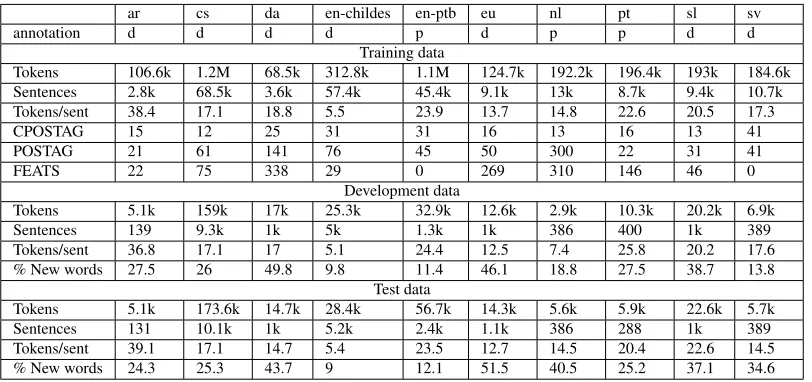
Below we describe the different treebanks used, and the conversion process into our data format for the purpose of the competition. Please see Table 1 for statistics on each of the treebanks.
Dependency treebanks We used the following
dependency treebanks: Arabic The Prague
Ara-bic Dependency Treebank V1 (Hajiˇc et al., 2004).6 Basque The Basque 3lb dependency treebank
(Aduriz et al., 2003). Czech The Prague
Depen-dency Treebank 2.0 (B¨ohmov´a et al., 2001).7
Dan-ish The Copenhagen Dependency Treebank
ver-sion 2 (Buch-Kromann et al., 2007). English The
CHILDES US/Brown subcorpus (Sagae et al.,
2007). Slovene The jos500k Treebank (Erjavec et
al., 2010). 8 Swedish The Talbanken treebank
(Nivre et al., 2006). The conversion of each of these treebanks was quite straightforward as they were al-ready annotated for dependencies. Moreover, many of these corpora had been used previously in the CoNLL 2006 and 2007 shared tasks, and therefore we were able to reuse this data and/or their conver-sion scripts. In the case of Arabic and Swedish we used the exact same data, simply converting from CoNLL dependency format into our own format (re-moving redundant columns and adding a UPOS col-umn). While many of the other corpora had also
4In the following corpus descriptions, when not otherwise
specified the corpus is freely available for research purposes.
5http://code.google.com/p/ universal-pos-tags
6
LDC catalogue number LDC2004T23.
7LDC catalogue number LDC2006T01. 8
For the shared task, the annotation was converted to english using the tables found at the JOS website:http://nl.ijs. si/jos/msd/html-en/index.html
been used previously, our data is different, making use of subsequent corrections to these treebanks and additional annotated data now available.
First language acquisition provides an important motivation for grammar induction research, conse-quently we have included data from the CHILDES
database of child-directed speech. We use the
Brown sub-corpus, a longitudinal study of parent-child interactions for three parent-children aged between 18 months and 5 years old. The corpus has been man-ually annotated with syntactic dependencies (Sagae et al., 2007) and morphology. From this we take all child-directed utterances, extracting word, morphol-ogy, part-of-speech and dependency markup, and developed our own conversion into UPOS. Our test-ing and development sets were drawn from the first 15 Eve files which were manually annotated for de-pendency structure. The rest of the corpus, which had not been manually annotated for syntax, was merged to form the training set.
Phrase-structure treebanks As well as depen-dency treebanks, we used three different
phrase-structure treebanks: The Dutch Alpino treebank
(Bouma et al., 2000), the English Penn Treebank V3 (Marcus et al., 1993),9 and thePortuguese Flo-resta Sint´a(c)tica treebank (Afonso et al., 2002). As these treebanks do not explicitly mark dependen-cies, we automatically extracted these using head finding heuristics. Thankfully the difficult work of creating such scripts has already been done as part of the CoNLL shared tasks. We have reused their scripts to create dependency representations of these treebanks, before converting into our file for-mat and augmenting with UPOS annotation. In the case of Dutch, we have reused the same CoNLL 2006 data; note that this dataset includes predicted part-of-speech rather than gold standard annotation (Buchholz and Marsi, 2006). For the Portuguese,
we used the same Bosque 7.3 sub-corpus10 from
CoNLL 2006, additionally including in our training set the recently-annotated Selva 1.0 subcorpus.
The Penn Treebank is the most common data set in parsing and grammar induction. We have patched
9LDC catalogue number LDC99T42. 10
ar cs da en-childes en-ptb eu nl pt sl sv
annotation d d d d p d p p d d
Training data
Tokens 106.6k 1.2M 68.5k 312.8k 1.1M 124.7k 192.2k 196.4k 193k 184.6k Sentences 2.8k 68.5k 3.6k 57.4k 45.4k 9.1k 13k 8.7k 9.4k 10.7k Tokens/sent 38.4 17.1 18.8 5.5 23.9 13.7 14.8 22.6 20.5 17.3
CPOSTAG 15 12 25 31 31 16 13 16 13 41
POSTAG 21 61 141 76 45 50 300 22 31 41
FEATS 22 75 338 29 0 269 310 146 46 0
Development data
Tokens 5.1k 159k 17k 25.3k 32.9k 12.6k 2.9k 10.3k 20.2k 6.9k Sentences 139 9.3k 1k 5k 1.3k 1k 386 400 1k 389 Tokens/sent 36.8 17.1 17 5.1 24.4 12.5 7.4 25.8 20.2 17.6 % New words 27.5 26 49.8 9.8 11.4 46.1 18.8 27.5 38.7 13.8
Test data
[image:5.612.104.510.70.261.2]Tokens 5.1k 173.6k 14.7k 28.4k 56.7k 14.3k 5.6k 5.9k 22.6k 5.7k Sentences 131 10.1k 1k 5.2k 2.4k 1.1k 386 288 1k 389 Tokens/sent 39.1 17.1 14.7 5.4 23.5 12.7 14.5 20.4 22.6 14.5 % New words 24.3 25.3 43.7 9 12.1 51.5 40.5 25.2 37.1 34.6
Table 1: Properties of the treebanks. We report the linguistic annotation method (dependency vs. phrase-structure), the size of each treebank, the number of types for the different granularities of part-of-speech tags and morphological features (note that UPOS has a fixed set of 12 tags), and the proportion of word types that were not present in training.
the treebank to include NP-internal structure using Vadas and Curran’s annotations (Vadas and Cur-ran, 2007), which was then converted to dependency
structures using the penn-converter11 script
(Johansson and Nugues, 2007). This tool has a num-ber of options controlling the linguistic decisions in converting from phrase-structure to dependency trees, e.g., the treatment of coordination. We ex-tracted five versions of the treebank, each encoding each different sets of linguistic assumptions (Tsar-faty et al., 2011).12 These are denoted default, old-LTH, CoNLL-2007, functional and lexical; for the main results we used the standard options, we also report separately evaluations using each of the five variants. The treebank was partitioned into training (sections 0-22), development (sec. 24) and testing sets (sec. 23).
4 Baselines and Benchmarks
A number of standard baselines and previously pub-lished benchmark systems were implemented for each task in order to place the submitted systems in context.
11http://nlp.cs.lth.se/software/treebank_ converter
12
Note that Tsarfaty et al. (2011) also propose an evalua-tion metric for comparing dependency trees, which we have not used. Note however that it could, in principle, be used for simi-lar evaluations.
The standard baseline for grammar induction models is to assume either left branching or right branching analyses (LB,RB). These capture the ten-dency for languages to favour one attachment direc-tion over another. The most frequently cited and extended model for dependency induction is DMV (Klein and Manning, 2004). We provide results for this model trained on each of the coarse (DMVc), fine (DMVp), and universal (DMVu) POS tag sets, all ini-tialised with the original harmonic initialiser. As a further baseline we also evaluated the dependency trees resulting from directly using the harmonic ini-tialiser without any training (H).
As a strong benchmark we include the results of the non-parametric Bayesian model previously pub-lished in Blunsom and Cohn (2010) (BC). The stated results are for the unlexicalised model described in that paper where the final analysis is formed by choosing the maximum marginal probability depen-dency links estimated from forty independent Gibbs sampler runs.
property of both of these word class models is that they enforce a one-tag-per-type restriction that en-sures there is a one-to-one mapping between word types and classes.
For POS tagging we also provide benchmark re-sults from two previously published models. The first of these is the Pitman-Yor HMM model de-scribed in (Blunsom and Cohn, 2011), which in-corporates ta one-tag-per-type restriction (BC). This model was trained with the same number of tags as in the gold standard fine tag set for each corpus. The second benchmark is the HMM with Sparsity Con-straints trained using Posterior Regularization (PR) described in (Grac¸a et al., 2011). In this model the HMM emission probabilitiy distribution are esti-mated using small Maximum Entropy models (fea-tures set described in the original paper). The mod-els were trained for 200 iterations of PR using both the same number of hidden states as the coarseGc
and universalGugold standard. All parameters were set to the values described in the original paper.
5 Submissions
The shared task received submissions covering a di-verse range of approaches to the dependency and part-of-speech induction challenges. Encouragingly all of these submissions made significant departures from the benchmark HMM and DMV approaches which have dominated the published literature on these tasks in recent years. The submissions were characterised by varied choices of model structure, parameterisation, regularisation, and the degree to which light supervision was provided through con-straints or the use of labelled tuning data. In the fol-lowing sections we summarise the approaches taken by the systems submitted for each task.
5.1 Part-of-Speech Induction
The part-of-speech induction challenge received two submission, (Chrupała, 2012; Christodoulopoulos et al., 2012). Both of these submissions based their in-duction systems on LDA inspired models for cluster-ing word types by the contexts in which they appear. Notably, the strongest of the provided benchmarks and the two submissions modelled part-of-speech tags at the type level, thus restricting all tokens of a given word type to share the same tag. Though
clearly out of step with the gold standard tagging, this one-tag-per-type restriction has previously been shown to be a crude but effective way of regularising models towards a good solution. Below we sum-marise the approach of each submission, identified by the surname of the first author on the submitted system description.
Chrupała (2012) employed a two stage approach to inducing part-of-speech tags. The first stage used an LDA style probabilistic model to induce a dis-tribution over possible tags for a given word type. These distributions were then hierarchically clus-tered and the final tags selected using the prefix of the path from the root node to the word type in the cluster tree. The length of the prefixes, and thus the number of tags, was tuned on the labelled develop-ment data.
The system of Christodoulopoulos et al. (2012) was based upon an LDA type model which included both contexts and other conditionally independent features (Christodoulopoulos et al., 2011). This base system was then iterated with a DMV system and with the resultant dependencies being repeatedly fed back into the POS model as features. This submis-sion is notable for being one of the first to attempt joint POS and dependency induction rather than tak-ing a pipeline approach.
5.2 Dependency Induction
The dependency parsing task saw a variety of ap-proaches with only a couple based on the previously dominant DMV system. Two forms of light super-vision were popular, the first being the inclusion of pre-specified constraints or rules for allowable de-pendency links, and the second being the tuning of model parameters or selecting between competing models on the labelled development data. Obviously the merits of such supervision would depend on the desired application for the induced parser. The di-rect comparison of models which include a form of universal prior syntactic information with those that don’t does permit interesting development linguistic questions to be explored in future.
cate-gories for each POS tag and the heads of sentences. Key features of their approach were a maximum likelihood objective function and an iterative proce-dure for generating composite categories from sim-ple ones. Such composite categories allow the pa-rameterisation of larger units than just head-child dependencies, improving over the more limited con-ditioning of DMV.
Maraˇcek and ˇZabokrtsk´y (2012) introduced a number of novel features in their dependency induc-tion submission. Wikipedia articles were used to quantify the reducibility of word types, the degree to which the word could be removed from a sen-tence and grammaticality maintained. This metric was then used, along with a model of child fertil-ity and dependency distance, within a probabilistic model. Inference was performed by using a local Gibbs sampler to approximate the marginal distribu-tion over head-child links.
Søgaard (2012) presented two model-free heuris-tic algorithms. The first was based on heurisheuris-tically adding dependency edges based on rules such as ad-jacency, function words, and morphology. The re-sulting structure is then run through a PageRank al-gorithm and another heuristic is used to select a tree from the resulting ranked dependency edges. The second approach takes the universal rules of Naseem et al. (2010) but rather than estimating a probabilis-tic model with these rules, a rule based heurisprobabilis-tic is used to select a parse rather. This second model-free approach in particular provides a strong baseline for probabilistic models built upon hand-specified de-pendency rules.
Tu (2012) described a system based on an ex-tended DMV model. Their work focussed on the exploration of multiple forms of regularisation, in-cluding Dirichlet priors and posterior regularisation, to favour both sparse conditional distributions and low ambiguity in the induced parse charts. While many previous works have included sparse priors on the conditional hechild distributions the ad-ditional regularisation of the ambiguity over parse trees is a novel and interesting addition. The la-belled development sets were employed to both se-lect between models employing different regularisa-tion, and to tune model parameters.
5.3 POS and Dependency Induction
There was only a single submission for the task of inducing dependencies without gold standard part-of-speech tags supplied. Christodoulopoulos et al. (2012) submitted the same joint tagging and DMV system used for the POS induction task to the depen-dency induction task. Results on the development data indicated that this iterated joint training had a significant benefit for the induced tags and a smaller benefit for the dependency structures induced.
6 Results
The main results for the three tasks are shown in Ta-bles 2, 3, and 4, for the POS induction, dependency induction and joint tasks, respectively.13 We now present a detailed analysis of each of the three tasks.
6.1 POS induction
The main evaluation results for the POS induc-tion task are shown in Table 2, which compares the induced clusters against the gold universal tags (UPOS).14Given the diversity of scenarions used by
each system (e.g. number of hidden states, tuning on development data) a direct comparison between the systems can only be illustrative. A first obser-vation is that depending on the particular evaluation metric employed the ranking of the systems changes substantially, for instance the Gu system is the best using the 1-1 and VI metric but is the worst of the en-tries (excepting the baselines) when using the other two metrics. Focusing on the VM metric, which was shown empirically not to have low bias with re-spect to the word classes (Christodoulopoulos et al., 2010), the best entry is the BC system which has the best performance in 9 out of 10 entries followed by the CGS and the C system. Note that this ranking holds also for the comparison against fine POS tags, shown in Table 7.
An interesting aspect is that almost all systems beat the strong Brown (B) and mkcls (MK) base-line across the different metrics when we restrict our attention to the cases where the same number
13Additional tables of results are in the appendix, and
fur-ther results are online at http://wiki.cs.ox.ac.uk/ InducingLinguisticStructure.
14
M-1
testset BC CGS Cc Cp Gc Gu Bc Bp Bu MKc MKp MKu
arabic 83.80 N/A 83.33 83.33 65.05 66.61 66.20 69.89 66.22 71.08 72.72 68.03
basque 80.85 79.54 86.67 86.67 77.37 73.88 74.73 77.49 73.32 74.80 78.63 71.40
czech 83.10 66.78 72.27 77.97 N/A N/A 60.85 75.57 60.42 65.43 79.35 57.16
danish 81.44 77.76 84.13 84.92 68.16 53.78 72.12 79.77 47.09 72.26 82.59 53.07
dutch 80.75 70.13 74.04 76.11 63.37 57.64 57.99 84.17 57.31 68.18 84.78 63.04
en-childes 90.36 85.42 91.50 91.50 N/A N/A 82.65 89.70 70.12 86.27 91.44 75.63
en-ptb 86.73 81.93 78.11 84.35 77.14 71.10 77.29 80.88 63.74 79.99 83.88 63.34
portuguese 81.69 77.38 80.38 81.90 75.54 74.35 70.07 74.25 67.60 70.79 72.90 68.08
slovene 70.81 65.31 75.53 75.92 67.94 59.96 61.58 68.93 58.32 58.43 65.69 50.36
swedish 78.61 80.45 79.60 79.60 69.91 58.79 71.69 71.69 57.55 76.45 76.45 57.30
averages 81.82 76.08 80.56 82.23 70.56 64.51 69.52 77.23 62.17 72.37 78.84 62.74
1-1
testset BC CGS Cc Cp Gc Gu Bc Bp Bu MKc MKp MKu
arabic 53.67 N/A 39.44 39.44 39.83 55.52 40.55 33.57 43.31 51.54 40.24 51.58
basque 36.10 36.03 47.15 47.15 47.09 54.70 32.61 20.53 40.62 34.80 27.28 37.65
czech 31.82 49.30 30.49 27.20 N/A N/A 46.19 26.66 45.10 43.70 24.48 39.25
danish 42.54 42.77 31.67 31.04 39.95 45.58 36.04 17.74 39.19 43.89 22.18 44.23
dutch 42.79 56.15 43.10 39.62 56.45 45.37 48.18 21.36 43.12 55.99 21.32 54.09
en-childes 38.79 42.57 43.76 43.76 N/A N/A 40.78 35.54 57.71 43.45 32.00 59.18
en-ptb 41.55 39.57 43.86 31.56 42.07 51.70 39.79 33.90 46.50 40.55 36.22 51.17
portuguese 59.66 47.45 35.90 35.50 46.50 56.08 51.15 42.68 51.58 44.28 35.38 46.31
slovene 39.02 53.04 33.18 32.50 50.90 48.50 46.83 40.16 42.28 40.34 39.32 40.58
swedish 42.38 32.44 26.45 26.45 34.99 54.92 27.56 27.56 51.34 35.82 35.82 43.60
averages 42.83 44.37 37.50 35.42 44.72 51.55 40.97 29.97 46.07 43.44 31.42 46.76
VM
testset BC CGS Cc Cp Gc Gu Bc Bp Bu MKc MKp MKu
arabic 61.75 N/A 51.27 51.27 44.81 47.07 39.93 42.43 39.92 47.47 43.91 44.49
basque 42.17 41.52 43.04 43.04 40.86 40.05 34.85 33.33 36.08 36.32 34.35 33.42
czech 52.26 45.31 40.22 39.20 N/A N/A 38.56 42.90 37.46 41.70 46.03 37.34
danish 56.57 54.63 52.46 52.32 47.26 41.96 47.89 44.37 35.13 50.52 48.17 39.96
dutch 56.96 53.35 54.87 52.90 48.57 45.80 43.34 49.33 43.67 51.37 50.11 47.20
en-childes 64.53 62.32 62.76 62.76 N/A N/A 58.87 60.31 57.06 62.76 60.92 60.51
en-ptb 60.73 57.99 53.14 52.09 55.10 52.54 54.76 55.08 48.04 56.81 57.29 48.46
portuguese 64.17 58.41 52.54 52.32 55.96 58.14 52.09 53.18 50.32 52.48 50.87 50.18
slovene 51.15 51.29 46.60 46.50 50.98 45.98 44.49 45.80 38.61 36.79 43.43 36.43
swedish 57.05 54.21 47.08 47.08 48.89 45.73 45.87 45.87 40.84 49.77 49.77 42.83
averages 56.73 53.23 50.40 49.95 49.05 47.16 46.06 47.26 42.71 48.60 48.48 44.08
VI
testset BC CGS Cc Cp Gc Gu Bc Bp Bu MKc MKp MKu arabic 2.48 N/A 3.70 3.70 3.39 2.98 3.78 3.94 3.53 3.31 3.82 3.30
basque 3.82 3.44 3.98 3.98 3.25 2.82 3.92 4.98 3.45 3.79 4.76 3.58
czech 3.83 3.41 4.92 5.77 N/A N/A 3.70 4.76 3.69 3.63 4.53 3.83
danish 3.36 3.34 4.31 4.38 3.78 3.46 3.86 5.43 3.79 3.64 4.90 3.59
dutch 3.56 3.13 3.28 3.71 3.30 3.44 3.66 5.22 3.60 3.26 5.15 3.39
en-childes 2.81 2.86 3.06 3.06 N/A N/A 3.13 3.34 2.59 2.84 3.33 2.50
en-ptb 3.18 3.28 3.67 4.36 3.34 3.03 3.46 3.62 3.36 3.36 3.52 3.28
portuguese 2.47 2.83 3.96 4.09 2.96 2.62 3.19 3.36 3.10 3.21 3.52 3.15
slovene 3.62 3.14 4.80 4.86 3.16 3.30 3.61 4.09 3.73 4.15 4.33 3.99
swedish 3.31 3.68 4.98 4.98 3.90 3.32 4.46 4.46 3.70 4.07 4.07 3.62
[image:8.612.75.541.86.619.2]averages 3.24 3.23 4.07 4.29 3.39 3.12 3.68 4.32 3.45 3.53 4.19 3.42
of hidden states are used (the exception being the G system which occasionally under-performed against MK). Interestingly the assumption of one-tag-per-word, made by all but the G system, works very well in practice leading to consistently strong re-sults. This suggests that dealing with word ambigu-ity is still an unresolved issue in unsupervised POS induction.
Comparing the performance of the systems for different languages, as expected the languages for which we have a larger corpora (English CHILDES and PTB and Czech) tend to result in systems with better accuracies. An interesting future question is how do the propose methods scale when training on really large corpora (e.g., wikipedia) both in terms of performance (accuracy) but also in the resources they required.
Finally, the wild divergences in the system rank-ings when considering the different evaluation met-rics calls for some sort of external evaluation using the induced clusters as features to other end sys-tems, for instance semi-supervised tagging. The main question is if there will be a definitive ranking between systems for a diverse set of tasks, or if on the contrary the effectiveness of the output of each system will vary according to the task at hand.
6.2 Dependency induction
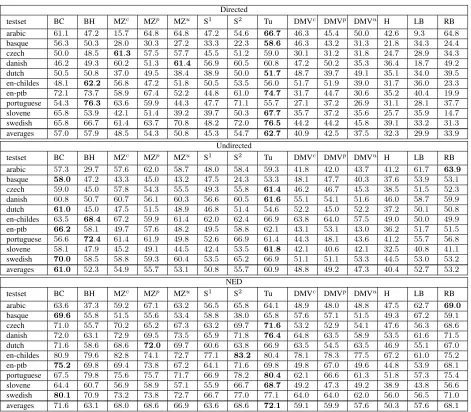
The main evaluation results for the dependency task are shown in Table 3. From this we make several observations.15 Firstly, for almost all the corpora
the participants systems have outperformed the sim-ple baselines, and by a significant margin. There are three exceptions to this: for Arabic, Basque and Danish the left or right-branching baselines outper-forms most or all of the competitors. This may in-dicate that these languages are inherently difficult, or may simply be a consequence of these three lan-guages having the least data of all of our corpora. Basque and Dutch proved to be the hardest of the treebanks, with the lowest overall scores, and the CHILDES (English) and Portuguese were the eas-iest. The reasons for this are not immediately clear,
15
Table 3 evaluates against the full test sets, however it is traditional to present results for short sentences mirroring the common training setup. See Tables 8 and 9 for results over sentences with 10 words or fewer, excluding punctuation. Note that our analysis is based on the results for the full test set.
although we speculate that Basque is difficult due to its dissimilarity from other European languages, and therefore may not match the assumptions underly-ing models developed primarily on English. Dutch is difficult as its annotation was non-projective, and it has a very large set of POS tags, while CHILDES is made easier due to its extremely short and simple sentences.
In terms of declaring a ‘winner’, it is clear that Tu’s system ranks best under directed accuracy and NED, and a very narrow second (to the organisers’ submission, BC) for undirected accuracy. Moreover Tu’s system was a consistent performed across all corpora, with no single result well below the results of the other participants. Note that the three different metrics often predict the same winner across the dif-ferent treebanks, however there are some large dis-crepancies, such as Portuguese and Dutch where the directed and undirected accuracy metrics concur, but NED produces a very different ranking. It is unclear which metric should be trusted more than another; this could only be assessed by correlating these met-rics with some form of secondary evaluation, such as in a task based setting or obtaining human gram-maticality judgements.16
The benchmark systems include DMV (Klein and Manning, 2004), which has historical importance in terms of being the first research systems to out-perform simple baselines for dependency induction, and also the model upon which most recent depen-dency induction research is based, including many
of the competitors in the competition. We
ob-serve that in most cases the competitors have out-performed the DMV models, in many cases by a
large margin. In all cases DMV improved over
its initialisation condition (the harmonic initialiser), although often this improvement was only slight, underscoring the importance of good initialisation. The effect of inducing DMV grammars from var-ious different granularity of POS tags made little difference in most cases, although for Dutch17 and the English PTB there change was more dramatic.
16It was our intention to include a task-based evaluation for
machine translation, but this proved impractical for the compe-tition due to the volumes of data that we would require each participant to process.
17Note that for Dutch the full POS tags were not gold
Directed
testset BC BH MZc MZp MZu S1 S2 Tu DMVc DMVp DMVu H LB RB
arabic 61.1 47.2 15.7 64.8 64.8 47.2 54.6 66.7 46.3 45.4 50.0 42.6 9.3 64.8
basque 56.3 50.3 28.0 30.3 27.2 33.3 22.3 58.6 46.3 43.2 31.3 21.8 34.3 24.4
czech 50.0 48.5 61.3 57.5 57.7 45.5 51.2 59.0 30.1 31.2 31.8 24.7 28.9 34.3
danish 46.2 49.3 60.2 51.3 61.4 56.9 60.5 60.8 47.2 50.2 35.3 36.4 18.7 49.2
dutch 50.5 50.8 37.0 49.5 38.4 38.9 50.0 51.7 48.7 39.7 49.1 35.1 34.0 39.5
en-childes 48.1 62.2 56.8 47.2 51.8 50.5 53.5 56.0 51.7 51.9 39.0 31.7 36.0 23.3
en-ptb 72.1 73.7 58.9 67.4 52.2 44.8 61.0 74.7 31.7 44.7 30.6 35.2 40.4 19.9
portuguese 54.3 76.3 63.6 59.9 44.3 47.7 71.1 55.7 27.1 37.2 26.9 31.1 28.1 37.7
slovene 65.8 53.9 42.1 51.4 39.2 39.7 50.3 67.7 35.7 37.2 35.6 25.7 35.9 14.7
swedish 65.8 66.7 61.4 63.7 70.8 48.2 72.0 76.5 44.2 44.2 45.8 39.1 33.2 31.3
averages 57.0 57.9 48.5 54.3 50.8 45.3 54.7 62.7 40.9 42.5 37.5 32.3 29.9 33.9
Undirected
testset BC BH MZc MZp MZu S1 S2 Tu DMVc DMVp DMVu H LB RB
arabic 57.3 29.7 57.6 62.0 58.7 48.0 58.4 59.3 41.8 42.0 43.7 41.2 61.7 63.9
basque 58.0 47.2 43.3 45.0 43.2 47.5 24.3 53.3 48.1 47.7 40.3 37.6 53.9 53.1
czech 59.0 45.0 57.8 54.3 55.5 49.3 55.8 61.4 46.2 46.7 45.3 38.5 51.5 52.3
danish 60.8 50.7 60.7 56.1 60.3 56.6 60.5 61.6 55.1 54.1 51.6 46.0 58.7 59.9
dutch 61.0 45.0 47.5 51.5 48.9 46.8 51.4 54.6 52.2 45.0 52.2 37.2 50.1 50.8
en-childes 63.5 68.4 67.2 59.9 61.4 62.0 62.4 66.9 63.8 64.0 57.5 49.0 50.0 49.9
en-ptb 66.2 58.1 49.7 57.6 48.2 49.5 58.8 62.1 43.1 53.1 43.0 36.2 51.7 51.5
portuguese 56.6 72.4 61.4 61.9 49.8 52.6 66.9 61.4 44.3 48.1 43.6 41.2 55.7 56.8
slovene 58.1 47.9 45.2 49.1 44.5 42.4 53.5 61.8 42.1 40.6 42.1 32.5 40.8 41.1
swedish 70.0 58.5 58.8 59.3 60.4 53.5 65.2 66.9 51.1 51.1 53.3 44.5 53.0 53.2
averages 61.0 52.3 54.9 55.7 53.1 50.8 55.7 60.9 48.8 49.2 47.3 40.4 52.7 53.2
NED
testset BC BH MZc MZp MZu S1 S2 Tu DMVc DMVp DMVu H LB RB
arabic 63.6 37.3 59.2 67.1 63.2 56.5 65.8 64.1 48.9 48.0 48.8 47.5 62.7 69.0
basque 69.6 55.8 51.5 55.6 53.4 58.8 38.0 65.8 57.6 57.1 51.5 49.3 67.2 59.1
czech 71.0 55.7 70.2 65.2 67.3 63.2 69.7 71.6 53.2 52.9 54.1 47.6 56.3 68.6
danish 72.0 63.1 72.9 69.5 73.5 65.9 71.8 76.4 64.8 63.5 58.9 53.5 61.6 71.5
dutch 71.6 58.6 68.6 72.0 69.7 60.6 63.8 66.9 63.5 54.5 63.5 46.9 55.1 67.0
en-childes 80.9 79.6 82.8 74.1 72.7 77.1 83.2 80.4 78.1 78.3 77.5 67.2 61.0 75.2
en-ptb 75.2 69.8 69.4 73.8 67.2 64.1 71.6 69.8 49.8 67.0 49.6 44.8 53.9 68.1
portuguese 67.5 79.8 75.6 75.7 71.7 66.9 78.2 80.4 62.1 66.6 61.3 51.8 57.3 75.4
slovene 64.4 60.7 56.9 58.9 57.1 55.9 66.7 68.7 49.2 47.3 49.2 38.9 43.8 56.6
swedish 80.1 70.9 73.2 73.8 72.7 66.7 77.0 77.1 64.0 64.0 62.0 56.0 56.5 71.0
[image:10.612.72.543.67.479.2]averages 71.6 63.1 68.0 68.6 66.9 63.6 68.6 72.1 59.1 59.9 57.6 50.3 57.6 68.1
Table 3: Directed accuracy, undirected accuracy and NED results for the dependency task (using supplied POS). The first column (BC) is our benchmark system, the next seven are participants systems, and the remaining columns consist of the DMV benchmark and various simple baselines. The superscriptsc,pandudenote which type of POS was used, andS1andS2denote two different submissions for Søgaard (2012).
Overall the full POS tagset lead to the best perfor-mance over the coarse and universal tags (consider-ing undirected accuracy or NED), which is to be ex-pected as there is considerably more syntactic infor-mation contained in the full POS. This must be bal-anced against the additional model complexity from expanding its parameter space, which may explain why the difference in performance differences are so small. The same pattern can also be seen in Maraˇcek and ˇZabokrtsk´y (2012)’s submission, whose system using full POS (Mp) outperformed their other vari-ants.
6.3 Joint task
[image:10.612.74.542.74.482.2]directed
testset CGS DMVc DMVp DMVu
arabic N/A 35.3 44.4 34.2
basque 24.5 27.5 25.1 28.7
czech 24.7 19.9 33.2 20.0
danish 21.4 23.3 31.9 10.0
dutch 15.1 20.6 33.7 20.5
en-childes 29.9 38.6 42.2 40.3
en-ptb 21.5 22.5 23.3 17.2
portuguese 19.7 28.5 28.0 17.1
slovene 19.2 13.9 11.5 14.4
swedish 23.6 26.4 26.4 20.5
averages 22.2 25.7 30.0 22.3
undirected
testset CGS DMVc DMVp DMVu
arabic N/A 45.5 52.5 45.0
basque 43.5 46.4 47.3 47.0
czech 38.9 37.5 50.9 38.5
danish 51.4 52.2 48.8 37.3
dutch 40.3 41.9 48.6 40.8
en-childes 54.9 59.2 60.8 58.1
en-ptb 43.4 45.4 48.8 39.4
portuguese 45.5 51.8 52.7 39.8
slovene 32.8 33.3 36.7 32.8
swedish 45.6 48.9 48.9 40.3
averages 44.0 46.2 49.6 41.9
NED
testset CGS DMVc DMVp DMVu
arabic N/A 53.4 57.6 53.3
basque 55.9 55.6 54.4 54.7
czech 51.2 49.3 63.4 51.5
danish 61.7 60.3 60.4 46.3
dutch 47.2 57.5 56.8 55.2
en-childes 78.2 77.7 78.1 76.5
en-ptb 53.9 60.2 63.5 47.5
portuguese 50.0 69.4 70.8 57.9
slovene 40.7 38.7 47.5 40.3
swedish 54.5 65.4 65.4 54.3
[image:11.612.72.300.66.481.2]averages 54.8 58.8 61.8 53.8
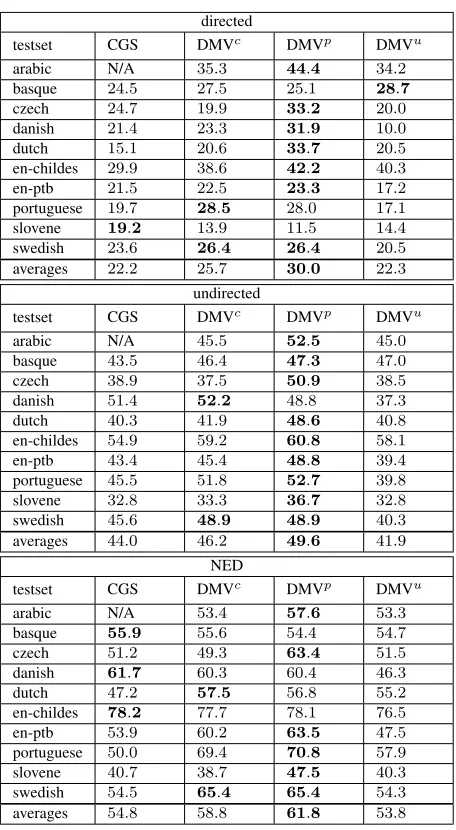
Table 4: Directed, undirected and NED accuracy results for evaluating the predicted dependency structures in the joint task (i.e., not using supplied POS tags). The first column is the participant’s system and the next three are DMV models trained on the Brown word clusters (see section 6.1).
above with gold standard tags. The best joint
sys-tem was the DMVp model, which only marginally
under-performed the equivalent DMV model trained on gold POS. This is an encouraging finding, sug-gesting that word clusters are able to represent im-portant POS distinctions to inform deeper syntactic processing.
6.4 Analysis
Until now we have adopted the standard metrics in dependency evaluation: namely directed head at-tachment accuracy, and its more lenient counter-parts, undirected accuracy and NED. The latter met-rics reward structures that almost match the gold standard tree, by way of rewarding child-parent edges that are predicted in the reverse direction, i.e., attaching the child as the parent (NED takes this fur-ther, by also rewarding the grandparent-child edge when this occurs). This allows some degree of flexi-bility when considering various contentious linguis-tic decisions such as whether a preposition should head a preposition phrase, or the head of the child noun-phrase. This added leniency comes at a price, as shown in Table 3 where the undirected accuracy and NED results are considerably higher than di-rected accuracy, and display less spread of values (look in particular at the random trees, Ra). Is is unclear that the predicted trees are truly predicting linguistically plausible structures, but instead that the differences are due largely to chance. Moreover, systems that predict linguistic phenomena inconsis-tently between sentences or across types of related phenomena are rewarded under these lenient met-rics.
For these reasons we also consider a different, less permissive, evaluation method, using multiple references of the treebank where each is annotated with different styles of dependency. As described in section 2, we processed the Penn treebank five times with different options to the LTH conversion tool. This affected the treatment of coordination, preposition phrases, subordinate clauses, infinitival clauses etc. Next we compare the directed accu-racy of the systems against these five different ‘gold standard’ references, which are displayed in Table 5, alongside the maximum score for each system. Note that most systems performed well against the stan-dard, conll2007 and functional references but poorly against the lexical and oldLTH references.18 Con-sidering the latter two references, a different system would be selected as the highest performing, namely Bisk and Hockenmaier (2012) (BH) over Blunsom and Cohn (2010) (BC) which wins in the other cases.
18The common difference here is that the latter two
This evaluation method rewards many different lin-guistically plausible structures, but in such a way that the predictions must be consistent between dif-ferent sentences in the testing set, and in their treat-ment of related linguistic phenomena. One caveat is that this method can only be used when there are many references, although in many cases differ-ent outputs can be generated automatically, e.g., by adjusting head-finding heuristics in converting be-tween phrase-structure to dependency trees.
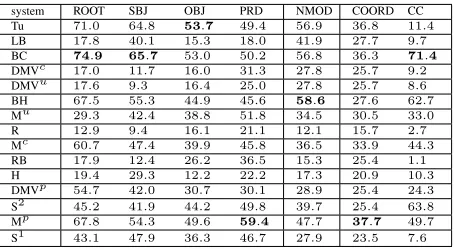
The previous analysis has rated each system in terms of overall performance against treebank trees, however this doesn’t necessarily mean that the pre-dictions of the best ranked system will be the most useful ones in a task-based setting. Take the ex-ample of information extraction, in which a central problem is to identify the arguments (subject, object etc) of a given verb. This setting gives rise to some types of dependency edges being more valuable than others. We present comparative results for the Penn treebank in Table 6 showing the directed accuracy for different types of dependency relations. Observe that there is a wide spread of accuracies for predict-ing the head word of the sentence (ROOT), and simi-larly for verbs’ subject and object arguments. These scores are similar to the scores for the local modi-fiers shown, such as NMOD which describe the ar-guments of a noun. This is surprising as noun edges tend to be much shorter than for the arguments to a verb, and thus should be easier to predict. Also in-teresting are the spread of results for the CC edges (these link a coordinating conjunction to its head), suggesting that the systems learn to represent coor-dination in very different ways to the method used in the reference.
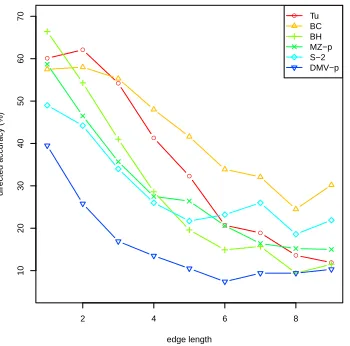
Figure 1 illustrates the directed accuracy over dif-ferent lengths of dependency edge. For all systems the accuracy diminishes with edge length, however some fall at a much faster rate. The two best systems (Tu, BC) have similar overall accuracy results, but it is clear that Tu does better on short edges while BC does better on longer ones. The same pattern was also observed when considering the average ac-curacy over all treebanks (not shown), although the systems’ results were closer together.
system ROOT SBJ OBJ PRD NMOD COORD CC Tu 71.0 64.8 53.7 49.4 56.9 36.8 11.4
LB 17.8 40.1 15.3 18.0 41.9 27.7 9.7
BC 74.9 65.7 53.0 50.2 56.8 36.3 71.4 DMVc 17.0 11.7 16.0 31.3 27.8 25.7 9.2
DMVu 17.6 9.3 16.4 25.0 27.8 25.7 8.6
BH 67.5 55.3 44.9 45.6 58.6 27.6 62.7
Mu 29.3 42.4 38.8 51.8 34.5 30.5 33.0 R 12.9 9.4 16.1 21.1 12.1 15.7 2.7
Mc 60.7 47.4 39.9 45.8 36.5 33.9 44.3
RB 17.9 12.4 26.2 36.5 15.3 25.4 1.1
H 19.4 29.3 12.2 22.2 17.3 20.9 10.3
DMVp 54.7 42.0 30.7 30.1 28.9 25.4 24.3 S2 45.2 41.9 44.2 49.8 39.7 25.4 63.8
Mp 67.8 54.3 49.6 59.4 47.7 37.7 49.7
[image:12.612.314.541.70.195.2]S1 43.1 47.9 36.3 46.7 27.9 23.5 7.6
Table 6: Directed accuracy results on the Penn treebank, stratified by dependency relation. For clarity, only 9 im-portant relation types are shown. The vertical bars sepa-rate different groups of relations, from left to right, relat-ing to the main verb, general modifiers and coordination.
7 Conclusion
This challenge set out to evaluate the state-of-the-art in pstate-of-the-art-of-speech and dependency grammar in-duction, promoting research in this field and, im-portantly, providing a fair means of evaluation. The participants submissions used a wide variety of dif-ferent approaches, many of which we shown to have improved over competitive benchmark sys-tems. While the results were overall very positive, it is fair to say that the tasks of part-of-speech and grammar induction are still very much open chal-lenges, and that there is still considerable room for improvement. The data submitted to this evaluation campaign will provide a great resource for devising new methods of evaluation, and we plan to pursue this avenue in future work, in particular task-based evaluation such as in an information extraction or machine translation setting.
8 Acknowledgements
previ-testset BC BH MZc MZp MZu S1 S2 Tu DMVc DMVp DMVu H LB RB
conll2007 54.9 51.7 40.4 49.2 36.8 32.2 41.7 54.2 20.9 33.2 20.4 18.0 30.1 20.3
functional 59.6 52.4 41.5 47.4 36.2 30.6 40.0 58.5 20.9 37.2 20.6 19.3 29.2 23.7
lexical 40.6 41.9 28.5 37.3 24.8 27.7 35.5 39.5 23.5 23.1 23.0 14.4 33.1 10.1
oldLTH 41.4 43.6 28.8 37.8 24.6 28.6 36.1 39.5 22.3 23.7 21.8 14.3 32.0 10.7
standard 56.0 50.4 41.0 50.3 37.5 32.8 42.5 55.5 22.3 33.5 21.8 18.4 31.4 20.4
[image:13.612.70.543.70.149.2]best 59.6 52.4 41.5 50.3 37.5 32.8 42.5 58.5 23.5 37.2 23.0 19.3 33.1 23.7
Table 5: Directed accuracy results measured against different conversions of the Penn Treebank into dependency trees.
● ●
●
●
●
● ●
● ●
2 4 6 8
10
20
30
40
50
60
70
edge length
directed accur
acy (%)
● Tu BC BH MZ−p S−2 DMV−p
Figure 1: Directed accuracy on the Penn treebank strat-ified by dependency length. For clarity only a subset of the systems are shown, and edges of length 10 or more were omitted.
ous CoNLL 2006 and 2007 competitions, who con-tributed significant efforts into collating so many treebanks and developing treebank conversion tools, making our job much easier than it would other-wise have been. Thanks to Sebastian Reidel, Joakim Nivre and Sabine Buchholz for promptly
answer-ing our questions. We would like to thank the
LDC, who allowed their licenced data to be used free of charge by the competitors, and Ilya Ahtaridis who administered the licencing and corpus distribu-tion. Thanks also to Valentin Spitkovski and Chris-tos Christodoulopoulos who kindly provided us with their evaluation scripts, and finally, the participants themselves for taking part.
References
I. Aduriz, M. J. Aranzabe, J. M. Arriola, A. Atutxa, A. Diaz de Ilarraza, A. Garmendia, and M. Oronoz. 2003. Construction of a Basque dependency treebank.
InProceedings of the 2nd Workshop on Treebanks and Linguistic Theories (TLT).
Susana Afonso, Eckhard Bick, Renato Haber, and Di-ana Santos. 2002. Floresta sint´a(c)tica: a treebank for Portuguese. InProceedings of the Third Interna-tional Conference on Language Resources and Evalu-ation (LREC 2002), pages 1698–1703, May.
Yonatan Bisk and Julia Hockenmaier. 2012. Induction of linguistic structure with combinatory categorial gram-mars. InProceedings of the NAACL-HLT 2012 Work-shop on Inducing Linguistic Structure Shared Task, June.
Phil Blunsom and Trevor Cohn. 2010. Unsupervised in-duction of tree substitution grammars for dependency parsing. In Proceedings of the 2010 Conference on Empirical Methods on Natural Language Processing (EMNLP), pages 1204–1213, Cambridge, MA, USA. Phil Blunsom and Trevor Cohn. 2011. A hierarchical
Pitman-Yor process HMM for unsupervised part of speech induction. InProceedings of the 49th Annual Meeting of the Association for Computational Linguis-tics: Human Language Technologies, pages 865–874, Portland, Oregon, USA, June.
Alena B¨ohmov´a, Jan Hajiˇc, Eva Hajiˇcov´a, and Barbora Hladk´a. 2001. The Prague Dependency Treebank: A Three-Level Annotation Scenario. In Anne Abeill´e, editor, Treebanks: Building and Using Syntactically Annotated Corpora, pages 103–127. Kluwer Aca-demic Publishers.
Gosse Bouma, Gertjan van Noord, and Robert Malouf. 2000. Alpino: Wide coverage computational analysis of Dutch. InProceedings of Computational Linguis-tics in the Netherlands (CLIN 2000), pages 45–59. Peter F. Brown, Peter V. deSouza, Robert L. Mercer,
Vin-cent J. Della Pietra, and Jenifer C. Lai. 1992. Class-based n-gram models of natural language. Comput. Linguist., 18:467–479, December.
Matthias Buch-Kromann, J¨urgen Wedekind,
and Jakob Elming. 2007. The
Copen-hagen Danish-English dependency
tree-bank. http://code.google.com/p/
copenhagen-dependency-treebank.
[image:13.612.98.273.195.368.2]Proceedings of the Tenth Conference on Computa-tional Natural Language Learning (CoNLL-X), pages 149–164.
Christos Christodoulopoulos, Sharon Goldwater, and Mark Steedman. 2010. Two decades of unsupervised POS induction: how far have we come? In Proceed-ings of the 2010 Conference on Empirical Methods in Natural Language Processing, EMNLP ’10, pages 575–584.
Christos Christodoulopoulos, Sharon Goldwater, and Mark Steedman. 2011. A Bayesian mixture model for PoS induction using multiple features. In Proceed-ings of the 2011 Conference on Empirical Methods in Natural Language Processing, pages 638–647, Edin-burgh, Scotland, UK., July.
Christos Christodoulopoulos, Sharon Goldwater, and Mark Steedman. 2012. Turning the pipeline into a loop: Iterated unsupervised dependency parsing and pos induction. In Proceedings of the NAACL-HLT 2012 Workshop on Inducing Linguistic Structure Shared Task, June.
Grzegorz Chrupała. 2012. Hierarchical clustering of word class distributions. In Proceedings of the NAACL-HLT 2012 Workshop on Inducing Linguistic Structure Shared Task, June.
Tomaˇz Erjavec, Darja Fiˇser, Simon Krek, and Nina Ledinek. 2010. The JOS linguistically tagged corpus of Slovene. In Proceedings of the Seventh Interna-tional Conference on Language Resources and Evalu-ation (LREC’10).
Jo˜ao Grac¸a, Kuzman Ganchev, Lu´ısa Coheur, Fernando Pereira, and Benjamin Taskar. 2011. Controlling complexity in part-of-speech induction. J. Artif. Intell. Res. (JAIR), 41:527–551.
Aria Haghighi and Dan Klein. 2006. Prototype-driven learning for sequence models. In Proceedings of the main conference on Human Language Technology Conference of the North American Chapter of the As-sociation of Computational Linguistics (HLT-NAACL ’06), pages 320–327.
Jan Hajiˇc, Otakar Smrˇz, Petr Zem´anek, Jan ˇSnaidauf, and Emanuel Beˇska. 2004. Prague Arabic dependency treebank: Development in data and tools. In Proceed-ings of the NEMLAR International Conference on Ara-bic Language Resources and Tools, pages 110–117. Richard Johansson and Pierre Nugues. 2007. Extended
constituent-to-dependency conversion for English. In
Proceedings of the 16th Nordic Conference of Compu-tational Linguistics (NODALIDA 2007).
Mark Johnson. 2007. Why doesn’t EM find good hmm pos-taggers. InProceedings of the 2007 Joint Confer-ence on Empirical Methods in Natural Language Pro-cessing and Computational Natural Language Learn-ing, EMNLP-CoNLL ’07, pages 296–305.
Dan Klein and Christopher D. Manning. 2004. Corpus-based induction of syntactic structure: models of de-pendency and constituency. InACL ’04: Proceedings of the 42nd Annual Meeting on Association for Com-putational Linguistics, page 478.
David Maraˇcek and Zdenˇek ˇZabokrtsk´y. 2012. Unsuper-vised dependency parsing using reducibility and fertil-ity features. InProceedings of the NAACL-HLT 2012 Workshop on Inducing Linguistic Structure Shared Task, June.
Mitchell P Marcus, Mary Ann Marcinkiewicz, and Beat-rice Santorini. 1993. Building a large annotated cor-pus of English: the Penn treebank. Computational Linguistics, 19(2):313–330.
Marina Meila. 2003. Comparing Clusterings by the Vari-ation of InformVari-ation. Learning Theory and Kernel Machines, pages 173–187.
Tahira Naseem, Harr Chen, Regina Barzilay, and Mark Johnson. 2010. Using universal linguistic knowl-edge to guide grammar induction. InProceedings of the 2010 Conference on Empirical Methods in Natural Language Processing, pages 1234–1244, October. Joakim Nivre, Jens Nilsson, and Johan Hall. 2006.
Tal-banken05: A Swedish treebank with phrase structure and dependency annotation. InProceedings of the fifth international conference on Language Resources and Evaluation (LREC2006).
Joakim Nivre, Johan Hall, Sandra K¨ubler, Ryan Mc-Donald, Jens Nilsson, Sebastian Riedel, and Deniz Yuret. 2007. The CoNLL 2007 shared task on depen-dency parsing. InProceedings of the CoNLL Shared Task Session of EMNLP-CoNLL 2007, pages 915–932, June.
Franz Josef Och. 1999. An efficient method for deter-mining bilingual word classes. InProceedings of the ninth conference on European chapter of the Associa-tion for ComputaAssocia-tional Linguistics, pages 71–76. Slav Petrov, Dipanjan Das, and Ryan T. McDonald.
2011. A universal part-of-speech tagset. CoRR, abs/1104.2086.
Andrew Rosenberg and Julia Hirschberg. 2007. V-measure: A conditional entropy-based external cluster evaluation measure. InProceedings of the 2007 Joint Conference on Empirical Methods in Natural guage Processing and Computational Natural Lan-guage Learning (EMNLP-CoNLL), pages 410–420. K. Sagae, E. Davis, A. Lavie, B. MacWhinney, and
S. Wintner. 2007. High-accuracy annotation and pars-ing of CHILDES transcripts. InProceedings of the ACL-2007 Workshop on Cognitive Aspects of Compu-tational Language Acquisition., June.
annotations in unsupervised dependency parsing eval-uation. In Proceedings of the 49th Annual Meeting of the Association for Computational Linguistics: Hu-man Language Technologies, pages 663–672.
Anders Søgaard. 2012. Two baselines for unsupervised dependency parsing. InProceedings of the NAACL-HLT 2012 Workshop on Inducing Linguistic Structure Shared Task, June.
Reut Tsarfaty, Joakim Nivre, and Evelina Andersson. 2011. Evaluating dependency parsing: Robust and heuristics-free cross-annotation evaluation. In Pro-ceedings of the 2011 Conference on Empirical Meth-ods in Natural Language Processing, pages 385–396, Edinburgh, UK, July.
Kewei Tu. 2012. Combining the sparsity and unambi-guity biases for grammar induction. InProceedings of the NAACL-HLT 2012 Workshop on Inducing Linguis-tic Structure Shared Task, June.
David Vadas and James R. Curran. 2007. Adding noun phrase structure to the Penn Treebank. In Proceed-ings of the 45th Annual Meeting of the Association for Computational Linguistics (ACL-07), pages 240–247, June.
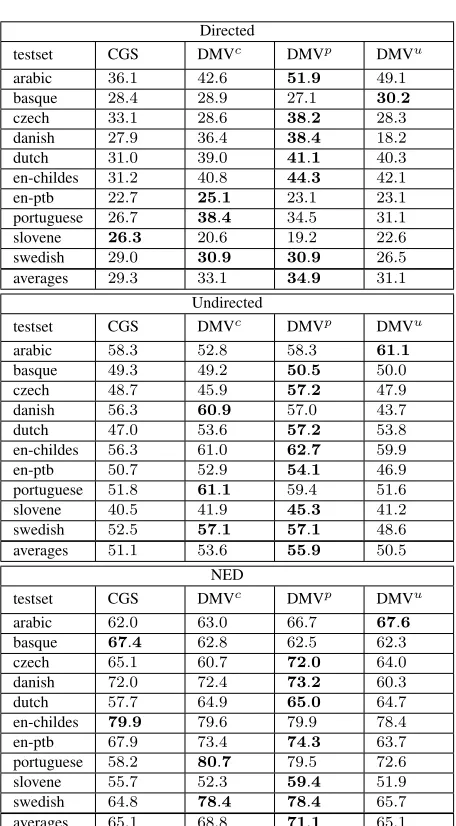
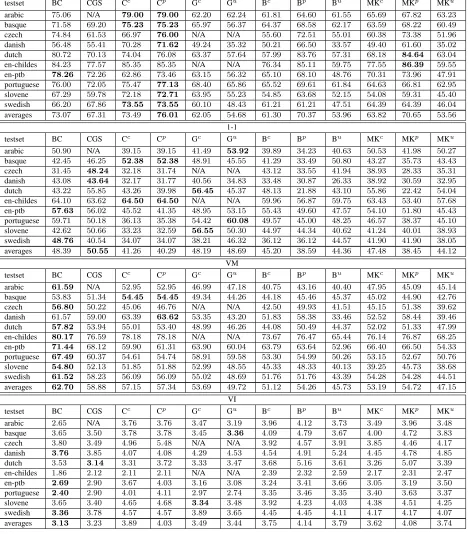
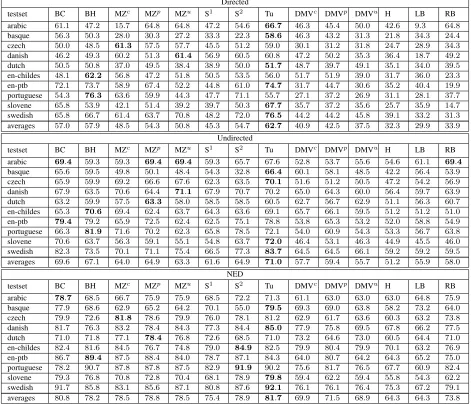
Appendix
Directed
testset CGS DMVc DMVp DMVu
arabic 36.1 42.6 51.9 49.1
basque 28.4 28.9 27.1 30.2
czech 33.1 28.6 38.2 28.3
danish 27.9 36.4 38.4 18.2
dutch 31.0 39.0 41.1 40.3
en-childes 31.2 40.8 44.3 42.1
en-ptb 22.7 25.1 23.1 23.1
portuguese 26.7 38.4 34.5 31.1
slovene 26.3 20.6 19.2 22.6
swedish 29.0 30.9 30.9 26.5
averages 29.3 33.1 34.9 31.1
Undirected
testset CGS DMVc DMVp DMVu
arabic 58.3 52.8 58.3 61.1
basque 49.3 49.2 50.5 50.0
czech 48.7 45.9 57.2 47.9
danish 56.3 60.9 57.0 43.7
dutch 47.0 53.6 57.2 53.8
en-childes 56.3 61.0 62.7 59.9
en-ptb 50.7 52.9 54.1 46.9
portuguese 51.8 61.1 59.4 51.6
slovene 40.5 41.9 45.3 41.2
swedish 52.5 57.1 57.1 48.6
averages 51.1 53.6 55.9 50.5
NED
testset CGS DMVc DMVp DMVu arabic 62.0 63.0 66.7 67.6
basque 67.4 62.8 62.5 62.3
czech 65.1 60.7 72.0 64.0
danish 72.0 72.4 73.2 60.3
dutch 57.7 64.9 65.0 64.7
en-childes 79.9 79.6 79.9 78.4
en-ptb 67.9 73.4 74.3 63.7
portuguese 58.2 80.7 79.5 72.6
slovene 55.7 52.3 59.4 51.9
swedish 64.8 78.4 78.4 65.7
[image:15.612.313.541.94.507.2]averages 65.1 68.8 71.1 65.1
M-1
testset BC CGS Cc Cp Gc Gu Bc Bp Bu MKc MKp MKu
arabic 75.06 N/A 79.00 79.00 62.20 62.24 61.81 64.60 61.55 65.69 67.82 63.23
basque 71.58 69.20 75.23 75.23 65.97 56.37 64.37 68.58 62.17 63.59 68.22 60.49
czech 74.84 61.53 66.97 76.00 N/A N/A 55.60 72.51 55.01 60.38 73.38 51.96
danish 56.48 55.41 70.28 71.62 49.24 35.32 50.21 66.50 33.57 49.40 61.60 35.02
dutch 80.72 70.13 74.04 76.08 63.37 57.64 57.99 83.76 57.31 68.18 84.64 63.04
en-childes 84.23 77.57 85.35 85.35 N/A N/A 76.34 85.11 59.75 77.55 86.39 59.55
en-ptb 78.26 72.26 62.86 73.46 63.15 56.32 65.10 68.10 48.76 70.31 73.96 47.91
portuguese 76.00 72.05 75.47 77.13 68.40 65.86 65.52 69.61 61.84 64.63 66.81 62.95
slovene 67.29 59.78 72.18 72.71 63.95 55.23 54.85 63.68 52.15 54.08 59.31 45.40
swedish 66.20 67.86 73.55 73.55 60.10 48.43 61.21 61.21 47.51 64.39 64.39 46.04
averages 73.07 67.31 73.49 76.01 62.05 54.68 61.30 70.37 53.96 63.82 70.65 53.56
1-1
testset BC CGS Cc Cp Gc Gu Bc Bp Bu MKc MKp MKu
arabic 50.90 N/A 39.15 39.15 41.49 53.92 39.89 34.23 40.63 50.53 41.98 50.27
basque 42.45 46.25 52.38 52.38 48.91 45.55 41.29 33.49 50.80 43.27 35.73 43.43
czech 31.45 48.24 32.18 31.74 N/A N/A 43.12 33.55 41.94 38.93 28.33 35.31
danish 43.08 43.64 32.17 31.77 40.56 34.83 33.48 30.87 26.33 38.92 30.59 32.95
dutch 43.22 55.85 43.26 39.98 56.45 45.37 48.13 21.88 43.10 55.86 22.42 54.04
en-childes 64.10 63.62 64.50 64.50 N/A N/A 59.96 56.87 59.75 63.43 53.40 57.68
en-ptb 57.63 56.02 45.52 41.35 48.95 53.15 55.43 49.60 47.57 54.10 51.80 45.43
portuguese 59.71 50.18 36.13 35.38 54.42 60.08 49.57 45.00 48.25 46.57 38.37 45.10
slovene 42.62 50.66 33.23 32.59 56.55 50.30 44.97 44.34 40.62 41.24 40.01 38.93
swedish 48.76 40.54 34.07 34.07 38.21 46.32 36.12 36.12 44.57 41.90 41.90 38.05
averages 48.39 50.55 41.26 40.29 48.19 48.69 45.20 38.59 44.36 47.48 38.45 44.12
VM
testset BC CGS Cc Cp Gc Gu Bc Bp Bu MKc MKp MKu
arabic 61.59 N/A 52.95 52.95 46.99 47.18 40.75 43.16 40.40 47.95 45.09 45.14
basque 53.83 51.34 54.45 54.45 49.34 44.26 44.18 45.46 45.37 45.02 44.90 42.76
czech 56.80 50.22 45.06 46.76 N/A N/A 42.50 49.93 41.51 45.15 51.38 39.62
danish 61.57 59.00 63.39 63.62 53.35 43.20 51.83 58.38 33.46 52.52 58.44 39.46
dutch 57.82 53.94 55.01 53.40 48.99 46.26 44.08 50.49 44.37 52.02 51.33 47.99
en-childes 80.17 76.59 78.18 78.18 N/A N/A 73.67 76.47 65.44 76.14 76.87 68.25
en-ptb 71.44 68.12 59.90 61.31 63.90 60.04 63.79 63.64 52.96 66.40 66.50 54.33
portuguese 67.49 60.37 54.61 54.74 58.91 59.58 53.30 54.99 50.26 53.15 52.67 50.76
slovene 54.80 52.13 51.85 51.88 52.99 48.55 45.33 48.33 40.13 39.25 45.73 38.68
swedish 61.52 58.23 56.09 56.09 55.02 48.69 51.76 51.76 43.39 54.28 54.28 44.51
averages 62.70 58.88 57.15 57.34 53.69 49.72 51.12 54.26 45.73 53.19 54.72 47.15
VI
testset BC CGS Cc Cp Gc Gu Bc Bp Bu MKc MKp MKu
arabic 2.65 N/A 3.76 3.76 3.47 3.19 3.96 4.12 3.73 3.49 3.96 3.48
basque 3.65 3.50 3.78 3.78 3.45 3.36 4.09 4.79 3.67 4.00 4.72 3.83
czech 3.80 3.49 4.96 5.48 N/A N/A 3.92 4.57 3.91 3.85 4.46 4.17
danish 3.76 3.85 4.07 4.08 4.29 4.53 4.54 4.91 5.24 4.45 4.78 4.85
dutch 3.53 3.14 3.31 3.72 3.33 3.47 3.68 5.16 3.61 3.26 5.07 3.39
en-childes 1.86 2.12 2.11 2.11 N/A N/A 2.39 2.32 2.59 2.17 2.31 2.47
en-ptb 2.69 2.90 3.67 4.03 3.16 3.08 3.24 3.41 3.66 3.05 3.19 3.50
portuguese 2.40 2.90 4.01 4.11 2.97 2.74 3.35 3.46 3.35 3.40 3.63 3.37
slovene 3.65 3.40 4.65 4.68 3.34 3.48 3.92 4.23 4.03 4.38 4.51 4.25
swedish 3.36 3.78 4.57 4.57 3.89 3.65 4.45 4.45 4.11 4.17 4.17 4.07
[image:16.612.74.543.120.654.2]averages 3.13 3.23 3.89 4.03 3.49 3.44 3.75 4.14 3.79 3.62 4.08 3.74
Directed
testset BC BH MZc MZp MZu S1 S2 Tu DMVc DMVp DMVu H LB RB arabic 61.1 47.2 15.7 64.8 64.8 47.2 54.6 66.7 46.3 45.4 50.0 42.6 9.3 64.8
basque 56.3 50.3 28.0 30.3 27.2 33.3 22.3 58.6 46.3 43.2 31.3 21.8 34.3 24.4
czech 50.0 48.5 61.3 57.5 57.7 45.5 51.2 59.0 30.1 31.2 31.8 24.7 28.9 34.3
danish 46.2 49.3 60.2 51.3 61.4 56.9 60.5 60.8 47.2 50.2 35.3 36.4 18.7 49.2
dutch 50.5 50.8 37.0 49.5 38.4 38.9 50.0 51.7 48.7 39.7 49.1 35.1 34.0 39.5
en-childes 48.1 62.2 56.8 47.2 51.8 50.5 53.5 56.0 51.7 51.9 39.0 31.7 36.0 23.3
en-ptb 72.1 73.7 58.9 67.4 52.2 44.8 61.0 74.7 31.7 44.7 30.6 35.2 40.4 19.9
portuguese 54.3 76.3 63.6 59.9 44.3 47.7 71.1 55.7 27.1 37.2 26.9 31.1 28.1 37.7
slovene 65.8 53.9 42.1 51.4 39.2 39.7 50.3 67.7 35.7 37.2 35.6 25.7 35.9 14.7
swedish 65.8 66.7 61.4 63.7 70.8 48.2 72.0 76.5 44.2 44.2 45.8 39.1 33.2 31.3
averages 57.0 57.9 48.5 54.3 50.8 45.3 54.7 62.7 40.9 42.5 37.5 32.3 29.9 33.9
Undirected
testset BC BH MZc MZp MZu S1 S2 Tu DMVc DMVp DMVu H LB RB
arabic 69.4 59.3 59.3 69.4 69.4 59.3 65.7 67.6 52.8 53.7 55.6 54.6 61.1 69.4
basque 65.6 59.5 49.8 50.1 48.4 54.3 32.8 66.4 60.1 58.1 48.5 42.2 56.4 53.9
czech 65.9 59.9 69.2 66.6 67.6 62.3 63.5 70.1 51.6 51.2 50.5 47.2 54.2 56.9
danish 67.9 63.5 70.6 64.4 71.1 67.9 70.7 70.2 65.0 64.3 60.0 56.4 59.7 63.9
dutch 63.2 59.9 57.5 63.3 58.0 58.5 58.5 60.5 62.7 56.7 62.9 51.1 56.3 60.7
en-childes 65.3 70.6 69.4 62.4 63.7 64.3 63.6 69.1 65.7 66.1 59.5 51.2 51.2 51.0
en-ptb 79.4 79.2 65.9 72.5 62.4 62.5 75.1 78.8 53.8 65.3 53.2 52.0 58.8 54.9
portuguese 66.3 81.9 71.6 70.2 62.3 65.8 78.5 72.1 54.0 60.9 54.3 53.3 56.7 63.8
slovene 70.6 63.7 56.3 59.1 55.1 54.8 63.7 72.0 46.4 53.1 46.3 44.9 45.5 46.0
swedish 82.3 73.5 70.1 71.1 75.4 66.5 77.3 83.7 64.5 64.5 66.1 59.2 59.2 59.5
averages 69.6 67.1 64.0 64.9 63.3 61.6 64.9 71.0 57.7 59.4 55.7 51.2 55.9 58.0
NED
testset BC BH MZc MZp MZu S1 S2 Tu DMVc DMVp DMVu H LB RB
arabic 78.7 68.5 66.7 75.9 75.9 68.5 72.2 71.3 61.1 63.0 63.0 63.0 64.8 75.9
basque 77.9 68.6 62.9 65.2 64.2 70.1 55.0 79.5 69.3 69.0 63.8 58.2 73.2 64.0
czech 79.9 72.6 81.8 78.6 79.9 76.0 78.1 81.2 62.9 61.7 63.6 60.3 63.2 73.8
danish 81.7 76.3 83.2 78.4 84.3 77.3 84.4 85.0 77.9 75.8 69.5 67.8 66.2 77.5
dutch 71.0 71.8 77.1 78.4 76.8 72.6 68.5 71.0 73.2 64.6 73.0 60.5 64.4 71.0
en-childes 82.4 81.6 84.5 76.7 74.8 79.0 84.9 82.5 79.9 80.4 79.9 70.1 63.2 76.9
en-ptb 86.7 89.4 87.5 88.4 84.0 78.7 87.1 84.3 64.0 80.7 64.2 64.3 65.2 75.0
portuguese 78.2 90.7 87.8 87.8 87.5 82.9 91.9 90.2 75.6 81.7 76.5 67.7 60.9 82.4
slovene 79.3 76.8 70.8 72.8 70.4 68.1 78.9 79.8 59.4 62.2 59.4 55.8 54.3 62.2
swedish 91.7 85.8 83.1 85.6 87.1 80.8 87.6 92.1 76.1 76.1 76.4 75.3 67.2 79.1
[image:17.612.71.542.177.585.2]averages 80.8 78.2 78.5 78.8 78.5 75.4 78.9 81.7 69.9 71.5 68.9 64.3 64.3 73.8