20 March 2005
Don Passey
Any queries about this report should be sent to:
Don Passey Senior Research Fellow Department of Educational Research
Lancaster University Lancaster LA1 4YL
Tel: 01524 593600
Email: [email protected]
Acknowledgements
Contents
1. Executive summary 1
2. Introduction to this report 4
3. Background to the ICT in the Home pilot 5
4. Aims and objectives of this evaluation study 7
5. Methods and approaches to undertake the evaluation 8
6. Evidence base of this evaluation study 10
7. Findings and outcomes 11
8. Outcomes related to evaluation criteria 22
1.
Executive summary
Introduction to this report
1. This report details the outcomes identified and the implications arising from an evaluation of a specific school pilot being undertaken within the Aston Pride Information and
Communication Technologies (ICT) Phase 1 Project.
2. It should be noted that the outcomes have been identified at an early stage, with the pilot having been in place only a matter of months.
Background to the ICT in the Home pilot
3. An element of the Aston Pride ICT Phase 1 Project has been a concern to look at ways in which schools can be involved with and support community based capacity building, particularly in terms of ICT skills and employment, or through the medium of ICT. One of the pilots selected by the Aston Pride board to meet these needs was proposed by Prince Albert J/I School. Its intention was to provide computers on loan to homes, supported by training sessions within the school, and further supported within the home environment by mentoring through children.
4. Prince Albert J/I School had been involved in a range of ICT developments prior to this pilot being proposed.
5. The pilot as proposed was intended to contrast with other models concerned with the introduction of ICT knowledge and skills into the community, particularly those models where computers were centrally based in a community building.
Aims and objectives of this evaluation study
6. It was agreed with the Aston Pride ICT Project team that the evaluation would focus on a specific number of pilot objectives, using appropriate criteria, so that outcomes arising could be reported as early as possible.
7. Outcomes from an evaluation conducted in January and February 2005 can only be indicative; the evaluation was not intended to provide summative evaluation evidence, but to report on formative feedback that could be indicative of implementation outcomes.
Methods and approaches to undertake the evaluation
8. Evaluation evidence was gathered during visits to the school, in order to see training in action, to look at training and school-based data, to interview pupils, family members and key managers, and to run questionnaires as appropriate.
Evidence base of this evaluation study
9. Evaluation evidence was gathered from a wide range of sources, including documentary evidence, school-based data, key manager responses, teacher and school staff responses, pupil and parent responses, and training session observations.
Findings and outcomes
11. The school is well resourced in terms of ICT. The expertise of staff in terms of ICT is high, and the school has 2 technicians that support network and curriculum needs. ICT has been used prior to this pilot to support learning at home for some pupils.
12. By January 2005 15 PCs were under trial in homes, and a variety of meetings had been run with parents. Of the 15 families involved, only 2 had PCs in the home already (even though the pupils had acquired high levels of ICT capability in the school), and none had internet access. Five pupils with high levels of ICT capability were selected from each of the three year 5 classes.
13. By January 2005, 11 training sessions had been run in the school, all run as evening sessions after school. The average attendance was 6 sessions (to one significant figure). Initial sessions indicated that family members often had low levels of ICT skills.
14. Technical support and liaison for the pilot had been undertaken entirely by the project manager, who was employed by the school. Overall, from records kept, technical support time involved had been:
Computer and peripheral equipment set-up, 1 hour per home.
Internet provision and set-up, 0.5 hour per home.
Addressing technical problems that arise, 0.3 hour per home per month
15. Including the 15 pupils, 124 people had been affected in terms of use of the 15 PCs. If this pilot was scaled up to cover the entire school, then the number of people affected could be in the order of 2,000.
16. Many pupils use the computers for educational purposes, for homework, research, and specific activities such as revision or identifying interesting books to read.
17. Many mothers have, through the use of the home computers, experienced computer use for the first time. Of 13 mothers, 10 were reported to be using a computer for the first time. A high number used the internet to access native music.
18. Of 13 fathers, 7 were reported to be using a computer for the first time. A high number used the ICT to support aspects of employment (11 cases were reported).
19. The highest proportional level of use by brothers and sisters that was reported was for educational purposes (coursework, homework or school work).
20. The highest proportional use by other family members that was reported was for playing games, but high levels of use for school work, research, and employment were also reported. The use of email was specified in a number of cases.
21. Pupils feel that their computer skills are increasing as a result of having home access. Many report that they feel they are able to keep their work tidier. A teacher indicated that of five pupils in her class, one pupil had improved a great deal in numeracy, that two pupils were now felt to be more confident, and that one pupil was now doing extra homework and sending emails to her about work
22. Pupils with home computers have gained in terms of added value in reading more than have pupils without home computers.
23. Pupils with home computers have gained in terms of added value in mathematics more than have pupils without home computers.
24. Of three parents interviewed, all indicated the value and usefulness of having a computer at home. All parents felt that the computer was helping their children.
Outcomes related to evaluation criteria
26. Even though the pilot is at an early stage, and none of the dates specified in the proposal when outcomes would be realised have yet been reached, there are strong outcomes in terms of certain evaluation criteria already.
27. This is an important trial pilot model, which is achieving success at an early stage. It is a model that is working in the context of the community. The sustainability of the model will need to be considered in wider terms, but at this stage success has been gained at levels above those that might have been expected.
Conclusions and recommendations
28. The pilot outcomes suggest already that this is an approach to supporting community skills that should be taken further. This pilot is at a first stage, but outcomes are already indicative of high levels of engagement and outcome, which is suggestive of a potentially wider application of this approach.
29. There are indications of the ICT facilities being used to support work and employment. Many family members use the ICT facilities to support school work, coursework and homework. Of the 15 families, 11 fathers, 1 mother and 6 other family members use the facilities for work purposes. Examples of enhanced business prospects, enhanced business efficiency and enhance business effectiveness already exist.
30. Many family members are using computers for the first time (13 mothers and 7 fathers are included). There are reports of ICT skills that have developed and applied that have not been accessible before. Some family members are pursuing personal interests that are engaging them in ICT use (finding and listening to native songs and music, for example). This form of avenue should be explored further across Aston Pride.
31. How this pilot could be developed across Aston Pride, involving all pupils in Prince Albert J/I School, and progressively all pupils in all schools across Aston Pride, should be considered strongly. Evidence indicates that this pilot is working successfully within the context of the Aston Pride community. A widening of this pilot could have a strong and wide impact on community needs in the future.
2.
Introduction to this report
This report details the outcomes identified and the implications arising from an evaluation of a specific school pilot being undertaken within the Aston Pride ICT Phase 1 Project. The report details the basis on which the evaluation of the ICT in the Home pilot in Prince Albert J/I School was commissioned, the methods adopted to gather evidence, findings identified, conclusions drawn, and recommendations given on the basis of the evidence arising.
It should be noted that the outcomes have been identified at an early stage, with the pilot having been in place only a matter of months. However, the results are judged to be significant, and it is felt that the level of outcomes arising warrant recommendations being offered, even after only a short period of implementation.
3.
Background to the ICT in the Home pilot
The Aston Pride ICT Phase 1 Project
The Aston Pride ICT Phase 1 Project is described as, ‘an innovative £2m project intended to initiate a basic physical and skills-based broadband ICT infrastructure to the community of Aston Pride in Birmingham. Part of a £54m regeneration programme by Aston Pride
Partnership, this two-year project managed by the City Council Education IT Department is funded by New Deals for Communities, ESF and ERDF. At the core of the project is the provision of 5 fixed and 1 mobile broadband learning centres in which over 1,000 residents will receive basic ICT training, and all residents can access and experience free broadband Internet services. A Community Web Portal will facilitate the provision of community-driven and controlled resources, as well as a channel for other Aston Pride projects. A range of other activities such as community research and consultation and connectivity pilots will seek to inform the future direction of the community ICT needs. Having established the capacity and infrastructure, the project is about to begin delivering the core revenue-based activities, which must be complete for the project end date of March 2005’.
An element of the Aston Pride ICT Phase 1 Project has been a concern to look at ways in which schools can be involved with and support community based capacity building,
particularly in terms of ICT skills and employment, or through the medium of ICT. One of the pilots selected by the Aston Pride board to support community based capacity building was the pilot that is the focus of this report. The pilot was proposed by Prince Albert J/I School, and its intention was to provide computers on loan to homes, supported by training sessions within the school, and further supported within the home environment by mentoring through children.
Previous Prince Albert J/I School community based projects
Prince Albert J/I School had been involved in a range of ICT developments prior to this pilot being proposed. In 2003 the school completed a short project called ‘Anywhere Anytime Learning in Aston’. In this project year 4 pupils took laptops home for a short period and used them to support their own learning. One outcome of that project was to raise the school awareness of the low level of ICT knowledge and skills within the pupils’ families.
The focus of the ICT in the Home pilot
The school has high levels of communication with the community and with pupils’ families, and is well aware of the overall low skill levels with regard to ICT. This is due often to a low level of computer ownership and internet access within pupils’ homes. Even where ICT skills of the community and families are being supported through courses offered in community centres, the school has become increasingly aware of a reluctance (particularly of Asian women) to join these ICT courses. The school also recognises that ICT knowledge and skill levels are crucial elements in enhancing current as well as future employment prospects.
The pilot proposed by the school was put forward on the basis of providing an implementation that would seek to address the lack of ICT skills, within the context of community needs and concerns. The pilot sought to take the practice already developed in the past, and to look at how to develop ICT within family units, using a partnership involving the school, children, and adults.
The ICT in the Home pilot proposal
It was proposed that between 20 and 30 selected families of year 4 and year 5 pupils would gain access to a loan computer with appropriate software that was internet linked. As a part of the condition of the loan, a named representative adult from each of the selected families would be given the chance to receive training on the use of the computer and software. It was proposed that this would be facilitated in specially created adult and child workshops that would be linked to a European Computer Driving Licence (ECDL) qualification. It was proposed that the development of ICT skills in the workshops would support a wider dissemination of ICT practice within the family unit. The school proposed a model where trainers included the children, and the children’s extended skills would be used to support their family units. It was proposed that the computer access in the home would provide a facility to enable whole family training, so that the specially delivered school-based training sessions would be cascaded within the family home.
In the initial stages of the project, it was proposed that computers would be on loan to the family units, but owned by Aston Pride. Families would need to accept responsibility for the safe keeping of the computer equipment, but the computers would ultimately be offered for sale to the parents. It was suggested that this would provide a source of income for the
Birmingham e-learning Foundation, which in turn could generate further government funding, linked to its ‘Anywhere Anytime Learning’ plan. The e-learning Foundation would then be in a position to provide more computers for schools and families in the Aston Pride area.
The school considered a range of safeguards within its proposal. To prevent inappropriate internet access and accidental misuse, connectivity would be offered through the Birmingham Grid for Learning (BGfL). BGfL PLUS (a virtual learning environment within BGfL), would be available to families, and it was anticipated that this environment would support high levels of communication between members of the project.
The proposal identified a range of anticipated outputs at particular times. It was proposed that ECDL-linked training, available to some 20 to 30 families, involving about 240 training hours in total, would be completed by April 2005, that enhancement of self-learning skills of
training members would be recognised by April 2005, that a family ICT training course linked to community needs would be completed by December 2005, that raised skill levels of pupils would be recognised by April 2006, and that a trialled model for introducing ICT into the community would be completed by April 2006.
The school indicated in its proposal that a range of community groups would be likely to benefit from this project. It indicated that the local community would benefit through improved employment prospects, that the school would benefit through greater parental involvement, and that Aston Pride would have a sustainable and workable model for
4.
Aims and objectives of this evaluation study
The aims of this evaluation study were set out within the evaluation proposal. The aims as stated were concerned with looking at the progress and the outcomes of the ICT in the Home pilot after a short implementation period, in order to identify any outcomes that could inform the next phase of the Aston Pride ICT Project. It was agreed with the Aston Pride ICT Project team that the evaluation would focus on a specific number of pilot objectives, using
appropriate criteria, so that outcomes identified could be reported by the end of February 2005. These outcomes were reported verbally, and this report details those outcomes.
Evaluation objectives were selected on the basis of their being in line with pilot objectives. Eleven pilot objectives were selected, and evaluation objectives were set on the basis of the need to measure outcomes of these pilot objectives. Specifically, the pilot objectives and features identified for measurement were:
ECDL-linked training.
Enhancement of self-learning skills.
Family ICT training course linked to community needs.
Raised skill levels of pupils.
Trialled model of introducing ICT into the community.
On-line attendance.
Enhanced ICT knowledge and skills for community adults.
Whole family unit training - school based training cascaded within the family home .
Improved employment prospects for the local community.
Greater parental involvement in the school community.
A sustainable working model for delivering ICT knowledge and skills to the community.
5.
Methods and approaches to undertake the evaluation
In order to evaluate the outcomes of this pilot, and to inform at the level of the potential that this pilot might have for application at a wider level, it was proposed that evidence be
gathered in a range of ways. The evaluation proposed to make visits to the school and the area over a one week period, at a suitable and selected time during January 2005, to match school needs, and to gather data in a number of ways. The visits would provide opportunity to see training in action and to talk to the trainer, look at the training records of ECDL outcomes, look at school based contextual data, interview pupils involved, interview family members involved, run questionnaires with pupils and family members, and interview the key managers involved.
In the light of the pilot objectives that were selected for measurement, suitable methods were suggested for evidence gathering, and ways that evidence would be reported were also proposed. The design, the methods involved, and the reporting features suggested, are outlined in the table following.
Criteria (what to
measure) How to measure the criteria Who to involve in evidence gathering Features and concerns for reporting
EDCL linked training Numbers and how far they have got
Trainer and records Implications of the extent moved within particular time periods
Enhancement of self-learning skills
Interview and questionnaire
Pupils and family members
Implications for involvement in other pilots in other situations
Family ICT training course linked to community needs
Interview Trainer and family members
Implications for future preparation and training in pilots of this nature
Raised skill levels of pupils
Questionnaires Pupils Implications for outcomes in future pilots
Trialled model of introducing ICT into the community
Analysis of evidence, and interviews with key managers
Managers Implications for widening the pilot to other situations
Online attendance Interview with key managers
Managers Implications for use in other pilots
Enhanced ICT knowledge and skills for community adults
Interview and questionnaire
Family members Implications for outcomes from future pilots in other situations
Whole family unit training - school based training cascaded within the family home
Interview Family members Implications for the design of other future pilots
Improved employment prospects for the local community
Analysis of evidence, and interviews with key managers
Managers Implications for future outcomes
Greater parental involvement in the school community
Interview with key managers
Managers Implications for outcomes from other pilots
A sustainable working model for delivering ICT knowledge and skills to the community
Analysis of evidence, and interviews with key managers
Table 1: Details of evaluation criteria, methods, and reporting implications
6.
Evidence base of this evaluation study
Within the time scale available, the widest range of evidence possible was gathered in order to inform this report. Specifically, the forms of evidence gathered were:
Documentary evidence (the original pilot proposal documents, and other documentary material produced by pilot managers).
Manager interviews (the project manager and head teacher were interviewed and involved in discussions on two separate occasions).
Teacher and school staff discussions (two teachers and two school staff were involved).
Pupil interviews (15 pupils were interviewed individually).
Parent interviews (3 parents were interviewed).
Pupil questionnaires (15 pupils completed a questionnaire, on two separate occasions).
Training session observation (15 family representatives and children were observed in a training session).
7.
Findings and outcomes
Background information
Prince Albert J/I School is a large primary school, with some 750 pupils. The nursery unit has provision for 77 children and the majority continue their education in the main school. Whilst pupils come from a full range of economic backgrounds, over half of them are eligible for free school meals. Pupils enter the school with relatively low levels of skills, particularly in terms of speaking and listening.
It is a multi-ethnic school; the pupils come mainly from Pakistani and Bangladeshi
backgrounds, and there are very few white pupils. Virtually all the pupils come from homes where English is not the first language spoken. A large number of the pupils are of second and third generation. It is recognised that the community is strong in cultural traditions.
Aspirations of pupils are considered to be high. As ICT use has developed across the school, staff expectations of pupils have increased also. Family support is considered to be positive, although some financial deprivation exists. The school seeks to work with parents and the community in order to enhance the educational outcomes and prospects of pupils.
The school ICT background
The school is well resourced in terms of ICT. It has a custom-built resource centre with sound system and interactive whiteboard, and classrooms also have computer facilities and a number have interactive whiteboards. The expertise of staff in terms of ICT is high, and the school has 2 technicians that support network and curriculum needs. There are displays of pupil work using ICT around the school. For example, the use of Photoshop to manipulate and create imagery was displayed in the hall at one point, showing pupil work undertaken with a professional artist. Teacher uses of ICT are varied. One teacher, for example, used a digital camera to capture video and images of gymnastic movements using specific software. A video of a forward roll could be captured, for example, and images could be frozen, so that techniques could be discussed. Images could be slowed down so that pupils could cross reference their performance with previous results.
ICT has been used prior to this pilot to support learning at home for some pupils. Laptops have been used at home by some pupils for research, and to create MS PowerPoint presentations. Work has also been sent by some pupils to teachers by email.
Preparedness for undertaking a home ICT pilot
The school clearly had the capability, through staff and pupil expertise and capacity, through experience with a range of technologies and applications, to develop further ICT provision at a school and home level at the outset of the pilot. The school had considered the need to work through a series of pilots that would enable the full scalability at a school level and beyond to be considered adequately. For the pilot to work fully, however, parents clearly needed to be involved and to have confidence in the school if this initiative was to succeed.
primary guarantee initiative had been agreed with Aston Pride, which involved pupils in residential experiences.
Reasoning behind the pilot
It was felt by school staff that traditional routes, involving the running of courses through FE colleges, were not reaching parent and community populations widely. To address this perceived limitation, home learning was proposed as a pilot in the school. In this pilot, 30 PCs would initially go into pupils’ homes. The pupils involved would all be in one year group. The pupil would act as a prime educator in the home, especially as the pupils in the classes involved were estimated to be at level 4 or level 5 in ICT already. Internet connectivity at home was to be provided, and parents could attend an evening session at the school, where they could learn with their children, then go home to try out further what they had learned and to develop further practice.
The overall stage of the pilot reached by January 2005
By January 2005 15 PCs were under trial in homes, and a variety of meetings had been run with parents. Of the 15 families involved, only 2 had computers in the home already (even though the pupils had acquired high levels of ICT capability in the school), and none had internet access. Parents were given a 2 year option to use the facilities, then to be able to buy the equipment. The pilot involved the use of standalone computers, selected because of their memory capacity, robustness, and their ability to be housed in ways that would allow them to be used in a family-based way. The school employed a project manager, who spent time going into houses to set up the computer systems, and addressing any technical problems arising. Considerable effort was put into training, as some parents had no mouse skills when they started.
Implementing the pilot
By January 2005, 15 year 5 families had been involved in the computer home access pilot. Five pupils with high levels of ICT capability were selected from each of the three year 5 classes. Parents were asked if they would like to be involved, and of the original 15 selected, 14 agreed. One other family was substituted in order to run the full pilot. By January 2005, all 15 homes had robust computer access, and 12 had robust internet access.
Of the 15 year 5 pupils involved, 6 were girls and 9 were boys, 10 were of Bangladeshi origin, and 5 were of Pakistani origin. The project manager’s records indicated that the computers were installed between August 2004 and December 2004, while internet installation for 12 homes was installed between October 2004 and December 2004.
By January 2005, 11 training sessions had been run in the school, all run as evening sessions after school. Attendance records showed that 2 families had been represented in all sessions, 3 families had been represented in no sessions, and the remaining 10 families had been
represented in between 2 and 10 sessions. The average attendance was 6 sessions (to one significant figure).
Technical support
The project manager estimated the time needed to un-box the computer, to gather all the items needed, to travel to a home, and to unpack and set the computer up, to be about one hour. The total time involved for the setting up was therefore some 15 hours.
For internet access, the project manager had to fix the router and configure it, travel to the home, and install Sophos antivirus software. This took about 30 minutes per household, or a total of 7.5 hours.
Supporting technical problems arising has taken approximately the same time. Some rebuilds have been necessary, as well as the need to tackle other problems. The project manager recorded some 34 occasions when it was necessary to visit homes to address problems. Some of these were severe and required re-ghosting, while others took less time. The time to undertake re-ghosting, with travel time, then having to reset the printer and Sophos antivirus software, was about 45 minutes. The total estimated time involved in addressing technical problems was some 22 hours. For 15 homes over a period of 5 months, this equates to an average technical support time need of about 0.3 hour per home per month.
Overall, from the records kept, technical support time involved was:
Computer and peripheral equipment set-up, 1 hour per home.
Internet provision and set-up, 0.5 hour per home.
Addressing technical problems that arose, 0.3 hour per home per month.
By January 2005, all 15 homes had robust computer access, and 12 had robust internet access. Of the 3 homes without internet access, one was in dispute due to lack of attendance at training sessions, and in 2 cases there were no BT lines into the homes. Delays with internet connection had arisen for unexpected reasons in some cases. In two cases this was due to a difference between the family name used in school and the family name on BT records, and in one case this was due to a language issue and a consequent lack of understanding.
Training sessions
The project manager was responsible for designing and running all training sessions by February 2005. Training sessions lasted some 40 minutes, and some 30 minutes preparation time was involved for each one. Training sessions started at 3.40 p.m., with family
representatives and pupils working together. Pupils did not attend if a family representative was not present. Parents were asked initially which days they could attend training sessions, but whether parent attendance had been affected by employment needs or for other reasons, had not been explored.
Initial sessions indicated that family members often had low ICT skills. In one session, all 7 family representatives attending could not use a mouse, so sessions were run on how to use a mouse. Sessions had been designed by the project manager to match the needs of family representatives rather than being run to a previously constructed training plan.
accessed the internet, or produced a birthday card, or wrote the days of the week in an MS Word document. Previous attendance patterns, and previous ICT skills, tended to determine the activities being undertaken. For example, one mother wrote the days of the week in an MS Word document (she knew no English when she started the sessions, and the ICT was
supporting her learning of English). Of 12 families represented at one point, 9 were mothers and 3 were fathers.
It was planned that the school would run the training after an initial trial period, with two school staff being responsible for this. The original intention to provide ECDL training was being explored further in January 2005. No ECDL training had been provided at pupil or parent level by February 2005. The school at that time was looking at how to apply to become an ECDL centre.
Pupil mentoring
By February 2005 there was no particular structure adopted for pupil mentoring. The only structure involved was that arising in training sessions, and no follow-up or specific exercises were identified in training sessions for pupils or family representatives to do at home. There was no model to help pupils to mentor those family representatives who did not attend training sessions.
Pupil feedback on impacts and outcomes
In January 2005, the 15 pupils were involved in a questionnaire feedback session. Pupils were asked to provide some background information about how the pilot was working, some 3 to 4 months from the outset. Their responses indicated that:
All 15 pupils enjoyed having a computer at home.
14 said they used it when they got home from school.
15 said they used it at the weekend.
15 said they had other brothers or sisters who used it (45 in total – an average of 3 per family).
14 said they had other family members who used it (62 in total – an average of 4 per family).
14 said their family asked them to help them with using the computer.
14 said that requests for help had been made between 1 and 45 days ago, but 10 days before on average.
14 said that at least one member of their family used the computer to help with work.
10 said that at least one member of their family used it every day.
None indicated that any member of their family did not enjoy having the computer at home.
At that point, therefore, an investment in 15 home machines and 12 internet connections had, according to pupil feedback, resulted in 15 pupils having greater home access and
opportunities. But further than this, there had been engagement of 45 other brothers and sisters, and 62 other family members (107 family members in total). This is a seven-fold leverage in terms of engagement.
spares (an example of improved business effectiveness). Another father was using the computer to create cash flows and cash forecasts for a restaurant business (an example of potential improved business efficiency).
Family use and leverage
The extent of family use of the home PCs was explored further in February 2005, when each of the 15 pupils involved was interviewed individually. Pupils were asked to give details of members of the family who used the computers at home. Their collective responses are shown in the table following.
Additional users Frequency
Mothers 13
Fathers 13
Brothers 22
Sisters 20
Aunts 7
Uncles 7
Nieces 3
Nephews 3
Cousins 6
Cousin sisters 4
Cousin brothers 10
Neighbours 2
Total 109
Table 2: Additional family member users of the 15 home computers
Including the 15 pupils, 124 people have been affected in terms of use of the 15 computers. If this pilot was scaled up to cover the entire school, then the number of people affected could be high. The head teacher estimates that there are perhaps 3 pupils in the school in a single family, so, of the 750 pupils in the school in total, some 250 families are represented. If the leverage level on each family was the same as that seen in this pilot, then the number of people affected would be in the region of 2,000. This is clearly a very high level of potential leverage.
Pupil use of the computers at home
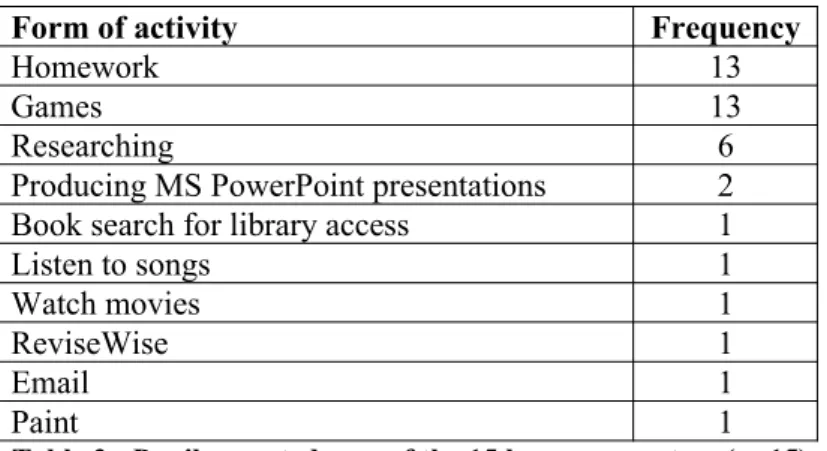
The 15 pupils involved in the pilot were asked in February 2005 about uses of the computers at home. The table following shows their collected responses.
Form of activity Frequency
Homework 13
Games 13
Researching 6
Producing MS PowerPoint presentations 2 Book search for library access 1
Listen to songs 1
Watch movies 1
ReviseWise 1
Email 1
Paint 1
The responses indicated that many pupils used the computers for educational purposes, for homework, research, and specific activities such as revision or identifying interesting books to read. One girl, for example, said that she used the internet to look at book summaries, so that she could then go to the library to check these books out and read them. Although many pupils used the computers for game activities, these activities were generally secondary to educational uses.
Use of the computers by mothers
Pupils were asked how their mothers were using the computers at home. There were responses about uses by 13 mothers, and these are collated into the table following.
Form of activity Frequency
Initial computer use 10
Internet access 5
Bengali/Indian music 5
Initial typing 1
News access 1
Excel for work 1
Table 4: Pupil reports of mothers’ uses of the 15 home computers (n=15)
It is clear from these results that many mothers have, through the use of the home computers, experienced computer use for the first time. Of the 13 mothers, 10 were reported to be using a computer for the first time. This is a high proportion, and suggests that home access is
enabling this group within the community to gain access and skills that had not happened previously through other forms of support. It should also be noted that a high number had used the internet to access native music. This is potentially significant in terms of looking further at this area of interest for this specific community group. The results suggest that many Bangladeshi and Pakistani mothers could be engaged in computer use through their interests in native music.
Use of the computers by fathers
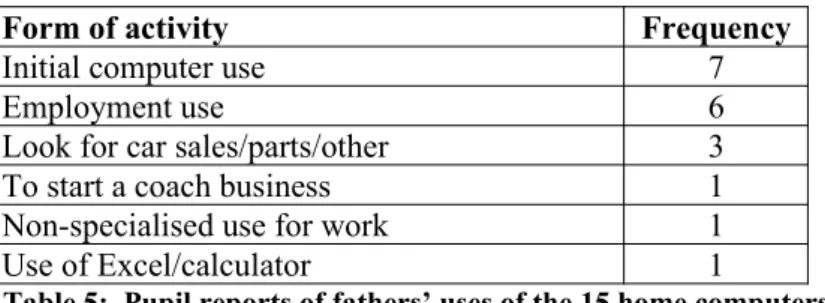
Pupils were asked how their fathers were using the computers at home. There were responses about uses by 13 fathers, and these are collated into the table following.
Form of activity Frequency
Initial computer use 7
Employment use 6
Look for car sales/parts/other 3
To start a coach business 1
Non-specialised use for work 1
Use of Excel/calculator 1
Table 5: Pupil reports of fathers’ uses of the 15 home computers (n=15)
Of the 13 fathers, 7 were reported to be using a computer for the first time. This is again a high proportion, and indicates that home access is enabling this group within the community to gain access and skills that had not happened previously through other forms of support. It should also be noted that a high number used the ICT to support employment (11 cases were reported).
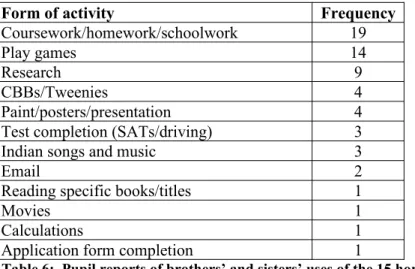
Pupils were asked how their brothers and sisters were using the computers at home. There were responses about uses by 42 brothers and sisters, and these are collated into the table following.
Form of activity Frequency
Coursework/homework/schoolwork 19
Play games 14
Research 9
CBBs/Tweenies 4
Paint/posters/presentation 4
Test completion (SATs/driving) 3
Indian songs and music 3
Email 2
Reading specific books/titles 1
Movies 1
Calculations 1
Application form completion 1
Table 6: Pupil reports of brothers’ and sisters’ uses of the 15 home computers (n=15)
The highest proportional level of use reported was for educational purposes (coursework, homework or school work). Although a proportion were reported to be playing games, it was also clear that a number of pupils had very young brothers and sisters, who were accessing games on particular web sites and gaining initial ICT skills at an early age. Native music and songs were accessed by some sisters.
Use of the computers by other family members
Pupils were asked how other family members were using the computers at home. There were responses about uses by 42 other family members, and these are collated into the table following.
Form of activity Frequency
Play games 12
School work 7
Research 6
Employment work 6
Nothing specific 4
CBBs 2
Email (to Pakistan) 2
Music and song 2
Shopping 2
Movies 1
Educational sites 1
Test completion (driving test) 1
Paint 1
Table 7: Pupil reports of other family members’ uses of the 15 home computers (n=15)
Specific pupil uses of the computers at home
Pupil uses of the computers at home have tended to focus on uses associated with literacy – many being concerned with writing, and many being concerned with reading. From the pilot pupil group, 13 pupils who were present on a specific day were asked in more detail about their uses. They completed a questionnaire that provided responses in February 2005.
They were asked about certain specific uses of the computers. The numbers indicating positive responses are shown in the table following.
Form of activity Frequency
Write 13
Complete homework 12
Find things out using the internet
11
Read things from the internet 11
Table 8: Pupil reports of specific uses of the home computers (n=13)
It is clear from these responses that pupils are using the computers at home to support writing, reading, researching, and school work generally. Pupils were asked about activities other than literacy, and about their skills more generally. Their responses are shown in the table
following.
Form of activity Frequency
Have more computer skills 13 Keep your work tidier 11 Do calculations or
mathematics
9
Table 9: Pupil reports of specific skills arising from uses of the home computers (n=13)
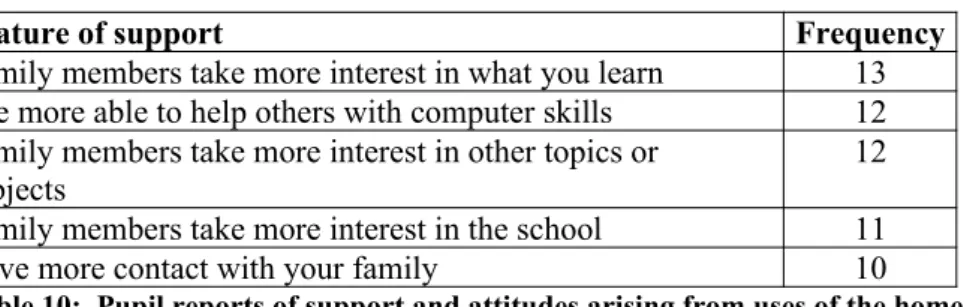
These responses indicate that pupils feel that their computer skills are increasing as a result of having home access. Many report that they feel they are able to keep their work tidier, and a large number use the facilities to do calculations or mathematics also. Pupils were asked about their support skills, and about family attitudes as a result of having a computer at home. Their responses are shown in the table following.
Feature of support Frequency
Family members take more interest in what you learn 13 Are more able to help others with computer skills 12 Family members take more interest in other topics or
subjects
12
Family members take more interest in the school 11
Have more contact with your family 10
Table 10: Pupil reports of support and attitudes arising from uses of the home computers (n=13)
indicated that one pupil had improved a great deal in numeracy, that two pupils were now felt to be more confident, and that one pupil was now doing extra homework and sending emails to her about work. She reported no observable shifts in terms of parental interest or support.
Pupils were asked further about the ICT skills of family members. Their responses are shown in the table following.
Family member skills Frequency
At least one family member can now switch a computer on 13 At least one family member can now use a mouse 12 At least one family member can now play music from the
internet
12
At least one family member can now draw or make a diagram 11 At least one family member can now browse the internet 10 At least one family member can now write a document 10 At least one family member can now do calculations of some sort 9 At least one family member can now send an email 7
Table 11: Pupil reports of family ICT skills arising from uses of the home computers (n=13)
Pupils indicated that the ICT access was leading to an enhanced level of ICT skills for family members. There were individuals who now had ICT skills that they did not have before. It should be noted that the use of these facilities within the homes was largely in a language other than English. Pupils were asked which languages were spoken at home. Their responses are shown in the table following.
Language spoken at home Frequency
Bengali 10
Urdu 3
English (with Bengali) 4
Table 12: Pupil reports of languages spoken at home (n=13)
In no cases was English spoken on its own at home, and only with another language in the case of 4 homes. Pupils were also asked whether family members had access to web sites in these languages. Four pupils indicated access to web sites in Bengali, and two indicated access to web sites in Urdu. This form of access indicates an area of interest that could be explored further in terms of engaging community groups with ICT.
Pupil skills and attainment
Pupils were selected for this pilot on the basis of their levels of ICT capability. The levels of ICT capability recorded by the school were examined for all year 5 pupils, and a comparison was undertaken to contrast the levels of ICT capability of those involved with home ICT and those where home ICT was not involved. Using the school’s approach in terms of identifying levels of ICT capability, the average level for those pupils with home ICT was level 4, compared to the average for those without home ICT, which was level 3. On average, pupils with home ICT had higher average scores in all ICT skills, in word processing, use of data bases, control, email, graphics, music and file management. They had lower average scores only in aspects concerned with uses of spreadsheets and multimedia.
comparison average was calculated for those pupils with home ICT and those without home ICT. The average results are shown in the tables following.
Total cohort 98.4 (n=69)
Total home IT cohort 96.6 (n=14)
Total non-home IT cohort 98.8 (n=55)
Total cohort 105.9 (n=69)
Total home IT cohort 106.6 (n=14)
Total non-home IT cohort 105.7 (n=55)
Table 14: Average NFER Suffolk Reading Test scores in February 2005
Average difference in points
Total cohort 7.5 (n=69)
Total home IT cohort 10.0 (n=14)
Total non-home IT cohort 6.9 (n=55)
Table 15: Average difference in points in the NFER Suffolk Reading Test scores
These results indicated that pupils with home ICT started with scores below those of the pupils without home ICT. However, the latest test results showed that this difference had been turned around, so that pupils with home ICT then had average scores above those of pupils without home ICT. The amount of added value was greater for those with home ICT. This difference was not related to the differences within particular ability bands, which was checked by contrasting the added value levels gained in different scoring bands.
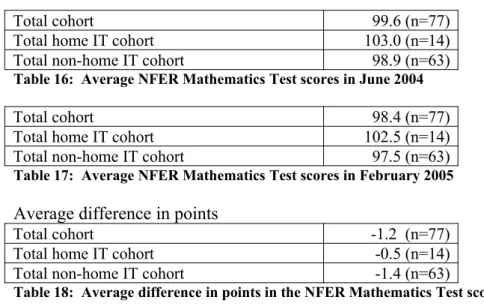
The added value related to the pupils with home ICT could be explained by the additional exposure that these pupils had to writing and reading. Many pupils with home ICT also indicated that they used the home computers for calculations or mathematics. The school records of mathematics scores for all year 5 pupils was examined, and a comparison between average scores gained by pupils with home ICT and average scores for those without home ICT was calculated. The NFER Mathematics Test was the test used by the school to look at mathematics attainment in June 2004 and February 2005. The average results are shown in the tables following.
Total cohort 99.6 (n=77)
Total home IT cohort 103.0 (n=14)
Total non-home IT cohort 98.9 (n=63)
Table 16: Average NFER Mathematics Test scores in June 2004
Total cohort 98.4 (n=77)
Total home IT cohort 102.5 (n=14)
Total non-home IT cohort 97.5 (n=63)
Table 17: Average NFER Mathematics Test scores in February 2005
Average difference in points
Total cohort -1.2 (n=77)
Total home IT cohort -0.5 (n=14)
Total non-home IT cohort -1.4 (n=63)
Table 18: Average difference in points in the NFER Mathematics Test scores
Views of parents
Of three parents interviewed, all indicated the value and usefulness of having a computer at home. All parents felt that the computer was helping their children. One mother had taken a greater interest in learning English since having the computer, and could then listen to English and films in English, she was starting to write English for the first time, although she could not speak English easily. Another mother had started to use a computer for the first time, and could then use MS Word and access the internet without help from her son. Parents felt that they understood more about the school work that their children were doing, and that they came into the school more frequently than they did before. One father indicated that although the computer was particularly valuable, that the cost for electricity was likely to be in the region of £10 per week, which was difficult to afford in his particular circumstances.
Next steps
8.
Outcomes related to evaluation criteria
ECDL-linked training
There is currently no ECDL training provided. Many family members have started from a very low base of ICT skills, and many mothers and fathers are using a computer for the first time. The school was exploring this avenue at that point in time.
Enhancement of self-learning skills
There is evidence at this early stage of some impact of home ICT upon many of the pupils. Different sources corroborate the evidence:
Most pupils reported that they were using the computer at home to undertake school work, that they could use the internet for research purposes, that they could write using the computer, and that they kept their work tidier by using the computer.
A teacher reported that from 5 pupils in her class, two appeared to be more confident, one had improved numeracy skills, and another engaged much more with homework and sent emails to her.
Three parents reported that their children were being supported directly by the computer in terms of their school work, including engaging with reading and books more.
Family ICT training course linked to community needs
The training course observed had needed to provide for a wide range of needs, including support for those family members who were non-English speakers, and those who had not used a mouse before. Some family members displayed erratic attendance, which did not easily allow a course to be planned in a non-responsive way. The school was looking at how to further develop the course sessions with key school staff.
Raised skill levels of pupils
School test results indicated that:
Pupils with home computers had gained in terms of added value in reading more than had pupils without home computers.
Pupils with home computers had gained in terms of added value in mathematics more than had pupils without home computers.
Trialled model of introducing ICT into the community
This was the first stage of a pilot that the school intended to roll out to an increasingly wider number of pupils and families. At the time of the evaluation, the first stage had been trialled, and the successes arising from the implementation within 15 homes indicated that the pilot should be further developed in order to trial the model further.
On-line attendance
This is an aspect that is due to be implemented later in the pilot. The school was reviewing its web site at the time of this evaluation, and was considering what changes could be made to increase family engagement. Access to the internet from homes via BGfL was widespread.
Enhanced ICT knowledge and skills for community adults
10 mothers were using a computer for the first time.
7 fathers were using a computer for the first time.
Access to the ICT facilities was providing for a wide age range, including very young brothers and sisters.
From across 13 families, at least one family member could as a result of the pilot:
Switch on a computer (in 13 cases).
Use a mouse (in 12 cases).
Play music from the internet (in 12 cases).
Draw or make a diagram (in 11 cases).
Browse the internet (in 10 cases).
Write a document (in 10 cases).
Do calculations of some sort (in 9 cases).
Send an email (in 7 cases).
Whole family unit training - school based training cascaded within the family home
All 15 pupils reported that they were asked by family members to support them at home. A large number of family members were using the ICT facilities provided (109 in total,
excluding the pupils themselves). There was no structured approach to the cascading process, and families that missed training sessions were not provided with specific tasks to address the aspects that they had missed.
Improved employment prospects for the local community
It was early in the pilot to assess outcomes in terms of employment prospects, but already there were indications that the ICT facilities were enhancing aspects of employment and work:
Pupils reported that 11 fathers, 1 mother and 6 other family members used the ICT facilities to support their work.
Examples of additional business prospects, improved business efficiency, and improved business effectiveness existed at that time.
Greater parental involvement in the school community
Some parents believed that they had a greater understanding of the work their children did in school, and that they attended the school more frequently. Responses from 13 pupils indicated that:
Family members took more interest in what they learned (in all cases).
Family members took more interest in the school (in 11 cases).
A sustainable working model for delivering ICT knowledge and skills to the community
9.
Conclusions and recommendations
1. This pilot was viewed at an early stage (only 3 or 4 months had lapsed since computers and internet were installed in homes in most cases), and outcomes needed to be considered in that context. Outcomes need to be considered in a formative rather than a summative way.
2. The pilot outcomes suggest that this is an approach to supporting community skills that should be taken further. This pilot was at a first stage, but outcomes at that time were already indicative of high levels of engagement and outcome, which was suggestive of a potentially wider application of this approach.
3. The school ICT background was strong, and many staff had high levels of ICT skills. The school had a background of pilot initiative involvement, and had worked with its parents and community on a number of initiatives in the past.
4. Technical support for a wider pilot and implementation need to take account of the levels of technical support that had been involved in this pilot (1 hour per home for computer and peripheral set-up, 0.5 hour per home for internet set-up, and 0.3 hour per month per home for addressing technical problems).
5. There had been variable attendance in training sessions, and the low starting level of many participants had created challenges. The school was looking at how to take training further. It might be possible to use technologies such as mobile telephone text messaging to remind parents of sessions in the future, for example.
6. Pupil mentoring had not been set up in any systematic way to enable families missing training sessions to catch up with what had been missed. Mentoring was found to be highly successful with 16 and 17 year old pupils in the Children's University, and there has been accreditation for pupils involved in the King Edward Foundation involving student/pupil mentoring. Providing an accreditation route for mentoring from a young age in this pilot could support longer term employability and employment.
7. Outcomes from pupils indicated that the pilot has been successful, and that pupils and family members appreciated the opportunity that had been offered.
8. A large number of family members used the ICT facilities, so that 15 machines were providing levels of access and use to 124 people. This level of leverage was high, and widening the pilot could produce a very high level of leverage across the Aston Pride area (2,000 people could be affected if all pupils in Prince Albert J/I School were involved), and a figure approaching the entire population of Aston Pride could be affected if all schools and pupils across Aston Pride were involved.
9. The ICT facilities were being used to support work and employment. Many family members used the ICT facilities to support school work, coursework and homework. Of the 15 families, 11 fathers, 1 mother and 6 other family members used the facilities for work purposes. Examples of enhanced business prospects, enhanced business efficiency and enhance business effectiveness were identified.
10. Many family members were using computers for the first time (13 mothers and 7 fathers are included). There were reports of ICT skills that had been developed and applied that had not been accessible before. Some family members were pursuing personal interests that were engaging them in ICT use (finding and listening to native songs and music, for example). This form of avenue should in the future be explored further across Aston Pride.
in terms of added value in reading and mathematics than have their peers without home computers.
12. Parents were supportive of the initiative, and some reported that they would like to see the pilot develop further.
13. The school was ready to engage with the next stage of the pilot, and was prepared at the time of the evaluation review.
14. How this pilot could be developed across Aston Pride, involving all pupils in Prince Albert J/I School, and progressively all pupils in all schools across Aston Pride, should be considered strongly. Evidence indicates that this pilot is working successfully within the context of the Aston Pride community. A widening of this pilot could have a strong and wide impact on community needs in the future.