Despite the increasing horsepower of modern multi-core processors and the promise of virtualization, we’re seeing relatively little progress in the amount of concurrent work they accomplish. That’s why we’re having to buy a lot more virtualized servers than we expected.
On closer examination, we find the root cause to be IO-starved virtual machines (VMs), especially for heavy online transactional processing (OLTP) apps, databases and mainstream IO-intensive workloads. Plenty of compute power is at their disposal, but servers have a tough time fielding inputs and outputs. This gives rise to an odd phenomenon of stalled virtualized apps while many processor cores remain idle. So how exactly do we crank up IOs to keep up with the computational appetite while shaving costs? This can best be achieved by parallel IO technology designed to process IO across many cores simultaneously, thereby putting those idle CPUs to work. Such technology has been developed by DataCore Software, a long-time master of parallelism in the field of storage virtualization.
In this paper, we will discuss DataCore’s underlying parallel architecture, how it evolved over the years and how it results in a markedly different way to address the craving for IOPS (input/output operations per second) in a software-defined world.
How Big is the IO Gap?
It’s big and getting bigger – and more costly. Two developments have utterly upset the balance: Multiple CPUs on a single chip (multi-core processor designs) and server virtualization software. Taken together they made it possible to run several independent workloads at once on the same server using separate CPU and memory resources.
Waiting on IO: The Straw That
Broke Virtualization’s Back
ABOUT THE AUTHOR
Augie Gonzalez is an
expert in the areas of
virtualization,
high-performance systems
and software-defined
technologies, having
worked for companies
such as Citrix, Sun
Microsystems and Encore
Computers. He is currently
Director of Product
Marketing at DataCore
Software.
”The existing approach
has been to allocate all
cores to compute except
for one that is assigned
to IO. As a consequence,
the gap between compute
power and IO has become
a gaping chasm.”
- Augie Gonzalez
DataCore Software
All those workloads generate concurrent IO requests. Unfortunately, there is only one core charged with IO processing. IO, then, is the ‘straw’ that breaks the back of virtualized multi-core infrastructures; especially when it comes to critical business applications. IO limitations are constantly strangling the life out of application performance, forcing us to distribute them over more servers.
What changed?
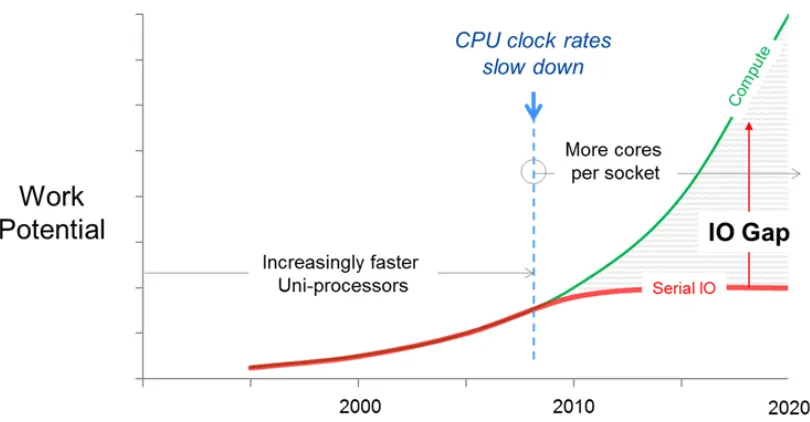
IO had not been a serious problem in single processor systems when only one app had a server all to itself. In fact, every 2 years or so, CPU clock rates got faster, so compute and IO benefited equally.
As Moore’s Law advanced over the years, however, there was an unseen side effect. The “tick tock cycle” of ever faster clock speeds came to a crunching halt due to high power consumption and heat dissipation challenges. Since that time, clock speeds have been dialed back to more manageable levels. The playing field shifted, applying greater transistor densities to squeeze multiple CPUs onto the same size chips. This change saw the advent of multi-core processing – first two processors/two cores, then the addition of multiple cores on one die became the norm. Transistor densities continue to double every two years thereby reaffirming Moore’s Law without having to raise clock speeds. How much of a disparity are we talking about between compute power and IO? It’s directly proportional to the number of CPUs and cores in the server. The existing approach has been to allocate all cores to compute except for one that is assigned to IO. As a consequence, the gap between compute power and IO has become a gaping chasm as can be seen in Figure 1.
IO Through a Straw
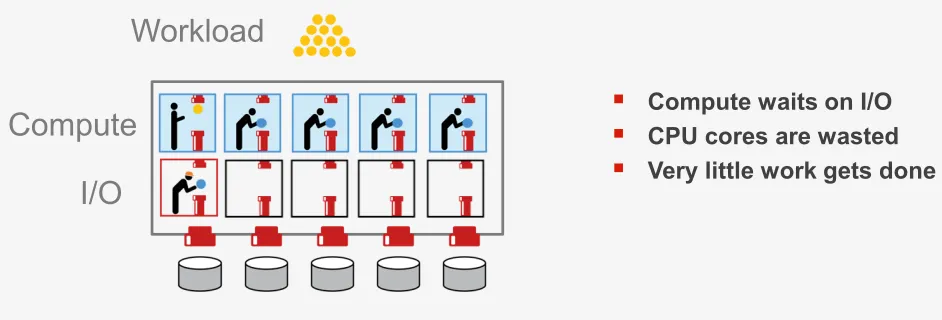
Let’s take a look at the real underlying issue. Hypervisors are designed to process IO using only one CPU. Several VMs running simultaneously on multi-core processors can churn out an almost inconceivable volume of work, easily overwhelming the one processor tasked with serial IO. In essence, multiple VMs must wait on a single straw. This restrictive, serial IO architecture originated in the single processor days when one IO thread could handle requests from its one app. In the multi-core era the arrangement breaks down. Adding more servers to expand the number of straws just throws money at the problem without addressing the root cause: IO starved virtual servers. It also results in wasted processing power.
For the purposes of analogy, imagine a cashier line at a cinema. There are five cashier booths available but only one is manned. Half an hour before movie time, long lines develop and that one lonely cashier struggles to get everyone inside before the start of the feature. Similarly, a mere trickle of IO emerges from VMs compared to their actual potential.
”Imagine a cashier line at
a cinema. There are five
cashier booths available but
only one is manned. Half an
hour before movie time, long
lines develop and that one
lonely cashier struggles to
get everyone inside before
the start of the feature.
Now imagine all five cashier
stations manned; traffic flows
through without slowdown.
That’s DataCore™ Parallel IO.”
- Augie Gonzalez
DataCore Software
Compute
Compute waits on I/O
CPU cores are wasted
Very little work gets done
I/O
Workload
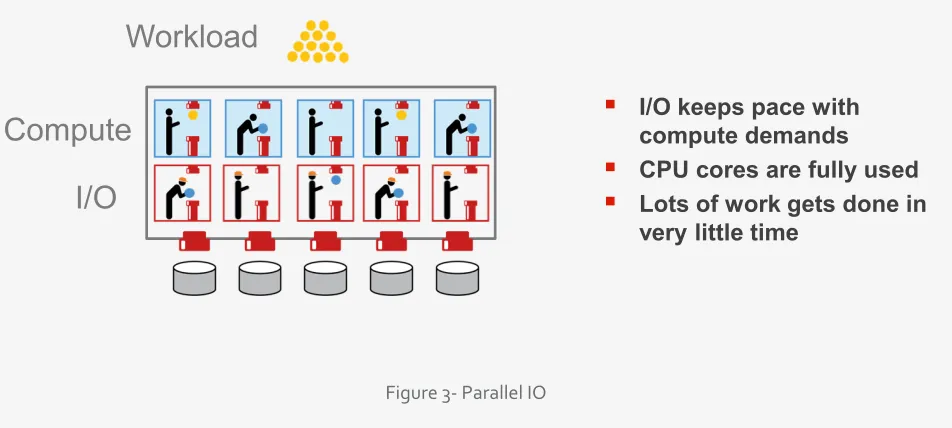
Now imagine all five cashier stations manned; traffic flows through without slowdown. That’s DataCore™ Parallel IO. More on this breakthrough shortly.
Existing Workarounds
Gang of Commodity Servers – Forced Scale Out due to IO;
Adds Cost and Complexity
Many in the industry try to compensate for the IO gap by throwing lots of servers at the problem. In effect, they concede that serial IO processing limits the useful work each server can do, so they are forced to distribute the loads across many servers. For example, 10 servers may be needed where, on paper, two should do the job. The downfall of this workaround is that it suffers from a hefty price tag and leaves large numbers of servers operating at low levels of utilization.
It also goes against the anticipated benefits of server virtualization – to do a lot more with far less equipment by raising processor utilization rates. Although high VM consolidation ratios (15:1 or better) are common with low-value apps which generate little IO, mainstream IO-intensive apps like databases require rack after rack of poorly utilized servers.
I/O keeps pace with
compute demands
CPU cores are fully used
Lots of work gets done in
very little time
Compute
I/O
Workload
Faster Pipes and Speedier Disks – Not Good Enough
Some vendors concentrate on speeding up the pipes and end-points on which serial IO relies. This is where faster network connections and quicker solid state storage come into play. Certainly, technologies such as flash have helped to speed up IO flow rates through the single straw, but when you consider the amount of processing power and memory available to applications, the gains on the user side of the ledger just don’t match up. What little improvements have been observed are severely constrained by the serial IO limitations inside the server. The point is that these approaches only provide marginal IO benefits and raise costs. That one IO worker inside the server remains a bottleneck. It just doesn’t wait so much on spinning disks or slow network links with a faster straw.
Parallel IO Solution
DataCore solves the IO dilemma via a unique software-defined parallel IO
architecture. Rather than a single IO worker per server, several IO workers operate in parallel to service the workloads. In our five VM example, applications have five times the amount of IO available ensuring the work is accomplished in one fifth of the time. Two machines can now do the work of ten. Financially, that’s huge!
Breakthrough Architecture
Why is it that DataCore can do this and others have to embark upon expensive workarounds? The company’s founders have been involved in the development of IO parallelization since the nineties. Their goal at that time was to create superfast data acquisition machines by operating multiple processors in parallel – some assigned to compute, others to IO.
However, the computer marketplace shifted direction. The idea of speeding up performance via what was then considered exotic, parallel architectures was replaced by single processor systems with scaled-up clock frequencies. Individual workloads executed sequentially in shorter time yielding similar benefits.
Yearly improvements in CPU speeds largely ended much of the commercial parallelization work being done within the IT industry during those years. The rapid progress made on CPU chip architectures since the
nineties allowed the industry to get by without parallel IO – at least temporarily. But that era ended around 2010 when multi-core CPUs gained broad acceptance, and CPU clocks no longer sped up.
The primary element that has been missing is software that can capitalize on today’s powerful multi-core/parallel processing infrastructure.
”The primary element
that has been missing is
software that can capitalize
on today’s powerful
multi-core/parallel processing
infrastructure. DataCore’s
software-defined storage
For additional information, please visit www.datacore.com or email [email protected]
0116
DataCore’s software-defined storage and parallel IO software technology is designed to enlist IO processors across many different cores simultaneously. It takes full advantage of new multi-core server technologies to eradicate IO bottlenecks. Following many years of development work on parallel IO, the founders of DataCore released SANsymphony™ software - their pioneering work in storage virtualization. Now in its 10th generation, DataCore is recognized by analyst firms as a leader in software defined storage, helping customers transition towards the software defined data center (SDDC).
Adaptive Algorithms
DataCore’s software actively senses the IO load being generated by concurrent VMs. It responds dynamically by assigning the appropriate number of CPUs to process inputs and outputs, thereby eliminating bottlenecks. VM’s no longer sit idle waiting on a serial IO thread to become available. The system responds quickly without hesitation. Should the IO load lighten, CPUs are freed to do more computational work. How exactly do you orchestrate multiple concurrent IO threads across
multi-core processors efficiently and effectively? And how do you design the intelligence necessary for self-tuning. This is far from an easy task. DataCore has developed this core competency over many years and is estimated to be a decade ahead of the industry.
Conclusion
DataCore’s parallel IO breakthrough not only solves the immediate performance problem facing multi-core virtualized environments, it significantly increases the VM density possible per physical server. In effect, it achieves remarkable cost reductions through maximum utilization of CPUs, memory and storage while fulfilling the promise of virtualization. VMs no longer wait on IO.
ABOUT DATACORE
DataCore is a leader
in software-defined
storage. The company’s
storage virtualization
and hyper-converged
Virtual SAN solutions
empower organizations to
seamlessly manage and
scale their data storage
architectures, delivering
massive performance
gains at a fraction of
the cost of solutions
offered by legacy storage
hardware vendors. Backed
by 10,000 customer
sites around the world,
DataCore’s adaptive
and self-learning and
healing technology takes
the pain out of manual
processes and helps
deliver on the promise of
the new software defined
data center through
its hardware agnostic
architecture.