Page 1 of 49
Morphometric
parameters measured
by Skyscan™
Introduction
3D morphometric parameters are calculated by CT-analyser either in direct 3D based on a surface-rendered volume model in 3D space. Additionally, morphometry in 2D can be done on individual binarised crossection images.
There are two types of analysis for both 3D and 2D measurements.
Firstly, all objects in the selected region can be analysed together, and the integrated results calculated, such as total volume or surface of all
objects, or mean thickness of all objects, etc. Secondly, individual
“discreet” objects can be analysed, defined as groups of connected solid voxels. Morphometric parameters in 3D and 2D can be carried out on all these individual objects.
Therefore four categories of analysis can be performed, comprising both integrated analysis of all selected objects (with a single result output for all objects collectively), and individual analysis of all discreet objects (with a separate result output for each object); and both of these are calculated in both 2D and 3D.
All calculations are performed over the selected region/volume of interest. Consistent and accurate selection of the regions or volumes of interest is fundamentally important to obtaining accurate and meaningful data. Some clarification of terminology for this is useful. The term “region of interest”, or ROI, will refer to a selected region of a single crossectional image. 2D analysis is performed within a ROI. The “volume of interest” refers to the collective sum of all ROIs over a contiguous set of crossectional image slices, representing a selected 3D volume. Morphometric analysis in 3D is performed in a VOI.
Note however that 2D type analysis can also be performed on a VOI, by integrating or summing the results of 2D analysis over many slices. This is sometimes called “slice-by-slice” analysis. It can yield calculations (or estimates) of 3D parameters such as surfaces and volumes and
thicknesses of objects, but it should be understood that these results are based on integration of many 2D analyses of separate crossections, and this is not the same as true direct 3D analysis, which is performed on a surface-rendered 3D volumetric model. So, within a 3D volume of interest, both true 3D analysis, and 2D “slice-by-slice” analysis, can be performed in CT-analyser. (Note further – you do not see this 3D surface rendered model of objects during 3D analysis – it is created “in the
background” but not displayed. Creation and display of 3D models is also provided in the CT-analyser and CT-volume programs, but these are separate procedures not connected to morphometric analysis.) Parameter names follow two alternative nomenclatures, “General Scientific” or “Bone ASBMR”, the latter based on Parfitt et al. (1987). Parfitt’s paper proposed a system of symbols for bone histomorphometry, and the principles of Parfitt’s system are applied here to both the Bone (ASBMR) and the General Scientific parameter names. In this document, both the General Scientific and the Bone ASBMR name will be given at the
title of each parameter. In the contents pages, however, only the General Scientific names are given, for conciseness.
Within Skyscan CT-analyser four alternative dimensional units are selectable: mm, µm, inch or pixel. For clarity in this document, all dimension units are given as mm.
All measurements of morphometric parameters in 3D and 2D are performed on segmented or binarised images. Segmentation or “thresholding” must be done prior to morphometric analysis.
A final note – in the CT-analyser preferences (general tab) you can also specify numerical parameter reporting in scientific notation (e.g. 1.2345E-001) or non-scientific (e.g. 0.12345). Scientific notation is useful for preserving the same decimal point accuracy level for parameter values over different orders of magnitude.
SUMMARY: Morphometric analysis in 3D
3D integrated analysis of all objects in VOI (all selected image levels)
3D individual analysis of all objects in the VOI (over all selected image levels)
Parameter Symbol Unit Parameter Symbol Unit
VOI volume TV mm3 Object volume Obj.V mm3
Object volume Obj.V mm3 Object surface Obj.S mm3
Percent object volume Obj.V/TV % Volume of pores Po.V mm3
VOI surface TS mm2 Surface of pores Po.S mm2
Object surface Obj.S mm2 Porosity Po %
Intersection surface i.S mm2 Number of pores N.Po
Object surface / volume ratio
Obj.S/Obj. V
mm-1
Centroid x Crd.X mm
Object surface density Obj.S/TV mm-1 Centroid y Crd.Y mm
Fragmentation index Fr.I mm-1 Centroid z Crd.Z mm
Centroid (x) Crd.X mm Structure model index SMI
Centroid (y) Crd.Y mm Volume-equivalent
sphere diameter
ESDv mm
Centroid (z) Crd.Z mm Surface-equivalent
sphere diameter
ESDs mm
Structure model index SMI Sphericity Sph
Structure thickness St.Th mm Structure linear density St.Li.Dn mm Structure separation St.Sp mm-1 Degree of anisotropy DA Eigenvalue 1 Eigenvalue 2 Eigenvalue 3 Fractal dimension FD Number of objects Obj.N Number of closed pores Po.N(cl)
Volume of closed pores Po.V(cl) mm3 Surface of closed pores Po.S(cl) mm2 Closed porosity (percent) Po(cl) % Volume of open pores Po.V(op) mm3 Open porosity (percent) Po(op) % Total volume of pores Po.V(tot) mm3 Total porosity (percent) Po(tot) %
Default results filename [prefix]_3D.txt/csv Default results filename
SUMMARY: Morphometric analysis in 2D
2D integrated analysis of all objects inVOI (all selected image levels, line-by-line)
2D individual analysis of all objects in the ROI (from the single current image level only)
Parameter Symbol Unit Parameter Symbol Unit
VOI volume TV mm3 Area Ar mm2
Object volume Obj.V mm3 Perimeter Pm mm
Percent object volume Obj.V/TV % Form factor FF
VOI surface TS mm2 Area-equivalent circle
diameter
ECDa mm
Object surface Obj.S mm2 Roundness Rd
Object surface / volume ratio
Obj.S/Obj. V
mm-1 Euler number EN
Mean total crossectional ROI area
T.Ar mm2 Porosity Po %
Mean total crossectional ROI perimeter
T.Pm mm Extent Ext
Mean total crossectional object area
Obj.Ar mm2 Orientation Or °
Mean total crossectional object perimeter
Obj.Pm mm Eccentricity Ecc
Mean number of objects per slice
Obj.N Centroid x mm
Average object area per slice
Av.Obj.Ar mm2 Centroid y mm
Average object equivalent circle diameter per slice
Av.Obj.EC D
mm Moments of inertia x MMIx mm4
Mean polar moment of inertia
MMI (polar)
mm4 Moments of inertia y MMIy mm4
Mean eccentricity Ecc Polar Moment of inertia MMIp mm4
Crossectional thickness Cs.Th mm Product of inertia pI mm4
Structure thickness (plate model)
St.Th(pl) mm Maximum principal moment of inertia
MMI(max) mm4 Structure separation (plate
model)
St.Sp(pl) mm Minimum principal moment of inertia
MMI(min) mm4 Structure linear density
(plate model)
St.Li.Dn(pl) mm-1 Major axis-length of inertia
Ma mm
Structure diameter (rod model)
Tb.Dm(rd) mm Minor axis-length of inertia
Mi mm
Structure separation (rod model)
Tb.Sp(rd) mm Major diameter d(max) mm
Structure linear density (rod model)
St.Li.Dn (rd)
mm-1 Minor diameter d(min) mm
Mean fragmentation index Fr.I mm-1 Aspect ratio AR
Closed porosity (%) Po(cl) % Mean Thickness Av.Th mm
Centroid (x) Crd.X mm Perimeter-equivalent
circle diameter
ECDp mm
Centroid (y) Crd.Y mm Hydraulic diameter HD mm
Centroid (z) Crd.Z mm
Mean fractal dimension FD
Total intersection surface i.S mm2
Default results filename [prefix]_2D.txt/csv Default results filename
A: 3D MORPHOMETRIC PARAMETERS
A1:
3D
morphometric parameters integrated for
the whole volume of interest (VOI)
Nomenclature
General Scientific Bone ASBMR
Parameter name
Total VOI
volume
Tissue volume
Parameter symbol TV
TV
Unit
mm
3mm
3Total volume of the volume-of-interest (VOI). The 3D volume
measurement is based on the marching cubes volume model of the VOI. Please note that in the case of Bone ASBMR nomenclature, the word
“tissue” simply refers to the volume of interest. It does not mean any kind of recognition of any particular density range as biological tissue, soft, hard or otherwise.
Nomenclature
General Scientific Bone ASBMR
Parameter name
Object volume
Bone volume
Parameter symbol Obj.V
BV
Unit
mm
3mm
3Total volume of binarised objects within the VOI. The 3D volume measurement is based on the marching cubes volume model of the binarised objects within the VOI.
Nomenclature
General Scientific Bone ASBMR
Parameter name
Percent object
volume
Percent bone
volume
Parameter symbol Obj.V/TV
BV/TV
Unit
%
%
The proportion of the VOI occupied by binarised solid objects. This
parameter is only relevant if the studied volume is fully contained within a well-defined biphasic region of solid and space, such as a trabecular bone
region, and does not for example extend into or beyond the boundary of the object – such as the cortical boundary of a bone sample. The
meaningfulness of measured percent volume depends on the criteria applied in selecting the volume of interest. Where the ROI / VOI
boundaries are loosely drawn in the surrounding space around an object for instance, then % object volume has no meaning.
Nomenclature
General Scientific Bone ASBMR
Parameter name
VOI surface
Tissue surface
Parameter symbol TS
TS
Unit
mm
2mm
2The surface area of the volume of interest, measured in 3D (Marching cubes method).
Nomenclature
General Scientific Bone ASBMR
Parameter name
Object surface
Bone surface
Parameter symbol Obj.S
BS
Unit
mm
2mm
2The surface area of all the solid objects within the VOI, measured in 3D (Marching cubes method).
Nomenclature
General Scientific Bone ASBMR
Parameter name
Intersection
surface
Intersection
surface
Parameter symbol i.S
i.S
Unit
mm
2mm
2Intersection surface is the surface of the VOI intersected by solid binarised objects, that is, the part of the VOI boundary surface that runs through solid objects. This parameter is useful, for example, in evaluating bone growth at a defined boundary – for example at a fixed distance away from an orthopaedic bone implant.
Nomenclature
General Scientific Bone ASBMR
Parameter name
Object surface /
volume ratio
Bone surface /
volume ratio
Parameter symbol Obj.S/Obj.V
BS/BV
Unit
mm
-1mm
-1The ratio of solid surface to volume measured in 3D within the VOI. Surface to volume ratio or “specific surface” is a useful basic parameter for characterising the thickness and complexity of structures.
Nomenclature
General Scientific Bone ASBMR
Parameter name
Object surface
density
Bone surface
density
Parameter symbol Obj.S/TV
BS/TV
Unit
mm
-1mm
-1The ratio of surface area to total volume measured as described above in 3D, within the VOI.
Nomenclature
General Scientific Bone ASBMR
Parameter name
Fragmentation
index
Trabecular bone
pattern factor
Parameter symbol Fr.I
Tb.Pf
Unit
mm
-1mm
-1This is an inverse index of connectivity, which was developed and defined by Hahn et al. (1992) for application to trabecular bone. It was applied by these authors originally to 2D images of trabecular bone, and calculates an index of relative convexity or concavity of the total bone surface, on the principle that concavity indicates connectivity (and the presence of “nodes”), and convexity indicates isolated disconnected structures (struts). Tb.Pf is calculated in 3D, by comparing volume and surface of binarised solid before and after a single voxel image dilation. It is defined:
2 1 2 1 . V V S S Pf Tb
Where S and V are solid surface and volume, and the subscript numbers 1 and 2 indicate before and after image dilation.
Where structural / trabecular connectedness results in enclosed marrow spaces, then dilation of trabecular surfaces will contract the surface. By contrast, open ends or nodes will have their surface expanded by surface dilation. As a result, lower Tb.Pf signifies better connected trabecular lattices while higher Tb.Pf means a more disconnected trabecular structure. A prevalence of enclosed cavities and concave surfaces can push Tb.Pf to negative values – as with the structure model index (SMI) – see below. This parameter Tb.Pf or fragmentation index is best considered as a relative index for comparing different scanned objects; its absolute value does not have much meaning.
Nomenclature
General Scientific Bone ASBMR
Parameter name
Centroids X, Y, Z Centroids X, Y, Z
Parameter symbol Crd.X, CrdY, CrdZ Crd.X, CrdY, CrdZ
Unit
mm
mm
The centroid is the 3D XYZ coordinate of the average Cartesian vectorial position of all voxels within the VOI.
Nomenclature
General Scientific Bone ASBMR
Parameter name
Structure model
index
Structure model
index
Parameter symbol SMI
SMI
Unit
(none)
(none)
Structure model index indicates the relative prevalence of rods and plates in a 3D structure such as trabecular bone. SMI involves a measurement of surface convex curvature. This parameter is of importance in osteoporotic degradation of trabecular bone which is characterised by a transition from plate-like to rod-like architecture. An ideal plate, cylinder and sphere have SMI values of 0, 3 and 4 respectively. (Conversely, cylindrical and
The calculation of SMI is based on dilation of the 3D voxel model, that is, artificially adding one voxel thickness to all binarised object surfaces (Hildebrand et al. 1997b). This is also the basis of the Tb.Pf parameter (see above) which explains why changes in both parameters correlate very closely with each other. SMI is derived as follows:
6 '2 S V S SMI
where S is the object surface area before dilation and S’ is the change in surface area caused by dilation. V is the initial, undilated object volume. It should be noted that concave surfaces of enclosed cavities represent negative convexity to the SMI parameter, since dilation of an enclosed space will reduce surface area causing S’ to be negative. Therefore regions of a solid (such as bone) containing enclosed cavities – such as regions with relative volume above 50% – can have negative SMI values. As a consequence, the SMI parameter is sensitive to percent volume. Note also that artificial corners and edges created by the intersection of an object with the volume of interest boundary will also affect the measured SMI, increasing its value.
Nomenclature
General Scientific Bone ASBMR
Parameter name
Structure
thickness
Trabecular
thickness
Parameter symbol St.Th
Tb.Th
Unit
mm
mm
With 3D image analysis by micro-CT a true 3D thickness can be measured which is model-independent. Local thickness for a point in solid is defined by Hildebrand and Ruegsegger (1997a) as the diameter of the largest sphere which fulfils two conditions:
the sphere encloses the point (but the point is not necessarily the centre of the sphere);
the sphere is entirely bounded within the solid surfaces.
The key advantage of the local thickness measurement is that the bias from the 3D orientation of the structure is kept to a minimum (Ulrich et al. 1999).
Distance transform methods described by Remy and Thiel (2002) are the basis for the implementation by CT-analyser of local thickness
medial axes of all structures. Then the “sphere-fitting” local thickness measurement is made for all the voxels lying along this axis.
Histomorphometrists typically measure a single mean value of bone Tb.Th from a trabecular bone site. However a trabecular bone volume – or any complex biphasic object region – can also be characterised by a
distribution of thicknesses. CT-analyser outputs a histogram of thickness (and separation also) with an interval of two pixels. Thickness distribution is a powerful method for characterising the shape of a complex structure.
Nomenclature
General Scientific Bone ASBMR
Parameter name
Structure linear
density
Trabecular
number
Parameter symbol St.Li.Dn
Tb.N
Unit
mm
-1mm
-1Structure linear density or trabecular number implies the number of traversals across a trabecular or solid structure made per unit length on a random linear path through the VOI.
Again the complexities of model dependence associated with 2D
measurements are eliminated by true 3D calculation of St.Li.Dn / Tb.N from 3D micro-CT images. This parameter is measured in CT-analyser in 3D by application of the equation for the parallel plate model (fractional volume/thickness), but using a direct 3D measurement of thickness. Note that the optional stereology analysis (not included in this report) includes measurements of thickness, separation and number/linear density based on the mean intercept length (MIL) analysis which represents an
alternative basis for these architectural measurements.
Furthermore, another alternative definition of trabecular number, based on 3D measurements of the spacing of trabeculae, is:
TbTh TbSp
N Tb . . 1 . Since both Tb.Th and Tb.Sp are measured in 3D by sphere-fitting, this latter equation could be considered a calculation directly from a 3D-measured trabecular spacing.
Nomenclature
General Scientific Bone ASBMR
Parameter name
Structure
separation
Trabecular
separation
Parameter symbol Sr.Sp
Tb.Sp
Unit
mm
mm
Trabecular separation is essentially the thickness of the spaces as defined by binarisation within the VOI. Skyscan CT-analyser software measures Tb.Sp directly and model-independently in 3D by the same method used to measure trabecular thickness (see above), just applied to the space rather than the solid voxels.
Nomenclature
General Scientific Bone ASBMR
Parameter name
Degree of
anisotropy
Degree of
anisotropy
Parameter symbol DA
DA
Unit
(none)
(none)
Isotropy is a measure of 3D symmetry or the presence or absence of preferential alignment of structures along a particular directional axis. Apart from percent volume, DA and the general stereology parameters of trabecular bone are probably the most important determinants of
mechanical strength (Odgaard 1997). Mean intercept length (MIL) and Eigen analysis are used to calculate DA, and these involve some quite advanced engineering mathematics. However the essentials of the MIL eigen analysis can be summarised in normal English.
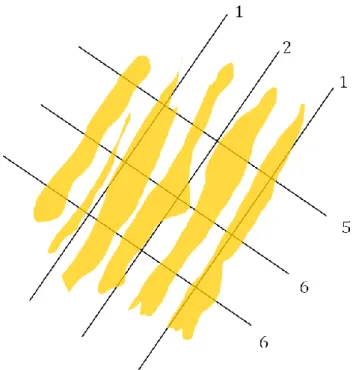
Consider a region or volume containing two phases (solid and space), both having complex architecture, such as a region of trabecular bone. We can study this volume to determine isotropy. If the volume is isotropic, then a line passing through the volume at any 3D orientation will make a similar number of intercepts through the solid phase. A bag of marbles would be isotropic. However a packet of spaghetti would be non-isotropic, or anisotropic, since lines going along the direction of the spaghetti would make few intercepts along the spaghetti rods while lines crossing at right-angles would make many intercepts. Figure 1 illustrates the difference in the number of intercepts for lines from different directions through an anisotropic, aligned group of structures.
Mean intercept length (MIL) analysis measures isotropy (it is usual to talk of measurement of the negative quantity anisotropy). Mean intercept length is found by sending a line through a 3D image volume containing binarised objects, and dividing the length of the test line through the analysed volume by the number of times that the line passes through or
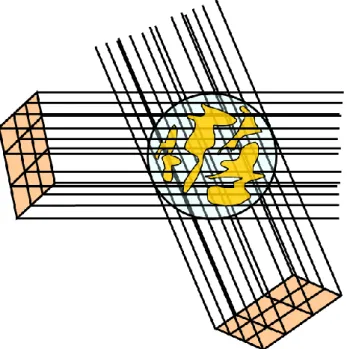
intercepts part of the solid phase. Note that in this MIL calculation the intercept length may correlate with object thickness in a given orientation but does not measure it directly. Therefore it will give an accurate result if analysing a volume containing a sufficiently large number of objects, but is not suitable for analysis of single or small numbers of objects. For the MIL analysis, a grid of test lines is sent through the volume over a large number of 3D angles. The MIL for each angle is calculated as the average for all the lines of the grid. The spacing of this grid can be selected in CT-analyser preferences (the “advanced” tab).
Figure 1. A group of aligned long structures has a high anisotropy: test lines make few intercepts through the solid objects in the direction of the long axis of the structures, but perpendicular to the structures the lines make many more intercepts (numbers of intercepts are shown for each line).
This requires that a spherical region is first defined within which the MIL analysis will be done and anisotropy measured, since the test lines must all cross the sphere centre and have an equal distribution of lengths, covering all 3D angles but distributed at random. In CT-analyser you can actually set a spherical volume of interest (VOI). However if a
Figure 2. For the MIL analysis, a grid of lines is sent through the volume over a large number of 3D angles (just two are illustrated here). The MIL for each angle is calculated as the average for all the lines of the grid.
The next step involves visualisation of the 3D distribution of MIL lengths as an ellipsoid. All the MIL lines are drawn passing through one point, and the length of each line is the bone phase MIL for that line. This process is called a polar plot of MIL. In 3D this creates a dense pin-cushion like effect with lines in all directions at different lengths. Figure 3 shows in a simple diagram the appearance of an MIL distribution in 3D. Any
asymmetry in the MILs with respect to 3D angle - which will represent the anisotropy of the bone in the spherical region - will make the line
distribution depart from an overall spherical shape and become elongated in the direction where the solid structures have the longest MIL (such as the axis of the spaghetti packet).
Clearly the MIL "pin-cushion" is a complex object, and a method is needed to extract some summary numerical parameters defining the orientation and isotropy / anisotropy of the MIL distribution. This is where the
anisotropy tensor analysis steps in. (Tensor means matrix.) This method is probably best attributed to Harrigan and Mann (1984) and describes the MIL distribution as an ellipsoid. An ellipsoid is a 3D ellipse.
As shown in figure 1, an ellipsoid has three axes. These describe the longest orientation, and the length and width (major and minor axes) of the ellipse section at right-angles to the longest orientation. The ellipsoid can be asymmetric in one axis only, like a rugby ball, or in two axes, like a bar of soap.
Figure 3. An ellipsoid (3D ellipse) is fitted to the 3D distribution of MILs (mean intercept lengths) measured over a full range of 3D stereo-angles. This ellipsoid is fitted statistically and has 3 vectors which are orthogonal (at right-angles to each other). A tensor (matrix) of 9 (3x3) eigenvectors describes the directions of the three vectors.
An ellipsoid is fitted to the MIL “pin-cushion” 3D polar plot. This is a statistical fit, finding the ellipsoid which most closely describes the 3D shape of the MIL distribution. MIL analysis therefore also outputs values indicating the strength of fit of the ellipsoid and associated error, such as the correlation coefficients.
A tensor or matrix is a way of describing an ellipse by a 3x3 matrix of numbers. Technically this is a second order tensor. The tensor describing the anisotropy ellipsoid is an orthogonal tensor, since it describes the ellipsoid axes which are orthogonal (at right angles) to each other. The end result of the anisotropy tensor analysis is the eigen analysis, eigen meaning characteristic. This comes in two parts. You have the 3x3 matrix of eigenvectors which describe the 3D angles of the three axes of the ellipsoid as described above - one column of 3 numbers for each vector. And the three eigenvalues are each an index of the relative MIL values (distance between bone intercepts) in each of the three axes described by the eigenvectors.
Finally, you can derive from the tensor eigen analysis a single parameter measuring anisotropy: this is the degree of anisotropy (DA), and is traditionally expressed as the maximum eigenvalue divided by the minimum eigenvalue. Values for DA calculated in this way vary from 1 (fully isotropic) to infinity (fully anisotropic). Mathematically this is a cumbersome scale. A more convenient mathematical index of anisotropy is calculated as:
Vector 1 Vector 2
eigenvalue eigenvalue DA max min 1
Here DA is 0 for total isotropy and 1 for total anisotropy. (Both values are reported by CT-analyser).
Nomenclature
General Scientific Bone ASBMR
Parameter name
Eigenvalues 1,
2, 3
Eigenvalues 1,
2, 3
Parameter symbol none
none
Unit
none
none
The three eigenvalues are each an index of the relative MIL values
(distance between intercepts) in each of the three directions of the three MIL analyses. These three directions are also expressed as the
eigenvectors, and are orthogonal to each other.
Nomenclature
General Scientific Bone ASBMR
Parameter name
Fractal
dimension
Fractal
dimension
Parameter symbol FD
FD
Unit
none
none
Fractal dimension is an indicator of surface complexity of an object, which quantifies how that object’s surface fills space. For examples of fractal objects, “fractal art” is abundant on the internet. True fractal objects have surface shapes which are repeated over many spatial scales. So the closer you look (i.e. the higher the magnification or “zoom in”) the more self-similar structure you see. A typical example is a fern leaf in which each side-branch is very similar to the whole fern leaf, and likewise each side-finger of each side branch also looks the same as the whole fern leaf, and so on. A true fractal object essentially has fractional, non-integer dimension, i.e. a line “trying” to fill a plane, or a plane trying to fill a 3D space, having dimension somewhere between 2 and 3.
Fractal dimension is calculated using the Kolmogorov or “box counting” method. It is calculated in both 2D and 3D in Skyscan CT-analyser. For the 3D calculation of FD, the volume is divided into an array of equal cubes, and the number of cubes containing part of the object surface is counted. This is repeated over a range of cube sizes such as 2-100 pixels. The number of cubes containing surface is plotted against cube length in a log-log plot, and the fractal dimension is obtained from the slope of the log-log regression. Fractal characteristics of trabecular bone, and methods for measurement of fractal dimension, are discussed by Chappard et al.
(2001).
For more details on fractal dimension please refer to:
http://en.wikipedia.org/wiki/Fractal_dimension
Nomenclature
General Scientific Bone ASBMR
Parameter name
Number of
objects
Number of
objects
Parameter symbol N. Obj.
N. Obj.
Unit
none
none
The total number of discreet binarised objects within the VOI is reported. A discreet 3D object is a connected assemblage of solid (white) voxels fully surrounded on all sides in 3D by space (black) voxels.
Nomenclature
General Scientific Bone ASBMR
Parameter name
Number of
Closed Pores
Number of
Closed Pores
Parameter symbol Po.N(cl)
Po.N(cl)
Unit
none
none
The total number of discreet binarised closed pores within the VOI is reported. A closed pore in 3D is a connected assemblage of space (black) voxels that is fully surrounded on all sides in 3D by solid (white) voxels.
Nomenclature
General Scientific Bone ASBMR
Parameter name
Volume of
Closed Pores
Volume of
Closed Pores
Parameter symbol Po.V(cl)
Po.V(cl)
Unit
mm
3mm
3The total volume of all closed pores within the VOI, as defined above (under “number of closed pores”) is reported.
Nomenclature
General Scientific Bone ASBMR
Parameter name
Surface of
Closed Pores
Surface of
Closed Pores
Parameter symbol Po.S(cl)
Po.S(cl)
Unit
mm
2mm
2The total surface area of all closed pores within the VOI, as defined above (under “number of closed pores”) is reported.
Nomenclature
General Scientific Bone ASBMR
Parameter name
Closed Porosity
(percent)
Closed Porosity
(percent)
Parameter symbol Po
Po
Unit
%
%
Percent closed porosity is the volume of closed pores (as defined above) as a percent of the total of solid plus closed pore volume, within the VOI. (Please note – this is a “material porosity”, and is calculated differently from of open porosity and total porosity, where the denominator is total VOI volume.)
Nomenclature
General Scientific Bone ASBMR
Parameter name
Volume of Open
Pore Space
Volume of Open
Pore Space
Parameter symbol Po.V(op)
Po.V(op)
Unit
mm
3mm
3The total volume of all open pores within the VOI, is reported. An open pore is defined as any space located within a solid object or between solid objects, which has any connection in 3D to the space outside the object or objects.
Nomenclature
General Scientific Bone ASBMR
Parameter name
Open Porosity
(percent)
Open Porosity
(percent)
Parameter symbol Po(op)
Po(op)
Unit
%
%
Percent open porosity is the volume of open pores (as defined above) as a percent of the total VOI volume.
Nomenclature
General Scientific Bone ASBMR
Parameter name
Total Volume of
Pore Space
Total Volume of
Pore Space
Parameter symbol Po.V(tot)
Po.V(tot)
Unit
mm
3mm
3Nomenclature
General Scientific Bone ASBMR
Parameter name
Total Porosity
(percent)
Total Porosity
(percent)
Parameter symbol Po(tot)
Po(tot)
Unit
%
%
Total porosity is the volume of all open plus closed pores (as defined above) as a percent of the total VOI volume.
Nomenclature
General Scientific Bone ASBMR
Parameter name
Euler number
Euler number
Parameter symbol EN
EN
Unit
none
none
The calculation of Euler number in 3D is based on software code kindly provided by Erasmus University, Rotterdam, The Netherlands (Dr Erwin Waarsing) using the Conneulor method from Aarhus University, Denmark (Dr. Anders Odgaard; see Gunderson et. al. 1993).
Note also that up to CTAn version 1.9.3.2 Euler number was calculated in the 2D analysis only (both in the integrated and individual object 2D analyses) . From CTAn version 1.9.3.3 onwards Euler connectivity and number are also calculated in 3D, and included in the standard
(integrated) 3D analysis.
The Euler-Poincare number –abbreviated to “Euler number” – is an
indicator of connectedness of a 3D complex structure. The Euler number is characteristic of a three-dimensional structure which is topologically
invariant (it is unchanged by inflation or compression or distortion of the structure). It measures what might be called “redundant connectivity” – the degree to which parts of the object are multiply connected (Odgaard
et al. 1993). It is a measure of how many connections in a structure can be severed before the structure falls into two separate pieces.
(Topologically the object can be compressed into a sphere and the
redundant connections appear as “handles”.) The components of the Euler number are the three Betti numbers: 0 is the number of objects, 1 the
connectivity, and 2 the number of enclosed cavities. The Euler-Poincare
formula for a 3D object X is given:
2 1 0
)
(
X
Euler analysis provides a measure of connectivity density, indicating the number of redundant connections between trabecular structures per unit volume. Trabecular connectivity can contribute significantly to structure strength (Odgaard 1997). One useful and fast algorithm for calculating the Euler connectivity in 3D is the “Conneulor” (Gunderson et al. 1993).
A2: 3D morphometric parameters calculated for all
individual binarised 3D object within the volume of
interest (VOI)
Nomenclature
General Scientific Bone ASBMR
Parameter name
Object volume
Bone volume
Parameter symbol Obj.V
BV
Unit
mm
3mm
3Total volume of each binarised 3D object within the VOI. The 3D volume measurement is based on the marching cubes volume model.
Nomenclature
General Scientific Bone ASBMR
Parameter name
Object surface
Bone surface
Parameter symbol Obj.S
BS
Unit
mm
2mm
2Total surface of each binarised 3D object within the VOI. The 3D surface measurement is based on the marching cubes model.
Nomenclature
General Scientific Bone ASBMR
Parameter name
Volume of Pores Volume of Pores
Parameter symbol Po.V
Po.V
Unit
mm
3mm
3Nomenclature
General Scientific Bone ASBMR
Parameter name
Surface of Pores Surface of Pores
Parameter symbol Po.S
Po.S
Unit
mm
2mm
2The total surface area of all pores within each discreet 3D object.
Nomenclature
General Scientific Bone ASBMR
Parameter name
Percent Porosity Percent Porosity
Parameter symbol Po
Po
Unit
%
%
Percent porosity is the volume of closed pores within each discreet 3D object as a percent of the total volume of that object (including any closed pore volume).
Nomenclature
General Scientific Bone ASBMR
Parameter name
Number of
Pores
Number of
Pores
Parameter symbol Po.N
Po.N
Unit
none
none
The number of pores within each discreet 3D object.
Nomenclature
General Scientific Bone ASBMR
Parameter name
Centroids X, Y, Z Centroids X, Y, Z
Parameter symbol Crd.X, CrdY, CrdZ Crd.X, CrdY, CrdZ
Unit
mm
mm
The centroid is the XYZ coordinate of the average Cartesian vectorial position of each discreet 3D object, within the VOI.
Nomenclature
General Scientific Bone ASBMR
Parameter name
Structure model
index
Structure model
index
Parameter symbol SMI
SMI
Unit
Structure model index indicates the relative prevalence of rods and plates in a 3D structure such as trabecular bone. SMI involves a measurement of surface convexity. Ideal values of SMI for an exact rectangular plate, cylinder and sphere are 0, 3 and 4 respectively. (Conversely, cylindrical and spherical cavities have SMI of -3 and -4 respectively.)
The calculation of SMI is based on dilation of the 3D voxel model, that is, artificially adding one voxel thickness to all binarised object surfaces (Hildebrand et al. 1997b). SMI is derived as follows:
6 '2 S V S SMI
where S is the object surface area before dilation and S’ is the change in surface area caused by dilation. V is the initial, undilated object volume. It should be noted that concave surfaces of enclosed cavities represent negative convexity to the SMI parameter, since dilation of an enclosed space will reduce surface area causing S’ to be negative. Therefore regions of a solid (such as bone) containing enclosed cavities – such as regions with relative volume above 50% – can have negative SMI values. As a consequence, the SMI parameter is sensitive to percent volume. Note also that artificial corners and edges created by the intersection of an object with the volume of interest boundary will also affect the measured SMI, increasing its value.
Nomenclature
General Scientific Bone ASBMR
Parameter name
Volume-equivalent
sphere diameter
Volume-equivalent
sphere diameter
Parameter symbol ESDv
ESDv
Unit
mm
mm
The diameter of the sphere that would have the same volume as the discreet 3D object. ESDv is expressed:
√
where V is the object volume.
Nomenclature
General Scientific Bone ASBMR
Parameter name
Surface-equivalent
sphere diameter
Surface-equivalent
sphere diameter
Parameter symbol ESDs
ESDs
Unit
mm
mm
The diameter of the sphere that would have the same surface area as the discreet 3D object. ESDs is expressed:
√
where S is the object surface area.
Nomenclature
General Scientific Bone ASBMR
Parameter name
Sauter diameter Sauter diameter
Parameter symbol SD
SD
Unit
mm
mm
The Sauter mean diameter is the diameter of the sphere that would have the same volume-to-surface (V/S) ratio as the discreet 3D object. SD is a fluid dynamics parameter, introduced by the German scientist J. Sauter in the late 1920’s; it is expressed:
where ESDv and ESDs are as defined just above. A Wikipedia entry on SD is at:
http://en.wikipedia.org/wiki/Sauter_mean_diameter
Nomenclature
General Scientific Bone ASBMR
Parameter name
Sphericity
Sphericity
Parameter symbol Sph
Sph
Unit
Sphericity is a measure of how spherical a 3D object is. This parameter was defined by Wadell in 1935. Sphericity, Ψ or Sph, of a particle is the ratio of the surface area of a sphere (with the same volume as the given particle) to the surface area of the particle:
√ ( )
where V and S are the object volume and surface area respectively. For complex, non-spherical objects the surface area of the
volume-equivalent sphere will be much smaller than the particle surface area, thus
Sph will be low. The maximum value possible is 1, which would be obtained for a sphere.
A Wikipedia entry on Sph is at:
B: 2D MORPHOMETRIC PARAMETERS
B1: 2D morphometric parameters calculated
“slice-by-slice”, integrated for the whole volume of
interest (VOI)
Nomenclature
General Scientific Bone ASBMR
Parameter name
Total VOI
volume
Tissue volume
Parameter symbol TV
TV
Unit
mm
3mm
3Total volume of the volume-of-interest (VOI). The 2D measurement is the total number of voxels of (solid and space) in the VOI times the voxel volume. Please note that in the case of Bone ASBMR nomenclature, the word “tissue” refers to the volume of interest. It does not mean any kind of recognition of any particular density range as biological tissue, soft, hard or otherwise.
Nomenclature
General Scientific Bone ASBMR
Parameter name
Object volume
Bone volume
Parameter symbol Obj.V
BV
Unit
mm
3mm
3Total volume of binarised objects within the VOI. The 2D measurement is equal to the number of voxels of binarised solid objects within the VOI times the voxel volume.
Nomenclature
General Scientific Bone ASBMR
Parameter name
Percent volume Percent bone
volume
Parameter symbol Obj.V/TV
BV/TV
Unit
%
%
The percentage of the VOI occupied by binarised solid objects. This
parameter is only relevant if the studied volume is fully contained within a well-defined biphasic region of solid and space, such as a trabecular bone region, and does not for example extend into or beyond the boundary of the object – such as the cortical boundary of a bone sample. The
meaningfulness of measured percent volume depends on the criteria applied in selecting the volume of interest. Where the ROI / VOI
boundaries are loosely drawn in the surrounding space around an object for instance, then % object volume has no meaning.
Nomenclature
General Scientific Bone ASBMR
Parameter name
VOI surface
Tissue surface
Parameter symbol TS
TS
Unit
mm
2mm
2The surface area of the volume of interest, measured in 2D, using the Pratt algorithm (Pratt 1991). Note that there are two components to
surface measured in 2D for a 3D multilayer dataset; first the perimeters of the binarised objects on each crossectional level, and second, the vertical surfaces exposed by pixel differences between adjacent crossections.
Nomenclature
General Scientific Bone ASBMR
Parameter name
Object surface
Bone surface
Parameter symbol Obj.S
BS
Unit
mm
2mm
2The surface area of all the solid objects within the VOI, measured in 2D, using the Pratt algorithm (Pratt 1991). Note that there are two
components to surface measured in 2D for a 3D multilayer dataset; first the perimeters of the binarised objects on each crossectional level, and
second, the vertical surfaces exposed by pixel differences between adjacent crossections.
Nomenclature
General Scientific Bone ASBMR
Parameter name
Object surface /
volume ratio
Bone surface /
volume ratio
Parameter symbol Obj.S/Obj.V
BS/BV
Unit
mm
-1mm
-1The ratio of solid surface to volume (both as defined above) measured in 2D within the VOI. Surface to volume ratio or “specific surface” is a useful basic parameter in characterising the complexity of structures.
Nomenclature
General Scientific Bone ASBMR
Parameter name
Mean total
crossectional
ROI area
Mean total
crossectional
tissue area
Parameter symbol T.Ar
T.Ar
Unit
mm
2mm
2The mean of the crossectional ROI area for all slices in the selected range of the VOI. Note that by using the “shrink-wrap” function, the ROI
boundary can become effectively the outer boundary of the object, while not including any internal spaces or structure in the measurement. This allows for example measurement of inner and outer surfaces of porous or hollow objects, such as the periosteal (outer) and endosteal (inner)
Nomenclature
General Scientific Bone ASBMR
Parameter name
Mean total
crossectional
ROI perimeter
Mean total
crossectional
tissue perimeter
Parameter symbol T.Pm
T.Pm
Unit
mm
mm
The mean of the crossectional ROI perimeter for all slices in the selected range of the VOI. Note that by using the “shrink-wrap” function, the ROI perimeter can become effectively the outer perimeter of the object, while not including any internal spaces or structure in the measurement. This allows for example measurement of inner and outer surfaces of porous or hollow objects.
Nomenclature
General Scientific Bone ASBMR
Parameter name
Mean total
crossectional
object area
Mean total
crossectional
bone area
Parameter symbol Obj.Ar
B.Ar
Unit
mm
2mm
2The mean of the crossectional object or bone area for all slices in the selected range of the VOI.
Nomenclature
General Scientific Bone ASBMR
Parameter name
Mean total
crossectional
object perimeter
Mean total
crossectional
bone perimeter
Parameter symbol Obj.Pm
B.Pm
Unit
mm
mm
The mean of the crossectional object or bone perimeter for all slices in the selected range of the VOI.
Nomenclature
General Scientific Bone ASBMR
Parameter name
Mean number of
objects per slice
Mean number of
objects per slice
Parameter symbol Obj.N
Obj.N
Unit
(none)
(none)
The mean number of discreet 2D objects in a single crossectional image slice. This parameter can be an indicator of structural connectivity – in interconnected structures (e.g. trabecular bone or other networks, scaffolds or foams) high connectivity results in highly interconnected objects which are few in number in a single crossection – by contrast fragmentation results in larger numbers of smaller objects (e.g. Vermeirsch et al. 2004, 2007).
Nomenclature
General Scientific Bone ASBMR
Parameter name
Average object
area per slice
Average object
area per slice
Parameter symbol Av.Obj.Ar
Av.Obj.Ar
Unit
mm
2mm
2The mean area of discreet 2D objects in a single crossectional image slice. This parameter can be an indicator of structural connectivity – in
interconnected structures (e.g. trabecular bone or other networks, scaffolds or foams) high connectivity results in highly interconnected objects which are few in number in a single crossection – by contrast fragmentation results in larger numbers of smaller objects (for application of this parameter to bone morphometry see for example Vermeirsch et al.
Nomenclature
General Scientific Bone ASBMR
Parameter name
Average object
equivalent circle
diameter per
slice
Average object
equivalent circle
diameter per
slice
Parameter symbol Av.Obj.ECD
Av.Obj.ECD
Unit
mm
mm
The mean equivalent circle diameter of all discreet 2D objects in a single crossectional image slice, defined as the diameter of the equivalent circle having the same area as the measured object.
Nomenclature
General Scientific Bone ASBMR
Parameter name
Mean polar
moment of
inertia
Mean polar
moment of
inertia
Parameter symbol MMI(polar)
MMI(polar)
Unit
mm
4mm
4This 2D crossectional function is a basic strength index and indicates the resistance to rotation of a crossection about a chosen axis (assuming uniform material stress-strain strength properties).
Moment of inertia is the rotational analogue of mass for linear motion and must be specified with respect to a chosen axis of rotation. For a point mass (represented by an image pixel) the moment of inertia (I) is simply the mass (m) times the square of perpendicular distance (r) to the
rotation axis, I = mr2. Moment of inertia for a crossection – for example of
cortical bone – is the integral of all the solid (bone) pixels. For more detail on moment of inertia please refer to:
Nomenclature
General Scientific Bone ASBMR
Parameter name
Mean
eccentricity
Mean
eccentricity
Parameter symbol Ecc
Ecc
Unit
(none)
(none)
Eccentricity is a 2D shape analysis of discreet binarised objects. Objects are approximated as ellipses, and
eccentricity is an elliptic parameter indicating departure from circular shape by lengthening (a circle is an ellipse with an eccentricity of zero). An ellipse is defined as having two focal points (F1 and F2), a centre (C) and major and minor axes. The major axis is defined as 2a where a is the “semi major axis”; likewise, 2b is the minor axis. Eccentricity e is a function of the (semi)major and minor axes such that: 2 2
1
a
b
e
Higher eccentricity means generally elongated objects, while decreased values means an approach toward circular shape.
Nomenclature
General Scientific Bone ASBMR
Parameter name
Crossectional
thickness
Crossectional
thickness
Parameter symbol Cs.Th
Cs.Th
Unit
mm
mm
Crossectional thickness is calculated in 2D on the basis of the plate model where Th = 2 / (surface/volume) . Surface in 2D integrated “slice-by-slice” analysis is calculated as described above (Obj.S) from both horizontal and vertical pixel boundaries. Crossectional thickness is a calculation of thickness in which the vertical surfaces, between pixels of adjacent crossections, are excluded; only the perimeters of crossections are used to calculate surface. This definition of surface excludes error caused by large artificially cut surfaces that sometimes occur at the top
and bottom of VOIs, such as a VOI representing a short section of cortical bone with large exposed crossections at each end. (By contrast, the “structure thickness” or “trabecular thickness” 2D parameters – below – include surface measured both vertically and horizontally: thus this latter thickness calculation yields smaller thickness values.)
Nomenclature
General Scientific Bone ASBMR
Parameter name
Structure
thickness (plate
and rod models)
Trabecular
thickness (plate
and rod models)
Parameter symbol St.Th (pl) or (rd) Tb.Th(pl) or (rd)
Unit
mm
mm
Calculation – or estimation – of St.Th or Tb.Th from 2D measurements requires an assumption about the nature of the structure (a “structural model”). Three simple structure models, the parallel plate, the cylinder rod and the sphere model, provide the range of values within which a hypothetical “true” thickness will be located. Thickness defined by these models (Parfitt et al. 1987) is given:
Parallel plate model:
BS BV
Th Tb / 2 . Cylinder rod model:
BS BV
Th Tb / 4 . Sphere model:
BS BV
Th Tb / 6 . Where BS/BV is the surface to volume ratio, mm-1.
Note that for the above equations, if the surface measurements are made from one or a few 2D crossectional slices (such as in histological analysis), then the numerator (2, 4 or 6) should be divided by a correction factor of 1.199. This approximates a correction from 2D to 3D. However as
CT-analyser includes vertical surfaces between solid and space voxels in adjacent image slices. It is thus in fact an essentially 3D measurement based on a simple cubic voxel model. Therefore the thickness model based estimated should not here include the 1.199 correction factor.
Nomenclature
General Scientific Bone ASBMR
Parameter name
Structure
separation
(plate and rod
models)
Trabecular
separation
(plate and rod
models)
Parameter symbol Sr.Sp
Tb.Sp
Unit
mm
mm
Trabecular separation is essentially the thickness of the spaces as defined by binarisation within the VOI. It can also be calculated from 2D images with model assumptions. Applying the structural models as for thickness, structure separation is calculated:
Parallel plate model:
Th Tb N Tb Sp Tb . . 1 .
Cylinder rod model:
1 4 . . BV TV Dm Tb Sp Tb
where TV is total volume of VOI and BV is bone (or solid) volume (Parfitt
et al. 1987). Note that each of the above definitions takes the Tb.Th (or Tb.Dm) value derived from the corresponding plate or rod model.
Nomenclature
General Scientific Bone ASBMR
Parameter name
Structure linear
density (plate
and rod models)
Trabecular
number (plate
and rod models)
Parameter symbol St.Li.Dn(pl)
Tb.N
Unit
mm
-1mm
-1Structure linear density or trabecular number implies the number of traversals across a solid structure, such as a bone trabecula, made per unit length by a random linear path through the volume of interest (VOI). Plate and rod model 2D-based definitions of Tb.N again take the
corresponding Tb.Th values: Parallel plate model:
Th
Tb
TV
BV
N
Tb
.
)
/
(
.
Cylinder rod model:
Dm Tb TV BV N Tb . 4 .
Nomenclature
General Scientific Bone ASBMR
Parameter name
Fragmentation
index
Trabecular bone
pattern factor
Parameter symbol Fr.I
Tb.Pf
Unit
mm
-1mm
-1This is an inverse index of connectivity, which was developed and defined by Hahn et al. (1992) for application to trabecular bone. It was applied by these authors originally to 2D images of trabecular bone, and it calculates an index of relative convexity or concavity of the total bone surface, on the principle that concavity indicates connectivity (and the presence of “nodes”), and convexity indicates isolated disconnected structures (struts). Tb.Pf is calculated in 2D by comparing area and perimeter of binarised solid before and after a single voxel image dilation. It is defined:
2 1 2 1 . A A P P Pf Tb
Where P and A are the solid perimeter and area, respectively, and the subscript numbers 1 and 2 indicate before and after image dilation. Structural / trabecular connectedness results in enclosed spaces and concave perimeters, and dilation of such perimeters will contract them, resulting in reduced perimeter. By contrast, open ends or nodes which have convex perimeters will have their surface expanded by surface dilation, thus causing increased perimeter. As a result, lower Tb.Pf signifies better connected trabecular lattices while higher Tb.Pf means a more disconnected trabecular structure. A prevalence of enclosed cavities and concave surfaces can push Tb.Pf to negative values. This parameter is best considered as a relative index for comparing different scanned
objects; its absolute value does not have much meaning.
Nomenclature
General Scientific Bone ASBMR
Parameter name
Closed Porosity
(percent)
Closed Porosity
(percent)
Parameter symbol Po(cl)
Po(cl)
Unit
%
%
Closed porosity is measured in the 2D slice-by-slice analysis in
CT-analyser. Binarised objects are identified containing fully enclosed spaces, and closed porosity is the area of those spaces as a percent of the total area of binarised objects. Note that the denominator of total object area includes the closed pores. Closed porosity measurement ignores space which is not fully surrounded by solid. Note – closed porosity in 2D is usually much larger than the equivalent parameter measured in 3D; a space region is more likely to be surrounded by solid in a single
Nomenclature
General Scientific Bone ASBMR
Parameter name
Centroids X, Y, Z Centroids X, Y, Z
Parameter symbol Crd.X, CrdY, CrdZ Crd.X, CrdY, CrdZ
Unit
mm
mm
The centroid is the XYZ coordinate of the average Cartesian vectorial position of all voxels within the VOI.
Nomenclature
General Scientific Bone ASBMR
Parameter name
Fractal
dimension
Fractal
dimension
Parameter symbol FD
FD
Unit
none
none
Fractal dimension is an indicator of surface complexity of an object, which quantifies how that object’s surface fills space. For examples of fractal objects, “fractal art” is abundant on the internet. True fractal objects have surface shapes which are repeated over many spatial scales. So the closer you look (i.e. the higher the magnification or “zoom in”) the more self-similar structure you see. A typical example is a fern leaf in which each side-branch is very similar to the whole fern leaf, and likewise each side-finger of each side branch also looks the same as the whole fern leaf, and so on. A true fractal object essentially has fractional, non-integer dimension, i.e. a line “trying” to fill a plane, or a plane trying to fill a 3D space, having dimension somewhere between 2 and 3.
Fractal dimension is calculated using the Kolmogorov or “box counting” method. It is calculated in both 2D and 3D in Skyscan CT-analyser. For 2D calculation of FD, the crossection image is divided into an array of equal squares, and the number of squares containing part of the object surface is counted. This is repeated over a range of square sizes such as 2-100 pixels. The number of squares containing surface is plotted against square length in a log-log plot, and the fractal dimension is obtained from the slope of the log-log regression. Fractal characteristics of trabecular bone, and methods for measurement of fractal dimension, are discussed by Chappard et al. (2001). Fractal dimension is a useful indicator of complexity in structures.
Nomenclature
General Scientific Bone ASBMR
Parameter name
Intersection
surface
Intersection
surface
Parameter symbol i.S
i.S
Unit
mm
2mm
2Intersection surface is the surface of the ROI intersected by solid binarised objects, that is, the part of the ROI boundary surface that runs through solid objects. This parameter is useful, for example, in evaluating bone growth at a fixed distance away from an orthopaedic bone implant. The intersection surface is calculated for each separate crossection level, but is also integrated over all VOI levels in the data summary at the head of the 2D analysis report. Note that the intersection surface calculated in 2D does not include vertical (between-crossection) surfaces, only perimeters of objects within crossections. This can make the 2D calculation of i.S. useful for excluding artificial cut surfaces at the top and bottom of the VOI, as was discussed for the parameter crossectional thickness.
B2: 2D morphometric parameters calculated for
each individual binarised 2D object within the
region of interest (ROI) for the single selected
image level only
Nomenclature
General Scientific Bone ASBMR
Parameter name
Area
Area
Parameter symbol Ar
Ar
Unit
mm
2mm
2The area of the individual 2D object, calculated using the Pratt algorithm (Pratt 1991).
Nomenclature
General Scientific Bone ASBMR
Parameter name
Perimeter
Perimeter
Parameter symbol Pm
Pm
Unit
mm
mm
The perimeter of the individual 2D object, calculated using the Pratt algorithm (Pratt 1991).
Nomenclature
General Scientific Bone ASBMR
Parameter name
Form factor
Form factor
Parameter symbol FF
FF
Unit
none
none
The form factor of the individual 2D object. FF is calculated by the equation below: 4 2 Pm A FF
where A and Pm are object area and perimeter respectively. Elongation of individual objects results in smaller values of form factor.
Nomenclature
General Scientific Bone ASBMR
Parameter name
Area Equivalent
Circle Diameter
Area Equivalent
Circle Diameter
Parameter symbol ECDa
ECDa
Unit
mm
mm
The area-equivalent circle diameter of a discreet 2D object is defined as the diameter of the circle having the same area as the measured object. It is calculated as
√
where A is the area of the object.
Nomenclature
General Scientific Bone ASBMR
Parameter name
Roundness
Roundness
Parameter symbol R
R
Unit
none
none
Roundness of a discreet 2D object is defined as:
( ( ) )
where A is the object area. The value of R ranges from 0 to 1, with 1 signifying a circle.
Nomenclature
General Scientific Bone ASBMR
Parameter name
Euler number
Euler number
Parameter symbol EN
EN
Unit
none
none
The Euler-Poincare – or the abbreviated “Euler number” – is also an indicator of connectedness of a complex object. The Euler number
measures what might be called “redundant connectivity” – the degree to which parts of the object are multiply connected (Odgaard et al. 1993). It is a measure of how many connections in a structure can be severed before the structure falls into two separate pieces. (Topologically the object can be compressed into a circle and the redundant connections appear as “handles”.) The components of the Euler number are the three Betti numbers: 0 is the number of objects, 1 the connectivity, and 2 the
number of enclosed cavities. The Euler-Poincare formula for a 3D object X is given: 2 1 0
)
(
X
In calculating the Euler number of an individual object,
0will always be 1. The values of
1 and
2will therefore determine the single object’s Euler number.Nomenclature
General Scientific Bone ASBMR
Parameter name
Porosity
Porosity
Parameter symbol Po
Po
Unit
%
%
Porosity for individual objects in 2D is defined as closed porosity as described elsewhere – the volume of any spaces fully surrounded in the given crossectional plane by solid, as a percent of the volume of solid plus closed pores.