Royal Entomological Society
HANDBOOKS FOR
THE IDENTIFICATION
OF BRITISH INSECTS
To purchase current handbooks and to download
out-of-print parts visit:
http://www.royensoc.co.uk/publications/index.htm
This work is licensed under a Creative Commons
Attribution-NonCommercial-ShareAlike 2.0 UK:
England & Wales License.
Handbooks for the Identification of British Insects
Vol. 7, Part 11
CLASSIFICATION AND
BIOLOGY OF BRACONID
WASPS
(HYMENOPTER
A: BRACONIDAE)
M. R. Shaw and T. Huddleston
flandbooksforthe
Identification of British Insects
Editors: W. R. Dolling &
R. R. Askew
Vol. 7, Part 11
CLASSIFICATION AND BIOLOGY
OF BRACONID WASPS
(HYMENOPTERA: BRACONIDAE)
By
M. R. Shaw
Department of Natural History,
Royal Museum of Scotland,
Edinburgh EHllJF.
and
T.
Huddleston
/Department of Entomology,
Natural History Museum,
London SW7 5BD.
1991
The aim of the Handbooks is to provide illustrated identification keys to the insects of Britain, together with concise morphological, biological and distributional information. The series also includes a Check List of British Insects.
Each part should serve both as an introduction to a particular group of insects and as an identification manual.
Details of handbooks currently available can be obtained from Publications Sales, The Natural History Museum, Cromwell Road, London SW7 5BD.
World List abbreviation: Handbk !dent. Br. Insects ©Royal Entomological Society of London, 1991
First published 1991 by the British Museum (Natural History) at TheN atural History Museum, London
ISBN 0 901546 77 1
Photoset by Row land Phototypesetting Ltd Bury St Edmunds, Suffolk
Contents
Page
Introduction . . . 3
Additional literature . . . 6
General biology . . . 7
Phylogeny and classification. . . 16
Morphological terminology . . . 19
Recognition ofBraconidae . . . 24
Checklist ofthe British genera . . . 27
Key to subfamilies of British Braconidae . . . 30
Accounts of British subfamilies . . . 44
Adeliinae . . . 44 Agathidinae . . . 44 Alysiinae . . . 46 Aphidiinae . . . 52 Blacinae . . . 54 Braconinae . . . 54 ( Cardiochilinae) . . . 58 Cenocoeliinae . . . 58 Cheloninae . . . 59 Doryctinae ... . Euphorinae ... . Gnamptodontinae ... . Helconinae ... . Histeromerinae ... . Homolobinae ... . Ichneutinae ... . Macrocentrinae ... . Meteorinae ... . Microgastrinae ... . Miracinae ... .
62
65 69 70 72 7374
74
7780
87 Neoneurinae . . . 87 Opiinae . . . 87 Orgilinae . . . 91 Rogadinae . . . . . . 91 Sigalphinae . . . 96 Acknowledgements . . . 97 References . . . 97 Glossary . . . 125Introduction
Hymenoptera constitute one of the largest and most successful orders of insects. The order is divided into two sub-orders, Symphyta ( sawfiies) and Apocrita. The larger of these is Apocrita, which is best known to the layman for the remarkable levels of social organisation attained by some species of bees, wasps and ants, the so-called aculeate Hymenoptera. However, apocritans are of at least equally great significance and interest on account of the parasitoid lineages that have evolved as the so-called parasitic Hymenoptera. In fact, these two groups are rather arbitrary divisions of the
sub-order Apocrita, and have much in common with one another biologically, as is stressed by Gauld & Bolton (1988) in their comprehensive introductory account of the biology and systematics of the order Hymenoptera.
Typically the parasitoids, the 'parasitic Hymenoptera', develop as larvae by feeding on the immature stages of other insects: the fact that the latter are killed in the process is one of several features that set parasitoids (known also as protelean parasites) apart from conventional parasites (Askew, 1971). In parasitoids the adult stage is free-living, though it has the job of locating the 'host' for the next generation. The larvae of parasitoids differ from typical predators in that they do not pursue successive prey items, but are generally rather helpless creatures dependent on their mother to place them, as eggs, on or in the body of a single 'host', which must then provide sufficient food for all their growth to take place. There are several rather minor variations on this life-style (e.g. attacking adult instead of immature insects; consuming spiders instead of insects; feeding on successive host eggs in a concealed batch, thereby inflicting more than the usual single host mortality; or having first-instar larvae or even eggs that make first contact with the host), and the biological distinction between the 'parasitic' and the 'aculeate' Hymenoptera can run very thin. This is chiefly because all apocritans share and still exhibit the ancestry of a free-living adult form that provides for a larva feeding on a high-protein diet that it cannot locate for itself (Gauld & Bolton, 1988). Indeed, some species in 'aculeate' groups behave as typical parasitoids in developing on a single 'prey' item which, in extreme cases, may have been scarcely or not at all moved by the female parent and might even recover its activity for a while.
In Britain there are about 6500 species of Hymenoptera- more than in any other insect order and just one of the parasitoid superfamilies, Ichneumonoidea, contains nearly half of them. Most workers now recognise only two families in Ichneumonoidea. These are Ichneumonidae, with over two thousand British species, and Braconidae, with nearly 1200 representatives in Britain. They are, respectively, the largest and the second largest families of British insects, with only Staphylinidae (Coleoptera) otherwise near the thousand mark. Ichneumonoids also include the biggest parasitoids.
Although in size British Ichneumonidae (mostly 6-17 mm long) tend to over-shadow Braconidae (mostly2-6 mm in Britain), both groups contain some large and attractive species and Braconidae exhibit the greater range of morphological diver-sity. All braconids are parasitoids of other insects, developing as larvae on the tissues of the host, which is killed as a result of the association. They are mostly very host-specialised, being adapted to attack and feed as larvae on a narrow range of hosts that is delimited according to a complex and fascinating mix of extrinsic and intrinsic factors. In attaining this intimate association with their hosts, they have evolved specialised and often remarkable behavioural and other biological adapta-tions, manifest to a greater or lesser extent in the adult's morphology. They are important in the population dynamics of their hosts, many of which are plant-feeding insects, and braconids have been particularly heavily involved in the so-called classical biological control of insect pests (and more recently in integrated pest management programmes), often with considerable success (Clausen, 1978). Being so specialised also gives braconids, along with all parasitoids, a high potential as indicators of environmental richness and stability.
In view of their numbers, interesting biology and economic significance it is surprising that Braconidae (and indeed Ichneumonidae) are studied by so few entomologists. Even in Britain, where knowledge of our insect fauna in general is unrivalled, very little is known about the biology or distribution of the great majority of the species belonging to the two largest families. Why has the enthusiasm of amateur entomologists, on whose painstaking fieldwork so much of our knowledge of British insects has depended, so rarely been channelled into studying the larger
parasitic Hymenoptera? It is certainly not because they are uncommon or unimpor-tant; but it may be because of a lack of introductory texts. Without an introduction, they have perhaps seemed hopelessly difficult and obscure even to the point of dullness.
Several recent publications, particularly Gauld & Bolton (1988), have made Hymenoptera more accessible to non-specialists. From that base, the purpose of this Handbook is to bring Braconidae into focus: to provide access to the information needed to study them in Britain confidently and to best effect. Rather than take up space on topics that have been fully discussed elsewhere, such as ways of collecting, rearing, mounting and storing specimens (e.g. Gauld & Bolton, 1988; Fitton et al., 1988; Shaw, 1990) and the general biology of parasitoids (Askew, 1971) or Hyme-noptera (Gauld & Bolton, 1988), we have concentrated on two main aims. First, we have tried to provide a simple and workable illustrated key to the 24 subfamilies of Braconidae known to occur in Britain, and a guide to the literature that is available for species-level identification for each of these. We hope that this will make trying to identify braconids much easier. Second, we have attempted to summarise the host-associations and biology of each subfamily at the level of current knowledge, as far as possible pointing out what important aspects are not known as well as summarising those that are. We hope that this account, which occupies the greater part of this work, will encourage interest in the biology of Braconidae. In drawing together a lot of otherwise scattered literature we also hope to provide an easy means for the user to relate new information, when it arises, to existing knowledge. We have attempted to consider all relevant literature to the end of 1989, but include only a few titles thereafter.
In Britain relatively little has been published on the developmental biology of parasitoids, partly because the conditions in which biological pest control becomes attractive are not strongly promoted by our Atlantic climate and relatively varied agriculture. In parts of continental Europe, on the other hand, and especially in North America, many more studies on the ecology of pest species and their actual or potential parasitoids have been undertaken, and some of the statements made here are necessarily derived from these non-British studies. However, many such studies have involved parasitoid species that do also occur in Britain, and others have concerned species that would not be expected to differ materially from their British congeners in the characteristics mentioned: any exceptions have been clearly indicated.
Although this Handbook is orientated towards the British fauna it also serves as a practically complete summary of the known general biology of Braconidae, as the subfamilies that are excluded are mostly very small and poorly known biologically. Van Achterberg (1984b) recognised 35 subfamilies, to which should be added Apozyginae as it is no longer generally regarded as a separate family (e.g. Rasnitsyn, 1988). Two further subfamilies have been described since van Achterberg's (1984b) classification (van Achterberg, 1985b; Quicke, 1987c) and with our recognition of Meteorinae, followingS. R. Shaw (1985, 1988), the number rises to 39. (We discount Sharma's (1984) subfamily Excultinae as the species on which this was based, though described as a braconid, appears to be a chrysidid.) Twenty four of these subfamilies occur in the British Isles and are treated in detail here. Cardiochilinae and Meteorideinae are the best known biologically of the non-British subfamilies, and some reference to both is included: Cardiochilinae is accorded a brief entry in the account of subfamilies in the context of deleting it from the British list, and the aberrant biology of Meteoridea is discussed and referenced in the section on general biology. This leaves thirteen very small subfamilies, all of restricted distribution. Nothing is known of the biology of eight of them (Apozyginae, Telengaiinae, Cercobarconinae, Trachypetinae, Betylobraconinae, Khoikhoiinae, Ecnomiinae and Vaepellinae) and for the remaining five the biology is known only in faint
outline: Ypsistocerinae live in termite nests, but it is not clear what they are parasitising (Cushman, 1923; Brues, 1923); Mesostoinae have been reared from unidentified galls (Quicke & Huddleston, 1989); Dirrhopinae have been rearevd from nepticulid Lepidoptera (Muesebeck, 1936b), pupating in the host cocoon (Capek, 1970); Xiphozelinae are recorded as larval endoparasitoids of noctuid Lepidoptera (van Achterberg, 1979b); and Amicrocentrinae are known as solitary parasitoids of large stem-boring lepidopteran larvae such as Cossidae and Noctuidae (van Achter-berg, 1979a).
Additional literature
In addition to the literature cited in the text, there are some more general literature sources that are important for the study of Braconidae. These can be split into three categories:
(1) Catalogues. Because they are arranged systematically these provide an espe-cially valuable route to the biological and taxonomic literature concerning particular taxa. Workers on Braconidae have been magnificently served in comparison with students of most other groups of hymenopteran parasitoids. Thanks largely toR. D. Shenefelt, all the subfamilies of Braconidae except Opiinae (in prep.) have been catalogued on a world basis in the new series of Hymenopterorum Catalogus (Mackauer, 1968; Shenefelt, 1969-1980; Shenefelt & Marsh, 1976), though some-times under different subfamily groupings from those now recognised. In a different series, Opiinae have been catalogued by Fischer (1971b). In addition, Aphidiinae have been treated in alternative ways by Mackauer & Stary (1967) and Stary (1987). The North American braconid fauna has been catalogued (though with poor inclusion of biological literature) by Marsh (1979). There is no catalogue exclusively of the British fauna but checklists, which are more limited in scope, have been produced from time to time. The most recent British checklist (Huddleston, 1978) was compiled by abstraction from the existing world catalogues mentioned above and, unfortunately, includes errors from these sources. Both checklists and cata-logues are vitally important for evaluating and reconciling the nomenclature used in other publications.
(2) Identification literature. Unfortunately much work needs to be done even on the relatively well-known western European braconid fauna, and there are no modern revisions available for many of the groups of Braconidae that occur in Britain. If no key is cited under the 'identification' heading at the end of a given subfamily section in the present account, the best general works for the species-level identification of British Braconidae remain those of Marshall (1885-1899) and Marshall (in Andre, 1888-1900). Although now badly out of date, in terms of both nomenclature and faunistics, Marshall's keys were compiled by a gifted taxonomist working from first-hand experience, making them very much more reliable than the more skimpy and derived accounts that were produced by various authors seeking greater completeness in the middle part of the present century. While Marshall's work may not enable a species to be determined with complete confidence, it is unlikely to give results that are wholly misleading and, with subsequent checking in catalogues to trace the fate of names and to assess what species unknown to Marshall may be present, it is surprising how useful his considerable contribution remains. A recent key direct to the genera of Braconidae occurring in North America (Marsh et al., 1987) works quite well for the British fauna owing to the very high overlap at the generic level. Tobias's (1971; English translation 1975) a generic-level treatment of the braconid fauna of the USSR is also useful for the British members of some groups. Van Achterberg (1990b) provided a key to subfamilies for the Holarctic fauna, including a number of non-British genera that would not run correctly in the key we give here.
(3) Reviews and other compilations. Shenefelt (1965) gave a fairly comprehensive listing of the literature concerning Braconidae to that date, arranged alphabetically by author; Matthews (1974) reviewed some aspects of the biology ofBraconidae; and Gauld & Bolton (1988) set Braconidae in the context of other Hymenoptera. Most of the reviews that include information on Braconidae in the context of particular aspects of parasitoid biology are cited in the present section on general biology, but some additional topics are covered in Waage & Greathead (1986).
General biology
This section explains the biological terminology used in the sections on subfamilies. In addition, some general trends in the biology of Braconidae are outlined: further detail can be found in the sections devoted to the subfamilies indicated.
Braconidae share with other groups of parasitoids many biological features that can be described using standard terminology. Thus the parasitoid larva can feed from a position external to the host, in which case it is termed ectoparasitic', or from inside the host's body endoparasitically. The majority of Braconidae are endoparasitoids, though in a substantial number of subfamilies the final-instar larva erupts from the host to complete its feeding externally. Ectoparasitism throughout larval life occurs in just one group of closely related subfamilies, the so-called cyclostome group, represented in Britain by Doryctinae, Braconinae, Histeromerinae and Rogadinae. The relationship a parasitoid has to its host can be described in another way, reflecting the extent to which the host's active life continues after being parasitised (Haeselbarth, 1979; Askew & Shaw, 1986). Parasitoids that do not permit the host significant activity or development after attack are termed idiobionts, while those whose host continues to feed, develop, move around or otherwise look after itself for a time following oviposition are called koinobionts. These terms reflect a difference in physiological adaptation by parasitoids: idiobionts feed on corpses or paralysed hosts that have been rendered physiologically and behaviourally helpless, while koinobionts have to be able to fit in with the continuing life of their hosts and, in particular, evade their physiological defences. These biological differences have some bearing on host-specialisation: idiobionts have at least the potential for relatively broader host ranges than koinobionts, and the difference between them has been useful in analysing the structure of parasitoid communities of various kinds (Askew & Shaw, 1986; Hawkins et al., 1990). Evolutionary pathways are also
fruitfully examined and expressed in these terms (Gauld & Bolton, 1988; Gauld, 1988). There is in general a high degree of overlap between idiobiosis and ecto-parasitism on the one hand, and between koinobiosis and endoecto-parasitism on the other, and in Braconidae these correlations are probably more nearly complete than in any other family of Hymenoptera in which the whole span is found. That is to say, there are remarkably few ectoparasitic koinobionts or endoparasitic idiobionts in the Braconidae, these habits being known (or suspected) only in the subfamilies Rogadinae, Doryctinae and Braconinae. In fact an estimated 92 per cent of British braconids but only 50 per cent of ichneumonids are endoparasitic koinobionts (Gauld, 1988).
A parasitoid can be primary- that is, developing at the expense of a non-parasitoid host- or it can be a secondary parasitoid (also called a hyperparasitoid) with respect to such a host if it is parasitising a parasitoid of that host. Primary and secondary parasitoids have opposite effects in the population dynamics of the host. Secondary parasitoids can be further divided (Shaw & Askew, 1976b) according to whether the primary parasitoid is attacked while it is still feeding on the original host (true hyperparasitism), or only after its direct association with the host is over (pseudo-hyperparasitism). Some groups of Hymenoptera behave as obligatory true
hyper-parasitoids, sometimes exhibiting extremely specialised and unusual life-histories. In others, niche-dependent secondary parasitism has arisen in a more or less facultative way, a common example being the pseudohyperparasitism resulting when para-sitoids that attack small cocoons discover those made by the larvae of ichneumonid or braconid parasitoids.
Hyperparasitism of any kind is extremely rarely practised by Braconidae, perhaps for two main reasons, which may be interconnected. First, braconids on the whole eschew the pupal or cocoon stages of endopterygote hosts: not only are these structures not attacked (except facultatively, and probably also by Aspidobraconina, a small exotic group of braconine endoparasitoids of Lepidoptera), but also the pupal stage is extremely rarely the stage killed by koinobionts (except for Opiinae and Alysiinae, all of which pupate within dipteran puparia, and the non-British subfamily Meteorideinae). Second, very little use of Hymenoptera as a host group is found among Braconidae (only the small subfamily Ichneutinae and a few ectopar-asitoids in the subfamilies Doryctinae, Rogadinae and Braconinae attack Symphyta, and only single species of Doryctinae (Marsh, 1982) and Meteorideinae (see below) have been recorded attacking immature Apocrita, though adult apocritans are attacked by a few Euphorinae and by Neoneurinae). In both of these respects Braconidae differ markedly from their nearest relatives, Ichneumonidae, in which oviposition through silk occurs very widely and using Hymenoptera as hosts has been central to the evolution of various lineages (Gauld, 1988). Not surprisingly, various forms of hyperparasitism are commonly found in Ichneumonidae. There are no known instances of Braconidae attacking Hymenoptera as true hyperparasitoids, but there are at least two groups which can behave as pseudohyperparasitoids. First, some species of Syntretus (Euphorinae) parasitise adult Ichneumonidae and, as all ichneumonids are parasitoids, these braconids always fall into the definition of pseudohyperparasitoids, though clearly only as a peripheral consequence of the subfamily's association with a range of adult insects. Second, the genus Meteoridea (Meteorideinae) has been found to be capable of facultative pseudohyperparasitism, ovipositing into larvae of endoparasitic microgastrine braconids that have left their hosts but have not yet had time to spin their cocoons: the Meteoridea larva is said then to develop as an endoparasitoid of the T.icrogastrine pupa in its cocoon (Ghosh & Abdurahiman, 1986). Meteorideinae is a small subfamily, remarkable even in its more usual development as a primary parasitoid: biologically known species are solitary or gregarious parasitoids of pyralid and noctuid Lepidoptera, ovipositing into the host larva but delaying their full development until the host reaches the pupal stage, in which the parasitoid's cocoons are spun (Capek, 1970; Ghosh & Abdurahiman, 1984).
In contrast to the weak relationship between Braconidae and hymenopteran hosts, there has been a major radiation of braconids (Opiinae plus Alysiinae) in association with cyclorrhaphous Diptera. While all opiines and many alysiines attack phytopha-gous hosts, some of the latter group parasitise saprophaphytopha-gous Diptera, a habit of the host group from which the progression to truly parasitoid behaviour (e.g. Hodson, 1939) has rather frequently arisen. Not surprisingly, several alysiines attacking for example larvae of Phoridae and Sarcophagidae qualify as hyperparasitoids under some circumstances (e.g. Witter & Kulman, 1979). However, it is questionable whether these should be regarded as true hyperparasitoids or pseudohyperparasi-toids, because even though the dipteran is attacked while still larval and feeding, the attack probably happens very late and only after the original host is dead and becoming putrid. Indeed, orientation to putrefaction or fermentation is evidently the dominant behavioural cue, as is demonstrated by the almost (but cf. Godfray, 1987) universal failure of Alysiinae to engage the fully parasitoid and koinobiont Tachini-dae as a host group. For this reason the categorisation of these alysiines as true hyperparasitoids carries little conceptual value, as they seem to exhibit no
specialisa-tions leading them into contact with the original host or its substrate in life. The behaviour of alysiines as hyperparasitoids is really only incidental, in much the same way as that of Syntretus.
Parasitoids can be solitary, in which case only one parasitoid larva develops on or in each host individual, or they can be gregarious if several individuals, called a brood on the tacit assumption that they are the progeny of a single female, develop at the expense of a single host. Gregariousness has arisen widely in the Braconidae, being found (if uncommonly, in some cases) in at least ten of the 24 British subfamilies, particularly commonly in Microgastrinae and Macrocentrinae. Gregariousness in endoparasitoids may help to overcome the host's haemocytic defences (Kitano, 1986). Although in some quite large and relatively well-studied braconid groups (e.g. Aphidiinae, Opiinae, Cheloninae, Helconinae, Agathidinae) gregariousness is com-pletely unknown, the contrast between Ichneumonidae and Braconidae is again strong: gregariousness in ichneumonids is extremely rare outside ectoparasitoid subfamilies and even in these it is usually of only sporadic occurrence. A peculiar form of gregarious development is polyembryony, in which a single egg laid in a host gives rise to many larvae (cf. Hagen, 1964). Polyembryony has arisen independently in several mostly small groups of endoparasitic Hymenoptera, including the braconid subfamily Macrocentrinae.
The term superparasitism refers to the deposition of an egg (or eggs) on or in a host individual that has already been parasitised by the same species. While this definition is deliberately neutral about the outcome (H. C. J. Godfray, personal communica-tion), the term has traditionally been applied in the sense that 'supernumaries' result - that is, that more immature conspecific parasitoids come to be present than can develop. Many immature parasitoids (especially endoparasitoids) are strictly solitary in their development and are known to compete lethally for sole possession of the host's body, the first parasitoid larva to establish itself usually being the victor in competitions between conspecifics (e.g. Ell er et al., 1990). Thus it is not surprising
that many species as adults adopt behaviours or have sensory abilities that tend to lead them to avoid superparasitism under a range of circumstances (van Lenteren, 1981). It is nevertheless left open to interpret superparasitism as adaptive (van Alphen & Visser, 1990) under circumsta!lces in which it does tend to occur, such as when there is a shortage of hosts, or among gregarious species under wider conditions, whether or not some individuals are eliminated as a result. When superparasitism leads to supernumaries, the usual outcome is for them to be eliminated very quicly by competition of one kind or another. Although first-instar braconid larvae- especially those of solitary koinobiont endoparasitoids- are often conspicuously adapted for physical struggles (e.g. having powerful mandibles for fighting, or puncturing eggs), physiological means of suppressing rivals are also widely employed (Vinson & lwantsch, 1980a). Multiparasitism is the term applied to the presence of two (or more) parasitoid species both developing on or in the same host individual, whether both succeed in developing fully, or one is eventually eliminated, or both die.
The general sex-determination mechanism in Hymenoptera is known as haplo-diploidy, in which males are haploid and develop from unfertilised eggs ( arrheno-tokous parthenogenesis) while females are diploid and result only from fertilised eggs after a mating has taken place (Kerr, 1962; Crozier, 1975). However, in some species unfertilised eggs produce diploid females ( thelytokous parthenogenesis), making males not only extremely rare but also redundant, at least in the short term. Such species are sometimes called uniparental, and their occurrence is common in Hymenoptera, especially among sawflies and most groups of parasitoids including Braconidae. As might be expected from the range of mechanisms that seem to be involved (White, 1973), sex ratios of progeny produced uniparentally are sometimes influenced by environmental conditions.
Most primary parasitoids attack and develop on or in their hosts at fairly precise life-history stages, and they can be referred to by categories reflecting differences in the host stages used. Egg parasitoids attack, and complete all development in, the host egg; larval parasitoids attack the host larva, also killing this stage; and pupal parasitoids attack and kill (and usually emerge as adults from) the host pupa. Those developing entirely in the nymphs of exopterygote insects could reasonably be called nymphal parasitoids, but (to avoid confusion) shortened terminology is not usually extended to parasitoids that attack the adult stage of their hosts. Some koinobiont endoparasitoids complete their feeding in, and kill, a later host stage than the one attacked, and they are then referred to as egg-larval parasitoids, larva-pupal parasitoids or nymph-adult parasitoids.
Egg parasitism is not practised by Braconidae, though egg-larval parasitism (Clausen, 1954) is known in six British subfamilies and suspected in several others. Although in some (Opiinae, Alysiinae, Microgastrinae) it is of only sporadic occurrence, it is general in Cheloninae and a major feature of at least some tribes of Helconinae and probably Ichneutinae. In fact, egg-larval parasitism may predomin-ate in most of the various braconids that have, to a grepredomin-ater or lesser extent, developed an abdominal carapace (Dudarenko, 1974), as this adaptation probably helps the ovipositor to be held rigidly and precisely in position for penetrating a small hard structure such as an insect egg. Several factors may have contributed to the evolution of egg-larval parasitism, which is quite commonly found in various groups of hymenopterous parasitoids. One is that insect eggs are poorly defended immunologi-cally in comparison with the larvae that will hatch from them. Another is that many host groups lay eggs in positions that are much more accessible to parasitoids than those in which the larva subsequently feeds. Furthermore, some hosts lay aggregated eggs but feed solitarily as dispersed larvae, and the former may be easier to find. Finally, in competitions between endoparasitoids for possession of the host's body the first parasitoid larva present is generally successful, and this situation may have encouraged adult females of koinobiont larval parasitoids to attack earlier and earlier stages of the host. This evolutionary process might culminate in oviposition into the first-instar host larva just before it leaves the egg, or progress to the more extreme ability to attack eggs early in their embryonic development, as is seen in Cheloninae.
At the other extreme, the small braconid subfamily Neoneurinae and some Euphorinae oviposit into adult holometabolous insects, and Aphidiinae and the rest of Euphorinae attack nymphal or adult exopterygotes. Attack on adult insects has evolved at least three times in Braconidae, resulting in substantial radiations in two cases (Euphorinae and Aphidiinae ). The majority of braconids, however, attack the larval stage of their endopterygote host, killing it as a larva (or very often as a prepupa). This habit is also seen in many Ichneumonidae, although they also commonly practise larva-pupal parasitism of host groups having more or less obtect pupae (e.g. most Lepidoptera, some Diptera). In contrast, larva-pupal parasitism is extremely unusual in Braconidae, being known for certain only in the very small exotic subfamily Meteorideinae which parasitises Lepidoptera (Ghosh & Abdurahiman, 1984) - although it may occur also in one small exotic group of Braconinae, and the large subfamilies Opiinae and Alysiinae approximate to it as koinobiont parasitoids (of cyclorrhaphan Diptera) that pupate within the host puparium. (Certain genera of Rogadinae have had the reputation of being larva-pupal in error: cf. Whitfield, 1988).
Further important differences in the overall host ranges of Ichneumonidae and Braconidae include the restriction of Braconidae to insect hosts in contrast to the use of spiders made by several groups of cocoon-orientated Ichneumonidae (cf. Fitton et
al., 1987); and the complete absence of both exopterygote insects and adult insects
utilisation in the two families have been discussed by Gauld (1988), who stressed especially the much greater importance of Hymenoptera as a host group for Ichneumonidae than for Braconidae. In habitat preferences, too, Ichneumonidae and Braconidae have a somewhat different overall slant, most groups of braconids (with the particular exceptions of Alysiinae, Blacinae and Ichneutinae) being characteristic of relatively warm and dry habitats while ichneumonids are generally more prevalent under cooler and moister conditions (Townes, 1958; Juillet, 1964). Thus Braconidae have proved much more useful than Ichneumonidae for the biological control of pest insects in field crops, though in temperate forests the reverse is often true (Greathead, 1976, 1986; Clausen, 1978).
The known host-associations of the subfamilies of Braconidae as they are repre-sented in Britain are given in Table 1. Adding non-British species and subfamilies would extend the overall host spectrum only a little, by the inclusion of Neuroptera and Orthoptera (for Euphorinae), Embioptera (Doryctinae) and, probably, Isopter a (Ypsistocerinae). Subfamiiy Hosts Coleoptera. Doryctinae (I) Rogadinae (I, K) Braconinae (I) Histeromerinae (?I) Opiinae (K)
Lepidoptera, Diptera, Hymenoptera (Tenthredinidae), Coleoptera. Coleoptera, Lepidoptera, Diptera, Hymenoptera (Symphyta). Coleoptera. Alysiinae (K) Gnamptodontinae (K) Ichneutinae (K) Miracinae (K) Adeliinae (K) Aphidiinae (K) Helconinae (K) Blacinae (K) Meteorinae (K) Euphorinae (K) Diptera (Cyclorrhapha). Diptera (Cyclorrhapha). Lepidoptera (N epticulidae). Hymenoptera (Symphyta). Lepidoptera (N epticulidae). Lepidoptera (Nepticulidae). Hemiptera (Aphididae, sensu lata). Coleoptera.
? Coleoptera, Mecoptera. Lepidoptera, Coleoptera.
Coleoptera, Hemiptera (Heteroptera), Psocoptera, Hymenoptera (Apocrita). Homolobinae (K) Lepidoptera. Sigalphinae (K) Lepidoptera. Cenocoeliinae (K) Coleoptera. Agathidinae (K) Lepidoptera. Macrocentrinae (K) Lepidoptera. Orgi!inae (K) Lepidoptera. Cheloninae (K) Lepidoptera.
Neoneurinae (?K) Hymenoptera (Formicidae). Microgastrinae (K) Lepidoptera.
Table 1. The known host associations of subfamilies of Braconidae in Britain (I =
Idiobiotic, K = Koinobiotic).
The process by which female parasitoids successfully parasitise their hosts has been split by Doutt (1959) into four successive steps, or conditions to be met: host-habitat finding; host finding; host acceptance; and host suitability. The first three of these aspects of parasitoid biology have been well reviewed, with varying degrees of overlap, by several authors (e.g. Vinson, 1976, 1981, 1984a,b, 1988; Weseloh, 1981; Arthur, 1981; van Alphen & Vet, 1986) and a fairly high proportion of the examples given concern species of Braconidae, albeit mostly belonging to only a small number of subfamilies under close investigation in biological control projects (see also Matthews, 1974). Both physical and chemical cues, derived from the host's substrate as well as from the host itself, are important in the location and acceptance process.
Idiobiont ectoparasitoids usually paralyse the host at the time of attack, per-manently disabling it and sometimes enhancing its preservation through the use of biochemically complex paralysing venoms (Beard, 1978; Piek, 1986). The parasitoid larva then has relatively few problems in utilising the host's body and larval development is usually swift. For koinobionts, especially if they are endoparasitic (as most koinobiont braconids are), host suitability (Vinson & Iwantsch, 1980a) is a much more complex subject, involving not only nutrition (Slansky, 1986; Vinson & Barbosa, 1987) but also overcoming the host's various defences (Salt, 1968, 1970) and a range of endocrine and other interactions (Beckage, 1985; D. Jones, 1985, 1987; Lawrence, 1986; Vinson & Barbosa, 1987; Tanaka, 1987a) between host and parasitoid that together ensure that the parasitoid's sometimes prolonged development is successful.
Understanding this tuning, and especially 'regulation' of the host by the parasitoid (Vinson, 1975b; Vinson & Iwantsch, 1980b; Vinson & Barbosa, 1987), has been the aim of considerable research effort by biochemists, physiologists and, more recently, virologists. The latter became involved when it was realised that the venoms injected along with eggs by the females of some endoparasitic braconids and ichneumonids contain virus-like particles that originate and replicate in the calyx epithelium of the female's oviduct (Stolz & Vinson, 1979). Such particles had long been known (Rotheram, 1967) but it was some time before they were characterised as the new virus family Polydnaviridae, a group of baculoviruses (Stolz et al., 1984). There is some evidence that polydnaviruses (as found in ichneumonids, at least) may be inherited from mother to. offspring by incorporation in the genome (Flemming & Summers, 1986; Stoltz et al., 1986). They penetrate host cells but do not appear to replicate there: eo-occurring viruses of a different kind that do replicate in host cells have, however, been noted in some Microgastrinae (Stoltz & Faulkner, 1978; Styler
et al., 1987; Stoltz, Krel! et al. , 1988), but these may not belong to the
Polydnavir-idae. Once in the host cells polydnaviruses appear to play a major role in allowing the parasitoid to become established, apparently through some sort of immunosup-pressive action. However, as the viruses are introduced with a range of other biochemically complex factors in the venom, some of which (in the investigated braconid systems) appear to be essential for the virus to function in this way (Kitano, 1982, 1986; Tanaka, 1987b; Stoltz, Ouzo et al., 1988), it has not been easy to ascribe effects to viruses or other venom components unequivocally. Indeed, the literature to date on the effects of endoparasitoid venoms and viruses - and also supposed secretions from the eggs, larvae or associated teratocytes- is somewhat confusing (cf. Stoltz, 1986) and there is also a clear need for extensive comparative studies if their origins and evolutionary significance are to be fully understood. The associated viruses similarly need comparative review and assessment: several morphologically different sorts of polydnaviruses have been described, and viruses of possibly completely different kinds have also been found. At least two distinct kinds occur in the Braconidae: the more usual differ markedly from those noted so far in Ichneumo-nidae (Stoltz & Vinson, 1979), but the less frequent exhibit several similarities. Viruses have been found in the Microgastrinae, Cardiochilinae and Cheloninae, but a thorough search has not been made for them in other groups. Stoltz & Vinson (1979) state that they may be absent in Rogadinae, Opiinae and Alysiinae (but see Edson et al., 1982, who suggested that particles seen in the venom apparatus of Meteorinae and Opiinae might be viral).
Idiobiont ectoparasitic braconids (and also the endoparasitic Rogadinae, even though koinobionts) are synovigenic (cf. Flanders, 1942); that is, they lay relatively large and fully-yolked eggs that are matured successively by the adult female. In contrast, most koinobiont endoparasitic braconids are proovigenic; that is, they start their adult lives with all their eggs more or less mature and lay small and poorly-yolked eggs. Iwata (1959) has surveyed the form and structure of the ovary and
ovarian egg in Braconidae. Most synovigenic female parasitoids feed as adults on the body fluids of a proportion of the hosts they encounter, either killing and mutilating the host specifically for the purpose (destructive host-feeding) or else using the host individual also for oviposition (concurrent host-feeding). Host-feeding is well-known in various Braconinae and Rogadinae, but has been reported only rarely in proovigenic koinobiont subfamilies (Clausen, 1940; Bartlett, 1964; Jervis & Kidd, 1986). However, some synovigenic idiobionts (e.g. Doryctinae and certain Bracon-inae) attacking deeply concealed hosts have not been observed to host-feed, and may depend on some other source of food. Flowers are known to be important to the adults of many braconids (especially in arid habitats), and morphological adaptations for feeding on them are found in several groups (in Britain chiefly in Agathidinae).
Larval development in idiobiont braconids is normally unremarkable except for the speed with which transition to the better-protected cocoon stage is usually achieved, facilitated by the rapid moulting that apocritan Hymenoptera (possibly in part because they lack a mid-gut/hind-gut connection) can accomplish. Often the entire feeding period is over within a very few days if the conditions are favourable. The first-instar larva of most ectoparasitoids is somewhat adapted for mobility as the egg may be deposited near rather than on the paralysed host, but succeeding ins tars are generally closely similar to one another. In contrast, koinobiotic endoparasitoids usually take much longer to reach the cocoon stage, in part because the host is often attacked while it is still small, and they pass through a succession of more or less distinctive developmental phases in the process.
Although some braconids (most notably Agathidinae and also some Aphidiinae) oviposit into special organs such as nerve ganglia, most species of most endoparasitic subfamilies place their eggs directly into the haemocoel. The eggs of all studied endoparasitic braconid subfamilies, except for Rogadinae, are alecithal (=hydropic sensu Flanders, 1942): that is, they absorb nutrients from the host's haemolymph, swelling considerably, during the embryonic development of the larva within (Hagen, 1964). Production of small eggs rather than large ones may have several advantages, including allowing females to carry larger numbers of them, to attack younger hosts, and to invest more time in searching for hosts as opposed to feeding, without loss of size in the first instar larva when it first faces the host's haemocytic defences. The greatest increases in size have been recorded in Euplwrinae, but the extent to which endoparasitic braconid eggs absorb nutrients varies greatly, not only between subfamilies but also within them.
The cells comprising the trophamnion grow, just as the embryo does, before the eggs hatch, and a mass of these swollen serosal cells in some cases still partially surrounds the first-instar larva for a time after it has hatched (e.g. in some Agathidi-nae, MicrogastriAgathidi-nae, OrgiliAgathidi-nae, Opiinae and Alysiinae) and may be fed upon during early larval development, at least in Agathidinae. In other cases the cells may completely dissociate and continue growing to become teratocytes (Hinton, 1954)-cells from the trophamnion that float free in the haemolymph absorbing nutrients and become conspicuously large, without dividing further. Teratocytes are known in several subfamilies of Braconidae (Euphorinae, Aphidiinae, Microgastrinae, Car-diochilinae, Cheloninae and Meteorinae, with somewhat similar phenomena arising in Macrocentrinae) and occur also in Scelionidae, Platygastridae and perhaps Trichogrammatidae.
In the braconid subfamilies in which teratocytes have been most intensively studied (Euphorinae and Aphidiinae) they seem to have a clear trophic role, and are extensively fed upon by middle-instar parasitoid larvae, whose mandibles are reduced or absent. In Microgastrinae and some other subfamilies feeding on teratocytes has also been detected, though with difficulty, despite claims that it does not occur. A wide range of other functions, including the dissipation of the host's
haemocytic defences, and the secretion of factors suppressing other parasitoids or microorganisms or in some way controlling the host itself, have been claimed for teratocytes originating from braconids (reviewed by Fiihrer & Elsufty, 1979; Vinson & Iwantsch, 1980b; Gauld & Bolton, 1988). Although Stoltz (1986) considered that the evidence behind most of these suggestions was rather insubstantial, the involve-ment, if not the exact role, of teratocytes seems clear from some later studies (e.g. Zhang & Dalman, 1989). Whatever else may be involved, the trophic use ofteratocytes by certain braconids enables the middle-instar larvae to minimise direct damage to the host's vital organs, and the diversion of nutrients in this way correlates with the success that various endoparasitic braconid subfamilies have had as essentially haemolymph feeders dispensing with a final ectophagous phase. Perhaps it underlies the successful exploitation of exopterygote and adult insects as well.
The first-instar larva in many groups (especially in solitary species) is specialised not for feeding but for retaining possession of the host by fighting or otherwise suppressing competitors (reviews by Salt, 1961; Vinson & Iwantsch, 1980a), and development beyond this specialised stage may therefore be delayed until the host has grown past the stages most susceptible to attack from conspecific or other endoparasitoids. In several groups the moult to the second instar takes place only when the host ceases feeding and seeks a pupation site: the egg-larval groups such as Cheloninae furnish the most extreme examples of this kind of delayed development. While the first-instar larva is typically armed with large, sickle-shaped mandibles and may have various locomotory adaptations, including a tail-like caudal process, the middle instars tend to be rather featureless, with entirely smooth integuments and mandibles that are either very reduced in form or even in some groups (e.g. Aphidiinae) entirely absent. In several subfamilies (e.g. Microgastrinae, Cheloni-nae, OrgiliCheloni-nae, Helconinae and in a less pronounced form in Macrocentrinae) an anal vesicle develops in the first and persists in the second and sometimes subsequent instars: this is an evagination of the proctodeum, and it seems to assist in excretion and the absorption of certain nutrients (Edson & Vinson, 1976, 1977). Fleshy processes on various segments are borne by larvae in a few subfamilies: these structures are of uncertain function (but perhaps largely locomotory) and are not necessarily all homologous. They are found especially in the first-instar larvae of Agathidinae, Macrocentrinae, Opiinae and (rarely) Aphidiinae and Alysiinae. They also occur, in clearly different form, in the final-instar larvae of a very few Euphorinae.
The first and final instars of most braconid larvae are very distinctive, but there is much confusion in the literature over the number of intermediate instars passed through in most subfamilies, one, two and three often being reported by different workers. It seems that some expansion of the head capsule takes place in each ins tar, and mandibles of the next instar are sometimes confusingly visible: the general impression given by particularly careful studies (e.g. O'Donnell, 1987a,b for Aphi-diinae) is that the number of intermediate ins tars has been overestimated more often than underestimated. In most subfamilies a closed tracheal system is visible in some or all instars before the final one, but again it is difficult to compare subfamilies with much confidence from the inconsistent and incomplete accounts given in the literature. Closed spiracles have also sometimes been noted in early ins tars, but open spiracles first appear in the final instar, and the form of the mandibles and integument also then differ markedly from the middle instars. The mandibles in the final instar are relatively well developed and, especially in the groups that then practise ectophagy, have serrations more or less like those of the idiobiont ectoparasitoids. Clausen (1940), Hagen (1964), Capek (1973) and Finlayson & Hagen (1979) have given comparative accounts of larval forms.
Beirne (1941) and Short (1952) pioneered morphological study of final-instar larvae as an important aid to the study of, respectively, Ichneumonidae and
Braconidae at the tribal and subfamilial levels, and Capek (1965, 1969, 1970) augmented various kinds of biological information with extensive study of final-instar larvae to launch what was essentially a new approach to the classification of Braconidae. These studies concentrated on the final-instar larva chiefly for conveni-ence: exuviae of this ins tar are easily recovered from cocoons that accompany reared adult braconids in collections. Unfortunately, the existing literature on earlier ins tars is too uneven in quality to serve as a basis for seriously considering these perhaps even more revealing stages and, although we have attempted to summarise what appears in the literature in our treatment of subfamilies in this work, we strongly caution others not to use this information uncritically. Indeed, its greatest value is perhaps to point to uncertainties or unanswered questions. The work of O'Donnell (1987a,b, 1989) on the larvae of Aphidiinae provides a good demonstration of the benefit of a single worker investigating in detail and at first hand the larval morphology and behaviour of a group on a comparative basis. It is this kind of approach, rather than a further digesting of the piecemeal literature, that is most likely to unlock the considerable wealth of phylogenetic and other interesting information that is undoubtedly available from the accurate study of early stages, especially as living entities.
Fiihrer (1968) pointed out that, in general, parasitised and unparasitised hosts might be expected to respond differently to the environment and, indeed, this does seem to be true of a wide range of hosts parasitised by koinobiont braconids. Quite often it has been found that hosts parasitised by braconids have been under- or over-represented by particular sampling methods (e.g. Powell, 1980; Ryan, 1985; Nealis & Regniere, 1987), and it seems to be decidedly unusual for overwintering parasitised and unparasitised hosts to be found to break diapause at the same time when such subtleties have been investigated. A very large number of macrolepidop-teran larvae parasitised by Microgastrinae (especially), koinobiont Rogadinae and others have been found to climb vegetation, or sometimes to descend, just before succumbing, in ways that are completely uncharacter.istic of healthy individuals of the host species. The coleopteran larvae harbouring some Helconinae make abnor-mal pupation chambers, and hosts parasitised by Aphidiinae and Euphorinae have also often been found to behave abnormally. The rather different cases of precocious formation of the host cocoon induced by some Cheloninae and Rogadinae are known to be caused by venom. Despite some evidence that, under certain conditions, parasitised hosts can be subjected to higher mortality than unparasitised ones as a result of differential behaviour (e.g. R. E. Jones, 1987; McAllister & Roitberg, 1987, 1988), the evidence that changes in the host's behaviour are controlled by, in the sense of being adaptive for, the parasitoids is on the whole compelling over a wide range of situations (Haeselbarth, 1962; Stamp, 1981; Fritz, 1982; Brodeur & McNeil, 1989).
Silk from the labial glands of the final-instar larva is used to spin a cocoon in all investigated subfamilies of Braconidae with the exception of Opiinae, in which cocoon formation has not been reported and may be universally absent. In the other British groups that similarly pupate inside their host's cuticle (all Alysiinae; most Aphidiinae; endoparasitoid Rogadinae) the cocoon is reduced to varying extents or occasionally altogether lost. Some parasitoids of deeply endophytic hosts also make relatively weak cocoons. In some subfamilies adults eclose from the cocoon by cutting a circular, detachable cap from its apex: the neat emergence holes produced are so distinctive that empty cocoons found in the field can easily be sorted into those from which braconids have emerged successfully and those that have produced hyperparasitoids (which chew irregular emergence holes). In other braconid sub-families, however, the emerging adults chew more ragged holes resembling those made by hyperparasitoids. Many gregarious braconids produce communal cocoon masses (in which discrete individual cocoons are nevertheless present): although the
most familiar examples are in the Microgastrinae, complex and highly ordered structures have been noted in most subfamilies in which gregarious development occurs. The cocoon is important in protecting the soft, exarate pupa from mechanical damage and predation, but it also prevents invasion by pathogenic microorganisms. Not surprisingly, cocoons in which braconids dispause are usually much tougher than those from which adults are destined to emerge within a week or two. The contrast between the winter and summer cocoons of some plurivoltine Microgastrinae, Aphidiinae and Braconinae illustrates this difference well. Defaecation by the final-instar larva takes place after cocoon construction but before pupation in almost all groups, but in Opiinae and Alysiinae the meconium is retained until adult eclosion.
In temperate areas such as Britain a means of overwintering is an important requirement and often has a bearing on a parasitoid's realised host range. Braconids can get through the winter in various ways, though the way in which a given species does so is usually absolutely consistent (a few exceptions, in which the winter can be passed either as a prepupa or as a larva in a diapausing host, are known in Microgastrinae, Ichneutinae and exotic Cenocoeliinae ). The idiobiont ectopara-sitoids practically all overwinter as cocooned prepupae, though some species of Braconinae possibly do so as adults. Some koinobiont endoparasitoids also overwin-ter as cocooned prepupae, but if the host overwinoverwin-ters as a partly-fed form the braconids attacking it will almost invariably go through within it as a first-instar larva and, indeed, may be unable to use closely related hosts that overwinter in different ways. Some of the braconids that overwinter as first-instar larvae are plurivoltine and have an alternation of univoltine hosts throughout the year, often with a much greater spread of summer hosts than winter ones.
In many cases it seems to be adaptive for essentially monophagous species to slow down the host's development, perhaps to achieve synchrony for the next generation, and parasitised hosts have often been noticed to break winter diapause later than unparasitised individuals (e.g. Askew & Shaw, 1986; Nealis & Regniere, 1987). On the other hand, overwintering hosts parasitised by some braconids break diapause earlier than unparasitised ones. Early termination of the host's diapause is clearly advantageous in groups such as Euphorinae and Microgastrinae, in which certain species follow their overwintering generation with one or more subsequent genera-tions on the same host generation. There are some circumstances in which the exploitation of hosts very early in the season is facilitated by different overwintering strategies. Thus some Euphorinae overwinter as cocooned pharate adults, and some Rogadinae go through as adult females. Although overwintering as female adults is known to occur also in a few Blacinae, it is a very rare habit among British braconids.
Information on courtship behaviour in Braconidae can be sought through Matthews (1975) and Sivinski & Webb (1989). Although females of most braconids apparently refuse to mate once they have started to oviposit, receptivity and the ability to mate successfully can persist in some Aphidiinae (Liu & Carver, 1985) and Rogadinae (M. R. Shaw, unpublished). Whether or not a female has mated may have a bearing on clutch size in some gregarious Microgastrinae (Tagawa, 1987).
Phylogeny and classification
The superfamily Ichneumonoidea, now generally considered to contain only the two extant families Braconidae and Ichneumonidae, seems to have been one of the first major parasitoid lineages to evolve in the order Hymenoptera (Rasnitsyn, 1980, 1988; see also Gauld & Bolton, 1988). The Braconidae and Ichneumonidae diverged relatively early and the nature of their common ancestor is no longer easy to surmise. Both families have radiated extensively, and today they are of roughly comparable
size. There are about 13000 described species of Braconidae, from an estimated total world fauna of at least 40000 (e.g. van Achterberg, 1984b ): estimates of 15000 and 60000 respectively have been made for Ichneumonidae (Townes, 1969). Approaching 1200 species of Braconidae in nearly 150 genera are known in Britain. These represent 24 of the currently recognised 39 subfamilies (counting Meteorinae and Apozyginae as subfamilies).
Van Achterberg (1976d) gives an historical summary of various views on the internal classification of Braconidae, which has always been problematical owing to the high incidence of convergent trends in the family, mostly in the form of character reductions (van Achterberg, 1988c). These have often been interpreted only super-ficially, with little phylogenetic pretension. Tl!e most recent phylogenetic classifi-cation of Braconidae is that proposed by van Achterberg (1984b ). While it is open to criticism on various grounds, we have adopted his classification and (in the checklist) arrangement of subfamilies here, except that we have taken account of subsequent views on tribal composition (e.g. in Rogadinae and Euphorinae) and, more significantly, we have followed S.R. Shaw (1985, 1988) in recognising Meteorinae as a subfamily distinct from Euphorinae. It should nevertheless be stressed that the classification is tentative; in other words, relationships within and between subfamilies of Braconidae are still only poorly understood.
Van Achterberg's (1984b) classification is rooted especially in the work of Capek (1965, 1969, 1970) and Tobias (1967), whose approaches taken together include consideration of host associations, larval morphology and behaviour, and a critical assessment of the apomorphy (=derived nature) or plesiomorphy (=relict nature) of adult character states. As more data of phylogenetic value became available and awareness of parallelism grew, more powerful techniques for phylogenetic analysis were developed and van Achterberg's (1984b) hypothesis represents a considerable refinement of the views advanced previously. Since then, of course, more infor-mation has accrued, and in some cases additional sources of useful data have been found (e.g. Barlin & Vinson, 1981; Edson eta!., 1982; MaetO, 1987; Buckingham & Sharkey, 1988), so that major improvements to the classification hypothesis are shortly to be expected (e.g. Quicke & van Achterberg, 1990, published while our work was in press). This process will no doubt continue for some time, as the data available for analysis improve.
The grounds for viewing ectoparasitism as ancestral in Braconidae have never seriously been disputed, and there are good reasons for regarding beetle larvae living in wood or bark as the earliest hosts. To bias (1967), in particular, expressed the clear view that there are two principal lineages of Braconidae, each originating as parasitoids of this host group. One lineage includes all the relatively plesiomorphic ectoparasitic groups (which, indeed, can be difficult to separate from one another in terms both of classification decisions and recognition) plus the endoparasitic Rogadi-nae- often called the 'cyclostome' groups on account of the presence in all of them of a strongly emarginate clypeus and an exposed, concave labrum, forming a character-istic opening (properly the hypoclypeal depression) above the mandibles. The other lineage in Tobias's (1967) view comprises the rest of the endoparasitoids (including several rather diverse subfamilies now often called the 'helconine' group).
In advancing his views, Tobias was explicit in rejecting Capek's (1965) suggestion that the closely related subfamilies Opiinae and Alysiinae had evolved from ecto-parasitic ancestors within the cyclostome group. This idea is, however, now gaining acceptance (e.g. Wharton, 1988b) and, indeed, it is in the placement of these relatively specialised endoparasitic parasitoids of cyclorrhaphous Diptera as offshoots of the cyclostome branch of the Braconidae that van Achterberg's (1984b) classification departs most significantly from Tobias's scheme. Nevertheless, Tobias's view of the evolution of endoparasitism in the cyclostome group has been largely supported, at least to the extent that in Rogadinae it has involved a shift to
only temporary paralysis at the time of oviposition in conjunction with exploiting progressively more exposed hosts (M. R. Shaw, 1983b). The current view that Opiinae and Alysiinae, and possibly some other independent endoparasitic groups, also arose more or less directly from these ectoparasitic origins does, of course, imply that the transition to endoparasitism has occurred more than once within the cyclostome lineage.
Regarding the other major group, the helconine lineage, Tobias (1967) suggested that large, non-cyclostome ectoparasitic ancestors (a group that is now apparently completely extinct) switched to endoparasitism by injecting the egg, without prior paralysis, into host beetle larvae deeply concealed in plant tissue. This view is also better supported now than when he advanced it. In the first place, while endoparasit-oids that inject venom into the host as a separate action before again inserting the ovipositor to lay the egg are known in the cyclostome lineage (M. R. Shaw, 1983b), this habit of dual insertion still remains unknown in the helconine lineage as currently perceived. In the second place, Tobias stressed that the problem of anoxia deep in plant tissue faced by the large ancestors would have meant that endoparasitism, favoured for other reasons, could be endured only while the surface-to-volume ratio of the parasitoid larva remained high, and he suggested this constraint as the origin of the final external feeding phase of some endoparasitic braconid larvae. To bias cited only four subfamilies (in current senses) in which a final ectophagous phase was known (and in fact he was in error about Meteorinae, leaving only three), but such activity is now known to occur, though sometimes not universally, in ten subfamilies: Helconinae, Homolobinae, Sigalphinae, Cenocoeliinae, Agathidinae, Macrocentri-nae, OrgiliMacrocentri-nae, CheloniMacrocentri-nae, Cardiochilinae and Microgastrinae.
In van Achterberg's (1984b) phylogenetic classific:ation it can be seen that all of these endoparasitic subfamilies in which a final ectophagous phase is known are placed in his groups III and IV (although van Achterberg was aware of the habit in only five subfamilies), which comprise one of his major lineages. It might be expected that the remaining subfamilies in van Achterberg's groups III and IV (only Euphorinae, Meteorinae, Blacinae and Neoneurinae in the British fauna) either will be found also to feed externally in the final instar or will be seen to have largely or entirely lost this habit- as indeed has clearly happened in Euphorinae, Meteorinae and in most Microgastrinae, in all of which a non-feeding final-instar larva is commonly found. It might lend further support to Tobias's anoxia hypothesis that the insects that have abandoned their final ectophagy are among the smallest in the lineage and certainly of a very much smaller size than the postulated ancestors in which the habit arose.
Van Achterberg's (1984b) classification places the subfamily Aphidiinae closer to the other major lineage that he calls group II. The isolated position of Aphidiinae suggests an independent evolution of endoparasitism in association with aphids as hosts, but gives little idea of how this may have arisen. Group II includes all the ectoparasitoids and the endoparasitic Rogadinae that evolved from them (M. R. Shaw, 1983b) as group Ila (i.e. the cyclostomes sensu stricto), with an offshoot consisting of the specialised parasitoids of cyclorrhaphous Diptera - Opiinae and Alysiinae - placed close to it. The remainder of group II (Gnamptodontinae, Ichneutinae, Miracinae and Adeliinae in the British fauna, and Dirrhopinae) is termed the 'ichneutine' group.
All subfamilies in the ichneutine group include specialist, and apparently internal, parasitoids of nepticulid Lepidoptera, presumably reflecting an important switch between leaf-mining hosts as nepticulids are otherwise parasitised only facultatively by braconids (e.g. Shaw & Askew, 1976a). This subgroup is placed closer to the cyclostome subfamilies (group IIa) plus Opiinae and Alysiinae, and also to the Aphidiinae- in all of which parasitism is either wholly external or wholly internal-than to the group III and IV subfamilies, which correspond to Tobias's (1967)
concept of the other major lineage, in which the larval habit of feeding at first internally but later externally is basal. Although their hosts are well known, the developmental biology of Gnamptodontinae, Adeliinae and Miracinae is almost completely unstudied, and only marginally more detail is available for Ichneutinae. In each case they are known to form a cocoon outside the host's prepupal remains but within the host cocoon; otherwise, the crucially important behaviour of the final-instar larva remains unknown.
In view of the somewhat intermediate position of the ichneutine group, between the rest of group II on the one hand and groups III & IV on the other, the prediction implied by van Achterberg's (1984b) proposed phylogeny is not especially strong, but it does appear to suggest that they should be wholly endoparasitic until fully fed, with no non-feeding final-instar larva. Eclosion of the post-feeding final-instar larva from the host remains would then be a synapomorphy of this group, in contrast with the normal habit of pupating inside the host remains (lost in a few Aphidiinae) seen in all other endoparasitoids outside groups Ill and IV. According to Tobias's hypothesis this behaviour was not a characteristic of the common ancestor of groups III and IV either, posing the question as to how this form of endoparasitism arose in the Braconidae if not as a further instance of an evolution of endoparasitism from ectoparasitic ancestors attacking leaf-mining hosts within the cyclostome group.
If the cyclostome condition in Braconidae is considered to be derived (Tobias, 1967; van Achterberg, 1984b), the conclusion that the ectoparasitic common ances-tral group that gave rise to the two major lineages has become extinct seems inescapable, as all of the extant wholly ectoparasitic Braconidae, so far as is known, exhibit the cyclostome condition.
Morphological terminology
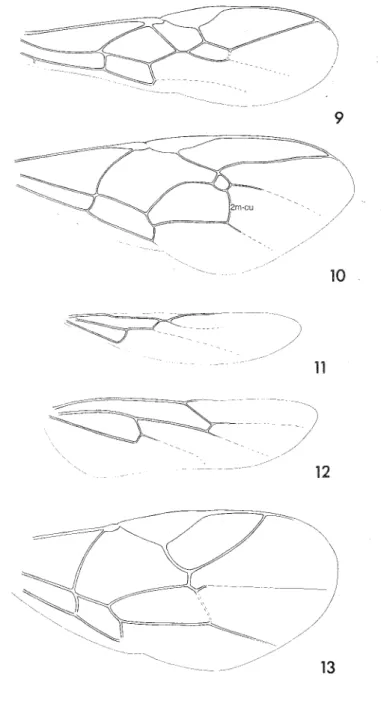
Richards (1977) surveyed the comparative morphology and associated terminology of Hymenoptera in considerable detail; it is, however, rather difficult to abstract from his account the information pertaining to a particular family. Gauld & Bolton (1988) included a less comprehensive review of the subject but incorporated recent advances in understanding, particularly of the terminology of wing veins. The morphological terms most used in taxonomic work on Braconidae are summarised here by means of labelled figures (figs 1-8). All terms used in the present work are included, but of course additional or alternative terms may be encountered in some of the keys for species-level identification to which we refer. Most will be traceable through Richards (1977), van Achterberg (1976c, 1979c) or Gauld & Bolton (1988). However, the older literature is sometimes difficult to interpret. In particular, different systems of venational terminology have been widely used for Braconidae, and authors have often used somewhat different interpretations within each framework. Eady (1974) reviewed the main systems and thei.r variants with particu-lar reference to the Braconidae and he proposed nomenclature that, slightly mod-ified, has been used by Sigwalt (1977) and by van Achterberg (1979c), and is illustrated here (fig. 8). Mason (1986) proposed a system for standardising illustra-tions of wings in taxonomic work. The terminology of other parts of the body has been much more stable and, except that the propodeum used often to be called the metathorax (in error) in the older literature, confusion is unlikely to arise (but see van Achterberg, 1976c, 1979c). Eady (1968) and Harris (1979) have given illustrated accounts of surface sculpture.
Ocelli Face
~
~ Clypeus ' {~ Malar Space1
Labrum Antenna! Socket"'
0
CJ
0
Vertex2
Antenna! socket Eye ~Tentorial pit Mandible Stemmaticum ~' Temple Occipital carinaFemur Coxa Trochantellus Trochanter Tibia Median lobe of mesoscutum
I
Tibial spurs Lateral lobe of mesoscutum Pronotum ~~I
Tarsus3~
Tarsal claw Tegula//(
Flagellum Pedicel Scape4
Base of gaster5
Scutellum Metanotum Notaulus Propodeum Spiracle Mid Coxa Prepectal carina Mesosternum
6
Tergites~
Ovipositor sheath Sternite7
Ovipositor HypopygiumFirst submarginal cell
Second submarginal cell
First subdiscal cell