Procedia Engineering 29 (2012) 1126 – 1132 1877-7058 © 2011 Published by Elsevier Ltd. doi:10.1016/j.proeng.2012.01.099 Procedia Engineering 00 (2011) 000–000
Procedia
Engineering
www.elsevier.com/locate/procedia2012 International Workshop on Information and Electronics Engineering (IWIEE)
Performance Analysis of Interworking between WLAN and
3G Networks Based on Three Approaches
Traoré Soungalo
a, Li Renfa
b, Zeng Fanzi
c, Humphrey Njogu Waita
d College of Information Science and Engineering, Hunan University, Changsha 410082, China[email protected], [email protected]b, [email protected]c, [email protected]d
Abstract
Interworking between WLAN and UMTS actualize the dream of achieving anywhere, anytime Internet access. This paper addresses the issue affecting the transmission of data within WLAN-UMTS interworking system. The key goal of this paper is to present the strategies for the interworking of UMTS-WLAN and discusses some aspects of integrated WLANs and cellular data networks, capable to support ubiquitous data services with very high data rates in hotspots and high vertical handoff between the two different technologies. To achieve our aim we implemented and tested three different approaches: Mobile IP, Gateway and Emulator Approach under the OPNET Modeler 11.5 simulations. Simulation results show that Mobile IP approach is an easy deployed strategy to implement the interworking of the heterogeneous network. However we noted that this approach suffers from long handover latency and might not be able to offer real-time services and applications. We noted that gateway approach offers lower latency than mobile approach. Lastly we observed that the emulator approach achieves the best performance in terms of vertical handover latency when compared to both mobile and gateway approaches. However, the emulator approach lacks the flexibility since the two networks are tightly coupled.
© 2011 Published by Elsevier Ltd.
Keywords: 3G Networks; WLAN-UMTS Interworking; Performance Evaluation
1. Introduction
The IMT-2000 effort is aimed to unite next generation wireless networks into common global specifications. One of the key mobility aspects, terminal mobility, is aimed to provide seamless wireless communication anywhere, anytime, between different heterogeneous networks as a terminal moves about within these networks [1]. The recent evolution and successful deployment of Wireless Local Area Networks (WLANs) worldwide has yield a demand to integrate them with third-generation (3G) mobile
* Traoré Soungalo Tel.: +8613787000449.
E-mail address: [email protected]
Open access under CC BY-NC-ND license.
networks, such as GSM/GPRS, UMTS and CDMA2000. UMTS provides users high mobility but less bandwidth. On the other hand, Wireless LAN systems offer high bandwidth with less mobility. However, there is a need for public wireless access: to cover the demand for high data-intensive applications and to enable smooth online access to corporate data services in hotspots [2]. Therefore, one possibility to supply interworking together, hence the title of this paper: Performance Analysis of Interworking between WLAN and 3G Networks based on three Approaches.
In order to achieve our aim or in other words to quantify the benefits offered by the interworking of WLAN and UMTS system, OPNETTM Modeler 11.5, which is a high level event based network
simulation tool, was used. This simulation software was utilized to implement and test the three different scenarios:
• Mobile IP approach
• Gateway approach
• Emulator approach
From the performed simulation experiments, we also addressed in this paper the performance evaluation of UMTS-WLAN interworking.
The rest of this paper is organized as follows: Section 2 describes some related works. The Problem statements of our study is introduced in section 3 while section 4 explore UMTS-WLAN Interworking Strategies and also discusses the performance evaluation of this heterogeneous networks interworking under OPNET Modeler 11.5 simulations results analysis. Finally, Section 5 concludes our work and highlights the future works.
2. Related Work
In order to face the new challenges in communication area several strategies for interworking of 3G (UMTS) and WLAN have been studied. They are classified as Protocol based approach. The Protocol based approach, Gateway approach and Emulator based approach. The protocol based approach support interworking between heterogeneous networks by reusing or slightly modifying protocols [3]. The Gateway approach needs new equipment which can serve as a gateway to connect 3G networks and WLAN. A gateway called IOTA, which incorporates all the functionalities of 3G networks and WLAN. Both are regrouped into what is called loosely coupled approach. In the Emulator based approach, WLAN are connected to 3G core networks, in order to act as access networks. This approach is called the tightly coupled approach. Here both signals and data always pass through the 3G core networks. Several issues such as AAA problem, seamless connectivity maintenance and (QoS) Guarantee, which need to be considered when integrating 3G networks, such as UMTS and WLAN have been analyzed [4,5]. However this means the approximate location and signal strength of the mobile host need to be cached in nearby router or base station.
3. Problem Statement
WCDMA technology stands for Wideband Code Division Multiple Access, UMTS for Universal Mobile Telecommunication System and GSM for Global System for Mobile Communication and WCDMA is an air interface for UMTS [6]. WCDMA has been designed to support future applications requiring simultaneous transmission of several bit streams that require individual quality of service (QoS). The WCDMA air interface was initially designed to support a wide variety of services with different QoS requirements having a maximum bit rate of 2 Mb/s. In order to satisfy the future service and application needs several technical enhancements are being studied and standardized for WCDMA in 3GPP [7]. Even with evolved WCDMA, there is a need for another public wireless access solution to cover the demand
for data-intensive applications and enable smooth online access to corporate data services in hotspots. As development objectives, the development of 3G will follow a few continuing key trends: increasing capacity optimization for voice services, increasing IP-based applications, supporting simultaneous voice and improving data services efficiency, delay, and average and peak user data rates, making more attractive multimedia terminals to be spread out everywhere, achieving high-quality high-data-rate everywhere, and finally decreasing cost to be affordable for everybody. However, WCDMA comes as an answer to the expected trends in the 3G development objectives, mentioned above. The answer of WCDMA evolution view [8], during the last decade, can be seen in three phases as described next:
• High-Speed Downlink Packet Access: The peak data rate and throughput of WCDMA downlink for best effort data will be greatly enhanced.
• Uplink Speed Data, Speed Access for TDD: The emphasis will be on Uplink High-Speed Data and High-High-Speed Access for TDD. Here, enhanced data rates in the uplink will benefit the end user.
• Capacity Improvements in Uplink and Downlink, Further Data Rate Enhancement. Here, there will be capacity improvements in uplink and downlink, and further enhancement of WCDMA. Even though the above answers appear to solve the problem, they however remain theoretical. They need to be deeply studied for them to be applied in real time. The next sessions are focused on the implementation details.
4. OPNETTM Modeler 11.5 simulation
To implement the previous UMTS-WLAN interworking strategies issues discussed above; three approaches for UMTS-WLAN interworking have been proposed:
• Mobile IP Approach
• Gateway Approach
• Emulator Approach
The simulation environment has a UMTS network and a WLAN (802.11 local area wireless networks) using OPNETTM Modeler 11.5 for this simulation. The UMTS network has 100Mbps backbone with 5
radio network subsystems and offers 32Kbps data services. WLAN has 4 access points and provides 100Kbps data service. Assuming 50% users are WLAN users and the other 50% users are UMTS users. Among all users, 50% are dual mode users and might moves in between two networks, and the other 50% are single mode users using either WLAN or UMTS. Dual mode users have a 0.5 probability to enter the WLAN (802.11 local area wireless networks) and a 0.5 probability to enter the UMTS.
4.1. Mobile IP Approach
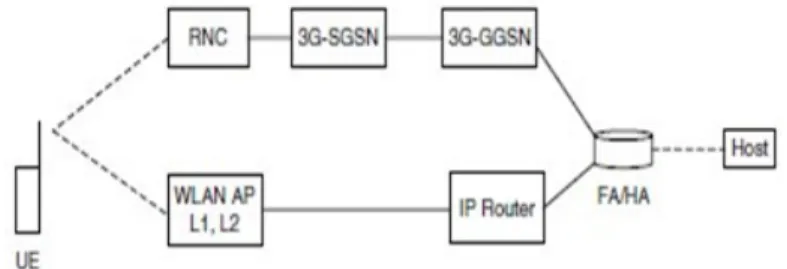
This interworking strategy use mobile IP as the protocol architecture as shown in Fig.1. In this approach (called loose coupling approach), UMTS and WLAN are peer- to- peer networks. In the UMTS network, user equipment UE uses standard UMTS session management (SM) and GPRS mobility management (GMM) to handle a packet data protocol (PDP) session and the roaming between WCDMA radio access networks, while, in the WLAN the UE uses IP directly [9]. As for the mobility management in WLAN, mobile IP might be also used. If a UE decides to handover from UMTS to WLAN, it simply disables its UMTS protocols and uses the IP stack. If the UE wants to use the same IP address that uses in the UMTS network or wants to be accessed via the original IP address, mobile IP should be involved. Foreign agents and home agents FA/HA are installed in the WLAN access router (AR) networks and
GGSN networks so that FA/HA can help routers to tunnel and forward the data packets. Generally speaking, the existing mobile IP and UMTS standards are quite enough and mature to support this approach. However, the handover latency and the packet lose are its two major problems.
Fig.1. The Protocol architecture of the mobile IP approach
4.2. Gateway Approach
The second approach is to use a gateway to interconnect the two networks. Fig.2. shows the protocol architecture. Here, UE uses standard SM and GMM to access the UMTS network and uses the standard IP to connect to the WLAN. In the WLAN, the UEs might use mobile IP to handle the mobility within the WLAN. For users wish to have interworking services, the control signals and data packets are be routed through the gateway. If the two network operators have a roaming agreement, the gateway enables the intersystem roaming of the two networks. The merits of this approach are that the two networks can be operated independently and mobile IP is not necessary [10].
Fig. 2. The protocol architecture of the gateway approach
4.3. Emulator Approach
This approach is to use WLAN as a UMTS access stratum (AS). The protocol architecture of the Emulator approach is shown on Fig.3. Here, the session management and the mobility management are handled by the UMTS SM and GMM. The UE cannot access internet through WLAN directly. This approach tightly couples the two networks and WLAN can be viewed as a slave network of the UMTS and called “tight coupling approach’’. The advantage of this approach is that the handover latency is much lower than other two approaches and disadvantage of this approach is that the gateway GPRS support node (GGSN) will be the single point to the Internet. All packets have to go through the GGSN first. GGSN and the core network become the bottleneck.
Fig. 3. The protocol architecture of the emulator approach
4.4. Performance Evaluation Analysis
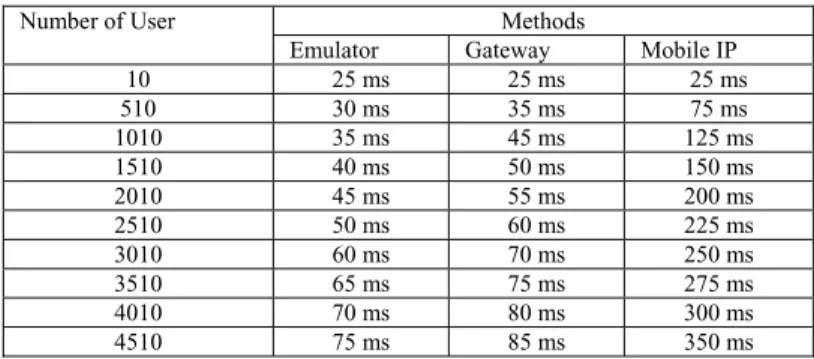
In this section, we present some performance and evaluation for the UMTS-WLAN interworking according to different approaches based on simulation. The three different approaches are compared here, mobile IP, gateway and emulator approaches. The vertical handover latency of different strategies of UMTS/WLAN interworking can be found in Table 1 where experiment results have been illustrated clearly. From which, it is clear that mobile IP obtains the poorest performance since the signalling packets have to go to Internet (home agent and foreign agents). Gateway and emulator approaches only involve the message exchange within intra-network. The latency of gateway approach is a little bit higher than the emulator approach. We also learn that mobile IP approach will introduce more than 200ms latency under this network configuration while the users are more than 2000. The latency might not be acceptable for real-time applications.
Table 1. Vertical handoff latency according to UMTS-WLAN interworking strategies Methods
Number of User
Emulator Gateway Mobile IP
10 25 ms 25 ms 25 ms 510 30 ms 35 ms 75 ms 1010 35 ms 45 ms 125 ms 1510 40 ms 50 ms 150 ms 2010 45 ms 55 ms 200 ms 2510 50 ms 60 ms 225 ms 3010 60 ms 70 ms 250 ms 3510 65 ms 75 ms 275 ms 4010 70 ms 80 ms 300 ms 4510 75 ms 85 ms 350 ms 4.5. Tight coupled and loosed coupled schemes analysis
According to the used approaches for implementing the discussed issues addressed in OPNETTM
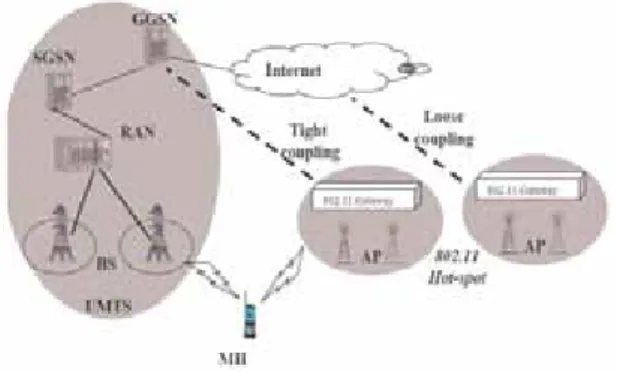
Modeler 11.5 simulation Section of this paper, we obtained tight coupling architecture for Emulator approach and loose coupling architecture when using Mobile IP approach as interworking strategy of UMTS and WLAN technologies. The main difference between tight coupling and loose coupling is whether the user’s traffic is delivered through the core network of UMTS or not. In tight coupling interworking architecture, a WLAN is connected to UMTS core network in the same manner as other UMTS radio access networks. The WLAN gateway implements all the UMTS protocols (authentication, mobility management, etc.) required in the UMTS radio access network. In this approach, UMTS and WLAN would use the same authentication, mobility, and billing infrastructures. The main advantage of this solution is that the mechanisms for mobility, QoS, and security in the UMTS core network can be
reused directly over the WLAN. However, tightly coupled solutions will be highly specific to the UMTS technology and require extensive access interface standardization of WLANs beyond the existing standards. Moreover, the configuration and design of UMTS network elements such as the serving General Packet Radio Service (GPRS) support node (SGSN) and gateway GPRS support node (GGSN), have to be modified to sustain the increased traffic from WLANs. In a loose coupling approach, the WLAN gateway does not have any direct connection to UMTS network elements as shown in Fig.4. Instead, they are connected to the internet. WLAN traffic would not go through the UMTS core network. Since each network operates independently, under loose coupling scheme; networks don’t need to change their network architectures or protocol stacks. Therefore, loose-coupled network cannot support service continuity to other access network during vertical handover, thus loose-coupled scheme has long handover latency and packet loss.
Fig. 4. UMTS and WLAN integration: tightly-coupled vs. loosely-coupled architecture
4.6.Billing Analysis
One of the advantages for interworking of UMTS and WLAN is common billing which means that a subscriber will receive a single combine bill for using services offered by different network operators. In fact, while 3G and WLANs are integrated, billing agreements or billing mechanisms must be provided. The billing mechanisms should support non-repudiation service. This is a very important issue especially when the 3G network and the WLAN network are administrated by different operators. If there’s not such a mechanism provided, operators may deceive each other. Moreover, the two operators can collude with each other for common billing. Therefore, Prasithsangaree and P. Krishnamurthy [11] proposed a dual signature scheme, called Localized Dual Signature Authentication, to achieve these requirements and it works in a loose coupling approach. Furthermore two billing Options are possible; pre-paid and post-paid billing. In prepaid billing, a subscriber has paid some money in advance. When the subscriber uses network services, the home network operator checks the charging information and deduct corresponding amount of money from the subscriber’s credit. When the subscriber is out of credit access network services is denied. In post-paid billing, a subscriber has a billing agreement with the home service provider to pay at intervals and is charged regularly for the usage within this period.
5. Conclusion
The necessity to provide telecommunication services at anytime, anywhere and with the best possible quality, high speed and large bandwidth has created the need to deploy a required set of mechanisms that
integrate different systems. In this paper, we described the main issues of evaluating UMTS-WLAN interworking performance based on 3 approaches. Mobile IP approach is the easiest deployment strategy and the standards to implement the interworking of the heterogeneous network. However, the simulation results show that it suffers from long handover latency and might not be able to offer real-time services and applications. The gateway approach obtains a much lower latency than mobile IP approach. It helps the two networks to operate independently and also provides the capability of the intersystem roaming. This approach is applicable to the current network environment. The emulator approach achieves the best performance in terms of handover latency. Moreover, this approach lacks the flexibility since the two networks are tightly coupled. From the simulation results, it also appears that the main difference between tight coupling and loose coupling is whether the user’s traffic is delivered through the core network of UMTS or not.
Therefore future studies must be done in order to know whether both approach (tightly coupled approach and loosely approach) can provide best performance of vertical handover between UMTS and WLAN interworking system under an adaptive integrated scheme.
References
[1] Shashwat Bhasvar “WLAN-Cellular Integration for Mobile Data Networks ”, University of New Brunswick P.O. Box 4400 Fredericton, CNSR 2003 Conference, Moncton, New Brunswick, Canada, pp. 126-127, 15-16-May, 2003.
[2] P. Pablo Garrido, Manuel P. Malumbres and Carlos T. Calafate, “ns-2 vs. OPNET: a comparative study of the IEEE 802.11e technology on MANET environments” Miguel Hernandez University Avda. Universidad and Technical University of Valencia Camino de Vera, 1st International ICST Conference on Simulation Tools and Techniques for Communications, Networks and Systems, SIMUTOOLS 2008, Marseille, France,pp.1-10, 3-7 March, 2008.
[3] M. Buddhikot, G. Chandranmenon, S. Han, Y. W. Lee, S. Miller, L. Salgarelli, “Integration of 802.11 and Third-Generation Wireless Data Networks”, Bell Labs, Lucent Technologies, NJ USA INFOCOM 2003, pp. 509-512, 2003.
[4] Arslan Munir and Vincent W. S. Wong “Interworking architectures for IP multimedia subsystems”, Department of Electrical and Computer Engineering, The University of British Columbia, Vancouver, Canada, Journal Mobile Networks and Applications, Volume 12 Issue 5, pp. 296-308, December 2007.
[5] Traoré Soungalo, Li Renfa, Zeng Fanzi, Humphrey Njogu Waita, “Vertical Handoff Analysis between WLAN and 3G Networks under an Adaptive QoS Control ”, WORLDCOMP'11 - The 2011 World Congress in Computer Science, Computer Engineering, and Applied Computing. ICWN2011.pp.141-146, Las Vegas, USA, July 18-21, 2011
[6] M. Rahman, P. Ernström, “Repeaters for Hotspot Capacity in DS-CDMA Networks,” IEEE Transactions on Vehicular Technology, Vol. 53, No. 3, pp. 626-633, May 2004.
[7] Mehwish Bashir and Salman Afsar, “Implementation of Universal Mobile Telecommunication System” Institute of Horticultural Sciences and Department of Computer Science, University of Agriculture, Journal of Agriculture & Social Sciences Faisalabad-38040, Pakistan, pp. 33-37, July 2006.
[8] Mohammad Abualreesh, “WLAN-3G Interworking” Helsinki University of Technology, Postgraduate Course in Radio Communications,pp.1-8, June 2004.
[9] F. G. Marquez, M. G. Rodriguez, T. R. Valladares, T.de Miguel, and L. A. Galindo, "Interworking of IP Multimedia Core Networks between 3GPP and WLAN," IEEE Wireless Communications, vol. 12, pp. 58-65, June 2005.
[10] T. Sasikala and S.K. Srivatsa, “Internetworking of WLAN and UMTS Networks”, Sathyabama Deemed University, Madras Institute of Technology, India. Information Technology Journal, Asian Network for Scientific Information Vol.5, pp. 923-929, 2006.
[11] P. Prasithsangaree and P. Krishnamurthy, “A new authentication mechanism for loosely coupled 3G-WLAN integrated networks,” in IEEE 59th Vehicular Technology Conference, VTC 2004-Spring, vol. 5, pp. 2998-3003, May 2004.