“DOING” INTERNATIONALIZATION: PRINCIPLES TO
PRACTICE
KUMARI BECK
Simon Fraser University ROUMIANA ILIEVA Simon Fraser University
Abstract
In the context of an increasing commodification of education in a neoliberal academy, this paper explores the usefulness of frameworks for principled internationalization of higher education. We review recent theoretical analyses of ideologies and orientations of higher education internationalization as well as suggested approaches for principled and ethical
internationalization as important signposts in that regard. We discuss data on the everyday experiences of internationalization of faculty, students and staff in one Faculty in Canada in light of these perspectives and propose guidelines that could influence internationalization practices in a more ethical and principled direction.
Keywords: internationalization of higher education; international education; principles of
“We must ask ourselves why we do what we do and what we want to achieve” (Stier, 2004, p. 95). Introduction
The predominant theme in international education news, whether in the media or official reports on the topic, is numbers. Canadian institutions appear to be focused on targets for
enrolment, the numbers of incoming students as compared year to year, and the impact on institutional rankings as a measure of how well the university is doing. Governments like to cite the impact of international students on the economy as a reason for why we should continue to recruit more of them. In Canada, there were 572,415 international students enrolled in 2018, contributing an estimated $21.6 billion to the Canadian economy (Canadian Bureau of
International Education [CBIE], 2019). These numbers reflect a 16% increase over the previous year, and 2017 saw a 28% increase over the previous year. A new Canadian Strategy for
International Education was unveiled in August 2019, with the current Minister of International Trade Diversification appreciating these economic benefits to Canada, including the 170,000 jobs that were created. International education, says the Minister, is “an essential pillar of Canada’s long-term competitiveness” (Global Affairs Canada [GAC], 2019) and by way of explanation for the strategy states: “Competitor countries in this sector recognize the long-term benefits of international education. They have upped their game, and to remain competitive, we upped our game too” (GAC, 2019).
In this regard, the new strategy certainly builds on the first International Education Strategy (Department of Foreign Affairs, Trade and Development [DFATD], 2014) where the language of competition is strong: the strategy aims to “maximize economic opportunities for Canada”, engage with “new and emerging markets”, attract “the best and brightest international students” (p. 5) and encourages “branding Canada to maximize success” (p. 10). The new strategy has three priorities. The first priority is promoting study abroad for Canadian students, the second, diversifying the source countries, disciplines and levels of study of international students coming to Canada. The third priority is support for Canadian educational institutions to “grow their export services and explore new opportunities abroad” (GAC, 2019). The first priority arguably holds promise but even study abroad is aimed at gaining ‘new skills’ in “key global markets”, to keep our graduates competitive in the global marketplace. The second priority is a strategy to maintain the financial sustainability of student recruitment by avoiding dependence on a single country or region, and the third is all about marketing and branding. It does not need much more in-depth reading of these policies to see ‘why we do what we do’.
Indeed, from a more critical standpoint, we scholars could ask ourselves, ‘why do we do what we do?’ in the face of the ongoing and even escalating commercialization and
commodification of international higher education? What are the gains, if any, from critiques of internationalization of higher education on policy and practice? Has research on
internationalization approaches made any impact on how we think about and practice international education? What is the role of researchers in this context?
We take up this last question in this paper, in an effort to make meaning for ourselves as practitioner-scholars in the field, and to consider how our research may be useful to practitioners. Before we elaborate on how we will proceed, we clarify our use of the terms internationalization and international education without getting into a longer discussion of definitions. We align with the widely held understanding of internationalization of higher education as a process made popular by Jane Knight (2004), and in particular with the updated definition by de Wit and Hunter (2015): “the intentional process of integrating an international, intercultural or global dimension into the purpose, functions and delivery of post-secondary education, in order to enhance the quality of education and research for all students and staff, and to make a
meaningful contribution to society.” (p. 3, italics in original). In our view, this perspective is
more oriented towards achieving educational outcomes, and thus, to our purpose in this paper. International education on the other hand has more divergent meanings, from comparative education, development education, global education to peace education (Gutek, 2006). Our use of the term follows Phillips and Schweisfurth’s (2006) description of international education as domains of practice and fields of inquiry, recognizing that participants in the study we cite have more of an affiliation with such conceptualization of international education.
As the purpose of our paper is more about illustrating how research can inform practice, we are departing from a more traditional presentation of elements such as a literature review and a standard theoretical framework. We do employ, however, selected scholarly and policy
documents to frame our discussion of ‘principles to practice’. To understand rationales and orientations of internationalization of higher education, we will be informed by Stier (2004, 2010) and Andreotti, Stein, Pashby and Nicolson (2016). Next we will discuss principles and ethics for internationalization through a policy document authored by the Association of Canadian Deans of Education (ACDE, 2014), and Stein, Andreottiand Suśa's (2019) article on global ethics. We illustrate how this scholarship can provide analytical tools for identifying harmful impacts of internationalization as well as possibilities for principled practice by analyzing data drawn from one of our studies on critical internationalization. We conclude by articulating guidelines for practice that could move internationalization towards making a “meaningful contribution to society” (de Wit & Hunter, 2015, p. 3).
Ideologies and Orientations
In early scholarship on the topic, Jane Knight and Hans de Wit categorized rationales for internationalization as academic, economic, political and cultural (Knight & de Wit, 1995). As Knight (1999, p. 9) herself acknowledges, the four groups of rationales are neither distinct nor exclusive. In spite of the caution that these rationales overlap, and a lack of clarity about what constitutes these categorizations, the rationales are being employed by institutions to show that internationalization itself is an academic endeavor, and thus above critique.
ideas surrounding internationalisation should not merely be discussed as rationales, but should be analysed as ideologies. Ideologies are more complex than rationales, and refer to a set of principles, underpinnings, goals and strategies which structure and permeate the actions and beliefs of educators, groups, organisations or societies” (p. 340, italics in original).
He identifies three ideological assumptions behind the internationalization of education, namely: idealism, instrumentalism and educationalism, and outlines as well their shortcomings. Stier maintains that despite an overarching recognition of the importance of the internationalization of higher education shared across these ideologies, the ideologies themselves are fundamentally different and this has “far-reaching consequences for how universities work with
internationalisation in general and for pedagogical practice in particular” (2010, p. 340).
The first ideology, idealism, refers to the notion that internationalization is ‘good per se’ (Stier, 2004, p. 88, italics in original) and that the outcome of internationalization of education will necessarily be a more democratic and equitable world through increased international
cooperation. Instrumentalism champions the perspective that education is a means towards other ends. The most significant element in this ideology is the strong connection between education and economic growth. Higher education becomes a commodity, positioning universities to be competitive in the global market place, vying for the business of students and faculty, and maximizing revenue for their institutions.
Stier frames the third ideology, educationalism, as being connected to life-long learning. While educationalism is presented as the most desirable ideology to drive internationalization, it should not be endorsed uncritically. The main critique, says Stier, is the risk of academicentrism, the assumption that ‘our’ ways of teaching, research, learning are superior.
Stier encourages us to reflect on the ideological nature of rationales, and to assess how societal and political ideologies are influencing internationalization in ways that undermine and contradict academic and educational values and principles of higher education. Even this framework, however, has its limitations in recognizing the multiple complexities within the categories of idealism, instrumentalism and educationalism.
We next discuss a different theoretical approach to this problem.
A Social Cartography Approach
In what is now considered a ground-breaking analysis, Andreotti et al. (2016) make a compelling case for social cartography in mapping the complexities of higher education as well as illustrating its uses for advancing possibilities for change. As they explain, their research project on Ethical Internationalism in Higher Education (EIHE) brought together over 20 partners in nine countries, all from “diverse disciplinary backgrounds, theoretical orientations, political perspectives, social locations and personal histories” resulting in a “rich tapestry of scholarly insights” (p. 3). In seeking a suitable methodology to bring together such a mix of diverse perspectives the team selected social cartography based on the work of Paulston (2009) to “identify the cracks and edges of existing positions” (p. 4).
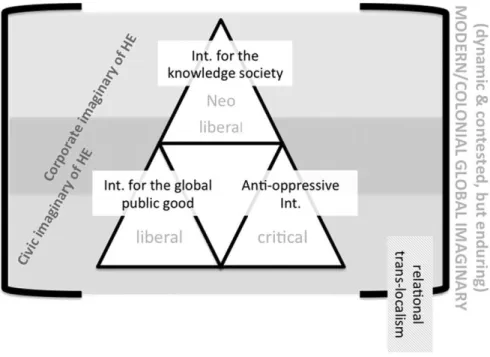
Andreotti et al. (2016) provide three sample cartographies developed in the EIHE project: the juxtaposed imaginaries of the university, corporate/civic orientations, and articulations of internationalization recognizing that they are all embedded in the modern/colonial global imaginary.
The first cartography identifies and maps four social imaginaries of the university in a historical context making visible the evolution of orientations of the modern university and the ways in which these imaginaries co-exist and interface with one another, in complementary, competing and contradictory ways. They conclude that the civic and corporate imaginaries (nesting always within the modern/colonial global imaginary) are the most visible and relevant today, “producing unpredictable and at times contradictory and incoherent outcomes for staff, faculty, students and communities” (p. 7).
The authors next discuss the civic/corporate imaginary, mapping three discursive orientations - neoliberal, liberal and critical, and four resulting interfaces among them, the neoliberal–liberal; liberal–critical; neoliberal–critical; and neoliberal–liberal–critical. The neoliberal references the commodification of knowledge, teaching, research and service, with many examples of the forms it takes. The liberal orientation “promotes a commitment to the public good, civic engagement, representative democracy, equality, individual freedoms, a Keynesian orientation to economics, and a strong state role in welfare and re-distribution” (p. 8) and the role of education is tied to the development of ‘good’ citizens. The critical orientation, as its name implies, challenges and aims to disrupt forms of oppression that have become
normalized in higher education processes and practices. It is aligned also with the civic
imaginary in advocating for voices of marginalized peoples, but goes beyond the simple critique to action in seeking change.
The significance of this cartography is that it helps to make visible the interfaces between these orientations in what the authors call ‘spaces of ambivalence where signifiers are used with multiple strategic meanings” (p. 9).
Carrying this analysis through to internationalization, the authors further discuss and provide examples of how the neoliberal-liberal-critical interfaces could be mapped, illuminating practices of internationalization. They present four “articulations of internationalization” (pp 9 – 11). The first, arising out of the neoliberal discourse, is internationalization for the knowledge society, with higher education serving economic growth and competitiveness, which is very clearly visible in both federal international education strategy documents (DFATD, 2014; GAC, 2019). The second articulation, internationalization for the global public good, is closely related to the civic discourse and the liberal ideals of democracy, inclusion and knowledge building.
The third, anti-oppressive internationalization is committed to “work in solidarity for systemic transformation towards social justice” (p. 11). Although this articulation challenges the other two, it still remains within the modern-colonial imaginary and so the authors present a fourth articulation, which drops the nomenclature of internationalization altogether to instead be named “relational trans-localism” (p. 11), “recognizing that interconnection and ethical
obligations exceed the borders of the nation state and the onto-epistemic grammar of modernity” (p. 11).
Figure 1. Articulations of internationalization (Andreotti et al., 2016, p. 10, Fig. 5)
Consistent with the authors' conclusion about the usefulness of social cartography in both making visible the complexity of higher education as well as “imagining and acting otherwise” (p. 13), we recognize the value of employing their cartography as an heuristic to understand our data in more complex ways.
The most apparent employment of Stier’s and Andreotti et al.’s analyses is in the critique of current internationalization practices, but as we posed in our introduction, how does this critique support practice? In our original study on Sustainable Internationalization (Beck, Ilieva, Waterstone, Hill, Tzy, & Zhang, 2011) we developed a ‘checklist’1 that a Faculty could use to question and assess their own practices. We now seek to modify that list of questions, generated from our data and from the fresh analyses afforded by the new set of theoretical lenses, to refine guidelines for practice. We suggest that they could provide a framework for ethical practice similar to recommendations made in the ACDE Accord that we discuss below. Andreotti et al.’s theorizing identifies for us with greater clarity the incommensurability of ‘doing’
internationalization within a ‘modern/colonial’ structure. And yet, even within these
impossibilities we see possibilities that could support faculties and practitioners to attempt the task of principled practice.
1 We recognize the negative implications of the term ‘checklist’ as denoting a simplistic and often problematic
approach to enacting complex processes and practices. Our use of the term in our original study referred to the opposite of what is implied in a checklist approach to internationalization. The checklist referred to a list of guiding questions in the environmental audit, prompting reflection and critical review, rather than a simplistic ‘checking off’.
Principles and Ethics
In moving from critique to possibility we have selected the Canadian Deans’ Accord on Internationalization (ACDE, 2014) and a recent publication by Stein et al. (2019) on global ethics in internationalization as being helpful in developing our guidelines for practice.
The Accord on Internationalization
The Association of Canadian Deans of Education, in their commitment to “national, public discourse on the importance of public education in developing and sustaining a civil society” (Association of Canadian Deans of Education [ACDE], 2006, p. 1), has developed a number of Accords that articulate principles and guidelines for the practice of education. The ratification of the Accord on Internationalization in 2014 by Faculties of Education across Canada was a significant statement as it followed the publication of, and was a challenge to, the first national strategy on internationalization.
The Accord on Internationalization promotes five principles, namely, equity, economic and social justice; reciprocity; global sustainability; intercultural awareness and respect, and equitable access. These principles are articulated to address concerns about the status quo of internationalization such as the impact of a market-driven economic orientation of
internationalization, the rapid increase in student mobility affecting “the capacity of institutions to respond to service demands in ways that are socially accountable” (2), and the challenges faced by educational institutions through the increasing complexity, uncertainty, and inequity in social conditions. The Accord names risks associated with internationalization that are connected to the above concerns, which include the uncritical adoption of exploitative practices based in profit-seeking systemic exclusion, personal and social disruption, neo-colonial practices, and the risk to participants engaged in international activities. Among the many benefits of
internationalization are the potential for “enriching and enhancing educational experiences for all students” (2) and, most importantly, the possibilities for systemic change. Implications for practice that arise out of these principles are further described, including desired outcomes, which provide some practical examples of how this Accord could be applied.
Global ethics
Stein et al. (2019) highlight the importance of attending to the ethical dilemmas that accompany the intensification of internationalization in Canadian universities and discuss how three ethical frameworks (liberal, critical and decolonial)2 frame and respond differently to such dilemmas within the main areas of internationalization: international student mobility, the internationalization of curriculum, and study (and service) abroad. Stein et al. advocate for multi-voiced dissensual conversations and against a single ethical approach on these topics if we
2 While the article by Andreotti et al. (2016) refers to three discursive orientations that circulate in discussions of the
global imaginaries of the civic/corporate university: neoliberal, liberal, and critical, the “liberal” framework within the global ethics frames suggested by Stein et al. (2019) encompasses both “neoliberal” and “liberal” discourses.
are to engage meaningfully with the complexity accompanying internationalization activities and practices in various contexts.
The three frameworks reflect different assumptions within the field of global ethics defined as “a field of study that addresses international, institutional, and interpersonal efforts to navigate and negotiate complex dilemmas that are not bounded by local contexts or national borders” (Stein, et al., 2019, p. 25). A liberal approach to global ethics is “rooted in a global imaginary” which naturalizes a particular way of being and knowing associated with “the presumed political authority of nation states, economic inevitability of capitalist markets, epistemic authority of Western knowledge, and anthropocentric separation of humans from the earth” (p. 26) as if it were the only valid one. Such a universalist frame closes down possibilities for different visions on education and societal change and for diverse perspectives on
subjectivity and relationality. Critical approaches question the universality of liberal global ethics and identify a set of unequal power relations dominant on a global scale as well as advocate for the redistribution of resources and the pluralization of knowledge traditions to be valued across societies. Yet, Stein et al. argue that critical approaches are articulated “from the edge of liberal frames” (p. 27) and do not offer possibilities beyond what is imaginable within liberal global ethics.
In contrast, a “decolonial approach to global ethics seeks to address the ambivalences, complexities, circularities, and complicities that are often involved in trying to imagine ethics ‘otherwise’.” (p. 27). This would entail denaturalizing universalistic Western frames which “need to be interrupted and decentred so that suppressed ethical frameworks can be regenerated and new possibilities for (co)existence can emerge” (p. 28). A decolonial approach “identifies a need for transitional practices, pedagogies, and engagements through which those who were socialized within a liberal global imaginary can work through not only the cognitive and material but also the affective and relational challenges of change” (p. 28). The authors then offer
examples of the kinds of questions that scholars and practitioners interested in ethical approaches to the practices of internationalization would pose and attempt to address from each of these three ethical frameworks with respect to student mobility, the internationalization of curriculum, and study and service abroad. The questions Stein et al. pose could be viewed as guidelines that could be reflected upon in developing strategies for ethical internationalization in faculties and universities.
We set out now to apply these frameworks to revisit and discuss one of our studies on sustainable internationalization3 that explored student, faculty and staff experiences of
internationalization in one Canadian faculty. In line with Stein et al.’s (2019) compelling argument for engaging in multi-voiced conversations on the topic, we see it as one way to talk through possibilities for ethical internationalization where our focus is on principles that guide actions rather than the process of internationalization itself.
3 We defined “sustainable internationalization” in our earlier work as epitomized by “ecological principles of
interconnectedness and dynamic interactions which involve the recognition of power relations and diverse understandings [of internationalization] among students, faculty, and staff” in the context of higher education (Ilieva, Beck, & Waterstone, 2014, p. 879).
Revisiting Sustainable Educational Ecologies: Our Study
The study that we refer to and that we draw on for our discussion in this paper was one aspect of a faculty wide research project on Sustainable Educational Ecologies (SEE; de Castell, Egan, Beck, Ilieva, Waterstone, Nilson, & Patterson, 2010) where an interdisciplinary team of education researchers sought to research and develop theoretical and practical measures
associated with the concept of educational sustainability investigated through the following themes: Sustainable Internationalization, Learning in Depth, Plants and People, Educational Delivery Systems, Place-based Pedagogy, and Learning Environments Research.
Together with another colleague we worked on the theme of sustainable
internationalization with the aim of developing an environmental audit instrument, consistent with the other teams, that could assess the human, institutional, and educational costs and
benefits of internationalization. Our data led us to develop a framework for a Faculty’s approach to understanding principled internationalization, as well as forming a set of guidelines for
practice that we now plan to revisit.
Methodology
The setting for the study was a Western Canadian university that has been actively involved in international activities for over 25 years, and is explicitly internationally oriented in its identity through claims made in its strategic vision. Within the faculty that was studied, international education had been a key program area in the previous 20 years with various educational opportunities for domestic and international students in undergraduate and graduate programs as well as pre-service teacher education programs.
We employed a qualitative dominant mixed methods design using an online survey, including forced choice as well as open-ended questions, and semi-structured qualitative interviews, to explore internationalization within this faculty. Survey participants included 125 students (representing 5 % of students enrolled), 34 faculty members (42 % of the faculty), 11 staff members (19 % of staff), and one administrator (13 %). The 13 interview participants included seven students (four graduate and three undergraduate), four faculty members and two staff members.
We first revised and administered an instrument used by the Universities Canada (UC, published as Association of Universities and Colleges of Canada [AUCC] to survey the status of internationalization of higher education in Canada (AUCC, 2007) and expanded the participant population from administrators to include students, faculty, and staff and sought to collect data on participants’ perceptions and experiences relating to the meaning of internationalization, rationales and outcomes of internationalization, and teaching and learning. In our semi-structured qualitative interviews, we covered topics such as the understanding of internationalization, curriculum, pedagogy, personal/social outcomes, decision-making, participation in international activities, value of credentials and so on.
For the purposes of this paper, we have selected two of the main themes generated in the data analysis [the full data set is elaborated upon elsewhere (Beck et al., 2011)]. The first
references the harmful impacts of internationalization, and the second highlights the possibilities that our participants described.
Harmful impacts of internationalization
Our first finding refers to the commodification of educational activities and practices. The second finding refers to the containment of difference, the erosion of cultural diversity, and the inequitable power relations that were evident in descriptions of international education activities.
Commercialization/marketization of higher education
As referred to earlier, findings from the Universities Canada (AUCC, 2007, UC 2014) national surveys claim that academic rationales drive post-secondary education
internationalization. When asked to select reasons for internationalizing, our own participants selected the so-called academic rationale: ‘the preparation of graduates to be internationally and inter-culturally knowledgeable and skilled’. This finding could be seen as reflecting a liberal orientation (Andreotti et al., 2016) or an educationalist ideology (Stier, 2004), until we began to analyze the qualitative comments in the survey and the interviews.
A faculty member challenged the interpretation of an academic rationale for
internationalization snapping, “being a university you cannot promote this financial benefit, it
will be politically incorrect, so you try to find other benefits” (F. Int. 2) implying that we should
be cautious of that finding. And we did find comments that supported another side of this story. In the faculty survey, some participants reported that getting ‘bums on seats’ or a “money grab” was the primary motivation for internationalization in the Faculty. Another provided a more detailed remark:
The internationalization of education is concerned with practices and policies
implemented by academic institutions to promote their interests around the world. Most often, international education is undertaken in the service of generating revenue and acquiring influence (Survey-Faculty).
In the survey question that asked participants to describe their understanding of current policies and plans in the area of internationalization, a Faculty member stated:
I think the Faculty is committed to increasing presence in the international education ‘marketplace’. I am not sure there is much understanding of socio-political-ethical reasons for internationalization (Survey – Faculty)
Faculty members made comments such as [internationalization is] “very uni-directional”, and “marketing is a priority”. There was one explicit comment directly critiquing what they saw as irrefutable evidence of a corporatizing university:
[we are an] increasingly commodified, corporatized university … marketing ourselves to most often more vulnerable populations, families and students in developing nations and calling it internationalization ... [this seems] parasitic (F. Int.2)
Student comments in the survey added to the data that speak to the visibility and, indeed, apparent priority of income generation from their experience: “[Internationalization is a]
reification of education as a commodity” (Survey- Student).
We were unprepared for the level of candour expressed by our participants, easily identifiable as what the ACDE (2014, p. 3) referred to as the “risk of exploitative practices emerging from an exclusive or primary focus on profit maximization”, and the “risk of (neo) colonization”. It is also clear that participants’ observations on internationalization identify the corporate imaginary of higher education, and the neoliberal discursive orientation (Andreotti et al. 2016).
Some of the data reflect the interface of the liberal and neoliberal orientations. The Faculty survey comments had many such examples:
This phrase [internationalization] primarily means two things to me: 1. the learning opportunities and possibilities that emerge from greater international contacts and initiatives; 2. the complications and problematics, unintentional and/or intentional, that emerge from greater international contacts and initiatives (Survey – Faculty).
We identified a strong presence of the critical orientation as well, as in the following observation reflecting the liberal-critical interface:
On the positive side, it means increasing our understanding and therefore improving our actions so as to be more respectful and effective vis-a-vis the students and others whom we work with in our diverse society. It can, however, take on a negative side when used as a tool for advancing the neo-colonial agenda, such as, preparing our students to work in "foreign" lands with the hidden agenda of changing values and ways of life so as to be more consistent with ours” [Survey - Faculty].
We have found the cartography to provide more of an insightful analysis than the broader categories of ideologies that Stier (2004) discusses. The liberal-neoliberal interface in particular, makes visible the ‘spaces of ambivalence’ and the fluidity of experience of the participants.
One of the findings of our study was pervasive ignorance about internationalization which led in many instances to an endorsement of internationalization as “inherently good” (see Stier, 2004) or the common perception that it is inevitable and somehow must go on. In this instance, a faculty member critiqued this: “We seem to start with the assumption that if it's
something international we should do it” (Survey - Faculty). Uncritical acceptance is an element
of Stier’s ideology of idealism.
Connecting the discussion of literature and data to the task we set ourselves, the naming of the harms and risks of internationalization has helped us to generate questions that may guide program development:
• What ideologies and discourses are influencing our rationales for internationalization?
• What are the ways in which a faculty is being coerced into prioritizing income generating activity over activities that are more aligned with social justice values and aims?
Inequity, difference and the containment of diversity
Some of the sub-themes that emerged from the data on the theme of equity, diversity and difference related to program and curriculum development, the monocultural and monolingual learning context, the problematics of study abroad and exchange programs, and the
marginalization of international students who look and sound different from the dominant culture white students, staff and faculty.
Students and faculty critiqued the North American focus in course curricula. One faculty member called the curriculum’s focus on North American content a “much too arrogant”
overvaluing of what ‘we’ have to offer those who come to study (F. Int. 2). A student reported, in the courses here students are not able to bring their culture into the learning
environment, it is more just like the knowledge comes from the top to the bottom ... From the school to the professor to the students. (St. Int. 4)
Linked to the overvaluing of North American content is the devaluing of international students, and their own background knowledge. This could be extended to include all students of diverse backgrounds. A comment from the faculty survey expresses the frustration felt about this:
We just never make use of the resources those [international] students bring … [we need to] STOP telling [international students] that they bring nothing of value to the table and START hearing them and GENUINELY putting their ideas into play. (Survey – Faculty)
Faculty are aware that curriculum and program content are still much too focused on a narrow range of knowledge, and that the ‘diversity’ supposedly present by international bodies in a classroom remains contained within a dominant worldview.
One faculty member named international students as undergoing a “segregated
experience” and another mentioned their invisibility: “the students that we receive here and host here from international contexts, they are sort of invisible in my mind … They are not a part of
our learning community” (Survey – Faculty). But, marginalization is not only about the lack of
representation of international students’ experiences in curriculum: students are constantly reminded of their inadequacy. One student reported that her friend from China was “humiliated by her TA where the TA actually told her her English is horrible in front of the whole class” (St. Int. 2).
Students and faculty described and critiqued the monolingual and monocultural learning context, and the stigma attached to those who spoke English as an additional language. Some faculty pointed to the domination of English in both research and teaching, and how this limits possibilities for a reciprocity, especially when there is no effort to value other languages. This is a larger issue, related to the linguistic imperialism of English, and a legacy of colonialism supported by global consumer capitalism (Beck, Ilieva, Scholefield, & Waterstone, 2007). As our data, and research in other Anglo-dominant contexts suggest, institutional requirements,
criteria and evaluations continue to reinforce a narrow view of educated English (Jenkins, 2014; Murray, 2016).
There was a recognition that student mobility and exchange programs do not always result in increased cultural understanding. Participants questioned, for example, the assumption that just ‘going there’ will bring about a change in Eurocentric worldviews, or an in-depth knowledge of people from other cultural backgrounds. Some students characterized a study abroad program as a “very westernized experience” that risked providing a “too superficial an
acquaintance with the host culture, possible reinforcement rather than erasure of stereotyping”.
This finding contradicts the facile assumption that study abroad can facilitate cultural understanding, which is the basis and goal of such programs.
Some faculty pointed at a deeper problem, the racial and colonial power imbalance that can be reinforced in such programs:
who benefits from study abroad?.... Students from this Canadian university speak of it being ‘life changing’ – but isn’t this just once again, the work of people of colour being there for the enlightenment of white folks? [but] organized now in a global context rather than within the nation state” (F. Int. 2).
This faculty member levels a deep critique at internationalization and study abroad programs in particular, pointing to the cultural dominance that can continue despite goals to the contrary.
These critiques, while making visible the ways in which international activities can ‘go wrong’, also illustrate that faculty and students, for example, are already engaging in the first stages of anti-oppressive practice (naming the harm). Accordingly, there are already faculty and students who understand the issues well and can be brought in to lead and engage in a movement to create change towards equitable and principled practices. The questions that they generate (as reflected in the data) include the following:
• Are the mobility activities of the faculty grounded in considerations of equity and mutuality?
• In what ways is the dominance of Western culture and English language addressed?
• How do study abroad programs address the potential for reproducing neocolonial attitudes, behaviours and practices?
• Is there an understanding of the experiences of international students, and how are their needs met?
Towards ethical and principled internationalization
Although the critiques of internationalization were more prevalent in our data, there were also examples of how the harms could be countered and even reduced. We will first discuss some of these examples shared in the open-ended survey comments and qualitative interviews and then feature some of their aspirations for strengthening their practice. We consider engaging with the questions these data generated as a first step in developing transitional practices and pedagogies in the context of the liberal global imaginary pervading university life to work
through cognitive, material, affective, and relational challenges (Stein et al., 2019) to enacting ethical internationalization.
Sharing practices
Some of our study participants shared examples of their pedagogy where they valued diverse knowledges, experiences, and multilingual resources. A staff member commented on how instructors in an in-service international teacher education program modified their curriculum in acknowledgement of the diverse experiences the students brought:
The people that are working with [the internationally educated teachers] … really try to understand their students …. I think our faculty gets a huge amount of credit for …
saying, “No, we are not going to do the cookie cutter thing ‘cause this isn’t working.
[Staff Int. 1]
Likewise, a student appreciates a professor’s conscious inclusion of international students’ knowledge and experience in their classroom in specifically asking international students questions such as
“What was high school like in China?” …. all of a sudden it’s like ‘Hey, you are
acknowledging that I have a different background, I have information to share’ …. I think even something just as simple as that … it gives them a personality…. It is easier to talk
to them after class” [St. Int. 6]
A faculty member offered creative ways to acknowledge the multilingual resources that students bring into the class:
Every time I teach ... the undergraduate course [about ESL] … [I ], frame the
multilingualism that many students bring [as] a resource to all of us.... I always do ... the five minutes of a language lesson … so that they see classmates as knowing [for example] Mandarin. [F. Int. 4]
A student also appreciated engaging in a classroom with the diverse knowledge and experiences that international students bring to the institution:
[in my PhD course] there was a student from Jordan…. It was so interesting hearing her perspective in our discussions because she had very different philosophies…it makes it much more heterogeneous and benefits the university. [St. Int. 7]
The ideas shared above show the enactment of some of the calls for action in the Deans’ Accord (ACDE, 2014), namely the importance to view the transnational knowledge of international students “as a social, cultural, and institutional asset that enriches the educational experience of all students, rather than as a problem” (p. 7) as well as the view that “multilingualism should be valued and encouraged” (p. 9). It seems to us as well that the practices enacted by some of our study participants show the co-existence of liberal, critical, and decolonial approaches (Stein et al., 2019) within this faculty by engaging with questions these authors pose as follows: “How can we encourage international students to share their knowledge in the classroom as a means of fostering epistemic pluralism and democratic deliberation?” (liberal approach); “How can we
ensure that diverse knowledges are not simply included in curriculum, but valued, supported, and rewarded?” (critical approach); “How can we make institutions into spaces of true epistemic pluralism, given the tendency to suppress knowledge systems that challenge not only Western epistemic hegemony but also dominant modes of ecological, relational, and economic
organization?” (decolonial approach) (Stein et al, 2019, p. 36).
The points shared by these study participants, together with discussions in the literature on internationalization rationales and principles, lead us to suggest the following questions for our guidelines on internationalization:
• Are programs and curriculum developed to address needs identified by those being served?
• Does course content include and value diverse knowledge?
• Are students regarded as resources?
• Are languages other than English recognized and valued in a given faculty, program, course?
We came across data that illustrate how some faculty and students are very much aware of the need for deep respect, mutual engagement with international partners, and mutuality in international relationships. Such actions though not widely represented in the data, are in
opposition to the “academicentrism” that Stier (2004) talks about which often involves “educated and enlightened people” from the West offering ’solutions’ to the ’problems’ of ‘less developed’ countries. As an undergraduate student reflected on a field school experience,
I felt very humbled [in Thailand]…. it was fantastic … and not necessarily to go and like “Oh, well, … I have something to give you” – it was just a learning experience [St. Int. 6]
Speaking of a multi-year development assistance project, a faculty member states, From what I understand …the] aim of this project had less to do with imposing
curriculum/pedagogy on developing countries, and more to do with a cultural exchange in the context of education. … allowing people in different cultures to communicate and learn from each other in a low-pressure environment - is what will foster … more sustainable changes in beliefs about best educational practice [Survey - Faculty] In another example, a student recalls an exchange visit:
we had a group from Botswana come a few years ago to work with us and the knowledge and skills that they brought to dealing with … attrition…. [I]t wasn’t a one-way where they came here to gather expertise from us, but they brought expertise. … We need to respect the knowledge and skills that other countries and other cultures bring to the picture. [St. Int. 7]
These ideas connect directly to a desired outcome suggested for internationalization activities in the Deans’ Accord for “ethical, mutually beneficial long-term relationships among project partners that result in richer and deeper understanding of education and educational practice” (ACDE, 2014, p. 10). They are also in line with some of the questions Stein et al. (2019) pose: “How can international service trips prompt students to recognize their relative advantage and
give back to the host community?” (p. 34, liberal approach); “How might we denaturalize assumptions about the superiority of Western(ized) higher education?” (p. 32, decolonial approach).
From these data and discussion, we added the following questions to our Guidelines:
• Are students and faculty able to engage critically with global issues?
• Do internationalization activities in the faculty encourage awareness and respect for other ways of knowing/being?
• Does a given faculty advocate for more reciprocity and mutual benefit with partners through its internationalization practices?
Desired practices
There are insights in our data that show possibilities for a more holistic, equitable and ethical approach to internationalization. In particular, data excerpts below are a collection of some of the hopes for a more equitable and ethical future in internationalization practices shared by participants in our study. Often, as in the quote below, these aspirations are based on
principles of inclusiveness, reciprocity, and/or mindfulness that directly resist or counter an instrumental rationale (Stier, 2004).
It's more about respect than money ... It must be a genuine desire on the part of all of us to learn about ourselves and our neighbors and to widen our perspectives and thus become better equipped educators. [St. Int.7]
Some of our participants were thoughtful about wanting to do more with their curriculum and pedagogies in relation to incorporating diverse educational traditions, scholarship and
experiences. As a staff person asserted, "[Internationalization] could mean … infusing the teaching with a variety of teaching methods that are not … traditional within the Canadian
educational system. [Staff Int. 2]. A faculty member recommended:
Internationalization to me means modifying your curriculum so that ... the scholarship of the world is available to students.... On every reading list in every course in the Faculty there should be non-Western/European authors. [F. Int. 4]
These views reiterate the call for action in the Deans’ Accord that “[p]edagogy and content should reflect the contributions of different populations and ways of knowing” (ACDE, 2014, p. 10). They also make us reflect on a question that Stein et al. (2019) pose: “What is needed to build enduring institutional capacity for teaching and research outside of Western knowledge traditions?” (p. 36, critical approach).
The Deans Accord reminds us that teaching and research should “involve reciprocal and equitable knowledge exchange” (ACDE, 2014, p. 9). Of particular significance for dialogicality in our relations seems to be a conscious effort to expand our knowledge of “the Other” as attested in a Faculty member’s observations:
We have all these Chinese students go through our graduate programs and is there any increased understanding of Confucian ideas about education in the Faculty
generally? … [We need to be] using social networking and on-line spaces to bring together scholars from around the world… Let’s sort of use the web space in a way … that it is a thinking space. [F. Int. 4]
Stein et al (2019) ask us to consider “How can we go beyond recognizing the effects of colonialism’s epistemological dominance…?” (p. 36, decolonial approach).
Following these discussions, we added the following questions to our guidelines:
• How can we incorporate the lived curriculum of international experience and knowledge in programs and courses across the faculty?
• Can collaborative curricula be developed across a faculty?
• Can non-western pedagogical practices be recognized and incorporated in universities of the Global North?
• Are we providing international students with opportunities to participate in course content and contribute to the faculty
• Does a faculty community consciously make use of on-line and other technology to expand understandings of diverse scholarship?
Equally important avenues for subverting current harmful internationalization practices would be to think outside the box; “[We need to] develop creative and transgressive strategies that benefit all students and faculty involved (e.g. at host and visiting institutions) as well as the
local communities in which these exchanges occur. [Survey - Faculty]. We discovered that some
faculty could even be inspired to be transgressive
I haven’t done this, but I would really like to …. [try] to get multilingual students to look in educational literature in their own language and bring that to class…. And it may be that … we build banks of resources with every class that we teach. [F. Int. 4]
These hopes for internationalization to be enacted “otherwise” among some of our study participants made us wonder about how Western knowledge could be de-naturalized within a decolonial approach so that it doesn’t foreclose “anything that would challenge its epistemic, moral, and other forms of authority” (Stein et al., 2019, p. 35). The first steps in this kind of decolonial approach is the capacity to listen.
The biggest portion of teaching is all about listening, respecting, appreciating and providing opportunity. … with international work it is very much like that. We have to be still, quiet, listen, watch, absorb and then find the answer for what would actually be productive in terms of what we have to offer. [F. Int. 1]
The above views acknowledge powerfully the capacities we need to grow as we engage in international work in a meaningful and ethical manner. Likewise, attending to the relationships we develop and sustain in international work is essential. As a faculty member reflected,
A more ethical approach [to internationalization] would be how much of a long-term relationship are we invested in? …. [And] being responsive to the needs that are there [in the local community] rather than bringing our needs and imposing those or bringing our solutions and imposing those onto problems that might not be problems or might not be
the urgent problems or questions or issues…. [Y]ou really need to pay attention to the basis of our relationships…. There is a reciprocity that needs to occur. [F. Int. 2] Thus, our data suggests that relationality within internationalization needs to be
creative/nonlinear/non-reductionistic/dialogical by inviting reciprocity, allowing diversity to emerge, giving voice to different perspectives, and engaging meaningfully with both “here and there.” Only then is a deep ethical stance, entailing transformation of power relations, a real possibility evidenced once again in the words of a participant:
When it is at its most powerful, international work can enhance all of us in different ways and so we each bring our strengths to that collaborative table but also because our political/social/cultural contexts are so unique, the things we draw on and gain from those relationships are always amplified in ways that are unpredictable….
We have a moral obligation and a moral responsibility as a public institution, as an educational institution and as an academic and scholarly space, to model the kind of collaborative thinking and creative thinking that can help us deal with some of the issues that are of relevance to the world beyond our own sphere
[F. Int. 2]
These words speak eloquently to the unpredictable gains of internationalization if it is practiced dialogically and ethically. Such kind of ethical internationalization is what we should be aiming for.
Final Thoughts
We have shared an issue we have been wrestling with in our work as scholars, teachers, and mentors in an internationalizing university, namely, the role of research in advancing us towards more principled practices in internationalization. We reviewed some of the various ideologies, orientations and articulations of internationalization that are prevalent. We have shown how the social cartography mapped by Andreotti et al. (2016) enhances and expands on Stier’s theorizing of how ideologies inform rationales of internationalization. Naming the realities of internationalization led us to considering approaches to principled
internationalization, and, as Stier asks, provokes us into identifying what we want to achieve. This scholarship was very useful for us in revisiting data analysis from a prior study on sustainable internationalization and we illustrated this with a discussion of key themes.
What we believe our data confirms is that there are no neat clear-cut distinctions between these ideologies as people live them; rather there is a blurring of boundaries, as suggested by Andreotti et al. (2016). Internationalization on the ground seems to be varied and elusive to frame with the main exception being the undercurrent of neoliberal/instrumental ideology impacting all other experiences and understandings of internationalization. The data have shown how commercialization and marketization of education directly undermines the ability of a faculty, staff and students to engage in principled internationalization practices. Many participants in our study expressed views that convey the prevalence of their
critical/anti-oppressive stance and this would be a basis to build on and yet we need to acknowledge that being critical does not absolve us of our complicity in the marketization of internationalization through our participation in programs that depend on revenue from international activities. In addition, the data on shared and desired practices offers ideas of enacting internationalization and signals potential transitional practices that move beyond liberal approaches. In that regard our findings pointed to guidelines for practice and action to reduce the harms we identified and move towards more principled internationalization practices. These can be summarized as follows:
• Recognize, value and incorporate diverse knowledges, traditions, scholarship and experiences in curriculum and pedagogy
• Prioritize mutuality and reciprocity in relationships and activities
• Expand knowledge of institutional policies, engagement in policy generation, and broader participation in program design, development and delivery.
• Meet educational and social needs
• Provide support to faculty, staff and students to build capacity and engage in research and educational partnerships that are equitable and reciprocal.
In the appendix to this article we have gathered, in no particular order, the questions that were generated by the data in our study on experiences of internationalization and the recent literature we found helpful as we attempt to imagine some of the ‘hows’ of ethical internationalization. Some areas, like program development or curriculum and pedagogy, were front and centre in the experiences our study participants shared and thus allowed us to generate a sizeable number of questions. Others, such as student experience and research and teaching partnerships, while significant, were discussed in the data to a lesser extent and thus the questions we ask around them are not comprehensive. Further, the questions in the appendix are not exhaustive and do not even address some pressing issues around internationalization activities such as, for example, connections to Indigenous education or to sustainability that have been raised in discussions of ethical internationalization (see ACDE, 2014; Ilieva, Beck, & Waterstone, 2014; Stein et al. 2019). An important point, raised by a reviewer of this article, refers to the need to acknowledge the potential pitfalls and limitations of work done in good faith and the dangers of being hopeful especially within higher education institutions that are still deeply colonial in their structures and impact (Andreotti et al. 2016). Such matters demand much more extensive engagement with the theorizing that we draw upon here. Yet, questions like those we have featured generated from lived experience, can guide transitional practices towards internationalization that better align with the educational values we believe to be important, and that can move us more in the direction of engaging in internationalization , in the words of de Wit and Hunter (2015), as a process that results in quality education for all, and make a meaningful contribution to society. We hope these questions and guidelines can be an important tool in engaging thoughtfully in multi-voiced conversations about how to begin enacting principled internationalization in Canadian universities.
References
Andreotti, V., Stein, S., Pashby, K., & Nicolson, M. (2016). Social cartographies as performative devices in research on higher education, Higher Education Research & Development, doi:10.1080/07294360.2015.1125857
Association of Canadian Deans of Education (2006). General accord, Vancouver, BC: Author. Association of Canadian Deans of Education (2014). Accord on the internationalization of
education. Vancouver, BC: Author.
Association of Universities and Colleges of Canada (2007). Internationalizing Canadian
campuses: Report on findings of the 2006 survey on internationalization. Ottawa:
Association of Universities and Colleges of Canada.
http://www.aucc.ca/_pdf/english/publications/aucc-scotia_web_e.pdf.
Beck, K., Ilieva, R., Scholefield, A., & Waterstone, B. (2007). Locating gold mountain: Cultural capital and the internationalization of teacher education. Journal of the American
Association for the Advancement of Curriculum Studies, 3.
doi:10.14288/jaaacs.v3i0.187666
Beck, K., Ilieva, R., Waterstone W., Hill, C., Tzy, S. H., & Zhang, O. (2011). Sustainable Educational Ecologies (SEE) Theme 1: The internationalization of education. Final
report. British Columbia: Simon Fraser University.
Canadian Bureau of International Education (2019). Facts and figures. Retrieved from https://cbie.ca/media/facts-and-figures/
de Castell, S., Egan, K., Beck, K., Ilieva, R., Waterstone, B., Nilson, M., & Patterson, D. (2010).
Sustainable Educational Ecologies: Final report. British Columbia: Simon Fraser
University.
de Wit, H., & Hunter, F. (2015). The future of internationalization of higher education in Europe.
International Higher Education, 83 (Special Issue), 2-3. Retrieved from:
https://ejournals.bc.edu/ojs/index.php/ihe/article/view/9073/8180
Department of Foreign Affairs, Trade and Development (2014). Canada’s international education strategy: Harnessing our knowledge advantage to drive innovation and
prosperity. Retrieved from
http://international.gc.ca/global-marketsmarches-mondiaux/assets/pdfs/overview-apercu-eng.pdf
Global Affairs Canada (2019). Canada’s International Education Strategy (2019- 2024). Retrieved from https://www.international.gc.ca/education/strategy-2019-2024-strategie.aspx?lang=eng#figure1
Gutek, G. (2006). Defining international education. In American education in a global society:
International and comparative perspectives. Long Grove, IL: Waveland Press Inc.
Ilieva, R., Beck, K., & Waterstone, B. (2014). Towards sustainable internationalisation of higher education. Higher Education, 68(6). doi:10.1007/s10734-014-9749-6
Jenkins, J. (2014). English as a lingua franca in the international university: The politics of
Knight, J. (1999). A time of turbulence and transformation for internationalization. Ottawa: CBIE.
Knight, J. (2004). Internationalization remodeled: Definition, approaches, and rationales. Journal
of Studies in International Education, 8(1), 5-31.
Knight, J., & de Wit, H. (1995). Strategies for internationalisation of higher education: Historical and conceptual perspectives. Strategies for internationalisation of higher education: A
comparative study of Australia, Canada, Europe and the United States of America, 5, 32.
Murray, N. (2016). Standards of English in higher education: Issues, challenges and strategies. Cambridge, England: University Press.
Paulston, R. G. (2009). Mapping comparative education after postmodernity. In R. Cowen & A.M. Kazamias (Eds.), International handbook of comparative education (pp. 965–990). Dordrecht: Springer.
Phillips, D., & Schweisfurth, M. (2006). Comparative and international education: An
introduction to theory, method, and practice. London & New York: Continuum.
Stein, S., Andreotti, V., & Suša, R. (2019). Pluralizing frameworks for global ethics in the internationalization of higher education in Canada. Canadian Journal of Higher
Education, 49(1), 22–46.
Stier, J. (2004). Taking a critical stance toward internationalization ideologies in higher education: Idealism, instrumentalism and educationalism. Globalisation, Societies and
Education, 2(1), 1–28.
Stier, J. (2010). International education: Trends, ideologies and alternative pedagogical approaches. Globalisation, Societies and Education, 8(3), 339-349.
Universities Canada (2014). Canada’s universities in the world: AUCC internationalisation
Appendix
Guiding questions for practice. Program development
• What ideologies and discourses are influencing our rationales for internationalization?
• What are the ways in which a faculty/unit is being coerced into income generating activity over activities that are more aligned with social justice values and aims?
• How are educational values shaping international activities?
• How do study abroad programs address the potential for reproducing neocolonial attitudes, behaviours, and practices?
• Are programs and curriculum developed to address needs identified by those being served?
• Do internationalization activities in the faculty encourage awareness and respect for other ways of knowing/being?
• What supports are being offered to all faculty, staff and students to build capacity and engage creatively with the ethical contradictions and dilemmas posed by
internationalization? Curriculum and Pedagogy
• Does course content include and value diverse knowledge?
• Are students regarded as resources?
• Are languages other than English recognized and valued?
• In what ways is the dominance of Western culture and English language addressed?
• Does a faculty community consciously make use of on-line and other technology to expand understandings of diverse scholarship?
• Are students and faculty able to engage critically with global issues?
• How can we incorporate the lived curriculum of international experience and knowledge in programs and courses across the faculty?
• Can collaborative curricula be developed across a faculty?
• Can non-western pedagogical practices be recognized and incorporated in universities of the Global North?
Student experience
• Is there an understanding of the experiences of international students, and how are their needs met?
• Are we providing international students with opportunities to participate in and contribute to the faculty?
Research and teaching partnerships
• Are the mobility activities of the faculty grounded in considerations of equity and mutuality?
• Does a given faculty advocate for more reciprocity and mutual benefit with partners through its internationalization practices?