Graph Structured Data Security using Trusted
Third Party Query Process in Cloud Computing
Prakash G L
University of Petroleum and Energy Studies, Dehradun- 248007, India Email: [email protected]
Dr. Manish Prateek and Dr. Inder Singh
University of Petroleum and Energy Studies, Dehradun- 248007, India Email: {mprateek, inder}@ddn.upes.ac.in
Abstract—Cloud computing enables the users to outsource and access data economically from the distributed cloud server. Once the data leaves from data owner premises, there is no privacy guarantee from the untrusted parties in cloud storage system. Providing data privacy for the outsourced sensitive data is a challenging task in cloud computing. In this paper we have proposed a Trusted Third party Query Process(TTQP) method to provide data privacy for graph structured outsourced data. This method utilize the encrypted graph frequent features search index list to search the matched query graph features in graph data base. The proposed system has analyzed in terms of different size of data graphs, index storage, query feature size and query execution time. The performance analysis of our proposed system shows, this method is more secure than the existing privacy preserving encrypted Query Graph (PPQG).
Index Terms—Security, Graph structured data, Feature, Trapdoor
I. INTRODUCTION
In the recent year, the data size is increases exponentially with time. To maintain and process these data in cloud system is a challenging task. Cloud computing is the new computing model which enables to outsource user data and process more economically.
In cloud computing, since the data owner and the cloud service providers are no longer in trusted domain, outsourcing unencrypted more sensitive information such as; emails, personal health records, and financial data, etc. will be in risk at centralized cloud server. To provide data privacy and access control of sensitive information, before outsourcing data owner has to encrypt the data using secure encryption method. To provide the security and utilize the outsourced data more effectively data encryption is one of the challenging task in cloud computing. Share the outsourced data to the large number of authorized users, who needs only specific data, one of the way is the ranked keyword based search [1].
The existing keyword search searchable encryption method [1] allows users to search data without decrypting the encrypted file. This method restricted to only the text
documents and without pre knowledge of encrypted cloud data requires more computational overheads for cloud server to retrieve the requested and matched data. In order to retrieve the graph structured sensitive data from the cloud server a feature such as tree and path based graph retrieval methods are designed. The graph structured data applications includes Bio-informatics, chemistry, social networking and UML diagrams etc.
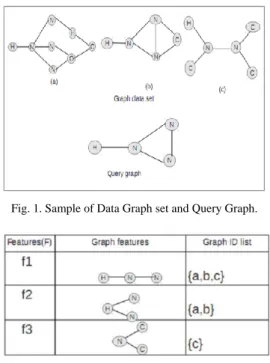
In chemical applications, the graphs are represents different types of chemical compounds. Consider a graph data base(G) consists of three data graphs and query graph (Q), retrieve all the graphs gi ϵ G such that Q ϵ gi as shown in Figure 1 and the sample of graph feature-based index as shown in Figure 2. When the graph size is increases the number of graph features are also increases larger and larger. Due to this growth of graph features, cloud server consumes more computational and communication overheads to retrieve all the data graphs of the query features. To reduce these overheads during searching process, there are many graph filtering and verification methods are introduced [2], [3].
Fig. 1. Sample of Data Graph set and Query Graph.
In filtering phase, using feature based index set of graph data set G, generate the set of candidate super graph set, which consists a query feature. In verification phase, generates the set of super graphs from the candidate super graph set which matches the exact query graph [2].
The rest of the paper is organized as fallows; In section 2, explain the background for data graph representation, In section 3, defines the problem and the design goals of our proposed security system. The detailed architecture, algorithms and performance analysis is explained in the section 4 and section 5, respectively and Section 6 explain the related work. Finally, concluding our proposed system.
II. BACKGROUND A. Data Set Representation
A undirected and connected data graph is represented as G = < V , E >, where V is the set of graph vertices, E is the set of graph edges and | V (G ) | represent the total number of vertices in the graph G i.e. size of the graph G. The graphs are represented in computer memory using adjacency matrix of (n × n ) matrix M with entries M ij = 1, if there is an edge from vertex i to vertex j in the graph, otherwise M ij = 0. Consider a two graphs G and H, if they have a common adjacency matrices then they are isomorphic graphs [4]. If graph H is a sub graph of G then we call it as graph G contains graph H. Given a graphs G = {G 1, G 2, ...Gm } and a sub graph Q, if Q contains k number of graphs in G, then k is called as frequency(minsup) of Q in G.
B. Frequent Feature Construction
Consider a data graph G of size is measured in terms of number of vertices | V (G ) | and the graph feature Fi such as sub trees and path of size | V (Fi ) |. As the number of vertices increase in the data graph the number of graph features also increases with different size. To store all the features index and processing of these features cloud server consumes more storage and computation overheads. In order to reduce the feature set size, only different feature size will be consider with different frequency of the feature in the data graph to construct the index set. The various frequent feature sub structures construction algorithms such as gSpan[5], Breadth First Search and Depth First Search are defined [5]
III. STATEMENT OF THE PROBLEM
The cloud security system model [6] consists of data user, data owner, cloud service providers and trusted trapdoor query process components as shown in the Figure 3.
Data user: is an entity to represents individuals or organizations who access the data graphs stored in the cloud server via trusted query auditor.
Cloud Service Provider: is an entity that retrieves the encrypted data graphs of the user request by computing the inner product of trapdoors of the query and the frequent feature set of the data graphs.
The data owner: is an entity to provide the data as a service to the user. In our proposed system model before outsourcing the encrypted data graphs to the cloud server, the data owner generate the symmetric key (Ks ) frequent feature set (F ) and data graph index list(Iinv ), then outsource the encrypted data graphs and the index list to the cloud service provider. One copy of the index list, symmetric key and the feature set send to the trusted query auditor.
Trusted Third party Query Process(TTQP): is an entity, which is trusted by all other components of the system. For the data privacy in cloud server, which is capable to generate the trapdoor for every user query using index list and the symmetric key generated by the data owner. In our system the cloud service provider and the trusted query auditor are always online during the data retrieval process while the data owner can be an offline.
Fig.3. Cloud data Security System Components.
A. Design Objectives
For effective utilization of out sourced and encrypted graph structured data, we are considered the following design objectives in the proposed cloud data security method.
To prevent clod server to learn graph features to access data graph encrypt all the features.
Design an efficient query graph feature encryption method than data graph encryption.
Minimize the computation and storage overheads of the cloud server while reducing frequent feature set size and introducing third party as trusted query process.
Table 1. Notations Notation Meaning
G Graph data set G={G1, … Gm} G′ Encrypted graph data F Feature set F={F1, … Fn} I Data graph index set
Q Query graph
TQ Trapdoor for the query graph Q g Data graph vector
q Query graph vector k Symmetric key FQ Query features
The various notations are used in this paper and their meaning is listed in Table 1.
IV. PROPOSED TRUSTED THIRD PARTY QUERY PROCESS S YSTEM
The proposed cloud security system model as defined in Figure 4, Before out sourcing the encrypted data graphs G ′ the data owner generate the inverted list of data graph identifier i.e. ID (G) for every data graph frequent feature (F ) using Ullman graph isomorphic algorithm [5]. Derive a symmetric key K = {S, M 1, M 2, ro } from secrete key (Ks ), where S is the split vector contains a sequence of n binary values, M 1 and M 2 are the two invertible matrix of (n + 1) size, and ro is the set of n random integer values.
Fig. 4. Proposed Cloud Security Model.
A. Graph Search Index List Generation
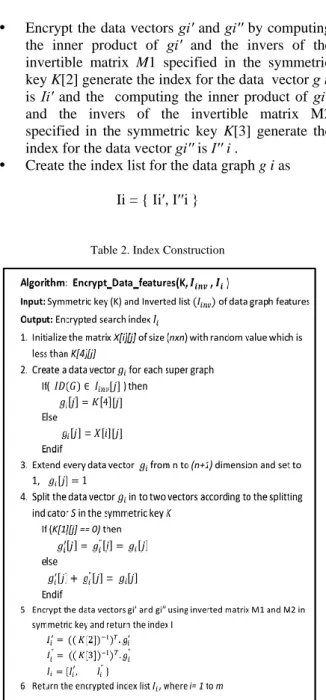
Consider a set of m data graph G = {G 1, G 2, ..Gm } and a set of n frequent features of a given graph G is F = {f 1, f2, ...fn } to generate the index list for every data graph using the inverted list (Iinv ) of data graph as fallows and the detailed algorithm for data graph index construction as explained in Table II.
Create a data vector gi of size n for each data graph and If the identifier of graph G i i.e ID (Gi) includes in the inverted list then g i[j] contains the value stored in the symmetric key i.e K[4][j], otherwise gi[j] contain any random value.
To hide the data graphs frequent features from the untrusted parties in system, extend the data graph vector g i from n dimension to (n + 1) dimension and set it as 1.
Split the data vectors g i in to two data vectors g i′ and g i′′ of same size based on the splitting vector S in the symmetric key K [1][j ]. If the split vector S[j] is equal to 0, then set gi′ and gi′′ as original value of gi, otherwise set it as sum of the gi′ and gi′′ should be equal to gi.
Encrypt the data vectors gi′ and gi′′ by computing the inner product of gi′ and the invers of the invertible matrix M1 specified in the symmetric key K[2] generate the index for the data vector g i′ is Ii′ and the computing the inner product of gi′′ and the invers of the invertible matrix M2 specified in the symmetric key K[3] generate the index for the data vector gi′′ is I′′ i .
Create the index list for the data graph g i as Ii = { Ii′, I′′i }
Table 2. Index Construction
B. Trapdoor Generation
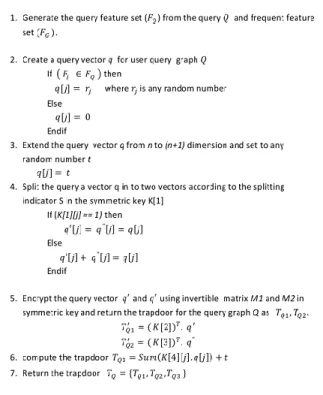
Once the data is stored in the cloud server, to provide privacy for out sourced data from the untrusted parties in the cloud system, trusted trapdoor query process encrypt all the graph features using following procedure. The detailed algorithm for trapdoor generation is explained in the Table III.
For every query Q from the user, generate the query feature set (FQ) by checking the user query Q is included in the data graphs frequent feature set or not.
• Create a n dimensional query vector q and if Fj contains FQ then it set as a positive random number rj otherwise set it as 0. For the privacy of the query features, extend the query vector q from n dimension to (n + 1) and set it as a random number t.
• Split the query vector q in to q′ and q′′ based on the split vector S in the symmetric key K [1]. If S [j] is equal to 1 then set q′[j] and q′′[j] as q[j], otherwise set its sum is equal to the q[j].
• Encrypt the query vectors q ′ and q′′ by computing the inner product of q ′ and the invertible matrix M1 specified in the symmetric key K[2] generate the trapdoor for the query vector q′ is TQ1 and by Computing the inner product of q′′ and the invertible matrix M2 specified in the symmetric key K[3] generate the trapdoor for the query vector q′′ is TQ 2.
• for the verification of data graph for the user query in the cloud server compute the trapdoor TQ 3
TQ3 = ∑ K[4][j] .q[j] + t
• Create the trapdoor list TQ = {TQ 1 , TQ 2, TQ 3 } Table 3. Trapdoor Generation
To retrieve all the encrypted super graphs for the query graph, cloud server computes the inner product of Query feature trapdoor vector with ever data graph feature index of cloud server, if this product matches with the TTQP inner product TQ3, then cloud server returns all the encrypted super graphs which matches the query features
to the user. The detailed encrypted data graph retrieval procedure is explained in the algorithm as shown in Table IV.
Table 4. Query Processing Operation
V. PERFORMANCE ANALYSIS
The performance analysis of the proposed graph structured data security system is analyzed in terms of index storage size, frequent feature set size, data and query vector encryption time and query process time as explained as fallows.
Index storage size: for the analysis of index storage size of frequent feature set, we are considered four different data graph set G = {10, 20, 30, 40, 50, 60 } and each graph contains 10 distinct vertices. The maximum number of features in the query graph set to four in our analysis.
In Figure 5, the index storage size of data graph features depends on the number of features in the feature set and the frequency of each feature i.e. minimum support. While varying the minimum support size of the frequent feature set reduces gradually this reduces the index storage size. The index construction cost is depends on the inner product computation of the data graph vector and inverse of invertible matrix M1 in the symmetric key. As the number of data graphs increases in the data set, cost of index set construction is also increases exponentially.
The size of the feature set for different size of feature (number of vertices in the graph) with different minimum support as defined in the Figure 6. As the minimum support increases the number of features in the feature set decreases for different graph size.
Fig. 5. Index Storage Size over Data Graph
Fig. 6. Frequent Feature set over Different Data graph Size Trapdoor Generation Cost for a Query(Q): cost of trapdoor generation for a given query is the sum of the time required for checking the query feature in the frequent feature set of data graph , computation of inner product of query vector and invertible matrix M 2 in the symmetric key and inner product of query vector and computation of sum of the inner product of query vector and K [4][ j ].
In figure 7, explains the total time required to generate the trapdoor for a different query feature size using fixed data graph size of 20. As the number of query features are increases trapdoor generation time is also increases linearly. Compared to the existing trapdoor generation method PPGQ, our method is optimal in terms of computation time, which reduces the computation overhead of the cloud server.
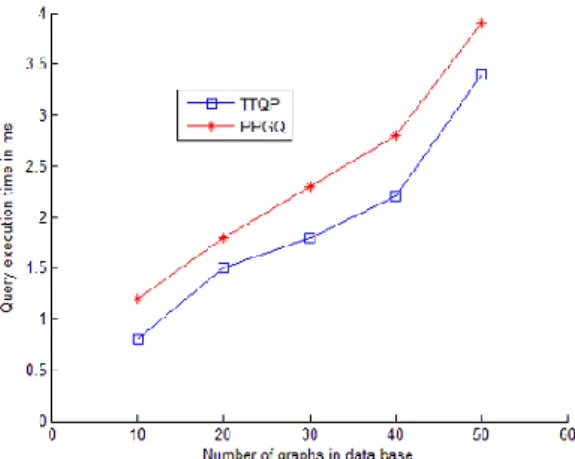
Query Processing Time in Cloud Server: Query processing cost in cloud server is the time required for the inner product computation of cloud server data graph index (Icsp) and trapdoor of the query TQ1 and TQ2. If this product is matches with the TQ3 sent from the query process [7-9], then cloud server send all the query feature matched encrypted super graphs to the user. In Figure 8, explain the fixed query size of 4 vertices execution time on different data base size(number of graphs). The query execution time is linear to the different data graphs size and our query processing is better than the existing PPGQ method as data base size increases.
Fig. 7. Trapdoor Generation Time
Fig. 8. Query execution Time over Different Data graph In Figure 9, explain the analysis of time required to execute variable query sizes on fixed data base size is set to 40 graphs. Query execution time in cloud server is better than the trapdoor generation of same query which improves the computation overhead of cloud server than PPGP.
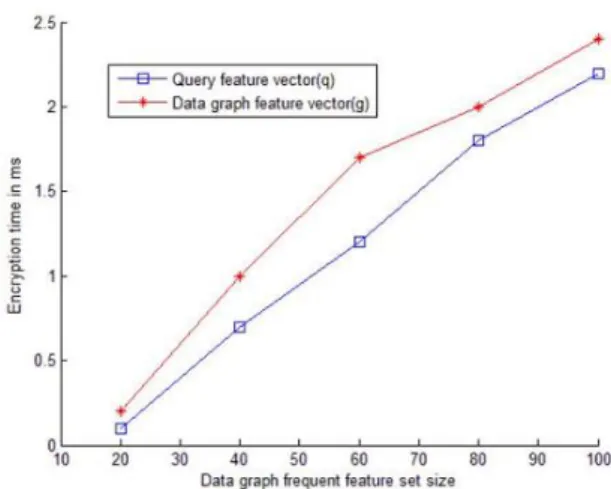
In Figure 10 explain the time required encrypt the data graph vector g and the query vector q of different frequent feature set of data graph. For variable size of frequent feature set, query vector encryption time is better than data vector g encryption time because data vector encryption compute the inner product of inverse of invertible matrix M 1 and data vector g.
Fig. 10. Graph Feature Encryption Time
VI. RELATED WORK
In cloud computing providing confidentiality for the out sourced personal data is an important research issue. WenjunLu, et al. [10] defined as problem of content based search of image data for preserving data confidentiality. They are proposed a solutions such as homomorphic encryption and feature randomization based search for image data privacy. The homomorphic based and feature randomization based search technique is efficient for searching a encrypted data in a list, but it has more computation and communication overheads but feature randomization based search is a deterministic randomization.
The information retrieval using cryptographic method defined Song et al. [11] based on text documents and they proposed using Boolean search operation to identify the matched document. Swaminathn et al. [12] they proposed a search protocol using rank ordered keyword search over the encrypted document. To handle large volume of semi structured XML data a tree search protocol [13] has proposed using storage, search and retrieval phases. In this method encryption time is linear to the input document size and which is depends on the structure of the document and search.
Jin Li et al. [14] defines the problem of fuzzy keyword search over the encrypted cloud data. To construct the fuzzy keyword set they proposed a wild-card and gram-based methods which helps to retrieve the user keyword matched documents from the cloud server. This solution has limitation of privacy of keywords and storage overhead in cloud server.
For query processing E Mykletun and G Tsudik [15], uses the secure co-processor to perform the secure computation and which is slower computational capacity than usual processor. In this device install the encryption and decryption key and deploy the application logic for data privacy.
VII. CONCLUSIONS
In this paper, we considered a graph structured data security problem in remotely stored encrypted data in
cloud server. To solve this problem we proposed an efficient Trusted party Query Process method using encrypted graph features search index. Using frequent graph feature isomorphism optimizes the storage overheads during query graph searching process. While introducing Trusted Trapdoor Query process between data owner, user and cloud server reduces the computation overhead of cloud server. Through security analysis, we show that, our proposed solution is better graph data security than the existing methods. We also identified to extend this method to solve the nested query features in a larger data set.
REFERENCES
[1] Ning Cao, Cong Wang, Ming Li, Kui Ren, and Wenjing Lou, Privacy Preserving Multi-keyword Ranked Search over Encrypted Cloud Data, The 30th IEEE Conference on Computer Communications (INFO COM’11), Shanghai, China, April 10-15, 2011.
[2] Haichuan Shang Ying Zhang Xuemin Lin, Jeffrey Xu Yu,
Taming Verification Hardness: An Efficient Algorithm for Testing Subgraph Isomorphism, PVLDB ’08, August
23-28, pp 364-375, New Zealand, 2008.
[3] Ning Cao, Zhenyu Yang, Cong Wang, Kui Ren, and Wenjing Lou, Privacy-preserving Query over Encrypted Graph-Structured Data in Cloud Computing, IEEE ICDCS2011, Minnesapolis, MN, Jun. 20-24, 2011 [4] Tero Harju, Lecture Notes on Graph Theory, Department
of Mathemat ics University of Turku, Finland, 2011. [5] Xifeng Yany, Philip S. Yuz, Jiawei Hany, Graph Indexing:
A Frequent Structure-based Approach, SIGMOD-2004, June 13-18, Paris, France, 2004.
[6] Shucheng Yu, Cong Wang, Kui Ren, and Wenjing
Lou,Attribute Based Data Sharing with Attribute Revocation, The 5th ACM Symposium on Information, Computer and Communications Security (ASIACCS’10), Beijing, China, April 13-16, 2010.
[7] J R Winkler, Securing the Cloud: Cloud Computing Security Techniques and Tactics, Elsvier Inc., USA, 2011. [8] Cong Wang, Bingsheng Zhang, Kui Ren, and Janet M.
Roveda, Privacy Assured Outsourcing of Image
Reconstruction Service in Cloud, in IEEE Transaction on Emerging Topics in Computing, vol. (1):1, pp 166-177, June 2013,
[9] Mi Wen, Rongxing Lu, Kuan Zhang, Jinsheng Lei, Xiaohui, and Xuemin Shen, PaRQ: A Privacy-Preserving Range Query Scheme Over Encrypted Metering Data for Smart Grid, IEEE Transactions on Emerging Topics in Computing, vol (1):1, pp 178-191, June 2013.
[10] Wenjun Lu, Avinash L Varna and Min Wu,
Confidentiality-Preserving Image Search: A Comparative Study Between Homomorphic Encryption and Distance Preserving Randomization, In IEEE Transactions on Content Mining, Vol. 2, March 2014.
[11] D Song, D Wagner and A Perrig, Practical Search Techniques for Searches in Encrypted Data, In IEEE Proceeding of Symp. Res. Sec. Privacy, pp. 44-55, 2000.
[12] A Swaminathan, Y Mao, G M Su, H Gou and A L Varna,
Confiden tiality Preserving Rank Ordered Search, in
Proceeding ACM Workshop Storage Security
Survivability, pp 7-12, 2007.
[13] R Brinkman, L Feng, J Doumen, P H Hartel and W Jonker,
Efficient Tree Search in Encrypted Data, Infirmation System Security, June, 2004.
over Encrypted Data in Cloud Computing, 2011.
[15] E Mykletun and G Tsudik, Incorporating a secure coprocessor in the Database as a Service Model, In International Conference on IWIA, 2005.
Authors’ Profiles
Prakash G L is an Assistant Professor with the Department of Computer Science
and Engineering of University of
Petroleum and Energy Studies, Dehradun, India. He received his B.E and M.E
degrees in Computer Science and
Engineering from Bangalore University, Bangalore. He is presently pursuing his Ph.D program in the area of data storage and security in Cloud Computing from University of Petroleum and Energy Studies. He has published three international journals and four international conference papers.
Dr. Manish Prateek did his Undergrad and Post Grad degree in the field of Computer Science from South West State University, (formerly known as Kursk State Technical University), Russia, in 1996. Since then he worked at different level in the IT industry in India as well as in Middle East. He did his PhD in the area of Manufacturing & Robotics and was awarded the degree in the year 2007. In 2005 he took up his career into technical education and started as Associate Professor and Head, Dept. of Information Technology at GRIET Hyderabad and later became a full Professor at the age of 36. Currently he is working as Professor & Associate Dean at UPES, Dehradun.
His area of research includes Robotics and Automation, Image Processing and Patter Recognition, Cyber Security, Machine Vision etc. So far, more than 40 research papers have been published by him in different International Journals. He is also a recipient of “Lifetime Achievement Award” for his contribution in the field of education and research by the prestigious scientific society “Pentagram Research Centre”. He is also a member at the prestigious “International Federation for Systems Research (IFSR), Austria.
Dr. Inder Singh, M.Sc.(IT), M.Tech (IT), Ph.D., Microsoft Certified Professional,
IBM DB2 certified, e-commerce
certification from Asset International. He is an Assistant Professor (SS) at University of Petroleum & Energy Studies, Dehradun, India. He has over 13 years of working experience. He has worked as Systems Administrator for 6 Years. His current areas of interest are Computer Networks, Cloud Computing and Virtualization, Strategic Information systems and e-Business.