Heterogeneous Recommendations:
What You Might Like To Read After Watching Interstellar
Rachid Guerraoui
EPFL [email protected]Anne-Marie Kermarrec
Inria [email protected]Tao Lin
EPFL [email protected]Rhicheek Patra
EPFL [email protected]ABSTRACT
Recommenders, as widely implemented nowadays by major e-commerce players like Netflix or Amazon, use collaborative filtering to suggest the most relevant items to their users. Clearly, the effectiveness of recommenders depends on the data they can exploit, i.e., the feedback of users conveying their preferences, typically based on their past ratings.
As of today, most recommenders arehomogeneous in the sense that they utilize one specific application at a time. In short, Alice will only get recommended a movie if she has been rating movies. But what if she has been only rating books and would like to get recommendations for a movie? Clearly, the multiplicity of web applications is calling for het-erogeneous recommenders that could utilize ratings in one application to provide recommendations in another one.
This paper presentsX-Map, a heterogeneous recommender. X-Mapleverages meta-paths between heterogeneous items
over several application domains, based on users who rated across these domains. Thesemeta-paths are then used in
X-Mapto generate, for every user, a profile (AlterEgo) in a
domain where the user might not have rated any item yet. Not surprisingly, leveragingmeta-pathsposes non-trivial is-sues of (a)meta-path-based inter-item similarity, in order to enable accurate predictions, (b)scalability, given the amount of computation required, as well as (c) privacy, given the need to aggregate information across multiple applications. We show in this paper howX-Mapaddresses the
above-mentioned issues to achieve accuracy, scalability and dif-ferential privacy. In short,X-Map weights the meta-paths
based on several factors to compute inter-item similarities, and ensures scalability through a layer-based pruning tech-nique. X-Map guarantees differential privacy using an
ex-ponential scheme that leverages the meta-path-based simi-larities while determining the probability of item selection to construct theAlterEgos. We present an exhaustive experi-mental evaluation ofX-Mapusing real traces from Amazon.
We show that, in terms of accuracy, X-Map outperforms
alternative heterogeneous recommenders and, in terms of throughput, X-Mapachieves a linear speedup with an
in-creasing number of machines.
This work is licensed under the Creative Commons Attribution-NonCommercial-NoDerivatives 4.0 International License. To view a copy of this license, visit http://creativecommons.org/licenses/by-nc-nd/4.0/. For any use beyond those covered by this license, obtain permission by emailing [email protected].
Proceedings of the VLDB Endowment,Vol. 10, No. 10 Copyright 2017 VLDB Endowment 2150-8097/17/06.
1.
INTRODUCTION
The vast amount of information available in the Inter-net calls forpersonalizationschemes, such asrecommenders, that aid the users in their web navigation activities. Rec-ommenders seek to suggestrelevantitems to users based on their preferences (expressed through ratings), by typically relying on Collaborative Filtering (CF) algorithms [28] to utilize similarities between users. Such similarities are com-puted using the rating history of users. The axiom here is thatif Alice and Bob liked the same items in the past, they will like the same items in the future with a high probability.
1.1
Motivation
Although widely used today, recommenders are mainly applied in a homogeneous way: movie recommenders like IMDb or Netflix, news recommenders like Google News or Yahoo News, as well as music recommenders like Last.fm or Spotify, each focuses on a single specific application do-main. In short, you will be recommended books only if you rated books, and you will be recommended movies only if you rated movies. Given the growing multiplicity of web applications, homogeneity is a major limitation. For ex-ample, with most state-of-the-art recommenders, Alice who just joined a book-oriented web application, and never rated any book before, cannot be recommended any relevant book, even if she has been rating many movies.
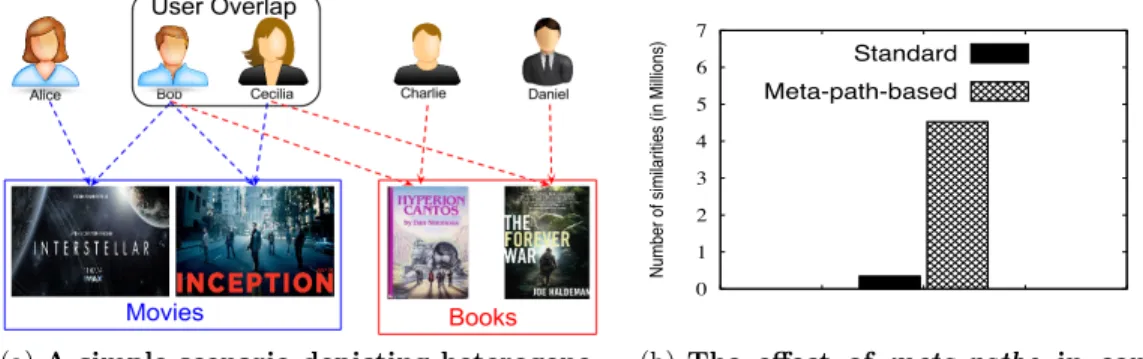
We argue that the next level to personalization is hetero-geneity, namelypersonalization across multiple domains[11]. Heterogeneous preferences on the web, i.e., preferences from multiple application domains, should be leveraged to im-prove personalization, not only for users who are new to a given domain (i.e, cold-start situation), but also when the data issparse [2] (e.g, very few ratings per user). In fact, if a user, say Alice, likes theInterstellarmovie, then a hetero-geneous personalization scheme could actually recommend her books such asThe Forever War by Joe Haldeman. To get an intuition of how such recommendation can be made by going beyond standard schemes, consider the scenario depicted in Figure1(a)where five users ratedat most one book. Indeed, according to a standard metric (adjusted co-sine [29]), the similarity betweenInterstellar andThe For-ever War is 0, for there are no common users who rated both. However, a closer look reveals the following meta-path 1 between these two heterogeneous items: Interstel-lar−−→BobInception−Cecilia−−−−→The Forever War.
1We call meta-path any path involving heterogeneous items, e.g., movies and books.
(a)A simple scenario depicting heterogene-ity across two domains.
0 1 2 3 4 5 6 7
Number of similarities (in Millions)
Standard Meta-path-based
(b) The effect of meta-paths in com-puting heterogeneous similarities. Figure 1: Heterogeneous recommendation using meta-paths. Figure1(b)compares the number of heterogeneous
simi-larities that could be exhibited with or without using meta-paths on real-world traces from Amazon (using two domains: movies and books). Meta-path-based heterogeneous simi-larities clearly lead to better recommendation quality as we show later in§ 6.4.
1.2
Challenges
While appealing, building a practical heterogeneous meta-path-based recommender raises several technical challenges. Meta-path-based similarity. Consider an undirected graph G where the vertices represent the items and each edge eij is associated with a weight sij, representing the
similarity between itemsiandj. A meta-path inGcan be defined as a sequence of adjacent vertices (movies or books) connected by edges inG. Computing aheterogeneous sim-ilarity based on these meta-paths is, however, not straight-forward. Such similarity could be affected by factors like the number of users involved, directly or indirectly (in the meta-paths), as well as the strength of the ties between item-pairs connected by (shorter) meta-paths. The challenge here is to capture these factors in a way that improves the accuracy of heterogeneous similarities.
Scalability. Clearly, the computational complexity in-creases many-fold while computing meta-path-based simi-larities. Computing all possible meta-paths on a large-scale graph with millions of vertices (heterogeneous items) can quickly become computationally intractable.
Privacy. Heterogeneous recommendations also raise pri-vacy concerns. For example, the new transitive link between Alice and Cecilia (Figure1(a)) provides the opportunity for a curious user, say Alice, to discover thestraddlers: people like Bob or Cecilia who connect multiple domains. Alice can actually determine the item(s) that allows her to get this recommendation by pretending to be another user and incrementally rating items until she gets the recommenda-tion. This is similar to the privacy risk in statistical database queries where inferences can be derived from combinations of queries [26]. As pointed out in [27], such straddlers are at a privacy risk, and information about their preferences could be used in conjunction with other data sources to uncover identities and reveal personal details. This can be partic-ularly problematic across different applications like Netflix (movies) and Last.fm (music).
Recent heterogeneous recommenders [11,30], extending classical homogeneous recommendation schemes across do-mains, are neither scalable nor private, and hence are not suitable for applications involving millions of users and items.
1.3
Contributions
In this paper, we present a recommender we callX-Map:
Cross-domain personalization system. X-Map fully
uti-lizes the overlap among users across multiple domains, as depicted in Figure1(a). This overlap is often derived from profiles maintained by users across various web applications along with interconnection mechanisms for cross-system in-teroperability [10] and cross-system user identification [9]. At the heart of X-Maplie several novel ideas.
• We introduce a novel similarity metric, X-Sim, which
computes a meta-path-based transitive closure of inter-item similarities across several domains. X-Sim involves adaptations, to the heterogeneous case, of classical signif-icance weighting [16] (to account for the number of users involved in a meta-path) andpath length[27] (to capture the effect of meta-path lengths) schemes.
• We introduce the notion of AlterEgos, namely artificial profiles (created using X-Sim), of users even in domains where they havenoorvery littleactivity yet. We generate an AlterEgo profile (of Alice) in a target domain leverag-ing an item-to-item mappleverag-ing from a source domain (e.g., movies) to the target domain (e.g., books). AlterEgos en-able to integrate any standard recommendation feature in the target domain and preserve, for example, the temporal behaviour of users [12].
• We use an effective layer-based pruning technique for se-lecting meta-paths. AlterEgos, acting as a caching mech-anism, alleviate computational intractability by only us-ing the information from the target domain. Combined with our layer-based pruning technique, AlterEgos enable
X-Mapto scale almost linearly with the number of ma-chines (a major requirement for the deployment of a rec-ommender in a practical environment). We illustrate this scalability through our implementation of X-Mapon top of Apache Spark [38].
• We introduce an obfuscation mechanism, based on meta-path-based similarities, to guarantee differentially private AlterEgos. We adapt, in addition, a probabilistic tech-nique, inspired by Zhu et al. [39,40], to protect the privacy of users in the target domain. Interestingly, we show that, despite these privacy techniques,X-Mapoutperforms the recommendation accuracy of alternative non-private het-erogeneous approaches [5,6,11].
• We deployed an online recommendation platform, using
X-Simon a database of 660K items, to recommend books
and movies to users based on their search queries at:
Books likeThe Da Vinci Code are indeed recommended when the search query is the Angels & Demons (2009) movie. Currently, we support Chrome, Safari and Firefox browsers.
1.4
Roadmap
The rest of the paper is structured as follows. We recall some background on collaborative filtering and differential privacy before formulating the heterogeneous recommenda-tion problem in§ 2. Next, we introduce ourX-Sim metric along with our layer-based pruning technique for selecting meta-paths in§ 3. For pedagogical reasons, we first present a non-private variant of our recommendation scheme ( NX-Map2) before the private one (X-Map) in§ 4. We then
present our scalable implementation of X-Mapin§ 5 and
our experimental results in§ 6. We review the related work in§ 7and conclude our paper in§ 8. Our open-sourced im-plementation ofX-Mapas well as the detailed proofs of our
privacy guarantees are provided in a GitHub repository [1].
2.
BACKGROUND AND PROBLEM
2.1
Collaborative Filtering
Collaborative Filtering(CF) algorithms fall mainly in two categories: memory-based [28,33] and model-based [17,20, 37]. Memory-based algorithms compute thetop-klike-minded users for any given user (say Alice), denoted as the neigh-bors of Alice, from the training database, and then make recommendations to that user based on the rating history of her neighbors. In contrast to memory-based algorithms, model-based ones first extract some information about users (including Alice) from the database to train a model and then use this model to make recommendations for the users (including Alice). Memory-based algorithms are more flexi-ble in practice compared to model-based ones [18]. It is usu-ally more difficult to add new incoming data to model-based systems because building a model is often a time-consuming and resource-consuming process.
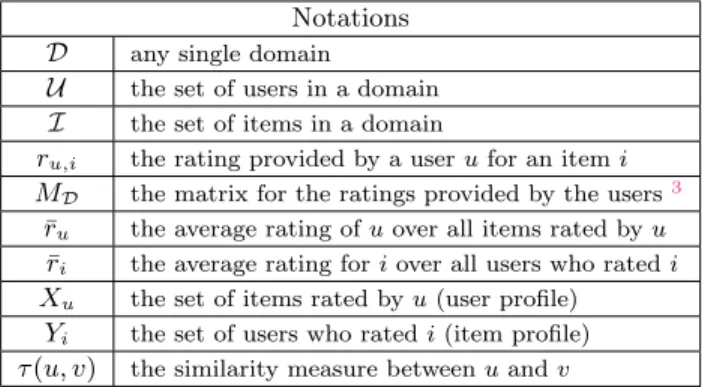
Among memory-based CF schemes, neighbor-based CF (based onk nearest neighbor (kNN) algorithms) are more popular and widely used in practice [29]. We summarize the basic notations used in this paper in Table1. A user-based CF scheme, as depicted in Algorithm 1, computes thek neighbors of Alice with highest user-to-user similari-ties (Phase 1 in Algorithm1). These neighbors’ profiles are then used to compute the best recommendations for Alice (Phase 2 in Algorithm1). An item-based CF scheme, as depicted in Algorithm2, computes thekmost similar items for every item based on item-to-item similarities (Phase 1 in Algorithm 2) and then computes the recommendations for Alice based on her ratings for similar items (Phase 2 in Algorithm2). As we will explain in§ 4,X-Map currently
supports user-based as well as item-based CF schemes while providing recommendations to its users. Different practi-cal deployment scenarios benefit from the proper choice of the recommendation algorithm. One requirement, which is crucial to any deployment scenario, isScalability. From the scalability aspect, item-based recommenders are suitable for big e-commerce players with more users than items whereas
2
NX-Mapillustrates the effectiveness ofX-Simand
Al-terEgos for heterogeneous recommendations without the pri-vacy overhead and could be used for applications with het-erogeneous intra-company services likeGoogle Play.
Table 1: Notations Notations D any single domain
U the set of users in a domain I the set of items in a domain
ru,i the rating provided by a userufor an itemi MD the matrix for the ratings provided by the users3
¯
ru the average rating ofuover all items rated byu
¯
ri the average rating foriover all users who ratedi Xu the set of items rated byu(user profile)
Yi the set of users who ratedi(item profile) τ(u, v) the similarity measure betweenuandv
user-based recommenders are preferable for new players with more items than users due to the number of item-item or user-user similarities leveraged by the respective recom-menders. Moreover, the user-user similarities are more dy-namic than item-item similarities for movies/books [3] due to the temporality in users’ online behaviour and hence re-quire frequent updates. For interested readers, we provide an empirical demonstration of the influence of item-based and user-based recommenders in two different practical de-ployment scenarios in our companion technical report [1]. Algorithm 1User-based CF
Input: I: Set of all items;U: Set of all users;X: set of profiles of all users whereXAdenotes the profile of Alice (with user-id asA) which contains the items rated byA.
Output: RA: Top-Nrecommendations for Alice
Phase 1 - Nearest Neighbor Selection: kNN(A,U,X) Input: U,X
Output: knearest neighbors for Alice
1: varτA; Dictionary with similarities for Alice 2: varr¯; Average rating for each item 3: foruinU do
4:
τA[u] =
P
i∈XA∩Xu(rA,i−ri¯)(ru,i−ri¯)
qP i∈XA(rA,i−ri¯)2 qP i∈Xu(ru,i−ri¯)2 (1) 5: end for
6: γA=τA.sortByV alue(ascending=f alse);
7: NA=γA[:k] Topkneighbors
8: return:NA;
Phase 2 - Recommendation: Top-N(NA,I) Input: I,NA
Output: Top-Nrecommendations for Alice
9: var Pred; Dictionary with predictions for Alice 10: varr¯; Average rating for each user 11: fori: iteminIdo 12: P red[i] = ¯r A+ P B∈NAτ(A, B)·(rB,i−rB¯ ) P B∈NA|τ(A, B)| ; (2) 13: end for
14: φA=P red.sortByV alue(ascending=f alse);
15: RA=φA[:N] TopNrecommendations 16: return:RA;
2.2
Differential Privacy
Differential privacy [14] was initially devised in a context where statistical information about a database is released without revealing information about its individual entries. Differential privacy provides formal privacy guarantees that
3M
D is typically a sparse matrix. Ifuhas not ratedi,
Algorithm 2Item-based CF
Input: I: Set of all items;U: Set of all users;Y: Set of profiles of all items whereYj denotes the list of users who rated an item with item-idj.
Output: RA: Top-N recommendations for Alice (A)
Phase 1 - Nearest Neighbor Selection: kNN(j,I,Y) Input: I,Y
Output: kmost similar items to itemj
1: varτj; Dictionary for item similarities withj
2: var¯r; Average rating for each user 3: foriinIdo
4:
τj[i] =
P
u∈Yj∩Yi(ru,j−ru¯)(ru,i−ru¯)
qP u∈Yj(ru,j−ru¯)2 q P u∈Yi(ru,i−ru¯)2 (3) 5: end for
6: γj=τj.sortByV alue(ascending=f alse);
7: Nj=γj[:k] Topkneighbors
8: return: Nj;
Phase 2 - Recommendation: Top-N(Y,I) Input: I,Y
Output: Top-N recommendations for Alice
9: var Pred; Dictionary with predictions for Alice 10: var¯r; Average rating for each item 11: fori:iteminIdo 12: P red[i] = ¯ri+ P j∈Niτ(i, j)·(rA,j−rj¯) P j∈Ni|τ(i, j)| ; (4) 13: end for
14: φA=P red.sortByV alue(ascending=f alse);
15: RA=φA[:N] TopN recommendations 16: return: RA;
do not depend on an adversary’s background knowledge (in-cluding access to other databases) or computational power. More specifically, differential privacy is defined as follows.
DEFINITION 1 (Differential Privacy [14]). A
random-ized function R ensures -differential privacy if for all datasetsD1 andD2, differing on at most one user profile, and allt∈Range(R), the following inequality always holds:
P r[R(D1) =t]
P r[R(D2) =t]
≤exp() (5)
2.3
Heterogeneous Recommendation Problem
Without loss of generality, we formulate the problem us-ing two domains, referred to as thesourcedomain (DS) and the target domain (DT
). We use superscript notations S and T to differentiate the source and the target domains.
We assume that users in US
and UT
overlap, but IS
and IT
have no common items. This captures the most com-mon heterogeneous personalization scenario in e-commerce companies such as Amazon or eBay nowadays. The het-erogeneous recommendation problem can then be stated as follows.
PROBLEM 1. Given any source domainDSand any
tar-get domainDT, the heterogeneous recommendation problem
consists in recommending items inIT
to users inUS based on the preferences ofUS for IS , UT for IT and US∩ UT forIS∪ IT.
In other words, we aim to recommend items in IT
to a user who rated a few items (sparsity) or no items (cold-start) inIT
. Figure1(a)conveys the scenario that illustrates this problem. The goal is to recommend new relevant items from DT (e.g., books) either to Alice who never rated any book
(cold-start) or to Bob who rated only a single book (spar-sity). Both the users rated items inDS
(e.g., movies).
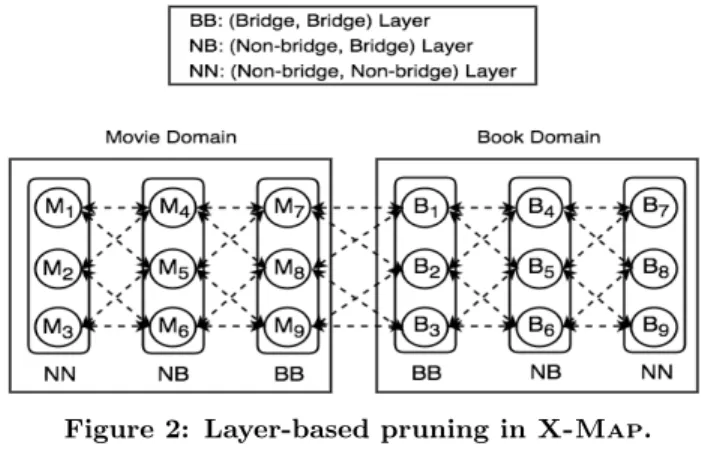
Figure 2: Layer-based pruning inX-Map.
3.
X-Sim
In this section, we present X-Sim, our novel similarity
metric designed for heterogeneous recommendation along with our meta-path pruning technique.
3.1
Baseline Similarity Graph
We first build a baseline similarity graph where the ver-tices are the items and the edges are weighted by the simi-larities. We could use here any classical item-item similarity metric like Cosine, Pearson, or Adjusted-cosine [29] for base-line similarity computations. We choose to use adjusted-cosine for it is considered the most effective [29]:
sac(i, j) =
P
u∈Yi∩Yj(ru,i−r¯u)(ru,j−r¯u) q P u∈Yi(ru,i−r¯u) 2qP u∈Yj(ru,j−r¯u) 2 (6) In this first step, we compute the (baseline) similarities by integrating bothDS
andDT
as a single domain. We denote by Gac 4 the resulting similarity graph in which any two
items areconnectedif they have common users. As shown in Figure1(b), the limitation of adjusted-cosine similarity leads to sparse connections inGac. We address this sparsity issue
ofGacprecisely by extending it withmeta-pathsconnecting
both domains.
Clearly, a brute-force scheme considering all possible meta-paths would be computationally intractable and not scal-able. Assuming m items in the database, the time com-plexity of such a brute-force scheme (computing similarity for every pair of items) would beO(m2), which is not suit-able for big datasets like the Amazon one with millions of items. X-Map uses a layer-based technique to prune the
number of meta-paths, thereby leading toO(km) 'O(m) time complexity wherek≪m.
3.2
Layer-based Pruning
Based on the baseline similarity graph, we determine what we callbridge items, namely any itemiin a domainDwhich connects to some itemjin another domainD0
. Bothiandj
are bridge items in this case. These bridge items are ascer-tained based on the overlapping users from both domains. We accordingly call any item that is not a bridge item a non-bridge item.
X-Map’s pruning technique partitions the items fromDS
andDT
into six possible layers, based on their connections with other items, as we explain below. In turn, the items in each domain, sayD, are divided into three layers (Figure2). • BB-layer. The (Bridge, Bridge)-layer consists of the bridge
4
items ofD connected to the bridge items of another do-main.
• NB-layer. The (Non-bridge, Bridge)-layer consists of the non-bridge items ofDwhich are connected to bridge items ofD.
• NN-layer. The (Non-bridge, Non-bridge)-layer consists of the non-bridge items of Dwhich are not connected to other bridge items.
X-Map then considers only the paths crossing different
layers, which we callmeta-paths. Since we use ak-nearest neighbor method inX-Map, each itemi in layerl is
con-nected to the top-k items from every neighboring layer l0
based on the item-item similarities. We describe our lay-ered meta-path selection in more details in§ 5.
3.3
X-Sim
: A Novel Similarity Metric
Consider any two items iandj. We denote byYi≥¯i the
set of users who rated item ihigher than or equal to the average rating fori over all the users in the database who ratedi. We also denote byYi<¯ias the set of users who rated
itemilower than the average rating fori. Additionally, we denote by|Yi|the cardinality of the set Yi.
DEFINITION 2 (Weighted Significance). Given any pair
of itemsiandj, we define weighted significance (Si,j) as the
number of users who mutually like or dislike this given pair. Formally, we define the weighted significance (Si,j) between iandj as follows. Si,j= Yi≥¯i∩Yj≥¯j | {z } Mutual like +Yi<¯i∩Yj<¯j | {z } Mutual dislike
Intuitively, a higher significance value implies higher impor-tance of the similarity value. For example, a similarity value of 0.5 between an item-pair (i,j) withSi,j = 1000is more
significant than a similarity value of 0.5 between an item-pair (i,k) with Si,k = 1 (for the latter may be a result of
pure coincidence). 5
DEFINITION 3 (Meta-path). GivenGand its six
corre-sponding layers of items, a meta-path consists of at most one item from each layer.
For every meta-pathp=i1↔i2. . .↔ik, we compute the
meta-path-based similaritysp, weighted by its significance
value, as follows. sp= Pt=k−1 t=1 Sit,it+1·sac(it, it+1) Pt=k−1 t=1 Sit,it+1
For each pair of items(i, j) from different domains, if i,
jare not connected directly, we aggregate the path similar-ities of all meta-paths betweeniand j. Due to the differ-ent lengths and similarities for meta-paths, we give differdiffer-ent weights to different meta-paths. Shorter meta-paths pro-duce better similarities in recommenders [27,34] and hence are preferred over longer ones. We now explain the scheme behind assigning these weights and thereby computing the
X-Simvalues.
DEFINITION 4 (Normalized Weighted Significance).
Given any pair of items i and j, we define normalized weighted significance (Sbi,j) between i and j as their
sig-nificance value weighted by the inverse of number of users rating either i or j. Formally, we denote normalized weighted significance as follows.
5This concept is analogous to statistical significance used in hypothesis testing.
b Si,j=
Si,j n(Yi∪Yj)
Next, we determine the notion ofpath certainty (cp) of a
meta-path to take into account the factor of varying path lengths. Path certainty measures how good a path is for the similarity computations.
DEFINITION 5 (Path Certainty). Given any meta-path
(p=i1 ↔i2. . .↔ik), we compute the path certainty (cp)
of the meta-pathpas the product of the normalized weighted significance between each consecutive pair of items in the pathp. Formally, we define the path certainty as follows.
cp= t=k−1 Y t=1 b Sit,it+1
It is important to note that the product of the normalized weighted significance values inherently incorporates the path length in our path certainty metric. Hence, shorter paths have higher weights compared to longer ones. Finally, we define ourX-Simmetric as follows.
DEFINITION 6 (X-Sim). LetP(i, j)denote the set of all
meta-paths between itemsiandj. We define the X-Simfor
the item pair (i,j) as the path similarity weighted by the path certainty for all paths inP(i, j). Formally, we define X-Sim
for any given pair of itemsiandjas follows.
X-Sim(i, j) = P p∈P(i,j) cp·sp P p∈P(i,j) cp
Here,X-Sim(i,j) denotes the meta-path-based heteroge-neous similarity between any two items iand j. X-Sim is
then utilized to build the artificial profiles for users ( AlterE-gos). Note that a trivial transitive closure over similarities would not take into account the above-mentioned factors, which would in turn impact the heterogeneous similarities and consequently the recommendation quality.
4.
RECOMMENDATION
We show in this section how to leverage ourX-Simmetric
to generate artificial (AlterEgo) profiles of users in domains where these users might not have any activity yet. For peda-gogical reasons, we first present the non-private (NX-Map)
scheme, and then the extensions needed for the private ( X-Map) one.
4.1
Similarity Computation Phase
In this phase, X-Maptreats both the source and target
domains as a single aggregated domain in order to com-pute pairwise item similarities, called baseline similarities. Basically,X-Mapcomputes the adjusted cosine similarities
between the items in IS∪IT based on the preferences of the users in US∪ UT
for these items. We distinguish the following two types of similarities:
(a) Homogeneous similaritiesare computed between items in the same domain. Such similarities are used for intra-domain extensions in§ 5.
(b) Heterogeneous similaritiesare computed between items in different domains. Such similarities are used for cross-domain extensions in§ 5.
4.2
X-Sim
Computation Phase
After the computation of the baseline item-item similari-ties,X-Mapuses theX-Simmetric within a single domain
domain and other items within the same domain. Then,
X-Mapuses theX-Simmetric to extend the similarities
be-tween items across domains (we come back to this in more details in§ 5). After the heterogeneous similarity extension, each item in source domain (DS
) has a corresponding set of items in target domain (DT
) with quantified (positive or negative)X-Simvalues.
4.3
AlterEgo Generation Phase
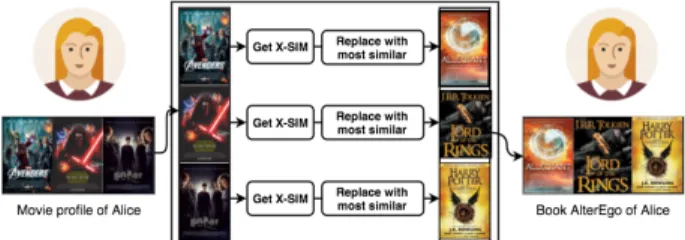
In this phase, the profile of Alice (in DS) is mapped to her AlterEgo profile (inDT) as shown in Figure3. We first
present the non-private case, and then discuss the private one.
NX-Map AlterEgo generation. The non-private
map-ping is performed in two steps.
Replacement selection. In this step, for every item i in DS, we determine the replacement itemjinDT. Here,jis
the heterogeneous item which is most similar toibased on the heterogeneous similarities computed usingX-Sim.
AlterEgo profile construction. We then replace every item rated by Alice inDSwith the most similar item inDT
com-puted in the previous step. This item replacement induces the AlterEgo profile6of Alice in the target domain as shown in Figure3.
This AlterEgo profile of Alice is the mapped profile of Alice from the source domain to the target domain. Note that the AlterEgo profiles could be incrementally updated to avoid re-computations inX-Map.
Figure 3: Alice’s AlterEgo profile (in target domain) mapped from her original profile (in source domain).
X-Map AlterEgo generation. We now explain how we
achieve the differentially private mapping.
Private replacement selection. We apply an obfuscation mechanism, depending on the meta-path-based heteroge-neous similarities, to design our differentially private re-placement selection technique (Algorithm 3). Note that standard differentially private techniques consisting, for ex-ample, in adding noise based on Laplace or Gaussian dis-tributions would not work here for they would not build a profile consisting of items in the target domain. The follow-ing theorem conveys our resultfollow-ing privacy guarantee.
THEOREM 1. Given any item ti, we denote the global
sensitivity of X-Sim by GS and the similarity between
ti and any arbitrary item tj by X-Sim(ti, tj). Our
Pri-vate Replacement Selection (PRS) mechanism, which out-putstj as the replacement with a probability proportional to exp(·X-Sim(ti,tj)
2·GS ), ensures-differential privacy.
Due to space constraints, the full proof is provided in our companion technical report [1] for interested readers.
6If Alice has rated a few items inDT, then the mapped
profile is appended to her original profile inDT to build her
AlterEgo profile.
Algorithm 3 Private Replacement Selection Algorithm: PRS(ti,I(ti),X-Sim(I(ti))) where I(ti) is the set of items in the
target domain with X-Simvalues.
Input: , ti, I(ti),X-Sim(I(ti)) :Privacy parameter 1: Global sensitivity forX-Sim:
2: GS =|X-Simmax−X-Simmin|= 2
3: foritemtjinI(ti)do
4: Allocate probability as:
exp(·X-Sim(ti,tj)
2·GS )
P
tk∈I(ti)
exp(·X-Sim(ti,tk)
2·GS )
5: end for
6: Sample an elementtfromI(ti)according to their probability. 7: return:t; -differentially private replacement forti
AlterEgo profile construction. In this step, we replace ev-ery item rated by Alice inDS
with the item inDT
returned by the PRS mechanism in the previous step. This item replacement scheme produces a private AlterEgo profile of Alice in the target domain.
Note that this private AlterEgo profile protects the pri-vacy of the straddlers, users who rated in both the domains, as the ratings of these users are used to compute the het-erogeneous similarities leaving their privacy at risk [27]. In addition, if the application domains are typically owned by different companies like Netflix and Last.fm, then this mech-anism aids the exchange of AlterEgo profiles while prevent-ing curious or malicious users to infer the preferences of others.
4.4
Recommendation Phase
We now present the main steps of our recommendation scheme. Again, we first explain the non-private case followed by the private one.
NX-Maprecommendation. The AlterEgo profile of
Al-ice is used along with the original profiles in the target do-main to compute the top-k similar users for Alice and then compute recommendations for Alice leveraging the profiles of thekmost similar users from the target domain as shown in Algorithm 1. The item-based version of X-Map utilizes
this AlterEgo profile and computes the recommendations as demonstrated in Algorithm2.
Furthermore, the AlterEgo profile in the target domain also retains the temporal behaviour [12] of the user in the source domain due to the item-to-item mapping. We incor-porate this temporal behaviour in the item-based version of
X-Mapby adding a time-based weight to the ratings to im-prove the recommendation quality further. The predictions (Equation4), weighted by the time-based parameter (α), for the ratings are computed as follows.
P red[i](t) = ¯ri+ P j∈Niτ(i, j)·(rA,j−r¯j)·e−α(t−tA,j) P j∈Ni|τ(i, j)| ·e −α(t−tA,j) (7) Note that the prediction has a time-based relevance factor (e−α(t−tA,j)) with a decaying rate controlled by the param-eter αto determine each rating’s weight for the prediction computation. Here,tA,jdenotes thetimestep7when userA
rated the itemj. This specific time-based CF technique is applicable to the item-based CF approach as the prediction computation (Equation7) for a userAis dependent only on her previous ratings for similar items and thereby leverages 7The timestep is a logical time corresponding to the ac-tual timestamp of an event.
time as observed byA.
X-Map recommendation. The private AlterEgo
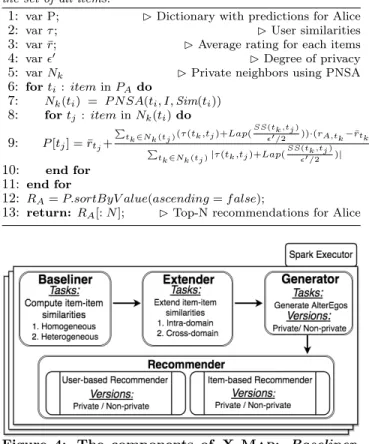
pro-file of Alice is used along with the original propro-files in the target domain to compute the recommendations for Alice. To demonstrate the adaptability of our heterogeneous rec-ommender, the recommendation step is integrated with a differentially private approach, inspired by [39,40], to pro-tect the privacy of users in the target domain against other curious users. We implemented both item-based and user-based versions of X-Map. The item-based recommenda-tion mechanism is demonstrated in Algorithm5which uti-lizes the PNSA mechanism (Algorithm4). We first present our similarity-based sensitivity, required for the private ap-proach, along with its correctness proof sketch.8
DEFINITION 7 (Local Sensitivity). For any given
func-tionf :R → Rand a datasetD, the Local Sensitivity off
is defined asLSf = max
D0 kf(D)−f(D
0
)k1, whereD andD0
are neighboring datasets which differ at one user profile. We define a rating vector rti = [rtai, ..., rtxi, rtyi]which
consists of all the ratings for an item ti ∈ D. Similarly,
we define a rating vector rt0i for ti ∈ D 0
. Since we use adjusted-cosine for X-Sim, a ratingrtxi is the result after
subtracting the average rating of userx(¯rx) from the actual
rating provided by x for an item i. The similarity-based sensitivity is formulated as follows.
THEOREM 2 (Similarity-based sensitivity). Given any
score function q :R → R and a dataset D, we formulate the similarity-based sensitivity corresponding to a score functionqi(I, tj) for a pair of itemsti andtj as:
SS(ti, tj) =max{maxux∈Uij(
rtxi×rtxj kr0 tik × kr 0 tj k ), maxux∈Uij( rti·rtj kr0 tik × kr 0 tj k − rti·rtj krtik × krtj k )} The full proof is provided in our companion technical re-port [1] for interested readers.
We use the notion oftruncated similarity [39,40] (Step 7 in Algorithm4) along with our similarity-based sensitivity to enhance the quality of selected neighbors. The two theo-rems which prove that this truncated similarity along with our similarity-based sensitivity can enhance the quality of neighbors are as follows.
THEOREM 3. Given any itemti, we denote itsk
neigh-bors by Nk(ti), the maximal length of all the rating
vec-tor pairs by|v|, the minimal similarity among the items in
Nk(ti)bySimk(ti) and the maximal similarity-based
sensi-tivity betweenti and other items by SS. Then, for a small
constant0< ρ <1, the similarity of all the items inNk(ti)
are larger than (Simk(ti)−w) with a probability at least
1−ρ, wherew=min(Simk(ti),4k×SS0 ×ln
k×(|v|−k)
ρ ).
Intuitively, Theorem3implies that the selected neighbors have similarities greater than some threshold value(Simk(ti)− w)with a high probability (1−ρ).
THEOREM 4. Given any item ti, for a small constant
0< ρ <1, all items with similarities greater than(Simk(ti)+ w)are present inNk(ti)with a probability at least1−ρwhere w=min(Simk(ti),4k×SS0 ×ln
k×(|v|−k)
ρ ).
8Our similarity-based sensitivity is slightly different from the recommendation-aware one presented in [39,40].
Intuitively, Theorem 4 implies that the items with sim-ilarities greater than some threshold value (Simk(ti) +w)
are selected as neighbors with a high probability (1−ρ). Both theorems prove that the truncated similarity along with our similarity-based sensitivity provides neighbors of good quality while providing 0/2-differential privacy. The predictions are computed leveraging the PNCF mechanism (Algorithm 5) which adds Laplacian noise to provide0/ 2-differential privacy. By the composition property of differen-tial privacy, PNSA and PNCF together provide0-differential privacy. The item-based version ofX-Mapincludes the
ad-ditional feature oftemporally relevant predictions to boost the recommendation quality traded for privacy.
We provide here only two illustrations (temporal dynam-ics and differential privacy) of the adaptability of our het-erogeneous recommender due to space constraints. Since the AlterEgo profile could be considered as an actual profile in the target domain, thereby any homogeneous recommenda-tion algorithm [2] like Matrix Factorization techniques, can be applied in the target domain to generate the recommen-dations. We provide a demonstration regarding how to use Spark-MLlib’s matrix factorization technique withX-Map
in our GitHub repository [1].
Algorithm 4Private Neighbor Selection : PNSA(ti,I,Sim(ti))
whereIis the set of all items.
Input: 0, w, ti, I,Sim(ti), k 0:Privacy 1: C1= [tj|s(ti, tj)≥Simk(ti)−w, tj∈I] 2: C0= [tj|s(ti, tj)<Simk(ti)−w, tj∈I] 3: w=min(Simk(ti),4k×SS0 ×ln k×(|v|−k) ρ ) 4: forN=1:kdo 5: foritemtjinIdo
6: SS(ti, tj) =max{maxux
∈Uij( rtxi×rtxj kr0tik × kr 0 tjk ), maxux∈Uij( rti·rtj kr0tik × kr 0 tj k − rti·rtj krtik × krtj k) )}
7: Simd(ti, tj) =max(Sim(ti, tj),Simk(ti)−w)
8: Allocate probability as: 20k-Privacy
exp( 0· d Sim(ti,tj) 2k×2SS(ti,tj)) P l∈C1 exp( 0·Simd(ti,tl) 2k×2SS(ti,tl)) + P l∈C0 exp( 0·Simd(ti,tl) 2k×2SS(ti,tl)) 9: end for
10: Sample an elementtfromC1andC0without replacement according to their probability.
11: Nk(ti) =Nk(ti)∪t
12: end for
13: return:Nk(ti);
5.
IMPLEMENTATION
In this section, we describe our implementation of X-Map. Figure4 outlines the four main components of our
implementation: baseliner, extender,generator and recom-mender. We describe each of these components along with their functionality.
5.1
Baseliner
This component computes the baseline similarities lever-aging the adjusted cosine similarity (Equation 3) between the items in the two domains. The baseliner splits the item-pairs based on whether both items belong to the same do-main or not. If both items are from the same dodo-main, then the item-pair similarities will be delivered as homogeneous
Algorithm 5 Private Recommendation: PNCF(PA, I)
wherePA denotes the AlterEgo profile of Alice, and I denotes
the set of all items.
1: var P; Dictionary with predictions for Alice
2: varτ; User similarities
3: var¯r; Average rating for each items
4: var0 Degree of privacy
5: varNk Private neighbors using PNSA 6: forti:iteminPAdo 7: Nk(ti) = P N SA(ti, I,Sim(ti)) 8: fortj:iteminNk(ti)do 9: P[tj] = ¯rtj+ P tk∈Nk(tj)(τ(tk,tj)+Lap( SS(tk,tj) 0/2 ))·(rA,tk−r¯tk) P tk∈Nk(tj)|τ(tk,tj)+Lap( SS(tk,tj) 0/2 )| 10: end for 11: end for
12: RA=P.sortByV alue(ascending=f alse);
13: return: RA[:N]; Top-N recommendations for Alice
Figure 4: The components of X-Map: Baseliner, Extender, Generator, Recommender.
similarities. If one of the items belongs to a different do-main, then the item-pair similarities will be delivered as heterogeneous similarities. The baseline heterogeneous sim-ilarities are computed based on the user overlap. 9
5.2
Extender
This component extends the baseline similarities both within a domain and across domains. The items in each domain are divided into three layers based on our layer-based pruning technique as shown in Figure2. For every item in a specific layer, the extender computes the top-k similar items for the neighboring layers. For instance, for the items in the BB-layer of DS
, the extender computes the top-k similar ones from items in the BB-layer inDT
and also the top-k similar ones from the items in the NB-layer inDS
.
Intra-domain extension. In this step, the extender com-putes theX-Sim similarities for the items in the NN-layer
in DS
and the items in the BB-layer of DS
via the NB-layer items ofDS. Similar computations are performed for
domainDT
.
Cross-domain extension. After the previous step, the extender updates the NB and NN layers in both domains based on the new connections (top-k). Then, it updates the connections between the items in NB and BB layers in one domain and the items in NB and BB layers in the other one. At the end of the execution, the extender outputs, for every item ti inDS, a set of itemsI(ti) in DT with some
quantified (positive or negative)X-Simvalues withti.
9These are the baseline similarities without any extension or enhancements.
5.3
Generator
The generator performs the following computational steps. Item mapping. The Generator maps every item in one domain (sayDS) to its most similar item (for
NX-Map) or
its private replacement (for X-Map) in the other domain
(DT
). After, the completion of this step, every item in one domain has a replacement item in the other domain. 10 Mapped user profiles. The Generator here creates an artificial profile (AlterEgo) of a user in a target domainDT
from her actual profile in the source domainDSby replacing
each item in her profile in DS
with its replacement in DT
as shown in Figure3. Finally, after this step, the Generator outputs the AlterEgo profile of a user in the target domain where she might have little or no activity yet.
5.4
Recommender
This component utilizes the artificial AlterEgo profile cre-ated by the Generator to perform the recommendation com-putation. It can implement any general recommendation algorithm for its underlying recommendation computation. In this paper, we implemented user-based and item-based CF schemes. For NX-Map, the recommender uses Algo-rithm 1 (user-based CF) or Algorithm 2 (item-based CF) in the target domain. For X-Map, the recommender also
uses the PNSA algorithm along with the PNCF algorithm to generate recommendations either in a user-based manner or in an item-based manner. Additionally, for bothNX-Map
andX-Map, the item-based CF recommender leverages the temporal relevance to boost the recommendation quality. It is important to note that X-Map runs periodically in an
offline manner to update the predicted ratings. The top-10 items (sorted by the predicted ratings), not-yet-seen by the current user, would be recommended to users inX-Map.
6.
EXPERIMENTAL EVALUATION
In this section, we report on our empirical evaluation of X-Mapon a cluster computing framework, namely Spark [38],
with real world traces from Amazon [25] to analyze its pre-diction accuracy, privacy and scalability. We choose Spark as our cluster computing framework since the underlying data processing framework to supportX-Mapmust be
scal-able and fault-tolerant.
6.1
Experimental Setup
Experimental platform. We perform all the experiments on a cluster of 20 machines. Each machine is an Intel Xeon CPU E5520 @2.26GHz with 32 GB memory. The ma-chines are connected through a 2xGigabit Ethernet (Broad-com NetXtremeII BCM5716).
Datasets. We now provide an overview of the datasets used in our experiments.
Amazon. We use two sets of real traces from Amazon datasets [25]: movies and books. We use the ratings for the period from 2011 till 2013. The movies dataset consists of 1,671,662ratings from 473,764 users for128,402movies whereas the books dataset consists of2,708,839ratings from 725,846users for403,234books. The ratings vary from 1 to 5 with an increment of 1. The overlapping users in these two datasets are those Amazon users who are present in both
10We could also choose a set of replacements for any item, usingX-Sim, in the target domain to have more diversity.
datasets and are ascertained using their Amazon customer-ids. The number of such overlapping users from both the domains is78,201.
Movielens. We use the Movielens dataset (ML-20M) for evaluating performance of X-Mapwithin a single domain.
This dataset consists of 20,000,263 ratings from 138,493 users for 27,278 movies. In this dataset, the ratings also vary from 1 to 5 with an increment of 1.
Evaluation metrics. We evaluate X-Map along three
complementary metrics: (1) the recommendationquality as perceived by the users in terms of predictionaccuracy, (2) the degree of privacy provided to the end-users in terms of the privacy parameters (, 0), and (3) thescalability in terms of speedup achieved inX-Map when increasing the
number of machines in the cluster.
Accuracy. We evaluate the accuracy of the predictions in terms of Mean Absolute Error (MAE). MAE computes the average absolute deviation between a predicted rating and the user’s true rating. MAE is a standard metric used to evaluate state-of-the-art recommenders [16,31]. We assume that the predicted rating for an itemiis denoted bypiand
the actual rating is denoted byriin the test dataset. Then,
the MAE for a test dataset, withN ratings, is computed as:
PN
i=1|pi−ri|
N . Given that rmin and rmax denotes the
minimum and maximum ratings respectively, the following inequality always holds: 0< M AE <(rmax−rmin). The
lower the MAE, the more accurate the predictions. Privacy. Our differential privacy guarantees are param-eterized as follows: for the PRS technique (Algorithm3) used for AlterEgo generation and0 for the PNCF (Algo-rithm 5) used for the private recommendation generation inX-Map. According to the privacy literature [13,39,40],
= 1or less would be suitable for privacy preserving pur-poses.
Speedup. We evaluate the speedup in terms of the time required for sequential execution (T1) and the time required for parallel execution withpprocessors (Tp). Amdahl’s law
models the performance of speedup (Sp) as follows. Sp=
T1
Tp
Due to the considerable amount of computations for hetero-geneous recommendation on the Amazon dataset, we com-pare the speedup onpprocessors with respect to a minimum of5processors (T5) instead of a sequential execution (T1). Competitors. We now present the recommenders against which we compareX-Map. Existing recommendation schemes over several domains can be classified as follows.
Linked-domain personalization. The goal here is to rec-ommend items in the target domain (DT
) by exploring rat-ing preferences aggregated from both source and target do-mains, i.e, to recommend items inIT
to users inUS
based on the preferences of users inUS ∪ UT
for items inIS∪ IT
. In this approach, ratings from multiple domains are aggregated into a single domain. Then, a traditional CF mechanism can be applied over this aggregated single domain [11,29].
Item-based-kNN is a linked-domain personalization
ap-proach [11,29] where we use item-based collaborative fil-tering over the aggregated ratings from both the domains.
Heterogeneous recommendation. The goal here is to rec-ommend items in IT to users in US based on the
prefer-ences ofUS forIS ,UT forIT andUS ∩ UT forIS ∪ IT . In this approach, the user similarities are first computed in both source and target domains. These domain-related
similarities are then aggregated into the overall heteroge-neous similarities. Finally, the k-nearest neighbors, used for recommendation computations, are selected based on these heterogeneous similarities [6]. In the RemoteUser
approach [6], the user similarities in source domain are used to compute theknearest neighbors for users who have not rated in the target domain. Finally, user-based collaborative filtering is performed.
Baseline prediction. For a sparse dataset, the baseline is provided by item-based average ratings [5] or user-based average ratings [22]. The goal here is to predict based on the average ratings provided by users inUS ∪ UT
for items inIS ∪ IT
. One of the most basic prediction schemes is theItemAveragescheme where we predict that each item
will be rated as the average over all users who rated that item [5]. Note that though this technique gives a very good estimate of the actual rating but it is not personalized due to same predictions for all the users.
We compareX-Mapwith these three other systems namely: Item-based-kNN,RemoteUserandItemAverage. Evaluation scheme. We partition the set of common users who rated both movies and books into training and test sets. For the test users, we hide their profile in the tar-get domain (say books) and use their profile in the source domain (movies) to predict books for them. This strategy evaluates the accuracy of the predictions if the user did not rate any item in the target domain. Hence, we can evalu-ate the performance of X-Map in the scenario where the
test users did not rate any item in the target domain (cold-start). Additionally, if we hide part of the user profile in the target domain, then we can evaluate how X-Maphandles
the scenario where the test users rated very few items in the target domain (sparsity). Furthermore, we denote the item-based variant of X-Map asX-Map-ib and the user-based
variant as X-Map-ub. Similarly for NX-Map, we denote
the item-based variant ofNX-MapasNX-Map-iband the user-based variant asNX-Map-ub.
6.2
Temporal Dynamics
In this section, we observe the temporal effect of users, retained by the AlterEgos across domains, in X-Map. We leverage the ibased recommender, and tune the tem-poral parameterαaccordingly. Figure5demonstrates this temporal relevance effect whereαvaries between 0 (no tem-poral effect) to 0.2. Note that an item-based CF approach computes the predictions leveraging the target user’s very few observed ratings on the nearest neighbors and given the very limited size of this set of ratings, any further amplifi-cation ofαimpacts the predictions negatively as it reduces the contribution of old ratings furthermore. We provide the optimally tuned parameter (αo) for our experiments, shown
in Figure5, to achieve optimal recommendation quality.
6.3
Privacy
In this section, we tune the privacy parameters (, 0) for
X-Map. Figures 6and 7demonstrate the effect of tuning
the privacy parameters on the prediction quality in terms of MAE. We observe that the recommendation quality im-proves (lower MAE) as we decrease the degree of privacy (higher,0). It is important to note thatX-Mapinherently transforms toNX-Mapas the privacy parameters increase
furthermore (lower privacy guarantees). For the following experiments, we select the privacy parameters as follows.
0.7106 0.7107 0.7108 0.7109 0.711 0.7111 0.7112 0 0.04 0.08 0.12 0.16 0.2 MAE α
Source: Movie Target: Book (X-Map)
αο = 0.03 0.68835 0.6884 0.68845 0.6885 0.68855 0.6886 0 0.04 0.08 0.12 0.16 0.2 MAE α
Source: Book Target: Movie (X-Map)
αο = 0.02 0.59005 0.5901 0.59015 0.5902 0.59025 0.5903 0.59035 0.5904 0 0.04 0.08 0.12 0.16 0.2 MAE α
Source: Movie Target: Book (NX-Map)
αο = 0.02 0.5638 0.564 0.5642 0.5644 0.5646 0.5648 0.565 0 0.04 0.08 0.12 0.16 0.2 MAE α
Source: Book Target: Movie (NX-Map)
αο = 0.02
Figure 5: Temporal relevance (X-Map,NX-Map). ForX-Map-ib, we select= 0.3and0= 0.8. For X-Map-ub, we select= 0.6and0= 0.3. 11
Source: Movie Target: Book
0 0.2 0.4 0.6 0.8 0 0.2 0.4 0.6 0.8 ’ 0.64 0.68 0.72 MAE 0.64 0.68 0.72
Source: Book Target: Movie
0 0.2 0.4 0.6 0.8 0 0.2 0.4 0.6 0.8 ’ 0.65 0.66 0.67 0.68 MAE 0.65 0.66 0.67
Figure 6: Privacy-quality trade-off inX-Map-ib. Source: Movie Target: Book
0 0.2 0.4 0.6 0.8 0 0.2 0.4 0.6 0.8 ’ 0.52 0.54 0.56 MAE 0.52 0.54 0.56
Source: Book Target: Movie
0 0.2 0.4 0.6 0.8 0 0.2 0.4 0.6 0.8 ’ 0.51 0.52 0.53 MAE 0.51 0.52 0.53
Figure 7: Privacy-quality trade-off inX-Map-ub.
6.4
Accuracy
We now compare the accuracy of the predictions of X-MapandNX-Mapwith the competitors.
Impact of top-k neighbors. First, we evaluate the qual-ity in terms of MAE when the size ofk(neighbors in Equa-tion7) is varied. Figure8(a)demonstrates thatX-Map-ub
andNX-Map-ub outperform the competitors by a
signifi-cant margin of 30% where the source domain is book and the target domain is movie. Also, Figure8(b) shows that
X-Map performs better than the non-private competitors
whereasNX-Mapagain outperforms the competitors by a margin of 18% where the source domain is movie and the tar-get domain is book. A higher number of neighbors induces more connections across the domains (Figure2) and hence enablesX-Mapto explore better meta-paths between items. Moreover, better meta-paths lead to better meta-path based similarities and thereby superior recommendation quality. We considerk as 50 for all further experiments.
11
These parameters are selected from a range of possible values providing quality close to the optimal one as observed from Figures6and7.
0.48 0.52 0.56 0.6 0.64 0.68 0.72 0 10 20 30 40 50 60 70 80 90 100 MAE k
(a) Source: Book Target: Movie X-MAP-IB
X-MAP-UB ITEMAVERAGEREMOTEUSER
0.52 0.56 0.6 0.64 0.68 0.72 0 10 20 30 40 50 60 70 80 90 100 k
(b) Source: Movie Target: Book NX-MAP-IB
NX-MAP-UB ITEM-BASED-KNN
Figure 8: MAE comparison with varyingk. Impact of overlap. We now evaluate how X-Map and NX-Map perform when the number of users in the
over-lap increases. Intuitively, a good approach should provide better accuracy as more and more users connect the do-mains. These increasing connections improve the baseline heterogeneous similarities which are then leveraged by X-Simto generate better meta-path based similarities across
the domains. Figure 9 shows that the prediction error of
X-Map decreases as there are more users connecting the
domains. This observation demonstrates that the quality of the AlterEgo profiles improves when the overlap size in-creases. Furthermore, we observe in Figure 9(a)that the user-based models show more improvement than the item-based ones. This behaviour occurs as the item similarities are more static than the user similarities [19].
0.52 0.56 0.6 0.64 0.68 0.72 0.2 0.3 0.4 0.5 0.6 0.7 0.8 MAE
Fraction of Training Set (a) Source: Book Target: Movie
X-MAP-IB X-MAP-UB I TEMAVERAGE REMOTEUSER 0.48 0.52 0.56 0.6 0.64 0.68 0.72 0.2 0.3 0.4 0.5 0.6 0.7 0.8
Fraction of Training Set (b) Source: Movie Target: Book
NX-MAP-IB
NX-MAP-UB I
TEM-BASED-KNN
Figure 9: MAE comparison (Overlap size).12 Impact of sparsity. We now evaluate how X-Map
per-forms when the size of the training profile of a user, in the target domain, increases from a minimum of 0 (cold-start situation) to a maximum of 6 (low sparsity), in addition to her profile in the source domain 13. This experiment also highlights the performance of X-Mapwhen the sparsity of the dataset decreases. Additionally, we evaluate the accu-racy improvement ofX-Mapover a single domain solution,
item-based kNN in the target domain denoted byKNN-sd,
as well as over a heterogeneous solution, item-based kNN in the aggregated domain denoted byKNN-cd. Figure 10
demonstrates thatKNN-sdandKNN-cdare outperformed
byNX-MapandX-Map. Furthermore, we observe a rela-tively fast improvement for our non-private item-based tech-nique (NX-Map-ib) due to the improvement in item
simi-larities with lower sparsity.
6.5
Homogeneity
We now evaluate the ability ofX-Mapto be applied to a homogeneous setting consisting of a single domain.
Depend-12
Training set size denotes overlap size.
13We consider only those users who rated at least10 prod-ucts in each domain.
0.4 0.44 0.48 0.52 0.56 0.6 0.64 0.68 0.72 0 1 2 3 4 5 6 MAE
Items in auxiliary profile (a) Source: Book Target: Movie
X-MAP-IB X-MAP-UB NX-MAP-UB
0.4 0.44 0.48 0.52 0.56 0.6 0.64 0.68 0.72 0.76 0 1 2 3 4 5 6 Items in auxiliary profile (b) Source: Movie Target: Book
KNN-CD KNN-SD NX-MAP-IB
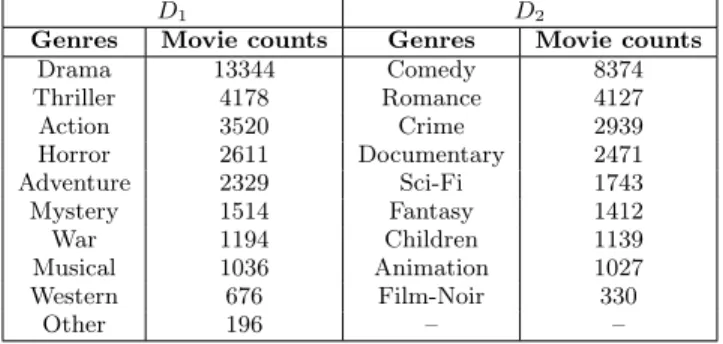
Figure 10: MAE comparison based on profile size. ing on the structural property of the data (e.g., genres), any domain could be partitioned into multiple sub-domains. For this experiment, we use the ML-20M dataset which consists of 19 different genres. We partition this dataset into two sub-domainsD1 andD2 by sorting the genres based on the movie counts per genre and allocating alternate sorted gen-res to the sub-domains as shown in Table 2. Note that a movie can have multiple genres. If a movie m belongs to both the sub-domains, we add it to the sub-domain which has the most number of genres overlapping withm’s set of genres and to any of the two sub-domains in case of equal overlap with both sub-domains. Sub-domainD1 consists of 15,119movies with138,492users whereas sub-domain D2 consists of11,383movies with138,483users.
Table 2: Sub-domains (D1 and D2) based on genres in Movielens 20M dataset.
D1 D2
Genres Movie counts Genres Movie counts
Drama 13344 Comedy 8374 Thriller 4178 Romance 4127 Action 3520 Crime 2939 Horror 2611 Documentary 2471 Adventure 2329 Sci-Fi 1743 Mystery 1514 Fantasy 1412 War 1194 Children 1139 Musical 1036 Animation 1027 Western 676 Film-Noir 330 Other 196 – –
We compareX-MapandNX-Mapwith Alternating Least Square from MLlib (MLlib-ALS). We observe from
Ta-ble3thatNX-Mapsignificantly outperformsMLlib-ALS
whereasX-Map, even with the additional privacy overhead, almost retains the quality of non-privateMLlib-ALS.
Table 3: MAE comparison (homogeneous setting on ML-20M dataset).
NX-Map X-Map MLlib-ALS
MAE 0.6027 0.6830 0.6729
6.6
Scalability
In this section, we evaluate the scalability of X-Map in
terms of the speedup achieved with an increasing number of computational nodes. We also compare our scalability with a state-of-the-art homogeneous recommender leverag-ing Spark to implementAlternating-Least-Squaresbased ma-trix factorization (MLlib-ALS). For the ALS recommender,
we use the aggregated ratings over both the domains (linked-domain personalization). Figure11demonstrates the near-linear speedup ofX-Map. Additionally, we see thatX-Map
outperforms the scalability achieved byMLlib-ALS. Note
thatX-Mapis periodically executed offline and the
compu-tation time for the recommendations, corresponding to all the users in the test set, is around810seconds on 20 nodes.
1 1.5 2 2.5 3 3.5 4 4 6 8 10 12 14 16 18 20 Speedup Number of Machines X-MAP MLLIB-ALS
Figure 11: Scalability of X-Map.
6.7
Online Deployment
We deployed an online recommendation platform (http:
//x-map.work/) leveraging X-Simand made it available
to users. We observe that this recommender indeed provides book recommendations like Shutter Island: A Novel when the user queries for the movieInception. Besides, it also rec-ommends theShutter Island movie as a homogeneous rec-ommendation. We observe similar results for multiple other queries.
7.
RELATED WORK
Heterogeneous trends. Research on heterogeneous rec-ommendation is relatively new. There are, however, a few approaches to tackle the problem which we discuss below.
Smart User Models. González et al. introduced the no-tion of Smart User Models (SUMs) [15]. The idea is to ag-gregate heterogeneous information to build user profiles that are applicable across different domains. SUMs rely on users’ emotional context which are, however, difficult to capture. Additionally, it has been shown that users’ ratings vary fre-quently with time depending on their emotions [4].
Web Monitoring. Hyung et al. designed a web agent which profiles user preferences across multiple domains and leverages this information for personalized web support [21]. Tuffield et al. proposed Semantic Logger, a meta-data ac-quisition web agent that collects and stores any information (from emails, URLs, tags) accessed by the users [36]. How-ever, web agents are considered a threat to users’ privacy as users’ data over different e-commerce applications are stored in a central database administered by the web agent.
Cross-domain Mediation. Berkovsky et al. [6] proposed the idea of cross-domain mediation to compute recommen-dations by aggregating data from several recommenders. We showed empirically that X-Mapoutperforms cross-domain
mediation in Figures8and9.
In contrast,X-Mapintroduces a new trend in
heteroge-neous personalization in the sense that the user profile from a source domain is leveraged to generate an artificial Al-terEgo profile in a target domain. The AlAl-terEgo profiles can even be exchanged between e-commerce companies like Netflix, Last.fm thanks to the privacy guarantee inX-Map.
Merging preferences. One could also view the heteroge-neous recommendation problem as that of merging single-domain user preferences. Through this viewpoint, several approaches can be considered which we discuss below.
Rating aggregation. This approach is based on aggregat-ing user rataggregat-ings over several domains into a saggregat-ingle multi-domain rating matrix [6,7]. Berkovsky et al. showed that
this approach can tackle cold-start problems in collabora-tive filtering [7]. We showed empirically thatX-Mapeasily
outperforms such rating aggregation based approaches [6]. Common representation. This approach is based on a common representation of user preferences from multiple domains either in the form of a social tag [35] or seman-tic relationships between domains [23]. Shi et al. devel-oped a Tag-induced Cross-Domain Collaborative Filtering (TagCDCF) to overcome cold-start problems in
collabora-tive filtering [32]. TagCDCFexploits shared tags to link different domains. They thus need additional tags to bridge the domains. X-Mapcan bridge the domains based on the
ratings provided by users using its novel X-Sim measure without requiring any such additional information which is difficult to collect in practice.
Linked preferences. This approach is based on linking users’ preferences in several domains [11]. We showed em-pirically that X-Map outperforms such linked preference
based approaches [11] in Figures8and9.
Domain-independent features. This approach is based on mapping user preferences to domain-independent features likepersonality types [8] oruser-item interactions[24]. This approach again requires additional information like person-ality scores which might not be available for all users.
8.
CONCLUDING REMARKS
We presented X-Map, a scalable and private
heteroge-neous recommender. X-Map leverages a novel similarity
metricX-Sim, identifying similar items across domains based
on meta-paths, to generate AlterEgo profiles of users in do-mains where these users might not have any activity yet. We demonstrated thatX-Mapperforms better in terms of
recommendation quality than alternative heterogeneous rec-ommenders [5,6,11]. (Although, not surprisingly, there is a trade-off between quality and privacy.)
Acknowledgement. This work was funded by Web-Alter-Ego Google Focused Award, and ERC grant for Adversary Oriented Computing under grant agreement number 339539.
9.
REFERENCES
[1] X-Map GitHub repository.https://github.com/LPD-EPFL-ML/X-MAP.
[2] G. Adomavicius and A. Tuzhilin. Toward the next generation of recommender systems: A survey of the state-of-the-art and possible extensions. InTKDE, pages 734–749, 2005.
[3] K. Ali and W. Van Stam. Tivo: making show recommendations using a distributed collaborative filtering architecture. In SIGKDD, pages 394–401, 2004.
[4] X. Amatriain, J. M. Pujol, and N. Oliver. I like it... i like it not: Evaluating user ratings noise in recommender systems. In UMAP, pages 247–258. 2009.
[5] L. Baltrunas and F. Ricci. Context-based splitting of item ratings in collaborative filtering. InRecSys, 2009.
[6] S. Berkovsky, T. Kuflik, and F. Ricci. Cross-domain mediation in collaborative filtering. InUser Modeling. 2007.
[7] S. Berkovsky, T. Kuflik, and F. Ricci. Distributed collaborative filtering with domain specialization. InRecSys, 2007.
[8] I. Cantador, I. Fernández-Tobías, A. Bellogín, M. Kosinski, and D. Stillwell. Relating personality types with user preferences in multiple entertainment domains. InUMAP Workshops, 2013. [9] F. Carmagnola and F. Cena. User identification for
cross-system personalisation.Information Sciences, 179(1):16–32, 2009.
[10] F. Carmagnola, F. Cena, and C. Gena. User model interoperability: a survey. InUMUAI, 2011.
[11] P. Cremonesi, A. Tripodi, and R. Turrin. Cross-domain recommender systems. InICDMW, 2011.
[12] Y. Ding and X. Li. Time weight collaborative filtering. In CIKM, pages 485–492, 2005.
[13] C. Dwork. A firm foundation for private data analysis.CACM, 54(1):86–95, 2011.
[14] C. Dwork, F. McSherry, K. Nissim, and A. Smith. Calibrating noise to sensitivity in private data analysis. InTheory of cryptography, pages 265–284. Springer, 2006.
[15] G. González, B. López, and J. L. de la Rosa. A multi-agent smart user model for cross-domain recommender systems. In Beyond Personalization, 2005.
[16] J. L. Herlocker, J. A. Konstan, A. Borchers, and J. Riedl. An algorithmic framework for performing collaborative filtering. In SIGIR, 1999.
[17] T. Hofmann and J. Puzicha. Latent class models for collaborative filtering. InIJCAI, 1999.
[18] Y. Huang, B. Cui, W. Zhang, J. Jiang, and Y. Xu. Tencentrec: Real-time stream recommendation in practice. InSIGMOD, 2015.
[19] D. Jannach, M. Zanker, A. Felfernig, and G. Friedrich. Recommender systems: an introduction. Cambridge University Press, 2010.
[20] A. Kohrs and B. Merialdo. Clustering for collaborative filtering applications. InCIMCA, 1999.
[21] H. J. Kook. Profiling multiple domains of user interests and using them for personalized web support. InAdvances in Intelligent Computing, pages 512–520. Springer, 2005. [22] D. Lemire and A. Maclachlan. Slope one predictors for online
rating-based collaborative filtering. InSIAM, 2005.
[23] A. Loizou.How to recommend music to film buffs. PhD thesis, UNIVERSITY OF SOUTHAMPTON, 2009.
[24] B. Loni, Y. Shi, M. Larson, and A. Hanjalic. Cross-domain collaborative filtering with factorization machines. InECIR. 2014.
[25] J. McAuley and J. Leskovec. Hidden factors and hidden topics: understanding rating dimensions with review text. InRecSys, 2013.
[26] M. F. Rahman, W. Liu, S. Thirumuruganathan, N. Zhang, and G. Das. Privacy implications of database ranking.PVLDB, 8(10):1106–1117, 2015.
[27] N. Ramakrishnan, B. J. Keller, B. J. Mirza, A. Y. Grama, and G. Karypis. Privacy risks in recommender systems.IEEE Internet Computing, (6):54–62, 2001.
[28] P. Resnick, N. Iacovou, M. Suchak, P. Bergstrom, and J. Riedl. Grouplens: an open architecture for collaborative filtering of netnews. InCSCW, 1994.
[29] B. Sarwar, G. Karypis, J. Konstan, and J. Riedl. Item-based collaborative filtering recommendation algorithms. InWWW, 2001.
[30] B. Shapira, L. Rokach, and S. Freilikhman. Facebook single and cross domain data for recommendation systems. InUMUAI, 2013.
[31] U. Shardanand and P. Maes. Social information filtering: algorithms for automating a word of mouth. InSIGCHI, 1995. [32] Y. Shi, M. Larson, and A. Hanjalic. Tags as bridges between
domains: Improving recommendation with tag-induced cross-domain collaborative filtering. InUMAP, 2011. [33] I. Soboroff and C. Nicholas. Collaborative filtering and the
generalized vector space model. InSIGIR, 2000.
[34] Y. Sun, J. Han, X. Yan, P. S. Yu, and T. Wu. Pathsim: Meta path-based top-k similarity search in heterogeneous information networks.PVLDB, 4(11):992–1003, 2011.
[35] M. N. Szomszor, I. Cantador, and H. Alani. Correlating user profiles from multiple folksonomies. InHypertext, 2008. [36] M. M. Tuffield, A. Loizou, and D. Dupplaw. The semantic
logger: Supporting service building from personal context. In CARPE, 2006.
[37] L. H. Ungar and D. P. Foster. Clustering methods for collaborative filtering. InAAAI workshop on recommendation systems, volume 1, 1998.
[38] M. Zaharia et al. Resilient distributed datasets: A fault-tolerant abstraction for in-memory cluster computing. InNSDI, 2012. [39] T. Zhu, G. Li, Y. Ren, W. Zhou, and P. Xiong. Differential
privacy for neighborhood-based collaborative filtering. In Asonam, pages 752–759, 2013.
[40] T. Zhu, Y. Ren, W. Zhou, J. Rong, and P. Xiong. An effective privacy preserving algorithm for neighborhood-based collaborative filtering.Future Generation Computer Systems, 36:142–155, 2014.