Citation: Premkumar, Karumbu, Chen, Xiaomin and Leith, Douglas J. (2015) Proportional
Fair Coding for Wireless Mesh Networks. IEEE/ACM Transactions on Networking, 23 (1). pp.
269-281. ISSN 1063-6692
Published by: IEEE
URL:
http://dx.doi.org/10.1109/TNET.2014.2298974
<http://dx.doi.org/10.1109/TNET.2014.2298974>
This version was downloaded from Northumbria Research Link:
http://nrl.northumbria.ac.uk/34833/
Northumbria University has developed Northumbria Research Link (NRL) to enable users to
access the University’s research output. Copyright
©and moral rights for items on NRL are
retained by the individual author(s) and/or other copyright owners. Single copies of full items
can be reproduced, displayed or performed, and given to third parties in any format or
medium for personal research or study, educational, or not-for-profit purposes without prior
permission or charge, provided the authors, title and full bibliographic details are given, as
well as a hyperlink and/or URL to the original metadata page. The content must not be
changed in any way. Full items must not be sold commercially in any format or medium
without formal permission of the copyright holder. The full policy is available online:
http://nrl.northumbria.ac.uk/policies.html
This document may differ from the final, published version of the research and has been
made available online in accordance with publisher policies. To read and/or cite from the
published version of the research, please visit the publisher’s website (a subscription may be
required.)
Proportional Fair Coding for Wireless Mesh Networks
Karumbu Premkumar
, Member, IEEE
, Xiaomin Chen, and Douglas J. Leith
, Senior Member, IEEE
Abstract—We consider multihop wireless networks carrying unicast flows for multiple users. Each flow has a specified delay deadline, and the lossy wireless links are modeled as binary symmetric channels (BSCs). Since transmission time, also called airtime, on the links is shared among flows, increasing the airtime for one flow comes at the cost of reducing the airtime available to other flows sharing the same link. We derive the joint allocation of flow airtimes and coding rates that achieves the proportionally fair throughput allocation. This utility optimization problem is nonconvex, and one of the technical contributions of this paper is to show that the proportional fair utility optimization can nev-ertheless be decomposed into a sequence of convex optimization problems. The solution to this sequence of convex problems is the unique solution to the original nonconvex optimization. Surpris-ingly, this solution can be written in an explicit form that yields considerable insight into the nature of the proportional fair joint airtime/coding rate allocation. To our knowledge, this is the first time that the utility fair joint allocation of airtime/coding rate has been analyzed, and also one of the first times that utility fairness with delay deadlines has been considered.
Index Terms—Binary symmetric channels, code rate selection, cross-layer optimization, network utility maximization, optimal packet size, resource allocation, scheduling.
I. INTRODUCTION
I
N THIS paper, we consider wireless mesh networks with lossy links and flow delay deadlines. Packets that are de-coded after a delay deadline are treated as losses. We derive the joint allocation of flow airtimes and coding rates that achieves the proportionally fair throughput allocation. To our knowledge, this is the first time that the utility fair joint allocation of air-time/coding rate has been analyzed, and also one of the first times that utility fairness with delay deadlines has been consid-ered (also, see [1] and [2]).In the special cases where all links in a network are loss-free or all flow delay deadlines are infinite, we show that the pro-portionally fair utility optimization decomposes into decoupled airtime and coding rate allocation tasks. That is, a layered ap-proach that separates MAC scheduling and packet coding rate selection is optimal. This corresponds to the current practice,
Manuscript received November 26, 2012; revised June 15, 2013; accepted December 08, 2013; approved by IEEE/ACM TRANSACTIONS ONNETWORKING Editor A. Proutiere. Date of publication January 28, 2014; date of current ver-sion February 12, 2015. This work was supported by the Science Foundation Ireland under Grants 07/IN.1/I901 and 11/PI/1177.
K. Premkumar was with the Hamilton Institute, NUI Maynooth, Maynooth, Ireland. He is now with the Department of Information Technology, SSN Col-lege of Engineering, Chennai 603 110, India (e-mail: [email protected]). X. Chen and D. J. Leith are with the Hamilton Institute, NUI Maynooth, Maynooth, Ireland (e-mail: [email protected]; [email protected]).
Fig. 1. Single-cell wireless LAN with three flows. The central node repre-sents the access point (AP), and the other nodes represent the wireless stations. (a) Topology. (b) Optimum utility versus classical utility.
and these tasks can be solved separately using a wealth of clas-sical techniques.
However, we show that no such decomposition occurs when one or more links are lossy or one or more flows have finite delay deadlines. Instead, in such cases, it is necessary to jointly opti-mize the flow airtimes and coding rates. Furthermore, we show that the resulting allocation of airtime and coding rates is qual-itatively different from classical results. For example, consider a single-hop wireless network carrying three flows; see Fig. 1. Flow is a delay-sensitive flow (e.g., video), while flows and are delay-insensitive flows (e.g., TCP data). Transmis-sions are scheduled in a TDMA manner, and the delay dead-line for flow is one schedule period, while the delay dead-line for flows and is infinite. The channel symbol error rate is for all flows, and flows use MDS codes for error correction. The proportionally fair airtime and coding rate allo-cation that we show in this paper [see (21) and (22)] results in the allocation of 41% of the airtime for flow , while flow and flow each receive 29.5%. Observe that the proportion-ally fair allocation assigns unequal airtimes to the flows, which is a notable departure from the usual equal-airtime property of the proportional fair allocation when selection of delay dead-lines and coding rate are not included, e.g., see [3]. The optimal coding rate is 0.62 for flow and 0.97 for flows and . The coding rate for flow is much lower than for flows and since a smaller block size must be used by flow (and more redundant symbols for error recovery) in order to respect the delay deadline. Due to the delay deadline, these optimal coding rates yield nonzero loss rates. For flow , the packet loss rate at the receiver, after decoding, is 20%, whereas flows and are loss-free. This highlights an important feature of the joint airtime and coding rate utility optimization. Namely, that it allows the throughput/loss/delay tradeoff among flows sharing network resources to be performed in a principled, fair
manner. Without consideration of coding rate, the tradeoff be-tween throughput and loss cannot be fully understood or op-timally managed. Without consideration of airtime, the con-tention between flows for shared network resources cannot be fully captured.
Proportional fairness can be formulated as a utility maxi-mization task, with the utility being the sum of log flow rates. Fig. 1(b) compares the optimal network utility to that obtained with a classical type of approach where all flows are allocated equal airtime and the coding rates are chosen based on the channel error probabilities alone (this corresponds to ignoring the delay deadline of flow ). It can be seen that the optimal approach that we present in this paper potentially offers signif-icant performance benefits over classical methods.
We note that one of the reasons why the joint selection of airtime/coding rate has not been previously studied is that the proportional fair utility optimization is nonconvex, and hence, powerful tools from convex optimization cannot be applied di-rectly. Also, the study of the throughput performance by jointly considering the coding and the MAC has not been performed be-fore. One of the technical contributions of this paper is to show that the proportional fair utility optimization can nevertheless be decomposed into a sequence of convex optimization prob-lems. The solution to this sequence of convex problems is the unique solution to the original nonconvex optimization. More-over, this solution can be written in an explicit form thereby yielding considerable insight into the nature of the proportional fair airtime/coding rate allocation.
Our analysis encompasses both hop-by-hop FEC and end-to-end FEC and hybrid combinations of these. For example, hop-by-hop FEC can be accommodated by partitioning an end-to-end route into segments and applying our results to each seg-ment individually (a segseg-ment here might consist of a single hop or, more generally, several hops). Our analysis is also relevant to the use of corrupted frames as an information channel. Re-cent measurement studies find that the number of erroneous bits in corrupted frames is often rather small, and so these frames potentially provide a useful information channel (e.g., [4] sug-gests potential capacity gains of 100% might be achieved in this way). In this case, there already exists hop-by-hop FEC at the PHY/MAC layer, and the end-to-end FEC is concatenated with this. Since the hop-by-hop PHY/MAC FEC is typically strongly constrained by the link hardware (e.g., it cannot exploit recent improvements in code efficiency nor take account of flow-level requirements), the addition of coding above the link layer can yield extra performance.
The rest of the paper is organized as follows. The related literature on utility optimal resource allocation is discussed in Section II. Section III defines the network model; in particular, we describe the mesh network architecture, the traffic model, and the channel model. We also discuss the transmission sched-uling model, decoding delay deadline, and the network con-straints. In Section IV, we obtain a measure for the end-to-end packet decoding error and describe the throughput of the net-work. In Section V, we formulate a network utility maximiza-tion problem subject to constraints on the transmission schedule lengths and discuss the optimization framework. In Section VI, we discuss two special cases of networks, delay-insensitive and
loss-free networks, and show that the tasks of obtaining optimal airtimes and coding rates decouple in these special cases. We discuss the optimal airtime/coding solution with some examples in Section VII. Finally, we conclude in Section VIII. The proofs of lemmas and theorems are provided in the Appendix.
II. RELATEDWORK
We consider a multihop Network Utility Maximization (NUM) problem with deadline constraints and with a practical model [4] for the PHY layer. By means of channel coding, we try to recover a packet from the channel errors. Having a low coding rate helps in recovering the packets, but at the cost of a small fraction of payload and at the cost of the transmission airtime of other flows. Thus, we consider the problem of resource allocation that answers the following question: how to allocate throughput across competingflows with eachflow seeing different channel conditions and respecting the delay deadline.
The problem of NUM has been studied in various contexts, with NUM as a network layering tool introduced in [5].
Much of the work on NUM is concerned with the flow scheduling and throughput allocation that achieves the network stability region. This work focuses on throughput and largely ignores delay constraints. Resource allocation problems from the viewpoint of network control and stability is studied by Georgiadis et al. in [6]. Network flow scheduling problems are studied in a utility optimal framework by Shakkottai and Srikant in [7]. In all these works and the references therein, the emphasis is on the MAC layers and above. In [6], an energy optimal scheduling problem is studied in which the PHYsical layer is also considered.
Some recent work explicitly includes delay constraints in the utility optimization. In [1], Li and Eryilmaz studied the problem of end-to-end delay constrained scheduling in mul-tihop networks. They propose algorithms based on Lyapunov drift minimization and pricing, and show that by dynamically selecting service disciplines, the proposed algorithms signif-icantly outperform existing throughput-optimal scheduling algorithms. In [2], Jaramillo and Srikant studied a resource allocation problem in ad hoc networks with elastic and inelastic traffic with deadlines for packet reception, and obtained joint congestion control and scheduling algorithm that maximizes a network utility. In [2], the focus is on congestion control and scheduling, with the PHYsical layer considered to be error-free. A short, preliminary version of the work in the current paper was presented in [8].
III. NETWORKMODEL
A. Cellular Mesh Architecture
We consider networks consisting of a set of cells, , which define the “interference domains” in the network. We allow intracell interference (i.e., transmis-sions by nodes within the same cell interfere), but assume that there is no intercell interference. This captures, for example, common network architectures where nodes within a given cell
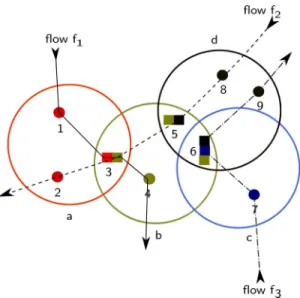
Fig. 2. Wireless mesh network with four cells. Cells , , , and use orthog-onal channels , , , and , respectively. Nodes 3, 5, and 6 are bridge nodes. The bridge node 3 (resp. 5 and 6) is provided a time slice of each of the channels and (resp. and for node 5, and , , and for node 6). Three flows , and are considered. In this
example, , , and .
use the same radio channel while neighboring cells use orthog-onal radio channels. Within each cell, any two nodes are within the decoding range of each other and, hence, can communi-cate with each other. The cells are interconnected using mul-tiradio bridging nodes to create a multihop wireless network. A multiradio bridging node connecting the set of cells
can be thought of as a set of single radio nodes, one in each cell, interconnected by a high-speed, loss-free wired backplane. See, for example, Fig. 2.
B. Unicast Flows
Data are transmitted across this multihop network as
a set , of unicast flows. The
route of each flow is given by a sequence of cells , where the source node and the destination node . We assume loop-free flows (i.e., no two cells in are the same). C. Binary Symmetric Channels
We associate a binary random variable with the th bit transmitted by flow in cell . indicates that the bit is received correctly, and indicates that the bit is received incorrectly, i.e., the bit is “flipped.” We assume that are independent and identically distributed
(i.i.d.), and . That is, we have
a binary symmetric channel (BSC) with crossover probability . A transmitted bit may be “flipped” multiple times as it travels along the route of flow and is received incorrectly at the flow destination only if there is an odd number of such flips. The end-to-end crossover probability along the route of flow is therefore given by
Note that we can accommodate transmission of symbols from any -ary alphabet (i.e., not just transmission of binary symbols) by associating channel uses of the BSC for every transmitted symbol. The symbol error probability (for any
) is then given by .
In this channel model, the channel processes across time are independent copies of the BSCs. In practice, this can be realized by means of an interleaver of sufficient depth (after the channel encoder), which randomly shuffles the encoded symbols subject to the delay deadline, combined with a de-interleaver (before the channel decoder) at the receiver. This interleaving and de-inter-leaving randomly mixes any channel fades, which can then be modeled as independent channel processes across time. D. Flow Transmission Scheduling
A scheduler assigns a time slice of duration s to each flow that flows through cell , subject to the con-straint that where is the period of the schedule in cell in seconds. We consider a periodic scheduling strategy in which, in each cell , service is given to the flows in a round-robin fashion, and that each flow in cell gets a time slice of seconds in every schedule. We definetime-slot corresponding to flow in cell as the time slice in each schedule length that serves the flow .
E. Flow Decoding Delay Deadline
At the source node for flow , we assume that sym-bols arrive in each schedule length , which allows us to simplify the analysis by ignoring queueing. Information sym-bols are formed into blocks of symbols, where
is the number of time-slots that the block may span. Each block of information symbols is encoded into a block of coded symbols, where symbols, with coding rate . Here, is the number of encoded symbols transmitted in one slot, i.e., the transmitted packet size. The code employed for encoding is discussed in Section IV. The quantity is a user or operator supplied quality of service parameter. It specifies the decoding delay deadline for flow , since after the flow destination has collected at most suc-cessive coded packets, it must attempt to decode the encoded information symbols. Note that also captures the encoding delay for nonsystematic codes—while systematic and convolu-tional codes incur no encoding delay at the transmitter, nonsys-tematic codes require the transmitter to wait for symbols to be received before producing the first coded symbol.
The end-to-end delay deadline is given by the following: For the first chunk, the delay is , and for each of the re-maining chunks, the delay is (recall that is the destination cell of flow ). Thus, the end-to-end delay dead-line is
In the case of equal 's, the end-to-end delay deadline is
F. Network Constraints on Coding Rate
For flow in cell , let be the rate of transmission in sym-bols/second, which is determined by the modulation and spec-tral bandwidth used for signal transmission and the within-cell FEC used. Each cell along the route of flow allo-cates an airtime of at least in order to transmit the packets
of flow . Let be the set of flows
that are routed through cell . We recall that the transmissions in any cell are scheduled in a TDMA fashion, and hence, the total time required for transmitting packets for all flows in cell is given by . Since, for cell , the transmission schedule interval is units of time, the encoded packet size must satisfy the schedulability constraint
Note that since we provide sufficient transmit time at each cell along route to allow coded symbols to be transmitted in every scheduled time-slot , , there is no queueing at the cells along the route of a flow.
IV. PACKETERRORPROBABILITY
Each transmitted symbol of flow reaches the destination node erroneously with probability . Hence, to help protect against errors when recovering the information symbols, we en-code information symbols at the source nodes using a block code (we note here that a convolutional code with zero-padding is also a block code). An block code has the following properties. The encoder takes a sequence of information sym-bols as input and generates a sequence of coded sym-bols as output. The decoder takes a sequence of coded sym-bols as input and outputs a sequence of information symsym-bols. These information symbols will be error-free provided no more than of the coded symbols are corrupted. The Singleton bound [9] tells us that , with equality for max-imum-distance separable (MDS) codes. Thus, an MDS code can correct up to
(1) errors. Examples for MDS codes include Reed–Solomon codes [9] and MDS-convolutional codes [10]. In [10], the authors show the existence of MDS-convolutional codes for any code rate. Hereafter, we will make use of (1), and so confine consideration to MDS codes. However, the analysis can be readily extended to other types of code provided a corresponding bound on is available.
Consider a coded block of flow and let
index the symbols in the block. Let be a binary random variable that equals 0 when the th coded symbol is received correctly and that equals 1
when it is received corrupted. , and
. From (1), the probability of the block being decoded incorrectly is given by
The symbol errors are i.i.d.
Bernoulli random variables, and so the is a binomial random variable. Hence, the probability of a decoding error can be computed exactly. However, the exact expression is combinatorial in nature and is not tractable for further analysis. We therefore proceed by obtaining upper and lower bounds on the error probability and show that the bounds are the same up to a prefactor, and that the prefactor decreases as the block size increases. Hence, we pose the NUM based on the upper bound on the error probability. Also, we relax the constraints and and allow them to take positive real
values, i.e., and .
A. Upper and Lower Bounds
Lemma 1: (Upper Bound). The end-to-end probability of a decoding error for flow satisfies
(2)
where , is the coding rate,
is the Chernoff-bound parameter, and the function
is called the rate function in large deviations theory.
Proof: See Appendix A.
Lemma 2: (Lower Bound). The end-to-end probability of a decoding error for flow satisfies
(3) where
and , is the Bernoulli distribution with pa-rameter , and is the entropy of probability mass func-tion (pmf) .
Proof: See Appendix B. B. Tightness of Bounds
It can be verified that
Since is a free parameter, we can select the value that maximizes and so provides the tightest upper bound. It can be verified (e.g., by inspection of the second derivative) that is concave in , and so the KKT conditions are necessary and sufficient for an optimum. The KKT condition here is
provided . Substituting for
where is the information divergence between the pmfs and . Thus, by Lemmas 1 and 2 , the probability of a decoding error satisfies
It can be seen that the upper and lower bounds are the same to within prefactor , and the gap between these bounds decreases exponentially as the block size increases.
V. NETWORKUTILITYOPTIMIZATION
We are interested in the fair allocation of flow airtimes and coding rates among flows in the network. Other things being equal, we expect that decreasing the coding rate (i.e., in-creasing the number of redundant symbols trans-mitted) for flow will decrease the error probability , and so increases the flow throughput. However, decreasing the coding rate increases the coded packet size , and so increases the airtime used by flow . Since the network capacity is limited and shared by other flows, this generally decreases the airtime available to other flows, and so decreases their throughout. Sim-ilarly, increasing the packet size of flow increases its throughput, but at the cost of increased airtime and a reduction in the throughput of other flows. We formulate this tradeoff as a utility fair optimization problem. In particular, we focus on the proportional fair allocation since it is of wide interest and, as we will see, is tractable, despite the nonconvex nature of the optimization.
We consider a network utility function that is a func-tion of the average network throughput. We recall that the ar-rival processes of symbols is such that for each flow , sym-bols arrive every seconds, and hence, there is no queueing (i.e., there is no dynamics in the rate of transmission). However, the network throughput is stochastic due to the error process induced by the channel. Extending our work to include sto-chastic arrivals would be important and interesting. However, a queueing analysis with coupled queues seems likely to be intractable, so one possible strategy is to change to use of a fluid-like framework, although this would require a change in the definition of delay deadline used.
The utility fair optimization problem is to obtain optimum , , and for a given set of parameters
and , which is given by
(4)
subject to (5)
(6) (7) (8)
with the vector of Chernoff parameters, the vector of flow packet sizes, and
the vector of flow coding rates (where we recall that ). Equation (5) enforces the network capacity (or the flow schedulability) constraints, (6) the positivity constraint on the Chernoff parameters, and the constraints (7) and (8) are in-troduced for technical reasons that will be discussed in more detail shortly (see Section V-C).
For proportional fairness, we select the sum of the log of the flow throughputs as our network utility . For flow , the ex-pected throughput is symbols in every time in-terval of duration (we recall that is the destination cell of flow ), which is the same as symbols every time interval of duration , where is the information packet size and the packet decoding error probability. As the exact expression of is intractable, we use the upper bound for
, which is . Thus, the objective function is given by
The optimization problem yields the proportional fair flow coding rates and coded packet size . Since the PHY trans-mission rates are known parameters, the coded packet size is proportional to the airtime used by a flow (i.e., the airtime is
given by ).
A. Nonconvexity
The objective function is separable in for each flow . However, it can be readily
verified that is not jointly concave in
, and so the optimization is nonconvex. Hence, the network utility maximization problem defined in (4)–(8) is not in the standard convex optimization framework.
B. Reformulation as Sequential Optimizations
We proceed by making the following key observation. Lemma 3: For convex sets and , and for a function
that is concave in and in , but not jointly in , the solution to the joint optimization problem
(9) is unique and is the same as the solution to
(10) if is a concave function of , where for each ,
. Proof: See Appendix C.
This lemma establishes conditions under which we can trans-form a nonconvex optimization into a sequence of convex op-timizations. Roughly speaking, we proceed by optimizing over each variable in turn and substituting the optimal variable value that is found back into the objective function. This creates a se-quence of objective functions. Provided each member of this sequence is concave in the variable being optimized (but not necessary jointly concave in all variables), the solution to the sequence of convex optimizations coincides with the solution to the original nonconvex optimization. Evidently, the condi-tion that concavity holds for every objective funccondi-tion in this se-quence is extremely strong. Remarkably, however, we show that it is satisfied in our present network utility optimization. C. Optimal
Taking a sequential optimization approach, we begin by first solving the optimization
subject to
given packet sizes and coding rates .
The objective function is separable and concave in the s. The partial derivative of with respect to is given by (11) Setting this derivative equal to zero, provided this is solved by
(12) Observe that in fact is a function only of and not both and . The requirement for ensures that . When , the derivative (11) is negative for all
. In this case, the optimum is zero, which yields an error probability of one. Thus, for error recovery we require
, i.e., the coding rate , and for a nonempty feasible region in the NUM problem formulation in (4)–(8), the constraints on should satisfy the following:
and . We note that the capacity region for a BSC having a crossover probability with an -ary signaling is
, and the coding rate lies in the capacity region. D. Optimal
The next step in our sequential optimization approach is to solve
subject to
That is, we substitute into the objective function for the optimal found in Section V-C. Defining
It can be verified that is not jointly concave in . To proceed, we therefore rewrite the objective in terms
of the log-transformed variables and .
Observe that the mapping from to is invertible, and sim-ilarly the mapping from to . Since is a monotone in-creasing function of (this can be verified by inspection of the first derivative), the inverse mapping from to exists and is one-to-one. With the obvious abuse of notation, we write inverse map as . In terms of these log-transformed co-ordinates, the objective function is . We note that the problem defined in (4)–(8) is equivalent to the problem
subject to (13)
(14) (15) (16) and hence, by Lemma 3, the solution to the log-transformed problem is the same as that of the problem defined in (4)–(8). We solve the maximization problem by convex optimization method. We show that the objective function is jointly concave in in the following lemma.
Lemma 4:
is jointly concave in and . Proof: See Appendix D.
Hence, we have the following convex optimization problem: (17)
subject to (18)
(19) (20) We solve the above maximization problem using the Lagrangian relaxation approach. The Lagrangian function of the problem is
given by
where , , and are Lagrangian multipliers cor-responding to the constraints given in (18)–(20). The channel error probabilities 's are strictly positive, and the channel coding rates are always assumed to be in the interior of the feasi-bility region. Hence, the constraints for the channel coding rate given in (19) and (20) are not active at the optimal point, and the Lagrangian costs 's and 's are zero. Thus, the shadow costs corresponding to these constraints will not appear in the Lagrangian relaxation.
Since the optimization problem falls within convex optimiza-tion framework, and the Slater condioptimiza-tion is satisfied, strong du-ality holds. Hence, the KKT conditions are necessary and suffi-cient for optimality. Differentiating the Lagrangian with respect to at , and setting equal to zero yields the KKT condition
(21) Similarly, the KKT condition for is
or
(22) Combining (21) and (22) yields
(23) Observe that the left-hand side (LHS) is a function of and the right-hand side (RHS) is a function of . Thus, the choice of packet size parameter and coding rate parameter are, in general, coupled.
E. Distributed Algorithm for Solving Optimization
Given the values of the Lagrange multipliers , the solu-tion to (23) specifies the optimal packet size and coding rate. To complete the solution to the optimization, it therefore remains to calculate the multipliers . These cannot be obtained in closed form since their values reflect the network topology and details of flow routing. However, they can be readily found in a dis-tributed manner using a standard subgradient approach.
We proceed as follows. The dual problem for the primal problem defined in (17) is given by
where the dual function is given by
(24)
From (24), for any
and in particular, the dual function is greater than that for for some arbitrary , i.e.,
(25) Thus, a subgradient of at any is given by the vector
and the projected subgradient descent update is
where is a sufficiently small stepsize, and
ensures that the Lagrange multiplier never goes negative (see [11]).
The subgradient updates can carried out locally by each cell since the update of only requires knowledge of the packet sizes of flows traversing cell . Thus, at the beginning of each iteration , the flow source nodes choose their packet sizes as and the coding rates as
, and each cell computes its cost based on the packet sizes (or equivalently the rates) of flows through it. The updated costs along the route of each flow are then fed back to the source
nodes to compute the packet size and coding rate for the next iteration.
Observe that the Lagrange multiplier can be interpreted as the cost of transmitting traffic through cell . The amount of ser-vice time that is available is given by . When is positive and large, then the Lagrangian cost decreases rapidly (because the dual function is convex), and when is negative, then the Lagrangian cost increases rapidly to make . We note that the increase or decrease of between successive iterations is proportional to , the amount of service time available. Thus, the subgradient proce-dure provides a dynamic control scheme to balance the network load.
The resulting distributed implementation of the joint airtime/ coding rate optimization is summarized in Algorithm 1.
Algorithm 1 Distributed Implementation of Joint Airtime/Coding Rate Optimization.
Each cell runs:
loop 1.
end loop
The source for eachflow runs:
loop
1. Measure , the aggregate cost of using the cells along the route of flow . E.g., if each cell updates the header of transmitted packets to reflect this sum, it can then be echoed back to the source by the flow destination.
2. Find the unique packet size and coding rate that solve (23). Since there are only two variables, a simple numerical search can be used.
end loop
VI. TWOSPECIALCASES
A. Delay-Insensitive Networks
Suppose the delay deadline for all flows. For any positive bounded , i.e., , the LHS of (22) can be written as
(26)
Thus, the asymptotic optimal coding rate as the delay dead-line requirement is the solution to
(27) Since , it is sufficient to find the solution to
Note that
and hence (28)
Since this is the limiting solution and , one can use for some arbitrarily small . Similarly, from (21), the asymptotic optimal packet size as is
(29) where the multipliers are obtained, as before, by subgradient descent
(30) Observe that the optimal coding rate that is given by the solution of (28) is determined solely by the channel error rate of flow . It is therefore completely independent of the other network properties. In particular, it is independent of the packet size used, of the other flows sharing the network, and of the network topology. Conversely, observe that the optimal packet size in (29) and (30) is dependent on the network topology and flow routes, but is completely independent of the error rate and coding rate . That is, in delay-insensitive networks, the joint airtime/coding rate optimization task breaks into sep-arate optimal airtime allocation and optimal coding rate allo-cation tasks that are completely decoupled. Our optimization therefore yields a MAC/PHY layering, whereby airtime alloca-tion/transmission scheduling is handled by the MAC, whereas coding rate selection is handled by the PHY, with no cross-layer communication. It is important to note, however, that this layering does not occur in networks where one or more flows have finite delay deadlines; see Section VII for a more detailed discussion.
B. Loss-Free Networks
Suppose the channel symbol error rate for all flows. From (12), we observe that
(31) and this yields for all flows. The objective function in
(17) degenerates to . We note that for
any , as , . Hence, the LHS of
(22) becomes
In the same way as in (28), this limit can be achieved by (i.e., ). Similarly, the optimal packet size is
. This optimal packet size is identical to that for delay-insensitive networks—see (29)—and it can be verified that in fact it corresponds to the classical proportional fair rate allocation for loss-free networks, as expected.
VII. EXAMPLES
A. Single Cell
We begin by considering network examples consisting of a single cell carrying multiple flows. The network topology is il-lustrated schematically in Fig. 1 and might correspond, for ex-ample, to a WLAN.
1) Mix of Delay-Sensitive and Delay-Insensitive Flows: Sup-pose the flows in the network belong to two classes, one of which is delay-sensitive and has a delay-deadline , whereas the other is delay-insensitive, i.e., has an infinite delay dead-line. These classes might correspond, for example, to video and data traffic. Fig. 3(a) plots the optimal airtime allocation as the delay deadline is varied. In this example, there is a single delay-sensitive flow and two delay-insensitive flows, and the airtime allocation is shown for the delay-sensitive flow and for one of the delay-insensitive flows (both receive the same air-time allocation). As expected, it can be seen that the airair-time al-locations of the delay-sensitive and delay-insensitive flows ap-proach each other as the delay deadline is increased. How-ever, it is notable that they approach each other fairly slowly, and when the delay deadline is low, the airtime allocated to the delay-sensitive flow is almost 50% greater than that allocated to a delay-insensitive flow. This behavior is qualitatively dif-ferent from the classical proportional fair allocation neglecting coding rate and delay deadlines, which would allocate equal air-time to all flows. By taking coding rate and delay deadlines into account, our approach allows the resource allocation to flows with different quality-of-service requirements to be carried out in a principled and fair manner.
Fig. 3(b) plots the optimal airtime allocation as the number of delay-insensitive flows is varied. It can be seen that the airtime allocated to each flow decreases as is increased, as expected since the number of flows sharing the network is in-creasing. Interestingly, observe that the airtime allocated to the delay-sensitive flow is a roughly constant margin above that al-located to the delay-insensitive flows. The delay-sensitive flow is therefore “protected” from the delay-insensitive flows. How-ever, in contrast toad hocapproaches, this protection is carried out in a principled and fair manner.
2) Mix of Near and Far Stations: Consider now a situation where all flows have the same delay deadline , but where for some flows the sources are located close to the destination, and for other flows, the sources are further away. We therefore have two classes of flows, one with a higher channel symbol error rate than the other when both use the same PHY rate. Fig. 4(a) plots the optimal airtime allocation for a flow in each class as the channel error rate for one class is varied. When the channel error rates for both classes are the same , it can be seen that the airtime allocation is the same. As the channel error rate decreases, the airtime allocated to flow 1 decreases. Conversely,
Fig. 3. Single WLAN with one delay-sensitive flow and delay-insensitive flows. Delay-sensitive flow has delay deadline ; delay-insensitive flows have infinite delay deadlines. Raw channel symbol error rate is for all flows; PHY rate for all flows is 10 symbols per schedule period. Optimal airtimes are given as a proportion of the schedule period. (a) Optimal airtime alloca-tion versus delay deadline , . (b) Optimal airtime allocation versus .
.
as the channel error rate increases, the airtime allocated to flow 1 increases.
Fig. 4(b)plots the optimalairtime allocation when flowsin both classes have the same channel error rate but different PHY rates, i.e., where the PHY modulation has been adjusted to equalize the channel error rates. When the PHY rates are the same (
symbols per schedule period), the airtime allocation is the same to both classes. As the PHY rate is increased, the airtime allocation for flow 1 decreases. Conversely, as the PHY rate is decreased, the airtime allocation for flow 1 increases. Again, note that this is qualitatively different from the classical proportional fair alloca-tion neglecting coding rate and delay deadlines that would allo-cate equal airtime to all flows.
3) Unequal Airtime: The basic observations in these exam-ples apply more generally. In particular, as noted above, in a loss-free, delay-insensitive single cell network, the proportional fair allocation is to assign equal airtime to all flows ([3] and Section VI-B). However, when delay deadlines are introduced and/or links are lossy, we see an interesting phenomenon.
Lemma 5: The optimum rate allocation (or equivalently ) is not equivalent to an equal airtime allocation.
Proof: See Appendix E.
In particular, flows that see a better channel get less airtime than flows that see a worse channel.
Fig. 4. Single WLAN with two delay-sensitive flows, both with delay deadline . In (a), PHY rate for both flows is 10 symbols per schedule period, and channel symbol error rate for flow 1 is varied. In (b), channel symbol error rate for both flows is , and PHY rate for flow 1 is varied. (a) Optimal airtime allocation versus channel symbol error rate for flow 1; symbol error rate for flow 2 is held fixed at . (b) Optimal airtime allocation versus PHY rate of flow 1; PHY rate for flow 2 is held fixed at 10 symbols/schedule.
Fig. 5. Linear Parking Lot network with cells and flows (one multihop flow and single-hop flows).
B. Multiple Cells
We now consider a mesh network consisting of cells car-rying flows in the well-studied Parking Lot topology. The network topology is illustrated in Fig. 5. The flows in this network can be assigned to two classes: Class 1 consists of the -hop flow, and class 2 consists of the single-hop flows 2, 3, , . Each cell has the same schedule period, i.e.,
.
1) Impact of Number of Hops: Suppose that both classes of flows use the same symbol transmission PHY rate and experience the same loss rate in each cell. Then, the -hop flow will experience a higher end-to-end symbol error rate than
Fig. 6. Ratio of airtime versus number of cells in Parking Lot topology of Fig. 5. The -axis is the ratio of the airtime allocated to the -hop flow to that allocated to a single hop flow; note that the airtime of the -hop flow is the sum of allocated airtime in each cell along the flows route. Data are shown for three different delay deadline requirements, as indicated in the legend. All flows have the same PHY rate.
the single-hop flows, and the loss rate will increase with . Fig. 6 plots the ratio of optimal airtime allocated to each class of flow versus . Results are shown for three delay-deadline requirements: Both classes of flow are delay-sensitive with delay deadline ; class 1 is delay-sensitive , while class 2 is delay-insensitive ; class 1 is delay-insensitive, while class 2 is delay-sensitive. It can be seen that in the first case, where both classes have the same delay deadline, the ratio of airtime is larger than 1. This is in accordance with the previous observation that flows with poorer channel conditions are allocated more airtime than flows with better channel conditions. In the second case, where class 2 is delay-insensitive , additional airtime is allocated to class 1, the delay-sensitive flow, which also corresponds with the single-cell analysis. In the third case, where class 1 is delay-insensitive and class 2 is delay-sensitive, it can be seen that class-2 flows are allocated slightly more airtime that the class-1 flow. Interestingly, however, observe that the airtime allocated to the class-1 flow is insensitive to the number of hops. This contrasts with the behavior when the class-1 flow is delay-sensitive.
2) Impact of Different Flow PHY Rates: Now consider a sit-uation where the number of cells and all flows have the same delay deadline . Flows 2 and 4 have symbol error rate , and flows 1 and 3 have symbol error rate . We classify the flows into three sets: Class 1 con-sists of multihop flow 1, class 2 concon-sists of single-hop flows 2 and 4, and class 3 consists of single-hop flow 3. Let denote the PHY rate used used by class-1 and class-2 flows, and denote the PHY rate used by the class-3 flow. Fig. 7 plots the optimal coded packet size versus the ratio . We begin by observing that when , all flows have the same PHY rate, and it can be seen that flows in classes 2 and 3 are allo-cated the same packet sizes (and so the same airtime). Hence, although the flow in class 3 crosses a much more lossy link than the flows in class 2, the optimal allocation ensures that all of the single-hop flows have the same airtime. The multihop flow in class 1 is allocated a smaller packet size (and so less airtime)
Fig. 7. Coded packet size versus ratio of PHY rates for Parking Lot topology of Fig. 5 with cells. Class 1 consists of multihop flow 1, class 2 consists of single-hop flows 2 and 4, and class 3 consists of single-hop flow 3. Class-1 and 2 flows use PHY rate bit/s; the class-3 flow uses a PHY rate of
bit/s. All flows have delay deadline .
than the single-hop flows. It can also be seen that varying the PHY rate for the single-hop flow in class 3 does not affect the optimal coded packet sizes of flows in classes 1 and 2, and hence the airtime of class-1 and class-2 flows remains the same as is varied. The coded packet size of the class-3 flow increases linearly with , and so the airtime of the class-4 flow re-mains invariant as well.
VIII. CONCLUSION
In this paper, we posed a utility fair problem that yields the optimum airtime and the coding rate across flows in a capacity constrained multihop network with delay deadlines. We showed that the problem is highly nonconvex. Nevertheless, we demon-strate that the global network utility optimization problem can be solved. We obtained the optimum airtime/packet size and channel coding rate and analyzed its properties. A key result is that in the presence of channel errors, even in a single cell case, the proportional fair allocations of airtime across flows are dif-ferent (which, in the loss-free channel, is the same). We also analyzed some simple networks based on the utility optimum framework we proposed. To the best of our knowledge, this is the first work on cross-layer optimization that studies optimum coding across flows that are competing for network resources and have delay-deadline constraints.
APPENDIXA
PROOF OFLEMMA1
From the definition of
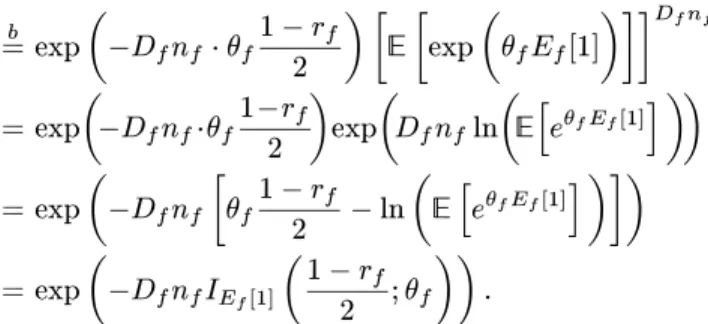
In the derivation above, in step , we applied Markov's in-equality, and in step , we applied the independence of the
random variables .
APPENDIXB
PROOF OFLEMMA2
From the definition of
The binomial coefficients can be bounded as follows:
Note that is the Bernoulli distribution with parameter , is the entropy of probability mass function (pmf) , and is the information divergence between the pmfs and .
APPENDIXC PROOF OFLEMMA3
For any , the function is concave in . Hence, for each , there exists a unique maximum , which is given by
If is a concave function of , then there exists a unique maximizer, which is denoted by , i.e.,
We show that is an optimum solution to (9). Since is the maximizer of , we have for any
or
For any given , is the maximizer of over all , i.e.,
and hence, for all
We note that maps into , and hence, . Hence, is a global maximizer.
APPENDIXD
PROOF OFLEMMA4
Consider the optimization problem
s.t.
We show that the objective function is jointly (strictly) con-cave in . The objective function is separable in , and we show that is convex, and
is concave.
Since, for , is a monotone function of , and is a monotone function of , it is clear that is invert-ible. Note that
Define . If ,
then is (strictly) convex. Note that , which implies
is increasing with , and hence, for ,
.
Define . consider the function
Similarly
Also
Similarly, one can show that . Define . If , then is (strictly) convex. Note that
. Therefore, .
APPENDIXE
PROOF OFLEMMA5
From (21), it is clear that even for a single cell, because of the nonzero second term in the LHS, the airtime of flow given by
is not the same for all the flows . REFERENCES
[1] R. Li and A. Eryilmaz, “Scheduling for end-to-end deadline-con-strained traffic with reliability requirements in multi-hop networks,” in Proc. IEEE INFOCOM, Shanghai, China, Apr. 2011, pp. 3065–3073. [2] J. Jaramillo and R. Srikant, “Optimal scheduling for fair resource allo-cation in ad hoc networks with elastic and inelastic traffic,”IEEE/ACM Trans. Netw., vol. 19, no. 4, pp. 1125–1136, Aug. 2011.
[3] A. Checco and D. J. Leith, “Proportional fairness in 802.11 wireless LANs,”IEEE Commun. Lett., vol. 15, no. 8, pp. 807–809, Aug. 2011. [4] X. Chen and D. J. Leith, “Frames in outdoor 802.11 WLANs pro-vide a hybrid binary symmetric/packet erasure channel,” 2012 [On-line]. Available: http://arxiv.org/abs/1209.4504
[5] M. Chiang, S. H. Low, A. R. Calderbank, and J. C. Doyle, “Layering as optimization decomposition: A mathematical theory of network ar-chitectures,”Proc. IEEE, vol. 95, no. 1, pp. 255–312, Jan. 2007. [6] L. Georgiadis, M. Neely, and L. Tassiulas, Resource Allocation and
Cross-Layer Control in Wireless Networks. Boston, MA, USA: Now, 2006.
[7] S. Shakkottai and R. Srikant, Network Optimization and Control. Boston, MA, USA: Now, 2008.
[8] K. Premkumar, X. Chen, and D. J. Leith, “Utility optimal coding for packet transmission over wireless networks—Part I: Networks of binary synchronous channels,” in Proc. 49th Annu. Allerton Conf. Commun., Control, Comput., Monticello, IL, USA, Sep. 2011, pp. 1592–1599.
[9] F. J. MacWilliams and N. J. A. Sloane, The Theory of Error-Correcting Codes. Amsterdam, The Netherlands: North-Holland, 1977.
[10] R. Smarandache, H. Gluesing-Luerssen, and J. Rosenthal, “Construc-tions of MDS-convolutional codes,”IEEE Trans. Inf. Theory, vol. 47, no. 5, pp. 2045–2049, Jul. 2001.
[11] D. P. Bertsekas, A. Nedich, and A. E. Ozdaglar, Convex Analysis and Optimization. Belmont, MA, USA: Athena Scientific, 2003.
Karumbu Premkumar(M'13) received the Ph.D. degree in engineering from the Indian Institute of Sci-ence, Bangalore, India, in 2011.
From 2010 to 2012, he was a Post-Doctoral Re-search Fellow with the Hamilton Institute, National University of Ireland Maynooth, Maynooth, Ireland. Since 2012, he has been an Associate Professor with the SSN College of Engineering, Chennai, India. His research interests are in resource allocation, perfor-mance modeling, analysis, design, and optimization problems arising in communication networks.
Xiaomin Chenreceived the M.Sc. degree from Bei-jing University of Posts and Telecommunications, Beijing, China, in 2008, and the Ph.D. degree from the Hamilton Institute, NUI Maynooth, Maynooth, Ireland, in 2012, both in engineering.
She is currently a Postdoctoral Research Fellow with the Hamilton Institute, NUI Maynooth. Her search interests lie in coding, protocol design, and re-source allocation in wireless networks.
Douglas J. Leith (M'02–SM'09) graduated from the University of Glasgow, Glasgow, U.K., in 1986, where he received the Ph.D. degree in engineering in 1989.
In 2001, he moved to the National University of Ireland, Maynooth, Ireland, to assume the position of SFI Principal Investigator and to establish the Hamilton Institute (http://www.hamilton.ie), of which he is Director. His current research interests include the analysis and design of network con-gestion control and resource allocation in wireless networks.