Modelling & Interpretation
for Annotation
Irfan Ullah
Submitted in partial fulfilment of the
Requirements for the degree
of Doctor of Philosophy
School of Engineering and Information Sciences
MIDDLESEX UNIVERSITY
May, 2011II
© 2011
Irfan Ullah All rights reserved
III
I certify that the thesis entitled Semantic Multimedia Modelling and
Interpretation for Annotation submitted for the degree of doctor of
philosophy is the result of my own work and I have fully cited and referenced
all material and results that are not original to this work.
Name ……….
[print name]
Signature ………
Date……….
IRFANULLAH
M
AY24
TH,
2011
IV
“If we knew what it was we were doing, it would not be called research, would it?” Albert Einstein
The emergence of multimedia enabled devices, particularly the incorporation of cameras in mobile phones, and the accelerated revolutions in the low cost storage devices, boosts the multimedia data production rate drastically. Witnessing such an iniquitousness of digital images and videos, the research community has been projecting the issue of its significant utilization and management. Stored in monumental multimedia corpora, digital data need to be retrieved and organized in an intelligent way, leaning on the rich semantics involved. The utilization of these image and video collections demands proficient image and video annotation and retrieval techniques.
Recently, the multimedia research community is progressively veering its emphasis to the personalization of these media. The main impediment in the image and video analysis is the semantic gap, which is the discrepancy among a user’s high-level interpretation of an image and the video and the low level computational interpretation of it. Content-based image and video annotation systems are remarkably susceptible to the semantic gap due to their reliance on low-level visual features for delineating semantically rich image and video contents. However, the fact is that the visual similarity is not semantic similarity, so there is a demand to break through this dilemma through an alternative way. The semantic gap can be narrowed by counting high-level and user-generated information in the annotation. High-level descriptions of images and or videos are more proficient of capturing the semantic meaning of multimedia content, but it is not always applicable to collect this information.
It is commonly agreed that the problem of high level semantic annotation of multimedia is still far from being answered. This dissertation puts forward approaches for intelligent multimedia semantic extraction for high level annotation. This dissertation intends to bridge the gap between the visual features and semantics. It proposes a framework for annotation enhancement and refinement for the object/concept annotated images and videos datasets. The entire theme is to first purify the datasets from noisy keyword and then expand the concepts lexically and commonsensical to fill the vocabulary and lexical gap to achieve
V
the advantages of the semantic intensity (SI), which is the concept dominancy factor in the image and annotation based semantic similarity of the images. As we are aware of the fact that the image is the combination of various concepts and among the list of concepts some of them are more dominant then the other, while semantic similarity of the images are based on the SI and concept semantic similarity among the pair of images. Moreover, the HLS exploits the clustering techniques to group similar images, where a single effort of the human experts to assign high level semantic to a randomly selected image and propagate to other images through clustering.
The investigation has been made on the LabelMe image and LabelMe video dataset. Experiments exhibit that the proposed approaches perform a noticeable improvement towards bridging the semantic gap and reveal that our proposed system outperforms the traditional systems.
VI
“No duty is more urgent than that of returning thanks [Schaff and Wace, 2002].” ST. AMBROSE Bishop of Milan (340 – 397)
I was once told that PhD is a long journey of transformation from a ‘novice’ to ‘professional’ researcher. To succeed, an individual can never do it alone; there must be someone who is there for them, providing all the helping hands and supports. I can’t agree more and as for my case, I have a lot of people to thank.
I owe my gratitude to all those people who have made this thesis possible. It is a pleasure to thank them all in my humble acknowledgment In the first place, I am heartily thankful to my supervisor Dr. Jonathan Loo (Middlesex University) for helpful discussions, guidance and support throughout my PhD studies. His scientific intuition and rigorous research attitude have enriched me with the in-depth understanding of the subject and the passion of dedicating myself to research, which I will benefit from in the long run. His gracious support in many aspects has enabled me to overcome difficulties and finish my study. I also extend my thanks to my second supervisor Dr. Martin Loomes.
Further, I would like to express my special gratitude to my colleague and best friend Nida Aslam, whose dedication, love, and persistent care has diminished all the difficulties of studying and living in the unfamiliar land far away from home.
I am grateful to my financial supporters, including the Kohat University of Science & Technology, Pakistan. Many thanks also go to my friends shafi Ullah khan, Tahir Naeem who accompanied me during the last three years, making my time in London most enjoyable. Finally, I pay tribute to the constant support of my family, but especially of my parents, Brother, sister and my wife & kids (Mahnoor & Lutfullah) for their untiring efforts and praying. Without them, my whole studies would have been impossible and whose sacrifice, I can never repay. This one is for you!
VII
I dedicate this thesis to my late Father, (may his soul rest in peace) for their
unconditional support and prayers, tireless love and motivation throughout
VIII
1. Irfan Ullah, Nida Aslam, Jonathan Loo, RoohUllah "Adding Semantics to the reliable Object Annotated Image Databases " World Conference on Information Technology, 2010.
2. Irfan Ullah, Nida Aslam, Jonathan Loo, RoohUllah “A Framework for High Level Semantic Annotation Using Trusted Object Annotated Dataset" IEEE International Symposium on Signal Processing and Information Technology December 15-18, 2010 - Luxor – Egypt.
3. I.Khan, N. Aslam, K.K. Loo, “Semantic Annotation Gap: where to put the responsibility”, International Journal of Digital Content Technology and its Applications (JDCTA), ISSN: 1975-9339, Vol. 3, No. 1, March 2009.
4. I.Khan, N. Aslam, K.K. Loo, “Semantic Multimedia Annotation: Text Analysis”, International Journal of Digital Content Technology and its Applications (JDCTA), ISSN: 1975-9339, Vol. 3, No. 2, June 2009.
5. Irfanullah, Nida Aslam, Jonathan Loo, Roohullah. “A Framework for Image Annotation Enhancement & Refining Using Knowledge Bases”. Springerlink International Journal on Digital Libraries (Submitted Feb 2011).
6. Irfanullah, Nida Aslam, Jonathan Loo, Roohullah. “Semantic Space Enhancement and Refinement for Video using Knowledgebases”. Elsevier Journal of King Saud University – Computer and Information. (Submitted Feb 2011)
7. Irfanullah, Nida Aslam, Jonathan Loo, Roohullah. “Exploiting the Semantic Intensity for High Level Semantic Annotation of Images”. Elsevier Journal of Visual Communication and Image Representation (Submitted Feb 2011)
8. Irfanullah, Nida Aslam, Jonathan Loo, Roohullah. A survey on exploiting
IX
LIST OF TABLES ... XVII LIST OF ACRONYMS ... XVIII
CHAPTER 01 - INTRODUCTION ... 1
1.1 INTRODUCTION ... 3
1.2 MOTIVATION AND APPLICATION ... 8
1.3 RESEARCH AIMS AND OBJECTIVES ... 10
1.4 THE EXISTING PROBLEMS AND CHALLENGES ... 11
1.5 RESEARCH DIRECTIONS ... 14
1.5.1 HIGH-LEVEL SEMANTIC CONCEPTS AND LOW-LEVEL VISUAL FEATURES ... 14
1.5.2 VARIATION OF OBJECTS IN THE MULTIMEDIA ... 14
1.5.3 CONCEPT GAP AND VOCABULARY SIZE ... 14
1.5.4 DIVERSE NATURE OF THE BENCH MARK DATASETS ... 15
1.5.5 SEMANTIC REASONING TOOLS ... 15
1.6 PROPOSED RESEARCH CONTRIBUTION ... 15
1.6.1 AFRAMEWORK FOR ANNOTATION EXPANSION AND REFINEMENT FOR IMAGES DATASET ... 16
1.6.2 HIGH LEVEL SEMANTIC PROPAGATION ... 17
1.6.3 ANNOTATION ENHANCEMENT AND REFINEMENT FOR VIDEO CORPUS ... 17
1.7 ORGANIZATION OF THE THESIS ... 18
CHAPTER 02 - FUNDAMENTAL CONCEPT & LITERATURE REVIEW ... 20
2.1 FUNDAMENTAL CONCEPTS ... 23
2.1.1 CHARACTERISTICS OF MULTIMEDIA FOR ANNOTATIONS ... 23
2.1.2 MULTIMEDIA ANNOTATION ... 25
2.1.3 WHAT IS SEMANTIC ANNOTATION OF MULTIMEDIA? ... 25
2.1.4 IS SEMANTIC ANNOTATION OF MULTIMEDIA FEASIBLE? ... 26
2.2 METADATA OF MULTIMEDIA OBJECTS ... 27
2.2.1 DESCRIPTIVE DATA ... 27
2.2.2 TEXT ANNOTATIONS ... 28
2.2.3 SEMANTIC ANNOTATIONS ... 28
2.3 STANDARDS FOR ANNOTATION TO DESCRIBE MULTIMEDIA ... 29
2.3.1 DUBLIN CORE ... 30
2.3.2 XML ... 31
X
2.4.1 ... 40
2.4.2 AUTOMATIC ANNOTATION ... 42
2.4.3 SEMI-AUTOMATIC ANNOTATION ... 60
2.5 VIDEO TEMPORAL SEMANTIC ANNOTATION ... 62
2.5.1 AUDIO ANALYSIS ... 62
2.5.2 VISUAL ANALYSIS ... 63
2.5.3 MULTIMODAL ANALYSIS ... 64
2.6 ANNOTATION USING ONTOLOGY AND KNOWLEDGEBASE ... 66
2.7 REFINING SCHEMES FOR MULTIMEDIA ANNOTATION ... 71
2.8 EVALUATION MEASURES ... 73
2.8.1 TAGGING RATIO ... 74
2.8.2 ENRICHMENT RATIO ... 74
2.8.3 CONCEPT DIVERSITY ... 74
2.8.4 RETRIEVAL DEGREE ... 75
2.8.5 PER-IMAGE PRECISION AND RECALL ... 76
2.9 CHAPTER SUMMARY ... 77
CHAPTER 03 - A FRAMEWORK FOR IMAGE ANNOTATION ENHANCEMENT & REFINING USING KNOWLEDGE BASES ... 78
3.1 INTRODUCTION ... 79
3.2 STATE-OF-THE-ART ... 82
3.3 PROPOSED FRAMEWORK ... 84
3.3.1 DATA FILTRATION PROCESS (DFP) ... 86
3.3.2 ANNOTATION ENHANCEMENT USING KNOWLEDGEBASES ... 91
3.3.3 CALCULATING SEMANTIC SIMILARITY... 95
3.3.4 CONCEPT REFINEMENT ... 104
3.4 EXPERIMENTAL SETUP AND EVALUATION ... 107
3.4.1 CONCEPT DIVERSITY ... 111
3.4.2 ENRICHMENT RATIO ... 112
3.4.3 RETRIEVAL DEGREE ... 117
3.5 CHAPTER SUMMARY ... 118
CHAPTER 04 - A FRAMEWORK FOR HIGH LEVEL SEMANTIC ANNOTATION USING TRUSTED OBJECT ANNOTATED DATASET ... 120
4.1 INTRODUCTION ... 122
4.2 STATE-OF-THE-ART ... 124
XI
4.3.4 CLUSTERING THE SIMILAR IMAGES ... 142
4.3.5 HLSPROPAGATION ... 151
4.4 EXPERIMENTS AND EVALUATION ... 152
4.5 CHAPTER SUMMARY ... 156
CHAPTER 05 - ANNOTATION ENHANCEMENT & REFINEMENT FOR VIDEO ... 158
5.1 INTRODUCTION ... 159
5.2 VIDEO STRUCTURE AND REPRESENTATION FOR ANNOTATION ... 161
5.3 STATE-OF-THE-ART ... 165
5.3.1 INDIVIDUAL CONCEPT ANNOTATION ... 167
5.3.2 CONTEXT-BASED CONCEPTUAL FUSION ANNOTATION ... 167
5.3.3 ONTOLOGICAL AND KNOWLEDGEBASE APPROACHES ... 168
5.4 PROPOSED FRAMEWORK ... 171
5.5 EVALUATION AND EXPERIMENTAL SETUP ... 173
5.5.1 LABELME VIDEOS DATASETS ... 173
5.5.2 CONCEPT DIVERSITY ... 174
5.5.3 ENRICHMENT RATIO ... 176
5.5.4 RETRIEVAL DEGREE ... 180
5.6 CHAPTER SUMMARY ... 182
CONCLUSION & PERSPECTIVES ... 183
CHAPTER 06 – CONCLUSION & PERSPECTIVES ... 183
6.1 RESEARCH SUMMARY ... 184
6.2.1 AFRAMEWORK FOR IMAGES ANNOTATION ENHANCEMENT &REFINING USING KNOWLEDGE BASES... 184
6.2.2 HIGH LEVEL SEMANTIC PROPAGATION ... 185
6.2.3 ANNOTATION ENHANCEMENT &REFINEMENT FOR VIDEO ... 186
6.2 FUTURE PERSPECTIVE ... 186
6.2.1 INTEGRATION OF CYC KNOWLEDGEBASE TO THE ANNOTATION ENHANCEMENT &REFINEMENT FRAMEWORK ... 187
6.2.2 LABELNET:ACONCEPTUAL SHAPE BASED KNOWLEDGEBASE OF THE LABELME IMAGE AND VIDEO DATASET ... 187
6.2.3 AUTOMATIC OBJECT DETECTION FOR THE LABELME ... 188
6.2.4 EXTENSION OF HIGH LEVEL SEMANTIC PROPAGATION FOR LABELME VIDEOS ... 188
Appendix ….……….. 189
XII
Figure 1.1 Data Production Exponential rate [John et al. 2008] Amount
of Digital Information Created and Replicated each year. 4
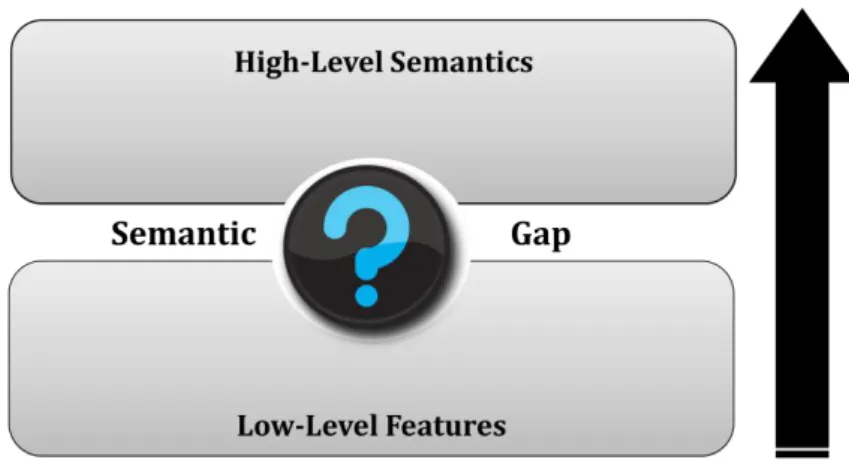
Figure 1.2 Semantic Gap between High-Level-Semantic and
Low-Level-Features 5
Figure 1.3 Broad picture of the semantic gap in multimedia. Mainly two major semantic gaps exists (1) the gap between low-level features and (2) the semantic gap exists between high level extracted concepts and semantically correct retrieval of the multimedia documents.
6
Figure 1.4 [Iskandar 2008] The semantic gap hierarchical representation levels from pixels to semantics, a large semantic gap exist between objects annotation and semantics i.e. how to deduce a high level concepts that what is happening in the image or what is the entire story of the image.
7
Figure 1.5 Images that visually look similar but they are not similar
semantically. 9
Figure 1.6 Longtail problem for multimedia data, the main challenge is how to make available Giga-byte of multimedia document at Head Term position.
13
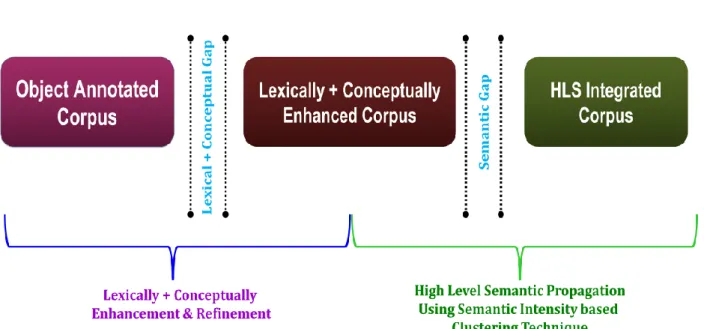
Figure 1.7 Proposed Research Contribution, where Lexical gap, Conceptual gap and semantic gap are tackled as a research contribution.
16
Figure 2.1 An example of RDF graph 33
Figure 2.2 Overview of the MPEG-7 multimedia description schemas 37 Figure 2.3 The training process of the co-occurrence model [Mori, et al
1999]. The keywords annotated to a training image propagated to each rectangular region in the image with equal chances.
43
Figure 2.4 The test process of the co-occurrence model [Mori, et al 1999]. The keyword distributions of all the rectangular regions are aggregated to generate the keyword distribution of the whole image
43
Figure 2.5 The hierarchical aspect model of Barnard and Forsyth
XIII
image belonging to a specific document cluster is generated by all the nodes on the transversing path (see the red arrows in the figure) from the root node to the leaf node.
Figure 2.6 The GCapmodel of [Pan et al. 2004]. The image nodes ( , )
are connected to its region nodes ( ) and textual word nodes
( ). To annotate an un-annotated image ( ), a random walk
starts from . The steady probability of the random walk to
reach a textual word ( ) is taken as the probability of
annotating to .
49
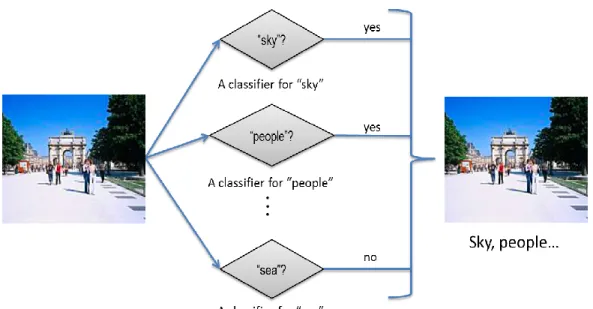
Figure 2.7 An illustration of the image annotation system through image classification. Each concept can have an independent image classifier
52
Figure 2.8 Bags and instances in multiple instances learning (MIL) [30]. A positive bag contains at least one positive instance. A negative bag contains no positive instance. The problem of MIL is classifying new bags given only the positive/negative labels of the training bags, without knowing the label of individual instances in each bag.
57
Figure 2.9 An example part of the concept ontology used by [Yuli, et al.
2006a]. 59
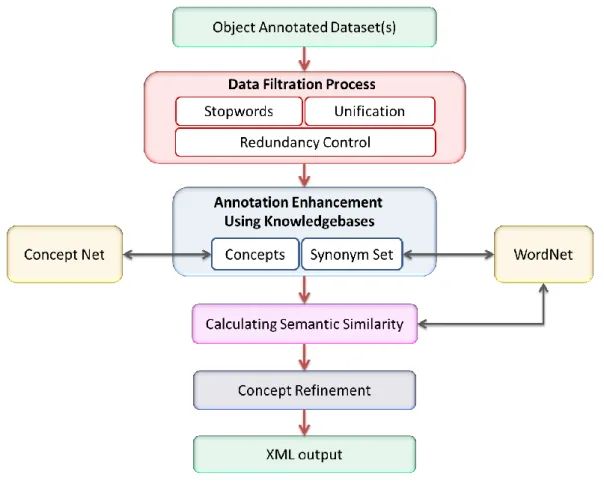
Figure 3.1 A framework for annotation expansion & refinement using
lexical and commonsensical knowledgebases 85
Figure 3.2 Example of synsets and semantic relations in WordNet 92 Figure 3.3 An illustration of a small section of ConceptNet 93 Figure 3.4 In this example LCS of the concepts car and truck is the
vehicle in the given taxonomy. 95
Figure 3.5 The figure [Thanh] shows an example of the hyponym taxonomy in WordNet used for path length similarity measurement, we observe that the length between car and auto is 1, car and truck is 3, car and bicycle is 4, car and fork is 12.
96
Figure 3.6 An example of information content in the WordNet [Yohan et al 2009].
98 Figure 3.7 Shows frequency of objects in the LabelMe Datasets. The
XIV
Figure 3.9 shows the Concept Diversity achieved after annotation enhancement and refinement perform over the LabelMe datasets
111
Figure 3.10 Graph shows the number of tags per image of the 10 sample
images taken from the LabelMe dataset, where T1 and T2
represents the number tags before and after data filtration
process, while T3 shows number of tags after the annotation
enhancement and refinement process.
112
Figure 3.11 Graph shows the Enrichment ratio between the and before/after the processing of the proposed framework
114 Figure 3.12 Graph depicts the overall Enrichment Ratio of the initial tags
and tags after the enhancement. A considerable enhancement occurs in term of enrichability.
115
Figure 3.13 Graph shows the retrieval degree for the original and enhanced annotation performs on the LabelMe datasets. The results are produce by using the Query Engine of the LabelMe.
117
Figure 4.1 Typical comparisons of the human and machine annotation approach. (1) where human experts generates only high-level-semantics, while machine produce both low-level and high-level semantics,(2)the errors occur during the annotation process by human experts are due to their nature while machine produce due to the errors in the algorithm or techniques used. (3) Human experts used similar approach for all domain, while machine is domain dependent, (4) Human experts are costly and time consuming while machine is less time consuming and less costly.
123
Figure 4.2 Proposed model for the high level semantic propagation 129 Figure 4.3 HLS propagation process, where semantic intensity of each
concepts are calculated and then similarity matrix of the images are prepared, cluster are then prepared and then HLS description are assign to each of the images cluster.
129
Figure 4.4 Sample Image taken from LabelMe corpus before/after
Annotation Purification 131
Figure 4.5 The image is taken from the LabelMe dataset. Image depicts a
XV
Figure 4.6 LabelMe web tool for images annotation, where two objects are irrelevant and need to be discarded before processing
133 Figure 4.7 Show snapshot of the web tool of LabelMe, where each
irrelevant and unusual objects and their tag words are removed.
134
Figure 4.8 Snapshot of the annotation file used by the LabelMe web tool
for object edge representation 134
Figure 4.9 Shape of the regular polygon, with side ‘s’, apothem ‘a’ and
circumradius ‘r’.
135
Figure 4.10 Shape of the irregular polygon 135
Figure 4.11 Figure (a) (b) Sample images related to single and
multi-concepts 136
Figure 4.12 Standard Similarity Matrix, the Similarity measures for images close return a value of 1; However dissimilarity measures return a value of 0.
138
Figure 4.13 Standard Similarity Matrix for a set of four images 138 Figure 4.14 The Weighted matrix, it’s not only find the relevant and
irrelevant, but also find the degree of relevancy among the pair of images.
139
Figure 4.15 Weighted Matrix for the four images 139
Figure 4.16 Image similarity measure on the basis of annotation. 141 Figure 4.17 Hypergraph vs. simple graph. (a) Tabular representation,
where set E = {e1; e2; e3} and an images set V = {v1; v2; v3; v4; v5; v6; v7}. (b) An undirected graph in which two images are joined together by an edge if there is at least one feature in common. (c) A hypergraph which completely illustrates the complex relationships among images.
145
Figure 4.18 The clustering of the common features among the images, where edges of the vertices (images) that share the common concepts are grouped into one cluster using the hypergraph hMETIS [Karypis et al. 1996] algorithm.
XVI
Figure 4.20 The example for the images similarity and clustering set
mechanism among the four images set (A, B, C, D, E, F) 149
Figure 4.21 XML format of the image similarity annotation handling 149 Figure 4.22 Example of the HSL annotation on Full Similar (FS) and
Partial Similar (PS) sets 151
Figure 4.23 Precision and recall in term of HLS description for the FS set
of 10 sample images. 153
Figure 4.24 Precision and recall in term of HLS description for the PS set
of 10 sample images. 155
Figure 5.1 Video retrieval system framework [Snoek et al., 2007] 159 Figure 5.2 Syntactic and semantic structure of video [Magalhaes et al.
2007]
161
Figure 5.3 Video annotation model 165
Figure 5.4 Shows the comparison of LabelMe video corpus in terms of Concept Diversity achieves before/after the process of the proposed framework.
173
Figure 5.5 Shows the number of tags per video of the 10 sample randomly selected videos taken from the LabelMe video dataset, where T1 and T2 represents the number tags before and after data filtration process, while T3 shows number of tags after the annotation enhancement and refinement phase.
174
Figure 5.6 Graph shows the Enrichment ration between the E1 and E2
before/after the processing of the proposed framework 176
Figure 5.7 Shows the Enrichment ratio for the LabelMe video dataset. 177 Figure 5.8 Precision recall curve for the top 10 queries result on the
XVII
Table 3.1 Semantic Measure between the concepts using JNC
Measure 102
Table 3.2 Result of the Proposed Framework for the sample two
images. 104
Table 3.3 Summary of datasets used for object detection and recognition research and suitable for this research work.
XVIII
CBIR Content Based Image Retrieval
HLS High Level Semantic
EXIF Exchangeable image file format
GPS Global Positioning System
XML Extensible Mark-up Language
RDF Resource Description Framework
MPEG Moving Picture Experts Group COMM Core Ontology for Multimedia
VIA Video Image Annotation
LSCOM Large-Scale Concept Ontology for Multimedia
SI Semantic Intensity
TBIR Text-Based Image Retrieval
Chapter 01 - Introduction
Introduction
“Logic will get you from A to B, Imagination will take you everywhere” Albert Einstein
2
Annotation is a methodology for adding information to a multimedia document at some level—a word or phrase, paragraph or section or the entire document. This information is called “metadata,” that is, data about other data. The difference between annotation and other forms of metadata is that an annotation is grounded to a specific point in a multimedia document. For example, one might consider a folder name on a computer as metadata for the files in that folder. So, a folder labelled “holiday 2010” might hold files of photographs taken on holiday. The folder name is a form of metadata. But, when an image file is taken out of the folder, it becomes separated from that metadata and thus loses some valuable context. Thus, the data that stays with the image and that describe the entire contents of the image is called annotation. The task of content annotation is to enrich the audio-visual content metadata and data that describes the content. Content analysis can thus be seen as reversing the authoring process, during which an audio-visual material is created based on information about the content to be produced.
Images taken from digital cameras, for example, are rarely annotated by consumers. Images are usually automatically recorded in meaningless alphanumeric filenames. Many people attempt to manage their digital images by annotating them manually, which is very time consuming and often subject to individual interpretation. As a simple solution, the images are archived in file system folders according to their semantics such as an event, a venue and a person of interest. But in reality, users need assistance for finding their way in this overload of digital information. Today’s search engines have achieved satisfying quality for textual information, but not for multimedia. The reason is that “a word is easily identifiable in a text and is usually associated with a concept at the level of human communication. An automatically identifiable feature of an image, such as a colour distribution, does not provide a retrieval system with a concept that is equally useful for user interrogation” [Ribeiro et al 2001] and is therefore not practical for indexing as is required by search engines. The available, searchable information for multimedia (such as filename or perhaps title, author and file format) is seldom sufficient for achieving pleasing search results. For effective retrieval, the semantic annotation of the still and moving images or visual resources is the central topic of this thesis.
3
The rest of the chapter is organized as follows. In the next section, we introduce the existing trends in the market in term of multimedia and in broad sense the problem faced by the research community in dealing such type of data. In section 1.2, we focus on the motivation and application of this research, which is further discuss in detail as a research aims and objectives in section 1.3. In section 1.4, the existing problem and challenges are discussed, while section 1.5 covers the research direction. 1.6 focuses on the research contribution of this thesis and finally, the chapter is concluded with an outline of the thesis in section 1.7.
1.1
Introduction
In early 1960, the first computer-based use of multimedia data was developed, which tried to unite the images and text in a document. Subsequently, more and more continuous media, e.g., audio, animations, and video, were incorporated in multimedia systems. Nowadays, most people refer to multimedia as the idea of combining different media sources into one application [Lawrence et al 2004], such as broadcast news video that uses text, images, and audio to describe the progress of news events. Interest in the production and potential of digital data has increased greatly in the past decade, also the storage costs have dropped to the point where user need hours, not minutes, of high-quality video to fill a standard hard disk. Digital data both images and videos are produced by a variety of devices such as digital cameras, camcorder, scanners, co-ordinate measuring machines, airborne radars and digital synthesizers. Digital data can also be created and modified by using multimedia editing software. The comprehensive use of digital technologies causes production of millions of images and videos daily. Adding to this, the growing amount of legitimate content from companies such as Apple Computer, Flickers, YouTube, and Google Video, and the scale of consumers demand for video begins to emerge as shown in the Figure 1.1 the increase in the digital contents and their technology in the past 5 years. However, if all these digital data are not manageable and approachable by general users, they will come to be much less useful in practice. This statement has been reflected in one of the SIGMM grand challenges [Lawrence et al 2004]:
“Making capturing, storing, finding and using digital media an everyday occurrence in our computing environment”.
4
Figure 1.1: Data Production Exponential rate [John et al. 2008] Amount of Digital Information Created and Replicated each year.
The alternative and most appropriate solution is the development and production of metadata which is an additional data, often in textual form, attached to multimedia or other resources for the purpose of describing them and has been identified as a way to compensate limited searchability. Once it has been established for a multimedia, search engines can index the given descriptions in the same way they index textual documents. Thereby, search for multimedia on a higher, conceptual level is enabled. There is a major problem of how to produce metadata for multimedia. Only so-called low-level features like predominant colour or shape can automatically be extracted and then translated into metadata. High-level, conceptual features of multimedia, such as topics of a discussion, story line of a movie, or entire semantic of the image or video cannot be recognized in a reliable way by computers. Those features need yet to be extracted and annotated either by human experts, computer or using hybrid approach of human and computer.
5
Human beings have the capability to interpret images at various levels, for example, by the colour and texture, objects, proper nouns and emotions. The interpretations can be represented in high-level semantics such as “sad”, “husband” and “president”. The only way a machine is able to interpret images is through examples of visual image feature descriptors or low level image features that represent colour, shape and texture in numerical format. This in turn, introduces an interpretation inconsistency between image descriptors and high-level semantics as shown in the Figure 1.2 and is known as semantic gap [Santini et al 1998, Smeulders et al 2000], which is defined as follows:
“The semantic gap is the lack of coincidence between the information that one can extract from the visual data and the interpretation that the same data have for a user in a given situation”
Figure 1.2: Semantic Gap between High-Level-Semantic and Low-Level-Features
This is due to the fact that the visual image feature descriptors extracted from an image cannot (as yet) be automatically translated reliably into high-level semantics [Datta et al 2008]. The broad spectrum of the semantic gap in multimedia is presented in Figure 1.3, the focus of this thesis in broad sense is to bridge the semantic gap between the low-level features and high level semantic concept extractions. This problem is further elaborated in Figure 1.4, which shows the semantic gap hierarchical representation levels from pixels to semantically correct concept extraction. A large semantic gap exist between objects annotation and semantics i.e. how to deduce a high level concepts that what is happening in
6
the image or what is the entire story of the image or multimedia in general and this is the main focus of this dissertation.
Figure 1.3: Broad picture of the semantic gap in multimedia. Mainly two major semantic gaps exists (1) the gap between low-level features and (2) the semantic gap exists between high level extracted concepts and semantically correct retrieval of the multimedia documents.
7
Figure 1.4: [Iskandar 2008] The semantic gap hierarchical representation levels from pixels to semantics, a large semantic gap exist between objects annotation and semantics i.e. how to deduce a high level concepts that what is happening in the image or what is the entire story of the image.
The emphasis of this dissertation is the semantic description, understanding, and modelling of multimedia. The goal is to reduce the semantic gap between the multimedia understanding of the human and the computer by developing a multimedia representation that allows describing them. The work focuses especially on the semantics multimedia interpretation and modelling for annotation. Recently often used in the context of content-based multimedia description, semantics is actually an area in linguistics that deals with the
8
sense and the meaning of language and the question how to deduce the meaning of complex concepts from the meaning of simple concepts. Because of the linguistic background, for us, semantic description implies verbal description, and we thus aim for a description of multimedia based on keywords. The main idea is to extents the simple object annotated datasets of the multimedia by using knowledgebase that not only supports in understanding the multimedia contents semantically but also extends and verify the already extracted concepts.
1.2
Motivation and Application
Research on multimedia annotation is mainly motivated by people’s increasing needs for handling large set of multimedia. With the large amount of multimedia data available favoured by cheaper and cheaper digital imaging and digital storage devices, there is an urgent need for an efficient management, indexing and retrieval system. Early image retrieval systems relied on keyword annotation and can be dated back to 1970’s as suggested by Chang [Chang et al 1992]. In such approaches, images are first manually annotated with textual keywords. As long as the annotation is accurate and complete, keywords can provide an accurate representation of the semantics of images. However, manually annotating images requires a large amount of human labour, and prone to error as different people can give or inconsistent annotations to the same images. Although it is possible to annotate web images by their associated texts, such as titles, captions, URL’s and surrounding texts, these annotations are still very noisy and they are not applicable to non-web images.
To overcome the above difficulties, an alternative scheme, content-based image retrieval (CBIR) was proposed in the early 1990’s by Huang et al. [Arnold et al 2000]. In these CBIR systems, various low-level visual features are extracted from a dataset and stored as image index. A query is an image example that is indexed by its features, and retrieved images are ranked with respect to their similarity to this query index. Given that indices are directly derived from the image content, this process requires no semantic labelling. Its advantage over the keyword-based image retrieval is that the feature extraction can be performed automatically and the image’s own content is always consistent. However, despite a great deal of work in CBIR, its performance is far from satisfactory due to the semantic gap between visual features and symbolic concepts. That is, images of different semantic content
9
may share some common low-level visual features, whereas images of the same semantic content may be scattered in the feature space, as an example shown in Figure 1.5. Although, today research in the field of low-level features for detecting and recognizing the objects in the images are most mature and there a lot of system available that can do this without human intervention. But in case of high level semantic there is a need to bridge the semantic gap between object annotations to semantic representation of the multimedia.
Figure 1.5: Images that visually looks similar but not semantically similar.
In order to narrow down or bridge this semantic gap, a large number of works has been done on semantic multimedia annotation using with or without knowledgebase. Also a lot of work has been done on the automatic annotation of multimedia, with the aim of allowing annotating with a minimal human assistance. The motivation of this dissertation is to bridge the semantic gap between object annotations and semantically representation of the multimedia by using knowledgebases and device a framework that not only provide semantic representation of the multimedia in specific domain but also work for general multimedia.
The intended audience for this specific research comprises most of the companies that acquire
1) Helps in managing the multimedia data effectively and efficiently.
2) Helps in searching and retrieving the particular piece of information from the large dump of information. It makes media search and retrieval easy.
10 3) Helps in managing the security data CCTV.
4) Content Owners -- Production companies like BBC, CNN, Geo news etc. 5) TV Service Providers -- Satellite & Cable companies
6) Electronics Manufacturers -- Mobile, DVRs, Digital media players 7) Internet Protocol TV software developers like Microsoft and Virage. 8) Content-Service Providers
9) Content monitoring companies which provide push and pull services 10)Web-Content aggregators
11)Companies that aggregate digital media like Google, Yahoo, YouTube, Flickers etc. 12)Content-repackaging companies
13)Companies that acquire content like sports videos and TV programs and repackage it according to user needs
1.3
Research Aims and Objectives
In general the aim of this work is to investigate promising approaches to extract high level semantic from the multimedia object annotated datasets with the help of knowledgebases, by either utilising or modifying different existing techniques or device a novel framework for the same. The object annotation of a multimedia consists of one or more textual keywords, each describing some specific semantic concept, such as “sky, sunset, tree, people, beach”. Despite many efforts by researchers in the last decade, this objective has remained, for the most part, unsolved. Although reasonably successful attempts have been made for some special concepts, such as human faces and people, no satisfactory methods exist that work well with high level semantic concepts in general.
The mainly objective is to focus on exploring the techniques for semantic concept extraction i.e. high level semantic annotation with the help of knowledgebases that can be applied for both images and videos and can be extend to other domain as well by integrating
11
a domain specific knowledgebase. Semantic concepts related to the multimedia are the main requirements to show that the indexing method is feasible; that is to support the search and retrieval with high accuracy.
More specifically, the objectives of the research project are as follows: 1) To solve the problem of high level semantic annotation
a) To address the issue in semantic annotation and the related work.
b) To investigate various techniques developed and used for semantic annotation and multimedia datasets indexing.
2) To explore the different knowledgebases and select suitable one that can support the annotation from mid-level to high-level semantics.
3) To formulate a framework for annotation at high level of semantics and develop a system based on this framework.
a) To develop a suitable algorithm for high level semantic extraction, knowledgebases utilization and indexing.
b) To design and develop an automatic system that extends the semantic space of the existence annotation.
c) The existing work can easily be integrated to domain specific by integrating the domain knowledgebase.
d) To conduct a set of evaluation with different evaluation parameters that can signify the strength of this research proposed.
1.4
The Existing Problems and Challenges
Annotation and retrieval of multimedia data has, without a doubt, received much attention in the last decade, both from a research and a commercial viewpoint. The amount of data that exists and continues to be created is unfathomable, to the point where the data starts to lose its intrinsic value. What good is data if the valid information and meaning that it
12
contains cannot be extracted? A digital camera, for example, allows a person to save thousands of pictures on a hard drive while a digital camcorder eats gigabytes of space to store hours upon hours of footage. If that was not enough, digital audio compression has turned computers into super jukeboxes. As exciting as these applications are, it is becoming increasingly evident that maintaining all this digital data is becoming a daunting task. Thousands of pictures on a hard drive become useless if we cannot find a specific image or a group of images in which we are interested. If we cannot find scenes of interest in video footage, it too loses its value as do music files if specific songs or music genres cannot be found. This problem is reflected in Figure 1.6 in the Longtail scenario, where a few gigabytes of images get search hits from most of the search engines, while thousand gigabytes of images get few search hits and millions gigabytes of images are either gets during achieving process or from the owner who knows the exact name or related information of the images. Thus we are beginning to be more concerned with what to do with digital data rather than how to create it.
These new consumer demands have bolstered research that aims to use computers and machine understanding to analyze digital data to extract useful meaning. This has given birth to the flourishing area of multimedia annotation.
13
Figure 1.6: Longtail problem for multimedia data, the main challenge is how to make available Giga-byte of multimedia document at Head Term position.
The application of signal processing and computer vision methodologies to images, video, and audio to extract information has initially been done at a low level (e.g., find specific colors or textures in an image). Such features, however, do not contain any meaning of the underlying content. For example, it would prove quite attractive to consumers if they could retrieve all the pictures that contain the Eiffel Tower from their large personal image database or if they could record a soccer game and automatically play back only the highlights. Further applications could automatically sort their digital audio collection into different genres or play back only the action scenes of a DVD movie. In other words, there exists more appeal and versatility in being able to retrieve multimedia data based on semantic meaning: high-level concepts that relate to language and logic. The ubiquitous nature of multimedia data, the push for manufacturers to create new products and applications, and the improvement in accessibility and speed of computing devices has caused an increase in research and development in the area of semantic annotation of multimedia.
14
1.5
Research Directions
Many advances have been made in various aspects of multimedia annotation, including visual content extraction, multi-dimension indexing and system design. However, we are still far away from a complete solution for semantic multimedia annotation because there are still many research directions and issues that need to be solved. These include:
1.5.1
High-Level Semantic Concepts and Low-Level Visual Features
Human tends to use high-level semantic concepts in daily life. However, what current computer vision techniques can automatically extract from image are mostly low level features. We have seen that in some constrained applications, such as human face and fingerprint, it is possible to link low level features to high-level semantics (face or finger print). In a general setting, however, the low-level features do not have direct links to high level semantics. To narrow down this semantic gap, some off-line processing can be performed to extract some level of semantics by using either supervised/unsupervised techniques or using some external knowledgebases/ontologies that fill the gap between mid-level and high-mid-level semantics because the knowledgebases/ontologies provide inter-relationship between objects and upsurge the exactitude in the semantics at high level.
1.5.2
Variation of Objects in the Multimedia
There is a large amount of variation in the object annotation of each specific concept. It is worth noting that multimedia object annotation can be thought of as being even more challenging than object recognition because of the diversity of concepts existing in the vocabulary. All the challenges existing in object recognition also exist in annotation. These include viewpoint change of object, background clutter, intra-class variation, occlusion and illumination changes.
1.5.3
Concept Gap and Vocabulary Size
There are large semantic gaps. Some concepts, such as “yellow”, “sport” and “car”, are not traditional object concepts, while these properties are mostly annotated by the human experts and their visual appearance is not well-defined or sketched. Learning a direct link from these concepts to semantics is challenging if not possible. Similarly the size of tag
15
vocabulary can be having varied size. The aim of semantic multimedia annotation is to describe the entire semantics of still and/or moving images using a set of textual keywords. Since any word in any language is qualified to be annotated to an image, the possible vocabulary size is nearly unlimited. This greatly increases the complexity of the annotation systems.
1.5.4
Diverse Nature of the Bench Mark Datasets
The availability of datasets and their annotation standard is another core challenge. The datasets like Coral, TRECVID, LabelMe are developed by keeping different aspects of the annotations in mind. This increase the complexity in firming a flexible system for all types of datasets.
1.5.5
Semantic Reasoning Tools
There are a few semantic reasoning knowledgebases available for annotation. A successful reasoner system for semantic annotation relies on the nodes representing concepts and their inter relationship present in the knowledgebases. However, it is hard to take advantage from more than one knowledgebase. The difficulties lie not only in the interpretation, but also different knowledgebases provide interfacing API for different tools, it’s rigid to implement them on one platform.
1.6
Proposed Research Contribution
In the light of the above mentioned problems, we propose a semantic multimedia modelling and interpretation framework that can offers a semantic accuracy in terms of annotation at high level. The main aim of this dissertation is to propose a novel framework for annotation of the multimedia data semantically. It is in this scope that we try to solve one of the most challenging issues of the semantic multimedia annotation i.e. the semantic gap. The research contribution are layout in the Figure 1.7 that address two main elements: Lexically and Conceptually Annotation Enhancement and Refinement for the images datasets, High Level Semantic propagation using Semantic Intensity based images clustering technique, while we have extends these approaches for video as well as a third element of the research contribution. Most of the previous work emphasises on low-level primitive features
16
of the multimedia. With this approach we try to investigate a way to explore what is the possible way that can enlarge the semantic space of the images and videos by utilizing the existing annotation sets. We have substantially reduced the semantic gap and achieve a noticeable improvement retrieval degree, concept diversity and enrichment ratio.
Figure 1.7: Proposed Research Contribution, where Lexical gap, Conceptual gap and semantic gap are tackle as a research contribution.
1.6.1
A Framework for Annotation Expansion and Refinement for Images
Dataset
Semantic annotation has become the very important and active research area in the multimedia community. Semantically enriched multimedia information is crucial for equipping the kind of multimedia search potentials that professional searchers need, while on the other side the expansion growth of multimedia (images and video) data online has the potential to encourage more erudite and vigorous models and algorithms to systematize, index, retrieve multimedia and the like corpus. On the contrary, inclusively how much data can be hitched and systematized remains a critical problem, also the semantic interpretation of multimedia is obsolete without some mechanism for understanding semantic content that is not explicitly available. However, Manual annotation is the exclusive source to
17
overwhelming this, which is not only time consuming and costly but also lacks semantic enrichment in terms of concept diversity and concept enrichability as well.
We have proposed semantically enhanced information extraction model that enhances the tagged concept lexically and commonsensically by using the WordNet and ConceptNet by increasing the semantic space for each of the image in the corpus. By doing this a lot of noises, redundant and unusual keywords are generated, which are then filtered out by applying various techniques like semantic similarity, stopwords and words unification.
1.6.2
High Level Semantic Propagation
Multimedia annotation data plays an important role in the future annotation-driven multimedia system. The basic intention of proposed High Level Semantic Propagation is to investigate a mechanism for the ease of manual annotation to a large pool of objects annotated images datasets, where images are clustered based on the annotation and the concept intensity and assigning high level semantic description to them. The research contribution under this head intent to equip the high level semantic annotation for images, and consequently, contributes to 1) calculating concept intensity of each concept in the annotation set of the image depicting the dominancy factor, (2) image similarity on the bases on metadata tag with the images, and (3) image classification and categorization on the basis of their image similarity while high level semantics are then propagate through the image corpus with their calculated similarity values.
1.6.3
Annotation Enhancement and Refinement for Video corpus
Semantic annotation for video is a key to semantic-level video browsing, search and navigation. The research on this topic evolved through three models. The first model applies the binary classification approaches to identify each individual concept in a concept set. It accomplished only limited success, as it did not exhibit the inherent correlation between concepts, e.g., urban and building. The second model added a second step on top of the individual-concept detectors to amalgamate multiple concepts. However, its performance diverges since the errors aroused in the first detection step can propagate to the second fusion step and therefore, degrade the overall performance. The third paradigm focuses on the ontological approach, where a visual knowledge is used to detect concepts and the
18
relationship among them provide an opportunity to inference semantically. As this method depends on rules that are created by domain experts and is suitable for specific domain and is suffer from experts personal knowledge as well. To address the above issues, we propose a forth paradigm which is the extension of the third paradigm from domain specific to general and is based on the concept of text mining approaches where the raw annotated structure of the video are expanded lexically and commonsensically through knowledgebases (i.e. WordNet, ConceptNet). We compare the performance between our proposed approach with the base line ground truth on the widely used LabelMe videos. We report superior performance from the proposed approach.
A detailed discussion on all these contribution has found in the forth coming chapter 3, 4 and 5.
1.7
Organization of the Thesis
The thesis is organized in the following manner.
In Chapter 2, an extensive discussion on the up-to-date achievements concerning the components of Image and video annotation is provided. The main aim of this chapter is to survey the state-of-the-art in the respective field. This includes general images annotation overview along with the overview of the video annotation. The discussion is leading from fundamental concepts to the high-level of semantics, starting from the annotation, its characteristics, standard for multimedia annotation and its type are discussed and then a comprehensive discussion on the multimedia annotation is presented. The discussion about the multimedia annotation is sub-sectioned into three categories i.e. manual, automatic and semi-automatic annotation. Adding to this the temporal based annotation for video is discussed separately. Moreover, comprehensive survey on ontology and knowledgebases based annotation for images and videos are presented. Finally the evaluation measures are discussed and the chapter concluded with summary.
In Chapter 3, a proposed framework for the annotation enhancement and refinement using object annotated datasets is presented. The chapter also explored the recent work in the area of multimedia annotation along with their pros and cons. The efficiency of the proposed system is tested in terms concept diversity, enrichment ratio and retrieval degree. The
19
experiments were performed on open source image dataset (LabelMe) to prove the semantic accuracy of the proposed system.
In Chapter 4, a semiautomatic way for the high level semantic propagation through the images corpus is presented. The work is support by the brief discussion on the state-of-the-art in the respective area. While a new term Semantic Intensity (SI) which depicts the concept dominancy in the image were introduced. The experimental work is performed on the enhanced version from the previous work of the LabelMe datasets, which is a trusted object annotated datasets and a noticeable improvement is achieved in the term of precision and recall.
In Chapter 5, the proposed framework for the annotation enhancement and refinement is extended to video domain. The chapter covers video structure and their representation for the annotation followed by the state-of-the-art of for video annotation and refinement. At the evaluation, the proposed work is evaluated on the LabelMe videos datasets. Results reported to verify the effectiveness of the proposed model.
Finally, in chapter 6 we conclude with a summary of achievements and the future work are discussed. Chapter 6 is followed by appendices and references.
The appendices contain the source code and implementation description of the proposed contributions.
It is to be noted that all the main chapters are presented with a self-contained set of introduction, main concepts, experimental results, and conclusion.
Chapter 02 -
Fundamental Concept &
Literature Review
Fundamental Concept & Literature
Review
“Never express yourself more clearly than you are able to think” Niels Henrik David Bohr
22
The technological revolution and achievement at present in the field of multimedia was a fantasy a few decades ago. With the advent of wide variety of multimedia enable and/or capturing devices allow an opportunity to anyone to act like a professional and capture photos or even record the event. On other side, the day by day decreases in the cost of the storage devices provide an opportunity to everyone to store photos or recorded events for later use. These progressions persist at an incredible velocity for a commercial purpose multimedia production and consumption as well. The TV and news broadcast channels, social media application like Facebook or video content provider like YouTube, Dailymotion and the like fueling this on daily basis. All these advances yet bought up with a new demand of effective multimedia data management and retrieval.
Today, the retrieval system has achieved the users need for the textual data but for the multimedia data like images and videos it‟s still at the infancy stage. The reason is that “a word is easily identifiable in a text and is usually associated with a concept at the level of human communication. An automatically identifiable feature of an image, such as a color distribution, does not provide a retrieval system with a concept that is equally useful for user interrogation” [Ribeiro et al. 2001] and is therefore, not practical for indexing as is required by search engines. There is a strong need to establish the metadata at an intelligent way that not only describe the image properties, but depicts the entire content of the multimedia as well.
In the past, metadata was often neglected and treated as a second-class citizen. However, once the computer era emerged and people started using computers to store their data, the need for techniques to retrieve these data from computers was established. Since then the metadata concept has evolved in the computer science paradigm, starting from the simple file systems (file names and types) in the early 60s, then database management systems (to describe database fields) in the early 70s, until the 21st century with the advent of the concept of metadata warehouses [Arun, 2004]. Metadata is more important for files in the Web or on a computer which is more abstract and need to be
23
opened to reveal their contents [Milstead et al 1999]. This is especially true for multimedia files.
Multimedia objects/files are data. Basically, there are two ways to represent them. “The representations of data closer to the sensor level are commonly called low level, and the symbolic levels, high-level.” [Jain, 1994], Features of audiovisual content follow this classification. Low-level features like for instance, hue, saturation and brightness for visual or energy and volume for audio information can be derived automatically from content. High-level features describe the content conceptually on a higher abstraction level and capture the content‟s semantics. [Mojsilovic, 2001] confirm that “High-level semantic concepts play a large role in the way we perceive images …” Also, “Users typically do not think in terms of low-level features, i.e., user queries are typically semantic (e.g., “show me a sunset image”) and not low-level (e.g., “show me a predominantly red and orange image”)” [Vailaya et al., 2001] when querying for multimedia.
Therefore, it is desirable to facilitate retrieval of multimedia based on semantic descriptions rather than on low-level features [Lindley et al, 1998; Mojsilovic et al, 2002; Zhou et al, 2000; Martinez et al, 2000]. The problem is “that only low-level features (as opposed to higher level features such as objects and their inter-relationships) can be reliably extracted from images [and videos]. For example, color histograms are easily extracted from color images, but the presence of sky, trees, buildings, people, etc., cannot be reliably detected.” [Vailaya et al., 2001]
In a nutshell, metadata constitutes an appealing way to store semantic descriptions and provides a number of “attractive potential uses: semantic searching, indexing, retrieval and filtering of multimedia databases; image understanding for intelligent vision and surveillance; and conversion between media (speech to text etc.)” [Page et al., 2001] in the multimedia area. Furthermore, the concept has been tried and refined since it has first been used in a library for books; in case of multimedia the same concept is called Annotation, which is data about multimedia [images and/or video].
24
This chapter reviews basic concepts and relevant literature on metadata, annotation and their techniques for representation of the multimedia semantically. Semantic annotation consists on representing objects, concepts and events inside the multimedia. In section 2.1, we present the fundamental and related concepts with the annotation. Adding to this, the standards for the multimedia annotation and its type are the part of this section is discussed in section 2.2 and 2.3 respectively. The method of annotation of multimedia are discussed in the section 2.4, where the annotation process are further sub-sectioned into manual, automatic and semi-automatic, while discussion about the video temporal annotation is covered in section 2.5. The ontological and knowledgebases integration for multimedia annotation are covered in section 2.6, while the section 2.7 is focus on the refining scheme for multimedia annotation. The evaluation measures are discussed in section 2.8, while the chapter summary is presented in section 2.9.
2.1
Fundamental Concepts
In this section, we will discuss some of the fundamental concepts related to our research starting from the basic to a higher level.
2.1.1
Characteristics of Multimedia for Annotations
Digital media types can be divided based on the modality they stimulate. There are two distinctive classes of media types based on this division: temporal and static media. The characteristic of temporal media is the time dimension, which static media do not possess. Examples of static types of media are images and graphics. Temporal media can be audio, animations, plain video and audiovisual presentations (e.g. movies). Multimedia is a special type of data, which refers to a collection of media types used together. In this context, we relate to multimedia representations and multimedia objects, referring to a multimedia data to which a specific meaning has been added. Annotating temporal media varies from annotating static media.
25
In case of static media, objects can be decomposed into smaller entities which characterize them. These derived characteristics are called features and can be described through annotations. Media content features shape the document, and define the modalities they activate. Features come in many forms, and they are usually divided between high-level and low-level features. Low-level features include data patterns and statistics of media content and depend strongly on the content type. Low-level feature extraction can be done computationally by automated processes. From images, we can extract statistics on the pixel values, creating color histograms that can be used to classify images. Videos are sequences of images, thus they will share common features. Furthermore with video we can automatically classify the image sequences using also the time dimension. High-level features bear more meaningful information than the low-level ones. From a color histogram, it is hard to derive meaningful information on the image; for example a green image may indicate to a forest landscape, or to a golf course. High level features represent high level concepts that are meaningful only to humans. The gap between high and low level representations is called the semantic gap. Deriving meaningful concepts from low-level features of non-speech audio and video in general level is not possible, but focusing to a specific application domain improves possibilities to succeed [Ranguelova, et al 2007]. In some occasions it is difficult to label a feature as low- or high-level. Frequently in complex classification the term mid-level feature is used. The derivation of the characteristics of media objects is called feature extraction [Ranguelova, et al 2007]. This process of feature extraction forms a basis for making annotations.
A temporal media can be thought as a sequence of static media objects, thus one could think that its annotation would involve annotating each media object of the sequence one by one. Fortunately, this is not the usual case: changes in the high-level features of the content are relatively slow and thus making annotating necessary for only certain events of interest. With low-level features, annotating can be performed automatically, thus annotating each object in the sequence is not a problem. There are two main methodologies to temporal media annotation scheme: stratified and segmented. Segmented is the simplest traditional way of doing it: the idea is to partition the media
26
object into consecutive temporal segments and describe each segment. Commonly, this scheme has been extended to permit grouping kindred segments together, producing a hierarchical multilevel segmentation. Traditional structure of scenes and shots corresponds well to this kind of segmentation. Stratification is a context-based approach to modeling video content. It permits any subsequence of video frames to be modeled as rich multi-layered descriptions that can be easily parsed to support a wide range of applications [Chua et al. 2002]. Ultimately the annotations are organized to form a data structure (i.e. index), which is also referred to as indexing.
2.1.2
Multimedia Annotation
People seem to use very little time to annotate their personal images. How many amateur photographers are determined enough and have enough time and energy to go through developed pictures, and put them into albums, instead of just sticking the pictures in a shoebox? How many people go through their digital photos and give each one a unique file name in an appropriate directory instead of leaving them in the default directory created by the camera software? Not many [Brown et al 2001]. As a result, more and more people have thousands of digital photos with little or no organization, and they are resigned to gaining no more benefit or enjoyment from them than the photos stored in overfilled shoeboxes around the house. Well-performed annotation has the power to transform this almost random collection of images into a powerful, searchable and rich record of events in people‟s lives [Jack. et al 2005].
There are two types of information related with a multimedia, which can be either image or video: Structured information about the object, called its metadata, and information contained within the object, called its visual features. Metadata is information connected to the object and can consist of digits and letters that are also referred to as text. It can also consist of sounds sketches or drawings. Visual features are usually automatically extracted from the image. These features are usually size, color, shapes and sketches [Gupta et al 1997].
![Figure 1.1: Data Production Exponential rate [John et al. 2008] Amount of Digital Information Created and Replicated each year](https://thumb-us.123doks.com/thumbv2/123dok_us/9213702.2805455/22.892.162.730.151.633/figure-data-production-exponential-digital-information-created-replicated.webp)


![Figure 2.6: The GCapmodel of [Pan et al. 2004]. The image nodes ( , ) are connected to its region nodes ( ) and textual word nodes ( )](https://thumb-us.123doks.com/thumbv2/123dok_us/9213702.2805455/68.918.209.725.632.1010/figure-gcapmodel-image-nodes-connected-region-nodes-textual.webp)
![Figure 2.9: An example part of the concept ontology used by [Yuli, et al. 2006a].](https://thumb-us.123doks.com/thumbv2/123dok_us/9213702.2805455/78.918.226.709.758.972/figure-example-concept-ontology-used-yuli-et-al.webp)