(will be inserted by the editor)
WW1LOD - An application of CIDOC-CRM to World War 1
Linked Data
Eetu Mäkelä · Juha Törnroos · Thea Lindquist · Eero Hyvönen
the date of receipt and acceptance should be inserted later
Abstract The CIDOC-CRM standard indicates that common events, actors, places and timeframes are im-portant in linking together cultural material, and pro-vides a framework for describing them. However, merely describing entities in this way in two datasets does not yet interlink them. To do that, the identities of in-stances still need to be either reconciled, or be based on a shared vocabulary.
The WW1LOD dataset presented in this paper was created to facilitate both of these approaches for collec-tions dealing with the First World War. For this pur-pose, the dataset includes events, places, agents, times, keywords, and themes related to the war, based on over ten different authoritative data sources from providers such as the Imperial War Museum. The content is har-monized into RDF, and published as a Linked Open Data service.
While generally basing on CIDOC-CRM, some mod-eling choices used also deviate from it where our expe-rience dictated such. In the article, these deviations are discussed in the hope that they may serve as examples where CIDOC-CRM itself may warrant further exami-nation.
As a demonstration of use, the dataset and online service have been used to create a contextual reader application that is able link together and pull in infor-mation related to WW1 from e.g. 1914–1918 Online, Wikipedia, WW1 Discovery, Europeana and the Digi-tal Public Library of America.
E. Mäkelä·J. Törnroos·E. Hyvönen Aalto University, Finland
E-mail: [email protected] T. Lindquist
University of Colorado Boulder, USA E-mail: [email protected]
Keywords applying CIDOC-CRM · linked data · modeling·historical data·dataset ·data interlinking
1 Introduction
Interest in the First World War (WW1) is high due to its centenary anniversary (2014–2018). In recent years, a spate of projects have been launched to publish re-lated content on the web, such as Europeana Collec-tions 1914–19181, 1914–1918 Online2, WW1 Discov-ery3, Out of the Trenches4, CENDARI5, and Muninn6. The confluence of interest and content exposed as Linked Open Data in this historical domain provides an unprecedented opportunity to bind together and enrich the user experience with cultural heritage collections.
The WW1LOD dataset presented in this paper is an application of the CIDOC-CRM and other established ontologies to create a Linked Data reference dataset of historical places, people, and events related to the First World War. It is one of only a handful of existing ap-plication descriptions of CIDOC [3, 2, 14] that can give insight into how the standard is able to cover material of different types.
The purpose of this dataset is to act as a controlled vocabulary or reference authority linking together dis-parate historical collections and data publications re-lated to WW1. It is additionally structured to provide common points of entry into such collections, resulting in improved access to and context for them.
1 http://www.europeana-collections-1914-1918.eu/ 2 http://www.1914-1918-online.net/ 3 http://ww1.discovery.ac.uk/ 4 http://www.canadiana.ca/en/pcdhn-lod 5 http://www.cendari.eu/about-cendari 6 http://blog.muninn-project.org/
In this article, the reasons for creating the dataset and major technological choices made are presented first. Section 3 then describes the contents of the dataset, while section 4 discusses how the ontologies selected were applied to model that data. Access to the dataset is outlined in section 5. Next, related work and projects are discussed and application examples are given in sections 6 and 7, respectively. In conclusion, the contributions made by this work and directions for future research are summarized.
2 Reasons for Creating the Dataset
The impetus for creating a Linked Data reference dataset in the WW1 domain sprang from user needs re-search undertaken at the University of Colorado Boul-der (CU) to improve the user experience in working with digitized collections of historical primary sources (that is, documents contemporary to, or reported by those who experienced the historical events under study).
To better understand the problems humanities searchers encounter in utilizing these collections, re-searchers conducted 21 semi-structured interviews with CU faculty and students [15]. The major user needs identified were better support for: 1) locating docu-ments and data relevant to a particular topic within distributed online collections; and 2) contextualizing the content, for instance, to gauge author bias or sim-ply become familiar with the places, events, and peo-ple mentioned in the documents. In addition, problems were identified with documents being in unfamiliar lan-guages, as well as with ambiguities and variations in names, such as place names changing over time or a person being referenced by different names in different documents.
To respond to such needs, reference vocabularies are needed that go far beyond the broad and often minimal subject headings commonly found in library catalogu-ing. In thinking about ways to interlink online historical collections, project partners chose to follow guidelines set out in the ISO standard CIDOC-CRM [6], which cultural heritage institutions have widely accepted as a means to integrate sources.
The core idea of CIDOC-CRM is to link collection items to their real-world context through the events they reference. These events, and the people, places, and timeframes related to them then provide a contex-tual framework that links together related items. This approach seemed well-adapted to primary sources, as their historical value is precisely in their view of and relation to the historical events they describe.
However, CIDOC-CRM only indicates that com-mon events, actors (for instance, people and organiza-tions), places, and timeframes are important and pro-vides a framework for how they can be described. To achieve interoperability among different datasets, these entities’ identifiers still need to be shared. Pointedly, it doesn’t do much good for integration to have two crm:E21_Persons in different data sets with the name ”Robert Lansing”, if they are not linked to a common strong identifier that disambiguates the First World War era politician from the later actor with the same name. The real work, then, is in creating suitable refer-ence vocabularies from which to source those identifiers, for example, for individual battles, historical places and army units involved.
Further benefits are derived if these reference vocab-ularies are also themselves richly interlinked, allowing for inferencing and navigation among the actors, places, and events identified.
To test these ideas, a focused case study was neces-sary. CU’s newly available collection of WW1 primary-source documents, the WWI Collection Online7 [16], was selected as the focus for evaluation, in part due to current interest in the WW1 domain.
In creating the reference dataset, a concerted effort was made to incorporate authoritative, high-quality in-formation sources. This decision stemmed from the ex-pressed needs of humanists as an important prospec-tive user group for the system. For instance, though Wikipedia content is readily available and contains a wealth of information on military history, additional information sources were sought since most historians do not regard Wikipedia as a reliable source for ei-ther themselves or their students [26]. Although it has proven surprisingly accurate when compared to tradi-tional reference sources in the field of science, existing evidence supports their skepticism about its reliability in the historical domain [7]. In a field in which schol-arly accountability is a core tenet, historians often raise questions about Wikipedia editors’ lack of accountabil-ity, the uneven quality of its articles, and the dearth of references to historical academic sources [17, 23].
WW1LOD project partners, therefore, sought to in-corporate data from as many sources as possible that historians would regard as authoritative and quality-controlled. At the same time, in order to become a part of and integrate with the established Linked Open Data (LOD) cloud, an attempt has been made to create equiv-alency relationships between the project’s data sources and relevant resources in the cloud.
7 The collection is available athttp://cudl.colorado.edu/
3 Dataset Description
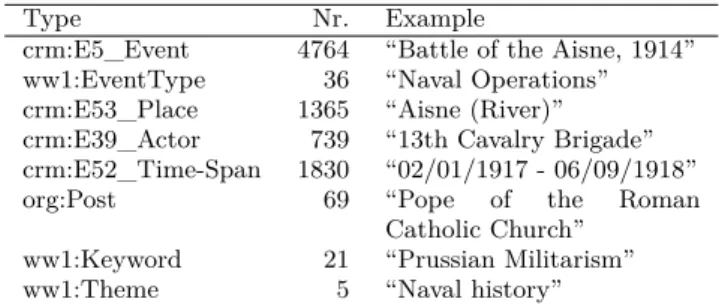
The main object types found in the WW1LOD dataset are described in Table 1 along with their instance counts. More detailed information on the schema and dataset content can be found on the WW1LOD dataset homepage at http://ldf.fi/ww1lod/. In total, the dataset is comprised of 63,807 triples.
Table 1 Core classes in the dataset
Type Nr. Example
crm:E5_Event 4764 “Battle of the Aisne, 1914” ww1:EventType 36 “Naval Operations” crm:E53_Place 1365 “Aisne (River)” crm:E39_Actor 739 “13th Cavalry Brigade” crm:E52_Time-Span 1830 “02/01/1917 - 06/09/1918”
org:Post 69 “Pope of the Roman
Catholic Church” ww1:Keyword 21 “Prussian Militarism” ww1:Theme 5 “Naval history”
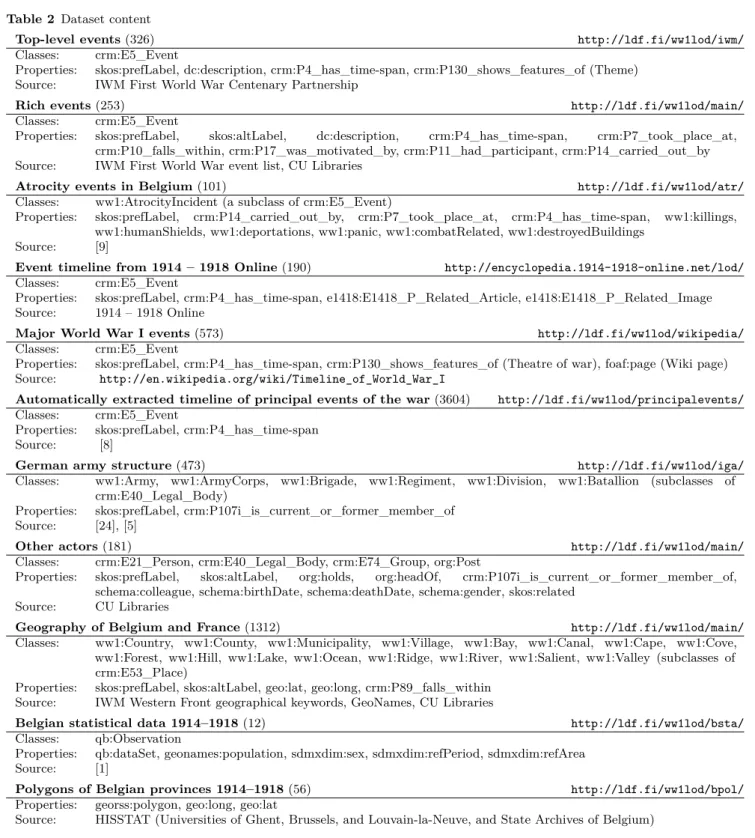
The instances included in the dataset come from a variety of sources, as detailed in Table 2.
3.1 Events
As a first step, general events spanning the war years were included in WW1LOD to provide a useful com-mon basis for linking acom-mong related datasets [11]. For this, an authoritative framework of 326 top-level wartime events was provided by the Imperial War Mu-seum (IWM)’s First World War Centenary Partner-ship8. The IWM is considered the major authority among cultural heritage institutions in the English-speaking world where the First World War is concerned. Thus both historians and cultural heritage profession-als should consider the sourced vocabulary authorita-tive, and it is likely to be re-used by others who are preparing datasets in this domain.
The IWM events, however, did not contain place or actor information. To overcome this limitation, a separate catalogue of some 250 domain expert-selected events was built for richer description, including the annotation of places, participating actors, and tempo-ral relationships. The information is drawn from vari-ous sources, including approved terminologies from the IWM and the British Army’s Battle Nomenclatures
8 This timeline was principally derived from the official
British series on the history of the war, theHistory of the Great War Based on Official Documents, particularly the volume Prin-cipal Events, 1914–1918[8]
Committee, as well as a custom term list on Belgium and WW1 created expressly for this purpose9.
These events were manually linked to the top-level events where appropriate, resulting in 46 owl:sameAs links. In addition, all events have been automati-cally linked to DBpedia [13], with a little over 150
owl:sameAsrelationships. Domain experts validated the
latter links using the Silk link discovery framework [25]. Finally, details on the “German atrocities” that took place in Belgium in 1914 were included. This informa-tion was based on a vast study by John Horne and Alan Kramer [9], which is considered the standard work on the topic. Included data, for example, are the place and date of each incident, the involved army unit, the num-ber of killings, and the numnum-ber of destroyed buildings.
The focus on Belgium apparent in this source was based on awareness that general thesauri and registries alone cannot provide the depth resolution needed for de-tailed research. Thus, the project decided to experiment on how also more detailed sources could be integrated as part of the general framework. In analyzing CU’s doc-ument collection, a rich subset of material was identified related to the German occupation of Belgium, and par-ticularly to the violence German soldiers perpetrated against Belgian civilians. This particular subtopic was therefore selected as a focus and related sources were particularly emphasized when building the dataset.
When it became available, an additional set of 190 events and attendant encyclopedia articles were incor-porated from the timeline created for 1914 – 1918 On-line10. 1914 – 1918 Online is an international collabora-tive project to create an authoritacollabora-tive, freely available online encyclopedia of the First World War. Released in October 2014, it boasts an editorial board made up of approximately 90 distinguished historical experts from 22 countries with responsibility for assessing and man-aging the quality of the resource. To revisit the point about integration needing to happen on an instance level, it should be noted that while this source was in fact provided to us as CIDOC-CRM compatible RDF, it still needed exactly the same mapping work to be done on it in order to be useful.
While the sources described above provide a quality-controlled corpus of richly described major war events, the more nuanced picture that could be gleaned from the inclusion of lower-level events was still missing. Thus two additional datasets were included for users who opt to increase their breadth of coverage at the pos-sible expense of data quality. The first is a set of 573
9 Derived in part from Patrick Lefevre’s standard
bibli-ography on this topic published by Belgium’s Musée Royal d’Armée [12]
Table 2 Dataset content
Top-level events(326) http://ldf.fi/ww1lod/iwm/
Classes: crm:E5_Event
Properties: skos:prefLabel, dc:description, crm:P4_has_time-span, crm:P130_shows_features_of (Theme) Source: IWM First World War Centenary Partnership
Rich events(253) http://ldf.fi/ww1lod/main/
Classes: crm:E5_Event
Properties: skos:prefLabel, skos:altLabel, dc:description, crm:P4_has_time-span, crm:P7_took_place_at, crm:P10_falls_within, crm:P17_was_motivated_by, crm:P11_had_participant, crm:P14_carried_out_by Source: IWM First World War event list, CU Libraries
Atrocity events in Belgium(101) http://ldf.fi/ww1lod/atr/
Classes: ww1:AtrocityIncident (a subclass of crm:E5_Event)
Properties: skos:prefLabel, crm:P14_carried_out_by, crm:P7_took_place_at, crm:P4_has_time-span, ww1:killings, ww1:humanShields, ww1:deportations, ww1:panic, ww1:combatRelated, ww1:destroyedBuildings
Source: [9]
Event timeline from 1914 – 1918 Online(190) http://encyclopedia.1914-1918-online.net/lod/
Classes: crm:E5_Event
Properties: skos:prefLabel, crm:P4_has_time-span, e1418:E1418_P_Related_Article, e1418:E1418_P_Related_Image Source: 1914 – 1918 Online
Major World War I events(573) http://ldf.fi/ww1lod/wikipedia/
Classes: crm:E5_Event
Properties: skos:prefLabel, crm:P4_has_time-span, crm:P130_shows_features_of (Theatre of war), foaf:page (Wiki page) Source: http://en.wikipedia.org/wiki/Timeline_of_World_War_I
Automatically extracted timeline of principal events of the war(3604) http://ldf.fi/ww1lod/principalevents/
Classes: crm:E5_Event
Properties: skos:prefLabel, crm:P4_has_time-span Source: [8]
German army structure(473) http://ldf.fi/ww1lod/iga/
Classes: ww1:Army, ww1:ArmyCorps, ww1:Brigade, ww1:Regiment, ww1:Division, ww1:Batallion (subclasses of crm:E40_Legal_Body)
Properties: skos:prefLabel, crm:P107i_is_current_or_former_member_of Source: [24], [5]
Other actors(181) http://ldf.fi/ww1lod/main/
Classes: crm:E21_Person, crm:E40_Legal_Body, crm:E74_Group, org:Post
Properties: skos:prefLabel, skos:altLabel, org:holds, org:headOf, crm:P107i_is_current_or_former_member_of, schema:colleague, schema:birthDate, schema:deathDate, schema:gender, skos:related
Source: CU Libraries
Geography of Belgium and France(1312) http://ldf.fi/ww1lod/main/
Classes: ww1:Country, ww1:County, ww1:Municipality, ww1:Village, ww1:Bay, ww1:Canal, ww1:Cape, ww1:Cove, ww1:Forest, ww1:Hill, ww1:Lake, ww1:Ocean, ww1:Ridge, ww1:River, ww1:Salient, ww1:Valley (subclasses of crm:E53_Place)
Properties: skos:prefLabel, skos:altLabel, geo:lat, geo:long, crm:P89_falls_within Source: IWM Western Front geographical keywords, GeoNames, CU Libraries
Belgian statistical data 1914–1918(12) http://ldf.fi/ww1lod/bsta/
Classes: qb:Observation
Properties: qb:dataSet, geonames:population, sdmxdim:sex, sdmxdim:refPeriod, sdmxdim:refArea Source: [1]
Polygons of Belgian provinces 1914–1918(56) http://ldf.fi/ww1lod/bpol/
Properties: georss:polygon, geo:long, geo:lat
Source: HISSTAT (Universities of Ghent, Brussels, and Louvain-la-Neuve, and State Archives of Belgium)
events extracted from Wikipedia’s timeline of World War I11, which are meant to provide an alternate view-point into major wartime events. The second is a list of 3604 events that were automatically extracted from a scanned copy of Great Britain. Committee of Imperial
11 http://en.wikipedia.org/wiki/Timeline_of_World_
War_I
Defence [8]. Although these events were harvested from an authoritative source, the entries contain numerous errors due to problems in optical character recognition and structure detection. Domain specialists at CU are currently cleaning up this data and enriching it with with actor and place information; however, this process is ongoing.
3.2 Actors
Actor information in the dataset is primarily derived from two sources. The first is information on the struc-ture of the Imperial German Army, which comes pri-marily from Georg Tessin’s Deutsche Verbände und
Truppe [24]. This work is recognized in the field as a
standard work of reference on the topic. The German army data was particularly important as it allows links to be made between the units mentioned in the atroc-ity data and their organizational hierarchy for further contextualization and reasoning.
Additionally, CU domain specialists have added ac-tor information in conjunction with enriching the event network. During this work, they not only linked actors to events, but also to each other, and to the organiza-tions to which they belong.
In addition, the actors were also linked to more gen-eral content keywords. However, unfortunately here a misunderstanding regarding modeling caused the actors to be related to the themes (such as ”slavery”) by the same property (skos:related) not only when they were directly associated with a theme through events, but also when they wrote about those events. Thus, this information should be used with caution.
3.3 Historical Places
Regarding the locations of wartime events, a key point is that events such as battles often refer specifically to geographical features such as ridges or rivers. How-ever, modern gazetteers such as GeoNames mainly con-tain administrative units (though they may also share a name with nearby geographical features).
Further, whereas geographical features and e.g vil-lage level administrative divisions are relatively static for the purposes of the project, larger administrative ar-eas may have changed substantially over the past cen-tury. Thus modern gazetteers are not always directly applicable to a historical case like WW1.
To help address these issues, an integrated gazetteer of historical place names was included in the WW1LOD dataset. As a core source of contemporary place name data, war-related locations were gathered from the IWM’s WW1 Western Front geographical key-word vocabulary. This vocabulary also contains a partonomy structure for the locations that was like-wise integrated into the dataset. Additional geograph-ical instances also were added manually during the event and actor enrichment process; for example, Pom-meroeul (ww1:Village) crm:P89_falls_within Hain-aut (ww1:Municipality) crm:P89_falls_within Bel-gium (ww1:Country, a subclass of crm:E53_Place,
and separate from Belgium the actor of type crm:E40_Legal_Body that holds this administrative area). Coordinate information for these places was sourced through multiple means. First, 1248 contem-porary place names were automatically mapped to their modern equivalents in GeoNames based on iden-tical name and hierarchy information. Domain experts then evaluated these links, encoded asskos:closeMatch triples, for accuracy, in the end accepting 836 matches. They also manually located an additional 57 locations.
Finally, wartime boundaries for the Belgian provinces were obtained from HISSTAT, a collabora-tive project of the Universities of Ghent, Brussels, and Louvain-la-Neuve, and the State Archives of Belgium. To encode these border polygons, the GeoRSS vocabu-lary12 was used.
Taken together, the geographical data gleaned from these various sources allows items to be placed in their geographical context using locations and boundaries ac-curately defined for the war years.
With regard to the rich modeling CIDOC-CRM ap-plies to spatiotemporal entities, it should be noted that again here we have opted for a more simple model. This was possible due to the limited temporal extent of the domain described. However, the vocabulary can easily be extended with the relevant spatiotemporal proper-ties and concepts, should these capabiliproper-ties be required later.
3.4 Time
Historical context and uncertainty also creates complex-ity for temporal modeling, as it is often difficult to state with absolute precision when a certain event took place. For this reason, CIDOC-CRM’s temporal representa-tion [4] supports a level of uncertainty in encoding. For instance, it is possible to create a time-stamp for ”at the beginning of the year 1917” by specifying four tem-poral points: the earliest possible start time, the lat-est possible start time, the earlilat-est possible end time, and the latest possible end time. By using flexible time-frames, analyses and visualizations of the temporal re-lationships between war events can include those with uncertain or ambiguous dates.
Another element that can add to the uncertainty of the temporal extent of wartime events is tendency of actors on opposing sides to regard it differently [8, ex-planatory notes]. In the case of a battle, for example, one side might include its preparatory attacks to the battle or the consolidation of gains following a success-ful attack in the timeframe. At present, such differences
are handled in the WW1LOD project merely by expand-ing the event interval. Formal encodexpand-ing of such different viewpoints has been been discussed, but remains future work.
3.5 Keywords and Themes
Supporting the core classes – events, agents, places, and timeframes – are themes and keywords. Themes cate-gorize historical events into major classes, mostly for use in public-facing interfaces. Keywords, on the other hand, provide non-event thematic foci for linking, a need that was identified early on in the process of in-dexing primary sources. Often the sources would refer to pervasive wartime events in general, instead of, or in addition to individual instances. Thus it was often use-ful to index the documents also as referencing wartime hunger and malnutrition as a whole, or the resistance of the Belgian Catholic Church to German occupation. In these cases the links between documents and events are less direct (by one level), but still allow the discovery of related items of probable relevance. For instance, the keyword ”agriculture” may be used to link documents dealing with agriculture to events affecting it.
3.6 Statistics
To round out the coverage on Belgium, population statistics for the Belgian provinces during the war years were sourced from annual figures published by the Bel-gian Interior Ministry [1]. The intended use for these statistics is to enable the identification of correlations between population fluctuations and wartime events. To model these statistics, the project utilizes the W3C Data Cube vocabulary13.
3.7 Interlinking
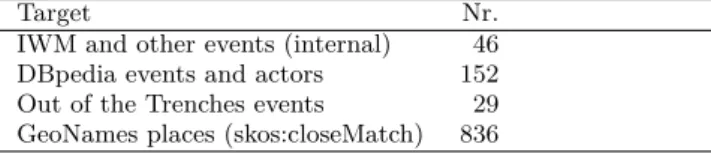
While the project strives mainly to include information humanities scholars would consider authoritative, it was also desirable to link the dataset to the LOD cloud to promote connection and interoperability. To facilitate this outcome, events and actors were linked to their counterparts in DBpedia, as well as other Linked Data datasets covering WW1. In addition, places were associ-ated with GeoNames, where appropriate. An overview of these links, which domain experts at CU manually verified for accuracy, is provided in Table 3. .
13 http://www.w3.org/TR/vocab-data-cube/
Table 3 Equivalency links in the dataset
Target Nr.
IWM and other events (internal) 46 DBpedia events and actors 152 Out of the Trenches events 29 GeoNames places (skos:closeMatch) 836
4 Experience of Ontologies Used
In making modeling decisions, the WW1LOD project has striven to balance the following guidelines: 1) make use of established ontologies (and the CIDOC-CRM in particular) as much as possible, and for incoming sub-datasets: 2) model similar data in a uniform manner, 3) model data in as intuitively as possible, and 4) never lose data included in the original version.
For most sub-datasets, adhering to CIDOC-CRM has fulfilled all of these goals. The first notable devia-tion was, however, that the decision was made not use CIDOC Appellation resources for labeling entities, in-stead opting to use the simple and widely used SKOS preferred and alternate label properties. The goal in doing so was to maintain the simplicity of the model, which could be done because none of the data sources contained metadata relating to the appellations them-selves.
A second notable deviation was in how relationships between organizations and people are modeled. In principle, CIDOC advocates modeling these also as events and has, for example, activity subclasses for joining and leaving a group (with a wide definition of what constitutes a group, including marriages and families). However, based on prior research [20, 14], this construction is not in line with how people intuitively organize such information. Instead, human end-users generally want to see this data as simple attributes and relations, possibly with attendant metadata such as pe-riod of validity. Incidentally, the Getty Foundation also adopted this model for their Thesaurus of Geographic Names and Union List of Artist Names. To an extent, the CIDOC standard itself also acknowledges this perspective by including ”shortcut” properties such as crm:P107i_is_current_or_former_member_of that can be used to relate an actor directly to a group.
In the WW1LOD dataset, this property is used where applicable, but the divergent modeling practice also required the definition of additional relationships. For these, the project makes use of multiple generally accepted vocabularies for such data: the W3C Organiza-tion Ontology14, the RELATIONSHIP ontology15, and
14 http://www.w3.org/TR/vocab-org/ 15 http://vocab.org/relationship/
the schema.org vocabulary16. Particularly used is the facility of the Organization Ontology to define Posts, which can then be linked to the associated people and organizations.
Should the project in the future need a pure event-oriented view of the data, inferencing rules can be put in place to translate between the current model and native CIDOC-CRM [14]. Naturally, the project could have also chosen to encode the data primarily as events and run inferencing the other way when querying, editing, or visualizing, but this would have added a great deal of complexity to common tasks, with no clear benefits to offset the cost.
Another important note regarding modeling is the fact that CIDOC-CRM often contains more specific ap-plicable classes than are actually used in the data. For example, almost all events in the dataset would actu-ally be instances of crm:E7_Activity, which includes all events that are carried out intentionally. Some could be instances of even more specific event subclasses, such as crm:E65_Creation or crm:E6_Destruction.
However, as the sub-datasets have for the most part been automatically converted, the included events were kept on the most general level of crm:E5_Event to pre-clude introducing any incorrect information into the model. In further manual processing, only some of these have been further refined. This situation is repeated for properties, opting often to use, for example, the neutral crm:P11_had_participant instead of the more specific crm:P14_carried_out_by, which implies agency.
5 Dataset Access
The dataset is published via the Linked Data Fin-land (LDF.fi) data publication service [10], which pro-vides browsing, editing, and visualization services on top of standard SPARQL and Linked Data browsing APIs. The main page for the project is at http:// ldf.fi/ww1lod/, which describes both the API end-points as well as the add-on service links in detail. In-dividual instances in the dataset are also defined in the http://ldf.fi/ww1lod/ namespace using unambigu-ous computer-generated identifiers (e.g.,http://ldf.fi/ ww1lod/a74d369dfor Viscount Bryce) and support direct Linked Data browser access with content-type negotia-tion.
The dataset is available openly under a CC-BY-SA 4.0 Creative Commons license17, which allows sharing and remixing of the dataset with attribution to the orig-inal licensors. All organizations mentioned in Table 2
16 http://schema.org/
17 http://creativecommons.org/licenses/by-sa/4.0/
should be referenced in case of using the dataset. The license also allows the dataset to be altered or redis-tributed with the same or similar license.
The dataset is being regularly updated, enriched and maintained by CU researchers live on the endpoint using the SAHA web-based collaborative metadata ed-itor for RDF data [19]. For this reason, actual instance counts or even data model specifics may not match those cited in this paper, which represents a snapshot in time. The most current information, however, is always available from the dataset’s home page.
6 Related Work
As stated, the dataset’s primary purpose is as a refer-ence vocabulary to which other projects, institutions, and organizations can link their WW1 collections. To avoid duplicate work and promote uptake, the project has striven to interface with as many of the others in the field as possible, both those publishing reference vocabularies and those publishing primary data.
Europeana 1914–1918 has created a simple vocabu-lary for WW1 that includes a subset of the Library of Congress Subject Headings (LCSH) along with 81 ad-ditional headings18. This vocabulary, however, is still preliminary, as the URIs for the added headings occur in a localhost namespace, and currently do not link to one another. Furthermore, the thesaurus (as the LCSH) is quite general and does not contain individual units or events but rather general headings such as ”War Crimes” or ”Eastern Front Campaigns”. Finally, the vocabulary has incorporated LCSH’s pre-Linked Data structure, which joins discrete aspects of information under a single identifier, such as having separate head-ings named ”World War, 1914–1918 – Social aspects – Great Britain” and ”World War, 1914–1918 – Social aspects – Germany”. Conversations are ongoing with Europeana about how the WW1LOD dataset could be aligned with their work.
The Trenches to Triples project has published Linked Data vocabularies of WW1 events, places, and actors19. In practice, however, these vocabularies do not parse as valid RDF, and even corrected, the data model used is not consistent. For example, the same concepts are sometimes referred to using literals, and at other times using object references. Furthermore, the event, actor and place lists are separate and do not contain cross-references, literal or otherwise. Nevertheless, the data has been corrected, parsed and loaded into a
stag-18 Viewable at http://skos.europeana.eu/api/
find-concepts?q=inScheme:*&rows=1000
ing area athttp://ldf.fi/ww1/for further study and possible integration into WW1LOD.
The Muninn project20 has published information particularly pertaining to Canada in the First World War. As of this writing, however, the primary data dump available consists of a SPARQL result set in XML format listing all quads rather than the N-Quads format claimed on its page. As the WW1LOD project has not yet had time to implement the custom parsing necessary to turn this result set back into triples, the dataset has also not yet been fully evaluated. Aside from this pri-mary data however, Muninn does maintain a number of well-thought-out ontologies relevant to the domain. These ontologies were consulted in deciding upon the data models to be used for WW1LOD, but in the end the decision was made to use the CIDOC-CRM and re-lated ontologies as a better supported albeit more gen-eral option.
A second Canadian project of interest is Out of the Trenches21, which in addition to publishing pri-mary collection data also includes a reference vocab-ulary containing 64 richly described events and 324 ac-tors relevant to the collection. Whereas the acac-tors are almost exclusively Canadian and did not appear in the WW1LOD data, 29 event equivalencies were discovered between the datasets and recorded in the WW1LOD project.
The CENDARI project22aims to provide WW1 his-torians with tools to contextualize, customize and share their research. The project is only starting to ramp up its vocabulary integration work, but has expressed an interest in using the WW1LOD vocabulary for this pur-pose.
The 1914 – 1918 Online23 encyclopedia has collabo-rated with the WW1LOD project by sharing their own timeline and attendant metadata. These datasets allow sources utilizing the WW1LOD dataset to link to rele-vant articles on 1914 – 1918 Online.
Finally, Historypin24 has expressed an interest in the WW1LOD data. Their intention is to use the project’s event timeline to highlight events that oc-curred one hundred years ago as part of its centennial coverage.
7 Examples of Use
In demonstrating the usefulness of the WW1LOD dataset, a first problem is that only the CU WWI
Col-20 http://rdf.muninn-project.org/ 21 http://www.canadiana.ca/en/pcdhn-lod 22 http://www.cendari.eu/about-cendari 23 http://www.1914-1918-online.net/ 24 http://historypin.com/
lection Online has been directly linked to it. The equiv-alency links to other vocabularies offer little help, due to either a low level of overlap or a high level of gener-ality in these vocabularies. As an example, a SPARQL query25for items related to events in West Flanders can be crafted to bring in content from multiple sources– Europeana, the CU WWI Collection Online, and Out of the Trenches. However, this example had to be care-fully selected. In reality, the Out of the Trenches data contains just a single individual event (the Battles of Ypres, 1917), while the Europeana vocabulary contains only three. In both collections on the other hand, there are a multitude of items merely referencing the war as a whole.
While discussions are ongoing to facilitate other in-stitutions’ direct use of the WW1LOD dataset, its util-ity is demonstrated through a contextual reader proto-type26 [21] developed in tandem with the project. This demonstrator, visualized in Figure 1, uses various meth-ods to overcome issues arising from the lack of detailed annotations in related collections.
First, the application uses dynamic entity extrac-tion to provide context for sources lacking formal meta-data. Here, textual mentions of e.g. events, places and people are identified and linked to their context as de-fined in the associated reference datasets. For the World War 1 configuration, these datasets are WW1LOD, Out of the Trenches, DBpedia, the 1914–1918 Online vocab-ulary and the Europeana 1914–1918 thesaurus. Being dynamic, this linking can be applied to any PDF or HTML source, be they primary source documents from the Colorado WWI Collection, item pages from Euro-peana or articles from the 1914–1918 Online encyclo-pedia. In the interface, the entities extracted are high-lighted for the researcher’s inspection. When they are moused over, a short description and an image or a map appear, as illustrated on the left-hand side of Figure 1a with the example of Captain Charles Algernon Fryatt. Naturally, the automatic extraction of entities can also result in spurious matches and context, for exam-ple resulting in the short gloss on ”Belgians” being il-lustrated by a photograph of Jean-Claude Van Damme, as he happens to appear as an example Belgian in the Wikipedia article on them. The extent to which the in-dividual vocabularies used are able to locate entities, as well as the relevance of those entities varies by source and configuration. Generally, in preliminary tests, the Europeana, Out of the Trenches and 1914–1918 vocab-ularies perform significantly worse than WW1LOD and DBpedia. DBpedia works well for the most notable people and places, but also brings in many spurious
25 http://j.mp/1EP1P5i
(a) (b) Fig. 1 The contextual reader interface
matches due to its more general scope. The WW1LOD vocabulary performs well on both precision and recall overall, suggesting the worth of such a specialized vo-cabulary in interlinking content pertaining to a partic-ular domain. The reasons for this outcome seem to be twofold. First, the vocabulary is more focused and rich in its field. Second, WW1LOD has made a conscious attempt to include alternative names and spellings for concept labels, further increasing recall.
In relation to sources originating from the Colorado WWI Collection, the reader also allows one to evalu-ate how well the dynamic extraction performs against manual item level indexing of the documents by the CU librarians. Here, preliminary experience seems to indicate that both have their place, but serve different needs. The item level indexing is useful to accurately describe the general content of the document, as well as to link it as a whole to its context. On the other hand, these keywords cannot give context to individ-ual mentions in the source text itself, and neither do they provide the breadth of linkage that the dynamic extraction enables (albeit at the cost of precision). For both uses however, it is apparent that the more focused vocabulary of WW1LOD outperforms the higher level LCSH subject heading classification traditionally used by libraries.
Back in the interface of the reader, clicking on the entity opens a side pane in the interface containing added context. For example, in Figure 1a, the shooting of nurse Edith Cavell is highlighted right next to that of Captain Fryatt’s. Clicking on this mention opens the view shown in Figure 1b, where a timeline locates her
execution in the context of 1) the IWM’s important top-level wartime events, 2) all events happening in the same timeframe, and 3) other wartime events that hap-pened nearby. All of these events are also presented on a map. These visual contextualizations make heavy use of the event timelines unified in WW1LOD, and would not be possible without the information contained therein. This side pane also contains linked content found from multiple sources. These are shown on the right hand side of Figure 1a for Charles Fryatt. Linked con-tent can be brought in from both sources with rich structured metadata, as well as those lacking such. In the example, metadata brings in a relevant primary source from the CU WWI Collection Online. Images of the burial of Captain Fryatt from Europeana, on the other hand, are found not through formal metadata, but rather from a keyword match on his name that appears in the textual description of the images.
The way this works is by the reader extracting from the configured vocabularies a number of relevant tex-tual search terms for an entity of interest and then us-ing the associated collections’ existus-ing keyword search functionality to discover related content. Here again the rich data and alternative names and spellings contained in WW1LOD are put to good use. Among the extracted data used in the query are multi-lingual primary and alternative labels for a place or event, as well as other closely related entities such as actors in an event or other events that took place in the same location. In the WW1 configuration, sources queried in this way in-clude WW1 Discovery, Europeana, the Digital Public
Library of America (DPLA), and the European Digital Library.
In such inexact linking, there is again a potential for spurious outlinks. The amount of such depends on both the linking vocabularies and configurations used, as well as the external data source. For example, any items found on WW1 Discovery should be pertinent, but for the other sources this may not be the case. Here, the issue is a matter of calibrating a desired bal-ance of precision and recall, for example by only using the more focused vocabularies for linking, or alterna-tively by adding external constraints, such as requiring objects matched to originate from the time-span of the war (but thereby missing e.g. later monuments, tributes or writings).
It should also be noted that whether bringing in con-tent through formal metadata or text queries, none of the sources queried make use of CIDOC-CRM as their content organization standard, instead relying on sim-pler, either Dublin Core or MARC -derived schemata. This again goes to show how in linking together col-lections, model uniformity is much less important than having a common and detailed enough domain vocabu-lary.
8 Discussion and Future Work
The WW1LOD dataset provides a rich framework for linking together content related to the First World War. Thought has been given to how collections can link not only to the entities contained in the dataset, but also to more general categories, be they unit types, keywords, etc. The usefulness of the dataset in linking has been demonstrated in a concrete application that is able to bring in and bridge content from a number of sources, both through formal metadata as well as hot linking through using the vocabulary in entity extraction and query expansion.
Relating to CIDOC-CRM, the project highlights how it is the particular instances in a domain that are important to interlinking, while model differences and deficiencies can actually quite easily be traversed. How-ever, in modeling these instances, the standard does seem to provide a good base, both in terms of entity types as well as properties by which to create a rich network of links inside the reference vocabulary. On the other hand, some instances were also identified where the event-based modeling of CIDOC-CRM runs counter to intuition as well as other established standards.
Content-wise, the WW1LOD dataset is currently able to provide a quality-controlled timeline of general events related to the entire war, as well as a much richer
representation of a particular subtopic, the occupation of Belgium. As such, WW1LOD currently represents the most comprehensive linked open reference avail-able related to WW1. However, while this is enough to demonstrate the potential of the approach, further work is needed to attain a similar level of quality and detail in additional sub-topical areas. The hope is that researchers who would benefit from inclusion, for exam-ple, of geographies for other countries, or the structures of armies other than the German one will add them, thereby enriching the dataset.
Discussions are ongoing with various projects, no-tably Out of the Trenches, Europeana 1914–1918, DPLA, and 1914 – 1918 Online about how the WW1LOD dataset could be better integrated with their collections and vocabularies. Here the sparse an-notations and general keywords in existing collections present a continuing challenge to integration. Where the CU WWI Collection Online is concerned, this gap was bridged both by manual annotation and by utiliz-ing entity extraction tools underlyutiliz-ing the contextual reader [18] to create structured metadata for entities mentioned in the source texts. A similar approach is likely feasible for other mainly textual collections. Fu-ture steps the project could take to facilitate this out-come is to reach out to more institutions holding WW1 collections.
Finally, it would be beneficial to formally evalu-ate how well the vocabulary is able to interlink collec-tions as well as provide context in comparison to other choices. Indeed, plans are under way to do this. Unfor-tunately, this is a complex undertaking which will take considerable time to plan and execute. First, it is not easy to design a concise test that would measure the degree of support in a meaningful real world scenario. Second, the amount of variables to be controlled for is also high, as the support provided is dependent on de-tails of all the collections and vocabularies linked, as well as a process of tuning the precision and recall of each through configuration.
Acknowledgements
We would like to thank Michael Ortiz (CU) and Tuo-mas Palonen (Aalto University) for annotating the re-sources, Michael Dulock (CU) and Holley Long (CU) for their aid with the digital collection and metadata, and Martha Hanna (CU), Patrick Tally (CU), Alan Kramer (Trinity College Dublin), Sophie de Schaepdri-jver (Pennsylvania State University) and Tammy Proc-tor (Wittenberg University) for their expert opinion on the content.
References
1. Belgium Ministère de l’Intérieur et de l’Hygiène (1922) Annuaire statistique de la Belgique et du
Congo Belge, vol 46. Brussels
2. Binding C, May K, Tudhope D (2008) Seman-tic Interoperability in Archaeological Datasets: Data Mapping and Extraction Via the CIDOC CRM. In: Christensen-Dalsgaard B, Castelli D, Ammitzbøll Jurik B, Lippincott J (eds) Research and Advanced Technology for Digital Libraries, Lecture Notes in Computer Science, vol 5173, Springer Berlin Heidelberg, p 280–290, DOI 10. 1007/978-3-540-87599-4_30, URLhttp://dx.doi. org/10.1007/978-3-540-87599-4_30
3. Bountouri L, Gergatsoulis M (2011) The Se-mantic Mapping of Archival Metadata to the CIDOC CRM Ontology. Journal of Archival Or-ganization 9(3-4):174–207, DOI 10.1080/15332748. 2011.650124, URL http://dx.doi.org/10.1080/ 15332748.2011.650124, http://dx.doi.org/10. 1080/15332748.2011.650124
4. CRM SIG (2011) How to implement crm time in rdf. Tech. rep., Amsterdam
5. Cron H (1937) Geschichte des Deutschen Heeres im Weltkriege 1914-1918. Biblio-Verlag, Berlin 6. Doerr M (2003) The CIDOC CRM – an ontological
approach to semantic interoperability of metadata. AI Magazine 24(3):75–92
7. Giles J (2005) Internet encyclopaedias go head to head. Nature 438(7070):900–901, URLhttp://dx. doi.org/10.1038/438900a
8. Great Britain Committee of Imperial Defence (1922) Principal events, 1914-1918. History of the
Great War based on official documents, London 9. Horne J, Kramer A (2001) German atrocities 1914:
a history of denial. Yale University Press, New Haven
10. Hyvönen E, Tuominen J, Alonen M, Mäkelä E (2014) Linked Data Finland: A 7-star model and platform for publishing and re-using linked datasets. In: [22], pp 226–230, DOI 10.1007/ 978-3-319-11955-7_24, URLhttp://dx.doi.org/ 10.1007/978-3-319-11955-7_24
11. Hyvönen E, Lindquist T, Törnroos J, Mäkelä E (2012) History on the semantic web as linked data – an event gazetteer and timeline for World War I. In: Proceedings of CIDOC 2012 – Enrich-ing Cultural Heritage, Helsinki, Finland, CIDOC, http://www.cidoc2012.fi/en/cidoc2012/programme 12. Lefevre P (ed) (1987-2001) Belgique et la Première
Guerre mondiale, bibliographie. Musée royal de l’Armée, Brussels
13. Lehmann J, Isele R, Jakob M, Jentzsch A, Kon-tokostas D, Mendes PN, Hellmann S, Morsey M, van Kleef P, Auer S, Bizer C (2015) DBpedia - a large-scale, multilingual knowledge base extracted from Wikipedia. Semantic Web Journal 6(2):167– 195
14. Lin CH, Hong JS, Doerr M (2008) Issues in an inference platform for generating deductive knowl-edge: a case study in cultural heritage digital li-braries using the CIDOC CRM. International Jour-nal on Digital Libraries 8(2):115–132, DOI 10.1007/ s00799-008-0034-0, URL http://dx.doi.org/10. 1007/s00799-008-0034-0
15. Lindquist T, Long H (2011) How can educational technology facilitate student engagement with on-line primary sources?: user needs assessment. Li-brary Hi Tech 29(2):224–241
16. Lindquist T, Dulock M, Törnroos J, Hyvönen E, Mäkelä E (2013) Using linked open data to en-hance subject access in online primary sources. Cat-aloging & Classification Quarterly 51(8):913–928, DOI 10.1080/01639374.2013.823583
17. Luyt B, Tan D (2010) Improving Wikipedia’s cred-ibility: References and citations in a sample of his-tory articles. Journal of the American Society for Information Science and Technology 61(4):715–722, DOI 10.1002/asi.21304, URLhttp://dx.doi.org/ 10.1002/asi.21304
18. Mäkelä E (2014) Combining a REST lexical anal-ysis web service with SPARQL for mashup se-mantic annotation from text. In: [22], pp 424–428, DOI 10.1007/978-3-319-11955-7_60, URLhttp:// dx.doi.org/10.1007/978-3-319-11955-7_60
19. Mäkelä E, Hyvönen E (2014) SPARQL SAHA, a configurable linked data editor and browser as a service. In: [22], pp 434–438, DOI 10.1007/ 978-3-319-11955-7_62, URLhttp://dx.doi.org/ 10.1007/978-3-319-11955-7_62
20. Mäkelä E, Hyvönen E, Ruotsalo T (2012) How to deal with massively heterogeneous cultural heritage data - lessons learned in CultureSampo. Semantic Web 3(1):85–109
21. Mäkelä E, Lindquist T, Hyvönen E (2016) CORE - a contextual reader based on linked data. In: Pro-ceedings of Digital Humanities 2016, long papers 22. Presutti V, Blomqvist E, Troncy R, Sack H,
Pa-padakis I, Tordai A (eds) (2014) The Semantic Web: ESWC 2014 Satellite Events - ESWC 2014 Satellite Events, Anissaras, Crete, Greece, May 25-29, 2014, Revised Selected Papers, Lecture Notes in Computer Science, vol 8798, Springer, DOI 10.1007/978-3-319-11955-7, URL http://dx.doi. org/10.1007/978-3-319-11955-7
23. Rector LH (2008) Comparison of Wikipedia and other encyclopedias for accuracy, breadth, and depth in historical articles. Reference Services Re-view 36(1):7–22
24. Tessin G (1974) Deutsche Verbände und Truppen. Biblio-Verlag, Osnabrück
25. Volz J, Bizer C, Gaedke M, Kobilarov G (2009) Dis-covering and maintaining links on the web of data. In: Bernstein A, Karger DR, Heath T, Feigenbaum L, Maynard D, Motta E, Thirunarayan K (eds) International Semantic Web Conference, Springer Verlag, Lecture Notes in Computer Science, vol 5823, pp 650–665
26. Waters NL (2007) Why you can’t cite Wikipedia in my class. Commun ACM 50(9):15–17, DOI 10.1145/1284621.1284635, URL http://doi.acm. org/10.1145/1284621.1284635