University of Huddersfield Repository
Qin, Yongrui, Sheng, Quan Z., Parkinson, Simon and Falkner, Nickolas J. G.
Edge Influence Computation in Dynamic Graphs
Original Citation
Qin, Yongrui, Sheng, Quan Z., Parkinson, Simon and Falkner, Nickolas J. G. (2017) Edge Influence
Computation in Dynamic Graphs. In: The 22nd International Conference on Database Systems for
Advanced Applications (DASFAA), 2730 March 2017, Suzou, China. (Unpublished)
This version is available at http://eprints.hud.ac.uk/30895/
The University Repository is a digital collection of the research output of the
University, available on Open Access. Copyright and Moral Rights for the items
on this site are retained by the individual author and/or other copyright owners.
Users may access full items free of charge; copies of full text items generally
can be reproduced, displayed or performed and given to third parties in any
format or medium for personal research or study, educational or notforprofit
purposes without prior permission or charge, provided:
•
The authors, title and full bibliographic details is credited in any copy;
•
A hyperlink and/or URL is included for the original metadata page; and
•
The content is not changed in any way.
For more information, including our policy and submission procedure, please
contact the Repository Team at: [email protected].
http://eprints.hud.ac.uk/
Yongrui Qin†
, Quan Z. Sheng‡
, Simon Parkinson†
, and Nickolas J.G. Falkner$ †
University of Huddersfield, United Kingdom
{y.qin2,s.parkinson}@hud.ac.uk
‡
Macquarie University, Australia
$University of Adelaide, Australia
Abstract. Reachability queries are of great importance in many research and application areas, including general graph mining, social network analysis and so on. Many approaches have been proposed to compute whether there exists one path from one node to another node in a graph. Most of these approaches focus on static graphs, however in practice dynamic graphs are more common. In this paper, we focus on handling graph reachability queries in dynamic graphs. Specifically we investigate the influence of a given edge in the graph, aiming to study the overall reachability changes in the graph brought by the possible failure/deletion of the edge. To this end, we firstly develop an efficient update algorithm for handling edge deletions. We then define the edge influence concept and put forward a novel computation algorithm to accelerate the computation of edge influence. We evaluate our approach using several real world datasets. The experimental results show that our approach outperforms traditional approaches significantly.
Keywords: Graph reachability, Dynamic graph, Edge influence
1
Introduction
Nowadays, graph structured data plays a more important role in various fields. As a foundational operation of a graph, reachability has a wide range of ap-plications in many areas such as web data mining, biological research, social networks and computer programming, etc. It is noteworthy that, in these areas, the structure of graph is large and dynamic. To illustrate, Facebook has 1.79 billion active users monthly in the third quarter of 2016, increased from 1.55 bil-lion active users monthly in the same period in 20151. They may have different characters such as age, gender, hobbies, and may have complicated relationship with existing users.
A large body of indexing techniques have been recently proposed to process reachability queries in graphs [2, 3, 5, 12–14]. Among them, a significant portion
1https://www.statista.com/statistics/264810/ number-of-monthly-active-facebook-users-worldwide/, retrieved December 2016
of indexes are based on 2-hop labeling, which is originally proposed by Cohen et al. [7]. Most of the above mentioned approaches generally make the assumption that graphs are static. Some approaches investigate reachability in dynamic graphs, but they mainly focus on updating the overall indexes and supporting reachability queries in dynamic graphs [1, 8, 10, 15].
One important question remains open: How can we evaluate the impact of an individual edge in a large graph in terms of reachability aspect? To the best of our knowledge, there is little work available in literature about the analysis of potential impact caused by changes in a large graph like edge deletions. How to evaluate the reachability influence of an edge is still an open problem. State-of-the-art approach TOL proposed in [1], which focuses on handling reachability queries in large dynamic graphs, does not provide an efficient way to compute the reachability difference caused by the failure or deletion of an edge. Therefore it remains challenging to evaluate the impact of the deletion of a given edge efficiently.
In this work, we firstly develop a decremental maintenance algorithm to efficiently update labeling index for edge deletions. We then define edge influ-ence to indicate the impact of an edge on the reachability of the whole graph and put forward a novel computation algorithm to calculate edge influences efficiently. Experimental results show that our method outperforms state-of-the-art approach TOL in updating indexes on edge deletions and our edge influence computation algorithm is very efficient and can scale well. Potential applications of our algorithm include finding the most influencing edges in a given network, looking to building up some most important connections in an existing network, and so on.
The remainder of this paper is organized as follows. Section 2 reviews related work. Section 3 describes the details of our approach. Section 4 presents the experimental results and analysis. Section 5 concludes the paper and discusses future work.
2
Related Work
There is a large body of work on handling reachability queries in large graphs.
Tree Cover approach is proposed by Agrawal et al. in [4], which searches a
path based on a tree cover. The principle of this method is to encode each node by multiple intervals in a graph. However, even though it searches the graph efficiently, Tree Cover method can only guarantee its efficiency on static graphs. This is mainly because in order to achieve the optimal tree cover, it has to firstly establish a spanning tree when a graph changes. Dual-Labeling approach proposed by Wang et al. in [3] answers reachability queries by a Dual-Labeling encoding scheme. As a tree encoding method, Dual-Dual-Labeling method also encodes each node as a tree structure. Similar to Tree Cover method, it is suited for handling static graphs.Chain Coverapproach proposed by Jagadish [6] uses a chain cover scheme to compute a reachability query. In this method, it divides a graph into several chains, which forms a chain cover for this graph.
If we want to answer a reachability query, we just search whether there exists a pair in the chain cover. The disadvantage of this method is that if the graph is dynamic, for each update operation, there are numerous pairs to be modified, which reduces the efficiency especially when the graph is large.Path-Tree Cover approach proposed by Jin et al. [5] answers reachability queries by using a path-tree cover scheme. Its principle is similar to the Chain Cover method and the Tree Cover method. The difference is that Path-Tree Cover uses an extra scheme to deal with non-edge in the tree structure like Dual-Labeling approach.
Meanwhile, a few approaches have been proposed for handling reachability queries in dynamic graphs [8, 10, 15]; however, these approaches cannot scale well. State-of-the-art approach in this direction is TOL, proposed by Zhu et al. [1]. TOL uses a total order labeling scheme to answer reachability queries. It encodes a level order to each node in a graph. According to this order, TOL can compute a labeling table. Comparing with other schemes mentioned above, the advantage of TOL is that it simplifies the process of table construction. TOL has an advantage in dealing with large dynamic graphs. Surprisingly, it also outperforms most existing approaches on static graphs [1]. However, the main drawback of TOL is that it can only handle node deletions but cannot handle edge deletions.
3
Methodology
In this section, we present our approach in detail. Since our approach is in-spired by state-of-the-art approach TOL [1], we firstly introduce TOL index briefly, then we develop our decremental maintenance algorithm for handling edge deletions. After that, we further define the concept of edge influence to investigate the impact of an edge in the overall reachability of a graph. We also put forward an efficient computation algorithm to compute edge influence on top of the updated labeling index of the graph.
3.1 TOL Index
The TOL Index [1] of graphGin Fig. 1 is shown in Fig. 2. There are three columns,
n(denoting nodes),LinandLout. Note that, TOL labeling is very similar to the
2-HOP Coverapproach proposed by Cohen et al. [7].
Fig. 2. TOL IndexL
Example 1. According to Fig. 2, for nodeC, ColumnLoutcontains{C}. It means
that nodeCcan reach all nodes that containsCin ColumnLin, including nodes
C,D,E, andF. Similarly, for nodeE, ColumnLin contains{C,E}. Hence node
Ecan be reached by all nodes in ColumnLoutthat containsCorE, including
nodesA,B,C,E, andF.
3.2 Handling Edge Deletions
Suppose the TOL index of a given graphGisL. Assuming after deleting edge
efromG, we haveG0
and its corresponding indexL0
. Using TOL approach, we have to computeL0
from scratch forG0
. It is obvious that such process is not efficient. To improve efficiency, we devise a new approach that only calculates the difference between labeling indexesLandL0
, if an edge deletion occurs. Given a DAGG=(V,E), if deleting edgee=NS →NE ∈Efrom it, we can
construct a new graphGr ∈ G, which includes only nodes that can reach or be
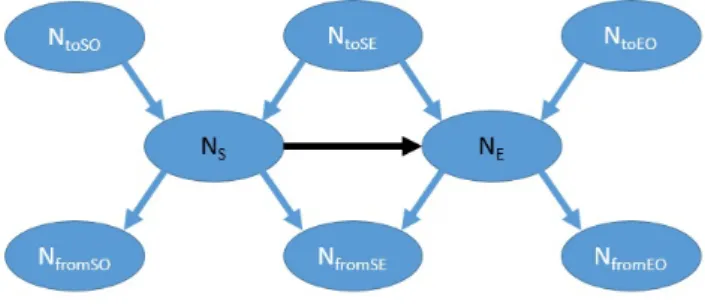
reached by either nodeNSor nodeNE. The structure ofGris presented in Fig. 3.
It should be noted that, we only need to deal with those nodes whose reachability status to another node might be changed due to the edge deletion. All such nodes can be divided into six sets,NtoSO,NtoEO,Nf romSO,Nf romEO,NtoSE
andNf romSE. Details of these node sets are as follows:
NtoSO contains nodes that can reach nodeNSbut cannot reach nodeNE, defined
as a special ancestor node set ofNS.
NtoEO contains nodes that can reach nodeNEbut cannot reach nodeNS, defined
as a special ancestor node set ofNE.
Nf romSO contains nodes that can be reached by nodeNSbut cannot be reached
by nodeNE, defined as a special descendant node set ofNS.
Nf romEO contains nodes that can be reached by nodeNEbut cannot be reached
by nodeNS, defined as a special descendant node set ofNE.
NtoSE contains nodes that can reach both nodeNSand nodeNE, which form the
common ancestor node set of bothNSandNE.
Nf romSE contains nodes that can be reached by both nodeNSand nodeNE, which
form the common descendant node set of bothNSandNE.
The next process is to classify all relevant nodes into the corresponding sets, which is described in the following.
1. Find all ancestor and descendant node sets ofNSandNEusing BFS
(Breadth-First-Search).
2. Compare the ancestor node set ofNSwith the ancestor node set ofNE; put
all nodes that appear in both ancestor node sets together and formNtoSE.
ThenNtoSO is the set containing the rest ancestor nodes ofNSandNtoEOis
the set containing the rest ancestor nodes ofNE.
3. Following a similar step to the above Step 2, we can construct all the defined descendant node sets, includingNf romSE,Nf romSOandNf romEO.
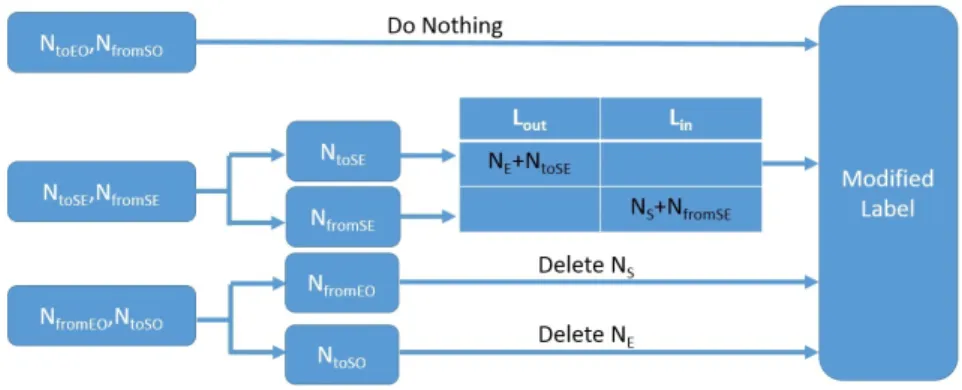
After completing the nodes classification, we can start to handle the edge deletion process. When deleting edgee=NS→NE ∈E, changes of each node
in the labeling index can be divided into three situations as shown in Fig. 4.
Fig. 4. Edge Deletion Flow Chart
Situation 1:For node setsNtoEOandNf romSO, no changes are needed in the
original labeling index. As shown in Fig. 3, a path from a node ofNtoEOto any
other node ofGr or a path from any node ofGr to a node inNf romSO, will not
contain edgee. In other words, reachability of any node in NtoEO andNf romSO
Situation 2:For node setsNtoSEandNf romSE, although the reachability related
to the nodes in these sets is the same as before, the path of reachability may be different. This creates impact on the labeling index. We use the following steps to modify the labeling index to ensure the reachability of these nodes remains the same as before when computed from the updated labeling index.
1. Denote node set ofLoutcolumn of nodeNEin the labeling index asNEout.
2. AddNEouttoLoutcolumn of each node inNtoSEin the labeling index.
3. Denote node set ofLincolumn ofNSin the labeling index asNSin.
4. AddNSintoLincolumn of each node inNf romSEin the labeling index.
For the three node sets thatNtoSEcan reach (includingNf romSO,Nf romSE and
Nf romEO), the reachability status from setNtoSE to setNf romSO is not affected by
edgee(see Fig. 3). For Nf romSE andNf romEO, they are the only sets that can be
reached by nodeNE. Therefore, we only need to addNEoutto the column of each
node ofNf romSEandNf romEOin the new labeling index.
Situation 3:For node setsNf romEO andNtoSO, whether edgeeis deleted or
not has significant influence on their reachability status. After deleting edgee, all nodes inNtoSOcannot reach nodeNE any more. When deleting edgee, the
update of the labeling index can be achieved by deleting nodeNEin the column
ofLinof each node inNtoSO. It is similar toNtoSO, forNf romEO, we only need to
delete nodeNSin the column ofLoutof each node ofNf romEO.
Similar to deleting a node in TOL approach [1], the key step of updating index in the above situation is to modify the labeling index as follows.
ForNtoSOandNS:
1. Check the columnLoutof nodeNS, if there is nodeNE, delete it.
2. Find out allLoutof child nodes ofNSexceptNE, and denote them as setSetS.
Add all nodes inSetSintoLoutofNSexcept the case that this node is already
inLout.
3. Find out all nodes inNtoSO, and apply steps similar to Steps 1 to 2.
ForNtoEOandNE:
1. Check the columnLinof nodeNE, if there is nodeNS, delete it.
2. Find out allLinof father nodes ofNEexceptNS, and denote them as setSetE.
Add all nodes inSetEintoLinofNEexcept the case that this node is already
inLin.
3. Find out all nodes inNtoEO, and apply steps similar to Steps 1 to 2.
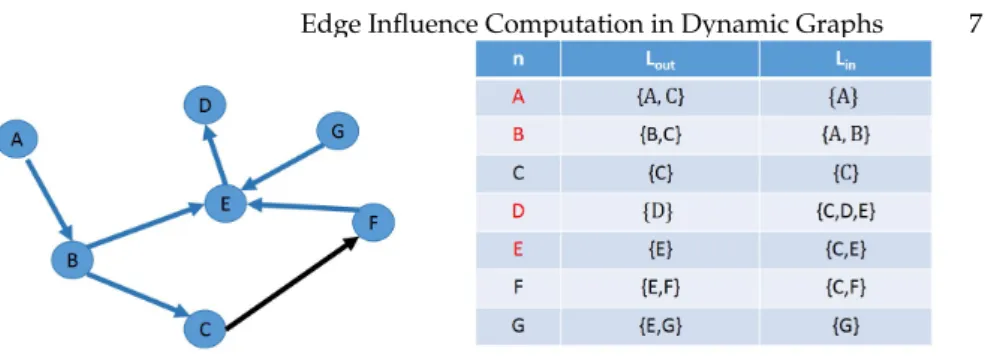
Example 2. Given a DAGGand its corresponding labeling indexLas shown in
Fig. 4, if deleting edgee=C→F, the process of edge deletion is as follows.
Firstly, we divide all nodes ofGinto six sets, where:
NtoSO contains nodesAandB.
Nf romEO contains nodesEandD.
Fig. 5. GraphGandlabeling indexL
It is obvious that we need to handleNtoSOandNf romEO, which is Situation 3.
1. After checking columnLoutof nodeC, we find that there is noF, so we do
not need to delete anything.
2. We need to find out the child node ofC, which is nodeF. BecauseFis the terminus node of edgee, we do not need to add anything toLout.
3. We deal with the father node ofC, which isB. BecauseFis not inLoutofB,
we just need to check all child nodes ofB,EandC. For child nodeC, the
LoutofChas already been included inLoutofB, which we do not need deal
with. For child nodeE, theLoutofEis not inLoutofB, so we need to addE
toLoutofB.
The newL0
outofB=LoutofB+LoutofE={B,E,C}.
4. We handle with the father node ofB, which isA. Similar toB, we can compute the newL0
outofA={A,B,C,E}. BecauseAdoes not have any father node,
the process of dealing withCfinishes.
5. Similar toC, after handlingF, we can compute the newL0
inofF={F}.
6. Similar to nodesBandA, we haveL0
inofE = {E}andL0inofD= {D,E}.
Because Ddoes not have any child node, the process of dealing with F finishes.
Finally we can successfully compute the newL0ofG0as shown in Fig. 6.
Fig. 6. New graphG0
andnew labeling indexL
3.3 Edge Influence
Next, we define edge influence and show how to calculate influence of a given edge efficiently. The influence provides a measure of how important an edge is
to a graph. In other words, without this edge, its influence shows how greatly the reachability of all pairs of nodes of this graph will change.
Definition 1. When one edge is deleted, the number of pairs of nodes whose reachability has been changed due to the deletion stands for the absolute influence of this edge (denoted as In fe).
According to Definition 1, we can calculate the maximum absolute influence of an edge in a given graph according to the following theorem.
Theorem 1. Whatever the structure of the graph is, provided the amount of nodes is
n, the maximum absolute influence (denoted as In fmax) of any edge in the graph is:
In fmax= n 2 2 n is even. (n−1) 2 · (n+1) 2 n is odd. (1)
Proof. Given a graph G = (V,E) with n nodes, there must exist an edge e ∈
E which divides V into three node setsA, B and C. SetsA and B meet two requirements: First, each node inAcan find a path to each node inB; Second, every such path containse. SetCcontains all other nodes that do not belong to setsAandB.
If denoting the number of nodes in setsA,BandCasa,bandc, we have formula (2).
n=a+b+c (2)
If deleting edgee, any path from one node inAto another node inBmay become disconnected. And the amount of these paths area·b. Then according
to Definition 1, we have formula (3).
In fe=ab (3)
Combining (2) and (3), we have formula (4) as follows.
In fe=a(n−a−c) (4)
It is obvious that whencincreases, the value ofIn fedecreases. In order to
achieve the maximum value ofIn fe,cshould be 0. Then, we can transform (4)
to (5).
In fe=a(n−a) (5)
Obviously,In fe is maximum whena= n2. Sincen ∈ Z+, ifnis even,a= n2, and ifnis odd,a= n−21. Combining (2), we arrive at formula (1). This completes
the proof. ut
OnceIn fmaxof a graph is known, the normalized influence of an edge in this
Definition 2. Given a graphG0=
(V,E)with n nodes, the influence of an edge e∈E
is denoted as In fe, which can be computed as follows:
In fe=
In fe
In fmax
(6)
Calculation Given a DAGG, if deleting an edgee=NS →NE, we can apply
the following steps to calculate the influence of edgee. – According to Theorem 1, we calculateIn fmax
– Find out the node set where nodes can be reached by nodeNE including
nodeNEitself, denoted asSetE
– Find out nodes that belong toSetE and can be reached by nodeNS before
deleting edgee, denoted asSetSP
– Find out nodes that belong toSetE and can be reached by node NS after
deleting edgee, denoted as SetSL. And then we can get node set SetS =
SetSP−SetSL. The amount of nodes inSetSequals to the amount of bode pairs
with changed reachability status that is related to nodeNSafter deleting edge
e
– For each ancestor node ofNS, we can calculate the correspondingSeti. It
should be noted that during the calculation, once we haveSeti=∅, we can
stop calculating ancestors of nodeNi
– Assumingniis the amount of nodes inSeti, the absolute influence of edge
eisIn fe =Pni. Then we can compute the influence of edgeeaccording to
formula (6)
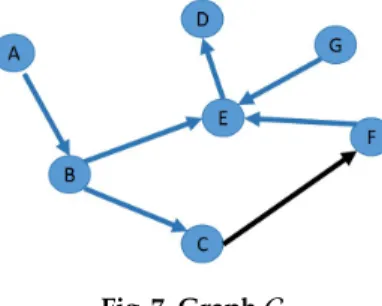
Example 3. Given a DAGG, we can calculate the influence of edgee=C→Fin
the following.
Fig. 7. GraphG
– Calculate the maximum absolute influenceIn fmaxof graphG.
In fmax=(7 −1)
2 ×
(7+1) 2 =12
– SetCP={D,E,F}
– SetCL=∅ThenSetC={D,E,F} −∅={D,E,F}.SetChas three nodesD,Eand
F, sonC=3
– For nodeC’s ancestor nodeB,SetB = {D,E,F} − {D,E}= {F}. There is only
one nodeFinSetB, sonB = 1. For the second ancestor nodeAof nodeC,
SetA={F} −∅={F}, which meansnA=1
– In fe=Pni=nC+nB+nA=3+1+1=5. Then In fe= In fe In fmax = 5 12 Therefore, the influence of edgeeis 5
12in graphGin Fig. 7.
4
Experiments
We use the following five real-world datasets in our experiments: p2p-Gnutella08 (Gnu08, 6.3K nodes, 21K edges), p2p-Gnutella06 (Gnu06, 8.7K nodes, 32K edges), Wiki-Vote (Wiki, 7.1K nodes, 104K edges), p2p-Gnutella31 (Gnu31, 63K nodes, 148K edges) and soc-Epinions1 (Epi1, 76K nodes, 509K edges) [11]. We use these datasets to conduct two sets of experiments. The first set is to delete 100 edges generated by the graph transformation module randomly. We compare labeling index method (TOL method) with our method by performing 100 edge dele-tions and record the average time cost and the average index size (the changed part). The second set is to validate our edge influence algorithm also by per-forming 100 edge deletions and record the average time cost. All experiments were performed on a PC with 64-bit Windows 7, 8GB RAM and 2.40GHZ Intel i7-3630QM CPU.
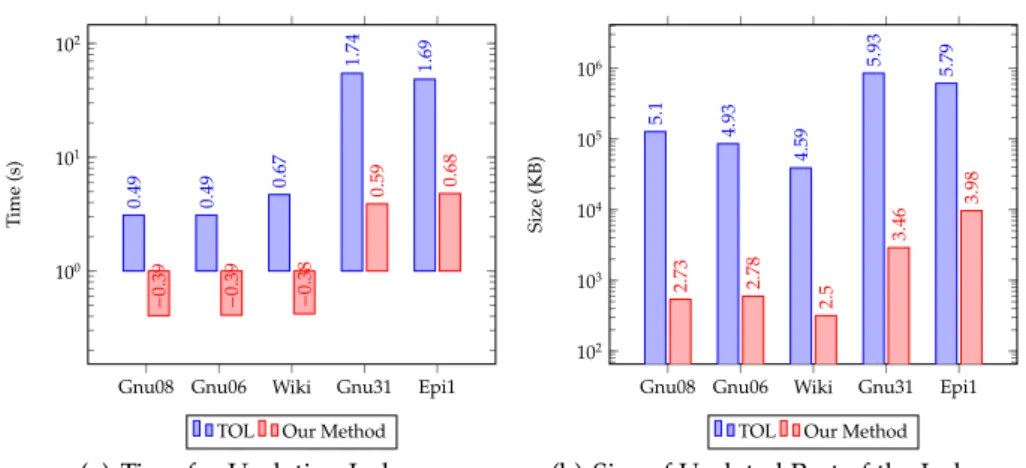
It should be noted that these bar charts use log-scale plotting features. From Fig. 8(a), we can see that our method performs deletion nearly at a speed of an order of magnitude faster than TOL method among all the datasets. The updated index size of our method is also much smaller than TOL method (see Fig. 8(b)). The main reason for these two experimental results is that our method can incrementally compute updated index for edge deletions, while TOL method can only support node deletions. For edge deletions, TOL method has to recompute the whole index from scratch. Here, we do not compare indexing time with other approaches for static graphs, as TOL method has been shown to outperform most existing approaches for static graphs [1].
Fig. 9 shows the average calculation time of edge influences for the 100 deleted edges. Since this is the first attempt on the calculation of edge influence, we compare our method with a modified BFS&DFS method2. From the figure we can see that our method can compute edge influences orders of magnitude faster than the modified BFS&DFS method. For datasetEpi1, the modified BFS&DFS method cannot complete the calculation within 24 hours.
2BFS&DFS refers to Breadth-First-Search and Depth-First-Search. Both our method and BFS&DFS were performed on top of the updated labeling index.
Gnu08 Gnu06 Wiki Gnu31 Epi1 100 101 102 0 . 49 0 . 49 0. 67 1 . 74 1 . 69 − 0 . 39 − 0 . 39 − 0 . 38 0 . 59 0.68 T ime (s)
TOL Our Method (a) Time for Updating Index
Gnu08 Gnu06 Wiki Gnu31 Epi1 102 103 104 105 106 5 . 1 4 . 93 4 . 59 5 . 93 5 . 79 2 . 73 2 . 78 2 . 5 3 . 46 3 . 98 Size (KB)
TOL Our Method (b) Size of Updated Part of the Index
Fig. 8.Comparison with TOL Approach
Gnu08 Gnu06 Wiki Gnu31 Epi1 100 101 102 103 104 1 . 51 1.66 1 . 94 3 . 53 0 . 72 0 . 7 0 . 55 2 . 12 3 . 13 T ime (s) BFS/DFS Our Method
Fig. 9.Calculation Time of Edge Influence
5
Conclusion
In this work, we propose a new approach to calculate an updated labeling index of a graph after edge deletions. Then we define the influence of edges in a graph based on reachability between nodes affected by the potential deletions of edges, and provide an approach to calculating the influence of any given edge in the graph. Our experiments validate the efficiency and scalability of our approach. Future work includes devising faster algorithms to handle even larger dy-namic graphs (e.g., at the scale of millions of nodes and edges) and design new algorithms to rank all the edges based on our defined edge influence in large graphs.
Acknowledgments
Authors would like to thank Xiaorong Liang for the implementation of the algorithms and thank anonymous reviewers for their valuable comments.
References
[1] Zhu, Andy Diwen, et al. ”Reachability Queries on Large Dynamic Graphs: A Total Order Approach.”
[2] Cheng, James, et al. ”TF-Label: a topological-folding labeling scheme for reacha-bility querying in a large graph.” Proceedings of the 2013 international conference on Management of data. ACM, 2013.
[3] Wang, Haixun, et al. ”Dual labeling: Answering graph reachability queries in constant time.” Data Engineering, 2006. ICDE’06. Proceedings of the 22nd Inter-national Conference on. IEEE, 2006.
[4] Agrawal, Rakesh, Alexander Borgida, and Hosagrahar Visvesvaraya Jagadish. Efficient management of transitive relationships in large data and knowledge bases. Vol. 18. No. 2. ACM, 1989.
[5] Jin, Ruoming, et al. ”Efficiently answering reachability queries on very large di-rected graphs.” Proceedings of the 2008 ACM SIGMOD international conference on Management of data. ACM, 2008.
[6] Jagadish, H. V. ”A compression technique to materialize transitive closure.” ACM Transactions on Database Systems (TODS) 15.4 (1990): 558-598.
[7] Cohen, Edith, et al. ”Reachability and distance queries via 2-hop labels.” SIAM Journal on Computing 32.5 (2003): 1338-1355.
[8] Bramandia, Ramadhana, Byron Choi, and Wee Keong Ng. ”Incremental main-tenance of 2-hop labeling of large graphs.” Knowledge and Data Engineering, IEEE Transactions on 22.5 (2010): 682-698.
[9] Schenkel, Ralf, Anja Theobald, and Gerhard Weikum. ”HOPI: An efficient con-nection index for complex XML document collections.” Advances in Database Technology-EDBT 2004. Springer Berlin Heidelberg, 2004. 237-255.
[10] Yildirim, Hilmi, Vineet Chaoji, and Mohammed J. Zaki. ”Dagger: A scal-able index for reachability queries in large dynamic graphs.” arXiv preprint arXiv:1301.0977 (2013).
[11] Leskovec, Jure. ”Stanford large network dataset collection, 2014.” URL: http://snap.stanford.edu/data/index.html
[12] H. Yildirim, V. Chaoji, and M. J. Zaki. Grail: Scalable reachability index for large graphs. PVLDB, 3(1):276284, 2010.
[13] S. J. van Schaik and O. de Moor. A memory efcient reachability data structure through bit vector compression. In SIGMOD, pages 913924, 2011.
[14] S. Seufert, A. Anand, S. J. Bedathur, and G. Weikum. Ferrari: Flexible and efcient reachability range assignment for graph indexing. In ICDE, pages 10091020, 2013.
[15] R. Schenkel, A. Theobald, and G. Weikum. Efcient creation and incremental maintenance of the hopi index for complex xml document collections. In ICDE, pages 360371, 2005.