Score Interpretation Manual
New Jersey Department of Education
September 2015 - February 2016
Alternate Profi ciency Assessment (APA)
Science
June 2016
PTM # 1510.68
Copyright 2016 by New Jersey Department of Education
STATE BOARD OF EDUCATION
MARK W. BIEDRON
Hunterdon
President
JOSEPH FISICARO
Burlington
Vice President
ARCELIO APONTE
Middlesex
RONALD K. BUTCHER
Gloucester
JACK FORNARO
Warren
EDITHE FULTON
Ocean
ERNEST P. LEPORE
Hudson
ANDREW J. MULVIHILL
Sussex
J. PETER SIMON
Morris
DOROTHY S. STRICKLAND
Essex
David C. Hespe, Commissioner
Secretary, State Board of Education
It is a policy of the New Jersey State Board of Education and the State Department of Education that no person, on the basis of race, creed, national origin, age, sex, handicap, or marital status, shall be subjected to discrimination in employment or be excluded from or denied benefits in any activity, program, or service for which the department has responsibility. The department will comply with all state and federal laws and regulations concerning nondiscrimination.
TABLE OF CONTENTS
PART 1: INTRODUCTION AND OVERVIEW OF ASSESSMENT PROGRAM
A. How to Use This Booklet ... 1
B. Test Security and Confidentiality ... 2
C. Reporting Process ... 2
Record Change ... 2
Reporting... 5
Portfolio Returns ... 5
District Student Data ... 5
State Summary ... 5
Report Distribution ... 6
D. Overview of Statewide Assessment Program ... 10
E. The Design of the APA ... 11
Alignment ... 12
Test Design ... 13
Test Specifications ... 14
Portfolio Components ... 16
Scoring ... 17
- Unscorable Entry Errors (zero scores for all three dimensions) ... 19
- Evidence Errors (zero score for one dimension) ... 19
- Errors (receives score different than may be expected) ... 20
PART 2: INFORMATION FOR SCHOOL ADMINISTRATORS A. Determining the Proficiency Levels for the APA ... 21
B. Other Portfolio Assessment Information ... 22
C. Guide to Teachers ... 22
Step 1. Review ISR Against Explanation Sheet ... 22
Step 2. Review Teacher Training Materials ... 23
Step 3. Other Interpretation Aid... 23
D. Using Assessment Information ... 24
Student-Level Evaluation... 24
E. Communicating Assessment Information ... 25
To the Parent/Guardian ... 26
To the District ... 28
To the Media ... 28
PART 3: SAMPLE REPORTS A. Terms and Definitions ... 29
B. Student-Level Reports ... 35
Student Sticker ... 35
Individual Student Report (ISR) ... 36
C. School- and District-Level Reports ... 40
All Subjects Roster ... 40
Student Roster ... 42
Summary of Performance – School, District ... 44
Performance by Demographic Groups – School, District, and State ... 46
APPENDICES Appendix A: Alternate Proficiency Assessment Scoring Rubric ... 48
Appendix B: Explanation Sheet ... 49
Appendix C: Entry Error Report ... 50
Appendix D: Performance Level Descriptors ... 51
Science ... 51
Biology ... 53
Appendix E: District Factor Groups (DFGs) ... 54
Appendix F: Student Demographic Information Form (SDIF) ... 56
REFERENCES ... 58
PART 1: INTRODUCTION AND OVERVIEW OF ASSESSMENT PROGRAM
A. How to Use This BookletThis Score Interpretation Manual provides a broad range of detailed information about how to interpret and use results of the Alternate Proficiency Assessment (APA). It is organized as a resource for teachers and school administrators who need to understand and discuss the score reports with others, such as parents/guardians, districts, or the media. This manual is divided into the following parts:
Part 1: Introduction and Overview of Assessment Program
This section provides a description of the New Jersey assessment program in general, the design of the APA, the components of an APA portfolio, and a summary of the scoring and reporting process.
Part 2: Information for School Administrators
This manual is primarily addressed to school administrators who are charged with understanding, using, and explaining the series of reports generated to communicate test results.
A. Determining the Proficiency Levels – describes the purpose of standard-setting for determining the proficiency levels.
B. Other Portfolio Assessment Information – addresses the differences between the APA and the general assessment, and accountability.
C. Guide to Teachers – assists teachers in reviewing the APA results.
D. Using Assessment Information – provides information about assisting students who score below the minimum level of proficiency on one or more subjects of the assessment, and suggestions for evaluating school instructional programs for potential curricular improvement.
E. Communicating Assessment Information – provides guidelines for communicating assessment results and publicly releasing assessment information.
Part 3: Sample Reports
This section provides a definition of terms that describes the meaning of the data, and examples of each report using fictional data.
B.Test Security and Confidentiality
Although the APA does not contain secure test items like other state assessments, APA portfolios are confidential pupil records and must be maintained as such. Portfolio contents should only be shared with parents and others in accordance with pupil records regulations.
C.Reporting Process
The APA program provides a variety of reports to help school personnel identify the needs of each student assessed and to support the evaluation of school and district programs. This manual aims to assist in the analysis, interpretation, and use of these different types of reports. The data contained therein can help identify student strengths and weaknesses and assist in instructional planning for students. In addition, this data will help both school and district personnel to identify and address curricular strengths and needs. Information regarding student progress can assist Individualized Education Program (IEP) teams in selecting appropriate goals and objectives and evaluation criteria for individual students.
Record Change. A Record Change period allows the districts an opportunity to correct inaccurate student demographic information that the district provided for the assessment. Record changes are completed before reporting. Corrections to the student demographic information submitted by the record change deadline are reflected in the final score reports.
It is a district’s responsibility, specifically the District Test Coordinator (DTC), to submit accurate student demographic information. A district has three opportunities to ensure data accuracy: Pre-ID file submission, Student Demographic Information Form, and the Record Change period. The data cannot be changed after the Record Change period ends.
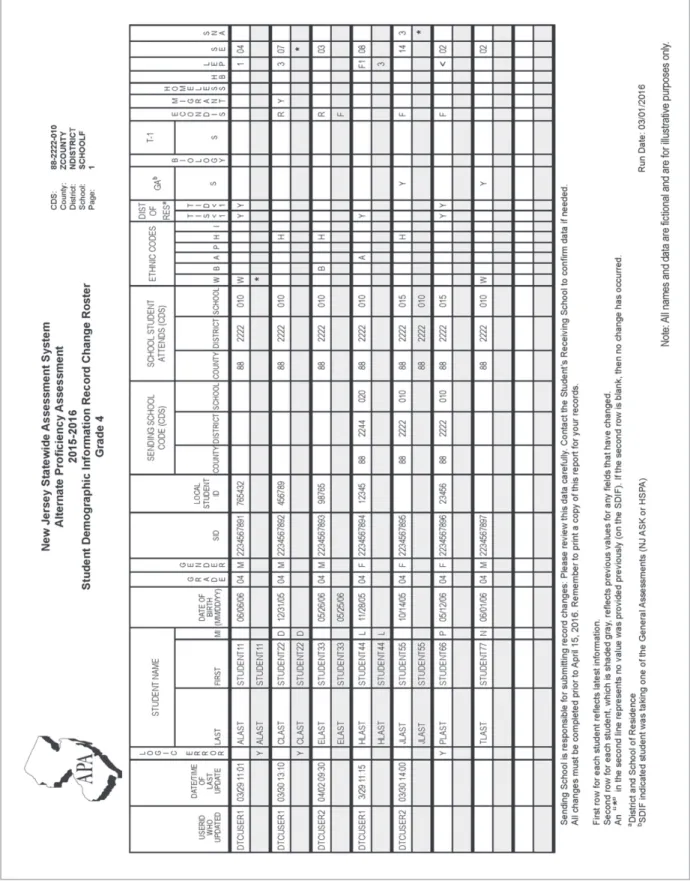
Prior to reporting, an online record change roster of the students who took the APA in their districts or at an out-of-district placement are posted to the vendor’s website. Figure 1 shows a sample of the record change roster. Figure 2 shows the record change roster contact page. The record change roster contains student demographic information that was provided by the district as part of a pre-ID file or on the Student Demographic Information Form (SDIF) for each student. Districts must review each student record and make any necessary corrections or additions to the data. It is the responsibility of the student’s Home School to submit updates to the demographic information.
When there is a sending and receiving relationship, both attending (receiving) and sending schools must communicate with each other and review the information for accuracy. The sending school is responsible for making and submitting any changes during record change, as errors (e.g., CDS code of sending school) will impact the sending school accountability reporting. The student’s attending (receiving) school must provide the sending school with any corrections and revisions several days prior to the record change deadline. Attending (receiving) schools are able to view all student records, but may not make any edits. Updated student demographic information is to be downloaded and saved during the Record Change period for recordkeeping purposes.
If the attending school is located out-of-state, then the sending school is responsible for completing and submitting the record changes and for keeping the attending school informed of the correct
Figure 1: Sample Record Change Roster
If changes have been made, the student record will appear twice in the record change roster. The first line shows the updated student record and the second line will show ONLY those fields that have changed and will reflect the original values for that field.
Reporting. The assessment results are reported electronically in early July. APA reports are delivered electronically by the APA vendor, Questar, via controlled secure web access (https://nj-servicepoint.questarai.com/login.aspx). Using district- and school-specific passwords, districts and schools will download and distribute their own reports. Reports will be available through December 31, 2016 and should be downloaded and saved as soon as they become available. Districts will subsequently receive a set of Individual Student Reports (ISR, 2 per student) and Student Stickers (1 per student) for each school in paper form.
The student’s “attending” school is responsible for sending a copy of the Individual Student Report (ISR) to the parent/guardian. The sending school, if applicable, receives one copy of the ISR. The district of residence (home district) also receives a copy of the ISR for review by the director of special education and the case manager.
New Jersey students attending an out-of-state facility participate in the NJ APA at the attending site. If a student attends an out-of-state facility, the New Jersey sending school should provide a copy of the ISR to the student’s parents and to the out-of-state attending facility.
Districts are required to report test results to their boards of education and to the public within 60 days of receiving test reports. However, any report or report category which contains data for ten or less students may not be publicly reported due to the need to protect student confidentiality. Portfolio Returns. Scored student portfolios are returned to districts in September. Districts may share with and explain the scored portfolios with parents.
District Student Data. Districts of residence and sending districts will receive student level data files of their students electronically. Files in fixed-width ASCII and Excel formats are created for districts and schools with ten or more students. The data file will be available on Questar’s ServicePoint site https://nj-servicepoint.questarai.com/login.aspx. When necessary, a CD-ROM may be requested. To request the data file, contact Questar Customer Support at (866) 690-4733 or [email protected].
State Summary. A state summary data file will be completed based on the reporting data and posted on the NJDOE website before the end of the calendar year (http://www.state.nj.us/education/schools/achievement/). The data file, available in text and Excel formats, contains the same type of test results as in the Performance by Demographics report. Due to the small size of the APA population, the APA reports the state summary at the state level only.
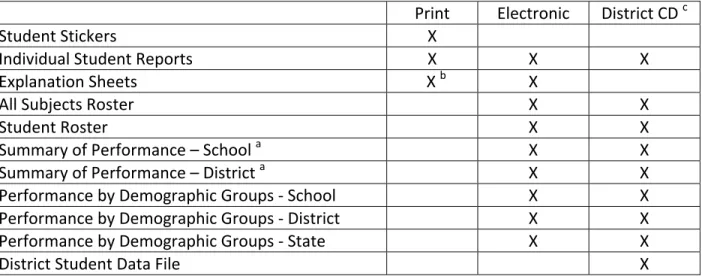
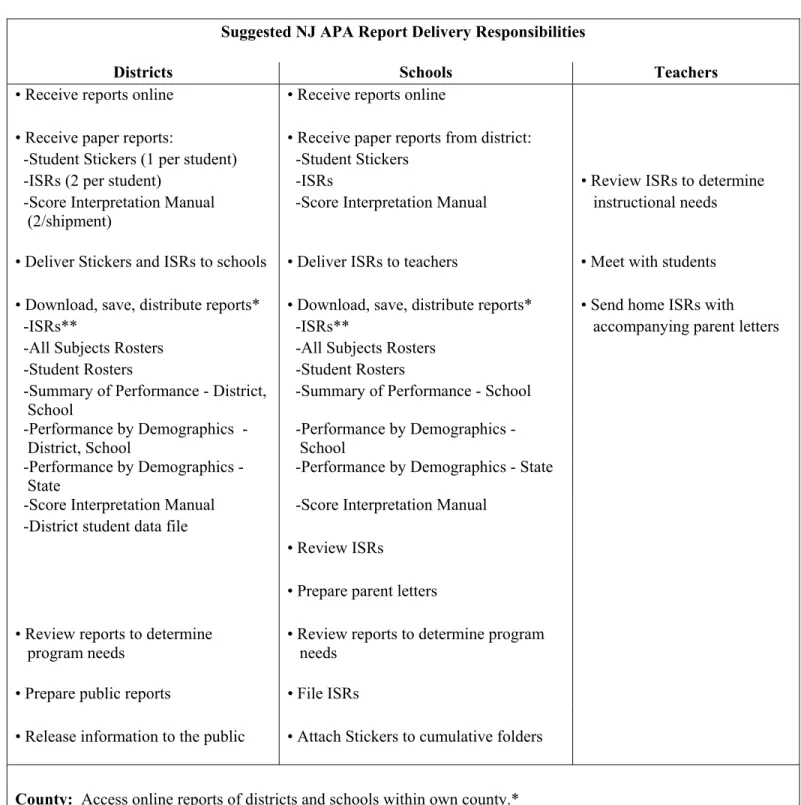
Report Distribution. Table 1 summarizes the available report media. Table 2 lists reports that are available online and the access level for districts and schools. Table 3 provides an overview of report distribution. Table 4 summarizes critical events of report delivery responsibilities and is provided as a suggested guideline.
Table 1: NJ APA Report Media
Print Electronic District CD c
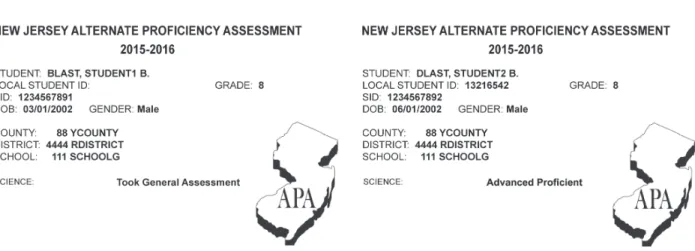
Student Stickers X
Individual Student Reports X X X
Explanation Sheets X b X
All Subjects Roster X X
Student Roster X X
Summary of Performance – School a X X
Summary of Performance – District a X X
Performance by Demographic Groups - School X X
Performance by Demographic Groups - District X X
Performance by Demographic Groups - State X X
District Student Data File X
a – Summary of Performance Report is not created for Private Schools. b – Explanation Sheets are printed and delivered with binder.
Table 2: NJ APA Report Access
a – Summary of Performance Report is not created for Private Schools.
b – A Receiving District can only access the ISR electronically via ServicePoint. Note: The County receives all of the same reports as the District does.
District/School where student resides and attends School District
Student Stickers X
Individual Student Reports X X
Explanation Sheets X
All Subjects Roster X X
Student Roster X X
Summary of Performance - School a X X Summary of Performance - District a X Performance by Demographic Groups - School X X Performance by Demographic Groups - District X Performance by Demographic Groups - State X X
District Student Data File X
District/School where student is sent to another District/School School District
Student Stickers X
Individual Student Reports X X
Explanation Sheets X
All Subjects Roster X X
All Subjects Roster X X
Summary of Performance – School a X X Summary of Performance – District a X Performance by Demographic Groups - School X X Performance by Demographic Groups - District X Performance by Demographic Groups - State X X
District Student Data File X
District/School where student is received by another District/School School District
Student Stickers
Individual Student Reports X X b
Explanation Sheets X
Table 3: Report Distribution Overview
Report Distribution Overview District Reports for Students Educated In and Out of the District
(* Receiving Districts, including Private Schools, will receive only the All Subjects Roster) All Subjects Roster
Summary of Performance - District Summary of Performance - School
Performance by Demographic Groups - District Performance by Demographic Groups - School Performance by Demographic Groups - State
School Reports for Students who Attend a Receiving School (if applicable)
Receiving School the Student Attends will receive: Individual Student Reports
Explanation Sheets (delivered only when student has non-score codes) All Subjects Roster
Student Roster
Sending School will receive: Student Stickers
Individual Student Reports
Explanation Sheets (delivered only when student has non-score codes) All Subjects Roster
Student Roster
Summary of Performance - School
Performance by Demographic Groups - School Performance by Demographic Groups - State
School Reports for Students who Attend a School in their District of Residence (if applicable)
Sending School will receive: Student Stickers
Individual Student Reports
Explanation Sheets (delivered only when student has non-score codes) All Subjects Roster
Student Roster
Summary of Performance - School
Performance by Demographic Groups - School Performance by Demographic Groups - State
Note for ISR: If a student attends an out-of-state facility, the sending school should provide a copy of the ISR to the student’s parents and to the out-of-state attending facility as feedback.
Table 4: Suggested Report Delivery Responsibilities
Suggested NJ APA Report Delivery Responsibilities
Districts Schools Teachers
• Receive reports online • Receive reports online
• Receive paper reports: • Receive paper reports from district: -Student Stickers (1 per student) -Student Stickers
-ISRs (2 per student) -ISRs • Review ISRs to determine
-Score Interpretation Manual (2/shipment)
-Score Interpretation Manual instructional needs
• Deliver Stickers and ISRs to schools • Deliver ISRs to teachers • Meet with students
• Download, save, distribute reports* • Download, save, distribute reports* • Send home ISRs with
-ISRs** -ISRs** accompanying parent letters
-All Subjects Rosters -All Subjects Rosters -Student Rosters -Student Rosters -Summary of Performance - District,
School
-Summary of Performance - School -Performance by Demographics - District, School -Performance by Demographics - School -Performance by Demographics - State
-Performance by Demographics - State -Score Interpretation Manual -Score Interpretation Manual
-District student data file
• Review ISRs
• Prepare parent letters
• Review reports to determine program needs
• Review reports to determine program needs
• Prepare public reports • File ISRs
• Release information to the public • Attach Stickers to cumulative folders
County: Access online reports of districts and schools within own county.* * NOTE:
Please remember to download and save your report files from https://nj-servicepoint.questarai.com/login.aspx as soon as they become available. Report files will not be available after December 31, 2016.
D. Overview of Statewide Assessment Program
In May, 1996, the New Jersey State Board of Education adopted Core Curriculum Content Standards (CCCS) to describe what all students should know and be able to do at the end of fourth grade, eighth grade, and upon completion of a New Jersey public school education. The Core Curriculum Content Standards delineate New Jersey’s expectations for student learning. All New Jersey school districts are required to organize instruction and design curricula so that all students, including students with disabilities, are working toward achieving the content standards. All New Jersey state assessments are now designed to measure achievement of the standards. The Elementary School Proficiency Assessment (ESPA) was designed, from its inception in 1997, to measure achievement of the NJ CCCS for fourth graders. In May 2003, the New Jersey Assessment of Skills and Knowledge (NJ ASK) for grades three and four, replaced the ESPA. The NJ ASK 3, the third grade assessment, became operational in March 2004. The NJ ASK was expanded in the spring of 2007 to include those students in grades 5, 6, and 7. In the spring of 2008, the NJ ASK was expanded again, now to include all grades between grade 3 and grade 8. The NJ ASK assessment is aligned with the content standards and should be used for placement and program planning so students can receive the appropriate instruction to enable them to pass the state’s graduation test. The High School Proficiency Assessment (HSPA) is aligned with the content standards and has replaced the HSPT11 as the state’s graduation test. In March 2002, the HSPA was administered for the first time to eleventh grade students. According to the Individuals with Disabilities Education Act of 2004 and the No Child Left Behind Act of 2001, all students with disabilities must participate in state assessments. States must develop alternate assessments for those students who cannot participate in the general state assessments. Most students with disabilities in New Jersey participate in the general assessments: the NJ ASK and HSPA. For those students with the most significant cognitive disabilities who are unable to participate in the general statewide assessments, the Alternate Proficiency Assessment (APA) was designed.
The APA is a portfolio assessment which measures progress toward achieving New Jersey’s CCCS. It was first administered during the 2001–2002 school year in two content areas: Language Arts Literacy and Mathematics at grades 4, 8, and 11.
During the 2004–2005 school year, the APA was administered at grades 4, 8, and 11 in Language Arts Literacy, Mathematics, and Science, and Language Arts Literacy and Mathematics in grade 3. Starting with the 2006–2007 administration of the APA, Language Arts Literacy, Mathematics, and Science were administered in grades 4, 8, and 11, and Language Arts Literacy and Mathematics were assessed in grades 3, 5, 6, and 7. With the implementation of the High School End of Course Biology Exam, Science was also assessed at grades 9 and 10 if the student was enrolled in a Biology class. Starting with the 2011 administration the New Jersey End of Course Biology exam was renamed to the New Jersey Biology Competency Test (NJBCT).
The Alternate Proficiency Assessment was redesigned and implemented in 2008–2009 to meet the requirements of the US Department of Education. The APA underwent significant changes between the 2007–2008 and the 2008–2009 school years, including changes to the test specifications, assessable content, and scoring dimensions. As a result, new Performance Level
across or including the 2008–2009 assessment year are not recommended, nor are they likely to be interpretable.
2007–2008 was an interim year of the design change. Based on the USED peer review, the skills assessed were required to be academic in nature and linked to a grade-level cumulative progress indicator (CPI). An interim standard setting was conducted in April 2008. The interim standard setting was to ease the further transition of additional changes for the re-designed APA.
In February 2009, the standard setting process for the revised APA began with the development of specific Performance Level Descriptors (PLD) for each grade and content area for the APA administered in 2008–2009. The standard setting was conducted in June 2009. The New Jersey State Board of Education approved the cut scores (i.e., proficiency levels) in July 2009.
Starting with the 2009 administration, the APA assessed Language Arts Literacy and Mathematics in grades 3, 4, 5, 6, 7, 8, 11, and grade 12 (if the student was not assessed as a grade 11 student). Science is assessed in grades 4 and 8, and in grades 9, 10, 11, or 12, depending on the grade in which a student receives Biology instruction.
The 2015 APA assessed Science only. For the 2014-2015 school year, the alternate assessment for English Language Arts and Mathematics transitioned to a new assessment system called Dynamic Learning Maps (DLM). For more information on DLM, please visit http://www.state.nj.us/education/assessment/apa/dlm/. The alternate assessment for Science continues to be assessed in a portfolio format in grades 4 and 8, and in grades 9, 10, 11, or 12, depending on the grade in which a student receives Biology instruction.
For accountability purposes, the APA is both a student assessment and a school/district program assessment. The proficiency level classification allows the APA results to be combined with the results from the general assessment for state and federal reporting. The Office of Title I produces accountability reporting using the assessment data.
E. The Design of the APA
The Alternate Proficiency Assessment (APA) is a portfolio-based assessment designed to measure progress toward achieving New Jersey’s state educational standards for those students with the most significant cognitive disabilities who are unable to participate in the general assessment: Partnership for Assessment of Readiness for College and Careers (PARCC), New Jersey Assessment of Skills and Knowledge in Science grades 4 and 8 (NJASK), the High School Proficiency Assessment (HSPA), and the New Jersey Biology Competency Test (NJBCT). The APA is not designed as a measure for graduation.
Federal peer review guidance indicates that a state’s academic achievement standards must be aligned with the State’s academic content standards and capture the full range and depth of knowledge and skills defined in the State’s academic content standards (USED, 2007). For the APA, this was achieved by the development of grade-level specific Performance Level Descriptors and achievement levels that cover the full range of knowledge and skills articulated in the CPI Links.
In order to meet the requirements of the United States Department of Education, the APA was revised to include changes to content that may be assessed and the dimensions on which that content is scored. These revisions in test design were implemented in the 2008–2009 school year. Alignment
In 2007, as part of the test redesign, the NJ DOE worked with ILSSA and NJ educators to identify appropriate standards and associated CPIs for the APA population. The standards and CPIs identified differed across grades to ensure the broadest coverage of the NJ CCCS.
The CPI Links are skill statements that directly link to the critical essence of CPIs from the New Jersey Core Curriculum Content Standards. Providing these skill statements removes the need for educators to determine an appropriate instructional link to the CPIs, as the CPI Links have already been vetted using criteria developed in NJ based on the peer-reviewed work of special education researchers and the National Alternate Assessment Center (NAAC).
Each link is presented at three different levels of complexity to provide examples of how the essence of grade level content can be taught to students with the most significant cognitive disabilities who have varied levels of communication and skills. The three levels of connection to each CPI are: Matched Link, Near Link, and Far Link.
All CPI Links are aligned with grade level CPIs, however they differ in the level of complexity and difficulty that the student is expected to perform. Matched Links have more complexity and difficulty than the Far Links.
The criteria used as guiding principles for test development and alignment process can be found in the 2015–2016 NJ APA Procedures Manual (Chapter One).
The different levels of the CPI Links do not correspond to a particular communication system, learning style, or disability category of a student. Students may be using a Matched Link in one entry and a Far Link in another entry.
Matched Link: Contains skill statements that are approximately the same complexity level of the CPI expectation, but the level of difficulty is lessened
• For instance, if the CPI complexity level is “understanding” then a Matched Link usually requires the student demonstrate understanding. However, if the CPI expectation is that the student understands similes, metaphors, personification, and alliteration, the Matched Link might only require a few of those concepts, thus modifying the difficulty level.
• The difficulty may also be lessened by providing an adapted text, fewer problems, or other supports.
Near Link:May be the same or lower complexity as the CPI expectation, but the difficulty level has been lessened even more
• If the complexity level for the CPI is at the “understanding” level, then the Near Link may be “understanding” but the difficulty level has been modified to include fewer concepts and additional supports.
OR
• A Near Link may have been developed by modifying the complexity level so that instead of “understanding” the student is required to demonstrate “remembering.”
Far Link: Contains skill statements that are a lower complexity level and difficulty is lessened even more.
• For instance, if the CPI expectation is at the “understanding” level, the student is only expected to perform at the “remembering” level.
• Also, the difficulty level has been lessened so that the student is only identifying part of the concept/skill required in the CPI and has additional supports.
Test Design
The basic design of the APA remains the same across grades and content (subject) areas; it is the specific academic content being measured which differs. In each APA subject area four strands from the NJ CCCS are measured. For each strand, a CPI from the CCCS and a CPI link must be identified. To assess student mastery of the CPI link the teacher uses data collected from classroom learning and assessment activities. The student’s ability to complete the tasks in the activities is measured once early in the assessment window providing the first piece of evidence (baseline). The student is then measured late in the assessment window on the same targeted skill to see the extent to which their performance has improved, providing the second piece of evidence.
The entries of the APA portfolio are scored based on three dimensions: complexity, performance, and independence.
Complexity: Evaluates how closely the CPI Link assesses the CCCS CPI. The CPI Links vary by complexity and difficulty in relation (Matched, Near, Far) to the CPI.
Performance: Evaluates the student’s accuracy performing the skills represented in the CPI Links. This dimension measures the extent to which students show progress toward achieving the CPI Link. The student’s performance is documented by evidence of the student working on the CPI Link within the specified two data collection periods in a school year (an initial piece of evidence and a final piece of evidence).
Independence: Evaluates the extent to which the student completed test items independently.
Each CPI Link maintains fidelity with the grade level CPI (content centrality) but the complexity and difficulty varies from Matched to Far Link (performance centrality). Complexity is the expectation level at which the student should perform the skill (remembering, understanding, applying, analyzing, evaluating and creating). Difficulty involves the number of concepts, skills, or ideas on which the student will be working or the type of adaptations and supports in place. Difficulty can be changed by reducing the number of nouns addressed within the CPI, limiting the
amount a student has to do, or by using adaptations such as adapted text of a limited number of items. Performance measures how well the student has demonstrated the skill specified in the CPI Link within the collection periods.
A student’s level of proficiency is based on the total earned score, combining the scores of the three dimensions. The cut scores established through standard setting are used to determine the performance classification indicated by the student’s earned score.
Test Specifications
Test specifications provide specific guidance on how to link to grade level CPIs and address the federal requirement of alignment to the skills tested in the general assessments. Specifying the strands and CPIs allows for more specific examples of grade-level linked skills, narrows the focus of assessment to select CPIs, and increases standardization of the assessment for students with significant cognitive disabilities.
Instruction and assessment must directly link to a grade-level CPI and address its critical essence. Students may not be assessed in functional, behavioral, or access (social, motor, etc.) skills. Functional activities and materials might be used to promote understanding during instruction, but the evidence and activities demonstrating student achievement for assessment must be academically focused and represent the entire grade-level CPI Link.
Each content area requires four entries, each one reflecting the assessment of a different CPI Link. The instructional activity used at the beginning and at the end of the CPI Link instruction is submitted as the assessment evidence. Therefore, each entry requires two pieces of evidence. For CPI Links, an activity must include at least five test items.
Each APA portfolio in each grade requires four entries per content area. Science is assessed at grades 4, 8, and high school.
Table 5 illustrates the required components for each APA portfolio, including the standards, strands, and CPIs that must be assessed by APA.
Table 5: Test Specifications
2015 - 2016
NJ APA Science Test Specifications Entry
Standard (NJ CCCS) Strand G4 G8 HS
5.5 Characteristics of Life A: Matter, Energy, and Organization in Living
Systems X X
B: Diversity and Biological Evolution X X 5.6 Chemistry A: Structure and Properties of Matter X
B: Chemical Reactions X
5.7 Physics B: Energy Transformations X 5.8 Earth Science B: Atmosphere and Water X 5.9 Astronomy and Space
Science A: Earth, Moon, and Sun System X
B: Solar System X
5.10 Environmental Studies A: Natural Systems and Interactions X B: Human Interactions and Impact X
Science Standards
5.5 Characteristics of Life
A. Matter, Energy, and Organization in Living Systems B. Diversity and Biological Evolution
5.6 Physical Science – Chemistry
A. Structure and Properties of Matter B. Chemical Reactions
5.7 Physical Science – Physics B. Energy Transformations 5.8 Earth Science
B. Atmosphere and Water 5.9 Astronomy and Space Science
A. Earth, Moon and Sun System B. Solar System
5.10 Environmental Studies
A. Natural Systems and Interactions (APA–High School only) B. Human Interactions and Impact (APA–High School only)
Portfolio Components
A portfolio is a collection of paper-based student work samples, student demographic data, and instructional information that relates to a student’s progress on the New Jersey Core Curriculum Content Standards (CCCS), strands, grade-level cumulative progress indicators (CPIs), and skill statements called CPI Links.
A completed portfolio should contain some or all of the following items: • Table of Contents
• Entry Cover Sheet for each standard, strand, CPI and CPI Link assessed • Standards-based entries:
• Science: Four entries
• Grade 4: One strand each from standards 5.5, 5.6, 5.8, and 5.9 • Grade 8: One strand each from standards 5.5, 5.6, 5.7, and 5.9
• High School Biology (Grades 9, 10, 11, or 12): Two different strands (A and B) each from standards 5.5 and 5.10
Science entries are to be submitted when the student is in grade 9, 10, 11, or 12 (students in high school must be assessed in science the year they receive instruction in biology).
Table of Contents. A table of contents helps the teacher organize the portfolio. A table of contents can be adapted to meet the individual needs of each student.
Entry Cover Sheets. An entry cover sheet must be submitted with each entry. The standard addressed in the entry is listed on the cover sheet.
Entries. A collection of evidence that documents a student’s knowledge and application of key concepts and skills pertaining to a particular content area; the entry must document student performance of a CPI Link that relates to a specific content Standard, Strand, and a selected grade-level CPI (CPI identified for assessment in the APA). An entry contains two pieces of evidence, one collected during each of the two specified collection periods.
Cumulative Progress Indicators (CPIs). Concepts and skills to be taught within the content standards, specified by grade level.
CPI Link. Skill statements that directly link to the critical essence of specific grade-level CPIs. Evidence. Representation of a student’s performance of a CPI Link. Evidence documents educational instruction and student performance of skills. The evidence presented may include samples of teacher-graded student work, captioned photographs, and a snapshot of completed student work that documents student performance of the skills contained within the CPI Link. Student work obtained from the instructional activities used at the beginning and at the end of the CPI Link instruction is submitted as the assessment evidence.
from the first collection period to establish the baseline: the initial prompt or Independence level on the CPI Link and the initial student performance accuracy; a CPI Link is only eligible for assessment if the initial student performance is less than 40% accurate. The last piece of evidence must come from the second collection period to document the student’s final level of accuracy and independence on the same CPI Link.
Below is this year’s collection schedule:
• First Collection Period September 1, 2015 to November 13, 2015 • Second Collection Period December 7, 2015 to February 12, 2016 Scoring
To score the portfolios, trained expert scorers used a scoring rubric designed to measure student performance on the skill, the level of independence when performing the skill, and the relationship of the skill to the grade-level cumulative progress indicator.
The scoring rubric was determined by reflecting on the purpose of the APA, which is to: • assess the district and school grade-level instructional program provided to the student, • assess a student’s attainment of knowledge and skills of the CCCS, and
• encourage high but appropriate instructional standards for all students, while providing necessary supports to access the curriculum and foster the highest level of independence possible for the student.
The entries of the APA portfolio are scored based on a rubric that contains three dimensions: Complexity, Performance, and Independence. Scores are reported with a proficiency level. The APA proficiency levels are based on the total score.
Entries that are inappropriate, missing, or when the student takes the general assessment in the same content area, are reported as unscorable. Please refer to the New Jersey APA 2015–2016 Procedures Manual for guidelines for scorable evidence meeting the Universal Scoring Rules.
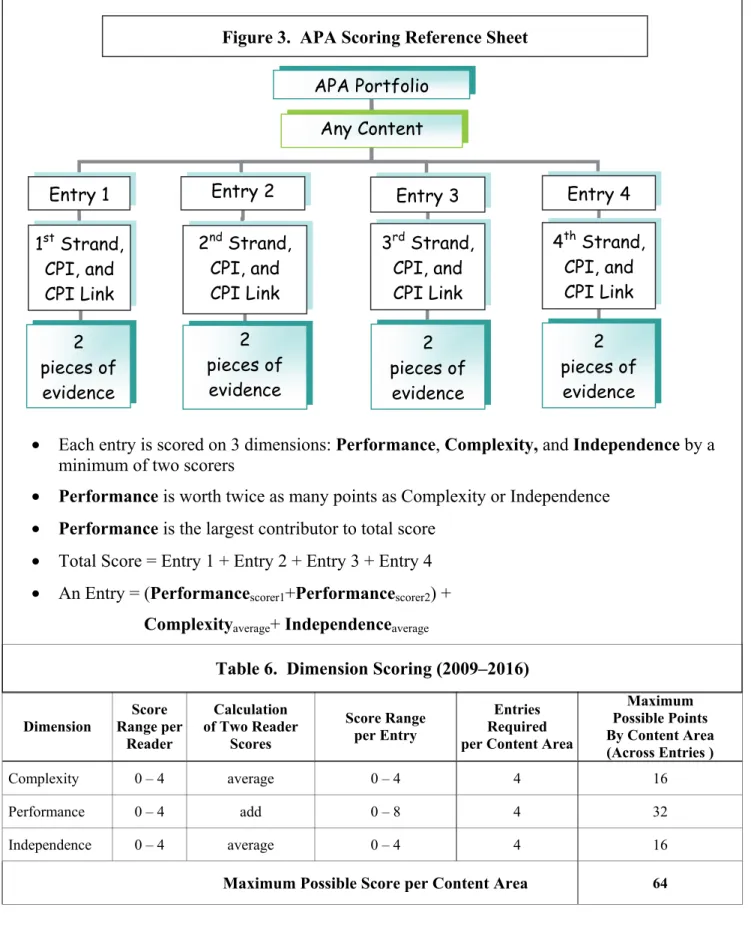
Each entry is reviewed independently by at least two readers for each of the three dimensions. An entry score is derived by two equivalent scores, one from each reader. If the scores given by the two readers do not agree, then a third reader scores the dimension(s) until there are two equal scores. The two equal scores are added or averaged, depending on the dimension. As a result of this scoring, there are no half-point scores.
Each scorable entry receives a score of 0–4 for each of the three dimensions. For the dimensions of complexity and independence, the two ratings are averaged with a score range of 0–4 per entry and 0–16 per dimension across all 4 entries. For the dimension of performance, the two ratings are summed with a score range of 0–8 per entry and 0–32 for the dimension across 4 entries. The total score of a content area is calculated by adding the scores of all three dimensions for each of the four entries and ranges from 0–64.
Figure 3 illustrates the blueprint of the test design with scoring references. Table 6 summarizes the dimension scoring. The scoring rubric which describes the ratings for each dimension can be found in Appendix A. For additional information, please reference the 2015–2016 NJ APA Procedures
APA Portfolio Any Content Entry 1 Entry 3 1st Strand, CPI, and CPI Link 2 pieces of evidence 3rd Strand, CPI, and CPI Link 2 pieces of evidence Entry 4 4th Strand, CPI, and CPI Link 2 pieces of evidence Entry 2 2nd Strand, CPI, and CPI Link 2 pieces of evidence
Figure 3. APA Scoring Reference Sheet
• Each entry is scored on 3 dimensions: Performance, Complexity, and Independence by a minimum of two scorers
• Performance is worth twice as many points as Complexity or Independence • Performance is the largest contributor to total score
• Total Score = Entry 1 + Entry 2 + Entry 3 + Entry 4 • An Entry = (Performancescorer1+Performancescorer2) +
Complexityaverage+ Independenceaverage
Table 6. Dimension Scoring (2009–2016)
Dimension Range per Score Reader Calculation of Two Reader Scores Score Range per Entry Entries Required per Content Area
Maximum Possible Points By Content Area (Across Entries ) Complexity 0 – 4 average 0 – 4 4 16 Performance 0 – 4 add 0 – 8 4 32 Independence 0 – 4 average 0 – 4 4 16
Unscorable Entry Errors (zero scores for all three dimensions)
The term unscorable means that an entry error results in zero scores for all three dimensions (a score point of 0 for Complexity, 0 for Performance, and 0 for Independence), and an unscorable code is assigned that describes the error. An Explanation Sheet (Appendix B) with the unscorable code, description, and a typed explanation of the error (as required) is placed under the plastic sleeve of the front cover of the scored portfolio to indicate that a basic test design requirement was not followed. (A copy of the Explanation Sheet also accompanies the ISR on Service Point.) If any of the following requirements are missing from a piece of entry evidence, the entire entry will be considered unscorable:
1. Student’s name
2. Complete dates (month/day/year) within the specified collection periods 3. A piece of evidence must include at least 5 test items that assess the CPI Link. 4. Evidence presented in the appropriate amount and format
An unscorable code may also result when the evidence/rubric presented in the entry does not align to the CPI/Strand/Standard. An Explanation Sheet (Appendix B) is placed under the plastic sleeve of the front cover of a scored portfolio to provide additional information on these types of errors:
1. Evidence must assess the link while connecting to the essence of the standard and strand. 2. The same CPI Link must be assessed in both pieces of evidence.
3. Evidence must not include more than the skills contained within the CPI Link. 4. One or more items indicate that the concept was incorrectly assessed.
Evidence Errors(zero score for one dimension):
A zero score is assigned to an individual dimension, instead of receiving zero score codes for all 3 dimensions in the entry. This allows the other two dimensions to receive score points. An individual dimension receives a zero when the following violations occur:
• Some or all test items are not marked for accuracy (Performance) • Accuracy score for initial evidence is higher than 39% (Performance)
• No editing marks related to the scoring rubric appear on the student writing response (Performance)
• Some or all test items are not marked for Independence/prompting (Independence)
• The first activity in the entry is clearly more difficult than the second activity (Performance) An Error Report (Appendix C) is placed under the plastic sleeve of the front cover of a scored portfolio to provide additional information on these types of errors:
Errors (receives score different than may be expected):
Rather than assigning an unscorable code for the entry, the scorers are allowed to recalculate percentages or reassign the appropriate performance score. The recalculation may result in a different final score point (1–4) than may be expected. The following violations are reviewed and the accuracy/independence scores recalculated by the scorers:
• One or more items are marked as physically prompted and correct (P+) • Items are marked correct/incorrect but no percentage provided
• Items are marked Independent/prompted but no percentage provided • One or more of the percentage scores provided are inaccurate
• One test item is not correctly graded (marked) for accuracy
For additional information, please reference the 2015–2016 NJ APA Procedures Manual (Chapter Seven, pages 59–72).
PART 2: INFORMATION FOR SCHOOL ADMINISTRATORS
Understanding the portfolio development process includes having knowledge of New Jersey’s Core Curriculum Content Standards (CCCS), the portfolio development procedures and design, the meaning of the Alternate Proficiency Assessment (APA) results, and ways in which the results can be used. This section focuses on the meaning of the APA portfolio results and the correct way to interpret the scores.
A. Determining the Proficiency Levels for the APA
The results of the APA provide data related to a student’s achievement of the NJ CCCS. The proficiency classification of the APA portfolio is determined by combining all dimension scores for each content area.
Of the required four entries, only one scorable entry is required to receive a proficiency level. If the “subject portfolio” contains only one scorable entry, the total score and proficiency level are reported based on the dimension scores of that one entry. Please refer to the New Jersey APA 2015–2016 Procedures Manual for guidelines for scorable evidence meeting the Universal Scoring Rules.
Complexity / Performance / Independence Dimensions
Each entry, within a content area, receives a score for complexity, performance and independence. The four Complexity scores are combined for a Complexity subtotal, the four Performance scores are combined for a Performance subtotal, and the four Independence scores are combined for an Independence subtotal.
Standard Setting
The main purpose of the standard setting was to use Performance Level Descriptors for each new content area and grade band to establish cut score recommendations for the proficiency levels. New test standards should be set whenever a testing procedure is adopted that is judged to be meaningfully different from previous testing procedures. The federal peer review notes emphasized the need for content-specific, grade-level alignment of APA skills assessed to the critical essence of the student’s grade-level cumulative progress indicator (CPI). The test design changes implemented for the 2008–2009 APA required that a new set of standards be established.
A Standard Setting was held in June 2009. The standard setting committee consisted of eighty-one special education teachers, child study team members, general education teachers, and administrators. The committee members were divided into smaller panels based on content. Participants were chosen because of their qualifications as well as their educational expertise. The selection criteria included number of years teaching, student population served, district factor group (DFG) of their educational facilities, type of educational facility, and regional location. Special care was taken to ensure gender and racial/ethnic representation on the committee.
The cut scores recommended by the standard setting committees were presented to NJDOE senior staff and the Commissioner of Education for review. Modifications were made, but only within the
presented the results of this review to the State Board of Education for approval and adoption. The State Board approved the cut scores in July 2009. The Performance Level Descriptors utilized during the standard setting were developed in February 2009 by committees of educators from New Jersey school districts (Appendix D; Science).
Proficiency Classification
The APA cut scores which determine how the total score for each subject area is classified were set in June 2009. Each grade level and subject area cut scores are determined independently; this mirrors the general assessments. The same number of total score points may yield different proficiency levels based on grade level and content being assessed.
Proficiency level is assigned based on the student’s total earned score, a combination of the three dimension scores: complexity, performance, and independence by content area. The three proficiency levels are:
• Advanced Proficient • Proficient
• Partially Proficient
A proficient level means that the student performance met the state level of proficiency. An advanced proficient level indicates performance exceeded the level of proficiency. Partially proficient is considered to be below the state minimum level of proficiency.
B. Other Portfolio Assessment Information
It is important to recognize that the APA system does not report scale scores. The APA scores are based solely on the information provided in the portfolio submitted; therefore, it may not be possible to compare these scores to other APA students and students taking the general assessment. Scale scores are not appropriate for use for the APA system as there are no issues of equating involved. There are no sets of standardized test items (questions); therefore, there are no item difficulties, nor is there a need to equate test scores from year to year.
The APA scores of students who transfer into the district within New Jersey on or after July 1, 2015, and whose demographic information indicates Time in District and Time in School is less than one year, will not be included in the district’s accountability reporting. The Office of Title I produces accountability reporting using this assessment data.
C. Guide to Teachers
Step 1. Review ISR Against Explanation Sheets
When the APA portfolio is returned to the districts, an Explanation Sheet, if applicable, will be included to identify errors in the portfolio construction.
Scored portfolios will be returned to districts in September. Prior to their return, teachers should review the reasons an entry would receive an unscorable code. By comparing score reports against
teachers, most of the issues should become apparent. Teachers may use the following as a guide to review the results:
Upon receipt of the student score report, review the portfolio as you read the Score Interpretation Manual and the Individual Student Report (ISR). All three documents are necessary in order to fully interpret the results.
Reflect on the scoring rubric as you examine the scores for an entry. The language used in the rubric will help you determine why a score point was given.
If an entry received zero scores, the entry did not meet the scoring rules.
• Some of the more complex errors will be described on an Explanation Sheet that is provided in the front cover of the portfolio binder.
• Basic errors such as dates on evidence outside the collection period or too few test items, etc., are easy to identify by examining the test design requirements and the unscorable rules outlined in the scoring section of this manual.
Additionally, listed below are some common mistakes found during current and previous scoring: Assessing the skills contained in the CPI Link without connection to the intent or big idea of
the content and concepts of CPI, Strand, and/or Standard
Assessing the skills contained within the CPI Link without correct understanding of the content or concepts of CPI, Strand, and/or Standard
Assessing more than one CPI Link in an entry
Assessing different parts of a CPI Link in each piece of evidence Assessing only part of the CPI Link
Failure to mark all test items with accuracy and/or Independence/prompt information Failure to give supports on the first activity
Failure to give prompts, instead marking student response as “Don’t Know” or “No Response”
Step 2. Review Teacher Training Materials Step 3. Other Interpretation Aid
Score of 1 for Complexity - due to major flaw
An entry that demonstrates work in a CPI Link but has a major flaw will result in a score of one instead of zero in Complexity. A major flaw includes
• Assessing only part of the CPI Link
• This may be found in the student work sample, and both pieces of evidence must be assessing the same part of the link.
• This may also be found in the writing rubric. • Assessing the same activity for both pieces of evidence Score of 1 for Performance– due to intrusive prompt
Prompting can affect the reliability of the performance score if not implemented correctly. A prompt is always more intrusive than an independent response. If a more intrusive prompt is used on the second activity than was used on the first activity, the entry will score a one for Performance dimension. The following reminders may assist teachers to identify reasons for
• It is important to adhere to the prompt level hierarchy
• Any item performed with a physical prompt is scored as an incorrect response because the student was given the answer
• The final piece of evidence may not have a more intrusive prompt than the initial piece of evidence
Unless otherwise noted by the teacher, the prompt hierarchy is Independent Verbal Gestural Model Physical
For additional information, please reference the 2015–2016 NJ APA Procedures Manual (Chapter Seven, pages 59–72).
D. Using Assessment Information Student-Level Evaluation
Individual Student Reports are provided to districts to assist in measuring student performance related to the content standards. Teachers and administrators may review Performance dimension scores and the student’s portfolio to answer the following questions:
• Did the student make sufficient progress in the skills (CPI Links) assessed?
• If not, were the activities and CPI Links selected at the appropriate difficulty level for the student?
• Were the necessary supports and adaptations provided that would allow the student to access the instruction and assessment?
1. Access to and interaction with materials
2. Multiple means of representation of the concepts and skills being taught and assessed (receptive communication)
3. Multiple means of presentation/response for the student to demonstrate understanding (expressive communication)
• Did the activity appropriately instruct and assess the content, concepts, and skills of the link, CPI and Strand, and Standard?
The APA Procedures Manual provides information regarding the dimensions and their relationship to instruction. IEP teams may use the complexity, performance, and independence scores when reviewing a student’s IEP to determine future goals and objectives, modifications and supports.
Most Intrusive Least Intrusive
Program-Level Evaluation
The APA score report information is used for the purpose of district and school monitoring. Student APA results are combined with the results of general state assessment results at the corresponding grade level of the student for accountability purposes only, in accordance with the Individuals with Disabilities Education Act of 2004 and the No Child Left Behind Act of 2001. Student results will be combined at the proficiency level only.
Results of students attending receiving schools are reported back to their sending schools. Performance and participation results are reported to the United States Department of Education.
Individual Student Reports and student rosters provide information regarding how well the student performed within the grade-level content standards. The student performance reflects how well the instructional program addresses best practice in instruction for students with the most significant cognitive disabilities which are represented in the dimensions of the rubric. Schools may review dimension scores across students tested to determine what program components included in the APA rubric are offered to students and where improvement is needed.
E. Communicating Assessment Information
Districts are required by the New Jersey Administrative Code (N.J.A.C. 6A:8-4.3) to report test results to their boards of education and to the public, including the parents/guardians, within 60 days of receipt of the reports. An analysis must be completed by the district and a summary report made available to the public.
Appropriate confidentiality safeguards must be implemented to protect individual students. Individual student data must never be released to the public. Public reports must not include data on individual students; therefore, actual rosters cannot be made available to the board or public because they list students’ names, which violates federal privacy laws and regulations.
This section provides guidelines for informing people and entities that need to know about test results: parents/guardians, the district, the state, and the media.
• Individual and roster reports must not be released to the public because they list students’ names and are, therefore, not in the public domain.
• Upon receipt of the student score report, review your copy of the portfolio as you read the score interpretation manual and the student score report. All three documents are necessary in order to fully interpret the results. Reflect on the scoring rubric as you examine the scores for an entry. The language used in the rubric will help you determine why a score point was given.
• The scored portfolio binders are returned to districts in September, after score reporting. When reviewing the results, refer to the Explanation Sheet to help identify the errors.
To the Parent/Guardian
Within 60 days of receipt of the reports, districts must provide the parent/guardian a copy of the individual student score report and interpretation materials. When reviewing the student’s assessment result with the parents, districts must provide a copy of the portfolio or the list of the CPI links or skills that his/her child was being assessed on, the score interpretation manual, and the student score report.
• Districts must include a letter to the parent/guardian explaining the purpose of the APA, the information provided on the Individual Student Report (ISR), how to use this information when reviewing the report, and a district contact name and phone number for assistance in the interpretation of scores. Figure 4 shows a sample letter that can be adapted, signed, photocopied, and sent home with each student along with his/her ISR. Additionally, a Parent Information Guide was produced in the Fall of 2015 which addresses common questions about the APA. It is available on Questar’s website (https://nj-servicepoint.questarai.com/login.aspx).
• Parents should receive either a copy of the score interpretation manual, or a copy of the Science Performance Level Descriptors. This is necessary in order for parents to understand the student’s performance classification of advanced proficient, proficient, or partially proficient. (See Appendix D for Performance Level Descriptors for Science and Biology) • Districts must provide information on each CPI Link (skill) that was tested in the APA. This
is extremely important, since students in the same grade may be assessed on different skills. Therefore, the parent/guardian must receive guidance from the district on what skills were tested and sufficient information to understand the test results. Districts may communicate the content area skills assessed in the APA in one of three ways:
Include in the letter to the parent the list of skills that were assessed for the content area, either in the body of the letter or as an attachment
Attach to the letter copies of each entry cover sheet that were submitted in the portfolio, highlighting the CPI Links (skills) assessed
Provide a copy of the portfolio in the packet to the parent, highlighting the CPI Links (skills) assessed
Reviewing a copy of the student’s portfolio with the parent/guardian prior to the receipt of the student score report helps to ensure that the parent is aware of the skills that are being assessed. Since students in the same grade may be assessed on different skills, it is extremely important that the parent/guardian receive guidance from the district and sufficient information to understand the test results, including what skills were tested.
Figure 4:Sample Parent/Guardian Letter Dear Parent/Guardian:
Your child’s Individual Student Report for the New Jersey Alternate Proficiency Assessment (APA) in Science is attached. The APA is a portfolio assessment that consists of a collection of student work which was gathered by your child’s teachers during instructional activities. Your child participated in the APA between September 1, 2015, and February 12, 2016. Your child’s APA portfolio was then submitted to the New Jersey Department of Education and scored by trained readers during the spring of 2016. The attached report provides your child’s APA scores in the content area assessed. The 2015-2016 APA assesses Science only. The alternate assessment for English Language Arts and Mathematics transitioned to a new assessment system called Dynamic Learning Maps (DLM) under a different contractor.
The report tells you the proficiency levels your child achieved on the skills assessed for Science. A level of “proficient” or “advanced proficient” is considered meeting the state standard for the APA. The boxes below the proficiency levels show the scores for each “dimension” scored for each Science standard assessed by the portfolio. Please refer to the back of the Individual Student Report for further information regarding these boxes.
APA results should not be used as the sole basis for instructional decisions. It is important that districts consider multiple measures on all students before making decisions about the student’s instructional placement.
This report is available only to parents, guardians, students, and authorized school officials. If your child attends a school outside of this district, reports are sent to the home school district, your child’s neighborhood school, and the school your child attends. All reports are kept confidential. If you have any questions about the report, please contact ______(district contact name / case manager / teacher / the principal of the school) at _________(phone number) for assistance.
To the District
Districts are required to make available to the public “the number of pupils tested and the percentage of pupils at or above the established levels of pupil proficiency.” When the number of students is large enough (more than 10 students), the results may be considered sufficiently meaningful to report. The Performance by Demographic Group reports contain information that can be used to prepare a public statement.
The School Summary of Performance in Science contains information that can be used to prepare a public report if the student count is greater than ten.
APA results should not be used as the sole basis for instructional decisions. It is important that districts consider multiple measures on all students before making decisions about the student’s instructional placement.
The APA is not a graduation test. The IEP team determines whether a student must meet state and local graduation requirements. Passing the APA is not a graduation requirement.
To the Media
Release information to the media only after having prepared to answer questions either in person or on the telephone. Be sure to analyze the data beforehand; understand and be able to clearly explain the various types of scores. It is recommended that any comparison among schools/districts be avoided.
PART 3: SAMPLE REPORTS
Assessment results are most useful when they are reported in a way that allows educators to focus on pertinent information. The APA reports are designed to communicate results in ways that provide information to educators and parents for program and individual student planning. Reports are generated based on student demographic information provided by the districts.
The APA reports are produced for public schools and districts only. The Individual Student Report provides data that may be used to help identify student and program strengths and needs. The rosters and school and district performance summaries help identify needs across students at the specified grade level.
Sample reports provided in this manual are made with fictional data for illustrative purposes. A. Terms and Definitions
Accountability: The APA is both a student progress assessment, and a school/district program assessment. APA test results will be combined with the results from the general assessments for accountability purposes for state and federal reports. The Office of Title I produces accountability reporting using this assessment data.
District Factor Group (DFG): The DFG used by NJDOE is a measure of the socioeconomic status of the population residing in each district based upon the United States Census data. These groups are labeled from A (lowest) to J (highest). See Appendix E for details related to current DFG designations. In the state summary reporting, the state level performance by DFG is aggregated based on the attending school DFG (where student sat and trained, not the sending school).
Ethnicity: W = White
B = Black or African American A = Asian
P = Native Hawaiian or other Pacific Islander H = Hispanic or Latino
I = American Indian or Alaska Native
Multiple codes are allowed; “O”= Other (no information or multiple codes).
Economically Disadvantaged (ED): An ED student is one who is eligible for either free (F) or reduced-price (R) school lunch. In the All Subject Roster, this is reported with the values F, R, or left blank (not ED). In the Performance by Demographic Group Report, free and reduced-price status defaults to economically disadvantaged status.
Homebound (HB): A homebound student receives home instruction for the duration of the APA portfolio collection period as reported by the student’s school district.
Homeless (H): Homeless is defined as a child or youth who lacks a fixed, regular, and adequate residence, pursuant to N.J.S.A. 18A:7B-12 and N.J.A.C. 6A:17-2.3. For questions regarding the determination of homeless status, contact the Office of Student Achievement and Accountability at 609-943-4283.
Individualized Education Program (IEP): The IEP determines who participates in the APA. The Individualized Education Program (IEP) is a written plan that is developed by members of the local school district child study team, a teacher who has knowledge of the child, and the parent/guardian. It describes how a child currently performs in school, specifies his/her educational needs, includes goals and objectives the parents and staff believe he/she can achieve during the school year, details his/her special education program, specifies why the child is receiving these special education services, and provides an organized way for school staff and parents to conduct an appropriate educational program for the child. The special education and related services are provided for the child after the parent and the school staff determine his/her needs (N.J.A.C. 6:28:3.6).
Limited English Proficient (LEP): A Limited English Proficient student is a student whose native language is one other than English and who has sufficient difficulty speaking, reading, writing, or understanding the English language and is currently enrolled in a language assistance program in a public school district. A student who exited a language assistance program before July 1, 2011, may not be coded as LEP.
There are six LEP codes for the current administration:
< = Entered LEP program ON or AFTER 7/1/2015, and is currently enrolled.
1 = Entered LEP program BETWEEN 7/1/2014 and 6/30/2015, and is currently enrolled. 2 = Entered LEP program BETWEEN 7/1/2013 and 6/30/2014, and is currently enrolled. 3 = Entered LEP program BEFORE 7/1/2013, and is currently enrolled.
F1 = Former LEP student exited a language assistance program BETWEEN July 1, 2014, and the last day of the current APA collection period and is NO longer enrolled in the program.
F2 = Former LEP student exited a language assistance program BETWEEN July 1, 2013, and June 30, 2014, and the last day of the current APA collection period and is NO longer enrolled in the program.
LEP Exempt (LAL Only): A Limited English Proficient student who is exempted from taking the LAL portion of the assessment. Such students are still required to be assessed in Mathematics and Science. These are students who entered the United States of America as well as a language assistance program on or after July 1, 2014 and are currently enrolled in the LEP program. In the performance by demographics report, such students are counted in the ‘Current LEP’ under “Not Required” in the LAL section. Score overwrites the exemption; if the portfolio submitted contains scoreable evidence for any of the LAL entries, then the total score is used in place of the LEP exempt. [Not applicable for Science only.]
Local Student ID: Assigned by the Home district (district of residence). This stands for the school or district-assigned student identification number, if one was provided on the APA Student Demographic Information Form.