XML Design for Relational Storage
Solmaz Kolahi
University of Toronto[email protected]
Leonid Libkin
University of Edinburgh[email protected]
ABSTRACT
Design principles for XML schemas that eliminate redun-dancies and avoid update anomalies have been studied re-cently. Several normal forms, generalizing those for rela-tional databases, have been proposed. All of them, how-ever, are based on the assumption of a native XML storage, while in practice most of XML data is stored in relational databases.
In this paper we study XML design and normalization for relational storage of XML documents. To be able to re-late and compare XML and relational designs, we use an information-theoretic framework that measures information content in relations and documents, with higher values cor-responding to lower levels of redundancy. We show that most common relational storage schemes preserve the no-tion of being well-designed (i.e., anomalies- and
redundancy-free). Thus, existing XML normal forms guarantee
well-designed relational storages as well. We further show that if this perfect option is not achievable, then a slight restriction on XML constraints guarantees a “second-best” relational design, according to possible values of the information-theoretic measure. We finally consider an edge-based re-lational representation of XML documents, and show that while it has similar information-theoretic properties with other relational representations, it can behave significantly worse in terms of enforcing integrity constraints.
Categories and Subject Descriptors
H.2.1 [Database Management]: Logical Design—Normal
Forms; H.1.1 [Models and Principles]: Systems and In-formation Theory—InIn-formation Theory, Value of Informa-tion
General Terms
Design, Management, Theory
Keywords
XML data, Design, Relational storage, Functional depen-dencies, Equality-generating dependepen-dencies, Information the-ory
Copyright is held by the International World Wide Web Conference Com-mittee (IW3C2). Distribution of these papers is limited to classroom use, and personal use by others.
WWW 2007, May 8–12, 2007, Banff, Alberta, Canada. ACM 978-1-59593-654-7/07/0005.
1.
INTRODUCTION
Database design and normalization, which originated with early papers by Codd [12, 13, 14], is one of the classical ar-eas of relational database theory, and a standard textbook topic. With a recent shift to XML as a data model, many of classical database subjects have been reexamined in the XML context, among them design and normalization [4, 35, 37, 36, 20, 38]. The goal of normalization is to eliminate redundancies from a database or an XML document, and by doing so, eliminate or reduce potential update anoma-lies. With that goal in mind, XML normal forms have been introduced [4, 38, 36] and proved to eliminate redundancies in data storage [5].
However, all the work on XML design was making an assumption of a native XML storage for reasoning about redundancies and anomalies. While native XML storage fa-cilities exist [31, 30, 23, 1], many XML processing systems take advantage of relational databases to store and query XML data [21, 39, 32, 34, 18]. The issues of storing and querying relational representations of XML have been stud-ied extensively (refer to [26] for a survey).
So the rationale for good XML designs that can be found in the literature applies to the storage model that is not the prevalent one in practice. Thus, a natural question to
ask is: Do the existing principles of XML design apply when
one stores XML in relational databases? And, in case there is a mismatch between the native XML representation and a relational one, how can one adjust XML design principles to guarantee well-designed relational representation of XML documents?
As we try to formulate these questions in a more precise way, one issue arises immediately: how do we compare XML designs and designs of their relational translations? After all, the notions of redundancies, updates, queries, etc. are rather different in these two worlds. To overcome this
prob-lem, we use an information-theoretic approachto database
designs proposed in [5] and further developed in [25]. The idea of this approach is that it measures, in a way indepen-dent of features such as updates and queries, the information content of data, as an entropy of a suitably chosen proba-bility distribution. The higher this information content is, the less redundancy the design carries. This measure applies across different data formats and integrity constraints, and allows us to reason about and compare data designs over different data models.
The values of the information-theoretic measure are real numbers between 0 and 1, with 0 meaning “completely re-dundant information” and 1 corresponding to no
redun-dancy at all. Good designs are those where all data items have measure 1. It is known, for example, that over re-lational databases this corresponds to BCNF (Boyce-Codd Normal Form) [2, 24, 28], and over XML documents, to a normal form XNF introduced in [4], if only functional de-pendencies are involved.
When XML documents are stored as relations, con-straints may not remain in the same forms, e.g. XML keys may change to functional dependencies over the relational schema [17]. However, the information-theoretic approach
applies toany kind of constraints, and as our first result,
we are able to show that the normal form XNF corresponds precisely to the perfect designs of relational translations of XML. For this result, we impose fairly mild conditions on translations of XML; in fact for most translations used in the literature [33, 21] the result holds.
While one often tries to achieve a perfect design, in prac-tice it is not always possible. For example, if we deal with relational databases and functional dependencies, the per-fect design that eliminates all redundancies is BCNF, but if one needs to enforce all the functional dependencies at the same time, a decomposition into BCNF may not exist [2]. In that case, one usually tries to obtain a 3NF (3rd Normal Form) design; in fact 3NF is much more commonly used in practice than BCNF. It was recently shown that 3NF can be explained information-theoretically as the best relational normal form achievable if all constraints are preserved [25]. Using the information-theoretic measure, one can also char-acterize it as a normal form always guaranteeing values of
the measure at least 12, which is the highest value that one
can guarantee if the preservation of functional dependencies is important.
Here we show that there is a simple XML design criterion that guarantees this second-best relational design. Namely, our XML design criterion says that every constraint
violat-ing XNF should berelative [10, 3], i.e. restricted to some
element type of a DTD that occurs under the scope of a Kleene star.
Thus, our results suggest the following guidelines for XML design if one stores XML documents in relations:
1. try to achieve the normal form XNF (using, e.g., algo-rithm from [4]);
2. if that fails, try replacing all XNF-violating constraints by relative ones.
This way one guarantees good design not only of an XML document itself, but also of its relational storage by remov-ing redundancies.
Our final result deals with a relational representation of documents in which we essentially store the document as a tree (the edge relation) [21]. This representation shares some of the information-theoretic characteristics with those more commonly used, but we show that it may require arbitrarily many more relational joins for enforcing XML constraints even for well-designed documents in XNF.
Organization
.
The paper is organized as follows. In Sec-tion 2 we define relaSec-tional and XML constraints and DTDs. In Section 3 we give a brief overview of normal forms BCNF, 3NF for relational databases, and XNF for XML. In Section 4, we give an overview of the information-theoretic measure, explain how it characterizes good designs. The precise for-mal definition is in the appendix. In Section 5 we overviewrelational translations of XML and XML constraints. In
Section 6, we show that perfect XML designs (i.e., XNF) correspond precisely to perfect designs of relational repre-sentations. In Section 7 we find conditions on XML docu-ments guaranteeing the best non-perfect relational designs, akin to 3NF. In Section 8 we discuss the edge representation, and in Sections 9 and 10 we give conclusions and directions for future work.
2.
NOTATIONS
Relational schemas and instances
.
A relational schema,usually written asS, is a set of relation names. With eachm
-ary relationR∈S, we associate a set of attributesattr(R).
We assume that all data values in a database instance are
from a countably infinite domain, N+ (the set of positive
natural numbers) for simplicity. Therefore, an instanceI of
S assigns to eachm-attribute relationRinSa finite subset
I(R) ofNm+. Theactive domainofI, denoted byadom(I)
is the set of all elements ofN+ that occur inI. The set of
positionsin an instanceIofS, denoted byPos(I), is the set {(R, t, A)|R∈S, t∈I(R) andA∈attr(R)}.
Schemas may contain integrity constraints. We denote
such schemas by (S,Σ), whereS is a set of relation names
and Σ is a set of constraints. In this paper, we deal with con-straints such as equality-generating dependencies (EGDs), and functional dependencies (FDs) as special cases of EGDs. An EGD is an expression of the form
∀(R1(¯x1) ∧ . . . ∧ Rm(¯xm)→x=y),
where ∀ represents the universal closure of the formula,
x, y ∈ x¯1∪. . .∪x¯m, and there is an assignment of vari-ables to columns such that each variable occurs only in one
column, andx, y are assigned to the same column. We
as-sume that FDs are of the form X → Y, where X, Y are
nonempty sets of attribute names.
If Σ is a set of constraints, then Σ+denotes the set of all
constraints implied by it, andinst(S,Σ) stands for the set
of all instances of S satisfying Σ. We writeinstk(S,Σ) for
the set of instancesI∈inst(S,Σ) withadom(I)⊆[1, k].
DTDs and XML trees
.
Assume that we have thefol-lowing disjoint sets: El of element names, Attof attribute
names,Strof possible values of string-valued attributes. All
attribute names start with the symbol @.
A DTDD is defined to beD= (E, A, P, R, r), where
• E⊆Elis a finite set of element types;
• A⊆Attis a finite set of attributes;
• P is a set of rulesτ →Pτ for eachτ∈E, wherePτ is
a regular expression overE− {r};
• R assigns a subset of A of attribute names to each
elementτ∈E;
• r∈E is the root element.
For simplicity, we do not considerPCDATAelements in XML
trees since they can be represented by attributes.
AnXML treeis a finite rooted directed treeT = (N, G),
where N is the set of nodes, and G is the set of edges,
@postalCode @name phone @number @streetNo @aptNo address contact @city student @postalCode @name phone @number @streetNo @aptNo address contact @city student @postalCode @name phone @number @streetNo @aptNo address contact @city student db
"Smith" "Collins" "Wilson"
"55 Queen St." "416 2561212" "M3Y 2P7" "Toronto" "416 3408888" "55 Queen St." "210" "M3Y 2P7" "Toronto" "510" "95 Dundas St." "613 1267777" "K2P 3G5" "310" "Ottawa" Figure 1: An XML tree. 1. a labeling functionλ:N →El;
2. an attribute functionρ@a :N → Str for each @a ∈
Att.
We say treeTconformsto DTDD= (E, A, P, R, r), written
asT|=D, if
• the root ofT is labeledr;
• for every x ∈ N with λ(x) = a, the word
λ(x1). . . λ(xn) is in the language defined byPawhere
x1, . . . , xnare children ofxin order;
• @l∈R(a) iff the functionρ@lis defined onx.
The set ofpositionsin an XML document is intuitively the
set of places where values (i.e. attribute values) occur.
For-mally, for a treeT = (N, G) that conforms to DTDD, the
set of positions is defined as the set{(x,@l)|x∈N, @l∈
R(λ(x))}, and is denoted byPos(T).
Given a DTDD = (E, A, P, R, r), anelement path qis a
word in the language E∗, and an attribute path is a word
of the formq.@l, whereq ∈E∗ and @l ∈ A. An element
pathq is consistent with D if there is a tree T |= D that
contains a node reachable byq; if the nodes reachable byq
have attribute @l, then the attribute pathq.@lis consistent
withD. The set of all paths consistent with a DTD D is
denoted bypaths(D). The last element type that occurs on
a pathqis calledlast(q).
A functional dependencyover a DTDD [4] is an
expres-sion of the form {q1, . . . , qn} → q, where q, q1, . . . , qn ∈
paths(D).
To define satisfaction of functional dependencies, we need
a notion oftree tuples in XML documents. Given an XML
tree T = (N, G) such that T |= D, a tree tuple [4] is
in-tuitively a subtree ofT rooted atr containing at most one
occurrence of every path. Then satisfaction is defined in the
usual way: if two tree tuples agree on all the pathsq1, . . . , qn,
then they must agree onq.
The precise definition requires a bit of care since a tree tuple may not be defined on some paths (as tree tuples have at most one occurrence of every path, and may have zero
occurrences). Let⊥represents such missing values. A tree
tuple is formally defined as a mappingt:paths(D)→N∪
Str∪{⊥}such that if for an element pathqwhose last letter
is a, we have t(q)6=⊥, then t(q) ∈ N andλ(t(q)) =a; if
q0 is a prefix ofq, thent(q0)6=⊥andt(q0) lies on the path
from the root tot(q) in T; if @l is defined for t(q) and its
value isv∈Str, thent(q.@l) =v.
Then a treeT satisfies an FD{q1, . . . , qn} →qif for any
two tree tuplest1, t2 in T, whenevert1(qi) =t2(qi)6=⊥for
alli∈[1, n], thent1(q) =t2(q).
If in an FD{q1, . . . , qn} →q, for someithe pathqi is an
element path, and for all j ∈ [1, n], j 6=i, the path qi is a
prefix of qj, then we say that such an FD isrelative(more
precisely, relative toqi).
Example 1. Consider the XML tree of Figure 1 that
con-forms to DTDD= (E, A, P, R, db), where
E={db, student, contact, address, phone}
A={@name,@streetN o,@aptN o,@city,@postalCode,
@number}
P={db→student∗, student→contact,
contact→address∗, address→, phone→} R(student) ={@name}
R(address) ={@streetN o,@aptN o,@city,@postalCode} R(phone) ={@number}
R(db) =R(contact) =∅
This XML tree satisfies the following constraints: (1) for eachstudent, no more than oneaddressis kept with a single postalCode, and (2) the value ofpostalCodeuniquely
deter-mines streetNo and city. These constraints can be
formu-lated as the following FDs:
db.student, db.student.contact.address.@postalCode→ db.student.contact.address
(1)
db.student.contact.address.@postalCode→ db.student.contact.address.@city (2)
The first FD is an example of a relative FD, where the
constraint holds within each fixed elementstudent.
3.
OVERVIEW OF NORMALIZATION
A normal form specifies a set of syntactic conditions over the constraints defined for a database that will lead to less redundant instances. We briefly review some normal forms
defined for relational and XML data and refer the reader to surveys [7, 22, 9], texts [2, 24, 28], and papers [4, 38] for additional information.
Relational normal forms
.
A schema (S,Σ) is in BCNF iffor every relation nameRin it and every nontrivial FDX →
Y over attributes ofR,Xis a key ofR. Prime attributes are
those that belong to a candidate (minimal) key. A schema
(S,Σ) is in 3NF if for every relation nameRin it and every
nontrivial FDX →Y over attributes of R, either X is a
key, or every attribute inY −X is prime.
Given a single-relation schema (R,Σ) and some normal
formNF, a lossless NF-decomposition is a set of schemas
(Rj,Σj), j ∈J, such that each (Rj,Σj) is in NF, and for
everyI∈inst(R,Σ) we haveπattr(Rj)(I)|= Σj and
further-moreI =1{πattr(Rj)(I)|j∈J}. Such a decomposition is
calleddependency-preserving if SjΣj+= Σ+. It is
well-known that both 3NF and BCNF admit lossless decompo-sitions, which in the case of 3NF can be guaranteed to be dependency-preserving. In the case of BCNF dependency preservation is not always possible (consider a schema with
attributesA, B, Cand FDsAB→C andC→A).
A normal form for XML
.
Given a DTD D and a setΣ of FDs overD, (D,Σ)+ is the set of all FDs implied by
(D,Σ). An FD is called trivialif it belongs to (D,∅)+. We
say that (D,Σ) is in XML Normal Form (XNF)[4] if for
every nontrivial FDX →q.@lin (D,Σ)+, the FD X →q
is also in (D,Σ)+.
Intuitively, this condition prevents redundancies among
values of attributes @lof q. It was shown in [4] that if
re-lational databases are translated into XML documents (say,
as instances of DTDsr→t∗, wherethas all the attributes
of a relationR), then XNF coincides with BCNF. Thus, it
is a natural extension of BCNF to XML documents. For further results on XNF, and its justification, see [4, 5].
We can see an example of XNF violation by FD (2)
in Example 1. While the path on the left-hand side
db.student.contact.address.@postalCode implies the
at-tribute pathdb.student.contact.address.@city, it does not
imply the element pathdb.student.contact.address.
4.
INFORMATION THEORY AND
NOR-MALIZATION
Since we shall be comparing XML designs and relational designs, we would like to work in a framework that applies across several data models and is independent of concepts such as query languages and updates (which are not yet as fully understood for XML as for relational world), and concepts such as dependency preservation (which has not been adequately explored in the XML context).
Such framework is provided by the classical information theory and its central concept of entropy which measures information content. Information theory has recently been used to characterize well-known relational normal forms, such as BCNF, 4NF, and 3NF, as well as XML normal
forms [5, 25]. Given a database schemaS, a set of integrity
constraints Σ and an instanceI of (S,Σ), the
information-theoretic measure, introduced in [5], assigns a number to
every positionpin the instance that contains a data value.
This number, which is called relative information content
with respect to constraints Σ and is written asRicI(p|Σ),
ranges between 0 and 1 and shows how much redundancy is
carried by positionp. Numbers close to 0 mean high
redun-dancy, while numbers close to 1 mean no or low redundancy
for the data value in positionp.
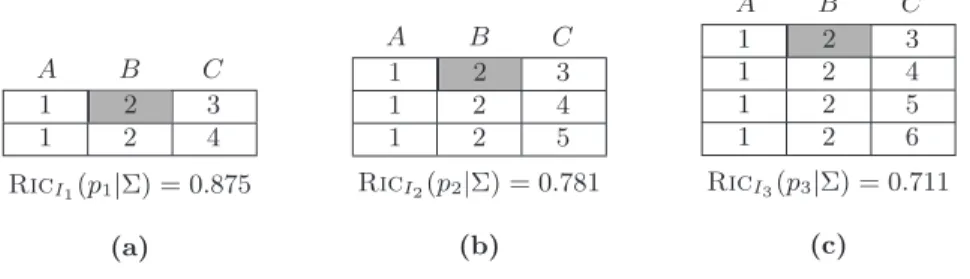
Example 2. (see [5]) Consider relation R(A, B, C) with the set of FDs Σ ={A →B}, and three instances I1, I2, and I3 of(R,Σ) shown in Figures 2(a), 2(b), and 2(c) re-spectively. Letp1,p2, andp3 denote the position of the gray cell in the instances. We can observe that the information content of the gray cell decreases as it becomes more redun-dant by adding tuples to the instances.
To define this measure intuitively, suppose that we have
npositions (data elements) in a relational or XML instance
I, whose values are drawn from a domain of size k (which
we may assume without loss of generality to be the interval
[1, k]). We want to measure, on average, how much
infor-mation is contained in position pwith respect to all other
setsX of positions — or, in other words, how much we can
derive aboutpfrom values in positions inX. When we can
derive the value in punambiguously, the information
con-tent will be 0; when we cannot say anything about it, it will be 1.
This in turn is measured as follows. SupposeXis a subset
of P os(I)− {p}. Suppose the values of positions in X are
lost, and then somehow restored from the set [1, k]. We
mea-sure how much information this gives us about the value of
p. This is done in a standard information-theoretic fashion,
by computing an entropy of a certain distribution1. Then
Rick
I(p|Σ) is the average of such entropy over all such sets
X.
We want the information content to be a value in [0,1].
It is known that the maximum entropy for a discrete
distri-bution onkelements is logk [15]. So we consider the ratio
Rick
I(p|Σ)/logk, and then define the relative information
content of positionpas RicI(p|Σ) = lim k→∞ Rick I(p|Σ) logk .
A key result of [5] is that this limit exists for all reasonable classes of constraints (e.g., all those definable in first-order logic, such as functional, multi-valued, join, etc. dependen-cies).
The following definition is from [5] and it applies across different data formats, including relational and XML data.
Definition 1. A database schema (S,Σ), with a set of constraints Σ, is well-designed if for every instance I of (S,Σ) and every positionpinI, we haveRicI(p|Σ) = 1.
In other words, a schema is well-designed if in every in-stance, no position has any redundancy at all.
Here we concentrate on designs guided by functional de-pendencies. For them, well-designed schemas have been pre-cisely characterized in [5].
Fact 1. (see [5])
1. IfSis a relational schema andΣis a set of functional dependencies, then(S,Σ) is well-designed if and only if it is in BCNF.
1The precise definition of this distribution and the definition
A B C 1 2 3 1 2 4 RicI1(p1|Σ) = 0.875 (a) A B C 1 2 3 1 2 4 1 2 5 RicI2(p2|Σ) = 0.781 (b) A B C 1 2 3 1 2 4 1 2 5 1 2 6 RicI3(p3|Σ) = 0.711 (c)
Figure 2: Information content vs redundancy.
2. IfD is a DTD andΣ is a set of XML functional de-pendencies, then (D,Σ)is well-designed if and only if it is in XNF.
We also note that the framework applies well beyond func-tional dependencies. For example, [5] used it to characterize designs based on multi-valued and join dependencies, and we shall use it soon for schemas for equality-generating de-pendencies (EGDs).
Some popular relational normal forms, such as 3NF, are not well-designed according to our definition, because they allow some amount of redundancy to compensate for pre-serving all the constraints. A way to measure and compare information contents over multiple schemes satisfying a par-ticular condition, such as a normal form, was introduced in [25].
LetCbe some condition on relational schemas, e.g., BCNF
or 3NF. Now consider all instancesIof these schemas (S,Σ),
and all the possible valuesRicI(p|Σ).
Definition 2. The guaranteed information content of
a condition C is the largest number c ∈ [0,1] such that RicI(p|Σ)≥cfor all such instancesI and positionsp. It is denoted byGIC(C). Formally,
GIC(C) = inf{RicI(p|Σ)},
whereI ranges over instances of schemas(S,Σ)that satisfy C, andpranges over positions inI.
Using this, one can characterize 3NF. In fact, it was no-ticed long ago that 3NF designs can differ significantly [40], and in general those accepted as good ones are the ones produced by the standard 3NF synthesis algorithm by Bern-stein [8]. In fact such a subset of 3NF, which we denote by
3NF+, can be characterized information-theoretically as
fol-lows:
Fact 2. (see [25]) GIC(3NF+) = 12. Moreover, if C is any other normal form that guarantees dependency-preserving decompositions, thenGIC(C)≤ 12.
Note that we can reformulate Fact 1 as GIC(BCNF) = 1. This means that if we cannot achieve the maximum informa-tion content equal to 1 for all posiinforma-tions, the next best thing that we guarantee is the value of the information-theoretic
measure equal to 12.
5.
RELATIONAL TRANSLATION OF XML
The main goal of this paper is to show how a good XML design can result in having a less redundant relational stor-age for XML documents. Redundancies occur when DTDs
permit adding more redundant values, or redundant tree tuples, to XML documents. In particular, they occur when element types occur under the scope of a Kleene star in the DTD. This is indeed what is required for the worst cases of redundancy, so for lower bounds we can safely concentrate on DTDs that basically model nested relations, i.e. non-recursive disjunction-free DTDs, where each element type appears once or under a Kleene star in the production rule of its parent.
We shall use theinliningtechnique [33] as our
XML-to-relational mapping scheme. While the inlining technique
is not the only [21, 39, 32, 6, 19, 18] or necessarily the best mapping scheme (see [26] for a survey), it produces the most natural relational schema for DTDs that are essentially nested relations. But our results are more general: they apply to any other mapping scheme that produces a similar relational schema for nested-relation-like DTDs.
Given a DTD, the basic idea of the inlining mapping is that separate relations are created for the root and the ele-ment types that appear under a star, and the other eleele-ment types are inlined in the relations corresponding to their par-ents. Each relation corresponding to an element type has an ID attribute that is a key for that relation as well as a parent ID attribute that is a foreign key pointing to the parent of that element in the document. All the attributes of a given element type in the DTD become attributes in the relation corresponding to that element type.
For example, the relational schema for storing XML doc-uments conforming to the DTD in Example 1 would be
student(stID, name, conID)
address(addID, conID, postalCode, streetN o, aptN o, city)
phone(phID, conID, number)
Key attributes are underlined, and the following foreign
keys also hold: address[conID] ⊆FK student[conID] and
phone[conID]⊆FKstudent[conID].
The inlining schema generation can be formally captured as follows.
Definition 3. Given a DTDD= (E, A, P, R, r), we de-fine theinliningofD to be a relational schema S, where
• S ={Re |e ∈E, ande∗occurs inPe0 for somee0 ∈ E oreoccurs inPr}, and
• there is a mappingσ:E→S recursively defined as
σ(e) =
Re ifRe∈S
σ(e0), whereeoccurs inPe0 ifRe6∈S
attr(Re) = Se0∈σ−1(Re)({e0ID} ∪A(e0)) ∪{e0ID|eoccurs inPe0} .
Then given an XML tree T = (N, G) conforming to D
and satisfying Σ, we can straightforwardlyshred it into an
instanceIT of relational schemaS, the inlining ofD. Note
that we can use node identifiers inN for values of ID
at-tributes when populatingIT. The precise definition of this
transformation is omitted here.
It is easy to observe that the FDs defined over a DTD do not necessarily translate into FDs over the relational schema, simply because the paths involved in an XML func-tional dependency may not all occur in a single relation. Therefore, we need to join different relations to enforce the
integrity constraints that are now in the form of
equality-generating dependencies(EGDs).
For example, the FDs in Example 1 would translate into
the following EGDs. Note that EGD (4) is an FD, but
EGD (3) is not.
∀ student(s, n, c) ∧ address(a, c, pc, st, apt, ct)∧
student(s, n, c) ∧ address(a0, c, pc, st0, apt0, ct0) → a=a0,
(3)
∀ address(a, c, pc, st, apt, ct)∧
address(a0, c0, pc, st0, apt0, ct0) → ct=ct0. (4)
We can show that every constraint expressed in the form of an FD for XML can be written as an EGD over the in-lining relational storage. More formally,
Proposition 1. For every DTDDand set of XML
func-tional dependenciesΣdefined overD, there is a set of EGDs ΣE over the relations ofS, the inlining ofD, such that for every XML treeT conforming toD, the treeT satisfiesΣif and only ifIT satisfiesΣE.
Note that there are also some key and foreign key
con-straints ΣK,FK over the ID attributes ofS, as shown in
pre-vious example. We then call (S,ΣS) theinlining translation
of (D,Σ), where ΣS= ΣE∪ΣK,FK.
6.
RELATIONAL TRANSLATIONS
PRE-SERVE PERFECT DESIGNS
We know that if we want a perfectly non-redundant design for XML, we should try to achieve XNF [4]. XML is most commonly stored in relational databases, in order to take ad-vantage of fast relational query engines and well-developed storage facilities. We therefore need to study the design and normalization not only for XML per se, but also for the rela-tional storage of XML documents. Here we study the effect of XNF normalization on the relational storage, and in the next section we will see how the relational storage looks, in terms of redundancy, for non-perfect XML designs.
We observe that the inlining mapping preserves a good XML design by showing that the information content of data values will remain maximum after transforming XML data into relational storage. Note that the FDs over XML data will become EGDs over the relational storage.
LetDbe a DTD, Σ be a set of XML functional
dependen-cies defined overD, and (S,ΣS) be the inlining translation of
(D,Σ). Consider an XML treeT conforming toDand
sat-isfying Σ. LetIT be the instance of (S,ΣS) that is obtained
by shreddingT into relations ofS. Now every positionpin
T is naturally mapped into a unique positionδ(p) inIT.
Definition 4. We say that an inlining translation
(S,ΣS) of (D,Σ) is well-designed iff for every XML tree
T conforming toDand satisfyingΣand every positionpin
T, we have RicIT(δ(p)|ΣS) = 1.
In other words, in positions corresponding to positions from the XML document, there is no redundancy whatso-ever in the shredded documents according to the translation of XML constraints.
Theorem 1. The following are equivalent for an XML
specification(D,Σ)and its inlining translation(S,ΣS): 1. (D,Σ)is well-designed (or, equivalently, is in XNF); 2. (S,ΣS)is well-designed.
This means that in order to ensure a non-redundant rela-tional storage for our XML data, we need to have an XNF design. In other words, XNF achieves nonredundant design no matter what type of storage – native or relational – is used.
7.
RELATIVE CONSTRAINTS AND GOOD
DESIGNS
Like in the relational case, bad XML designs may lead to very low information contents for positions in the relational storage. In fact, the information content of a position in a relational storage of an XML document can potentially be arbitrarily low.
Proposition 2. For every ε >0, we can find an XML design(D,Σ)with inlining translation(S,ΣS)and an XML tree T conforming toD and satisfying Σwith a position p, such that for the corresponding positionδ(p)inIT, we have RicIT(δ(p)|ΣS)< ε.
To avoid the possibility of having such a high redundancy, we need some restrictions that guarantee a reasonable infor-mation content for all positions in the relational storage of XML. We showed in the previous section that an XNF de-sign corresponds to maximum information content for the relational storage, but is it always possible to achieve XNF? Recall that in the relational context it is not always possible to achieve a dependency-preserving perfect design. Therefore to guarantee dependency preservation, we may have to tolerate some redundancy, at most equal to one half of the maximum information content, and this is exactly
what a good 3NF (i.e., 3NF+) normalization gives us.
Here we want to show that if a dependency-preserving XNF design is not achievable, then a simple restriction on FDs defined for XML guarantees the second best informa-tion content for the relainforma-tional storage of an XML document. The restriction is simply that all FDs should satisfy XNF or be relative to an element that occurs under the scope of a Kleene star. Then the information content of all positions of the relational storage of the XML document will be at
least 12.
Let D = (E, A, P, R, r) be a DTD, Σ be a set of XML
functional dependencies defined overD, and (S,ΣS) be the
Definition 5. We say that an FD{q1, . . . , qn} →q∈Σ is relative under the Kleene star if
• qi is an element path for somei∈[1, n], • for allj∈[1, n], qi is a prefix ofqj, and
• for some pwhich is a prefix ofqi andτ ∈E, last(p) occurs under a Kleene star inPτ.
An example of FD that violates this condition is FD (2)
in Example 1. We refer to such FDs asabsolute or global
FDs.
We now extend the definition of guaranteed information
content for relational storage of XML documents. Let C
be some condition on XML functional dependencies defined over a DTD, e.g. XNF or relative under the Kleene star.
Now consider all XML treesT conforming to some DTDD
and satisfying FDs Σ, such that FDs in Σ are of typeC. The
guaranteed information contentof a conditionCfor inlining
translation, written as GICinl(C) is the largest numberc∈
[0,1] such that for all such treesT and positionpin T,
RicIT(δ(p)|ΣS)≥c,
whereIT is the shredding ofT into the inlining translation
(S,ΣS) of (D,Σ), andδ(p) is the position inIT to whichp
is mapped. Formally,
GICinl(C) = inf{RicIT(δ(p)|ΣS)},
where T ranges over trees conforming to D and satisfying
FDs Σ of typeC, andpranges over positions inT.
Using this, we can reformulate Theorem 1 as
GICinl(XNF) = 1. Now let relative denote the
condi-tion of being relative under star. Then we can formally
state the main result of this section: Theorem 2. GICinl(relative)≥ 12.
In other words, if we manage to design an XML docu-ment in such a way that there is no global FDs, then the redundancy of each data value in the relational storage of
the XML document would not be worse than 12.
We can explain this result more intuitively by looking at update anomalies that could happen in the relational storage of an XML document. Most database management systems disallow updates that violate key constraints, but the only mechanism to enforce FDs or EGDs would be through writ-ing assertions. In the absence of global or absolute FDs on the XML side, the possibility of FD or EGD violation due to a bad update in the relational storage will be restricted to a small portion of the entire database. Informally speaking, if we are to numerically evaluate the possibility of having up-date anomalies, our results state that by having global FDs, the relational storage of an XML document could be ex-ponentially more prone to anomalies, compared to the case when we are restricted to XNF and relative FDs.
8.
A DIFFERENT MAPPING SCHEME
Beside inlining, there are other XML-to-relational data and query mapping schemes [21, 39, 32, 6, 19, 18], among
them being theEdgerepresentation [21], which is used as a
basis for many XML query translation techniques. Here we would like to study this mapping scheme from two points
of view: 1) redundancy and information content, and 2) the complexity of enforcing integrity constraints.
In the Edge representation, an XML tree is viewed as an edge-labeled graph. Each to-element and
element-to-attribute edge of the tree has a tuple inEdgetable, and
for each data value in the tree, there is a tuple inValuetable
associating the node identifier to a value. The relational storage for any XML tree, regardless of its schema, has the following relations:
Edge(source, target, label), Value(vid, val).
In the original definition of this schema [21], there are two
more attributes in theEdgerelation: ordinal, which
speci-fies the ordinal of thetargetamong children of thesource,
and f lag which specifies whether the tuple corresponds to an element-to-element edge or an element-to-attribute edge. We simplify the schema by removing these attributes, as they do not have any effect on the redundancy of data val-ues.
Assume that we have a set El of element names, Attr
of attribute names, andStr of all possible string-valued
at-tributes. Then given an XML treeT = (N, G), with labeling
functionλ:N →Eland attribute functionsρ@a:N→Str
for each @a∈Attr, we can populateEdgeand Valuesuch
that
• for each edge (x, y)∈G, there is a tuple (x, y, λ(y))∈
Edge, and
• for eachx∈Nand @a∈Attrsuch thatρ@ais defined
for x, there is a tuple (x, y,@a) ∈ Edgeas well as a
tuple (y, ρ@a(x))∈Value, wherey6∈Nis a fresh node
identifier.
Other variants of this approach also exist. One of them
is the binary approach [21, 32], where the Edge relation
is horizontally partitioned based on attribute label. The
schema would then have the following relations:
Blabel(source, target)
Value(vid, val).
In this representation, edge labels or element types are
not stored as attributes. We can therefore assume that
the domain of each attribute is an infinite set, and thus the measure of information content can be directly applied. Here we focus on the binary representation and show that redundancy-wise it looks the same as the inlining represen-tation.
Given a set of FDs Σ defined over a DTDD, the
transla-tion of Σ over the binary representatransla-tion ofD will again be
a set of EGDs. We denote thebinary translation of (D,Σ)
by (SB,ΣB), where ΣB contains some key and foreign key
constraints, as well as some EGDs obtained from Σ. Every
T conforming toD and satisfying Σ can be trivially
shred-ded into an instanceIB of (SB,ΣB), and each positionpin
T is mapped to a unique position δB(p) in IB. Then the
definitions of being well-designed and guaranteed
informa-tion content for binary translainforma-tion, GICbin, would be very
similar to those of inlining translation. Not surprisingly, the binary translation also preserves a perfect XML design:
Theorem 3. The following are equivalent for an XML
1. (D,Σ)is well-designed (or, equivalently, is in XNF); 2. (SB,ΣB) is well-designed.
Similarly, to guarantee an information content of12 for
po-sitions in the binary representation of an XML document, it is enough to make sure that all the XML functional de-pendencies are relative:
Theorem 4. GICbin(relative)≥12.
This might make us think that, from the design point of view, binary and inlining representations are equivalent. However, we will next show that they differ significantly when it comes to the complexity of enforcing integrity con-straints. Here by complexity, we mean the number of joins needed to write a SQL assertion that enforces an EGD trans-lated from an XML functional dependency. Given an XML
functional dependencyfover a DTDD, we use the notation
#1finl and #1fbin
to denote the number of joins required to enforce the
transla-tion offon the inlining and binary relational representation
ofD respectively.
Consider for instance FD (2) of Example 1. The transla-tion of this FD over the binary representatransla-tion of the DTD is an EGD that involves five joins, whereas over the inlining translation, it can be written as an FD requiring only one join as shown by (4).
In fact, we can show that even for key or XNF depen-dencies, the number of joins needed for the binary repre-sentation is never smaller than under inlining, and can be arbitrarily higher.
Proposition 3.
1. For every DTDD and XML functional dependencyf, we have #1fbin≥#1finl.
2. For every m >0, we can find a DTDDand an XML functional dependencyf over D, such that
#1fbin
#1finl > m.
9.
CONCLUSIONS
We have studied design and normalization for XML docu-ments stored in relations, rather than in native XML storage facilities (which was the assumption of the previous work on XML normalization). To be able to compare relational and XML designs, we applied the information-theoretic frame-work of [5] that can be used for many different data mod-els, and is independent of data model features such as up-date and query languages (which are still in the development stage for XML).
The main conclusions are as follows:
1. The XML normal form XNF, proposed in [4] as a gen-eralization of BCNF for XML documents, achieves the best possible design from the point of view of eliminat-ing redundancies in both native and relational storage of XML.
Note that algorithms for converting XML designs into XNF exist.
2. If XNF is not achievable, the next best possible de-sign is achieved by relativizing all constraints that vi-olate XNF. By relativizing we mean restricting them to the scope of an element that occurs in a DTD with a Kleene star (or under the scope of another element with a Kleene star). When we say “the next best pos-sible design”, our criterion is the information content of redundant values in the relational storage of XML documents.
3. The information-theoretic framework allows us to com-pare different shredding techniques from the point of view of redundancies in XML documents. We show that two popular techniques – inlining [33] and the
edge representation [21] – behave in the same way
information-theoretically, while the latter can behave arbitrarily worse in terms of enforcing integrity con-straints.
10.
FUTURE WORK
While the situation with the best possible design from the point of view of eliminating update anomalies has now been completely clarified for both native and relational storage, it is not yet entirely clear how to handle non-perfect de-signs that do not eliminate all redundancies. Such dede-signs are necessary, and in fact essential, in the relational world, where they guarantee database consistency by means of pendency preservation. This in fact explains why 3NF de-signs in practice are more popular than BCNF dede-signs. In the XML world, we do not yet have an adequate understand-ing of the notion of dependency preservation and its impact on XML design, whether for native or relational storage.
Another open issue is whether one can relativize con-straints, as suggested in this paper for achieving the best non-XNF design, and do it while preserving XML con-straints.
We also would like to extend the idea of using the information-theoretic framework for reasoning about and comparing different shredding techniques for XML docu-ments.
Acknowledgments
.
We thank Wenfei Fan and Rene´eMiller for comments and suggestions. Both authors are
supported by a grant from NSERC. Part of this work was done while Kolahi was visiting the University of Edinburgh. Libkin is on leave from the University of Toronto, supported by the European Commission Marie Curie Excellence grant MEXC-CT-2005-024502 and EPSRC grant E005039.
11.
REFERENCES
[1] Xyleme XML server & business document management.
http://www.xyleme.com/page/xml storage/.
[2] S. Abiteboul, R. Hull, and V. Vianu.Foundations of
Databases. Addison-Wesley, 1995.
[3] M. Arenas, W. Fan, and L. Libkin. On verifying
consistency of XML specifications. In PODS, pages
259–270, 2002.
[4] M. Arenas and L. Libkin. A normal form for XML
documents. ACM Trans. Database Syst., 29:195–232,
[5] M. Arenas and L. Libkin. An information-theoretic approach to normal forms for relational and XML
data.J. ACM, 52(2):246–283, 2005.
[6] D. Barbosa, J. Freire, and A. O. Mendelzon.
Designing information-preserving mapping schemes for
XML. InVLDB, pages 109–120, 2005.
[7] C. Beeri, P. A. Bernstein, and N. Goodman. A sophisticate’s introduction to database normalization
theory. InVLDB, pages 113–124, 1978.
[8] P. A. Bernstein. Synthesizing third normal form
relations from functional dependencies.ACM Trans.
Database Syst., 1(4):277–298, 1976.
[9] J. Biskup. Achievements of relational database schema
design theory revisited. InSemantics in Databases,
pages 29–54, 1995.
[10] P. Buneman, S. B. Davidson, W. Fan, C. S. Hara, and
W. C. Tan. Keys for XML. InWorld Wide Web, pages
201–210, 2001.
[11] R. Cavallo and M. Pittarelli. The theory of
probabilistic databases. InVLDB, pages 71–81, 1987.
[12] E. F. Codd. Normalized database structure: A brief
tutorial. InACM SIGFIDET Workshop on Data
Description, Access and Control, 1971.
[13] E. F. Codd. Further normalization of data base
relational model. InCourant Computer Science
Symposium 6: Data Base Systems, pages 33–64, 1972. [14] E. F. Codd. Recent investigations in relational
database systems. InInformation Processing, pages
1017–1021, 1974.
[15] T. M. Cover and J. A. Thomas.Elements of
Information Theory. John Wiley & sons, 1991. [16] M. M. Dalkilic and E. L. Roberston. Information
dependencies. InPODS, pages 245–253, 2000.
[17] S. Davidson, W. Fan, C. Hara, and J. Qin.
Propagating XML constraints to relations. InICDE,
pages 543–554, 2003.
[18] A. Deutsch, M. Fernandez, and D. Suciu. Storing
semistructured data with STORED. InSIGMOD,
pages 431–442, 1999.
[19] A. Deutsch and V. Tannen. MARS: A system for publishing XML from mixed and redundant storage. InVLDB, pages 201–212, 2003.
[20] D. W. Embley and W. Y. Mok. Developing XML documents with guaranteed “good” properties. In ER’01, pages 426–441.
[21] D. Florescu and D. Kossmann. Storing and querying
XML data using an RDBMS.IEEE Data Eng.
Bulletin, 22(3):27–34, 1999.
[22] P. C. Kanellakis. Elements of relational database theory. pages 1073–1156, 1990.
[23] C.-C. Kanne and G. Moerkotte. A linear-time algorithm for optimal tree sibling partitioning and
approximation algorithms in Natix. InVLDB, 2006.
[24] M. Kifer, A. Bernstein, and P. M. Lewis.Database
systems : an application-oriented approach. Addison-Wesley, 2006.
[25] S. Kolahi and L. Libkin. On redundancy vs dependency preservation in normalization: An
information-theoretic study of 3NF. InPODS, pages
114–123, 2006.
[26] R. Krishnamurthy, R. Kaushik, and J. F. Naughton.
XML-to-SQL query translation literature: The state
of the art and open problems. InXSym’03, LNCS
2824, pages 1–18, 2003.
[27] T. T. Lee. An information-theoretic analysis of relational databases - part i: Data dependencies and
information metric.IEEE Trans. Software Eng.,
13(10):1049–1061, 1987.
[28] M. Levene, M. Levene, and G. Loizou.A Guided Tour
of Relational Databases and Beyond. Springer-Verlag, London, UK, 1999.
[29] M. Levene and G. Loizou. Why is the snowflake
schema a good data warehouse design? Inf. Syst.,
28(3):225–240, 2003.
[30] Z. H. Liu, M. Krishnaprasad, and V. Arora. Native
XQuery processing in oracle XMLDB. InSIGMOD,
pages 828–833, 2005.
[31] M. Nicola and B. van der Linden. Native XML
support in DB2 universal database. InVLDB, pages
1164–1174, 2005.
[32] A. Schmidt, M. L. Kersten, M. Windhouwer, and F. Waas. Efficient relational storage and retrieval of
XML documents. InSelected papers from the Third
International Workshop WebDB 2000 on The World Wide Web and Databases, pages 137–150.
Springer-Verlag, 2001.
[33] J. Shanmugasundaram, K. Tufte, C. Zhang, G. He, D. J. DeWitt, and J. F. Naughton. Relational databases for querying XML documents: Limitations
and opportunities. InVLDB, pages 302–314, 1999.
[34] I. Tatarinov, S. D. Viglas, K. Beyer,
J. Shanmugasundaram, E. Shekita, and C. Zhang. Storing and querying ordered XML using a relational
database system. InSIGMOD, pages 204–215, 2002.
[35] M. W. Vincent and J. Liu. Functional dependencies
for XML. InAPWEB, pages 22–34, 2003.
[36] M. W. Vincent, J. Liu, and C. Liu. A redundancy free
4NF for XML. InXSym, pages 254–266, 2003.
[37] M. W. Vincent, J. Liu, and C. Liu. Strong functional dependencies and their application to normal forms in XML.ACM TODS, 29(3):445–462, 2004.
[38] J. Wang and R. W. Topor. Removing XML data redundancies using functional and equality-generating
dependencies. InAustralian Database Conference,
pages 65–74, 2005.
[39] M. Yoshikawa, T. Amagasa, T. Shimura, and S. Uemura. XRel: a path-based approach to storage and retrieval of XML documents using relational
databases.ACM Trans. Inter. Tech., 1(1):110–141,
2001.
[40] C. Zaniolo. A new normal form for the design of
relational database schemata.ACM Transactions on
Database Systems, 7(3):489–499, 1982.
APPENDIX
A.
DEFINITION OF THE
INFORMATION-THEORETIC MEASURE
A.1
Basics of information theory
The main concept of information theory is that of entropy, which measures the amount of information provided by a
certain event. Assume that an event can haven different
outcomes s1, . . ., sn. Then for a probability space A =
({s1, . . . , sn}, PA), where PA is a probability distribution, its entropy is defined as
H(A) = n X i=1 PA(si) log 1 PA(si).
For probabilities that are zero, we adopt the convention that
0 log10 = 0, since limx→0xlog1x = 0. It is known that
0≤H(A)≤logn, withH(A) = lognonly for the uniform
distributionPA(si) = 1/n[15].
We shall also need the concept of conditional entropy of
BassumingA.
Suppose we have two probability spaces A = ({s1, . . . , sn}, PA),
B = ({s01, . . . , s0m}, PB)
and probabilities P(s0j, si) of all the events (s0j, si). Note
that PA and PB need not be independent. Then the
con-ditional entropy of B givenA, denoted byH(B | A), gives
the average amount of information provided by B if A is
known [15]. If
P(s0j|si) = P(s
0
j, si)
PA(si)
are conditional probabilities, then the conditional entropy is defined as H(B | A) = n X i=1 PA(si) m X j=1 P(s0j|si) log 1 P(s0j|si) .
A.2
Relative information content
We now give a detailed definition of relative information content from [5] that was used to justify relational and XML normal forms [5, 25].
Unlike other proposed information-theoretic measures [27, 11, 16, 29] that work only at the level of data, this measure takes into account both data and schema constraints.
Fix a schema S and a set Σ of constraints, and let
I∈inst(S,Σ). We want to defineRicI(p|Σ), the relative
information content of a position p ∈Pos(I) with respect
to the set of constraints Σ.
Formally, we assume that I has n positions (which we
enumerate as 1, . . . , n), and fix ann-element set of variables
{vi |1≤i≤n}. Let Ω(I, p) be the set of all 2n−1 vectors
(a1, . . . , ap−1, ap+1, . . . , an) such that for everyi∈[1, n]−
{p},aiis eithervior the value in thei-th position ofI. We
make this into a probability space A(I, p) = (Ω(I, p), Pu)
with the uniform distributionPu(¯a) = 21−n.
We next define conditional probabilities Pk(a | ¯a) that
show how likelyais to occur in positionp, if values are
re-moved fromIaccording to the tuple ¯a∈Ω(I, p) LetI(a,¯a)be
obtained fromIby puttingain positionp, andaiin position
i6=p. A substitution is a map σ: ¯a →[1, k] that assigns
a value to eachai which is a variable, and leaves otherais
intact. We let SATkΣ(I(a,a¯)) be the set of all substitutions
σ such thatσ(I(a,¯a)) |= Σ and |σ(I(a,a¯))|=|I| (the latter
ensures that no two tuples collapse as the result of applying
σ). ThenPk(a|a¯) is defined as:
Pk(a|¯a) = |SAT k Σ(I(a,a¯))| P b∈[1,k]|SATkΣ(I(b,a¯))| .
With this, we defineRickI(p|Σ) as
X ¯ a∈Ω(I,p) 1 2n−1 X a∈[1,k] Pk(a|¯a) log 1 Pk(a|¯a) .
SincePa∈[1,k]Pk(a|¯a) logPk(1a|¯a) measures the amount of
information inp, given constraints Σ and some missing
val-ues in I, represented by the variables in ¯a, our measure
Rick
I(p|Σ) is the average such amount over all ¯a∈Ω(I, p).
To see thatRickI(p|Σ) is a conditional entropy, define
Pk0(a) = 1 2n−1 X ¯ a∈Ω(I,p) Pk(a|a¯).
It is a probability distribution on [1, k] (intuitively, it says
how likely an element from [1, k] is to satisfy Σ when put
in positionp, given all possible interactions between pand
sets of positions in I). If BkΣ(I, p) is the probability space
([1, k], Pk0), thenRickI(p|Σ) is the conditional entropy:
Rick
I(p|Σ) = H(BΣk(I, p)| A(I, p)).
Since the domain ofBkΣ(I, p) is [1, k], we have 0≤RickI(p|
Σ) ≤ logk. To normalize this, we consider the ratio
Rick
I(p | Σ)/logk. The key observation of [5] is that for
most reasonable constraints Σ (certainly for all definable in
first-order logic), this sequence converges ask→ ∞, and we
thus define RicI(p|Σ) = lim k→∞ Rick I(p|Σ) logk .