Introduction
Predicting consumer behaviour in food markets is a complex task. The tradi-tional demand analysis based on economic factors, i.e. price and household income, is no longer the best approach to model consumer behaviour in modern post-industrialised food markets, as food quality aspects now dominate con-sumer decision-making (Senauer, 2001). This food product quality is deter-mined by multiple characteristics (Hooker & Caswell, 1996) or, as Lancaster’s (1966) utility theory states, is shaped by a combination of product characteris-tics (attributes) that determine the good’s performance relative to price (utility).
Nowadays, consumer choice behaviour is motivated by a number of factors in-cluding taste, convenience, price, product availability, health concerns, and cul-tural traditions. Consumers are also more conscious about food quality attrib-utes such as nutrition, organic farming, fair trade, animal welfare and regionality (Caswell & Joseph, 2008). The focus of consumers on these aspects has stimu-lated competition within the food industry, and consequently the differentiation of products and processes along the food supply chain as a marketing strategy to preserve or increase market share. Despite the efforts made by food compa-nies to satisfy consumer demands, since the late 1980s the outbreak of several food crises (e.g. Mad Cow Disease, Foot and Mouth Disease, E. coli, Salmo-nella) with high media coverage and the use of some food-related technologies (e.g. genetically-modified organisms) has increased consumer risk perception in the food industry. As a result, public and private initiatives (e.g. certification standards, labelling programs, branding) to communicate and ensure quality and safety to consumers have proliferated in the food industry (Henson & Caswell, 1999; Henson & Reardon, 2005; Jahn et al., 2005). In particular, the use of certification procedures can serve as a signalling institution to overcome information asymmetries (Akerlof, 1970) and guarantee the trustworthiness of products in credence good markets (e.g. organic farming, animal welfare, fair trade). However, there is evidence that certification schemes are susceptible to fraud, as incentives (e.g. price premiums) and asymmetric information
encour-age firms to act opportunistically (Deaton, 2004; Giannakas, 2002; Jahn et al., 2005).
Credence goods in the food industry and consumer behaviour
Among credence goods or attributes, organic farming1 currently enjoys a privi-leged position in the food industry, providing consumers with non-conventional food alternatives at high price premiums. Official statistics estimate that sales of organic food and drinks around the world reached 63 billion US dollars in 2011 (Sahota, 2013), which means a 6.4% annual increase compared to 2010. De-mand is highly concentrated in North America and Europe (96% of sales), while in Asia, Latin America and Africa, organic production is mainly export-oriented (ibid.). The US has the largest organic food and drink market in the world. In Europe, Germany has the largest market (6.6 Billion Euros), whereas Denmark, Austria and Switzerland have the highest market shares. With per capita ex-penditures of 177 Euros per year, the Swiss led the world in organic purchases in 2011 (Schaack et al., 2013). One key issue to sustain this expansion of the organic market is the correct understanding of consumer behaviour. In this re-spect, however, there is conflicting evidence about the main forces driving con-sumer decision-making in different organic markets. The controversy between altruistic and egoistic motives as determinants of organic food consumption (Eden et al., 2008) justifies the need for more scientific research in this field to better understand the factors determining consumer behaviour in the organic food market. Consequently, marketers and policy makers will be able to base their policy and marketing decisions on more precise information.
This investigation also includes a chapter dealing with consumer behaviour to-wards homemade food. Surprisingly, the literature in this regard is very poor. Homemade food has been identified as playing an important social role, sup-porting small food producers and processors in developing countries (Barking, 1999; Boucher & Requier-Desjardins, 2005). From the consumer side, some consumer segments are motivated by romantic feelings when purchasing and
1
eating food products (Jolly, 1999) and/or are interested in maintaining local cus-toms, traditions and identity (Inwood et al., 2009; Vizcarra Bordi, 2006). Home-made food alternatives could therefore be an attractive offer for these consum-ers. However, empirical evidence about determinants of homemade food con-sumption is scarce. In addition, the effect of information about homemade food characteristics on consumer behaviour has not been addressed in the food lit-erature. Providing this type of information may assist homemade food produc-ers and processors in the design of effective and efficient marketing strategies to promote their products. Public authorities may also use the recommendations provided in this study in order to plan technical assistance programs for less skilled or vulnerable homemade food suppliers.
Performance of quality assurance schemes in the food industry
Another key aspect in the contemporary agrifood market is the implementation of quality assurance schemes (QAS) with different purposes (Theuvsen & Spiller, 2007). In food markets characterised by high information asymmetries, i.e. those of credence goods (Caswell, 1998; Giannakas, 2002; Jahn et al., 2005), the performance of certification systems is a critical issue to achieve consumer acceptance of goods and consequently business success. For this reason, the monitoring activities in the organic food industry are carried out by independent third-party certifiers to correct for information asymmetries in the marketplace. Nevertheless, certification and monitoring procedures in the food market have shown that they are still vulnerable to opportunistic practices. A clear example is the European horse meat and the German ‘organic’ eggs scandals, revealed at the beginning of 2013. Some authors have reported that this type of behaviour from the supply side creates uncertainty among consum-ers and distrust of certification schemes, which negatively affects consumer demand in the organic market (Aertsens et al., 2009; Botonaki et al., 2006; Eden et al., 2008; Hughner et al., 2007; Janssen & Hamm, 2011; Kristallis & Chryssohoidis, 2005). However, little is known about farmers’ perceptions of certification schemes. Despite the usefulness of certification systems (e.g. mar-ket access), which may generate high expectations (e.g. of improving house-hold income), farmers may also perceive negative aspects of adopting and
us-ing them (Gawron & Thevsen, 2009, Hammoudi et al., 2009; Karipidis et al., 2009), with detrimental consequences for farmers’ satisfaction with the scheme. Increasing dissatisfaction among farmers may encourage them to revert to con-ventional agricultural practices. There are few studies addressing issues of farmer satisfaction with certification standards. Moreover, these studies focus only on the European food market (Enneking et al., 2007; Schulze & Spiller, 2010). As Latin American countries are mainly net exporters and important sup-pliers of organic products to major consumption markets, i.e. USA, Europe and Japan (Flores, 2013), analysing farmers’ satisfaction with their certification sys-tem in Latin America may provide information useful for predicting further adop-tion of the organic certificaadop-tion scheme in this region on the one hand, and to assess any potential threat (e.g. decrease in availability, increase in price) in organic import markets.
The fact that current certification procedures based on the checklist governance are susceptible to failure has motivated some authors to favour the adoption of alternative auditing approaches. For example, the risk-oriented approach based on the risk of non-compliance among clients can apparently improve the audit-ing quality (Albersmeier et al., 2009; Albersmeier et al., 2010; Jahn et al., 2005). However, this inspection approach has only rarely been implemented in the food industry (e.g. QS system in German meat industry, KKM scheme in the Dutch dairy industry) (Jahn et al., 2005). One inspection technology that is con-sidered in some organic regulations (e.g. IFOAM organic norms; EU Regulation (EC) No 834/2007) is the use of unannounced audits. The current use of unan-nounced inspections in organic certification suggests that they should reinforce control procedures and improve audit quality. However, to what extent this in-spection technology actually improves the audit quality remains unexplored in the certification literature.
With the globalisation of the food trade, food standards and certification sys-tems are communicating food safety and quality claims not only in domestic food markets but also internationally. To successfully communicate claims, the
certification standard must be a credible process (Lohr, 1998). In domestic and international food supply chains, certificates issued by accredited certifiers are used to communicate quality and safety claims between suppliers and buyers. However, the certificate itself can be viewed as credence characteristic in the food market, as different actors along the marketing chain (e.g. intermediaries, processors, retailers) are not able to observe the quality of the audits in situ. This is maybe more critical for food companies working with suppliers from ex-port markets, since distance and time increase information asymmetries (Lohr, 1998) and, therefore, verifying the truthfulness of claims becomes more difficult. To overcome this problem, food companies may use the reputations of third-party certifiers and/or ‘country image’ to asses the credibility of standards and certification procedures in foreign markets. In the market of goods and services, country image or country-of-origin is an alternative quality indicator that buyers use when purchasing products and services from foreign countries (Bilkey & Nes, 1982; Knight et al., 2007; Manrai et al., 1998; Papadopoulus & Heslop, 2002). Nevertheless, it is still unknown if country image exerts an influence on the assessment made by food companies on the credibility of food standards from different countries. In case of a negative effect, what kind of strategies could countries implement to improve the credibility of their food standards and achieve international recognition?
Objectives of the dissertation
Analysing survey data and official reports with statistical methods, this disserta-tion study intends to answer the research quesdisserta-tions stated above. In addidisserta-tion, it aims to fill research gaps in the literature with respect to consumer behaviour in credence good markets (i.e. organic, home made) and food certification stan-dards. The final goal of this investigation is to provide new market information in as well as to contribute to the debate on aspects that remain unclear in the food and certification industries. Finally, implications for marketers and policy makers are derived from the findings reported in this dissertation.
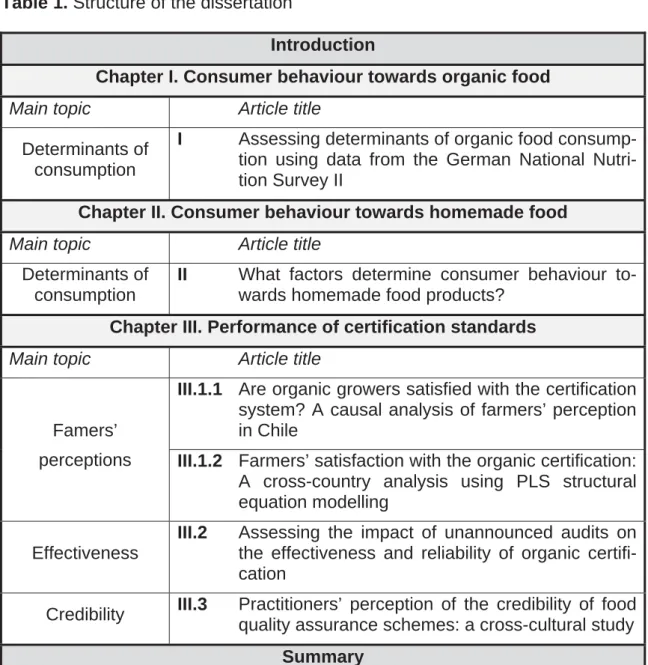
The topics addressed in this dissertation are covered in 6 research articles, which are collected here into three chapters. Table 1 outlines the content of this research document.
Table 1. Structure of the dissertation
Introduction
Chapter I. Consumer behaviour towards organic food
Main topic Article title
Determinants of consumption
I Assessing determinants of organic food consump-tion using data from the German Naconsump-tional Nutri-tion Survey II
Chapter II. Consumer behaviour towards homemade food
Main topic Article title Determinants of
consumption
II What factors determine consumer behaviour to-wards homemade food products?
Chapter III. Performance of certification standards
Main topic Article title
III.1.1 Are organic growers satisfied with the certification system? A causal analysis of farmers’ perception in Chile
Famers’
perceptions III.1.2 Farmers’ satisfaction with the organic certification: A cross-country analysis using PLS structural equation modelling
Effectiveness
III.2 Assessing the impact of unannounced audits on
the effectiveness and reliability of organic certifi-cation
Credibility III.3 Practitioners’ perception of the credibility of food quality assurance schemes: a cross-cultural study
Summary
After putting the scope of this investigation in context, a brief description of ob-jectives and methodological issues addressed in each article is provided in the following.
Chapter I. Consumer behaviour towards organic food
This chapter addresses the study of the factors driving organic food consump-tion. As earlier empirical evidence tends to be inconsistent regarding the relative importance of drivers of organic food purchasing behaviour, this study aims to contribute to this issue by using a large sample size combined with a highly dif-ferentiated stated behavioural measure. The article entitled (I) “Assessing de-terminants of organic food consumption using data from the German
Na-tional Nutrition Survey II” is an empirical approach that uses partial least
squares (PLS) path modelling to test causal relationships in a proposed re-search model built on a comprehensive literature review.
Chapter II. Consumer behaviour towards homemade food
Studies of homemade food consumption are rare in the food literature. Little empirical evidence is available for homemade food suppliers and regulators for decision-making purposes. Therefore, this additional chapter focuses on the analysis of potential determinants of homemade food consumption with special focus on sensory, attitudinal and socio-demographic variables. The effect of information is also important in the evaluation of consumer behaviour, thus, the second article (I) “what factors determine consumer behaviour towards
homemade food products?” combines sensory analysis with an information
experiment to asses a potential ‘homemade labelling’ effect. In addition, using ordinary least squares regression, a set of attitudinal, socio-demographic as well as sensory variables were tested to reveal the main determinants of con-sumer overall degree of liking and intention to buy a homemade food product.
Chapter III. Performance of certification standards
Food crises and scandals have shaken the food industry worldwide, increasing consumer risk perception and undermining consumer confidence in the food industry. As a result, public and private quality assurance mechanisms have been designed to protect consumers and recover consumer confidence. In addi-tion, the focus of consumers on new food quality attributes has also contributed
to the current governance of quality assurance tools in the food industry. Food standards and certification programs are used as QAS in the marketing of cre-dence goods (e.g. organic farming) that reduce market imperfections and com-municate information to consumers about the quality of products. Unfortunately, monitoring systems in the food industry are vulnerable to opportunist behaviour of firms with detrimental consequences for the reliability and credibility of certifi-cation systems. In this context, this dissertation analyses the performance of food and certification standards from three different perspectives, namely ex-ploratory/empirical, theoretical/empirical, and global/empirical.
The first two articles (III.1.1) “are organic growers satisfied with the
certifica-tion system? A causal analysis of farmers’ percepcertifica-tion in Chile” and (III.1.2)
“farmers’ satisfaction with the organic certification: a cross-country
analysis using PLS structural equation modelling” address the analysis of
farmers’ satisfaction with the organic certification system and its potential de-terminants in Latin American countries from an exploratory perspective. Using PLS path modelling, a causal model built on a comprehensive literature review is assessed. Particular attention in testing for significant differences between path coefficients estimates is also considered to reveal potential differences between countries.
The third article entitled (III.2) “assessing the impact of unannounced audits
on the effectiveness and reliability of organic certification” assesses the
effectiveness of the implementation of unannounced inspections in the organic control system from theoretical and empirical perspectives. Certification reports provided by the German Competent Authority (i.e. the Federal Office for Agricul-ture and Food, the BLE) in combination with statistical analyses (e.g. frequency, correlation) are used to test the performance of non-scheduled inspections.
The fourth and last paper focuses on food standards from a global perspective. The article (III.3) “practitioners’ perception of the credibility of food quality
image affects the credibility of food standards operating in different regions of the globe. In particular, this article focuses on potential differences in credibility assessments between countries and between practitioners from different re-gions of the world. For this purpose an on-line survey and the info-mail contacts of GLOBALG.A.P. were used. Statistical procedures for data analysis included descriptive statistics, independent samples t-test and factor analysis.
In the following, the articles forming this dissertation are presented in full, indi-cating in each case the names of the author and co-authors. After the presenta-tion of the research articles, a comprehensive summary including (i) remarks about the main findings; (ii) discussion of the main findings with emphasis on market and policy implications; and (iii) description of research limitations and potential topics for further research in each field is presented. Finally, a list of publications and presentations at scientific events carried out during the doc-toral period is attached.
References
Aertsens, J., Verbeke, W., Mondelaers, K., & van Huylenbroeck, G. (2009). Personal determinants of organic food consumption: A review. British Food Journal,111, 1140-1167.
Akerlof, G. (1970). The market for ‘Lemons’: Quality uncertainty and the market mechanism. Quarterly Journal of Economics, 84, 488-500.
Albersmeier, F., Schulze, H., Jahn, G., & Spiller, A. (2009). The reliability of third-party certification in the food chain: From checklists to risk-oriented auditing.Food Control, 20, 927-935.
Albersmeier, F., Schulze, H., & Spiller, A. (2010). System dynamics in food quality certifications: Development of an audit integrity system. International Journal on Food System Dynamics, 1, 69-81.
Barkin, D. (1999). Superando el paradigma neoliberal: Desarrollo popular sus-tentable.Cuadernos de Desarrollo Rural, 43, 11-31.
Bilkey, W. J., & Nes, E. (1982). Country of origin effects on product evaluations. Journal of International Business Studies, 13, 89-99.
Botonaki, A., Polymeros, K., Tsakiridou, E., & Mattas, K. (2006). The role of food quality certification on consumers’ food choices. British Food Journal, 108, 77-90.
Boucher, F., & Requier-Desjardins, D. (2005). La concentración de las queserí-as rurales de Cajamarca: Retos y dificultades de una estrategia colectiva de activación. Agroalimentaria, 21, 13-27.
Caswell, J. A. (1998). How labeling of safety and process attributes affects mar-kets for food. Agricultural and Resource Economics Review, 27, 151-158.
Caswell, J. A., & Joseph, S. (2008). Consumer demand for quality: Major de-terminant for agricultural food trade in the future? Journal of International Agricultural Trade and Development, 4, 99-116.
Deaton, B. J. (2004). A theoretical framework for examining the role of third-party certifiers. Food Control, 15, 615-619.
Eden, S., Bear, C., & Walker, G. (2008). The skeptical consumer? Exploring views about food assurance. Food Policy, 33, 624-630.
Enneking, U., Obersojer, T., & Kratzmair, M. (2007). Faktoren für die Zufrieden-heit mit Qualitätssystemen aus Sicht der Primärerzeuger. Agrarwirtschaft, 56, 112-124.
Flores, P. (2013). Organic agriculture in Latin America and the Caribbean. In H. Willer, J. Lernoud, & L. Kilcher (Eds.), The world of organic agriculture: Statistics and emerging trends 2013 (pp. 258-272). FiBL-IFOAM Report: FiBL, Frick, & IFOAM, Bonn.
Gawron, J-C., & Theuvsen, L. (2009). The international food standard: Bureau-cratic burden or helpful management instrument in global markets? Empiri-cal results from the German food industry. Journal of International Food and Agribusiness Marketing, 21, 239-252.
Giannakas, K. (2002). Information asymmetries and consumption decisions in organic food product markets. Canadian Journal of Agricultural Econom-ics, 50, 35-50.
Hammoudi, A., Hoffman, R., & Surry, Y. (2009). Food safety standards and agri-food supply chains: An introductory overview. European Review of Ag-ricultural Economics, 36, 469-478.
Henson, S., & Caswell, J. A. (1999). Food safety regulation: An overview of contemporary issues. Food Policy, 24, 589-603.
Henson, S., & Reardon, T. (2005). Private agri-food standards: Implications for food policy and the agri-food system. Food Policy, 30, 241-253.
Hooker, N. H., & Caswell, J. A. (1996). Regulatory targets and regimes for food safety: A comparison of North American and European approaches. In J. A. Caswell (Ed.), The economics of reducing health risk from food (pp.1-17). Food Marketing Policy Center, University of Connecticut, Connecticut.
Hughner R. S., McDonagh, P., Prothero, A., Shultz, C. S., & Stanton, J. (2007). Who are organic food consumers? A compilation and review of why people purchase organic food. Journal of Consumer Behaviour, 6, 94-110.
Inwood, S. M., Sharp, J. S., Moore, R. H., & Stinner, D. H. (2009). Restaurants, chefs and local foods: Insights drawn from application of a diffusion of in-novation framework. Agriculture and Human Values, 26, 177-191.
Jahn, G., Schramm, M., & Spiller, A. (2005). The reliability of certification: Qual-ity labels as a consumer policy tool. Journal of Consumer Policy, 28, 53-73.
Janssen, M., & Hamm, U. (2011). Consumer perception of different organic cer-tification schemes in five European countries. Organic Agriculture, 1, 31-43.
Jolly, D. (1999). ‘Home Made’ - The paradigms and paradoxes of changing consumer preferences: Implications for direct marketing. In Agricultural Outlook Forum, Arlington, Virginia, USA. <http://purl.umn.edu/32917> Ac-cessed 08.05.2012.
Karipidis, P., Athanassiadis, K., Aggelopoulos, S., & Giompliakis, E. (2009). Factors affecting the adoption of quality assurance systems in small food enterprises.Food Control, 20, 93-98.
Knight, J. G., Holdsworth, D. K., & Mather, D. W. (2007). Determinants of trust in imported food products: Perceptions of European gatekeepers. British Food Journal, 109, 792-804.
Krystallis, A., & Chryssohoidis, G. (2005). Consumers’ willingness to pay for organic food: Factors that affect it and variation per organic product type. British Food Journal, 107, 320-343.
Lancaster, K. J. (1966). A new approach to consumer theory. Journal of Political Economy, 74, 123-157.
Lohr, L. (1998). Implications of organic certification for market structure and trade.American Journal of Agricultural Economics, 80, 1125-1129.
Manrai, L. A., Lascu, D.-N., & Manrai, A. K. (1998). Interactive effects of country of origin and product category on product evaluations. International Busi-ness Review, 7, 591-615.
Papadopoulos, N., & Heslop, L. (2002). Country equity and country branding: Problems and prospects. Journal of Brand Management, 9, 294-315.
Sahota, A. (2013). The global market for organic food & drink. In H. Willer, J. Lernoud, & L. Kilcher (Eds.), The world of organic agriculture: Statistics and emerging trends 2013 (pp. 132-137). FiBL-IFOAM Report: FiBL, Frick, & IFOAM, Bonn.
Schulze, H., & Spiller, A. (2010). Farmers’ acceptance of the organic certifica-tion system in Germany: A partial least squares model. Journal of Interna-tional Food and Agribusiness Marketing, 22, 7-36.
Senauer, B. (2001). The food consumer in the 21st century: New research per-spective. Working paper 01-03, The Retail Food Industry Center, Univer-sity of Minnesota, Minnesota.
Schaack, D., Lernoud, J., Padel, S., & Willer, H. (2013). The organic market in Europe 2011 – Nine percent increase compared with 2012. In H. Willer, J. Lernoud, & L. Kilcher (Eds.), The world of organic agriculture: Statistics and emerging trends 2013 (pp. 224-229). FiBL-IFOAM Report: FiBL, Frick, & IFOAM, Bonn.
Theuvsen, L., & Spiller, A. (2007). Perspectives of quality management in mod-ern agribusiness. In L. Theuvsen, A. Spiller, M. Peupert, & G. Jahn (Eds.), Quality management in food chains (pp. 369-384). Wageningen: Wagen-ingen Academic Publishers.
Vizcarra Bordi, I. (2006). The ‘authentic’ taco and peasant women: Nostalgic consumption in the era of globalization. Culture & Agriculture, 28, 97-107.