Printed in Ethiopia 2010 Chemical Society of Ethiopia
__________
A REVERSED PHASE HPLC METHOD FOR THE ANALYSIS OF NUCLEOTIDES TO DETERMINE 5’-PDE ENZYME ACTIVITY
Jie Hua1,2 and Ke-long Huang1*
1School of Chemistry and Chemical Engineering, Central South University, 410083 Changsha, China
2
Department of Chemistry and Chemical Engineering, Hunan Institute of Science and Technology, 414000 Yueyang, China
(Received April 10, 2009; revised November 10, 2009) ABSTRACT.
ABSTRACT.ABSTRACT.
ABSTRACT. 5’-Phosphodiesterase (5'-PDE) can be extracted from barley roots and used as a catalyst in the hydrolysis of RNA to produce nucleotides. The assay of enzyme activity is essential for the production of 5'-PDE. To improve the conventional assays, we developed and validated a new method for the analysis of 5’-PDE enzyme activity using reversed phased high performance liquid chromatography (RP-HPLC). The method is based on the quantification of the four nucleotides namely cytidine monophosphate (CMP), uridine 5’-monophosphate UMP), guanosine 5’-mono-phosphate GMP) and adenosine 5’-mono-phosphate (5’-AMP), produced in the enzymatic hydrolysis of yeast RNA. The optimal condition for the enzymatic hydrolysis of RNA to detect the enzyme activity was investigated. The results show that when the hydrolysis takes place at 70 oC for 30 min at pH 5.0, the hydrolysis reaction has highest yield for the four of the 5’-nucleotides. 5’-PDE demonstrated highest catalytic capability. These four 5’-nucleotides were utilized for the analysis of enzyme activity of 5’-PDE with our newly developed HPLC method. Excellent reproducibility, precision, and linearity were obtained for this HPLC method.
KEY WORDS: KEY WORDS:KEY WORDS:
KEY WORDS: Enzyme activity, 5’-PDE, Barley roots, Nucleotides, RNA
INTRODUCTION
5'-Phosphodiesterase (5'-PDE) is used as a catalyst in the hydrolysis of yeast RNA to produce 5’-nucleotides which are important bio-reagents and raw materials for the research and production of medicine and foods. In the past decades, much progress has been made in the research of extraction of 5’-PDE from barley roots [1-4]. Research shows that several other phosphomonoesterase (PME) exist in the 5’-PDE extracts, and it is unfavorable for the purification of 5’-PDE from the extracts of barley roots [3]. Determination of enzyme activity of 5'-PDE is helpful to monitor the process of purification, for the enzyme activity varies with the purity of enzyme. There are two conventional methods for the detection of enzyme activity of 5'-PDE. One was featured by Fitt [5] and Bowles [6]. In their paper, one unit of the enzyme activity is defined as the amount of enzyme required to release 1 nmol of bis-(p-nitrophenyl) phosphate (NPP) in 1 min at 60 oC at pH 6.0. Prentice [7] and Chen [8] reported alternative methods. In their work, one unit of the enzyme activity is defined as the amount of enzyme required to hydrolyze certain amount RNA within 1 min and the product causes 0.1 unit change of UV absorption at 260 nm. These methods show very good accuracy for the determination of pure 5’-PDE enzyme activity. However, the 5’-PDE obtained from barley roots is not pure. The enzymes besides 5’-PDE are also active in the enzymatic hydrolysis of substrates RNA and NPP. All of the hydrolysis products contribute to the UV absorption, and the calculated activity of the enzyme product is obviously higher than that of the actual 5’-PDE product. Reported enzymes extracted from barley roots included DNase, RNase, 5’-adenosine monophosphatase, 3’-uridine monophophatase, and other nucleases [7, 9, 10]. Laufer and Gutcho [11] reported that 5’-nucleotides, 3’-nucleotides, phosphoric acid and nitrogenous bases were found in the
enzymatic hydrolysis products of yeast RNA by enzymes from barley roots. As we know, the main hydrolysis products of yeast RNA catalyzed by PDE are nucleotides, mainly 5’-CMP, 5’-UMP, 5’-GMP and 5’-AMP, it is more reasonable to appraise the enzyme activity of 5’-PDE by measuring the amount of the four 5’-nucleotides in the hydrolysis reaction, to detect a more reliable and precise enzyme activity. HPLC is a powerful tool to analyze 5’-nucleotides quantitatively and qualitatively [12-14]. In this work, we investigated the HPLC conditions suitable for the analysis of the 5’-nucleotides produced in the hydrolysis of RNA and established a method (RNA-HPLC) for the detection of enzyme activity of 5’-PDE.
EXPERIMENTAL
Chemical and reagents
Adenosine 5'-monophosphate disodium salt (AMP), cytidine 5'-monophosphate disodium salt (CMP), guanosine 5'-monophosphate disodium salt (GMP) and uridine 5'-monophosphate disodium salt (UMP), and tetrabutylammonium dihydrogen phosphate were purchased from Sigma (USA). Yeast RNA was purchased from Shanghai Chemical Reagent Company (China). THBS was purchased from Jintan Huadong Chemical Research Institute (China). Hydrochloric acid, methanol, acetonitrile (gradient grade for chromatography), perchloric acid 70%, sodium dihydrogen phosphatemonohydrate, and sodium hydroxide were purchased from Changsha Chemical Reagent Company (China). Barley seeds were purchased from Xianhuan Seed Company (Hubei, China). Water was purified using a Milli-Q system from Millipore (USA). Equipment
Analyses were performed utilizing a high performance liquid chromatograph (Agilent 1200 series, Agilent Technologies, USA). The chromatographic separation was performed on a 250 mm × 4.6 mm i.d., 5.0 µm, C18 column and a 20 mm × 2.1 mm i.d., 3.5 µm, C18 guard column kept at 25 oC. The mobile phase used for chromatographic separation was composed of 20 mmol potassium dihydrogen phosphate containing 2 mM TBAHS and 3.5% acetonitrile. Preparation of standard nucleotides solutions
A stock standard solution containing 0.6, 0.4, 0.15 and 0.10 mg/mL of 5'-CMP-Na2, 5'-UMP-Na2, 5'-AMP-Na2 and 5'-GMP-Na2, respectively, was prepared in water and stored at 4
o C for a maximum of 2 weeks. The standard working solutions containing nucleotides were prepared daily by diluting the stock solution with water to the required concentration followed by filtration through a 0.2 mm membrane filter.
Preparation of 5’-PDE
A 200 g barley seed was soaked in 400 mL water at room temperature for 5 hours. The mixture was filtrated and the seeds were spread on a medical gauze, which was laid on a sand bed with dimensions 60 x 500 x 1000 mm. Then the seeds were covered with sand of 20 mm in depth. The sand was wetted with water spray. The seeds were spouted at about 30 oC for 5 days. Barley roots were then obtained for the extraction of 5’-PDE.
The fresh root contained about 90-93 % water. A 200 g portion of wet root was soaked with 100 mL distilled water to extract 5’-PDE. By filtration and centrifugation, about 100 mL enzyme solution was prepared. The 5’-PDE enzyme solution can be also extracted from dry barley root, which contains about 10 % water. The proper ratio of root to distilled water is 1:15 (w/w).
HPLC analysis
Standard and sample solutions were analyzed under the following conditions: stationary phase, Diamonsil C18 5µ 250 × 4.6 mm. Flow rate: 1.0 mL/min. Oven temperature: 25
o
C. UV detector: detection wavelength 254 nm for 5‘-UMP, 5’-GMP and 5‘-AMP, and 5’-CMP. Injection volume: 25 µL. Run time: 65 min. Mobile phase: 20 mmol sodium dihydrogen phosphate and 2 mmol tetrabutylammonium dihydrogen phosphate were dissolved in 900 mL water. A 35 mL aliquot of acetonitrile was added and the pH adjusted to 5.0 with 1 % (v/v) phosphoric acid. Then the solution was made up to 1000 mL with water. Each 5’-mononucleotide was identified by comparing retention times of the standards and samples. Purity of each peak was checked so as to exclude any contribution from interfering peaks. Quantification was then carried out by comparing the areas of the corresponding peaks. At the end of each working day the whole chromatographic system was rinsed with water : methanol (95:5, v/v) for 120 min.
Assay of the enzyme 5'-PDE
A 1.0 mL aliquot of 2 % RNA solution and 0.8 mL portion of acetate buffer of pH 5.0 were preheated at 70 oC for 15 min. Then 0.2 mL of enzyme solution was added to the mixture. The reaction was quenched after 30 min by adding 2.0 mL of 5 % perchloric acid. The pH of the mixture was adjusted to 5.0 with ammonia solution, and the volume was adjusted to 6.0 mL with appropriate amount of water. The resulting solution was centrifuged at 7500 rpm for 20 min. The supernatant was analyzed by HPLC to calculate the amount of the four 5’-nucleotides in the 6.0 mL hydrolysis solution.
A standard graph for 5’-CMP, 5’-UMP, 5’-GMP, and 5’-AMP in the range of 2 × 10⁻⁶ - 10 × 10-3 mmol was plotted. Each 5’-nucleotide standard stock solution was accurately transferred to a 50 mL volumetric flask and diluted with mobile phase to volume. Thus, standard 5’-nucleotides solutions with different concentrations were prepared. The solutions were analyzed by HPLC under optimal chromatographic conditions in sequence from lower concentration solution to higher concentration solution.
A blank, to which no enzyme was added, was run. One unit of the enzyme activity is defined as the mmol of the total 5’-nucleotides hydrolyzed from RNA with 1.0 mL enzyme solution at 70 oC at pH 5.0 for 1.0 min.
Enzyme activity = [total 5’-nucleotides (mmol)]/30 min × 0.2 mL. The specific enzyme activity was calculated as follows: specific enzyme activity = [total 5’-nucleotides (mmol)]/(30 min × 0.2 mL × Cpro). The specific enzyme activity unit is mmol/mg × min); (Cpro is the concentration of protein in enzyme solution, mg/mL).
Linearity of enzyme activity assay
The 5'-PDE stock solution was prepared by extraction from barley roots, then diluted to six different concentrations with distilled water. The protein concentrations were 0.95, 0.8, 0.65, 0.5, 0.35 and 0.2 mg/mL, respectively. Enzyme activity of each solution was detected and a regression equation was obtained to appraise the linearity of the enzyme activity assay.
RESULTS AND DISCUSSION
HPLC analysis of RNA hydrolysate
Chromatography condition. Various nucleotides were produced when yeast RNA was
5’-PDE are 5’-CMP, 5’-UMP5’-GMP, and 5’-AMP. To determine the activity of 5’-5’-PDE, it is necessary to measure those four nucleotides in the hydrolysis products. HPLC provided an effective method to separate and analyze those substances. The HPLC condition for the separation of this mixture was determined by using orthogonal design, a widely used method for the purpose of optimization [15]. A four-factor-three-level orthogonal assay design was used in this experiment. The factors were solvent (acetonitrile), potassium dihydrogen phosphate, ion-pair reagents and pH. The results show that when 20 mmol sodium dihydrogen phosphate, 20 mmol tetrabutylammonium dihydrogen phosphate and 35 mL of acetonitrile were used to make up 1000 mL mobile phase and the pH was adjusted to 5.0, the hydrolysis products of RNA could be separated best. Typical chromatogram of the hydrolysis products under the optional conditions is shown in Figure 1. The retention times of 5’-AMP, 5’-CMP, 5’-GMP, 5’-UMP were determined separately with 5’-nucleotides standards under the same HPLC conditions, as marked up in Figure 1.
Figure 1. Chromatography of hydrolytic products of RNA catalyzed by the enzyme extracted from barley roots. 1: CMP(6.280); 2: UMP(10.362); 3: GMP(11.178); 4: 5’-AMP (21.013).
Quantitative analysis of 5’-nucleotides by HPLC
The linearity studies were performed by preparing standard 5’-nucleotides (5’-AMP, 5’-CMP, 5’-GMP, 5’-UMP) solutions of six different concentrations. The peak area (y) of each sample solution with certain concentration (x) was recorded, and the regressive curves were then plotted. The results are listed in Table 1. The correlation coefficients (r2) were more than 0.999, this indicated that the experiments showed excellent linearity.
Table 1. Regression equations, linear ranges, and correlation coefficients of the four nucleotides standards.
Analytes Original amount (mg)
Added amount (mg)
Detected amount mean (mg) Recovery mean (%) R.S.D. (%) 5’-CMP 0.1383 0.1248 0.2610 99.2 3.82 5’-UMP 0.1323 0.1025 0.2238 95.3 3.66 5’-GMP 0.1344 0.1108 0.2538 103.5 2.86 5’-AMP 0.0577 0.1084 0.1575 94.8 2.35
The accuracy of an analytical method can be described by recovery and repeatability. Experiment showed that the method was accurate with an overall recovery of more than 94.8 %, and a relative standard deviation of less than 4 % for all the analytes (Table 2).
Table 2. Recovery of 5’-nucleotides detected by standard addition method (n = 6).
Proper reaction conditions for the assay of enzyme activity by RNA-HPLC method
To appraise the catalytic ability of 5’-PDE properly, and for the determination of 5’-nucleotides in the hydrolysate, suitable conditions should be established for the enzymatic hydrolysis of RNA. The amount of substrate and enzyme, reaction temperature, pH, and reaction time are the major factors affecting the enzymatic hydrolysis reaction, which should be investigated carefully.
Reaction temperature. Temperature studies were carried out between 50 oC and 80 oC. The needed amount of 2 % RNA and enzyme was 1 mL and 0.2 mL, respectively, and the reaction lasted for 1 hour at pH = 5.0. The yields of 5’-nucleotides in the hydrolysis reaction at different temperature were determined by HPLC. The y-axis represented the total peak area of all the four 5’-nucleotides (Figure 2). The results showed that the favorable reaction temperature is 70 oC.
50 55 60 65 70 75 80 30000 40000 50000 60000 70000 80000 90000 100000 P e a k a re a o f fo u r n u c le o ti d e s ( m A U ·S ) Reaction temperature( ℃)
Figure 2. Effects of temperature on hydrolysis of RNA.
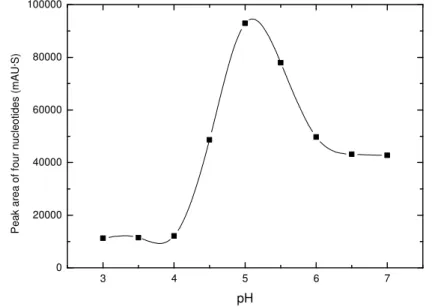
pH value. The yields of 5’-nucleotides in the hydrolysis reaction at different pH value were determined by HPLC. The pH value of the reaction was adjusted by disodium hydrogen phosphate/citric acid buffers. The amount of 2% RNA and enzyme used in the reaction was 1 mL and 0.2 mL, respectively, and the reaction lasted for 1 hour at 70 oC. The y-axis represented
Component Regression equation r2 Linear range (mg/mL) 5’-CMP Y = 19145.51x + 61.16 0.99940 0.00332-0.461 5’-UMP Y = 20234.82x + 73.57 0.99983 0.00318-0.441 5’-GMP Y = 29601.4x + 280.95 0.99984 0.00242-0.448 5’-AMP Y = 42475.7x + 59.91 0.99998 0.00154-2.671
the total peak area of all the four 5’-nucleotides (Figure 3). The results showed that the most favorable pH value is 5.0. 3 4 5 6 7 0 20000 40000 60000 80000 100000 P e a k a re a o f fo u r n u c le o ti d e s ( m A U ·S ) pH Figure 3. Effects of pH on hydrolysis of RNA.
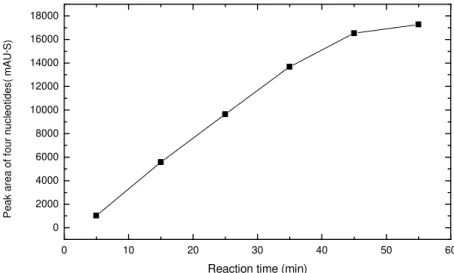
Reaction time. The relation between the yields of 5’-nucleotides in the reaction and reaction time is shown in Figure 4. The reaction was carried out at 70 oC, pH = 5, and the amount of 2 % RNA and enzyme was 2 mL and 0.2 mL, respectively. From Figure 4, we could find that the yields of 5’-nucleotides were proportional to the reaction time during 5-45 min. Thus, 30 min was chosen for the assay of enzyme activity for the sake of convenience.
Amount of substrate.The reaction went for 30 min at 70 oC, pH = 5, and the amount of RNA and enzyme was 2 mL and 0.2 mL, respectively, while the concentration of RNA solution was different. As we know, the yield of products (5’-nucleotides) is proportional to the amount of substrate (RNA), so that the hydration rate of RNA, not the yield of 5’-nucleotides, was used to appraise the reaction process. The results are shown in Figure 5. It shows that the hydration rate of RNA is high when the reaction takes place at lower RNA concentrations. Thus, 2 % RNA is recommended for the assay of enzyme activity.
Amount of enzyme. The reaction was conducted for 30 min at 70 oC, pH = 5, using a 2 mL solution of 2% RNA. Different amounts of enzyme were used in the reaction to investigate its influence on the yield of nucleotides. The results are listed in Table 3. The concentration of enzyme sample was 0.3704 mg/mL, which was determined with Coomassie Brilliant Blue method (Bradford method) [16, 17].
Table 3 shows that the yields of 5’-nucleotides increase with the amount of enzyme, and the calculated specific enzyme activities of the 7 samples are almost the same. It suggests that we can choose any amount of enzyme within this range of enzyme concentration for the assay of enzyme activity, and it shows that this method is very sensitive, only 5 µL enzyme solution (containing 0.001852 mg 5'-PDE) is needed for the detection of enzyme activity.
0 10 20 30 40 50 60 0 2000 4000 6000 8000 10000 12000 14000 16000 18000 P e a k a re a o f fo u r n u c le o ti d e s ( m A U ·S )
Reaction time (min)
Figure 4. Relation between the yields of 5'-nucleotides and reaction time.
0 1 2 3 4 5 26 28 30 32 34 36 38 40 42 44 46 H yd ra ti o n r a te ( % ) Concentration of RNA (%) Figure 5. Effects of RNA concentration on hydration rate. Table 3. Influence of enzyme amount on the yield of nucleotides.
Volume of enzyme solution (µL) 5 10 25 50 100 150
Yields of 5’-nucleotides (mmol) 0.0013997 0.002759 0.007236 0.013491 0.028757 0.043499 Specific enzyme activity
(mmol/mg × min)
Assay of enzyme activity of 5'-PDE samples
Six 5'-PDE solutions with different concentrations were prepared as described in the Experimental. The enzyme activities of these 5'-PDE samples were then detected at the above optimal reaction conditions.
The regression equation was y = 0.02505x - 1.2381 × 10⁻⁶, y is the enzyme activity (mmol/min × mL), x is the protein concentration (mg/mL), and the correlation coefficients (r2) were more than 0.9999, which indicates excellent linearity.
Furthermore, the enzyme activity of one 5'-PDE sample containing 0.81 mg/mL protein was measured six times under the optimal operating conditions. The average enzyme activity was 0.020295 mmol/(min × mL) and the relative standard deviation (RSD %) was 2.19 %, which suggested this method had good repeatability.
CONCLUSIONS
Chromatography conditions for the separation of products of hydrolysis of RNA were investigated and a method for the quantification of the 5'-nucleotides by RP-HPLC proposed. This method showed excellent reproducibility, precision, and linearity. Furthermore, a novel assay of 5'-PDE enzyme activity was developed. Compared with the conventional methods, this assay has some advantages: it can be used to detect the enzyme activity of PDE in impure 5'-PDE mixtures, which is important for monitoring the 5’-5'-PDE purification process This method is very sensitive, 5 µL enzyme solution (0.3704 mg/mL) is enough for the assay of enzyme activity. Enzymatic hydrolysis reaction conditions were studied thoroughly and optimum conditions were found at 70 oC and pH 5.0.
REFERENCES
1. Deoda, A.J.; Singhal, R.S. Bioresource Technol. 2003,88, 245.
2. Li, D.Y.; Qiu, W.R.; Ding, Q.B. J. East China Univ. Sci. Technol. 2002, 4, 376. 3. Chen, J.; Wang, Z. J. Wuxi Univ. Light Industry2001, 3, 270.
4. Tanekawa, T.; Takashima, H.; Hachiya, T. US Patent 4,303, 680, 1981. 5. Fitt, P.S.; Baddoo, P. Biochem. J.1978, 181, 347.
6. Bowles, L.K. US Patent 5,034,325, 1991, July 23. 7. Prentice, N. J. Cereal Sc. 1987, 5, 175.
8. Chen, J.; Wang, Z. Sci. Technol. Food Industry2000, 1, 19. 9. Prentice, N.J. Am. Soc. Brew. Chem.1983, 41, 133.
10. Fiers, W.; Vandendriessche, L. Arch. Int. Physiol. Biochim.1961, 69, 339. 11. Laufer, L.; Gutcho, S. Biotechnol. Bioeng. 1968, 10, 257.
12. Pierro, D.D.; Tavazzi, B.; Perno, C.F. Anal. Biochem.1995, 231, 407. 13. Perrin, C.; Meyer, L.; Mujahid, C.; Blake, J. Food Chem.2001, 74, 245. 14. Ferreira, I.M.P.L.V.O.; Mendes, E.; Gomes, A.M.P. Food Chem. 2001,74, 239.
15. Yi, L.T.; Zhang, L.; Ding, A.W.; Xu, Q.; Zhu, Q.; Kong, L.D. Arch. Pharm. Res.2009, 32, 1417.
16. Bradford, M.M. Anal. Biochem.1976, 72, 248. 17. Wei, Y.J.; Li, K.A.; Tong, S.Y. Talanta1997, 44, 923.