©2012Vilnius University
Learning Computer Programming
as an Extra Curriculum Activity, the Challenges
Francis DOGBEY
Advanced Information Technology Institute, Ghana-India Kofi Annan Centre of Excellence in ICT PMB, State House, Accra, Ghana
e-mail: [email protected]
Abstract.This paper describes the i2CAP project for senior high school students in Ghana. The project promotes and demystifies computer programming through programming contests. It is run in two distinct divisions: inter-schools programming contests and the National Olympiad in Infor-matics (in preparation towards IOI participation). This project has developed the algorithmic think-ing and computer programmthink-ing capacity of about 10,000 students and 303 ICT teachers from 257 senior high schools throughout the Ghana. This paper describes selection, training and organization of the project as well as the challenges and successes of running a fairly balanced programming contest among digital divided senior high schools in Ghana.
Key words:i2CAP, inter-schools programming contest, algorithms, national olympiad in informa-tics.
1. Introduction
The programming contest at high school level in Ghana was established by the Ghana– India Kofi Annan Centre of Excellence in ICT (AITI-KACE) in 2004 in preparation to-wards the country’s participation in the International Olympiad in Informatics (IOI). The contest, run under the project name ‘I TOO CAN PROGRAM’ (i2CAP), aims at demys-tifying computer programming, and promoting interest in computer science. The project provides students the opportunities and resources needed for exposure to computing ca-reers.
Ghana has a three level educational system namely: free compulsory basic education, senior high school education and tertiary education. Pre-tertiary education is made up of nine years basic education (i.e., primary and junior high) and a three years senior high school/technical/vocational education. There have been several educational reforms es-pecially at the pre-tertiary level with the sole objective of improving the standard of edu-cation in the country. Recently, the eduedu-cational institutions have incorporated teaching of Information and Communication Technology (ICT)/ computer literacy classes into their teaching curricula. Like other African countries, the use of ICTs in the Ghanaian schools is generally increasing and noticeably growing (Amenyedziet al., 2011). This was further strengthened by the enactment of the ICT for Accelerated Development (ICT4AD) policy into law in 2004 by the Parliament of Ghana. This law seeks to promote ICT education
and to support in the development of research capacity in ICT among others (National ICT Policy and Plan Development Committee, 2003).
The quality and quantity of ICT infrastructure and human resources at senior high schools in Ghana varies significantly. The so-called ‘endowed’ schools have more com-puting resources (i.e., PCs, Internet Access, ICT Teachers, etc.) compared to the ‘less endowed’ ones, creating a digital divide (Merry et al., 2008) among the schools. The interest of the project is to encourage as many students as possible to participate in the project in order to develop the algorithmic thinking and basic programming skills that are useful for their career. The question is how to run the contest among the digitally divided schools with some level of fairness?
There is no specialised school in Ghana for talented young students. All students at the pre-tertiary level, except those from the international schools, study a common curricu-lum and sit the same examination. Time is one of the critical resources required to develop exceptional programming skills and to develop the necessary algorithmic thinking skills required to compete at IOI. Another question is how to convince parents or guardians, teachers and heads of schools to embrace computer programming contests, and more im-portantly, the students, to invest time into this time consuming activity. A barrier is that the universities and the polytechnics in Ghana make undergraduate admission decisions strictly based on performance of the applicants at the West African Senior School Certifi-cate Examination (WASSCE), the standardized test for the English speaking West Africa countries.
This paper is structured as follows: Section 2 describes our training methodologies; Section 3 describes organization of the contests; Section 4 summarizes our observation, experience and challenges and Section 5 our conclusion.
2. Training
2.1. Training Material
Our first step in implementing the project was developing training materials for the par-ticipants. As a result we developed a training manual (both in hard and soft copies) that were distributed to participants and interested students during the training workshops. We also created an online resource (http://i2cap.aiti-kace.com.gh) to en-gage and to develop interested senior high school students around the country. In order to achieve fairness, we ensure that tutorials on the website are not significantly differ-ent from tutorial provided in the hard or soft (on CD) copies. Our aim is to involve the students in a computer programming contest that is fun, educational and beneficial to the society. As a further aid, contact details of professional programmers with excellent algorithmic thinking and thorough understanding of computational theories were made available to the interested students. The experienced programmers serve as both mentors and role models for the students.
The website also provides programming tips and pointers to other relevant learning materials. Practice questions as well as preliminary contest questions are uploaded onto
the website for students. Students are allowed to answer the problems and submit the answers for constructive comments or review by mentors either by post, email or up-loading it at the website. Major flaws identified in the student solutions are included in the frequently asked questions. Unfortunately, because of resource constraints including monetary constraints, information at the website is revised and updated regularly in con-trast to what can be done with the hard copies send to the schools. We also observed that many of the students prefer to download the materials from the website directly and share it among their colleagues rather than waiting for the hard copy from us. Also, many of the students involved in downloads are either from endowed schools or have affluent family background. This partially defeats our aim to provide equal opportunity to project resources.
2.2. Capacity Building
In Ghana, computer programming is not taught as a subject or part of a subject at senior high school level. There are steps being taken to introduce ICT (i.e., computer literacy) into the senior high school examination curriculum and to make it an examination sub-ject. Currently, some of the endowed schools engage the services of computer hardware technicians to maintain the computers at their computer laboratories and to train their students to acquire basic computer literacy skills.
We recognize that there is a very limited number of ICT teachers with excellent pro-gramming or algorithmic thinking background to support the project. As a result we adopted a capacity building approach in implementing the project by organising inten-sive two weeks programming training workshop for interested mathematics and science teachers. Our training assumed that teachers are familiar with basic-to-intermediate math-ematical concepts and have the capacity to think logically. This supports Gulati’s argu-ment that several open learning initiatives in developing countries have focused on edu-cating and training their unqualified teaching force (Gulati, 2008).
Since many of the participants of the train-the-trainer boot camp were relatively new to computer programming, we adopted hands-on training, pair programming (where nec-essary) and real world scenarios based on classical algorithms during the training work-shop. This combined with game technique such as error spotting, output prediction, etc., generated and sustained much interest, making programming fun among the participants. Our learner-centred approach enhanced the problem solving capacity of the teachers. This observation buttresses the Elizabeth Sklar, et al arguments for research in technology ed-ucation that student-centred learning environments support design (Martin, 1996; Leper, 2000), constructionism (Papert, 1980; Piaget, 1972) and team work (Garner, 1983) and therefore generates the strongest outcome (Eguchi, 2004).
The training was conducted using BASIC, Ruby and C/C++ programming lan-guages. The choice of programming language was hugely influenced by ease of use, learner ability and preference. For easy facilitation the entire country was divided into localities. A locality consisted of all selected schools from a region or parts of a region depending on the geographical dispersion of schools in the region. Also, each of the
participating teachers agreed to identify and train between 40 to 50 intelligent students, out of which a team is formed to represent their schools. The decision on the number of students was influenced by the voluntary nature of training and the fact the project is organized as an extra curriculum activity.
Our capacity building technique seeks to support our objective of providing near-balanced resources to enhance fairness and minimise the possible knowledge gap. At the same time it introduced another problem of severe under-representation of women during the mentoring session for ICT teachers, and therefore supports the well known fact that, women are underrepresented in computer science and this trend is worsening (Doerschuk, 2004). In our attempt to improve the underrepresentation, at all time a woman mentor was part of the mentoring programme for teachers and during our inspection visits to the school. Our invitation letters to the school authorities also encouraged them to nominate qualified women for the mentoring programme. In spite of all these measures, we had less than 10% female participation in the programme.
3. The Contests
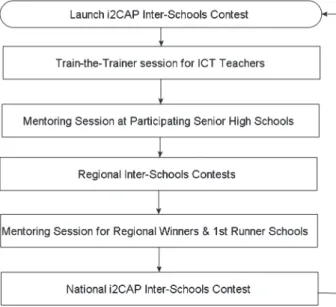
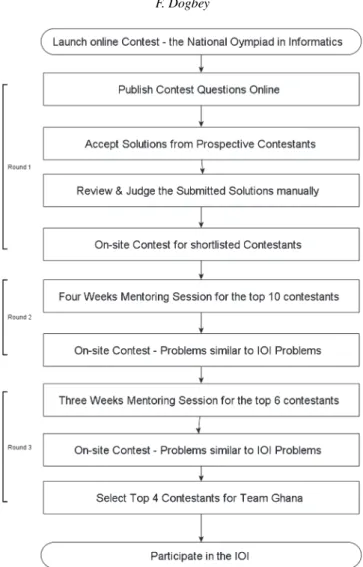
Unlike other participating countries at the IOI, we organized two distinct contests: the inter-schools contest (see Fig. 1) and the National Olympiad in Informatics (see Fig. 2) as described below.
Fig. 2. National Olympiad in Informatics.
3.1. Inter-Schools Contest
The first step of the inter-schools contest is the selection of participating schools. This is done through advertisement in the daily Graphic (i.e., national daily), project website and formal invitation to all schools that participated in the train-the-trainer workshop. We use these combinations of outreach methods to obtain larger coverage and to ensure our sponsors also got the necessary media publicity they deserve.
The inter-school contest is different from the regular IOI in many respects. Contes-tants represent their schools rather than themselves. Each school selects up to four con-testants to represent it at the regional contests. The concon-testants work in teams to submit one solution per question. They are assigned only one computer for programming. There are ten regions in Ghana and so we organized 10 regional contests and a national
inter-schools contest. At the national inter-inter-schools contest, each region is represented by the regional contest winner and 1st runner-up. Our first aim at this contest is to promote stu-dents interest in computer science and programming. Second, is to ensure that parents, teachers and the heads of schools accept the contest as a necessary capacity building project and to give their consents and supports for their childrens’ participation. Both aims were partially achieved as some of our stakeholders refused participation due to time constraints and for the fear that it would compromise their academic performance at the WASSCE. The disappointed brilliant students who could not represent their schools were encouraged to enrol for the National Olympiad in Informatics.
The tasks for this contest are less challenging compared to that used for the IOI and Ghana’s National Olympiad. The tasks are aimed at testing students’ understanding of mathematical concepts, and basic algorithms and programming concepts taught during the mentoring session organized by their teachers. Another aim is to fairly nurture algo-rithmic thinking in the younger students across Ghana.
The inter-schools contests are usually held on Saturdays to minimize interruption of regular classes. The regional contests are held at the secondary schools with function-ing and large computer laboratories. However, the National i2CAP events are held at our (AITI-KACE) laboratories in Accra. Each PC used for the contest has BASIC, Ruby or C compilers readily installed. Each team submit one solution for evaluation. There are four questions with varied difficulties to be solved within three hours by contestants. There are five judges made up of professional software engineers, computer science lecturers and mathematicians who manually evaluate the contest. Since many of the judges had their high school level education in Ghana, we conduct background checks to ensure that no two judges graduated from same institution particularly if that institution is compet-ing. The solutions submitted by the contestants are evaluated based on the quality and efficiency of the codes or the algorithms implemented.
During the inter-schools contests, computer science and mathematics book prizes are awarded to all participating schools. In addition, the top three schools are awarded PC prizes donated by our sponsors. By awarding prizes to top performing schools we hope to achieve the goal of supplementing the efforts of ICT education in the country. 3.2. National Olympiad in Informatics
The inter-schools contests were run for about three years prior to the first selection pro-cess for IOI event. As a result the National Olympiad in Informatics benefited immensely from the publicity generated by the inter-schools contests among the students. Our na-tional olympiad event is open to any senior high school student below 19 years by 1st July of the preceding year to the IOI event. However, only Ghanaian students are selected as part of the Ghana delegation. Like the inter-schools contest, the national olympiad contest is launched through the media and project website.
The first step of the selection process for the national olympiad team is the publica-tion of the preliminary contest quespublica-tions at the project website. We also run adverts in the national dailies to direct interested students to the website. All submissions for the
preliminary contest questions are done online. Students participating in this contest are expected to implement their answers in C/C++, BASIC or Ruby. Usually, 80 to 100 sub-missions are received by the deadline. The solutions submitted are then evaluated by a panel of judges manually. About 30 to 40 students are short-listed for an on-site contest (i.e.,round 1).
The top 10 best contestants from round 1 participate in 4-week boot camp training. The training focuses on classical algorithms used for IOI tasks. In addition, students are introduced to basic or advanced programming concepts using C/C++. Typically, the stu-dents are given 2 to 4 weeks break for self study after which another on-site contest (i.e., round 2) is then held to eliminate four more students. Assessment at this stage includes a 5% to 10% of continuous assessment and the remainder of the scores obtained during the contest. The continuous assessment is based on the number of questions successfully solved during the boot camp session, the observed algorithmic support to other students and the student attitude. Questions at this stage of on-site contest are based on previous or similar to the IOI tasks.
The best six students fromround 2participate in the final three-week problem solving boot camp. Afterwards, another onsite contest (i.e., final round) is run to select up to four students to represent Ghana at the IOI depending on funding.
4. Observations/Results
Generally, the project has been very successful but there are some challenges as well. There were both unanticipated challenges and benefits.
4.1. Observation
Although, just about 18% of the participants were females at inter-schools i2CAP events, some of the regional contests were won by all-female teams. This is an encouraging de-velopment and a good start for dede-velopment of women for computer science careers. It is also interesting to note that some of the winning schools actually had no computer labo-ratory and had to rely on a PC in an instructor’s home for the training towards the contest. This suggests that some of the potential leaders for the ICT industry are disadvantaged, but with appropriate support their talents can be realised. Another observation is that many of the schools that won regional contests are among the so-called ‘less endowed’ schools in the country.
4.2. Results
The i2CAP project has sparked a lot of interest among senior high school students na-tionwide with many considering a career in ICT. Also, several of the past participants at the inter-schools or National Olympiad in Informatics are pursuing computer science or related disciplines at the tertiary level. There is also a limited number of them who have built on the exposure and now own and run their small IT businesses. Others are also
employed as trainee software developers. Many of the high school authorities have also learnt to appreciate and embrace ICT, and now support the project.
About 10,000 (estimated) students were mentored nation-wide on programming con-cepts and algorithmic thinking through the 257 senior high schools that participated. A to-tal of 573 students tested their knowledge and skills through the inter-school contests. In addition, about 100 students received advanced programming in C/C++, algorithms and data structures through the National Olympiad in Informatics events.
The computer programming and problem solving capacity of 303 ICT coordina-tors/instructors nation-wide were enhanced.
All the participating schools and contestants (national olympiad only) were provided with computer science and discrete mathematics books to support their skills develop-ment in ICT. In addition, the winner, 1st runner-up and 2nd runner-up of the inter-schools contests were awarded with computers and their accessories to boost ICT education in their respective schools.
Ghana has been represented at IOI since 2008. Previous IOI participants have also developed the skills and now support the mentoring sessions for IOI. The performances of the contestants have also improved over the years.
In addition, there were some intangible but real successes of the project. Both the ICT coordinators and the students who participated in any of the activities of i2CAP project have become a community for continuous collaboration. Several of the participants have become more vocal, confident and supportive of one another. The inter-schools contests also provide the participating schools the opportunity to interact directly with educational authorities and to re-echo their needs to them.
4.3. Challenges
The i2CAP project failed to cover every single senior high school in the country due to budgetary constraints. As a result, participation in the inter-schools contest was re-stricted to only schools with installed and functioning computer laboratories or having access to computers to practice. This suggests that there may be some savvy young-sters with potential to develop excellent algorithms that are unused throughout the con-test.
Currently, teaching and learning of ICT (i.e., programming) as a subject at senior high schools is optional and non-gradable. As a result some intelligent students are not interested in studying a subject that has no contribution to their final grades at school.
It is also very difficult and challenging to obtain permission from parents for their children especially daughters to participate in the mentoring sessions, although the entire project is fully funded.
For some unknown reasons, many of the contestants are in the final year of their high school studies making them not eligible for the next contest. Several attempts to encourage first year students to participate in the contests failed to yield positive results.
The poor teacher remuneration makes the staff turnover of ICT teachers very high. This is because ICT teachers have a higher chance of getting other high paying jobs and
move out of the schools (Leliveld, 2002). This is attributable to the shortage of skilled ICT professionals in country. As a result, the project is forced to organize the train-the-trainer workshop all the time.
5. Conclusion
The i2CAP project provides senior high school students with the opportunity to experi-ence and develop computer programming skills whilst working in teams. This provides the contesting teams with an invaluable experience of teamwork, leadership and commu-nication skills. The project also strengthens and develops algorithmic thinking capacity required for software development and undergraduate computer science education.
Acknowledgements.The Finatrade Foundation Ghana was the main sponsor of i2CAP events from 2007 till 2010; the Star Assurance Company also provided travel insurance cover to the Ghana team to the IOI in 2010. AITI-KACE is the technical sponsor of the project.
References
Amenyedzi, F., Lartey, M., Dzomeku, B. (2011). The use of computers and internet as supplementary source of educational material: a case study of the senior high schools in the tema metropolis in Ghana.Contemporary Educational Technology, 2(2), 151–162.
CIA. (2012).The World Fact Book. Retrieved April 16, 2012, fromhttps://www.cia.gov/library/ publications/the-world-factbook/geos/gh.html.
Doerschuk, P. (2004). A research and mentoring program for undergraduate women in computer science.34th ASEE/IEEE Frontiers in Education Conference.
Eguchi, E.S. (2004). Learning while teaching robotics.American Association for Artificial Intelligence. Garner, H. (1983).Frames of Mind: Theory of Multiple Intelligences.Basic Books.
Gulati, S. (2008). Technology-enhanced learning in developing nations: a review.The International Review of Research in Open and Distance Learning.
Leliveld, M. (2002).Science, Mathematics and ICT (SMICT) Education in Senior Secondary Schools in Ghana. Leper, M.A. (2000). Turning “play” into “work” and “work” into “play”: 25 years of research on intrinsic versus
extrinsic motivation. Academic Press.
Martin, F. (1996). Idea and real systems – a study of notions of control in undergraduates who design robots.
Constructionism in Practice: Designing, Thinking and Learning in a Digital World.
Merry, B., Gallotta, M., Hultquist, C. (2008). Challenges of running a computer olympiad in South Africa.
OLympiads in Informatics, 2, 105–114.
National ICT Policy and Plan Development Committee. (2003).The Ghana ICT for Accelerated Development (ICT4AD) Policy.Retrieved from The Republic of Ghana.
http://www.moc.gov.gh/moc/PDFs/Ghana_ICT4AD_Policy.pdf. Papert, S. (1980).Mindstorms: Children, Computers, and Powerful Ideas. Basic Books. Piaget, J. (1972).To understand Is to Invent. New York, The Viking Press, Inc.
F. Dogbey holds an MSc in engineering (dependable computer sys-tems) from Chalmers University of Technology, Sweden. He is a faculty member of the Advanced Information Technology Institute, Ghana– India Kofi Annan Centre of Excellence in ICT. He was deputy team leader in 2008 but a team leader, coordinator of the Ghana National Olympiad since 2009. He has been the technical facilitator since i2CAP project inception. His current research interests include machine learning, databases, fault tolerance and object oriented programming.