Personality Development
through Interactions in Virtual Worlds
Chisato Numaoka
Sony Computer Science Laboratory - Paris 6, rue Amyot
75005 Pads, France [email protected]
Abstract
In this paper, we discuss personality from the viewpoint of training personal assistance in the 3D virtual world. Personality is a set of psychological traits that characterize the individual human. It is hypothesized that we have a set of innate factors from which social cognition or social intelligence emerges. Throughout this emergence, conditioning will play a primary role in allowing individuals to become attached to their social surroundings, especially to their parents or care-takers. A fundamental core personality is gradually developed in the early stage of life in the form of the referential associative knowledge required in social life. Given this hypothesis, we have developed a self-biased conditioning model composed of two basic units: a set of primary response networks and an associative memory in which a set of sensors are associated with motor centers and give reinforcement feedback to these centers. We have conducted an initial experiment to use this mechanism to train a virtual world agent through interactions with its user. In this paper, we will report some observations obtained through this experiment.
Introduction
Personality is a set of psychological traits by which we characterize ourselves, consciously or unconsciously. It is presented through a variety of daily activity; such as the formulation of attitudes and preferences or the exhibition of patterns of thought and behavior. As such, personality is very difficult to define, although our preferences well represent one aspect of our personality, we do not always know exactly why we like or dislike something. We may say, "I like it, but I don’t know why."
The biomechanics of personality is rooted deeply in our brain. We believe that the limbic system fully determines not only our emotions but our personalities. The major portion of personality development occurs early in life, and thereafter personality becomes rather persistent. Our decisions or reactions are influenced by our personality. In one sense, we might say that personality is determined by an associative table, through which a certain stimulus causes a primary response. We form this associative map early in life through interaction with the surrounding
environment, in which parents play a primary role.
In this study, we consider personality in relation to 3D virtual world applications in which we act as avatars which are virtual representations of ourselves. In 3D virtual world applications thus far, people have paid less attention to personality of avatars than to their apparatus. This is mainly because an avatar is just an interface
through which a particular user accesses a virtual world. We users have our personality. Nevertheless, out personality is hidden behind an avatar in a virtual world. Because, in the virtual world, we are encapsulated by avatars, it is important that these avatars be able to present a pseudo-personality representative of our own. The development of this pseudo-personality is the main
objective of this study.
The organization of this paper is as follows. In the next section, we will briefly introduce the notion of innate sociability, which forms the philosophical basis for our study, and we will discuss the relationship between this philosophy and the concept of personality. Then, we will describe a self-biased conditioning that we have invented for personality development of artificial agents. Finally, we report our experimental results.
Innate Sociability and Personality
How is personality developed? It is known that social animals such as humans and other primates can develop the social skills required for social life. Examples are alarm calls for predators, imitation, deception, attachment behaviors, governance relations, and the like. We can postulate that primates are equipped with an innate organ by which they can soon adapt to their own society (Worden 1997). Our hypothesis here is that this innate ability to learn social skills plays a key in personality development.Social Conditioning
It is known that vervet monkeys can produce three different calls corresponding to its three types of predator: raptor, leopard and snake. Premack asks:
Does the immature vervet figure out the structure of this domain, that is, does it learn the categories? No, it has the categories: what it learns is how to fine tune the membership of the categories (Premack and Premack 1994).
This means that vervet monkeys are innately equipped with an ability to discriminate some categories and to assign items among them. Nevertheless, this inheritance cannot account for the specificity of a vervet’s eagle-alarm call: the vervet must also learn. How do these animals learn? Recall that human babies can gradually learn a causal relationship between their crying behavior and a parental care-taking behavior. As Wallon points out, in practice this is an example of classical conditioning (Wallon 1945).
In classical conditioning, a system requires two types of inputs: a conditioned stimulus (CS) and unconditioned stimulus (US). To identify these inputs our scenario with the vervet, Consider the type of bodily responses which Damasio call primary emotion:
We are wired to respond with an emotion, in preorganized fashion, when certain features of stimuli in the world or in our bodies are perceived, alone or in combination .... Such features, individually or conjunctively, would be processed and then detected by a component of the brain’s limbic system, say, the amygdala (Damasio 1994). When a vervet detects a predator, a primary emotion is activated in response to features of the predator. We regard this set of feature inputs as a conditioned signal C.
Of course, we can say that an association between two unrelated objects has been made as the result of conditioning. We could also say that a vervet (or a vervet brain system) has learned features of the predator so as to discriminate from other animals because knowledge of the predator are so important for the vervet’s continued survival. Why does the dog learn to discriminate the features? What is the motivation?
We doubt the existence of a mechanism that detects a set of expected inputs only when a primary emotion is activated. To explain further, imagine that the fear of snakes is a primary emotion. When the features of a snake are perceived, even if it is not a snake but a coiled rope, the emotion may be evoked. Along with this activation, then, a mechanism for detecting a set of expected stimuli is made ready. As long as the stimuli is obtained as expected, nothing happens. That is, there is no need to discriminate the current situation from others.
In the case of the fear of snakes, suppose that the snake’s posture creates the expectation that it will attack. Then the emotion corresponding to the vervet’s fear of snakes must prepare for a possible escape.
We will postpone our discussion of the detailed mechanism of this phenomenon until the section on self-biased conditioning. We believe that it is essential to an animal’s behavioral development that there exists a mechanism to detect expected stimuli associated with
primary emotional responses; this is particularly so in the case of socially learned behavior, such as the eagle alarm call of the vervet monkey or the human baby’s attachment to its mother.
Personality Development
Personality, as defined by Pervin (1993), represents those characteristics of a person that account for consistent patterns of behavior. This is a very concise human-specific definition. To apply the notion of personality to artificial agents, Moffat adopted Pervin’s definition as follows: Personality is consistent reactive bias within the fringe of functionality (Moffat 1997). Personality has
close relationship with emotion because, as Frijda emphasises, emotion can be seen as changes in activation of behavioral dispositions caused by relevant stimulus events (Frijda 1987). Here emotion is almost equivalent to the emotional response discussed above.
Moffat defines each of emotion, sentiment, mood, and personality with respect to focus and duration (Moffat 1997). In this definition, emotion is a focused and short-term response while personality is a generous but long-term response. A significant function of emotion is action readiness by which we can prepare body conditions for some predicted danger. In a dangerous situation, it is very useful to respond quickly. "It is better to have treated a stick as a snake than not to have responded to a possible snake" (LeDoux 1997).
Again, emotion is equivallent to emotional response in this case. Personality is therefore sustained by the mechanism that creates emotional responses. In other words, personality is a whole body composed of emotional responses and acquired conditioned responses. Conditioned responses are acquired in a way that I explained above.
In the case of eagle-alarm-call learning in vervet monkeys, a young monkey’s eagle alarm call is initially nonspecific (Seyfarh 1980). But the monkey soon learns to be specific by observing its peers’ lack of reaction to its false eagle alarm call. Note here that young monkeys originally have a "nonspecific" response pattern of reacting to any bird.
Resulting specific patterns may differ among individuals due to their different experiences. This variation, we believe, is a root of personality. Therefore, we could summarize that personalities emerge through a process of specialization of given generic and consistent response pattens.
Further, we could say that personalities may constitute a consistent reactive bias because they are bounded by fundamental generic and consistent responses. Based on this notion of personality, we here consider the possible developemtn of personality. The notion of self-bias conditioning is briefly explained in the following section.
Self-biased Conditioning
We recently developed a self-biased conditioning system for the purpose of simulating the development of social intelligence in interactions with others (Numaoka 1998a). This is basically classical conditioning system that presumes a set of primary response networks, each of which responds to any definite pattern of inputs with a definite pattern of outputs. Each response network should be as general as possible, meaning that only a few sensor inputs are originally considered. Each primary response network contains at least one expectation node which detects whether an expected input is received. If the expectation is not realized, the learning system is forced to learn to produce a negative reinforcement signal so as to suppress the output of the primary response network.
This learning is done with an associative network by incorporating some sensors which were active at the moment when the expectation failed. This learning of a negative reinforcement signal may result in a situation where the output is suppressed even when the expectation is satisfied. This, in turn, forces the learning of a positive reinforcement signal in order to activate the output from a corresponding primary response network. In the following sections, we will explain the basic components of the primary response networks and associative memory in detail.
The primary response network
All primary responses are produced by a primary response network. This network consists of three types of nodes: an activation node, an expectation node, and a motor center. Note that a single primary response network may contain several motor centers and expectation nodes,
I1
12
yj+(t)[ [ yf(t)
Activat~ l ~
activate ~/ O 1 t (t)-~Mo or O?nJlte)r
o2j(t)
Expectation nodej Primary response network l
Figure 1: A primary response network. The primary
response network consists of three basic nodes: an activation node, an expectation node, and a motor center. An activation node, when activated by input I1, attempts to activate a corresponding motor center as well to open a corresponding expectation node so that the expectation node becomes ready for input I2. A motor center receives a pair of reinforcement inputs, yj+(t) and yj-(t), from an associative memory.
whereas only one activation node is allowed.
In cases where there are more than one motor center, the output of the activation node l, Ol1(0, is directly connected to each motor centerj. Each motor center j has one corresponding expectation node j and takes a pair of reinforcement signals, y/(t) and yf(t), from an associative memory (See Figure 1).
Whenever an activation node receives input from a sensor, it attempts to activate a corresponding motor center, which produces an emotional response. Simultaneously, the activation node enables an expectation node to receive input from any connected sensors.
Associative memory
An associative memory consists of a set of sensors x,(t) and a set of positive and negative reinforcement center pairs, yj+(t) and y/(t). Each node of this associative network takes two types of inputs: inputs from one or more sensors, and triples of activation inputs, Oll(t), O2j(t), and O3j(t), from each primary response network; Note that a subscript of Old(t) is different from O2j(t) O3j(t). Also, it is important to remember that each primary response network has only one activation node but potentially more than one motor center, and that one motor center corresponds to one expectation node.
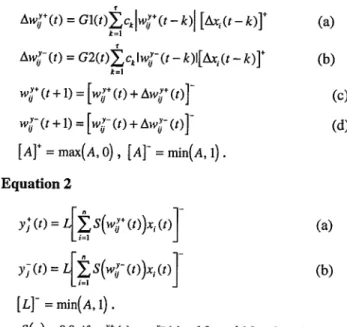
Our learning model is essentially the same as that of the D-R model (Klopf, Morgan, and Weaver 1993), although it differs in some details because it is based on a different conditioning model. Equation 1 defines a set of update function for an associative memory. The outputs of y/(t) and y[(t) to motor center j are, in the end, defined in Equation 2. Both %F(t) and w~jY(t) are weights
Equation 1
Aw;÷(t) Gl(t)~q w~+(t- k) [Ax,(t- k)] ÷ (a) k=l 1" Aw~-(t) G2(t)~qbv~-(t - k)l[Axi(t - k)÷ (b) k=l w;÷ (t + 1) = [w;÷ (t)+ A~¢÷ (t)]- (c) w~;-(t + 1) = [w~-(t) + Aw~.’-(t)]- (d) [A]÷ : max(A, 0), [A]- : rain(A,
Equation 2 n ~, S w~+ (t) x, (t) y~.(t)=L~,= )] (a) [L]- = min(A, 1). S(x) = 0.0, if "÷ (t) = w~;- (t) = 1.0, and 1.0, otherwise.
nodes between sensor I and motor center j. The weights become invalid when both w~jY*(t) and wjj~(t) become
Equation l(a) updates the weights of those nodes that produce yj÷(t), whereas Equation l(b) updates the weights of those nodes for y/(t). Gl(t) is 1.0 when Ol,(t) is O2j(t) is 0.0, and O3j(t) is 0.0, and 0.0 otherwise. G2(t) 1.0 when O2j(t) is 1.0, and 0.0 otherwise. Thus, Awu~÷ is updated when the motor center is not activated although the activation node fires and sensor inputs meet an expectation on the expectation node and Awuy is updated when the expectation on the expectation node is not satisfied.
The initial values of weights are set to a small value (e.g., 0.01), so that there is no effect on the motor center M. As can be seen from Equation 1 (c) and (d), the values of wijy* and wuy do not increase beyond 1.0 in the current model.
Personality Development in Virtual Agents A central idea of self-biased conditioning is that specialization of an innate generic behavior is guided by an expectation on inputs following an activation of the behavior. This expectation is used to trigger a process of discrimination of the present pattern of inputs from other patterns. We believe that this type of conditioning system is appropriate for training artificial agents interactively in cases in which the information to be presented to the agents is unknown. In this section, we introduce an experimental system in which we can train an agent to be aware of our preferences for a variety of objects.
Contents navigation in a 3D virtual world
We next develop agents who can perform contents navigation in a 3D virtual world. Unlike text-based web browsers, 3D virtual worlds allow us to arrange locations of information contents geographically in 3D space, in a variety of forms (e.g. shops, buildings, or monuments). There are advantages and disadvantages inherent in such a model. Some of the advantages are as follows. 1) We can rely on our senses to comprehend the 3D world. 2) We can reflect on relationships among information contents in terms of the placements of each object in the 3D worlds. On the other hand, there is a serious disadvantage in terms of navigation in the 3D virtual world.
In a text-based information navigation using HTML, some choice points are explicitly given to users and we can navigate through pages. On the other hand, in a 3D virtual world, the space is enough large to grasp all the choice points at a grance. This is why we will often be at a loss which to choose. As a result, we soon get tired from the navigation.
As in the real world, the 3D virtual world may be more easily negotiated with the help of a partner who is already familiar with it. And if the partner understands our preferences, his advice will be that much more effective.
Our goal in this study is to develop such a partner, which we term the symbiot (Numaoka 1998b), and which will hereafter be used to refer to the virtual world agent.
Embodied Action Tendency
A primary response network can represent an embodied action tendency associated with particular sensor inputs. In other words, it defines a pattern of reaction when a system observes a particular pattern of inputs.
A motor center has a pair of positive and negative reinforcement inputs from an associative memory. What the associative memory represents is a set of positive and negative correlations between sensors and motor centers. Sensors can, in this case, be read as attributes of objects. Due to its nature of conditioning, nodes of associative memory in which the weights may change are restricted. Namely, such a node must be connected to an attribute observed simultaneously with an attribute connected to an activation node of a primary response network.
In fact, we can view this associative memory as a personality engine, because it first responds to primary inputs by regulating a set of motor centers which produce emotional reactions.
Openminded Partner
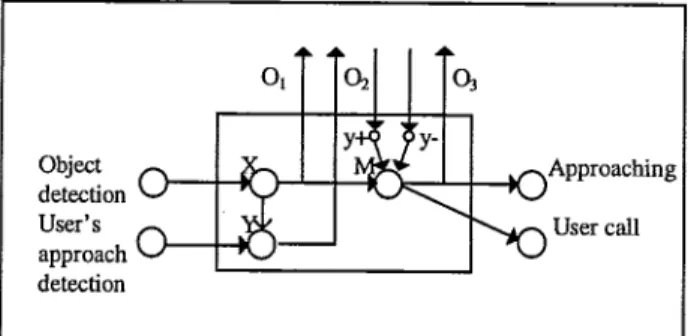
Here we take one example of a symbiot. In this case, the agent is characterized by the primary response network in Figure 2. This agent executes two actions simultaneously when it detects any object (something which has an
o2 % y y-detection ~ I "Y I "~""~l
u=’s
U=can
approach ~r---F-’V~-- I detectionFigure 2: A primary response network of an openmiuded symbioL
attribute "OBJECT"). These actions are approaching the object and calling a user so that he / she might go to it. Whenever the agent performs this action, it expects the user to approach the object.
From this symbiot’s point of view, it is initially attracted solely by an attribute "OBJECT," but it is aware of the user’s attitude - whether the user approachs the object or not. The symbiot’s personality would seem to be gradually affected by the user’s attitude so as to discriminate the significance of any attribute observed simultaneously with the attribute "OBJECT." In the end, it is expected that the symbiot will copy the attitudes of its
user to many attributes of objects. Of couse, this expectation will be realized only when the user has shown a consistent attitude to any particular attribute. Otherwise, the symbiot will become insensitive to that attribute to which the user’s attitude has been inconsistent.
Favor-imprinted Partner
The openminded partner might copy a user’s personality. What will happen when a symbiot has a special interest in some particular attribute? For example, what if the symbiot were initially sensitive to the "RED" attribute over other colors? Apart from the case that a user has a special disfavor to red objects in general, the user’s attitudes to any object with the attribute "RED" will become inconsistent. Therefore, it becomes insensitive to the attribute "RED". Nevertheless, because this symbiot initially has a primary response network in which a "RED" attribute stimulates an activation node, this symbiot would still become active when it observe a "RED" attribute. This is in fact an effect of primary response networks. That is, they work as a compensation modules for decision-making. If a developed personality is unreliable, then this initial module will take an initiative to take an action.
Simulation Environment
Rather than using a 3D world, we conducted our experiment using a 2D-world environment in which the user and symbiot were modeled as square mobile objects.
Within this 2D world, basic units were provided, i.e. the user unit, symbiot unit, object units, and world units. A world unit registers all the objects in a database, including the user and symbiot avatars, and maintains all the exported properties of these objects. Each symbiot has a limited range of sensors and can access the attribute information on objects, which is maintained in the world unit, within its sensor range.
Behaviors of a symbiot are defined as follows:
1) If the distance to a user is more than D, then the symbiot attempts to catch up with the user.
2) If the distance to the user is within D, then the symbio behaves as follows.
2.1) If the symbiot detects any object and the motor center outputs 1, then the symbiot draws a circle around the object on a screen at the same time as it approaches the object.
2.2) Otherwise, the symbiot attempts to follow the user. Attributes of objects have two categories: color and size. Color is either red, green, blue, or yellow and size is either large or small. The symbiot has sensors to detect all of these attributes. In addition, the symbiot has two other sensors: one to detect an object near it and the other to detect the approach of a user to an object to which the symbiot is attracted. The symbiot’s sensors are thus able to detect all the attributes, although some experiments may not use all the attributes.
Results
Typical examples of the personalities obtained through simulations are as follows. 1) Presentation of a strong preference; 2) Presentation of a strong aversion; and 3) neutral attitude. In case 1, a symbiot presents the behavior of hesitating to leave an object to which it is attracted, even if it has perceived that a user went away from the symbiot. In case 2, a symbiot no longer shows any interest for a detected object even if it passes near the object. In case 3, a symbiot produces an action as it is designed. Namely, it approaches an attracted object whenever it detects the object.
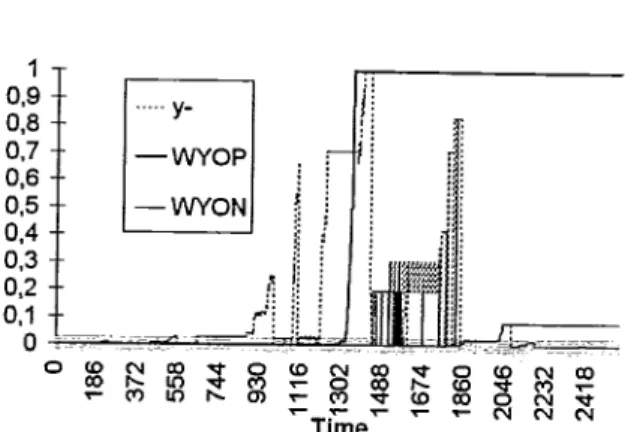
Figure 3 depicts a result of one particular experiment involving a strong preference to yellow objects. This shows a very good example of a symbiot developing a strong preference. It is inherent in the framework of self-biased conditioning that a positive preference cannot be develped alone. It is first required that there be a conflict between a perception as expected and an unexpected output of a motor center. As seen in Figure 3, WYOP, which is an intensity of preference for yellow objects, abraptly increases on the order of approximately 1300 to 1350 time steps, while the value of the negative reinforcement signal is high.
1 0,9 0,8 0,7 0,6 0,5 o,4 0,3 0,2 o,1 o
...
y-
il
,iil
i ii
’r-- 0’~ ,t-- 09 "~ (,.0 0 ~ "~ TimeFigure 3: Development of preference to yellow objects.
This figure depicts the result of an experiment to investigate the relationship between a negative reinforcement signal and the development of a positive preference to yellow objects. In this figure, the symbols y-, WYOPy-, and WYON stand for a negative reinforcement signal, an intensity of preference, and an intensity of aversion, respectively.
Conclusion
In this paper, we have discussed personality development in the context of 3D virtual world applications.
parents, artificial agents might also be conditioned by the user’s preferences. We began by developing a self-biased conditioning system.
Our stance is very similar to that of Johnson, who postulated that social cognition emerges as a result of three sets of factors: initial biases to attend to socially relevant stimuli such as faces and language, complex interactions with other people, and the basic architecture of the cortex and relevant sub-cortical structures (Johnson, 1997). Similarly, the proposed self-biased conditioning provides initial biases to attend to socially relevant stimuli, represented in primary response networks, and associative memory.
We next addressed the issue of personality development in association with social conditioning. Personality is a consistent reactive bias. Within the framework of self-biased conditioning, a secondary reactive bias can gradually be created by the associative memory.
We can use this method of personality development for training an assistant agent in the 3D virtual world. This agent is initially designed to show interest in all types of objects. By doing so, the agent can discriminate attributes in which a user shows his/her interest from other attributes. These basic preferential reactions are the foundation of the agent’s personality. We have conducted a simple experiment to test this.
What this paper describes is a preparation for the next will stage of development, the creation of emotional agents. Emotional agents will require a more complex and sophisticated architecture. Accordingly, our next challenge is to implement an architecture where we can test the somatic-marker hypothesis described by Damasio (1994).
Philadelphia: Taylor&Francis.
Numaoka, C. 1998b. SYMBIOT: Personalizing Agents in Social Contexts. In Proceedings of the First Kyoto Meeting on Social Interaction and Communityware. Pervin, L. A. 1993. Personality: Theory and Research (6a edition). New York: Wiley & Sons.
Premack, D., and Premack, A.J. 1994. Why animals have neither culture nor history. In Companion Encyclopedia of Anthropology. London: Routledge.
Seyfarth, R. M., and Cheney, D. L. 1980. The ontogeny of vervet monkey alarm calling behaviour: A preliminary report, z. Tierpsychology 54: 37-56.
Sidhu, C. 1998. Reflections of Communities in Virtual Environments: The Mirror. In Proceedings of the First Kyoto Meeting on Social Interaction and Communityware.
Wallon, H. 1945. Les origines de la pensge chez l’enfant, Presses Universitaires de France.
Worden, R. P. 1996. Primate Social Intelligence. Cognitive Science, 20:579-616.
References
Damasio, A. R. 1994. Descartes’ Error. New York: Avon Books.
Frieda, N. 1987. Emotions. Cambridge: Cambridge University Press. UK.
Johnson, M.H. 1997. Developmental Cognitive Neuroscience. Oxford: Blackwell Publishers Ltd.
Klopf, A. H., Morgan, J. S., and Weaver, S. E. 1993. Modeling Nervous System Function with a Hierarchical Network of Control Systems that Learn. In From animals to animats 2:254-261. Eds. J-A Meyer, H. L. Roitblat, and S. W. Wilson. Cambridge: The MIT Press.
LeDoux, J. 1997. The Emotional Brain. New York: Simon & Schuster.
Moffat, D. 1997. Personality Parameters and Programs. In Creating Personalities for Synthetic Actors (Eds. R. Trappl and P. Petta): 120-165, Berlin: Springer-Verlag. Numaoka, C. 1997. Innate Sociability: Sympathetic Coupling. In Proceeding of 1997 AAAI Fall Symposium on Socially Intelligent Agents: 98-102. AAAI Press. Numaoka, C. 1998a. Innate Sociability: Self-biased Conditioning. Applied Artificial Intelligence 12(7).