Piero Fraternali
Dipartimento di Elettronica e Informazione, Politecnico di Milano Piazza Leonardo da Vinci 32, I-20133 Milano, Italy
The exponential growth and the capillar diusion of the Web are nurturing a novel generation of applications, characterised by a direct business-to-customers relationship. The development of such applications is a hybrid between traditional IS development and Hypermedia authoring and challenges the existing tools and approaches for software production. This paper investigates the current situation of Web development tools, both in the commercial and research eld, by identifying and characterising dierent categories of solutions, evaluating their adequacy to the requirements of Web application development, enlightening open problems, and exposing possible future trends.
Categories and Subject Descriptors: H.5.4 [Information Interfaces and presentation]: Hy-pertext/Hypermedia; D.2.2 [Software Engineering]: Design Tools and techniques
General Terms: Application, Development
Additional Key Words and Phrases: WWW, HTML, Intranet
1. INTRODUCTION
Applications for the Internet in such domains as Electronic Commerce, Digital Libraries, and Distance Learning are characterized by an unprecedented mix of fea-tures that makes them radically dierent from previous applications of Information Technology [Myers et al. 1996]:
|Universal access by individuals with limited or no skills in the use of computer applications introduces the need of new man-machine interfaces capable of cap-turing customer's attention and of facilitating access to information.
|Global availability of heterogeneous information sources requires the integrated management of structured and unstructured content, possibly stored in dierent systems (databases, le systems, multimedia storage devices) and distributed over multiple sites.
Permission to make digital or hard copies of part or all of this work for personal or classroom use is granted without fee provided that copies are not made or distributed for prot or direct commercial advantage and that copies show this notice on the rst page or initial screen of a display along with the full citation. Copyrights for components of this work owned by others than ACM must be honored. Abstracting with credit is permitted. To copy otherwise, to republish, to post on servers, to redistribute to lists, or to use any component of this work in other works, requires prior specic permission and/or a fee. Permissions may be requested from Publications Dept, ACM Inc., 1515 Broadway, New York, NY 10036 USA, fax +1 (212) 869-0481, [email protected].
In the recent years the World Wide Web has been elected as the ideal platform for developing Internet applications, thanks to its powerful communication paradigm based on multimediality and browsing, and to its open architectural standards which facilitate the integration of dierent types of content and systems.
Modern Web applications are conveniently described as a hybrid between a Hy-permedia [Nielsen 1995] and an Information System. Like in HyHy-permedia, i.e., those applications commonly found in CD ROMS, kiosks, information points, and so on, information is accessed in an exploratory way rather than through \canned" interfaces, and the way in which it is navigated and presented is of prominent importance. Like in Information Systems, the size and volatility of data and the distribution of applications requires consolidated architectural solutions based on such technologies as database management systems and client-server computing.
Due to this hybrid nature, the development of a Web application is confronted to a number of applicative requirements, like:
|the need of handling both structured data (e.g., database records) and non-structured data (e.g., multimedia items);
|the support of exploratory access through navigational interfaces; |a high level of graphical quality;
|the customization and possibly dynamic adaptation of content structure, navi-gation primitives, and presentation styles;
|the support of proactive behavior, e.g., for recommendation and ltering. These requirements add up, and typically compete, with the technical and man-agerial issues of every software- and data-intensive application, which obviously remain valid also for large Web applications:
|security, scalability, and availability;
|interoperability with legacy systems and data; |ease of evolution and maintainability.
As it happened in the past with other emerging technologies, like databases and object oriented programming languages, methodologies and software tools may greatly help mastering the complexity of innovative applications, by fostering a correct understanding and use of a new development paradigm, providing produc-tivity advantages, and thus reducing the risk inherent in application development and migration.
The goal of this survey is to put forward the software engineering, architectural, and applicative issues of Web development (Section 2), classify and compare current development tools in light of such aspects (Section 4 to 10), formulate evaluations and perspectives by examinining the relationship between state-of-the-practice so-lutions and relevant research areas (section 11, 12, 13 and 14), and summarize current choices for the developer based on the characteristics of the application (section 15).
2. PERSPECTIVES OF WEB DEVELOPMENT
The development of a Web application is a multi-faceted activity, involving not only technical questions, but also organizational, managerial, and even social and artistic issues.
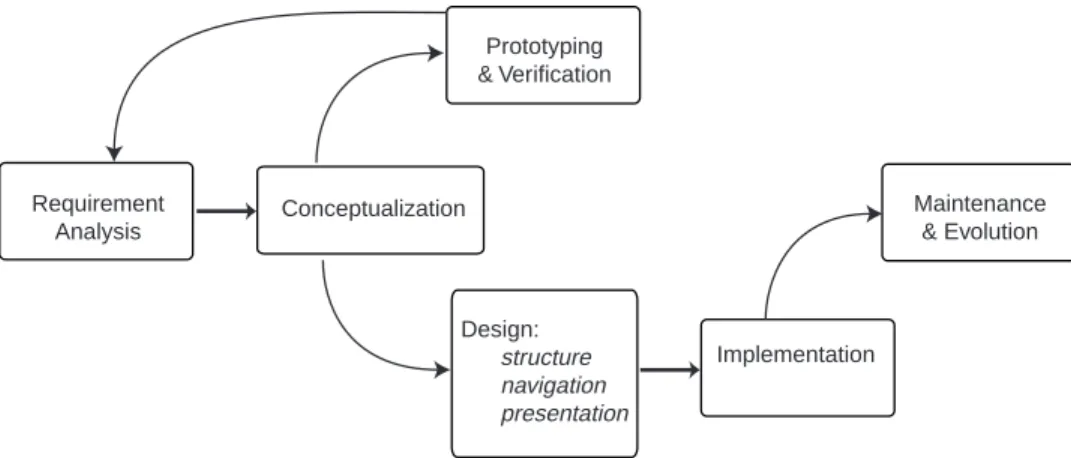
Requirement Analysis Conceptualization Design: structure navigation presentation Implementation Prototyping & Verification Maintenance & Evolution
Fig. 1. The Lifecycle of a Web Application
2.1 Process
Although there is still no consensus on a general model of the lifecycle of a Web application1, a scheme of the typical activities involved in the construction of a
Web application can be obtained by interpolating the lifecycle models of traditional Information Systems and the proposals for structured Hypermedia design [Garzotto et al. 1995; Isakowitz et al. 1995; J.Nanard and M.Nanard 1995; Schwabe and Rossi 1995]. Figure 1 illustrates the lifecycle model used as a reference in this paper. |Requirements Analysis: the mission of the application is established, by
iden-tifying the prospective users and dening the nature of the information base. In addition to the customary requirement collection and feasibility assessment tasks, Web applications designed for universal access require special care in the identication of human-computer interaction requirements, in order to establish the interaction mode most suitable for each expected category of users and for each type of output device that the users are expected to use to connect to the application (from hand-held personal communicators to high denition screens). |Conceptualization: the application is represented through a set of abstract mod-els which convey the main components of the envisioned solution. In the Web context, conceptualization has a dierent avor with respect to the same activ-ity in Information System design, because the focus is on capturing objects and relationships as they will appear to users, rather than as they will be represented within the software system. Although the notations may be the same (e.g., the Entity Relationship Model [Chen 1976]), usually the schemas resulting from the conceptualization of a Web application and a database application dier.2
|Prototyping and Validation: simplied versions of the applications are deployed to the users for early feedback. The importance of prototyping is particularly
1Among the current proposals there are: [Takahashi and Liang 1997; Atzeni et al. 1998; Fraternali
and Paolini 1998]
2A macroscopic dierence is in the interpretation of relationships, which in database modeling
represent semantic associations to be persistently recorded, whereas in Web modeling generally imply also a navigation possibility.
emphasized in the Web context, as it is in Hypermedia, because the intrinsic complexity of the interfaces requires a timely evaluation of the joint eectiveness of structure, navigation and presentation [Nielsen 1996; Bachiochi et al. 1997]. Typically, a prototype is built prior to design and on a simplied architecture, e.g., as a set of manually implemented pages containing samples of the application content, which emulate the desired appearance and behavior.
|Design: conceptual schemas are transformed into a lower-level representation, closer to the needs of implementation, but still independent of the actual content of the information base. Typically, the structural view of the application is mapped to the schema of a storage repository, the navigational view into a set of access primitives over the content repository, and the presentational view into a set of content-independent visual specications (styles). The latter activity, called visual design, is of prominent importance in Web application development and is emerging as an autonomous discipline [Sano 1996; Horton et al. 1996]. |Implementation: the repository is lled out with new content prepared by domain
experts and/or with existing data stored in legacy systems; the actual interfaces, pagesin the Web terminology, are constructed, by embedding repository content and navigational commands into the appropriate presentation style. The map-ping of design to implementation requires the choice of the network language in which the application is delivered (e.g., HTML, Java, ActiveX or a mix thereof), and the decision of the time of \binding" between content and application pages, which can be oine or online.
|Evolution and Maintenance: after delivery, changes in the requirements or bug xes may require the revision of structure, navigation, presentation, or content. Changes are applied as high as possible in the development chain and propagated down to implementation.
The described process model caters for a variety of actual processes, whose ap-plicability depends on the specic development context, including the available tool support, nancial and time constraints, application complexity and change frequency. Generally speaking, with applications of limited size and fairly stable requirements, requirement analysis is directly followed by implementation, possibly after a number of iterations through prototyping. Conceptualization and design assume more relevance as the complexity and volatility of the application increase. 2.2 Models, Languages, and Notations
A Web application is characterized by three major design dimensions:
|Structure: describes the organization of the information managed by the appli-cation, in terms of the pieces of content that constitute its information base and of their semantic relationships.
|Navigation: concerns the facilities for accessing information and for moving across the application content.
|Presentation: aects the way in which application content and navigation com-mands are presented to the user.
To support the representation of application features during the development lifecycle, notations with dierent levels of formality and abstraction can be used.
At the conceptual level, applications are described by means of high level prim-itives which specify the structural, navigational and presentational views in a way that abstracts from any architectural issue.
Structural modelling primitives describe the types of objects that constitute the information base and their semantic relationships, without committment to any specic mechanism for storing, retrieving and maintaining the actual instances of such object types. Examples of notations that can be used to express structural fea-tures include the best-known conceptual data models, like the Entity-Relationship model [Chen 1976] and various Object Models [Rumbaugh et al. 1991].
Navigation modelling primitives express the access paths to objects of the in-formation base and the available inter- and intra-object navigation facilities, again without committing to any specic technique for implementing access and naviga-tion. The vast range of notations and techniques proposed for the more general problem of human-computer interaction specication can be employed for naviga-tion modelling: data models extended with built-in naviganaviga-tion semantics [Garzotto et al. 1993; Isakowitz et al. 1995; Fraternali and Paolini 1998] or explicitly annotated with behavioral specications [Kesseler 1995; Schwabe and Rossi 1995], rst-order logic [Garg 1988], Petri nets [Stotts and Furuta 1989], nite state machines [Zheng and Pong 1992], and formal grammars [Jacob 1982] are among the viable options. Presentation modelling aims at representing the visual elements of the applica-tion interfaces in a way that abstracts from the particular language and device used in the delivery. Many dierent techniques can be used, with a varying de-gree of formality and rigour, ranging from simple storyboard specication [Madsen and Aiken 1993] to the use of software tools [Myers 1995] and formal methods. The independent specication of presentation, separate from structure and navi-gation, is particularly relevant in the Web context, because the nal rendering of the interface depends on the browser and display device and thus there may be the necessity of mapping the same abstract presentation scheme to dierent designs and implementations.
At the design level, structured or semi-structured data models are used to rep-resent the features of an application in a way amenable to manipulation, query, and verication. Typically, design representations are maintained as relational or object-oriented schemas, to exploit the capabilities of database management sys-tems, or as semi-structured objects, to cope with information having partial or missing schemas [Florescu et al. 1998].
At the lowest degree of abstraction, applications are represented by means of implementation-level languages, notably network languages directly interpretable by the user's browsers. At this stage, content, navigation and presentation are directly embedded in the physical marked-up texts or programs that make up the application.
2.3 Reuse
As in any other software process, reuse is an important aspect, related to the facility of building a novel application from existing artifacts [Biggersta and Perlis 1989]. Reuse may happen at all levels of the development process: conceptual schemas, design schemas, content and physical application pages can be reused across applications.
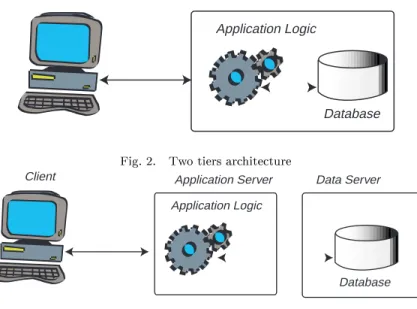
Client Server Application Logic
Database
Fig. 2. Two tiers architecture
Client Application Server
Application Logic
Database Data Server
Fig. 3. Three tiers architecture
The most common form of reuse on the Web, as in Hypermedia, is content reuse, possibly facilitated by the presence of a structured repository, which enables the construction of dierent applications on top of the same information base. Reuse also occurs at the implementation level, where component-based libraries of self-contained elements (e.g., JavaBeans or ActiveX components) can be plugged into application pages to provide predened functionalities (e.g., an electronic payment facility). Generation-based reuse focuses instead on reusing transformation tech-niques from design frameworks or partially instantiated implementations to full implementations (e.g., by generating application pages from page skeletons and database content).
2.4 Architecture
Architecture is the subject of design and implementation and reects the spatial arrangement of application data and the spatio-temporal distribution of computa-tion.
The minimal spatial conguration of a Web application is the so-called two-tier architecture, shown in gure 2, which closely resembles the traditional client-server paradigm. Dierently from client-client-server, in the two-tiers solution clients (i.e., browsers) are thin, i.e., they are lightweight applications responsible only of rendering the presentation. Application logic and data reside on the server side.
A more advanced conguration, called three- or multi-tier architecture (gure 3), separates the application logic from data, introducing an additional distinction of responsibilities at the back-end side. The presence of one or more distinct appli-cation tiers enables the implementation of advanced architectures which integrate the traditional HTTP protocol and client-server application distribution protocols, for better performance, scalability, reliability and security.
An orthogonal architectural issue concerns the time of binding between the con-tent of the information base and the application pages delivered to the client, which can be static when pages are computed at application denition time and are im-mutable during application usage; or dynamic, when pages are created just-in-time from fresh content. Dynamicity has further nuances: it may involve only content (navigation and presentation are static), or scale to presentation and navigation. 2.5 Usability
From the customer's perspective, usability is the most important quality of a Web application. Although a thorough discussion of the emerging Web usability en-gineering eld is outside the scope of this paper (we refer the reader to [Nielsen 1996]), it is possible to identify a set of general criteria to use in the assessment of Web usability:
|Degree of visual quality: indicates the overall coherence of the presentation and navigation metaphors and the individual quality of the graphic resources. |Degree of customization: measures the facility of tailoring the application
inter-face to individual users or user groups. At one end of the spectrum, applications may have a xed interface; at the other extreme, content, presentation, and navigation may be individually personalized.
|Degree of adaptivity: is proportional to the run-time exibility of the interface; at one end, the application may be immutable; at the other, it may track the user's activity and change accordingly [Fraternali and Paolini 1998].
|Degree of proactivity: indicates the capability of an application to interact with the user on its own initiative. Applications can be passive, i.e., provide informa-tion only in response to user's requests, or proactive, i.e., able to push informainforma-tion to users upon the occurrence of relevant events.
3. TOOLS FOR WEB DEVELOPMENT
In response to the above described complexity factors of Web application devel-opment, many software vendors are providing instruments for supporting the con-struction of new applications, or the migration of existing ones.
Notwithstanding their common goal, the available products greatly diverge in many aspects, which reects dierent conceptions of the nature of a Web application and of its development process.
To help understanding the state of the practice, we have grouped existing tools into six categories, which exibit homogeneous features. This grouping is the result of a broad review, which has considered over fourty products, listed in Appendix 15.
The individuated categories are: (1) Visual editors and site managers;
(2) Web-enabled Hypermedia authoring tools; (3) Web-DBPL integrators;
(4) Web form editors, report writers and database publishing wizards; (5) Multi-paradigm tools
The order of presentation of the dierent categories reects the increasing level of support that tools in each category oer to the structured development of Web applications.
Category 1 contains productivity tools that are a direct evolution of HTML ed-itors, which do not really support the development of large scale Web-database applications but are nonetheless interesting because they pioneered many concepts (like presentation styles and top-down site design) later integrated into more com-plex environments. The same limitation in the degree of support to structured development of large applications is shared by Category 2, which originates from a dierent application domain, o-line Hypermedia publishing, but recently added fa-cilities for Web and database integration; the interest in these tools is motivated by their non-conventional (with respect to the standard software engineering practice) approach to application design and specic focus on navigation and presentation. Category 3 is the rst one that explicitly addresses the integration of Web and databases to achieve a higher level of scalability, and includes very powerful, yet basic, products; these products can be used to implement applications on top of large databases, although to the price of a substantial programming eort. Category 4 takes quite a dierent, but still database-centric, approach to Web development, by addressing the migration of client/server, form-based applications; these tools aim at augmenting the implementor's productivity in such tasks as form editing, report writing, and event-based programming; they oer a higher level of support with respect to category 3, but still concentrate only on the implementation phase. Category 5 contains a number of tools whose common feature is the integration of dierent development approaches and technologies, drawn from the previous four tool families. Finally, category 6 includes those products (actually two products) that provide a complete coverage of all the development activities, from concep-tualization to implementation, by leveraging state-of-the-art software engineering techniques.
To complete the overview of Web application development, in Section 10 we in-clude a mention to other classes of products which are not directly concerned with the specic focus of this paper on the design and maintenance of Web sites, but either cover fundamental architectural issues like distribution, reliability, perfor-mance, and security, or provide specialized facilities to users and site administra-tors, like advanced search functions and collaborative work support.
4. VISUAL EDITORS AND SITE MANAGERS
This class includes authoring and site management environments originally con-ceived to alleviate the complexity of writing HTML code and of maintaining the pages of a Web site in the le system. In a typical conguration these products bundle a WYSIWYG editor, which lets the user design sophisticated HTML pages without programming, and a visual site manager, which displays in a graphical way the content of a Web site and supports functions like page upload, deletion, and renaming, and broken link detection and repair. Among the many products in this category there are Adobe SiteMill and PageMill, NetObject Inc.'s Fusion, SoftQuad's HotMetal, Claris Home Page, Macromedia's Backstage Designer, and Microsoft's FrontPage.
maintenance of Web sites; implementation is supported by content production func-tionalities and maintenance by site-level management facilities. The most advanced products (e.g., NetObject's Fusion and Microsoft FrontPage) also oer a rather rudimental approach to design, whereby it is possible to separate the denition of the hierarchical structure of a site from the authoring of content.
Automation concentrates on content production, by generating code from visual page designs. Support to code generation is particularly relevant in those tools (like Macromedia's DreamWeaver, SofQuad's HotMetal Pro 5.0, Allaire's Home-Site, and many more) that support the latest extensions of HTML, like Cascading Style Sheets (CSS) [World Wide Web Consortium 1998a] for content-independent presentation specication, and the Document Object Model (DOM) [World Wide Web Consortium 1998b], for the object-oriented representation of page elements and their manipulation via a scripting language.
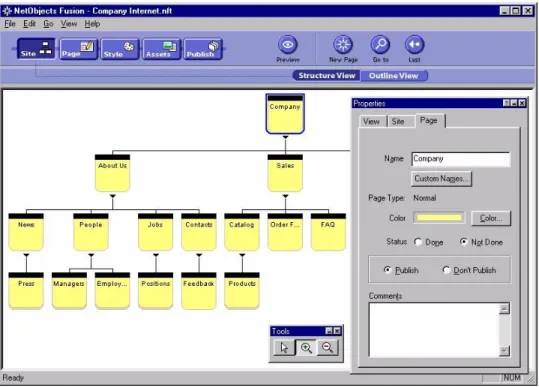
Some tools are also able to generate part of the navigation logic, by automatically inserting navigation buttons into pages based on their position in the tree-like layout of the site (gure 4). Development abstractions are basically implementation-level and oriented towards structure and navigation (pages and links); some tools also provide presentation abstractions, in the form of page templates or "themes", i.e., groups of graphic resources that can be applied to multiple pages to obtain visual consistency (gure 5).
Reuse mostly happens at the implementation level: content objects (e.g., mul-timedia, graphics, but also object-based components, like JavaBeans and ActiveX controls) can be reused across applications.
The architecture originally supported by these tools is le-based and two tier, and the binding between an application and its content is static. Recently, the most advanced tools have added functionalities for the dynamic connection to live database data, as we discuss in Section 8.
Since development is mostly conducted by hand, the level of customization and the resulting visual quality of the nal application is proportional to the eort spent and can be arbitrarily high; coherence of presentation and navigation metaphors is facilitated by visual templates and themes, although in this case customization becomes more expensive.
The features of these tools are shown in Table 6: in summary, they are an excellent solution for small- to medium-sized applications, where publishing large information bases stored in a DBMS is not the major issue. The lack of a design-level schema of the application independent of content imposes that the application features be dened instance-by-instance and is a major obstacle to scale-up and integration of large masses of data. These limitations, however, are going to become less sensible as these products become more integrated with Web-database tools. 5. WEB-ENABLED HYPERMEDIA AUTHORING TOOLS
Web-enabled Hypermedia authoring tools share the same focus on authoring as visual HTML editors but have a dierent origin, because they were initially con-ceived for the development of o-line Hypermedia applications, and have been ex-tended to support the generation of applications for the Web in recent times. The best known representatives of this class of products are: Asymetrix's Toolbook II Assistant/Instructor, Macromedia's Director and Authorware, Formula Graphics'
Fig. 4. Hierarchical Site Layout in NetObject's Fusion
Process: Lifecycle
Coverage
Design (limited to hierarchical layout denitions)Implementation MaintenanceProcess:
Automation
HTML generation from WYSIWYG page editingGeneration of commands for hierarchy navigationAbstractions
Implementation-level: pages, links, presentation stylesReuse
Plug-in components; Reusable presentation stylesArchitecture
Two-tiers, based on le systemStatic binding of content to pages
Usability
High graphical control through manual authoring High coherence through use of presentation styles Low customization, no adaptivity, no proactivityFig. 6. Synopsis of Visual Editors and Site Managers
Multimedia 97, Aimtech Iconauthor, and Allen Communication Quest. Most of these product have both Web export facilities and database connectivity, but these extensions are not always compatible, and often the developer must choose between the two possibilities. These products are characterized by the following features: |The authoring metaphor used in the denition of the application. Examples of
such metaphors are: owchart (Quest, Authorware, IconAuthor), book (Tool-book), movie making (Director).
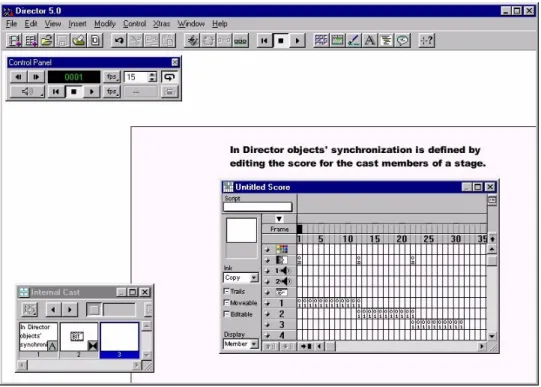
|The way navigation is dened, which may require programming in a scripting language or may be supported by visual programming and wizard tools coherent with the product's authoring metaphor (e.g., in Director objects' synchronization is dened by editing the score for the cast members of a stage, see gure 7). |The type of database connectivity, which may range from support of an
inter-nal database, of an exterinter-nal database via gateway software (typically ODBC or JDBC), of an external database through DBMS API.
|The type of Web connectivity, which may be achieved by means of a plug-in application extending a Web browser or by exporting the Hypermedia application into a network language. Web connectivity may aect database connectivity, because in the present version of most tools Web export can be done only for applications not connected to a database.
|The export language, which may be HTML, Java, or a mix of both.
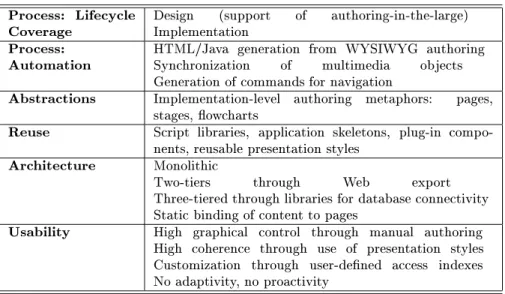
Hypermedia tools basically are authoring assistants and their focus is restricted to the ad hoc implementation of long-lived applications to be published once and for all in CDROMS or information kiosks. As a consequence, they still have lit-tle provision for a structured development lifecycle and oer limited support to application modelling, design, testing and maintenance.
To aid the implementation of large applications, some tools separate authoring in-the-large (i.e., the denition of the overall application structure) from authoring in-the-small (i.e., the detailed denition of the multimedia content of individual information nodes) [GMP95]. This distinction fosters an elementary form of design which helps reconguring the application structure and navigation independently
Fig. 7. The Film-Making Authoring Metaphor of Macromedia's Director
of content. For example, tools like Quest, Authorware, and IconAuthor distinguish between a \design mode", where information nodes are placed on a owchart, and an \edit mode", where each individual node can be edited. A parallel can be established between authoring in-the-large in Hypermedia authoring tools and the site layout view oered by some visual HTML editors: in both cases, design is done at the instance level, without the help of a content-independent application schema, and navigation is (in part) automatically generated from the abstract structure of the application.
Reuse is pursued both at the design level, by means of reusable substructures and application independent layouts, and at the implementation level, by leveraging libraries of scripts or multimedia components. The recent versions of most tools also oer interoperability with third-party components (for example inclusion of Java applets and ActiveX components).
Regarding the development abstractions, Hypermedia tools have a strong plus in the built-in facilities for explicitly modelling navigation paths orthogonal to appli-cation structure; for example, guided tours can be dened as sequential navigations based on associative properties of objects that may cut across the hierarchical struc-ture of the application. Other navigational aids include application-wide search functions, glossaries, and access indexes.
Like visual HTML editors, Hypermedia authoring tools:
|Do not provide a schema for distinguishing the type of objects constituting the application (beside the low-level distinction between objects of dierent media
Process: Lifecycle
Coverage
Design (support of authoring-in-the-large)ImplementationProcess:
Automation
HTML/Java generation from WYSIWYG authoringSynchronization of multimedia objects Generation of commands for navigationAbstractions
Implementation-level authoring metaphors: pages, stages, owchartsReuse
Script libraries, application skeletons, plug-in compo-nents, reusable presentation stylesArchitecture
MonolithicTwo-tiers through Web export
Three-tiered through libraries for database connectivity Static binding of content to pages
Usability
High graphical control through manual authoring High coherence through use of presentation styles Customization through user-dened access indexes No adaptivity, no proactivityFig. 8. Synopsis of Web-enabled Hypermedia Authoring Tools
types). The main development abstractions are generic container objects (pages, icons, stages), whose denition intermixes structural, presentation, and behav-ioral aspects (and in tools not supporting the separate specication of navigation, also navigational features).
|Oer presentation abstractions in the form of page styles, i.e., sets of graphic resources applied uniformly to the entire application or to part of it.
Architecture is where Hypermedia tools show a substantial immaturity with re-spect to competitor solutions; all tools were originally conceived for oine, le-based publication, and later upgraded to external database connectivity and Web export. Most products oer database connectivity via external libraries using ODBC, but lose this feature after Web export. Moreover, translation from na-tive proprietary format into a network language is still rudimental, and the most advanced features (like those obtained by exploiting the tool's scripting language) do not carry over to the Web version of an application.
Conversely, usability is the major strength of this category of products, which focus on delivering very sophisticated user interfaces exhibiting a degree of control over graphic accuracy and multimedia synchronization hardly available with other means. The inherent navigational design paradigm, coupled to very eective and well established aids like guided tours, and user-dened access indexes, which most tools oer for free or with little programming eort, contribute to the deployment of applications which are very eective and much closer to the kind of communication found in high quality, hand-developed Web sites.
6. WEB-DBPL INTEGRATORS
The common denominator of the products in this category is to produce Web pages dynamically from information stored in a database, by integrating databases and Web technology at the language level.
Dierent network languages (notably, HTML and Java) are merged with a data-base programming language (DBPL), to obtain an intermediate application pro-gramming language capable of making the best of both the Web and database technology. Web-DBPL integration is pursued in three distinct ways:
|HTML extensions add new tags to HTML to embed both generalized program-ming constructs and database-specic capabilities. The developer writes page templates, which intermix declarative HTML tags and executable code. Prod-ucts in this category can be further distinguished based on the language paradigm used to extend HTML (imperative, object-based, object-oriented). Page tem-plates must be translated into pure HTML and this task is normally executed at run-time by an interpreter. The performance of the dierent products vary based on the process in which the interpreter is executed and on the way the connection to the database is managed. Examples of HTML extensions include: the Cold Fusion Web Database Construction Kit by Allaire Inc., Microsoft's Ac-tive Server Pages (ASP) and Internet Database Connector (IDC), StoryServer by Vignette Corporation, HAHT Software's HahtSite, and Informix AppPages. In general, HTML extensions have a broader objective than the mere addition of database connectivity, and include primitives for overcoming well-known lim-itations of HTML, like the absence of control ow instructions, modularization mechanisms, and stateful interaction3.
|DBPL extensions take the other way round and add specialized functions to an existing DBPL, or to a general purpose programming language with a database interface, to enable the output of HTML code as a result of program execu-tion. Developers write database applications which construct HTML output from data retrieved from the database. This approach requires database pro-gramming skills, but may yield better performance, when DBPL programs are executed and optimized directly by the DBMS. Examples of DBPL extensions include: Oracle's PL/SQL Web Toolkit, Sybase's PowerBuilder Web.PB class library, and Borland's Web interface for the Delphi Client Server Suite.
|Java extensions add database connectivity to Java. The best known eort in this direction is the JDBC open standard, which oers an ODBC-like architecture for Java applications that want to interact with a DBMS. Dierently from HTML extensions, connectivity is added in the form of a library masking under a uniform callable interface the details of interacting with dierent proprietary DBMSs and SQL dialects.
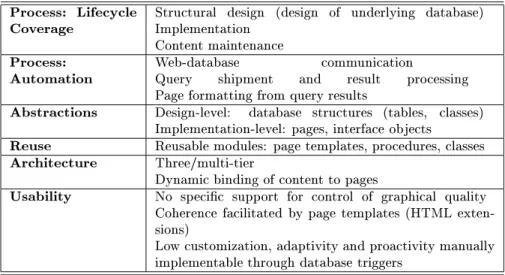
Dierently from visual HTML editors and Hypermedia authoring tools, which oer small-scale application development functions to the non-programmers, Web-DBPL integrators are tools for the programmer, who may use them to simplify
3Stateful interaction is the capability of retaining the application status between two consecutive
the task of gluing together Web pages and database queries by hand. Due to their focus on implementation languages, these products lack high level abstractions for describing applications and thus do not assist the developer in identifying the struc-ture, navigation, and presentation of an application, which is directly implemented by manually writing the necessary HMTL page templates or DBPL programs.
Reuse may be achieved either through the native constructs of the programming language, for example packages and modules, or through ad-hoc modularization mechanisms, for example inclusion between HTML page templates.
The target architecture is database-centered and three-tiered; the most sophisti-cated products also permit multiple database tiers and distributed queries.
Not having any specic support for presentation and navigation modeling, these products have no direct impact on the usability and graphical quality of the user interface, which must be designed separately.
The major dierence between Web-DBPL integrators and visual HTML editors and Hypermedia authoring tools is that the former introduce a clear separation between the nal application pages and the content repository, the schema of which acts as an implicit specication of the application structure.
This distinction has several consequences on the application development process: |it permits a more eective manipulation of the information base, because changes
to content can be performed without aecting navigation and presentation; |it exposes the dierent object types that constitute the application, although
these types are not elicited from the structural, navigational and presentation requirements of the application, but stem from the design of the underlying database;
|thanks to the explicit object typing, the uniformity and coherence of the presen-tation are facilitated, because all objects of the same type may be easily visualised in the same way. As a counterpart, customization at the instance level must be explicitly programmed, by identifying exceptional cases and treating them in ad hoc ways.
Being database driven, applications built with Web-DBPL integrators may lever-age the reactive capabilities of the underlying DBMS to achieve adaptivity and proactivity, e.g., database triggers. For example, an Oracle trigger could react to user-generated events and produce HTML pages adapted to the specic situation. In spite of the above mentioned positive side-eects, Web-DBPL integrators can-not be considered development tools in themselves, but are comparable to tradi-tional client/server 4GL, because they provide a high level programming interface masking lower-level architectural details; as such, they are often used to build more sophisticated products, like the ones reviewed next.
Table 9 summarizes the most important features of Web-DBPL integrators. 7. WEB FORM EDITORS, REPORT WRITERS, AND DATABASE PUBLISHING
WIZARDS
This category collects a large number of products, all having the common charac-teristic of leveraging traditional database design concepts and development tools to rapidly deploy both new and legacy data-intensive applications on the Web. A
Process: Lifecycle
Coverage
Structural design (design of underlying database)Implementation Content maintenanceProcess:
Automation
Web-databaseQuery shipment andcommunicationresult processing Page formatting from query resultsAbstractions
Design-level: database structures (tables, classes) Implementation-level: pages, interface objectsReuse
Reusable modules: page templates, procedures, classesArchitecture
Three/multi-tierDynamic binding of content to pages
Usability
No specic support for control of graphical quality Coherence facilitated by page templates (HTML exten-sions)Low customization, adaptivity and proactivity manually implementable through database triggers
Fig. 9. Synopsis of Web-DBPL Integrators
rst classication can be obtained by considering the functions oered by the tools, ordered by complexity and sophistication:
|database export: support is limited to the publication of basic database elements, like tables and views, and is achieved by automatically mapping database content into a network language, notably HTML. The export can be either static or dy-namic, the latter case requiring on-the-y HTML generation, which is normally implemented by means of a Web-DBPL integrator. A certain level of personaliza-tion can be obtained, by applying sets of preferences to drive the output of Web pages. A typical example is the exportation of tables and queries in Microsoft's Access97.
|Report writing: more complex read-only applications can be obtained by dening custom reports, which can be exported to the Web either statically or dynam-ically. Dynamic publication requires a report interpreter working side by side with the Web server. Examples include: Crystal Report Print Engine, Oracle's Reports for the Web, Microsoft's Access97 report export facility.
|Form-based application development: assistance extends to the construction of interactive, form-based applications for accessing and updating data, and more generally for implementing business functions.
Form-based application development is where the highest number of products concentrate, and developers are faced by an impressive spectrum of alternatives. Among the reviewed products, we cite: Microsoft's Visual InterDev, Visual Basic 5, and Access97, Oracle Developer 2000, Inprise IntraBuilder, Sybase's PowerBuilder, Apple's WebObjects, NetDynamics Visual Studio, Asymetrix SuperCede Database Edition, and Allaire's Cold Fusion Application Wizards. The most relevant dimen-sions characterizing the dierent products are:
|the application delivery format, i.e., the format in which the application is re-ceived by the browser, which can be pure HTML, a combination of HTML and
Java, HTML plus proprietary component technology and scripting languages (e.g., client-side ActiveX objects, VBScript or JavaScript tags), or a totally pro-prietary format (e.g., ActiveX documents, Sybase's PowerBuilder PBD les). The delivery format aects the client's performance and the application's porta-bility, with minimal overhead and maximum portability in the pure HTML case, and maximum overhead and minimal portability when the application is deployed in a totally proprietary format interpreted by a browser's plug-in application. |The application development language(s), which may be dierent from the
deliv-ery language(s) to preserve existing software investments and programming skills and/or increase performance and portability. Overall, the spectrum of bindings between development and delivery languages is extremely varied, ranging from products oering a single development language and multiple output formats (e.g., Oracle's Developer 2000 maps PL/SQL to HTML, Java, and Visual Basic), to products translating dierent input languages into the same output format (e.g., Microsoft's Visual InterDev maps design-time ActiveX controls scripted in VBScript or JavaScript into pure HTML).
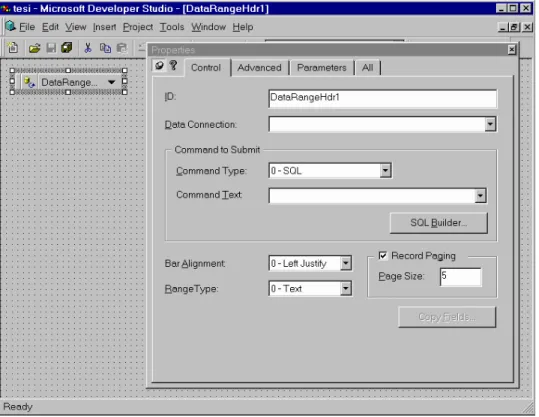
|The implementation paradigm, which can be 3GL programming, Rapid Applica-tion Development (RAD), wizard-based, or a mix thereof. Almost all tools oer RAD functionalities letting programmers dene an application by dragging and dropping components onto a form and by visually customizing their properties. Behavior customization, as necessary for the denition of complex forms, can be added by writing code in the tool's development language. A few products (e.g, Visual InterDev, IntraBuilder, NetDynamics, Cold Fusion) also include a simplied development path for non-programmers, based on "wizards" enabling the automatic generation of code from sets of preferences selected through a vi-sual interface (gure 10). Wizards are applied to obtain both components and complete applications; in the latter case they deliver "canned" database appli-cations, in which the data structure and the interface logic are predened (e.g., master-details data entry and visualization, drill-down reports, and so on). |The execution architecture: the way in which an application can be partitioned
among the dierent tiers of the Web architecture is even more varied than the choice of development and delivery languages, because object distribution (as supported by languages like Java and architectures like Corba and DCOM) per-mits the same functionality, e.g., a database driver, to be located either in the client or in the application server.
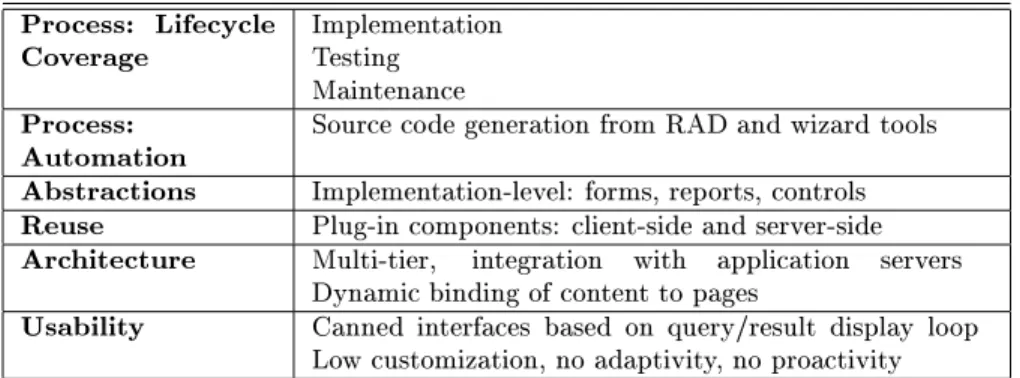
From a software engineering point of view, products in this class are to Web devel-opment what Integrated Develdevel-opment Environments (IDEs) and Rapid Application Development tools were to traditional application programming: instruments for boosting individuals' and teams' productivity in the implementation phase. The best tools also help process management, testing, and maintenance by leveraging standard software engineering techniques like source and version control, congu-ration management, and visual debugging.
With one exception reviewed later, form-based application generators do not provide upper-CASE capabilities: they do not encompass conceptual modeling nor support the model-driven design and implementation of applications. Typically, data structures, business logic, and interfaces are specied and designed separately
Fig. 10. Datarange Wizard in Microsoft's Visual Interdev and then implemented with the tool of choice.
Component-based reuse is also intrinsic to most products, which leverage the various object-level interoperability standards emerging on the Web. Components can be either client-side, in which case they encapsulate typical interface controls (e.g., menus, edit elds, grids, and so on), or server-side, in which case they typically wrap database access and data formatting primitives.
The development abstractions are interface-oriented and drawn from the tra-ditional client/server, database-centric world: query and data entry forms, in-put/output controls, record lists, and reports. The structure of the application is dictated by the forms that compose it and is generally isomorphic to (a sub-set of) the database schema, especially when forms are automatically derived from database tables and views through database wizards. More complex patterns can be obtained by exploiting canonical structures like table lookups and master-details, or by hand-programming non-standard combinations of objects. The navigation semantics is deeply embedded within the application and hyperlinks are emulated by means of form-to-form connections. In some cases, navigation is automatically inferred by the tool from database structure, like for example in automatically generated master-details and drill-down applications, where database foreign key constraints are translated into HTML hyperlinks. Presentation is addressed as an independent issue only in those products that provide a notion of "presentation style" (e.g., models in Access97, themes in InterDev, master pages in IntraBuilder)
Process: Lifecycle
Coverage
ImplementationTesting MaintenanceProcess:
Automation
Source code generation from RAD and wizard toolsAbstractions
Implementation-level: forms, reports, controlsReuse
Plug-in components: client-side and server-sideArchitecture
Multi-tier, integration with application servers Dynamic binding of content to pagesUsability
Canned interfaces based on query/result display loop Low customization, no adaptivity, no proactivityFig. 11. Synopsis of Web Form Editors, Report Writers, and Database Publishing Wizards which can be uniformly applied to all application pages to obtain a consistent look.
On the architectural side, all products target multi-tier architectures, and the most recent generation (e.g., NetDynamics Visual Studio) is tightly integrated with specialized middleware products, called application servers, which we review in section 10.1.
Dierently from Web-DBPL integrators, which are neutral products that can be used to shape any kind of application, form-based generators and database pub-lishing wizards deliver complete software solutions inclusive of user interface logic, and thus their underlying interaction model inuences the user perception of the application quality. The evalution must consider the application context in which a tool is used and consequently the kind of users addressed. In an intra-business or business-to-business context, these products are essentially vehicles for Web-enabling traditional client-server applications. In this setting, interface quality is proportional to the similarity between the look and feel of original client-server applications and their Web counterparts, because the peculiarities of Web interac-tion (free browsing, associative links, multimediality, user-level customizainterac-tion) are less important than adherence to interface standards well-established among users. Conversely, if these products are targeted to user-oriented applications for the In-ternet, they must be compared to Web and Hypermedia authoring tools, in which case their form-to-form navigation pattern and the limited graphic control imposed by wizards are a source of rigidity.
Table 11 overviews the main features of Web form editors, report writers and database publishing wizards.
8. MULTI-PARADIGM TOOLS
The ongoing trend of evolution of Web development tools sees an increasing con-vergence between visual editing and site management products, Web-HTML inte-grators, and client-server products (reviewed in Section 4, 6 and 7, respectively).
Multi-paradigm tools integrate solutions from the abovementioned categories into a unied development framework. The most typical conguration is the one in which visual HTML editing and site administration are extended with external components which provide database connectivity, or with enhanced HTML
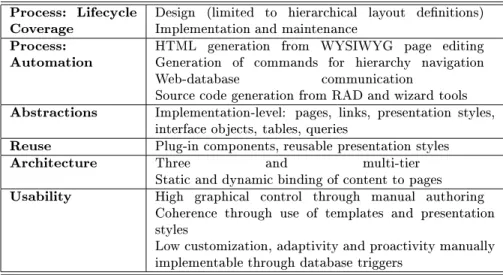
genera-Process: Lifecycle
Coverage
Design (limited to hierarchical layout denitions)Implementation and maintenanceProcess:
Automation
HTML generation from WYSIWYG page editingGeneration of commands for hierarchy navigationWeb-database communication
Source code generation from RAD and wizard tools
Abstractions
Implementation-level: pages, links, presentation styles, interface objects, tables, queriesReuse
Plug-in components, reusable presentation stylesArchitecture
Three and multi-tierStatic and dynamic binding of content to pages
Usability
High graphical control through manual authoring Coherence through use of templates and presentation stylesLow customization, adaptivity and proactivity manually implementable through database triggers
Fig. 12. Synopsis of Multi-Paradigm Tools
tion capabilities able to produce scripts for pulling content from databases, or with full-edged database publication wizards.
Example of such convergent tools are FrontPage98, which includes database ob-jects for connecting to external data sources, Elemental's Drumbeat, which com-bines sophisticated visual editing and assets management with database wizards comparable to those of specialized Web-database connectivity products, Lotus Domino and Domino Designer, which oer an integrated environment for Web-enabling Notes client-server applications and developing Web sites that take ad-vantage of the Domino Server capabilities, and NetObject's Fusion (version 3.0), which features the Fusion2Fusion extension for connecting NetObject's visual page editor and Allaire's HTML-SQL integrator.
Multi-paradigm tools do not introduce novel approaches into Web development, but combine already established features to broaden their spectrum of applicability with respect to single-paradigm products. Therefore, they oer advantages (sum-marized in Table 12) that are the sum of the strengths of their components (im-plementation productivity, top-down design, three-tier architecture, high graphic control), but do not overcome the major limitation of the products reviewed so far, i.e., the lack of a high level, content-independent representation of the site in terms structure, navigation and presentation.
9. MODEL-DRIVEN WEB GENERATORS
Model-driven Web generators are at the top of the proposed categories, because they provide the highest level of automation and lifecycle coverage, by applying conceptual modeling and code generation techniques to the development of Web applications.
This category comprises a few commercial tools, which exhibit dierent concep-tual models and code generation techniques. We review Hyperwave Server 4.0, and Oracle's Web Development Suite.
Hyperwave [Hyperwave Information Management 1998] is an advanced docu-ment managedocu-ment environdocu-ment which permits remote users to browse, annotate, and maintain documents distributed over the Web. Hyperwave has a very basic, yet powerful, high level model of a Web application, which is considered as a set of doc-ument collections organized hierarchically. Collections may contain sub-collections and documents, and have dierent behavior based on their type. Documents in a collection can be linked and annotated with a number of meta-data. Links are managed by the Hyperwave server, so that any hypertextual structure can be su-perimposed over a set of otherwise independent documents.
From the description of collections, links and meta-data, Hyperwave generates a Web interface that enables both user-oriented and administrative functions like collection and link browsing, searching and notication, remote document man-agement, ne-grain version and access control, collaborative work, and personal annotations. The generated interface has a default presentation, which can be personalized using a proprietary template language.
Although document-oriented, the Hyperware server relies on database technology and on a multi-tier architecture to store meta-data and manage links spanning multiple servers.
A more database-centric approach is taken by the Oracle Web Development Suite, which comprises Designer 2000 [Gwyer 1996; Barnes and Gwyer 1996], a CASE tool for generating Web applications from augmented Entity-Relationship diagrams.
Designer 2000 is an environment for business process and application modeling, integrated with software generators originally designed to target traditional client-server environments, namely Oracle Developer 2000 [Hoven 1997] and Visual Basic. The Web Generator enables previous applications developed with Designer 2000 and deployed on LANs to be ported to the Web, as well as the delivery of novel applications directly on the Internet or on intranets. The Web Generator takes its inputs from the Designer 2000 design repository and delivers PL/SQL code that runs within the Oracle Web Server to produce the desired HTML pages of the application. More specically, three inputs drive the generation process:
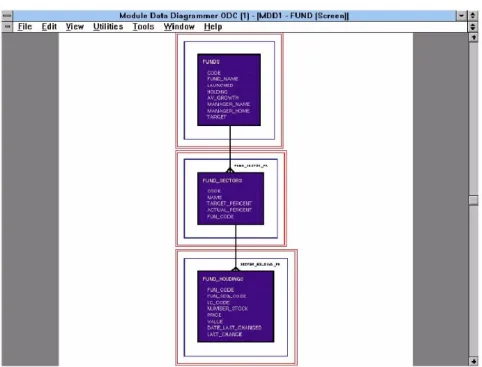
|A Web-enhanced database design: database design diagrams specify the struc-ture of the database in terms of tables, views, foreign key relationships, and integrity constraints. These constitute the schema of the future Web application. A few visual features can be specied in the schema: for example, column deni-tions can be supplemented with caption text and display format (e.g., a pop-up list). Moreover, some integrity constraints (e.g., valid ranges) can be attached to columns and tables, and the Web Generator can be instructed to produce code for checking them on the server via PL/SQL or on the client via JavaScript. |The denition of applications and modules: modules correspond to basic
appli-cation units; each module consists of a sequence of tables, linked by foreign key relationships (gure 13). The order of tables in a module determines the sequence of HTML pages that will be produced for that module. Navigation is established by drawing links between modules: the designer may dene which modules can be reached by a given module and introduce ctitious modules acting as hierarchical indexes over other modules.
Fig. 13. Module Denition in Oracle Designer 2000
the presentation of the generated application; they can be dened either globally, at the module, or at the component level. Example of preferences are colors, headers and footers, background images, and help text.
From these inputs, the WEB Generator produces xed-format Web pages; one set of related pages is generated for each module and links between dierent modules are turned into hyperlinks between the HTML startup pages of modules.
Model-driven generators apply to Web development the fundamental principles of software engineering; dierently from all other product categories, application are rst modelled at the conceptual level and then implemented through code gen-eration. This approach and its benets are comparable to the ones delivered by CASE tools for object-oriented application development, and range from reduced development eort, reverse engineering, and multi-level reuse.
However, Hyperwave and Designer 2000 diverge in the underlying conceptual model, and both exhibit limits in the description of Web applications.
Hyperwave adopts a simplied hypermedia model, which is well suited to repre-sent navigation, but lacks a proper structural model; as a consequence, the infor-mation base is reduced to a set of at documents annotated with meta-data.
Conversely, Designer 2000 draws the development abstractions from the database world and adapts such concepts as entities and relationships to Web modeling, by adding to them some navigation and presentation avor. This attempt to twist a database conceptual model and apply it to Web application is responsible of some limitations in the usability of the resulting applications, where the absence of proper modeling abstractions for navigation and presentation limits the exploitation of the
Designer 2000
Hyperwave
Process:
Lifecycle
Coverage
Conceptualization (E/R) Design (Relational Model) Implementation
Reverse Engineering
Conceptualization
(collection and link denition) Implementation
Process:
Automation
Relationalschema generation from ER Generation of HTML from de-sign models and presentation preferencesRelational metaschema gener-ation
Navigation generation Presentation generation
Abstractions
Conceptual-level: entity, relation-ships, attributesDesign-level:
mod-ules, tables, columns, constraints Implementation-level: pages, links
Conceptual-level: collections, views, abstract links, doc-uments, virtual collections Implementation-level: pages, HTML links
Reuse
Module reuse; Preferences reuse Multiple views over the same document baseArchitecture
Multi-tier, dynamic binding Multi-tier, dynamic bindingUsability
Lowgraph-ical control of generated pages
High coherence through
use of presentation preferences Low customization, no adaptivity, no proactivity
Low graphical control of
gen-erated pages
High coherence through use of presentation preferences Programmable customization, no adaptivity, proactivity through notication
Fig. 14. Synopsis of Model-Driven Generators (Oracle Designer 2000 and Hyperwave) communication capabilities of the Web.
The limitations of commercial Web generators are addressed by a few research prototypes, namely Araneus [Atzeni et al. 1997], Autoweb [Fraternali and Paolini 1998], Strudel [Fernandez et al. 1998], WebArchitect [Takahashi and Liang 1997], W3I3 [Ceri et al. 1998], HSDL [Kesseler 1995], RMC [Diaz et al. 1995], and OOHDM [Schwabe and Rossi 1995], which are discussed in Section 12.
10. MIDDLEWARE, SEARCH ENGINES, AND GROUPWARE
Beside support to conceptualization, design, and implementation, Web develop-ment requires tackling other issues which, although outside the focus of the paper, are critical for the delivery of eective applications: performance, availability, scal-ability, security, information retrieval, and support to collaborative administration and usage.
These needs are served by ad hoc tools or by specialized functions integrated into Web design products. In the sequel we briey review the most important features of three categories of products: application servers, search engines, and groupware and collaborative design tools.
10.1 Middleware
Industrial-strenght data-intensive applications require not only proper design tools but also a solid architecture, good performance, availability, scalability, and secu-rity. These goals have prompted for the extension of the original two-tier HTPP architecture to more sophisticated congurations, encompassing three, and even multiple, tiers. The key to multi-tiered applications is the capability of separating data, interfaces, and application logic, and of distributing each aspect to distinct network nodes. Such distibution leverages Internet-enabled application protocols (like Corba Internet InterOrb Protocol{Corba IIOP[Object Management Group 1996]{and Microsoft's Distributed Common Object Model{DCOM [Microsoft Cor-poration 1996]) and the native remote procedure call capabilities of network lan-guages (notably, Java's Remote Method Invocation{RMI [Sun Microsystems 1995]) The in-depth presentation of the alternative architectural and technological op-tions for multi-tiered applicaop-tions is outside the scope of this paper and is thor-oughly addresses by many authors (see, for example, the special issue of IEEE Internet Computing on Internet Architectures [Benda 1998] for a recent review of the state of the art, and Byte's special report on networked components [Mont-gomery et al. 1997] for a comparison of the Corba's and Microsoft's architectures). However, also in the tool market several vendors are addressing multi-tiered architectures, by oering specic products, called application servers, which are middleware facilities either integrated into HTTP servers, or working side by side to them. Example of application servers are NetDynamics, Lotus Domino Server, Oracle 8i Java Server, Sybase's Jaguar CTS and Inprise's VisiBroker for Java.
Application servers do not directly impact the client-side design process, but oer several extensions to the standard functions of HTTP engines which can be used to support server-side development:
|Ecient execution of server-side programs that implement the business logic of the Web application. Products dier in the development languages supported, which commonly include C++, Java and scripting languages like Perl, Visual Basic and JavaScript. Eciency is improved by replacing the Common Gateway Interface (CGI) between the Web server and the application programs by means of optimized protocols and architectures, like FastCGI (http://www.fastcgi.com) and Java Servlets [Chang 1998].
|High performance client-server communication. Such capability may be based on a comprehensive architecture for application distribution, on programming language features, or on proprietary remote procedure calls. Rather than us-ing HTTP, enabled clients may bypass the Web server and directly connect to the application server using either open protocols, like Corba/IIOP and Java RMI, or proprietary protocols, like Microsoft's DCOM, Domino's Notes Remote Procedure Calls (NRPC), and Sybase's Jaguar CTS remote procedure calls. |Optimized and extensible connection to multiple external data sources. This
functionality includes the pooling of connections to a database across multiple clients, the caching of result sets, and the possibility to extend the application server with plug-in gateways to heterogeneous data sources like Enterprise Re-source Planning (ERP) and legacy systems (examples of built-in gateway compo-nents and programmable toolkits are NetDynamics 4.0 Platform Adapter
Com-ponents (PACs) and Domino Enterprise Connection Services (DECS)).
|Flexible and dynamic load balancing of client requests by means of automatic replication of server functions. High-volume incoming trac may be dynami-cally routed to multiple instances of server-side functions, implemented either as separate threads of the application server, or as external processes, possibly residing on remote hosts. Dynamic redirection also enables transparent failure handling: user's request for an unavailable service can be routed to a replica of the same function, either dynamically spawned or statically instantiated at system conguration time.
|Implementation of a secure infrastructure for both data and messages. Security may be granted by a variety of means: user logging and authentication over both HTPP and non-HTTP connections ( e.g., by supporting the X.509 open standard certicate format, or authentication via third party directories), message and content encryption (e.g., by supporting the IETF Secure MIME standard and RSA/RC2 cryptography), and password quality testing.
|Transactionality, i.e., the capability of performing atomic and recoverable trans-actions over a single or multiple tiers. This feature, traditionally oered by distributed database servers and TP monitors, requires the application server to implement write ahead logging and two-phase commit protocols.
10.2 Search
The proper design of structure and navigation normally results in Web sites with a self-evident organization and consequently reduces the need of full-text searches over the information base [Halasz 1988]. However, Web applications oered to the general public must also consider the needs of casual readers and of readers with highly specic interests, for which content search is the most eective interaction paradigm.
Designing the search functions for a data-intensive Web site is an orthogonal issue with respect to the design of structure, navigation and presentation, and is supported either by ad hoc functions integrated into Web development tools, or by specialized products, called search engines.
Examples of Web development tools bundling integrated search functions are Hy-perwave (which comes also with a separate commercial search engine) and Lotus Domino Designer. Among the numerous standalone search engines, we mention Ver-ity Search97, Harvest, OpenText's LiveLink Search and Spider, Altavista Search, QuarterDeck's WebCompass, and Excite for Web Servers.
Search engines basically consist of two main components: a user interface and query processor, whereby users can pose queries and obtain a ranked list of pages whose content satises the query; and an indexing component (also called spider or crawler) which creates and maintains indexes over the data sources.
The available commercial products dier on a variety of dimensions: the kind of queries they support (keyword-based, boolean, natural language, fuzzy); the cus-tomizability of the display of results; the exibility of the index creation and main-tenance process (e.g., the possibility to schedule the updates of indexes dierently for dierent data sources or to analyze dierent le formats); and the adherence to the so called robot-exclusion standard, by which webmasters can deny access to
crawlers at their sites.
For a broad review of commercial search engines and a comparison of their fea-tures the reader may refer to [Lange 1997].
10.3 Groupware
Collaboration requirements aect Web development is several ways, going from the concurrent construction of a Web site by geographically distributed development teams, to the provision of limited content editing and interaction functions directly to end-users, to real-time interaction integrated into a Web site.
In the commercial market several tools oer groupware capabilities, including |concurrent access control via content locking and checkin/checkout procedures; |distributed le systems for concurrent content upload;
|oine collaboration tools like calendars, schedules, notication lists, and discus-sion groups;
|real-time collaboration facilities, like virtual rooms, white boards, chats, and video conference.
|full-edged workow support, including oine and online collaboration facilities and workow modeling and implementation.
Example of design tools supporting collaborative development are Hyperwave, TeamSite, and Lotus Domino Designer. Products for the denition of virtual work-teams are reviewed in [Wong 1998], and a comprehensive survey of Web-enabled workow systems is contained in [Miller et al. 1997].
11. EVALUATION
Table 15 summarizes the features of the categories of Web development tools de-scribed in Sections 4 to 9, in the light of the perspectives of Web development discussed in Section 2. To complete this picture, developers mult also consider middleware products, which address the enhancement of performance and security and oer a platform for implementing advanced business logic, and search engines and groupware tools, which add specialized functions orthogonal to the design pro-cess.
The state of the practice summarized in Table 15 can be better understood if compared with the current situations of mature software technologies, like object-oriented systems and databases (see gure 16).
In these contexts, development tools cover the entire spectrum of the application lifecycle and approach development from the right angle: they exploit well estab-lished abstractions suited to the specic context, like the conceptual and logical models for database design, and the object oriented notations for OO systems, and follow well-proven development guidelines, like those described in [Ceri et al. 1993] for database design and in [Rumbaugh et al. 1991] for object oriented design. Picto-rially, mature tools and approaches are represented as \light cones" that enlighten the various phases of the development cycle, without crossing the borders of their target application eld.
The situation of Web development is dierent and typical of a not yet mature technology (it could be easily compared to the OO tool market in the eighties):
Visual
Editors Hyper-media Tools
Web-DBPL Integrators
Form
Editors Multi-paradigm Tools Model-driven Generators Life-cycle coverage Implement., hierarchical site design, link maintenance Implement., design (Authoring in-the-large) Implement. Implement., mainte-nance (debugging) Implement., hierarchical site design, link main-tenance, debugging Conceptual. design, implement., maintenance, reverse eng.
Auto-mation Generationof HTML Generationof HTML/Java Database connection query ship-ment, result formatting Generation of HTML/Java Generation of HTML, database connection Generation of design schemas, navigation commands, interfaces
Abstrac-tions Page, link, presenta-tion style
Authoring
metaphors Table, pageelements Form,report, client-side and server-side control Page, link, presenta-tion style, form, table Entity, relationship, module, ta-ble, column, collection, link Reuse Components, presenta-tion styles Libraries, skele-tons, com-ponents, styles Page tem-plates, DBPL units Client-side and server-side components Components, presenta-tion styles, templates Modules, prefer-ences, col-lections, links Default Archi-tecture 2-tiers,
static 2-tiers,static 3-tiers,dynamic 3-tiers,dynamic 3-tiers,dynamic 3-tiers,dynamic Support to usability Good graphic control and coherence (manual) Very good graphic, naviga-tion, syn- chroniza-tion control (manual) Interface neutral, proactiv-ity through triggers Canned
interfaces Goodgraphic control and coherence (manual and with templates) Predened interfaces, low graphic control
Analysis Design Implementation O O database web Model-driven generators Visual HTML Editors Hypermedia tools HTML- DBPL Integrators Form Editors Multi-paradigm tools
Fig. 16. A Pictorial View of the State-of-the-Practice of Web Development Tools most products limit their focus to implementation, with some provision for design (as represented by the shorter \light cone" in gure 16); a few tools are trying to cover the lifecycle in a broader way, but do so by approaching development from an innatural angle, typically using models, abstractions, and processes drawn from other contexts. The \slanted" approach of these tools and approaches is represented by the light cone covering all the phases of development, but having an inclination due to its origin from the database area.4
12. RESEARCH PERSPECTIVES
Web application development has recently gained much attention not only in the commercial eld but also in the research community, where several projects are addressing the extension of the capabilities of site design tools in various directions and proposing innovative design processes and methodologies.
In this Section we briey review a number of projects which have proposed so-lutions for overcomening some of the limitations currently experienced by state-of-the-practice commercial tools: Araneus [Atzeni et al. 1997; Atzeni et al. 1998; Atzeni et al. 1998], Autoweb [Fraternali and Paolini 1998], Strudel [Fernandez et al. 1998], Web Architect [Takahashi and Liang 1997], and W3I3 [Ceri et al. 1998].
The common denominator of such eorts is the goal of supporting the activities of data-intensive Web design from conceptualization to maintenance, by properly distinguishing between the dierent dimensions of Web design, organizing the de-velopment activities into a structured process, and providing tools for partially automating repetitive development tasks.
However, beside such commonalities, each project has its special focus and best addresses only some of the issues left open in the currently available commercial tools.
4A similar phenomenon took place in the early days of object-orientation, when many proposals
were put forth to adapt Structured Analysis / Structured Design concepts to object oriented implementation.