Parallel Computing
Stanford CS149, Fall 2020
Lecture 10:
Stanford CS149, Fall 2020
Spark summary
▪
Introduces opaque sequence abstraction (RDD) to encapsulate intermediates of cluster computations (previously… frameworks like Hadoop/MapReduce stored intermediates in the file system)-
Observation: “files are a poor abstraction for intermediate variables inlarge-scale data-parallel programs”
-
RDDs are read-only, and created by deterministic data-parallel operators-
Lineage tracked and used for locality-aware scheduling and fault-tolerance (allows recomputation of partitions of RDD on failure, rather than restore from checkpoint *)-
Bulk operations allow overhead of lineage tracking (logging) to be low▪
Simple, versatile abstraction upon which many domain-specific distributed computing frameworks are being implemented-
SQL, MLlib, GraphX-
See Apache Spark project: spark.apache.orgStanford CS149, Fall 2020
Caution: “scale out” is not the entire story
▪
Distributed systems designed for cloud execution address many difficult challenges, and have been instrumental in the explosion of “big-data” computing and large-scale analytics-
Scale-out parallelism to many machines-
Resiliency in the face of failures-
Complexity of managing clusters of machines▪
But scale out is not the whole story:Further optimization of the baseline brought time down to 110s
20 Iterations of Page Rank
[“Scalability! At what COST?” McSherry et al. HotOS 2015]
Stanford CS149, Fall 2020
Intel Core i7
Stanford CS149, Fall 2020
Cache hierarchy of Intel Skylake CPU (2015)
Core L1 Data Cache
L2 Cache
Shared L3 Cache (One bank per core)
Ring Interconnect Core L1 Data Cache L2 Cache Core L1 Data Cache L2 Cache Core L1 Data Cache L2 Cache
L1: (private per core) 32 KB
8-way set associative, write back 2 x 32B load + 1 x 32B store per clock 4 cycle latency
L2: (private per core) 256 KB
4-way set associative, write back 64B / clock, 12 cycle latency L3: (per chip)
8 MB, inclusive 16-way set associative 32B / clock per bank 42 cycle latency
64 byte cache line size
Source: Intel 64 and IA-32 Architectures Optimization Reference Manual (June 2016)
Support for: 72 outstanding loads 56 outstanding stores Caches exploit locality
3 Cs cache miss model
•
Cold
•
Capacity
Stanford CS149, Fall 2020
Cache design review
▪
Do you know the difference between a write back and a
write-through cache?
▪
What about a write-allocate vs. write-no-allocate cache?
Data (64 bytes on modern Intel processors) Tag
Line state
Dirty bit
Let’s say your code executes int x = 1;
(Assume for simplicity x corresponds to the address 0x12345604 in memory... it’s not stored in a register)
1 0 0 0
One cache line:
. . .
Stanford CS149, Fall 2020
Behavior of write-allocate, write-back cache on a write miss
(uniprocessor case)
Example: processor executes int x = 1;
1. Processor performs write to address that "misses” in cache
2. Cache selects location to place line in cache, if there is a dirty line currently in
this location, the dirty line is written out to memory
3. Cache loads line from memory (“allocates line in cache”)
4. Whole cache line is fetched and 32 bits are updated
5. Cache line is marked as dirty
Data (64 bytes on modern Intel processors) Tag
Line state
Stanford CS149, Fall 2020
Review: Shared address space model (abstraction)
▪
Threads Reading/writing to shared variables
-
Inter-thread communication is implicit in memory operations-
Thread 1 stores to X-
Later, thread 2 reads X (and observes update of value by thread 1)-
Manipulating synchronization primitives-
e.g., ensuring mutual exclusion via use of locksStanford CS149, Fall 2020
A shared memory multi-processor
▪
Processors read and write to shared variables-
More precisely: processors issue load and store instructions▪
A reasonable expectation of memory is:-
Reading a value at address X should return the last valuewritten to address X by any processorProcessor Processor Processor Processor
Interconnect
Memory I/O
Stanford CS149, Fall 2020
The cache coherence problem
Modern processors replicate contents of memory in local caches
Problem: processors can observe different values for the same memory location
Processor Processor Processor Processor
Interconnect
Memory
Cache Cache Cache Cache
P1 $ P2 $ P3 $ P4 $ mem[X]
Action
0 int foo;(stored at address X)
P1 store X 1 0 0
P1 load Y
(assume this load causes eviction of X)
1
0 2
The chart at right shows the value of variable foo(stored at address X) in main memory and in each processor’s cache Assume the initial value stored at address X is 0
Assume write-back cache behavior
P3 load X 1 0 0 miss 0 0 1 0 2 P3 store X P2 load X 1 0 hit 2 0 P2 load X 0 0 miss 0 P1 load X 0 miss 0
Stanford CS149, Fall 2020
The cache coherence problem
Modern processors replicate contents of memory in local caches
Problem: processors can observe different values for the same memory location
Processor Processor Processor Processor
Interconnect
Memory
Cache Cache Cache Cache
P1 $ P2 $ P3 $ P4 $ mem[X]
Action
0 int foo;(stored at address X)
P1 store X 1 0 0
P1 load Y
(assume this load causes eviction of X)
1
0 2
The chart at right shows the value of variable foo(stored at address X) in main memory and in each processor’s cache Assume the initial value stored at address X is 0
Assume write-back cache behavior
P3 load X 1 0 0 miss 0 0 1 0 2 P3 store X P2 load X 1 0 hit 2 0 P2 load X 0 0 miss 0 P1 load X 0 miss 0
Is this a mutual exclusion problem?
Can you fix the problem by adding locks to your program?
NO!
This is a problem created by replicating the data stored at address X in local caches
Stanford CS149, Fall 2020
The memory coherence problem
▪
Intuitive behavior for memory system: reading value at address X should
return the last value written to address X
by any processor.
▪
Memory coherence problem exists because there is both global storage
(main memory) and per-processor local storage (processor caches)
Stanford CS149, Fall 2020
Intuitive expectation of shared memory
▪
Intuitive behavior for memory system: reading value at address X should return the last
value written to address X
by any processor.
▪
On a uniprocessor, providing this behavior is fairly simple, since writes typically come
from one source: the processor
Stanford CS149, Fall 2020
Coherence is an issue in a single CPU system
▪
Common solutions:-
CPU writes to shared buffers using uncached stores (e.g., driver code)-
OS support:-
Mark virtual memory pages containing shared buffers as not-cachable-
Explicitly flush pages from cache when I/O completes▪
In practice, DMA transfers are infrequent compared to CPU loads and stores (so these heavyweight software solutions are acceptable)Processor Network Card Interconnect Memory Cache Case 1:
Processor writes to buffer in main memory Processor tells network card to async send buffer Problem: network card many transfer stale data if processor’s writes (reflected in cached copy of data) are not flushed to memory
Case 2:
Network card receives message
Network card copies message in buffer in main memory using DMA transfer
Card notifies CPU msg was received, buffer ready to read Problem: CPU may read stale data if addresses updated by network card happen to be in cache
Message Buffer
Stanford CS149, Fall 2020
Problems with the intuition
▪
Intuitive behavior: reading value at address X should return the last value written to address X
by any processor
▪
What does “last” mean?
-
What if two processors write at the same time?
-
What if a write by P1 is followed by a read from P2 so close in time that it is impossible to communicate the
occurrence of the write to P2 in time?
▪
In a sequential program, “last” is determined by program order (not time)
-
Holds true within one thread of a parallel program
Stanford CS149, Fall 2020
Definition: Coherence
A memory system is coherent if:
The results of a parallel program’s execution are such that for
each memory
location
, there is a hypothetical serial order of all program operations
(executed by all processors) to the location that is consistent with the results
of execution, and:
1. Memory operations issued by any one processor occur in the order
issued by the processor
2. The value returned by a read is the value written by the last write to
the location… as given by the serial order
Chronology of operations on address X P0 write: 5 P1 read (5) P2 read (5) P0 read (5) P1 write: 25 P0 read (25)
Stanford CS149, Fall 2020
Implementation: Cache Coherence Invariants
▪
Single-Writer, Multiple-Read (SWMR) Invariant
-
For any memory location x, at any given time (epoch):
-
there exists only a single processor that may write to x (and can also read it)
-
some number of processors that may only read x
▪
Data-Value Invariant (write serialization)
-
The value of the memory location at the start of an epoch is the same as the value of
the memory location at the end of its last read-write epoch
Read-Write P0 Read-Only P0, P1, P2 Read-Write P1 Read-Only P0, P1 time
Stanford CS149, Fall 2020
Implementing coherence
▪
Software-based solutions (coarse grain: VM page)
-
OS uses page-fault mechanism to propagate writes-
Can be used to implement memory coherence over clusters of workstations-
We won’t discuss these solutions-
Big performance problem: false sharing▪
Hardware-based solutions (fine grain: cache line)
-
“Snooping”-based coherence implementations (today)Stanford CS149, Fall 2020
Shared caches: coherence made easy
▪
One single cache shared by all processors-
Eliminates problem of replicating state in multiple caches▪
Obvious scalability problems (since the point of a cache is to be local and fast)-
Interference (conflict misses) / contention due to many clients (destructive)▪
But shared caches can have benefits:-
Facilitates fine-grained sharing (overlapping working sets)-
Loads/stores by one processor might pre-fetch lines for another processor (constructive)Processor Processor Processor Processor
Memory I/O
Cache
Stanford CS149, Fall 2020
SUN Niagara 2 (UltraSPARC T2)
Memory Memory Memory Memory L2 cache L2 cache L2 cache L2 cache Processor Crossbar Switch Eight cores
Note area of crossbar (CCX):
about same area as one core on chip
Processor Processor Processor Processor Processor Processor Processor
Stanford CS149, Fall 2020
Snooping cache-coherence schemes
▪
Main idea: all coherence-related activity is broadcast to all processors in the system
(more specifically: to the processor’s cache controllers)
▪
Cache controllers monitor (“they snoop”) memory operations, and follow
cache
coherence protocol
to maintain memory coherence
Processor Interconnect Memory Cache Processor Cache Processor Cache . . .
Notice: now cache controller must respond to actions from “both ends”:
1. LD/ST requests from its local processor
2. Coherence-related activity broadcast over the chip’s interconnect
Stanford CS149, Fall 2020
Very simple coherence implementation
Let’s assume:
1. Write-throughcaches
2. Granularity of coherence is cache line Coherence Protocol:
• Upon write, cache controller broadcasts invalidation message
• As a result, the next read from other processors will trigger cache miss
(processor retrieves updated value from memory due to write-through policy)
P0 $ P1 $ mem location X Action 0 P1 load X 0 0 0 P0 load X 0 0 Cache Processor P0 Memory Cache
. . .
Interconnect Processor P1 Interconnect activitycache miss for X cache miss for X
P0 write 100 to X invalidation for X 100 100
Stanford CS149, Fall 2020
Write-through policy is inefficient
▪
Every write operation goes out to memory
-
Very high bandwidth requirements▪
Write-back caches absorb most write traffic as cache hits
-
Significantly reduces bandwidth requirements-
But now how do we ensure write propagation/serialization?Stanford CS149, Fall 2020
Cache coherence with write-back caches
Cache Processor P0 Memory Cache
. . .
Bus Processor P1 X Write X Read X▪
Dirty state of cache line now indicates exclusive ownership
-
Modified: cache is only cache with a valid copy of line (it can safely be written to)-
Owner: cache is responsible for propagating information to other processors when they attempt to load it from memory (otherwise a load from another processor will get stale data from memory)Chronology of operations on
address X P0 write P1 read
Stanford CS149, Fall 2020
Cache Coherence Protocol
▪
The logic we are about to describe is performed by each processor’s cache
controller in response to:
-
Loads and stores by the local processor-
Messages from other caches on the bus▪
If all cache controllers operate according to this described protocol, then
coherence will be maintained
Stanford CS149, Fall 2020
Invalidation-based write-back protocol
Key ideas:
▪
A line in the “modified” state can be modified without notifying the other
caches
▪
Processor can only write to lines in the modified state
-
Need a way to tell other caches that processor wants exclusive access to the line-
We accomplish this by sending all the other caches messages▪
When cache controller sees a request for modified access to a line it contains
Stanford CS149, Fall 2020
Recall cache line state bits
Data (64 bytes on modern Intel processors) Tag
Line state
Stanford CS149, Fall 2020
MSI write-back invalidation protocol
▪
Key tasks of protocol
-
Ensuring processor obtains exclusive access for a write-
Locating most recent copy of cache line’s data on cache miss▪
Three cache line states-
Invalid (I): same as meaning of invalid in uniprocessor cache-
Shared (S): line valid in one or more caches, memory is up to date-
Modified (M): line valid in exactly one cache (a.k.a. “dirty” or “exclusive” state)▪
Two processor operations (triggered by local CPU)
-
PrRd (read)-
PrWr (write)▪
Three coherence-related bus transactions (from remote caches)
-
BusRd: obtain copy of line with no intent to modify-
BusRdX: obtain copy of line with intent to modifyStanford CS149, Fall 2020
Cache Coherence Protocol: MSI State Diagram
PrRd /--M BusRdX/ BusWB PrWr / BusRdX S I PrWr / --BusRd / BusWB PrWr / BusRdX PrRd / BusRd BusRdX/ PrRd / --BusRd/ --Abbreviation Action PrRd Processor Read PrWr Processor WriteBusRd Bus Read
BusRdX Bus Read
Exclusive
BusWB Bus
Writeback
Processor initiated
- - - - Bus initiated
Stanford CS149, Fall 2020
MSI Invalidate Protocol
▪
Read obtains block in “shared”
-
even if only cached copy▪
Obtain exclusive ownership before
writing
-
BusRdX causes others to invalidate-
If M in another cache, will cause writeback-
BusRdX even if hit in S-
promote to M (upgrade) PrRd /--M BusRdX/ BusWB PrWr / BusRdX S I PrWr / --BusRd / BusWB PrWr / BusRdX PrRd / BusRd BusRdX/ PrRd / --BusRd/Stanford CS149, Fall 2020
A Cache Coherence Example
Proc Action P1 State P2 state P3 state Bus Act Data from
1. P1 read x S -- -- BusRd Memory
2. P3 read x S -- S BusRd Memory
3. P3 write x I -- M BusRdX Memory 4. P1 read x S -- S BusRd P3’s cache
5. P2 read x S S S BusRd Memory
6. P2 write x I M I BusRdX Memory
▪
Single writer, multiple reader protocol
▪
Why do you need Modified to Shared?
Stanford CS149, Fall 2020
Breakout: How Does MSI Satisfy Cache Coherence?
1.
Single-Writer, Multiple-Read (SWMR) Invariant
-
Only one cache can be in M-state all others get invalidation message
-
Multiple caches can be in read-only S-state
2.
Data-Value Invariant (write serialization)
-
On BusRd and BusRdx data is provided by cache with line in M-state
-
Bus serializes all transactions
Read-Write P0 Read-Only P0, P1, P2 Read-Write P1 Read-Only P0, P1 time
Stanford CS149, Fall 2020
Summary: MSI
▪
A line in the M state can be modified without notifying other caches
-
No other caches have the line resident, so other processors cannot read these values-
(without generating a memory read transaction)▪
Processor can only write to lines in the M state
-
If processor performs a write to a line that is not exclusive in cache, cache controller must first broadcast a read-exclusive transaction to move the line into that state-
Read-exclusive tells other caches about impending write (“you can’t read any more, because I’m going to write”)-
Read-exclusive transaction is required even if line is valid (but not exclusive… it’s in the S state) in processor’s local cache (why?)-
Dirty state implies exclusive▪
When cache controller snoops a “read exclusive” for a line it contains
-
Must invalidate the line in its cache-
Because if it didn’t, then multiple caches will have the line (and so it wouldn’t be exclusive in the other cache!)Stanford CS149, Fall 2020
MESI invalidation protocol
▪
This inefficiency exists even if application has no sharing at all
▪
Solution: add additional state E (“exclusive clean”)
-
Line has not been modified, but only this cache has a copy of the line-
Decouples exclusivity from line ownership (line not dirty, so copy in memory is valid copy of data)-
Upgrade from E to M does not require an bus transactionMESI, not Messi!
▪
MSI requires two interconnect transactions for the
common case of reading an address, then writing to it
-
Transaction 1: BusRd to move from I to S stateStanford CS149, Fall 2020
MESI state transition diagram
E (Exclusive) M (Modified) PrRd / PrWr /
--PrWr / BusRdX BusRd / BusWB
I (Invalid) PrWr / BusRdX PrWr / --PrRd / -- BusRdX / --BusRdX / BusWB BusRd / --S (Shared) PrRd / --PrRd / BusRd
(no other cache asserts shared) PrRd / BusRd BusRd / BusRdX / --(another cache asserts shared)
Stanford CS149, Fall 2020
Two Hard Things
There are only two hard things in Computer Science: cache
invalidation and naming things
.
Stanford CS149, Fall 2020
Scalable cache coherence using directories
▪
Snooping schemes broadcast coherence messages to determine the state of a line in
the other caches
▪
Alternative idea: avoid broadcast by storing information about the status of the
line in one place: a “directory”
-
The directory entry for a cache line contains information about the state of the cache line in all caches.-
Caches look up information from the directory as necessary-
Cache coherence is maintained by point-to-point messages between the caches on a “need to know” basis (not by broadcast mechanisms)▪
Still need to maintain invariants
-
SWMRStanford CS149, Fall 2020
Directory coherence in Intel Core i7 CPU
▪
L3 serves as centralized directory for all lines in the L3
cache
-
Serialization piont
(Since L3 is an inclusive cache, any line in L2 is guaranteed to also be resident in L3)
▪
Directory maintains list of L2 caches containing line
▪
Instead of broadcasting coherence traffic to all L2’s, only
send coherence messages to L2’s that contain the line
(Core i7 interconnect is a ring, it is not a bus)
▪
Directory dimensions:
-
P=4
-
M = number of L3 cache lines
CoreL1 Data Cache L2 Cache
Shared L3 Cache
(One bank per core)
Ring Interconnect Core L1 Data Cache L2 Cache Core L1 Data Cache L2 Cache Core L1 Data Cache L2 Cache
Stanford CS149, Fall 2020
Implications of cache coherence
to the programmer
Stanford CS149, Fall 2020
Communication Overhead
▪
Communication time is key parallel overhead
-
Appears as increased memory latency in multiprocessor
-
Extra main memory accesses in UMA systems
-
Must determine lowering of cache miss rate vs. uniprocessor
-
Some accesses have higher latency in NUMA systems
-
Only a fraction of a % of these can be significant!
Register, < 1nsL1 Cache, ~ 1ns L2 Cache, ~ 3-10ns Main Memory, ~ 50-100ns Remote, ~ 300-1000ns
Register, less register alloc. L1 Cache, lower hit rate L2 Cache, lower hit rate
Main, can “miss” in NUMA Remote, extra long delays
Stanford CS149, Fall 2020
Unintended communication via false sharing
What is the potential performance problem with this code?
// allocate per-thread variable for local per-thread accumulation int myPerThreadCounter[NUM_THREADS];
Why might this code be more performant?
// allocate per thread variable for local accumulation struct PerThreadState {
int myPerThreadCounter;
char padding[CACHE_LINE_SIZE - sizeof(int)]; };
Stanford CS149, Fall 2020
Demo: false sharing
void* worker(void* arg) {
volatile int* counter = (int*)arg; for (int i=0; i<MANY_ITERATIONS; i++)
(*counter)++;
return NULL;
}
void test1(int num_threads) {
pthread_t threads[MAX_THREADS];
int counter[MAX_THREADS];
for (int i=0; i<num_threads; i++) pthread_create(&threads[i], NULL,
&worker, &counter[i]);
for (int i=0; i<num_threads; i++) pthread_join(threads[i], NULL); }
void test2(int num_threads) {
pthread_t threads[MAX_THREADS];
padded_t counter[MAX_THREADS];
for (int i=0; i<num_threads; i++) pthread_create(&threads[i], NULL,
&worker, &(counter[i].counter));
for (int i=0; i<num_threads; i++) pthread_join(threads[i], NULL); }
struct padded_t { int counter;
char padding[CACHE_LINE_SIZE - sizeof(int)]; };
Execution time with num_threads=8 on 4-core system: 14.2 sec
Execution time with num_threads=8 on 4-core system: 4.7 sec
Stanford CS149, Fall 2020
False sharing
▪
Condition where two processors write to different addresses, but
addresses map to the same cache line
▪
Cache line “ping-pongs” between caches of writing processors,
generating significant amounts of communication due to the
coherence protocol
▪
No inherent communication, this is entirely artifactual
communication (cachelines > 4B)
▪
False sharing can be a factor in when programming for
cache-coherent architectures
P1
P2
Stanford CS149, Fall 2020
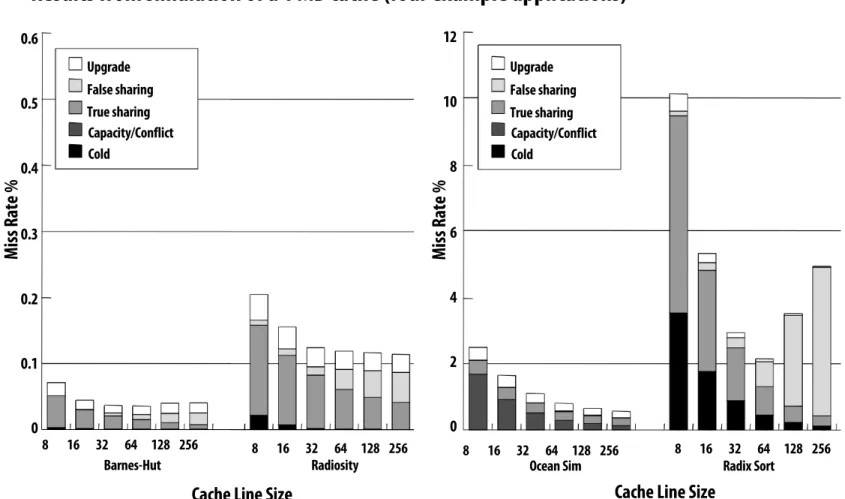
Impact of cache line size on miss rate
Mi ss Ra te % 0.6 0.5 0.4 0.3 0.2 0.1 0 Upgrade False sharing True sharing Capacity/Conflict Cold 8 16 32 64 128 256 8 16 32 64 128 256 Barnes-Hut Radiosity
Cache Line Size
Mi ss Ra te % 12 10 8 6 4 2 0 Upgrade False sharing True sharing Capacity/Conflict Cold 8 16 32 64 128 256 8 16 32 64 128 256 Ocean Sim Radix Sort
Cache Line Size
Results from simulation of a 1 MB cache (four example applications)
* Note: I separated the results into two graphs because of different Y-axis scales
Stanford CS149, Fall 2020