Sports Coach UK Research Project (March 2012)
Reflective Practice:
Value of, Issues, and Developments
within Sports Coaching
Dr. Brendan Cropley, Dr. Andy Miles, and John Peel
Cardiff School of Sport
1
Contents Page
1.0 Introduction 2
2.0 State of Knowledge: Reflective Practice in Coaching 4
2.1 Contextualising Reflective Practice 4
2.2 Reflective Practice in Sports Coaching 5
2.3 Rationale for Future Research 9
3.0 Research Question and Aims 11
4.0 Method 12
4.1 Participants 12
4.2 Approaches to data collection 12
4.21 4.22 Reflective journals 12 Interview guide 13 4.3 Procedure 14 4.4 Data Analysis 14 4.5 Trustworthiness 15
5.0 Results and Discussion 16
5.1 Knowledge of reflective practice and engagement 16
5.2 Issues associated with reflective practice 18
5.21 Finding time to reflect 18
5.22 Motivation: Gaining benefits 21
5.23 Knowledge and understanding: Approach to reflection 22
5.24 Reflecting on emotions 24
5.3 Changes to future practice 25
5.31 Frequency of reflection: Utilising a structured approach
26
5.32 Shared reflections 27
5.33 Education and support 28
5.4 Benefits associated with reflective practice 29
6.0 Study Summary and Conclusion 32
7.0 Anecdotal Support from the Field 34
7.1 Coach Biography 34
7.2 Learning to coach through reflection: An autoethnographical account
35
8.0 Recommendations 39
8.1 Recommendation 1: Educating and Implementing 40 8.2 Recommendation 2: Refining and Maximising 42
9.0 References 44
2
1.0 Introduction
It is widely recognised that sports coaches operate in complex social and often ambiguous environments that place varied and multiple demands on them (Bowes & Jones, 2006; Fletcher & Scott, 2010). Indeed, the roles of sports coaches, at all levels of the vocational continuum, have expanded beyond the mere preparation of athletes for competition into managerial, administrative, and organisational duties that are all underpinned by a coach’s ability to develop and manage interpersonal relationships. In attempts to better prepare coaches to be able to function effectively in this changing environment, coach education programmes have begun to embrace the value of both formal and informal approaches to learning and development (Gilbert, 2009; Werthner & Trudel, 2006). This has been done with the view to helping coaches develop both the theoretical and practical knowledge required to help coaches be sensitive to, and better cope with, the peculiarities, intricacies, and ambiguities of coaching and the unique conditions under which coaches act (Jones & Wallace, 2005). As such, different approaches to learning (e.g., mentoring, communities of practice) have started to become more valued within the traditional frameworks of formal qualifications (Cushion et al., 2010).
More specifically, the potential of reflective practice has been considered widely due to the support that it offers for both personal and professional development in related fields (e.g., education, sports science). Indeed, Knowles, Gilbourne, Borrie, and Neville (2001) suggested that through reflective practice coaches could access, make sense of, and learn from the relevant knowledge-in-action that would allow them to learn how to actually do sports coaching. However, Cushion and colleagues (2010) have also highlighted that although these approaches are becoming more widely recognised there is still limited understanding how to best implement them and the actual impact they have on coach learning and development. This is particularly true for reflective practice where it has been questioned as to whether the domain of sports coaching has jumped on the bandwagon of reflection without properly understanding the issues and problems related to implementing such an approach (Cropley & Hanton, 2011).
In light of this preceding discussion it is the aim of this research project to provide a more in-depth examination of the issues currently associated with reflective practice and the way in which it can be integrated into coach education programmes
3 and used by coaches to positively impact on their practice. Such research has the potential to provide an in-depth understanding of: (a) the value of different, more formalised, approaches to reflection; (b) the specific issues faced by coaches when attempting to reflect; (c) avenues to improving coaches’ ability to engage in reflective practice effectively; and (d) the ways in which coach education programmes maybe developed to better prepare coaches to be able to engage in processes of experiential learning. In attempts to achieve such aims this report contains: insights into current research knowledge regarding reflective practice in coaching; an original, empirical research study; a coach’s autoethnographical insight into the utility of reflective practice; and specific research-driven recommendations for the more effective implementation into coach education, learning, and practice. By providing both an empirical research study and an autoethnographic narrative it is thought that the implications and recommendations for future practice can be founded on more of an informed knowledge base.
4
2.0 State of Knowledge: Reflective Practice in Coaching
2.1 CONTEXTUALISING REFLECTIVE PRACTICE
The value of informal learning opportunities for coach education and development has gained credence in recent sports coaching literature (e.g., Erickson, Bruner, MacDonald, & Côté, 2008; Gilbert, 2009; Knowles, Borrie, & Telfer, 2005; Mallett, Trudel, Lyle, & Rynne, 2009). This is due, in part, to formalised learning venues not being valued by coaches as much as their day-to-day learning experiences in the field (Werthner & Trudel, 2006). In attempts to understand why this might be the case, Gilbert, Côté, and Mallett (2006) suggested that informal learning through experience is of vital importance because of the relatively small amount of time a coach might spend in a formalised learning environment in comparison to the number of hours she or he spends in the sporting venue, coaching and interacting with athletes and/or other coaches. Additionally, Mallett et al. (2009) commented that, “Formal educational situations cannot encompass all of the experiential learning required to ‘embed’ learning” (p. 332). More recently, Nash and Sproule’s (2011) research substantiated these arguments further by inferring that coaches need to be aware of, and have knowledge and understanding of, learning theory, self-reflection, motivational climate and knowledge construction as well as the technical detail of their sport. Such statements provide support for the findings of Saury and Durand (1998) who reported that effective elite coaching practice, in their sample of sailing coaches, was based on appropriate use of tacit, experiential knowledge and not just formal theoretical knowledge about coaching pedagogy, physiology or other bodies of knowledge. As a result of such research and commentary, a host of authors have begun to highlight the key role of experiential learning in the development of elite coaching knowledge and practice (e.g., Culver & Trudel, 2006; Irwin, Hanton, & Kerwin, 2004; Jones, Armour, & Potrac, 2003).
Despite the emphasis placed upon experiential learning, Cropley and Hanton (2011) stated that it is important to recognise that the presumption of learning being an automatic process associated with merely having an experience may be incorrect. Indeed, Aitchison and Graham (1993 in Criticos) suggested that we do not habitually learn from experience, but instead experience has to be examined, analyzed, and considered in order to shift it to knowledge. Further, research that has attempted to
5 improve understanding of the concept of ‘experience in sport’ found that for experience and learning to be obtained, learners must actively engage in processes that result in the excavation of knowledge embedded within the experience itself (Hanton, Cropley, Neil, Mellalieu, & Miles, 2007). One such process that has gained acceptance in recent years within the field of sports coaching is that of reflective practice (Cropley, Neil, Wilson, & Faull, 2011; Cushion et al., 2010).
Although many authors from a variety of fields have attempted to define reflective practice, the number of typologies available and the complex nature of reflection have made it difficult to obtain a simple definition. Those within sports coaching have tended to understand reflection as a process of looking back at practice, making sense of what happened, and learning in order to improve practice in the future (e.g., Carson, 2008; Gilbert & Trudel, 2001, 2005; Miles 2001). Indeed, Douglas and Carless (2008) have suggested that reflective practiceallows the coach to learn from his or her coaching experiences and to change and adapt in response to what has been learned. However, despite these insights, it has been acknowledged that the thought processes often labelled as reflection (e.g., contemplation, evaluation, pondering) seldom represent reflective practice (Cropley & Hanton, 2011). Coaches and other professionals are, therefore, at risk of misrepresenting the reflective process and subsequently not gaining the purported experiential learning benefits associated with the concept. This potential lack of clarity regarding reflective practice is likely to be a result of the infancy of the research that considers reflection within sports coaching. The issue may be compounded further by the paucity of empirical literature that examines the domain specific issues (e.g., impact, processes, and definitions of reflection) of reflective practice currently available in the field. Nevertheless, drawing from the support that reflective practice has gained in related fields (e.g., education, nursing, sport psychology), the concept has appeared to permeate many aspects of the sports coaching domain, such as: Higher Education (HE) courses in coaching; National Governing Body (NGB) coaching qualifications; coach education and development literature; and professional bodies’ (e.g., Sports Coach UK [SCUK]) policy documents. 2.2 REFLECTIVE PRACTICE IN SPORTS COACHING
For over a decade sports coaching research has begun to highlight the potentially significant impact that reflective practice could have on the development of coaching
6 expertise. However, this body of research can not be considered extensive or voluminous, and it is largely made up of position statements (e.g., Gilbert, 2003) and personal thoughts and accounts (e.g., Cushion, Armour, & Jones, 2003) rather than empirical studies, although some do exist (e.g., Knowles, Tyler, Gilbourne, & Eubank, 2006). Nevertheless, the research in this area has consistently advocated reflective practice as an approach to professional development that positively impacts coaching practice in a number of ways, such as: helping coaches develop elite coaching knowledge (Irwin et al., 2004); initiating change (Cushion et al., 2003); creating links between theory and practice (Douglas & Carless, 2008); improving understanding of how to cope with the ambiguity of practice (Jones & Wallace, 2005); and improving understanding of the coaching process (Carson, 2008). In sum, Ghaye (2001) simply highlighted that, “The purpose of reflection is to try to improve our coaching (not just understand it better) and improve the context in which our coaching takes place” (p. 9). Although such support currently exists, Cushion et al. (2010) importantly highlighted that despite reflection having research evidence within coaching of its efficacy; direct links to the development of coach effectiveness are not available.
Early insights into the concept of reflective practice for sports coaches were presented in the 2001 (January) special edition of Faster, Higher, Stronger. In this publication, articles (e.g., Ghaye, 2001) helped to expound the concept of reflective practice for coaches, as well as consider the practical application of reflective practice within coach education programmes (e.g., Miles, 2001). Although these articles were more anecdotal in nature, they added to the domain specific knowledge required to help coaches make more informed choices about the way in which reflective practice could be adopted and have helped to shape further research. For example, Carson (2008) utilised Ghaye’s (2001) concept of reflective questioning to inform his research into the utility of video in assisting coaches’ reflections. Carson’s findings advocate the value of video as a way of supporting reflective practice and indicate that coaches are better able to make sense of their experiences and improve coaching performance by adopting such an approach.
At the same time as this ‘professional practice’ edition (Faster, Higher, Stronger, 2001) two seminal studies were published that offered empirical investigations of reflective practice in sports coaching (Gilbert & Trudel, 2001; Knowles et al., 2001). Gilbert and Trudel (2001) examined how youth sports coaches used reflective practice
7 to learn to cope through experience over the course of a competitive season. As it was thought that reflection is evident in only certain types of coaches, ‘model’1 youth
coaches were selected. Overall, the study provides empirically based support for the proposition that coaches reflect in- and on-experience to learn how to coach. The study also presented an understanding of the components that may characterise reflection. These were identified as: coaching issues, role frame, issue setting, strategy generation, experimentation, and evaluation. Their results also suggested that the reflective conversation, triggered by coaching issues was central to reflection. This would support the ideas of Dewey (1933) who originally outlined that reflection is driven by the occurrence of problems and professional dilemmas. It must be recognised that whilst Gilbert and Trudel’s study offers specific insight, the research was limited by a relatively homogenous, small sample that engaged the participants, in part, in retrospective interviews. Data were also collected through observations yet the authors did not make it clear as to how they ‘observed’ reflection in coaches, which may be quite difficult given the cognitive nature of the process.
Knowles et al.’s (2001) study examined the potential for the development and assessment of sports coaching students’ reflective skills through a structured development programme (HE degree course). This programme subjected the student participants to theoretical lectures, a 60 hour work placement, and action learning group based reflective workshops. The findings indicated that following the structured support the level that participants were able to reflect at improved. Thus, Knowles et al. argued that, “If one assumes that this shift will facilitate the practical benefits of reflection then the reflective programme was a positive educational process for these coaches” (p. 204). The findings also suggested that practitioners may have a dominant or preferred reflective technique. As a result, this may affect the ability to use the various techniques, which may in turn affect coaches’ quality of reflection and shift in reflective level. Finally, the study uncovered several issues associated with reflecting on practice related to the issue of the time available for reflecting and the way in which reflection focuses on the self in problematic coaching situations lead to feelings of anxiety and ultimately reduced self-confidence. Whilst, this study provided an
1
The criteria for being selected as a ‘model’ coach were: (a) demonstrated interest in learning about theory and practice of coaching; (b) respected the local sporting community for their commitment to youth sport; (c) considered as good leaders, teachers, and organisers; and (d) kept winning in perspective and encouraged children to respect the rules of the game, their competitors, and officials (Gilbert & Trudel, 2001).
8 indication that the propensity to engage in reflective practice can be developed in coaches the sample size adopted (n = 8) was rather small to infer wider impact of the findings.
In a follow-up to the original 2001 study, Knowles et al. (2006) examined how six of the participants from the initial study had deployed reflective processes in their coaching practice outside the confines of a structured reflective-based curriculum. The findings suggested post-graduation reflection still occurred as an important element of coaching practice, demonstrating the enduring nature of reflection. However, the authors reported the existence of a ‘gap’ between the academic experience and the ‘real world’ reflective practice of the participating sports coaching graduates. In summary, the in-built reflective rigour present in the undergraduate programme was at variance with the post-graduation reality of sports coach employment. Knowles et al. suggested that this may have been a result of short term coaching contracts post-graduation that did not permit deeper levels of reflection as well as a lack of professional accountability in that reflections-on-practice were not being reviewed by key stakeholders. These findings could also be understood through Gilbert and Trudel’s (2005) earlier work which examined the settings that influence the use of reflection. Specifically, they identified four core conditions: (a) access to peers, (b) stage of learning (e.g., novice to expert), (c) issue characteristics (e.g., nature of the coaching issues experienced), and (d) environment (e.g., context of coaching practice). According to Gilbert and Trudel (2005), the nature, process, and impact of reflection are likely to change depending upon the combination of the conditions present at the time of reflecting. For example, if the issue experienced was relatively routine, coaches may tend to rely on coaching support materials in order to deal with the problem rather than in-depth reflection. Also, if the coach is in the presence of a more knowledgeable other it is likely that reflection will be shaped via a conversation, which may help coaches to reflect more critically. In consideration of these factors, the participants in Knowles et al.’s (2006) investigation may have experienced a variety of different conditions as a result of their progression into the ‘real-world’ of coaching where the stabilisers of academic and practical support through a structured programme were removed.
More recently, Cropley et al. (2011) provided additional support for the value of reflective practice through an intervention approach with two soccer coaches (head and assistant coach) working with the same team. In attempts to help the participants better
9 understand and deal with a range of coaching related issues the coaches were asked to individually reflect on their coaching experiences and engage in reflective conversations together. The aims of this were not to deal directly with the problems that had been identified but to encourage the coaches to: (a) improve their self-awareness; and (b) encourage consideration of the impact of their values and philosophy on the development of the players. To increase the likelihood that reflective practice would assist the coaches in achieving the proposed aims, a reflective practice training programme was administered. Following the programme coaches reflected on their practice over a five week period before being interviewed about their post-intervention experiences. The coaches reported that the reflective process had improved their understanding of themselves, their players, and the coaching environment. This resulted in: an altered approach to coaching that included the players in decision making regarding training activities; changes to the way in which they communicated with players; and changes in the way in which they reflected post-game – the reflective process reported in the intervention became a fundamental aspect of their coaching practice.
Cropley et al.’s (2011) work provides one of the first intervention studies that has utilised reflective practice and thus begun to elicit its potential impact on coaching practice. However, the findings should be reviewed with caution as the effects of the intervention were only measured in the short-term. Like the participants in Knowles et al.’s (2001) study, the participants may have altered their engagement in reflective practice once the study had been completed. Additionally, the intervention was with two coaches working in the same environment creating a unique situation conducive to both solitary and shared reflection. As a result of the discussion of the available reflective practice literature in sports coaching it is clear that additional research is required if a better understanding of the ways in which the concept can be effectively integrated into the profession of coaching are to be gained.
2.3 RATIONALE FOR FUTURE RESEARCH
In spite of a growing body of research concerning the value of reflective practice in the education and development of sports coaches a number of concerns still exist. First, it could be argued that reflective practice is somewhat misunderstood and misrepresented. For example, coaches are often asked to ‘reflect’ on their practicum
10 experiences during coach education qualifications yet this ‘reflection’ rarely moves beyond simple evaluation of coaching sessions. Indeed, Knowles et al. (2005) reported that although research has shown experiential learning through reflective practice to be the primary determinant of developing coach expertise, governing body award coaching programmes do not maximize opportunities for developing coaches’ ability to explore the nuances of their own practice, access and develop tacit knowledge, and be creative in their application of sport specific technical knowledge. As a consequence, coaches’ understanding and application of reflective practices becomes problematic.
Second, the lack of empirical research within coaching that specifically details the impact of reflective practice on the development of practice is a concern, especially as reflective practice appears to have been adopted seemingly without question. Newman (1999) warned against accepting the value of such a reflective approach to practice without questioning the evidence upon which claims are based. The relationship between reflective practice and the developing of effective coaching could therefore be questioned.
Finally, empirical research that is available that has examined the utility of reflective practice in sports coaching has begun to identify a number of issues associated with its application. For example, Knowles et al. (2001, 2006) suggested that engaging in structured approaches to reflection was deemed as time consuming. They also indicated that the traditionally ‘negative’ focus of reflective practice is problematic as it is likely to increase the anxiety of practitioners. Further, limited understanding of reflective practice results in coaches focusing too heavily on competitive outcome as an index of effectiveness resulting in narrow reflections.
It would appear that researchers in other fields who have attempted to integrate reflection more systematically into professional practice and improve practitioners’ ability to reflect have focused on the potential benefits reflective practice might have (e.g., Rhine & Bryant, 2007). However, Newman (1999) advocates that for any intervention to be effective due consideration of the potential issues that will negatively affect the efficacy of an intervention should be at the forefront of consideration. It would appear, therefore, that a more thorough, empirical investigation of the potential issues sports coaches currently face when asked to engage in reflective practice could provide the detail required to help develop more effective learning and development programmes within the field.
11
3.0 Research Question and Aims
As a result of the preceding discussion this study was designed to examine the current issues associated with reflective practice in order to better understand how reflective practice could be more effectively integrated into sports coaching education and development programmes. The specific aims of the investigation were to:
1. Examine, in-depth, coaches’ experience of reflective practice in action
2. Uncover the specific issues associated with asking coaches to formally reflect 3. Examine the factors that limit engagement in reflective practice
4. Identify ways in which such issues could be overcome to improve future reflective practice.
In line with the recommendations of a host of researchers (e.g., Cresswell, 2009; Patton, 2002), which indicate that the methods should be driven by the aims of a study, a qualitative approach was adopted in this project. Specifically, a process of engaging coaches in reflective practice followed by in-depth, semi-structured interviews with participants about their experiences of reflecting throughout the duration of the study was adopted.
12
4.0 Methods
4.1 PARTICIPANTS
Participants in this study were selected using purposive sampling techniques (Patton, 2002). Such procedures have been adopted in previous research where participants deemed as being ‘information rich’ are required in order to provide detailed discussion of the specific phenomena of importance to the investigation (e.g., Hanton et al., 2007). Consequently, in order to be considered for this study, participants had to meet the following criteria: (a) qualified to UKCC Level two (or NGB equivalent); (b) be registered as a coach on the NGB’s database of their sport; (c) be coaching two or more times per week; and (d) be aged over 18 years. Meeting these criteria ensured that the participants would be able to achieve the requirements of this study.
A number of coaches from a range of sports were contacted via telephone or email and asked a series of questions to determine whether they met the pre-defined sampling criteria. Out of those coaches who met all criteria, 12 agreed to participate. The sample was therefore made up of male (n = 8) and female (n = 4) coaches from a range of sports, including: cricket (n = 4); association football (n = 1); rugby union (n = 2); athletics (n = 3); and gymnastics (n = 2). Participants ranged in age from 20 to 40 years (M = 24.8; SD = 6.5), and in experience from three to eight years (M = 4.8; SD = 1.9). Finally, all participants held UKCC Level two qualifications and coached an average of 2.6 times per week (SD = 0.79).
4.2 APPROACHES TO DATA COLLECTION 4.21 Reflective journals
In attempts to give participants the experience of reflecting-on-practice (see Schön, 1983) and ensure that participants were engaging in a process of systematic reflective practice, a structured reflective journal was adopted (cf. Moon, 2006). This approach also afforded participants a similar reflective experience and therefore allowed a more valid examination of the concept to occur. The reflective journal was framed using a combination of reflective models that have gained credence in the extant literature (e.g., Anderson et al., 2004; Knowles et al., 2001). Specifically, a combination of Gibbs’ (1988) reflective cycle and Johns’ (1995) structured model of reflection was utilised to guide the participants through reflections on their experiences, whilst
13 allowing individual interpretation and application of the model (a copy of the model can be found in Appendix A). Additionally, the journal structure was designed to guide the examination of actions, thoughts, and feelings and encourage participants to engage in deeper levels of reflective thinking, thus resulting in a deeper understanding of their practice (cf. Cropley, Miles, Hanton, & Anderson, 2007).
4.22 Interview guide
An interview guide was developed in order to fully investigate the participants’ experiences over the period of this study and focused on the issues associated with reflection-on-practice, the benefits gleaned from the structured approach, and the ways the process could be developed to improve future practice (for a copy of the guide see Appendix B). The guide was semi-structured, maintaining a set of standardised questions but affording the interviewer the opportunity to probe any issues where necessary (Patton, 2002). This procedural flexibility enhanced the fluency of the interview and the richness of the information collected whilst retaining the systematic nature of the data collection between the participants (Patton, 2002).
The interview schedule consisted of five sections. Section one contained introductory comments including issues of confidentiality and the reasons for taping the session, as well as a declaration of the individuals’ rights and a request for honest answers. Section two asked the participants introductory questions regarding the coaching they had completed over the course of the study and their prior understanding of reflective practice. These questions were designed to help the participant settle into the interview process and contextualise their experiences. Section three examined the issues and problems participants had experienced by being asked to engage in structured reflective practice. For example, ‘What had the biggest influence on your engagement in reflective practice, and why?’ and ‘Which factor inhibited the quality of your reflections the most, and why?’ Section four focused on examining the participants’ opinions regarding how reflective practice could be better integrated into sports coaching. For example, ‘How could we improve coaches’ engagement in reflective practice?’ and ‘How might coach education make better use of reflective practice?’ Finally, section five concluded the interview with a set of questions that encouraged participants to comment on the performance of the interviewer and on the interview
14 process in general with the purpose of indicating any interviewer bias, as well as their overall satisfaction with their experience in the study.
4.3 PROCEDURE
After gaining School2 ethical approval selected participants were contacted,
informed of the nature of the study and asked to complete an informed consent form (see Appendix C). All participants were then asked to meet with the research team in a neutral location in order to brief them about their engagement in the study. During this meeting, participants were introduced to the structured reflective journal but they were not educated specifically as to how to effectively engage in the process. This was done under the premise that if the participants had been educated then a true representation of their reflective experiences would have been difficult to obtain. Participants were also informed that they would be required to reflect on one critical coaching incident3
per week for the 12 week duration of the study. Participants were asked to complete their reflections at a time convenient to them and then email or post their reflections to the research team on a weekly basis.
Once the participants had sent in their final reflection they were all interviewed within 48 hours in order to reduce the impact of memory decay and improve overall recall of their experiences. In order to maximise the retrieval of in-depth data and aid recall, each participant was sent an interview preparation booklet two days prior to the interview and asked to consider their answers (Hanton, Cropley, & Lee, 2009). All of the interviews were conducted by the lead researcher face-to-face in a neutral setting to aid the flow of conversation and to avoid any environmental bias. The interviews lasted between 30-45 minutes each, were audiotape recorded, and subsequently transcribed verbatim.
4.4 DATA ANALYSIS
Due to the rather exploratory nature of this investigation a combination of both conventional (inductive) and direct (deductive) content analysis procedures were adopted to interpret the data (Hsieh & Shannon, 2005). Consequently, following the approach adopted in recent research (e.g., Cropley, Hanton, Miles, & Niven, 2010), the
2
Cardiff School of Sport, Cardiff Metropolitan University granted ethical approval through its Research Ethics Committee.
3
A critical coaching incident was determined as a value judgement made on the basis of the significance the participant attached to the meaning of the incident (cf. Tripp, 1993).
15 data analysis procedures contained five main steps. First, all of the research team read the interview transcripts in order to immerse themselves in the data. Second, the data were analysed deductively using themes identified from the extant literature under which data could be coded and categorised. Data that could not be categorised using the existing themes were highlighted for further analysis in the next step. Third, the transcripts were analysed inductively where all of the highlighted data that could not be categorised using the deductive themes were coded and categorised into new ‘meaningful clusters’ (Patton, 2002). Fourth, the transcripts were re-analysed using deductive procedures, which now included the new inductive themes. This was completed in attempts to check whether any key information had been overlooked in the previous steps. As steps one to four had been completed independently by the research team the final step involved consensus validation procedures (Cropley et al., 2010) where the research team met to discuss and agree upon the final themes and their content.
4.5 TRUSTWORTHINESS
Lincoln and Guba (1985) highlighted that qualitative research should be judged based on its trustworthiness4, which is assessed on four criteria: credibility,
dependability, transferability, and confirmability. In attempts to account for these criteria, a number of measures were taken throughout the data collection and analysis procedures in this study. First, peer-debriefing and triangulation were used to enhance credibility. In order to maintain dependability (consistency) a semi-structured interview guide was utilised and all interviews conducted by the same researcher, thus reducing inter-interview bias. The transferability of the findings was enhanced through the provision of thick description of the participants and through the use of raw quotes to support the main themes in the results section. Finally, confirmability was established through a process of member checking where the final transcripts and results were sent to the participants for comment regarding whether they provided a true representation of the participants experiences. All participants confirmed that they were happy with the documents.
4
Trustworthiness could be considered as the qualitative equivalent of reliability and validity as considered in more traditional positivistic approaches to research.
16
5.0 Results and Discussion
Although the main focus of this investigation was to examine in more detail the issues and problems associated with reflection-on-practice a range of associated findings were uncovered. The findings are therefore presented in four main sections: (1) knowledge of reflective practice and engagement; (2) issues associated with reflective practice; (3) changes to future practice; and (4) benefits associated with reflective practice. Following the recommendations of Sparkes (2002) that the reader should be able to empathise with, and immerse themselves in the participants’ experiences while illustrating important points, the findings are presented in the form of tables and narrative that are supported with direct quotes from the transcripts. Finally, following a similar approach to that of Rainer, Cropley, Jarvis, and Griffiths (2012), the results are presented with an accompanying discussion. In this way it is thought that connections can more readily be established between the findings of this study and the extant literature and thus best explicate some of the challenges and issues experienced by the participants.
5.1 KNOWLEDGE OF REFLECTIVE PRACTICE AND ENGAGEMENT
Whilst not a direct aim of this investigation it was thought that by considering participants’ knowledge of reflective practice prior to the study and of their overall experiences of engaging in reflective practice during the study the main findings could be better understood and put into context. When asked about prior knowledge of reflective practice, all participants suggested that they had been introduced to the concept previously. Eight participants suggested that they have been introduced to reflective practice whilst on a HE degree course; six participants suggested that ‘reflection’ had been identified through a coach education programme, and one participant suggested that it was an entirely new concept to them. Of those participants who had been introduced to reflective practice, many (n = 9) indicated that they were not confident in their understanding of the concept or of the process involved in reflection-on-action. For example, one participant suggested, “It (reflection) was part of my degree but we only really spoke about it in a couple of lectures and never really got to do it, so before the study I wasn’t 100% sure what it was all about.” Another participant reported, “I
17 have heard about reflective practice but never really understood how to implement it or why I should commit to it.” Indeed, several participants (n = 8) outlined that they knew reflective practice was important but had never really been given the knowledge and understanding to engage in reflective processes. Consequently, these participants suggested that they had never really bought into reflection as an approach to adult learning and development. This is best summarised in the comments of a participating cricket coach:
From the information I’ve had at university and on coach education I realised it (reflective practice) was important, it just seems to keep appearing. However, I feel as though I haven’t been given the tools to reflect and therefore I’ve never really bothered to try and engage beyond what was needed on the courses.
These findings support the ideas of Cropley and Hanton (2011) in that formal professional qualifications in sport may have unquestioningly integrated reflective practice without due consideration of the ways in which those on the qualifications need to be educated and trained to engage in effective reflection. Indeed, in a review of coach education programmes Knowles et al. (2005) uncovered that none of the programmes they examined contained structures or processes for directly teaching or overtly nurturing reflective skills. As such, the way in which reflective practice is introduced, taught, encouraged, and supported must be a consideration of any profession where learning to practice is significantly influenced by a person’s ability to engage in processes of experiential learning (Cushion et al., 2003; Douglas & Carless, 2008; Nelson & Cushion, 2006).
All participants indicated that they had never really engaged in reflective practice in the form it was focused on in this study. The participants suggested that their methods of ‘evaluation’ were always less formal, less structured and often not recorded. Additionally, it appeared that the processes that the participants did engage in were more reminiscent of evaluation rather than reflective practice. One participant indicated, “I normally go over things in my head, or have a chat to another coach if they’re available. Sometimes this is just to evaluate, other times I try and figure out what I could do better next time.” Another participant explicated this further by commenting, “I think what we were asked to do on the coaching course was to reflect on our coaching sessions, but this was just ‘what was good’ and ‘what was bad’ about the session.” Such experiences support the work of Chesterfield, Potrac, and Jones (2010) who outlined how the ‘log books’ coaches are
18 required to submit at the end of a coach education course are decontextualised and, whilst they allude to a reflective process, often do not engage coaches in processes indicative of reflective practice. Thus, coaches may not gain the benefits purported in the reflective practice literature and become critical of the process (Cropley & Hanton, 2011).
In terms of the participants’ experiences of reflecting in a more structured manner during this study, participants’ views were equivocal as to the value of the approach. Some (n = 5) reported that they enjoyed trying something new and would like to find out more about the process in attempts to make it more effective. One participant acknowledged, “I did have problems with reflective practice but at the same time I started to see things differently by doing it so I’d like to get better at reflecting.” Other participants (n = 5) outlined that they struggled to reflect in such a formal manner as a result of a variety of issues and therefore gained little from the process (these issues are discussed in detail in the following sections and are therefore not subjected to further analysis here). In fact six participants suggested that they didn’t find out anything new from reflecting, with one participant suggesting, “I didn’t really learn anything new, it just helped to confirm things that I was doing were working.”
5.2 ISSUES ASSOCIATED WITH REFLECTIVE PRACTICE
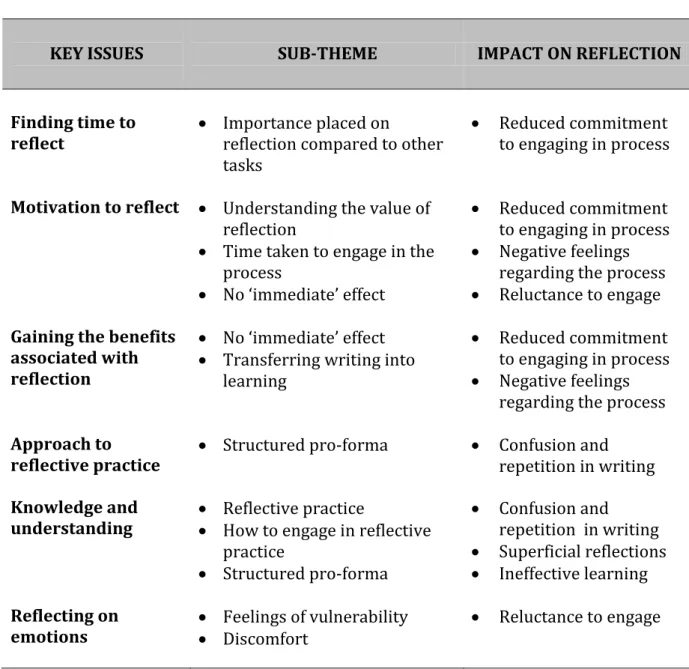
A range of issues and / or problems associated with the participants reflecting on their coaching practice emanated from this study. These issues, their associated sub-themes (key explanatory sub-themes of the main issue), and the impact of the theme on the participants’ reflections are summarised in Table 1. It is important to note that all participants experienced a combination of these issues, and all participants indicated that they did find reflective practice problematic to some extent. Each of the key issues are discussed separately.
5.21 Finding time to reflect
The issue of the time it takes to reflect in a structured, written manner was a prevalent theme with the participants (n = 9) in this study. For example, one participant indicated, “There are lots of other things I need to do and it (reflection) wasn’t always the top of my priorities.” Another participant reported, “There’s a lot of deadlines going on at work and that hampers, I wouldn’t say necessarily the quality but the amount of time you can sit down and
19 actually do it (reflect).” This finding is consistent with research across a range of fields. For example, Driscoll and Teh (2001) found that nurses tended to reflect more superficially because it takes up less time and effort. Similarly, Goldhill’s (2010) research with probation officers found that time constraints, due to the amount of professional work the officers were doing, inhibited their engagement in reflective practice.
KEY ISSUES SUB-THEME IMPACT ON REFLECTION
Finding time to
reflect Importance placed on reflection compared to other
tasks
Reduced commitment to engaging in process
Motivation to reflect Understanding the value of
reflection
Time taken to engage in the process
No ‘immediate’ effect
Reduced commitment to engaging in process Negative feelings
regarding the process Reluctance to engage Gaining the benefits
associated with reflection
No ‘immediate’ effect Transferring writing into
learning
Reduced commitment to engaging in process Negative feelings
regarding the process Approach to
reflective practice Structured pro-forma Confusion and repetition in writing
Knowledge and
understanding Reflective practice How to engage in reflective
practice Structured pro-forma Confusion and repetition in writing Superficial reflections Ineffective learning Reflecting on
emotions Feelings of vulnerability Discomfort
Reluctance to engage
20 It is thought that time became a specific issue with the participants in this study due to their professional status. All participants were part-time coaches who either had other jobs or were in full-time education, and in some instances (n = 2) both. Indeed, one participant confirmed, “As you can imagine with the workload that I have to sit down and truly reflect is time consuming. When I reflected I felt as though I should be doing something else. So it (reflection) was difficult at times.” As a consequence of this issue, some participants (n = 5) reported a reduced commitment to engaging in the process of reflection. For example, participants reported, “To be honest, I was so busy that I wrote the reflection as quickly as I could without really giving it much thought,” and, “Reflecting was taking me quite a while so in the end I’d skip over the last few questions because I’d lost the drive to do it.” These findings resonate with the thoughts of Knowles and colleagues (2006) who suggested that once coaches engage with paid coaching, accountability tasks, such as written reflection and annual reflective reports might be seen as time consuming and unnecessary and as a consequence are cast aside. Additionally, these participants acknowledged that a lack of understanding of reflection added to the time it took to engage in the process. For instance, “I didn’t really know what I was doing so it seemed to take ages for me to think about what to write in each section.” This would suggest that time issues may be reduced if practitioners were afforded a clear understanding of the reflective process and if they had the skills (e.g., problem-solving, critical thinking) required for effective reflection (Cropley et al., 2007).
Without doubt, as the demands placed upon sports coaches increase managing their time effectively becomes ever more problematic. However, reflection should not be seen as an ‘add on’ to practice. It should not be seen as something ‘extra’ to do. It should be seen as an integral part of the practice cycle where coaches plan, deliver, and reflect before planning again. Such a process is indicative of action research (Knowles et al., 2001) and must be established as common practice within coaching where each aspect is given equal importance. In support of this, Cropley and Hanton (2011) suggested that if practitioners are committed to and willing to learn and develop both their practice and themselves they will make time to fully engage in reflection. Indeed, Titchen and Binnie (1998) outlined how time allocated to medical personnel encourages formal reflection where teams of surgeons attend scheduled weekly meetings in order to reflect on operations.
21 5.22 Motivation: Gaining benefits
Linked to the theme of ‘finding time to reflect’, the majority (n = 8) confirmed that motivation was an issue for them with regards to completing the structured reflective pro-forma each week and thus engaging in the process of reflection. For example, one participant indicated, “I had a lot of other things going on and I thought the importance of it (reflecting) wasn’t high at the time, so I kind of left it until the last minute, so I think motivation held me back.” Antonsen, Thunberg, and Tiller (2009) agreed that one of the issues with reflection is the lack of motivation from practitioners; if motivation is low then real learning will not occur from real-life encounters. Similarly, in the current study one participant outlined, “I realised how long it took to reflect and with everything else I had on that really stopped me going in detail, so I suppose my motivation wasn’t the best which probably stopped me from benefitting from it (reflection).” Such findings are further supported by Driscoll and Teh, (2001) who suggested that when things get busy, reflective practice is the first thing to be dropped or tossed aside.
Those reporting a low motivation to reflect in this study may have done so because they were not able to elicit the benefits associated with reflective practice straight away. For example, one participant noted, “Well I wasn’t really getting much from my reflections, they just told me what I knew anyway so I started to put less thought into them if I’m honest.” Otienoh (2010) suggested that the problem with reflection is that the product of the process is rarely tangible and therefore people may not physically see the benefits of their reflective practices. However, in agreement with Cushion et al. (2010), the skills required to reflect are developed over time and therefore practitioners must remain patient and committed to the process of reflection. Considering the recommendations made previously, motivation is likely to be improved if a mentor is available to provide guidance and encouragement (Cropley & Hanton, 2011). This would corroborate the ideas of one participant who said:
If someone was ringing me up and reminding me not to forget the reflective journals that would make me sit down and do them more consistently. If I don’t think I have that pressure I probably would continue to pay lip service to them (reflections) and not done the reflections.
It is thought that mentors are able to facilitate effective reflection, where learning occurs in a way that has the potential to improve practice. Mentors are therefore likely to help practitioners achieve the benefits of reflective practice. In line with self-efficacy theory
22 (Bandura, 1977), achieving these benefits is likely to enhance the self-confidence of the practitioner and in turn increase the practitioner’s propensity to reflect.
5.23 Knowledge and understanding: Approach to reflection
As a result of these themes being intrinsically linked they will be reported and discussed together here. A number of participants (n = 5) specifically reported that if their knowledge and understanding of the process had been better their reflections would have improved. One participant stated:
It (reflecting) would have gone a lot better if I’d been clearer about the process because I would have known what to pick out of my brain. When I answered your questions, when I wrote down my answers, my answers were quite vague because I didn’t really know what to take out and what to put down on paper.
In line with this, four participants outlined that they found that they were repeating themselves when filling out the reflective pro-forma. This is best summarised by the following comment, “I didn’t really know what to write and where to write it. I seemed to keep writing the same things in different boxes which was annoying.”
Moon and Boullon (1997) have highlighted that reflection is a complex process in which high metacognitive skill levels are required, and reaching such skill levels takes time and practice. Specifically, Moon and Boullon (1997) found that assessing teachers’ levels of reflection after only a period of six weeks was not long enough for them to fully understand the process of reflective practice. Although this study engaged participants in reflective practice over a period of 12 weeks this may still have not been enough time for participants to establish their reflective skills, and knowledge and understanding of the process. In fact, one participant noted, “I feel as though I was getting better at it (reflecting) as I did more, but I could have done with more guidance.” This suggests that even without any formal training by engaging in structured reflective practice over time coaches begin to develop the knowledge and skills required to make reflection more effective. In support of this another participant suggested, “I just need to keep doing it. I think the more I do it the easier it will become and the more efficient.”
Participants (n = 3) in this study also outlined difficulty in understanding what to reflect on. For example,
I found a lot of things difficult with the age of the kids the U11’s, because I found it hard to add to some of the questions because they (athletes) tend to do things
23 randomly and there wasn’t so much a reason behind it (coach behaviours) in my
coaching so I found that quite hard to understand what I should be reflecting on.
This issue is also likely to compound the issue of time, as the participants reported the lengthy process taken to decide upon a direction for the reflection. It has also been considered in other fields where Martindale and Collins (2007) stated that it is still not clear as to what practitioners should actually reflect on from their experiences. In this situation, the participants could have been more informed by focusing on critical incidents within their coaching (Cropley et al., 2010). Coaches should reflect on situations that have personal significance to them as greater learning will occur and ultimately have a more pronounced impact on practice (Cropley & Hanton, 2011). Clearly, the coaches in this study would have benefited from specific education, guidance and support and therefore such process should be considered by those responsible for the training and development of sports coaches.
Interestingly, one of the participants acknowledged, “If I had someone who would say whether the reflections were on the right thing or could give more guidance through the process, then that probably would have made reflecting a bit easier because sometimes you’re just a bit unsure.” Other participants (n = 6) suggested that having the support of someone who “knew what they were doing when it came to reflective practice” would have helped them to engage in the process more effectively. This supports the notion that a mentor or tutor could help participants through the reflective process. The value of solitary reflective practice for students, or neophyte practitioners, has been questioned on the basis that students do not have access to the body of knowledge and experience in the day-to-day of the professionals that is seen as the real content of professional reflection (Moon, 2006).As implicated in Knowles et al.’s (2006) study, formal mentoring support could offer coaches the guidance and advice they require in order to improve their knowledge and understanding of reflection, and subsequently reduce the amount of time they spend doubting whether their reflections are good enough or not. In addition, mentoring has the potential to develop further learning as Cox (2005) mentioned that practitioners will start to see the benefits of reflective practice and engage in it more frequently.
24 5.24 Reflecting on emotions
Seven participants reported having problems or feeling uncomfortable with writing about their emotions when reflecting. One participant responded, “I couldn’t get across on paper what I felt, because…basically the hardest bit was trying to understand feelings.” Another suggested, “Maybe I didn’t want to lie to myself, maybe I knew what to write but maybe I didn’t write it because I didn’t want to sound like an idiot by talking about all those emotions I felt.” Other participants commented that considering affective issues connected to coaching practice was relatively novel, “I’ve never really considered the idea that my emotions impact on the session so I found it difficult to think about these (emotions) things…it was alien to me.” Several authors have commented that reflective practice is likely to lead to feelings of discomfort and vulnerability as reflection directs us to challenge habitual knowledge and practice (Anderson et al., 2004). Certainly, Raelin (2001) warned that reflection can also make practitioners feel insecure, anxious and doubt our practice. However, Raelin (2001) also advocates that emotions and feelings can act as catalysts during reflection. Consequently, in order to engage in the reflective process fully practitioners must be open with themselves and questioning; challenging their emotions and thoughts, which will enable them to learn from their experiences, adapt and improve their practice (Anderson et al., 2004).
Three participants also specifically commented on the issue of the recalling of emotions. Specifically, one participant stated, “Writing about how you feel and how you felt at that exact moment is really hard to recall, even if you did it half an hour after its really hard to exactly pin point the feeling.” Another participant agreed, “Depending on how the session goes I struggle to remember how I was feeling before and during the session because I’m either really happy or really xxxxxx off.” Recall of emotions and information has been discussed in the extant literature. Indeed, Knowles et al. (2006) promoted the use of dual-staged reflection, where an initial reflection is recorded as soon after the event as possible and then a more thorough reflection is conducted, fuelled by those initial thoughts, at a later date. Knowles et al. (2006) also suggested that mental imagery could be a vital skill in helping coaches to relive their experiences and recreate the emotions involved, thus facilitating recall. Linked to this mental skill, the use of technology has also been supported in recent literature (e.g., Carson, 2008; Rhine & Bryant, 2007). Videos of coaching sessions, for example, can help coaches to recapture the intensity and frequency of emotions as well as better understand the impact of these on behaviour.
25 Coaches must therefore consider the ways in which they may use certain techniques or resources to help recall the detail that is necessary for in-depth reflection.
5.3 CHANGES TO FUTURE PRACTICE
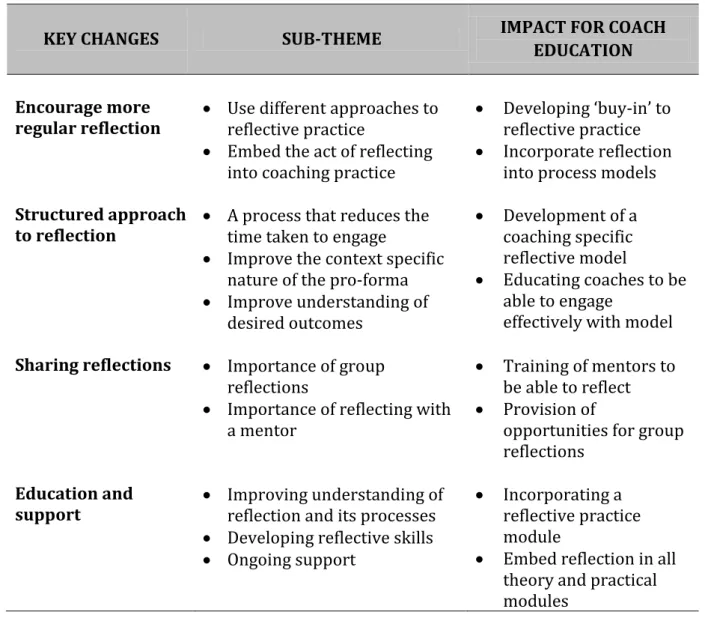
Based on the participants’ experiences of reflecting on their practice during the study, they were able to identify a range of ways that reflective practice could be integrated more stringently into individual practice and NGB coaching awards. These potential changes, their associated sub-themes (key explanatory themes of the main issue), and the impact of the theme for coach education qualifications are summarised in Table 2 and discussed below.
Table 2. Potential changes to improve the use of reflective practice by sports coaches.
KEY CHANGES SUB-THEME IMPACT FOR COACH EDUCATION
Encourage more
regular reflection Use different approaches to reflective practice
Embed the act of reflecting into coaching practice
Developing ‘buy-in’ to reflective practice Incorporate reflection
into process models Structured approach
to reflection A process that reduces the time taken to engage
Improve the context specific nature of the pro-forma Improve understanding of desired outcomes Development of a coaching specific reflective model Educating coaches to be able to engage
effectively with model
Sharing reflections Importance of group
reflections
Importance of reflecting with a mentor
Training of mentors to be able to reflect Provision of
opportunities for group reflections
Education and
support Improving understanding of reflection and its processes
Developing reflective skills Ongoing support
Incorporating a reflective practice module
Embed reflection in all theory and practical modules
26 5.31 Frequency of reflection: Utilising a structured approach
A number of participants (n = 4) suggested that they would have liked to have been encouraged to reflect more frequently. These participants suggested, “I would have liked to do it (reflect) more frequently,” and, “I had issues with time but reflection is something I think we (coaches) should do on every session, that’s what I would recommend.” For these participants it would appear that reflective practice, despite several issues, had overarching benefits that helped them to understand how to think and behave more effectively as a coach. Previous literature has tended to advocate a critical incident approach to reflective practice (e.g., Holt & Strean, 2001) when considering the frequency of reflection. This individualised approach affords practitioners the opportunity to reflect on personally significant incidents, which, in turn, makes reflective practice more meaningful to the individual (Tripp, 1993). Instead of asking coaches to reflect on everything they do in a formal, structured manner and thus forcing reflection in some instances, coaches should be educated and advised as to critical incident reflection (cf. Cropley & Hanton, 2011). This will provide coaches with the information needed to make an informed decision about how and when they might engage in reflective practice.
The majority of the participants (n = 8) stated that they would make changes to the structure of the log that they used to reflect. One participant said, “I would put it (reflective pro-forma) all on one page, it’d be easier to follow and do.” Another participant added, “I would possibly cut down some of questions to make it more manageable.” Participants advised that such changes would reduce the amount of time spent on a reflection and make it easier to see and understand. The participants appeared to want to make the process quicker and more accessible given their busy schedules. Being able to do this may have a positive impact on coaches’ levels of motivation to reflect, which in turn will enhance their engagement in the process leading to more positive learning outcomes. In line with the findings of Knowles et al. (2006) coaches should be encouraged to develop their own approaches to reflection that suit both their own learning needs and the context of their practice. Empowering individuals to make such decisions is also likely to enhance the motivation to reflect more consistently (Cropley et al., 2007).
Interestingly, although not all of the participants specifically recommended the structured approach, none of the participants indicated that it had been detrimental to their reflective practices beyond a lack of understanding regarding how to engage. One
27 participant noted, “The pro-forma and the questions gave me a focus. I wasn’t always sure about what to write for each bit but it definitely got me thinking.” These findings are somewhat in line with the comments of Knowles et al. (2001) who suggested that a structured approach to reflection affords more of a systematic process rather than the simple mulling over of an experience. Being encouraged to reflect in such a way may, therefore, be beneficial.
5.32 Shared reflections
Five participants in this study suggested that reflective practice could be improved through the use of a peer or a mentor to assist with the process. For example, one participant recommended, “Coaches, particularly inexperienced ones, could use older peers who are more experienced in order to help facilitate reflections.” It was thought that a shared reflective process would help coaches consider their actions and behaviours more carefully and help them to better understand their experiences. One participant added, “I found it difficult to reflect on my own because I didn’t know what else I could have done or what my session was like. If I had someone prompting me and giving me feedback I would have learnt more.” This comment resonates with the suggestions of Anderson et al. (2004) who proposed that peers could help in offering alternative solutions and challenging the individual when reflecting. This was further brought to light in the current findings as one participant stated, “Other coaches can challenge the person to get a better reflection out of them.”
A number of researchers have advocated a shared approach suggesting that the heart of reflective practice lies in the reflective conversation (e.g., Cropley et al., 2007; Ghaye & Lillyman, 2000; Gilbert & Trudel, 2001) under the premise that mentors or critical friends5 facilitate the reflective process, add depth to reflections, and help to
improve understandings of situations. The current findings correlate to these ideas with one participant reporting, “You could act as a mentor to inexperienced coaches…this would really help them to reflect…two heads are better than one aren’t they!” Additionally, participants in this study made the distinction that shared processes of reflection would be more beneficial for an inexperienced coach as “they are still learning about the environment that they operate in, so support is necessary to ensure that their reflections are
5 A critical friend refers to a relationship based on cooperative adult learning, with ‘critical’ meaning
28 meaningful.” The view shared amongst the participants of this study was that coaches could “feed” off the knowledge of others, which may help them make sense of their own coaching and promote further learning. These ideas link to the comments of Moon (2006) who suggested that trainees may not have the professional knowledge required to reflect on their own, making shared processes vital.
In relation to the sharing of reflections with a ‘more knowledgeable other’ one participant also suggested that, “Reflecting in groups could be good because ideas could be swapped and this may help a reflection I think.” The notion of group reflection supports the work of Gustafsson and Fagerberg (2004) who identified that group reflection can help to trade ideas and create a supportive environment for learning and change. Providing support or creating an environment for shared/group reflective practice to take place may, therefore, substantially benefit the outcome of reflection-on-action and improve a coach’s effectiveness.
5.33 Education and support
Knowles et al. (2005) commented that given that research has shown experiential learning to be the primary determinant of developing coach expertise, it has been argued that NGB education programmes do not currently maximize opportunities for developing coaching practice. Failing to provide an underpinning structure to support experiential learning is unlikely to allow coaches to explore the nuances of their own practice, access and develop tacit knowledge and be creative in their application of sport specific technical knowledge. In line with this, the participants in this study commented on the need for more formal education regarding reflective practice and its application. Specifically, six participants outlined that their reflections were limited due to the little knowledge that they had regarding the process. One participant outlined, “I didn’t really know what I was doing I really needed more instruction and guidance. I thought I had a basic understanding of reflective practice but it didn’t help me here.” Another stated, “Being taught how to reflect and use the model would have really helped me to do it (reflection) better.” The notion of reflective practice being ‘trained’ sits well with the work of Russell (2005) who concluded that reflective practice can and should be taught. Russell (2005) went on to suggest that, “The results of explicit instruction seem far more productive than merely advocating reflective practice and assuming that individuals will understand how reflective practice differs profoundly from our