HAL Id: hal-01847358
https://hal.archives-ouvertes.fr/hal-01847358v2
Preprint submitted on 1 Aug 2018
HAL
is a multi-disciplinary open access
archive for the deposit and dissemination of
sci-entific research documents, whether they are
pub-lished or not. The documents may come from
teaching and research institutions in France or
abroad, or from public or private research centers.
L’archive ouverte pluridisciplinaire
HAL, est
destinée au dépôt et à la diffusion de documents
scientifiques de niveau recherche, publiés ou non,
émanant des établissements d’enseignement et de
recherche français ou étrangers, des laboratoires
publics ou privés.
Threshold functions for small subgraphs in simple
graphs and multigraphs
Gwendal Collet, Elie de Panafieu, Danièle Gardy, Bernhard Gittenberger,
Vlady Ravelomanana
To cite this version:
Gwendal Collet, Elie de Panafieu, Danièle Gardy, Bernhard Gittenberger, Vlady Ravelomanana.
Threshold functions for small subgraphs in simple graphs and multigraphs. 2018. �hal-01847358v2�
Threshold functions for small subgraphs in simple graphs and
multigraphs
Gwendal Collet
∗´
Elie de Panafieu
†Dani`
ele Gardy
‡Bernhard Gittenberger
§Vlady Ravelomanana
¶July 15, 2018
Abstract
We revisit the problem of counting the number of copies of a fixed graph in a random graph or multigraph, for various models of random (multi)graphs. For our proofs we introduce the notion ofpatchworks to describe the possible overlappings of copies of subgraphs. Furthermore, the proofs are based on analytic combinatorics to carry out asymptotic computations. The flexibility of our approach allows us to tackle a wide range of problems. We obtain the asymptotic number and the limiting distribution of the number of subgraphs which are isomorphic to a graph from a given set of graphs. The results apply to multigraphs as well as to (multi)graphs with degree constraints. One application is to scale-free multigraphs, where the degree distribution follows a power law, for which we show how to obtain the asymptotic number of copies of a given subgraph and give as an illustration the expected number of small cycles.
Keywords. random graphs, subgraphs, analytic combinatorics, generating functions, power law.
1
Introduction
Since the introduction of the random graphsG(n, m) andG(n, p) by Erd˝os-R´enyi [17] in 1960 one of the most studied parameters is the number of subgraphs isomorphic to a given graphF.
Throughout the paper, for a given graph or subgraph G, E(G) (resp. V(G)) denotes the set of its edges (resp. vertices). For a given graph F denote by G[F] the number of copies of F contained in the random graphG(n, p) as a subgraph. Observe that by the asymptotic equivalence betweenG(n, p) and
G(n, m) (see for instance [28]) results from one model can be translated into the other rigorously. The distribution ofG[F] has been studied extensively since the seminal work of Erd˝os-R´enyi [17] who gave the first results in this direction. A general threshold for {G[F] >0} has been established in 1981 by Bollob´as [8] located atp=n−1/µ whereµ= max
H{|E(H)|/|V(H)|:H ⊂F}. If the order of magnitude
ofpis smaller than the threshold, then asymptotically almost surely there is no subgraphF in
A major reference about the distribution ofG[F] is the work of Ruci´nski [40] stating that the number of copies ofF is asymptotically normal if and only ifnpµ → ∞andn2(1−p)→ ∞. In the same paper,
∗Institute of Discrete Mathematics and Geometry, TU Wien, Wiedner Hauptstr. 8–10/104, 1040 Wien, Austria.
Sup-ported by the Austrian Science Foundation FWF, grant SFB F50-02.
†Nokia–Bell Labs and LINCS (France). This work was partially founded by the Austrian Science Fund (FWF) grant
F5004, the Amadeus program and the PEPS HYDrATA.
‡DAVID Laboratory, University of Versailles Saint Quentin (France). Partially supported by the Amadeus project
33697ZK Threshold problems and phase transitions in graph-like structures (2015–16) and by the ANR-MOST project MetaConc (2015–19).
§Institute of Discrete Mathematics and Geometry, TU Wien, Wiedner Hauptstr. 8–10/104, 1040 Wien, Austria.
Sup-ported by the Austrian Science Foundation FWF, grant SFB F50-03 and the ¨OAD grant Amad´ee F01/2015.
¶IRIF, University of Paris 7 (France). Partially supported by the Amadeus project 33697ZKThreshold problems and
phase transitions in graph-like structures(2015–16), by the projectCombinatorics in Paris (2014–17) and by the CNRS-PICS projectConstraint analysis through analytic combinatorics (2017–19).
Ruci´nski proved also that at the threshold the number of subgraphsF follows a Poisson law if and only ifF is strictly balanced.
In this context, Janson, Oleszkiewicz and Ruci´nski [29] developed a moment-based method that gives estimates forP(G[F]≥(1 +ε)EG[F]) which are best possible up to logarithmic factors in the exponent (the authors proved that their exponential bounds on the upper tail ofG[F] are tight). It is important to remark that the notion of strongly balanced graphs, introduced by Ruci´nski and Vince [41], plays a key role to obtain the results mentioned above.
Recently, there has been an increasing interest in the study of constrained random graphs such as random graphs with given degree sequences or random regular graphs. In these directions, the number of given subgraphs in such structures has been also studied. For instance, Wormald [49] proved in his survey about random regular graphs that the number of short cycles in these structures follows asymptotically a Poisson distribution. McKay, Wormald and Wysocka [35] consider random regular graphs of degree
dand show that, when g is such that (d−1)2g−1 =o(n), the numbers of cycles of length up to g are
asymptotically distributed as independent Poisson variables. Kim, Sudakov and Vu [30], considering a regular unlabeled graph with nvertices of degreedand a fixed subgraphH, study how the probability that a copy of H occurs varies when d grows, show that this probability gets close to 1 for d around
n1−1/E(H)and prove the convergence of the number of copies ofH towards a Poisson distribution. Gao
and Wormald [22] prove the asymptotic normality of the number of copies of a strictly balanced subgraph
H in a randomd-regular graph whendgrows large.
Instead of constraining the whole graph, we can also require that thesubgraphis regular. An article by Bollob´as, Kim and Verstra¨ete [9] considers the appearance of such ak-regular subgraph when the density of the graph is around 4k. Several papers have studied the relation between ak-regular subgraph and a
k-core: Pra lat, Verstra¨ete and Wormald [39] prove that the threshold for the appearance of a k-regular subgraph is at most the threshold for the appearance of a non-empty (k+ 2)-core, a result improved first by Chan and Molloy [10] to a (k+ 1)-core, and further by Gao [20], who showed that the size of a k-regular subgraph is “close” to the size of the k-core. Concurrently, Letzter [31] has obtained the existence of a sharp threshold for the existence of ak-regular subgraph fork≥3. Very recently, Mitsche, Molloy and Pra lat [36] proved that a random graphG(n, p=c/n) typically has ak-regular subgraph if
c > e−Θ(k), which is above the threshold for the appearance of ak-core.
Now extend regular graphs and consider graphs whose degrees form a specified degree sequence. An early reference on the enumeration of such graphs is the article of McKay and Wormald [34], followed by Greenhill and McKay [25] who studied the asymptotic number of sparse multigraphs with degree sequences. Barvinok [3] studies directed and bipartite graphs with prescribed degree, and two papers by Barvinok and Hartigan [4, 5] establish results about (uniform random) graphs with a given degree sequence. In [4], the authors count asymptotically the number ofm×nmatrices with prescribed row and column sums, so that their results can be applied to the number of graphs and bipartite graphs with prescribed degrees (on both sides); in [5] they obtain the number of labeled graphs where the degree sequence is fixed. More recently, Gao and Wormald [21] consider sparse graphs and present a survey of enumeration results for graphs with given degree sequences as well.
If we are interested in the appearance of subgraphs in graphs with specified degree sequences, a good survey of the results up to 2010 is by McKay [32]. McKay [33] again studies the structure of a random graph with a given degree sequence, including the probability of a given subgraph or induced subgraph. Chatterjee, Diaconis and Sly [11] consider a general model for (dense) graphs with a given degree sequence and the existence of a limit for sequence of such graphs; this allows them to obtain a general formula from which one might deduce results on the number of triangles (although not explicitly given).Very recent results by Greenhill et al. [24] give the asymptotic expected number of copies of a graph and of induced subgraphs in a random graph with a known degree sequence. As multigraphs model many real-world networks, subgraphs counts have also been derived for random multigraph models with prescribed degrees. For very recent works in these directions we refer to the preprint of Angel, van der Hofstad and Holmgren [1] where the authors consider multigraphs with prescribed degrees and study Poisson approximations of the number of self-loops and multiple edges as well as an estimate on the total variation distance between the number of self-loops and multiple edges and the Poisson limit of their sum. Barbour and R¨ollin [2] provide a general normal approximation theorem for local graph statistics in the same model.
The next step after fixing the degree sequence is allowing this sequence to follow some probability distribution. An important class of graphs with such a distribution is that of scale-free graphs, i.e.,
graphs where the degree distribution follows a power law which means that the probability that a vertex has degree d is proportional to d−γ for some γ. Results from the afore-mentioned article by Gao and
Wormald [21] can be applied to some power-law sequences. Van der Hofstad [44] gives a nice presentation of the different models for graphs; see also his survey [43] on the configuration model.
Van der Hofstad, Janssen, van Leeuwaarden and Stegehuis [42,45] consider triangles, or rather the
clustering coefficient,in a class of simple graphs with a hidden variables model and a power-law degree distribution. Van der Hofstad, van Leeuwaarden and Stegehuis [46] consider the number of occurrences of a small connected graph, either as a subgraph or as an induced subgraph; all their results are for the so-called “erased” configuration model, which amounts to a simple graph model. In a companion paper [47] they consider clustering,i.e., the probability of existence of an edge between two neighbours of a given vertex in the configuration model. When the degree of the vertex becomes at least of order√n, this probability becomes that of a power law. Their result can be used to derive the expected number of triangles, when a triangle with multiple edges is counted once (this is again the erased configuration model).
Our goal in this paper is to revisit some of these results and to extend them, through analytic combinatorics and extensive use of generating functions for counting graphs with a specified subgraph, or with a given number of subgraphs.
Ours is not the first paper that approaches graph problems with these tools. Roughly at the same time as the pioneer articles of Flajolet, Knuth and Pittel [18] about the appearance of cycles and of Janson et al. [27] about the birth of the giant component, higher-dimensional multivariate generating functions where variables are associated to vertices of the graph were used by McKay and Wormald [34]. Such highly multidimensional generating functions appear again in further papers, see McKay [32, 33] and Barvinok and Hartigan [5]. An important development was the study of planar graphs by Gimenez and Noy [23] through analytic combinatorics, followed by several papers in the same direction. E.g., the recent paper by Drmota, Ramos and Ru´e [15] deals with the limiting distribution of the number of copies of a subgraph in subcritical graphs. Noy, R´equil´e and Ru´e [37] study precise properties of random cubic planar graphs including, most notably for the topics of this article, a proof of asymptotic normality for the number of triangles. Another relevant result, upon which we shall build Section6, is the enumeration of graphs whose degrees must belong to a specific set, presented by de Panafieu and Ramos [14].
Overview of results
In the next section we give the formal definitions of our model and the objects we are interested in: simple graphs and multigraphs, possibly weighted.
Section 3presents some combinatorial results on the expected number of subgraphs that can be ob-tained without resorting to analytic combinatorics tools. We give here the expected number of subgraphs belonging to a given familyF in simple graphs or in multigraphs. The notion ofpatchwork of copies of subgraphs, which is defined there, allows us to study the distribution of the number of occurrences of a subgraph. We are then able to consider the total number (weight) of simple graphs or of multigraphs with a specific number of occurrences of subgraphs inF. We finally derive a Poisson limiting distribution for the number of occurrences of a strictly balanced subgraph in a weighted multigraph.
The tools from analytic combinatorics which we shall use in the rest of the article are generating functions enumerating families of graphs. They are presented in Section 4; we also give there the first generating functions for the families we consider.
The following sections are devoted to probabilistic results under two different random models. In Section 5, (multi)graphs are chosen uniformly at random among all graphs of the same size (number of vertices and edges): This is reminiscent of the Erd˝os-R´enyi G(n, m) model. In Sections 6 and 7, we consider weighted (multi)graphs to study different degree distributions. Both distributions can be achieved by the means of Boltzmann samplers [16], presented in more detail in Section 6.2, which automatically translate our combinatorial decomposition of the (multi)graphs (weighted or not) into a random sampler. In particular, the Boltzmann sampler for multigraphs weighted according to their degrees produces multigraphs following the same distribution as the configuration model does. This equivalence, detailed in Section 6.2, bridges the gap between analytic combinatorics and the “pure” probabilistic setting.
We address the problem of evaluating the number of copies of a given subgraph in Section5, for both simple graphs and multigraphs. Theorems1and 2give exact and asymptotic expressions for the number
of multigraphs and simple graphs with one distinguished subgraph inF; then Theorems3and4give the number of multigraphs and simple graphs with exactlyt subgraphs in F. The probability that there is at least one copy of a subgraph ofF with high density goes to 0, as shown in Corollary1for multigraphs whenm=o(n2−1/d(F)); Corollary2 is a more precise variant of this result when we know the essential
density of the subgraph. Corollary3is the equivalent result for simple graphs; it gives a new proof of the upper bound on the average number of copies of a densest subgraph in a simple graph form=O(nα), αfixed<2, and shows that the number of copies tends almost surely to 0 whenα <2−1/d∗(F), with d∗(f) the essential density of the subgraphF. Finally, Theorems 5 and6 prove a Poisson distribution
for the number of copies of a strictly balanced subgraph F for a random multigraph and for a random simple graph, respectively, in the rangem∼cn2−1/d(F) whered(F) is the density of the subgraphF.
Section 6 considers how to extend these results to multigraphs with degree constraints. We present our model of randomness for simple graphs or multigraphs with degree constraints in Section 6.1 and examine its relation to the well-known configuration model in Section 6.2. Theorem 7 is the analog of Theorems1 and 2for weighted graphs; it gives an exact expression for the total weight of multigraphs with one distinguished subgraph in the familyF, from which we derive the expected number of subgraphs belonging toF and the probability that there aret such subgraphs in Corollaries6and7. To get more precise results, we have to consider properties of the set of weights. Weight sets with only finitely many nonzero elements are considered in Section6.4forn andmproportional. There we show that the only subgraphs that have a nonzero probability are trees and unicycles, derive the expected number of copies of a tree, and prove a Poisson limiting distribution for the number of occurrences of cycles of given length (Theorem8). We first obtain a general result when the weights do not grow too fast (in a sense that we make precise), then derive the weighted equivalent of Theorems5 and6(this is Theorem9).
We consider further examples of weight sets in Section 7, most notably quickly increasing weights. This occurs for instance in the important case ofpower-law multigraphs, also known asscale-free networks, which are treated in Section7.2. We sketch there a general approach to finding the expected number of copies of a sub-multigraph in a multigraph and give a complete answer for small cycles in Theorem11. We also get results on the threshold for the appearance of trees in the case wherem/n→0 in Section7.1
(this is Theorem10), and on multigraphs where the set of vertex degrees is periodic in Section7.3.
2
Models and definitions
Most of the following definitions come from Erd˝os-R´enyi [17] and Bollob´as [8] for graphs, and from Flajolet, Knuth and Pittel [18], Jansonet al.[27] or more recently [14] for multigraphs.
Graphs. A simple graph, or graph,Gis a pair (V(G), E(G)), where V(G) denotes the set of vertices carrying distinct labels, andE(G) the set of edges. Each edge is an unoriented pair of distinct vertices, thus loops and multiple edges are forbidden. An (n, m)-graph is a simple graph withnvertices andm
edges. The labels of the vertices are distinct integers. When no other constraint is added, the labeling is said to be general. When the vertices are labeled from 1 to n, the labeling is said to be canonical. Unless otherwise mentioned, the graphs considered have canonical labeling. The set of all simple graphs with canonical labeling is denoted bySG.
Multigraphs. We define a multigraph as a graph-like object with labeled vertices, and labeled oriented edges, where loops and multiple edges are allowed. More formally, a multigraphGis a pair (V(G), E(G)), whereV(G) is the set of labeled vertices andE(G) the set of labeled edges (the edge labels are indepen-dent from the vertex labels). Each edge is a triple (v, w, e), wherev, ware vertices, ande is the label of the edge (which is oriented fromvto w). A loop is a triple (v, v, e) and a multiple edge is a set of at least two edges {(u, v, e1), . . . ,(u, v, ek)}. An (n, m)-multigraph is a multigraph with nvertices and m
edges. Again, the vertex labels are distinct integers, and the edge labels are distinct integers. When no other constraint is added, the labeling is said to begeneral. When the vertices are labeled from 1 ton
and the edges from 1 tom, the labeling is said to becanonical. The set of all multigraphs with canonical labeling is denoted byMG, and unless otherwise mentioned, the multigraphs considered have canonical labeling.
Notice that, although a given multigraph may have neither loops nor multiple edges, it would still not be a simple graph, as its edges are oriented and labeled. The orientation of the edges allows a very
simple description of a canonical (n, m)-multigraphGas a sequence (v1, . . . , v2m), wherevi ∈V(G) and ej = (v2j−1, v2j)∈E(G),∀1≤j≤m. This model of multigraphs can be found in the literature under
the name ofquiver or multidigraph, and appears notably in category theory and representation theory (see [12]. It introduces a bias in the enumeration of multigraphs and so differs from the more classical model of vertex-labeled, edge-labeled multigraphs since loops have only one possible orientation, while other edges have two.
1 2 3 4 5 2 7 5 8 3 1 2 3 4 5 2 7 5 8 3 2 3 6 5 7 1 4 8 12 1 3 4 5 7 8 10
Figure 1: On the left, two isomorphic simple graphs (the first one with canonical labeling). On the right, two isomorphic multigraphs (the first one with canonical labeling).
The following definitions stand for both simple graphs and multigraphs. As such, they are stated for (multi)graphs, which can refer either to simple graphs or to multigraphs depending on the context.
Isomorphic (multi)graphs. Two (multi)graphs G and H with general labeling are isomorphic if there exists a bijectionαbetweenV(G) andV(H) that induces a bijection β betweenE(G) andE(H),
i.e.,
(for simple graphs) ∀{v, w} ∈E(G), β({v, w}) ={α(v), α(w)} ∈E(H);
(for multigraphs)∀v, w∈V(G) : {β(v, w, e) : (v, w, e)∈E(G)}={(α(v), α(w), e0)∈E(H)}.
We also say that H is a G-(multi)graph. Notice that (multi)graph isomorphism is independent from labels. Given a (multi)graph familyF,H is aF-(multi)graph if it is isomorphic to an element ofF.
Subgraphs. A (multi)graphF is asubgraph of a (multi)graphGifV(F)⊂V(G) andE(F)⊂E(G). We then writeF ⊂G.
Given a (multi)graph familyF and a (multi)graphG, anF-subgraph ofGis a subgraph ofGwhich is isomorphic to an element ofF. The number ofF-subgraphs of Gis denoted byG[F]. WhenF is a singleton{H}, we simply writeG[H] instead ofG[{H}].
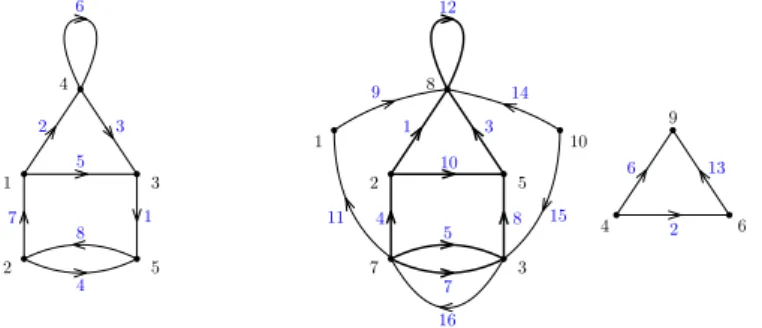
1 2 3 4 5 2 7 5 8 3 2 3 6 5 7 1 4 8 12 1 3 4 5 7 8 10 1 10 4 6 9 2 6 9 11 13 14 15 16
Figure 2: On the left, a multigraph appearing as a subgraph on the (non-connected) multigraph on the right.
Weighted (multi)graphs. A weighted (multi)graph family Fω is a (multi)graph family F equipped
with a weight ω, which is a function from F to a given set. In this article, this set will be either the nonnegative real numbers (see Section6.1for weights related to the degree sequence of the multigraph, or Section 7.2 for a concrete example with weights following a power law) or the polynomials in the
variable uwith real coefficients (which can be seen as formal weights, useful to track some parameters in (multi)graphs, see Section4.4). The weight of a (multi)graphGis denoted byω(G). The weight Fω
of the familyFωis defined as the sum of the weights of its elements. Thetrivial weight is the one that
assigns to each (multi)graph the value 1. When weightωis the trivial one, it is omitted in the notations, soF denotes the trivial weight of the familyF, equal to its cardinality. Hence, the results on weighted (multi)graphs extend the enumerative results. When no other weight is specified, the weight is assumed to be the trivial one.
Weights are usually associated to (multi)graph families which are equipped with a non-uniform dis-tribution. For instance, while with the trivial weight each (multi)graph is equally likely, replacing the weight of a single (multi)graphH by 2 would make it twice as likely to be picked in the new weighted distribution.
We state some general results on the distribution of subgraphs in a weighted (multi)graph family in Section 3. In Section5, we obtain more precise results for the trivial weight,i.e., for the usual models of graphs and multigraphs. Finally, we consider the case where the weight of a (multi)graph depends on the degrees of its vertices in Section6.
Counting and probabilities. For enumeration purposes, we will only consider families of (multi)graphs with canonical labeling. Given a familyF of (multi)graphs, the set of elements ofF havingn vertices andmedges is denoted byFn,m, and its cardinality byFn,m. For instance, SGn,mis equal to (
n
2) m
, while MGn,m is equal ton2m, as the labels and orientations of the edges induce a canonical representation of
any multigraph as a sequence of 2m vertices. When a weightω is specified, the weight of the set of all (multi)graphs in the (multi)graph familyFω which havenvertices andmedges is denoted by Fn,m,ω.
In our model, a random (n, m)-(multi)graph is then a (multi)graph chosen uniformly at random from the setSGn,m(resp.MGn,m):
P(G∈ SGn,m) = 1 SGn,m , P(G∈ MGn,m) = 1 MGn,m .
This corresponds to the modelG(n, m) introduced by Erd˝os and R´enyi [17]. When a weightωis specified, then a random (n, m, ω)-(multi)graph is an (n, m)-(multi)graph chosen with probability proportional to its weight: P(G∈ SGn,m,ω) = ω(G) SGn,m,ω , P(G∈ MGn,m,ω) = ω(G) MGn,m,ω .
Density and balance. Erd˝os and R´enyi [17] observed first that the analysis of the number of F -subgraphs in a random (n, m)-graph is easier when the graph F is strictly balanced. We recall the definition of this property below.
The density of a (multi)graph G is defined as the ratio between the numbers of its edges and its vertices, and is denoted by
d(G) = m(G)
n(G).
By convention, the empty (multi)graph has density 0. Theessential density d?(G) of a (multi)graphG
is the density of a subgraph of maximal density:
d?(G) = max H⊂Gd(H).
A (multi)graphF isstrictly balanced if its density is greater than the density of all its strict subgraphs:
d(F)>max
H Fd(H).
It isbalanced if
d(F)≥max
H Fd(H),
andbarely balanced if it is balanced, but not strictly balanced. Equivalently a (multi)graph is balanced if and only ifd(F) =d?(F).
Lemma 1. Given a connected (multi)graph F, let PairF denote the set of (multi)graph such that H is
inPairF if and only if it is obtained by merging two distinct non-disjoint F-(multi)graphsF1,F2, i.e.,
V(H) =V(F1)∪V(F2), E(H) =E(F1)∪E(F2),
and V(F1)∩V(F2) is non-empty. If F is strictly balanced, then the density of any (multi)graph from
PairF is greater than the density ofF.
3
Subgraphs in weighted graphs and multigraphs
In this section, we investigate the distribution of finite subgraphs in a random (n, m, ω)-(multi)graph, for a general weight function ω, and reduce the study of this distribution to the analysis of (n, m, ω )-(multi)graphs where an F-subgraph is distinguished, for a well chosen (multi)graph family F. The weighted number of all (n, m, ω)-(multi)graphs is denoted by MGn,m,ω
A (multi)graph G with a distinguished subgraphF can be represented as a pair (G, F). Consider two weighted familiesGωG andFωF; G
[FωF]
ωG denotes the weighted family of all pairs (G, F) withG∈ G
andF being anF-subgraph ofG. The weight of (G, F) is then implicitly defined as
ω((G, F)) :=ωG(G)ωF(F).
Therefore, the total weight MG[FωF]
n,m,ωG of all (n, m)-(multi)graphs with a distinguishedFωF-subgraph is
equal to MG[FωF] n,m,ωG := X (n, m)-(multi)graphG F-subgraphFofG ωG(G)ωF(F).
When no weight functionωF is provided, the trivial weight 1 is used. This total weight plays a central
role in the article.
In the rest of this section, we provide three propositions that reduce the study of the numberG[F] of
F-subgraphs in a random (n, m, ω)-(multi)graphGto the analysis of MG[HωH]
n,m,ω, for well chosen families
HωH. The expected value ofG[F] is computed in Proposition1using MG
[HωH]
n,m,ω. Proposition2then gives
an exact expression for the total weight of (n, m, ω)-(multi)graphs with exactlytF-subgraphs. Finally, Proposition3provides technical conditions on the weights so that the limit law ofG[F] is a Poisson law for any strictly balanced (multi)graphF.
3.1
Expected number of subgraphs
Proposition 1(Expected number of subgraphs, weights, simple graphs and multigraphs). The expected number ofF-subgraphs in a random(n, m, ω)-graph and a random(n, m, ω)-multigraph is
SG[n,m,ωF] SGn,m,ω and MG [F] n,m,ω MGn,m,ω , respectively,
whereSGn,m,ωis the weighted number of all(n, m, ω)-graphs, andSG[n,m,ωF] is the weighted number of all
(n, m, ω)-graphs with a distinguishedF-subgraph (and similarly for multigraphs).
Proof. We give the proof for graphs, the proof for multigraphs being identical. By definition, the expected number ofF-subgraphs in a random (n, m, ω)-graph is equal to
1 SGn,m,ω X G∈SGn,m F∈F G[F]ω(G).
Since GcontainsG[F] F-subgraphs, there areG[F] pairs (G, F) inSG[n,mF] , so the expected number is
also equal to 1 SGn,m,ω X (G,F)∈SG[n,m,ωF] ω(G) = SG [F] n,m,ω SGn,m,ω .
3.2
Exact number of subgraphs and patchworks
When counting the number of (multi)graphs with n vertices, m edges and containing exactly t F -subgraphs, we run into a difficulty: those subgraphs may overlap. To describe these overlaps, we use the notion of anF-patchwork, defined below.
Patchworks for multigraphs. Given a family F of multigraphs, an F-patchwork is a finite set of distinctF-multigraphs (calledpieces)
P ={(V1, E1), . . . ,(V|P|, E|P|)},
each carrying a general labeling (i.e., the vertex or edge labels need not be consecutive integers staring at 1) which may share vertices and edges, such that if two vertices (from two distinct pieces) share the same labels, then they are merged and similarly, if two edges from distinct pieces share the same label, then they are merged. In particular, this implies that two edges sharing a label must connect the same two vertices with the same orientation. The vertices and edges ofP are
V(P) = |P| [ i=1 Vi, and E(P) = |P| [ i=1 Ei, (1)
and their cardinalities are denoted by n(P) and m(P). The size of P is the number of pieces and is denoted by|P|. This notion is illustrated in Figure3.
1 2 3 2 7 8 1 6 3 3 1 4 5 6 4 4 5 6 6 1 1 12 14 10 17 2 7 8 1 12 14 10 17 18 18 16 16 15 15 13 13 11 11 9 9 9 8 8 8 7 7 2 2 2 3 3 3 4 4 4 6 6 5 5 5 1 P: G(P) : F:
Figure 3: A multigraphF (left) and aF-patchworkP of size 4 (center) with its representation G(P) as a multigraph (right).
A patchwork is calleddisjointed if it contains no pair of pieces sharing one vertex or more.
Patchworks for simple graphs. The notion of a patchwork can be naturally adapted to simple graphs. For a simple graph familyF, each piece of an F-patchwork is then anF-subgraph and pieces can share vertices and edges. As distinguished from multigraphs, edges connecting the same two vertices in distinct pieces are necessarily merged in the patchwork, so as to avoid multiple edges.
Figure 4: A graphT and twoT-patchworksP andP0 that have the same graph representationG(P) =
Weights of patchworks and exact number of subgraphs. The familyPF(u) denotes the set of
F-patchworks equipped with the weight function
ω(P) :=u|P|,
so the weight of a patchworkP is the variableuraised to the power equaling the number of pieces ofP. Similarly, the family DisjPF denotes the subset of disjointedF-patchworks.
Proposition 2(Total weight, simple and multigraphs). The total weightSGFn,m,ω,tof all(n, m, ω)-graphs
that contain exactlyt F-subgraphs is
SGFn,m,ω,t:= [u
t] SG[PF(u−1)] n,m,ω .
Likewise, for any multigraph familyF, the total weightMGFn,m,ω,tof all(n, m, ω)-multigraphs that contain
exactly tF-subgraphs is
MGFn,m,ω,t:= [u t
] MG[n,m,ωPF(u−1)].
Proof. We give the proof for graphs, as the proof for multigraphs is identical. It relies on the interpre-tation of the inclusion-exclusion principle commonly used in analytic combinatorics (see Flajolet and Sedgewick [19, Section III.7.4]). Recall thatG[F] denotes the number of occurrences ofF-subgraphs in the graph G. LetSGFn,m,ω(u) denote the graph family that contains all (n, m)-graphs, equipped with the weightωu defined as
ωu(G) :=ω(G)uG[F].
Its weight is denoted by SGFn,m,ω(u) and is equal to
SGFn,m,ω(u) = X
G∈SGn,m
ω(G)uG[F],
and the weight of the (n, m, ω)-graphs that contain exactlyt F-subgraphs is then thet-th coefficient of SGFn,m,ω(u)
SGFn,m,ω,t= [u t] SGF
n,m,ω(u). (2)
When we evaluate SGFn,m,ω(u) atu+ 1 instead ofuand develop the powers ofu+ 1, we obtain
SGFn,m,ω(u+ 1) = X G∈SGn,m G[F] X j=0 ω(G) G[F] j uj.
The binomial coefficient G[jF]
is equal to the number of F-patchworks with j pieces contained in G, anduj is the weight of each of those patchworks. Hence, SGF
n,m,ω(u+ 1) is also the total weight of the
(n, m, ω)-graphs where anF-patchwork is distinguished:
SGFn,m,ω(u+ 1) =
X
(G,P)∈SG[n,mPF(u)]
ω(G)u|P|= SG[PatchF(u)] n,m,ω .
Replacing uwithu−1, extracting the coefficient [ut], and injecting the result in Equation (2) finishes
the proof.
3.3
Limit law of the number of subgraphs
Let c denote a real value or a polynomial in the variable u, and F a connected (multi)graph (in this section c will denote the weight of F). For simplification we will deviate from standard notations and use
ecF :=Set(c{F})
to denote the set of (multi)graphs where each component is isomorphic to F. The weight of such a (multi)graph is then defined asck, wherekis the number of components. Similarly, given a (multi)graph H, we write
HecF :={H} ∗
to denote the set of (multi)graphs where one distinguished connected component is isomorphic to H, while all the others are isomorphic toF. The weight of a (multi)graph from this family is defined asck,
wherekis the number of components isomorphic toF. By convention, whenH is the empty (multi)graph (i.e., the graph that has no vertex and no edge), then HecF is equal toecF.
Lemma 2. LetF be a connected multigraph, andPairF denote the (finite) set of multigraphs obtained by
merging two distinct isomorphic copies ofF sharing at least one vertex. Consider a sequencem:=m(n)
and recall thatMG[n,m,ωG] denotes the cumulative weight of all (n, m, ω)-multigraphs with a distinguished
G-subgraph. Assume that the following asymptotic relations hold, as ntends to infinity:
• (Case c= 2) For all H ∈PairF, we haveMG[He 2F]
n,m,ω =o(MG
[F]
n,m,ω).
• (Case c=u−1) Fort fixed,[ut] MG[e(u−1)F]
n,m,ω = Θ(MG
[F]
n,m,ω).
Then the weight of all(n, m, ω)-multigraphs that contain exactlyt F-subgraphs satisfies
MGFn,m,ω,t∼[u
t] MG[e(u−1)F]
n,m,ω .
Proof. Let DisjMGF denote the set of multigraphs G such that the F-subgraphs of G are disjoint
(i.e., share no vertex), and NonDisjMGF the complementary set. As usual, let DisjMGF
n,m,ω,t (resp.
NonDisjMGF
n,m,ω,t) denote the weight of the (n, m, ω)-multigraphs from DisjMG
F (resp. NonDisjMGF)
with exactlyt F-subgraphs. Then their sum is equal to the weight ofMGFn,m,ω,t
MGF n,m,ω,t= DisjMG F n,m,ω,t+ NonDisjMG F n,m,ω,t.
Applying the same inclusion-exclusion principle as in the proof of Theorem2, we obtain DisjMGFn,m,ω,t= [u
t] DisjMG[DisjPF(u−1)]
n,m,ω .
The right-hand side can be decomposed using the relation MG[DisjPF(u−1)] n,m,ω = DisjMG [DisjPF(u −1)] n,m,ω + NonDisjMG [DisjPF(u −1)] n,m,ω .
Combining the last three equations, we obtain MGFn,m,ω,t= [u t] MG[DisjPF(u−1)] n,m,ω −[u t] NonDisjMG[DisjPF(u−1)] n,m,ω + NonDisjMG F n,m,ω,t. (4)
We now consider the right-hand side, express the first term, and prove that the third term and the absolute value of second term are negligible.
First term. Recall that a disjointed F-patchwork is a set of mutually disjoint multigraphs which are isomorphic toF, so [ut] MG[DisjPF(u −1)] n,m,ω = [u t] MG[e(u−1)F] n,m,ω , which is of order Θ(MG[n,m,ωF] ).
Third term. The (n, m)-multigraphs witht F-subgraphs form a subset of all (n, m)-multigraphs, so NonDisjMGF
n,m,ω,t≤NonDisjMGn,m,ω.
Any multigraph with a distinguished PairF-subgraph is in NonDisjMGF, so
NonDisjMGn,m,ω≤MG [PairF] n,m,ω = X H∈PairF MG[H] n,m,ω. Since MG[He2F] n,m,ω =o(MG [F] n,m,ω), so is MG [H]
n,m,ω, and so the third term of the right-hand side of
Equa-tion (4) is negligible compared to the first one.
Second term. The absolute value of the second term is bounded by
[u t] NonDisjMG[DisjPF(u −1)] n,m,ω ≤[u t] NonDisjMG[e(u+1)F] n,m,ω ≤X t≥0 [ut] NonDisjMG[e(u+1)F] n,m,ω 1 t= NonDisjMG[e2F] n,m,ω,
which is the weight of the set of all multigraphs from NonDisjMGn,m where a disjointed patchwork P is distinguished, and counted with a weight 2|P|. Let K be the finite set of graphs composed of a
multigraphH from PairF and a (possibly empty) set of disjoint copies ofF, each sharing at least one
vertex withH. PairF being finite, and each element having at most 2V(F)−1 vertices, the setKis also
finite. There exists at least one element ofK in each graph from NonDisjMG, thus the following holds: NonDisjMG[n,m,ωe2F] ≤
X
K∈K
MG[n,m,ωKe2F].
Since the sum is finite and each terms is of ordero(MG[F]
n,m,ω), the second term of the right-hand side of
Equation (4) is also negligible, which concludes the proof.
The following proposition provides simple conditions on the asymptotic weight of multigraphs with a distinguished subgraph to conclude that the number of F-subgraphs has a Poisson limit when F is strictly balanced.
Proposition 3(Poisson distribution, strictly balanced, multigraphs). Let m:=m(n)denote an integer sequence going to infinity withn, F be a strictly balanced multigraph, andω a weight function. Let us assume that there exists a sequence of functionsλn:MG →R satisfying the following assertions:
• The limitλ(F) := limn→∞λn(F)exists and is positive.
• For any constantc and any multigraphH, we have
MG[HecF]
n,m,ω ∼λn(H)e
cλn(F)MGn,m,ω,
where we used the notation introduced in (3).
• If d(G)> d(F) thenλ(G) = 0.
Then the number of F-subgraphs in a random (n, m, ω)-multigraph follows a Poisson limit law with parameterλ(F).
Proof. SinceF is connected and strictly balanced, according to Lemma1, any multigraphH in PairF is
denser thanF. The third hypothesis of the proposition implies thatλn(H) tends to 0, so MG[He2F]
n,m,ω ∼λn(H)e2
λn(F)MG
n,m,ω=o(MGn,m,ω).
Thus, the first hypothesis of Lemma2is satisfied. In the last part of the proof, we will prove [ut] MG[e(u−1)F] n,m,ω ∼ λn(F)t t! e −λn(F)MG n,m,ω. (5) This implies [ut] MG[e(u−1)F] n,m,ω = Θ(MGn,m,ω),
so the second hypothesis of Lemma2 is satisfied. Applying this lemma, we then obtain MGF n,m,ω,t∼[u t] MG[e(u−1)F] n,m,ω ∼ λn(F)t t! e −λn(F)MGn,m,ω,
so the number of F-subgraphs in a random (n, m, ω)-multigraph has a Poisson limit law of parame-terλ(F).
Proof of Equation (5). We follow the proof of [19, Theorem IX.1]. For any uin the unit disk, the function sequence fn(u) = MG [e(u−1)F] n,m,ω MGn,m,ω tends toe(u−1)λ(F), and |fn(u)| ≤ MG [e(|u−1|)F] n,m,ω MGn,m,ω ≤MG [e2F] n,m,ω MGn,m,ω .
Since the right-hand side has a finite limit, it is bounded, so |fn(u)|is uniformly bounded on the unit disk. Then, according to Vitali’s Theorem, the sequence of functions fn(u) converges uniformly in a neighborhood of 0 toe(u−1)λ(F), which implies Equation (5).
4
Generating functions for graphs and multigraphs
4.1
Analytic combinatorics
We recall here briefly the technique of translating combinatorial operations into equations for generating functions.
Symbolic Method. The book of Flajolet and Sedgewick [19] provides an excellent introduction to the techniques of analytic combinatorics. The main idea is to associate to any combinatorial family A
of canonically labeled objects a generating function
A(z) =X
n≥0
anz n
n!,
wherean denotes the number of objects of sizenin A. In the present article, to express the generating function of interesting combinatorial families, we apply the following dictionary to translate combinatorial relations between the families into analytic equations on their generating functions.
• Disjoint union. IfA ∩ B=∅, andC=A ∪ B, then C(z) =A(z) +B(z).
• Relabeled Cartesian product. In the relabeled Cartesian productC=A × B, we consider all relabelings of the pairs (a, b), with a∈ Aand b∈ B, so that each label, from 1 to the sum of the sizes of aand b, appears exactly once,i.e., (a, b) is canonically labelled. We then have
C(z) =A(z)B(z).
• Set. The family of sets of objects fromA(where the elements of a set are relabeled such that the set is canonically labeled after all) has generating function eA(z).
4.2
Multigraphs.
Since vertices and edges are labeled, we choose exponential generating functions with respect to both quantities (see Bergeron, Labelle and Leroux [6] or again [19]). Furthermore, a weight 1/2 is assigned to each edge to take into account the orientation. The generating function of a multigraph familyF is then F(z, w) = X G∈F wm(G) 2m(G)m(G)! zn(G) n(G)!,
and the number of multigraphs withnvertices andmedges in the familyF is
Fn,m=n!2mm![znwm]F(z, w).
For example, the generating function of the setMG of all multigraphs is
MG(z, w) =X
n≥0
ewn2/2zn
n!.
Weighted multigraphs. Aweightedmultigraph family is a familyFωwhere each multigraphGcomes
with a weightω(G). For example, a multigraph family is a particular case of a weighted family, where each multigraph has weight 1. The weight of the weighted familyF is
Fω= X
G∈F ω(G),
and its generating function is
Fω(z, w) = X G∈F ω(G) w m(G) 2m(G)m(G)! zn(G) n(G)!.
The weight ofFn,m,ω, the set of multigraphs fromFωwithnvertices andmedges, is then Fn,m,ω=n!2mm![znwm]Fω(z, w).
Subgraphs. In this article, we consider a uniform random multigraph Gin MGn,m, where nand m
are large integers, and aim at deriving the limit law for the numberG[F] of F-subgraphs for any finite familyF. The generating function of all multigraphs where the number of F-subgraphs is marked (by the variableu) is denoted by
MGF(z, w, u) = X G∈MG uG[F] wm(G) 2m(G)m(G)! zn(G) n(G)!.
Therefore, the number of multigraphs with n vertices, m edges, and that contain exactly t F -multigraphs is
MGFn,m,t=n!2
mm![znwmut] MGF(z, w, u).
Notice that this formula corresponds to weighted multigraphs where each graph G∈ MG has weight
ω(G) =uG[F].
Multivariate vs. weighted series. The generating series MGF(z, w, u), in three variablesz, wand
u, can also be seen as a bivariate series inz and w, for the weighted multigraph family where a graph
G∈ MG has weightω(G) =uG[F].
In the following, we will sometimes exploit this equivalence between multivariate generating series and weighted generating series.
4.3
From multigraphs to graphs
Most of our results are first derived for multigraphs, because this model is better suited for generating function manipulations. However, the most common model in the graph and combinatorics communities is the simple graph model.
In a multigraph, aloopis an edge linking a vertex to itself. Amultiple edge is a set of edges between the same two distinct vertices. Agraph is a multigraph where the edges are neither labeled nor oriented and loops as well as multiple edges are forbidden. Thus, a simple graph onn vertices contains at most
n
2
edges. Since the edges are non-labeled and non-oriented, we define the generating function of a simple graph familyF as
F(z, w) = X
G∈F
wm(G)zn(G)
n(G)!. For example, the generating function of all simple graphs is
SG(z, w) =X
n≥0
(1 +w)(n2)z n
n!.
Lemma 3. Consider a multigraph familyF which is stable with respect to edge relabeling and change of orientation and containing neither loops nor multiple edges. We build the simple graph family H from
F by removing the edge labels and orientations. Then, the generating functions ofF andHare equal:
F(z, w) = X G∈F wm(G) 2m(G)m(G)! zn(G) n(G)! = X G∈H wm(G)z n(G) n(G)! =H(z, w).
Proof. There exist 2m(G)m(G)! possible orientations and labelings for the edges of any simple graphG.
The multigraphs obtained contain neither loops nor multiple edges. Conversely, any multigraph family being stable with respect to edge relabeling and change of orientation and containing neither loops nor multiple edges corresponds to a unique graph family.
LetFdenote a simple graph family, andHthe corresponding multigraph family, obtained by labeling and orienting the edges in all possible ways. In light of the previous lemma, counting graphs from
SGn,m with t copies from F is equivalent to counting multigraphs from MGn,m with no loops and no
multiple edges and containingt copies fromH. Removing the loops and multiple edges can be realized by forbidding subgraphs from the multigraph family that consists of the following two elements: the multigraph being a single loop and the multigraph which forms a double edge. There are actually four multigraphs comprising solely a double edge (by relabeling and re-orienting the edges), but as the notion of subgraph is independent of the labeling, only one is needed.
4.4
Patchworks
A patchwork P gives rise to a (multi)graph G(P) := (V(P), E(P)) (cf. (1)). However, as seen in Figure 4, this underlying (multi)graph is not enough to characterize a patchwork. Some information is lost, e.g., the number of pieces in the patchwork which turns out to be useful for enumeration purposes. As was already the case for (multi)graphs, a patchworkP has a canonical labeling if its (multi)graph representation G(P) has a canonical labeling. The set of all F-patchworks with canonical labeling is denoted by PatchF, and its generating function is
PatchF(z, w, u) = X P∈PatchF u|P| wm(P) 2m(P)m(P)! zn(P) n(P)! (for multigraphs); PatchF(z, w, u) = X P∈PatchF u|P|wm(P)zn(P)
n(P)! (for simple graphs).
Proposition 4 (Generating function, patchworks). Given a (multi)graph family F, closed by isomor-phism and with generating functionF(z, w), the generating function of disjointed patchworks is
DisjPF(z, w, u) =euF(z,w).
The generating function of all patchworks is
PatchF(z, w, u) =euF(z,w)(1 +QF(z, w, u)),
whereQF(z, w, u)denotes the generating function of patchworks that contain no isolated piece, i.e., each
piece shares at least one vertex with another piece.
5
Number of small subgraphs in a random (multi)graph
We consider here simple graphs and multigraphs without degree constraints and examine what can be said about the number of occurrences of subgraphs in the whole graph. First, we derive the exact and asymptotic numbers of (multi)graphs with a distinguished subgraph belonging to a family F in Sections5.1and5.2.
Next, we obtain an exact formula for the number of subgraphs of F in Section 5.3. Finally, we apply our results to a variety of problems, some old and some new ones, in Section 5.4: probability of occurrence of a “high-density” subgraph in a multigraph, densest subgraph in a simple graph, limiting Poisson distributions for the number of occurrences of a graph in a simple graph and of a strictly balanced graph in a multigraph.
5.1
Multigraphs with one distinguished subgraph
We first consider here how we can obtain the generating function of the class of all (multi)graphs with one distinguished subgraph, which belongs to the familyF.
Given two multigraph families H and F, we denote by H[F] the set of multigraphs from H where
exactly one copy of a multigraph fromF is distinguished. IfF is a weighted family, then the weight of
G∈ H[F] is equal to the weight of the distinguished copy fromF.
Theorem 1(Distinguished, exact/asymptotics, multigraphs). i) The number (or total weight) of multi-graphs withn vertices,m edges, and that contain one distinguished subgraph fromF, is equal to
MG[n,mF] =n!2 m
m![znwm]F(z, w)ezen2w/2. (6)
ii) Assume that the generating function F of the familyF is entire in both variables. Let D denote an open set containing the compact unit disk. Let n and m = m(n) be two integers going to infinity such that FF(nz,(n,22mw/nm/n2)2) converges uniformly on each compact K ∈ D
2 to an analytic function on D2,
L(z, w). Then the setMG[n,mF] of multigraphs containingn vertices,m edges, and with one copy fromF
distinguished, has weight
MG[n,mF] ∼n 2mF n,2m n2 . (7)
Remark. Although assuming that the functionF is entire in both variables might seem restrictive, it is in fact quite natural: if the familyF is finite, then the functionF(z, w) is a polynomial. An example of an infinite family with infinite radius of convergence in both variables would be the family of cycles with increasing labelling on edges and vertices (the first vertex is labelled by 1, then the edge between 1 and 2 is labelled by 1, and so on). But the familyFof all labelled cycles does not satisfy the assumption of the theorem, as it leads to a generating function satisfying F(z,1) = log 1
1−z, which has radius of
convergence 1.
In Section 5.4, Theorem1 will also be applied when F is the set of elements from a finite family, whose generating function, the exponential of a polynomial, is indeed entire.
Proof. A multigraph onnvertices, where oneF-subgraph is distinguished, is a copy of a multigraphF
from F, a set of additional vertices, and a set of additional edges. The symbolic method (see [19]) translates this combinatorial description into an expression for the generating function, from which we extract the desired coefficient to get the exact expression ofi). The asymptotics ofii) is then extracted using a saddle-point method. We now consider each of these points in detail.
Exact expression. To build a multigraph, we start with a distinguished copy of a subgraph fromF
and add first a set of vertices. So far, this family is described by the generating function
F(z, w)ez.
Now, we add edges. If the multigraph we want to obtain at the end containsnvertices, then the number of possible edges isn2. With our convention (an edge has weight 1
2), the generating function of one edge
isw/2. Thus adding a set of edges among then2possible ones translates into multiplying the generating
function withen2w/2. We obtain
F(z, w)ezen2w/2 .
Finally, we extract the coefficients inzandwto consider only multigraphs withnvertices andmedges and obtain
n!2mm![znwm]F(z, w)ezen2w/2.
Asymptotics. We now apply a bivariate saddle-point method to extract the asymptotics (see Sec-tionA1.2).
We start from the exact expression (6), to which we apply the following changes of variables
z→nz, and w→2m n2 w, and get MG[n,mF] =n 2mn! nn m! mm[z nwm]F nz,2m n2w enz+mw.
We rewrite the coefficient extractions as Cauchy integrals on circles of radii 1
MG[n,mF] =n 2mn! nn m! mm 1 (2iπ)2 I |w|=1 I |z|=1 F nz,2m n2w enz+mw dz zn+1 dw wm+1. On this contour F(nz,2nm2w) F(n,2m n2)
converges uniformly to L(z, w) which is analytic at (1,1), where its value is 1. Now there exists a sequence of analytic functions (n(z, w))n≥0converging uniformly to 0 such that
F nz,2m n2w =F n,2m n2 (L(z, w) +n(z, w)). We thus have MG[n,mF] ∼n 2mn! nn m! mm 1 (2iπ)2 I |w|=1 I |z|=1 F n,2m n2 L(z, w)enz+mw dz zn+1 dw wm+1.
A simple saddle-point method for large powers atz= 1, w= 1 (see Theorem VIII.8 from [19] or Lemma9
in the appendix) and Stirling’s formula then lead to
MG[n,mF] ∼n 2mn! nn m! mmF n,2m n2 L(1,1) e n √ 2πn em √ 2πm ∼n 2mF n,2m n2 .
5.2
Simple graphs with one distinguished subgraph
We now turn to simple graphs, and establish a result parallel to Theorem1, which is valid for multigraphs.
Theorem 2(Distinguished, exact/asymptotics, simple). i) The number of simple graphs withnvertices,
medges, and that contain one distinguished subgraph from F, is
SG[n,mF] =n![z nwm]F z, w 1 +w ez(1 +w)(n2). (8)
ii) Assume that the generating function F of the family F is entire in both variables. Let D denote an open set containing the compact unit disk. Let n and m =m(n) be two integers going to infinity, such thatm=o(n2)and that F nz,mw/(n2)
F n,m/(n2) converges uniformly on each compactK∈D
2 to an analytic
function onD2,L(z, w). Then the setSG[F]
n,mof simple graphs containing nvertices, medges, and with
one copy from F distinguished, has weight
SG[n,mF] ∼ n 2 m F n, mn 2 ! , (9) where (n2) m
is the total number of graphs with nvertices andm edges.
Proof. The proof mimics the one we gave for multigraphs, and we concentrate our efforts on the points where it differs.
Exact expression. A simple graph with one distinguishedH-graph is a copy F of a graph fromH, a set of additional vertices, and a set of additional edges. Those edges can link any pair of vertices, except those already linked inF.
We first prove parti)of the theorem for a familyHthat is composed of the simple graphs isomorphic to some (k, `)-graphH; we shall then extend it to a general familyF of simple graphs.
For the familyHdefined above, let|Aut(H)|be the number of automorphisms of the graphH. The number ofH-graphs isk!/|Aut(H)|, and the generating function ofHis
H(z, w) = 1
|Aut(H)|w
` zk.
The generating function of an H-graph and a set of isolated vertices is H(z, w)ez. If we assume that
there arenvertices, we extract the coefficient inz and obtainn![zn]H(z, w)ez.
Then each pair of the n vertices can be linked by an edge, except the pairs already linked in the
H-graph: the number of edges that can be added is n2
−`. For each of those edges, we decide either to add it, or to not add it. Thus, the generating function of graphs onn vertices with a distinguished
H-graph, additional vertices, and additional edges, is
n![zn]H(z, w)ez(1 +w)(n2)−`.
ReplacingH(z, w) by its expression, this is equal to
n![zn] 1 |Aut(H)|w `zkez(1 +w)(n2)−`=n![zn]H z, w 1 +w ez(1 +w)(n2).
Finally, we fix the number of edges tom, and obtain the number of (n, m)-graphs where oneH-graph is distinguished as n![znwm]H z, w 1 +w ez(1 +w)(n2).
If F is now a general graph family, its generating function is the sum of the generating functions of allH-graphs for which there exists at least one isomorphic copy ofH inF:
F(z, w) = X
there is anH-graph inF
The number of (n, m)-graphs where oneF-graph is distinguished is X there is aH-graph inF n![znwm]H z, w 1 +w ez(1 +w)(n2),
and by linearity this is simply
n![znwm]F z, w 1 +w ez(1 +w)(n2).
Asymptotics. We again apply a bivariate saddle-point method to extract the asymptotics. In expres-sion (8), we apply the changes of variables
z→nz, w→ mn 2 w, and obtain n! nn n 2 m mm [z n wm]F nz, mw/ n 2 1 +mw/ n2 ! enz 1 + nm 2 w !(n2) .
Again the function
F nz, mw/ n2 F n, m/ n2
converges uniformly to an analytic functionL(z, w), withL(1,1) = 1. Furthermore, the function
F nz, mw/( n 2) 1+mw/(n 2) F n, m/ n 2
converges uniformly to L(z, w) as well, becausem=o n2
. Thus, there exists a sequence of analytic functions (n(z, w))n≥0 converging uniformly to 0 such that
F nz, mw/ n 2 1 +mw/ n2 ! =F n, mn 2 ! (L(z, w) +n(z, w)).
The number of (n, m)-graphs, with oneF-subgraph distinguished, becomes
n! nn n 2 m mm F n, m n 2 ! [znwm] (L(z, w) +n(z, w))enz 1 + m n 2 w !(n2) .
By an exp-log argument (see Flajolet and Sedgewick [19, p. 29]), there exists a sequence of analytic functions (˜n(w))n≥0) converging uniformly to 0 such that
1 + mn
2
w !(n2)
=emw(1 + ˜n(w)),
so the number of desired graphs can be written as
n! nn n 2 m mm F n, m n 2 ! [znwm] (L(z, w) +n(z, w)) (1 + ˜(w))enzemw.
The end of the proof is parallel to the one for Theorem 1: the number of graphs is asymptotically equivalent to n! nn n 2 m mm F n, m n 2 ! [znwm]L(1,1)enzemw ∼ n 2 m F n, mn 2 ! .
5.3
Exact enumeration of (multi)graphs with a given number of subgraphs
We now turn our attention to deriving an exact expression for the number MGFn,m,t=n!2mm![znwmut] MGF(z, w, u)
of multigraphs withn vertices, m edges and containing exactlyt F-subgraphs. The main difficulty is that these subgraphs may overlap. To describe the overlaps, we shall use the notion ofpatchworkdefined in Section3.2, see also Section4.4.
Theorem 3 (Number of subgraphs, exact, multigraphs). The number MGFn,m,t of (n, m)-multigraphs
that contain exactlyt F-subgraphs is
MGFn,m,t=n!2
mm![znwmut] Patch
F(z, w, u−1)ezen 2w/2
. (10)
Proof. The weighted number of (n, m)-multigraphs with oneF-patchwork distinguished is MGPatchF(u) n,m =n!2 mm![znwm] Patch F(z, w, u)ezen 2w/2 . By Proposition2we have MGFn,m,t= [ut] MG [PatchF(u−1)]
n,m which completes the proof.
We defer extracting more detailed information in the case where the subgraphs are strictly balanced until Section 5.4.2, and consider below a result that closely parallels Theorem 3, but now for simple graphs.
Theorem 4 (Number of subgraphs, exact, simple). The numberSGFn,m,t of (n, m)-graphs that contain
exactly tF-subgraphs is SGFn,m,t=n![z nwmut] Patch F z, w 1 +w, u−1 ez(1 +w)(n2). (11)
Proof. If we replaceF(z, w) by PatchF(z, w, u) in Theorem 2we obtain SGPatchF(u) n,m =n![z nwm] Patch F z, w 1 +w, u ez(1 +w)(n2).
Then, applying Proposition2completes the proof.
5.4
Asymptotics for the number of occurrences of subgraphs
The problem with the exact expressions derived in Theorems3and4 is that we do not know in general the expression of the generating function of patchworks. Thus, Theorems 1 and 2 cannot be directly applied to extract the asymptotics of the coefficients. However, partial information is enough to address some interesting problems. In Section 5.4.1below, we give an upper bound for the probability that a high-density subgraph appears in a multigraph of lower density, then derive a bound on the probability of appearance for the densest subgraph of a family F in a random simple graph. We then consider in Section 5.4.2 the appearance of strictly balanced subgraphs in multigraphs. Finally, we show in Section5.4.3that we can easily rederive the well-known Poisson limiting distribution for the number of subgraphs in a simple graph.
5.4.1 Dense subgraphs, and densest subgraph
We investigate here whether a subgraph of high density is likely to appear in a (multi)graph of smaller density.
As a first application of Theorem 1, we prove that subgraphs with high edge density are unlikely to appear in random multigraphs with small edge density. This result was first derived by Erd˝os and R´enyi [17].
Corollary 1 (Probability for high-density subgraph, multigraphs). Assume that m = o n2−1/d(F)
. Then the probability for a uniform random multigraph fromMGn,mto contain one or more copies of the
subgraphF tends to0 at rateO m n1/d(F)−2m(F)
Proof. LetF be a given multigraph with generating function F(z, w) = z n(F) n(F)! wm(F) 2m(F)m(F)!.
By Proposition 1 the expected number of F-subgraphs in a random (n, m)-multigraph is E(G[F]) = MG[n,mF] /MGn,m= MG[n,mF] /n2m. Applying Theorem1, we obtain form=O(nα) with 0< α <2
E(G[F])∼F n,2m n2 =O(nn(F)−2m(F)+αm(F)).
Finally, this yields
α <2− 1
d(F) ⇒E(G[F])−−−−→n→∞ 0⇒P(G[F]>0)−−−−→n→∞ 0.
This bound can be further improved by noticing that the relevant parameter is not the density of the multigraphF, but the density of itsdensest subgraph,i.e., itsessential density d?(F). We directly
obtain the following:
Corollary 2 (Probability for high-essential-density subgraph, multigraphs). Denote by d? the density
of a maximal densest subgraph of F, and consider a random (n, m)-multigraph G with m=O(nα)for
some fixed 0< α <2. Then
(
G[F] = 0asymptotically almost surely ifα <2−1/d?,
E(G[F]) =O(nm(F)(α−2+1/d)) ifα≥2−1/d?.
Proof. LetGdenote a random (n, m)-multigraph. If H is a subgraph ofF, thenGcontainsF only if it containsH, so
P(G[F]>0)≤P(G[H]>0).
Assume thatH is a densest subgraph ofF. By Corollary1,H almost surely does not appear whenever
α <2−1/d(H) = 2−1/d?, and the same holds forF.
The bound onE(G[F]) whenα≥2−1/d? follows directly from Theorem1.
We now turn to simple graphs, for which we obtain a new proof of the following classic result of Erd˝os and R´enyi [17] and Bollob´as [8] by a simple application of Theorem2.
Corollary 3(Probability for high-essential-density subgraph, simple graphs). Denote byd? the density
of a maximal densest subgraph ofF, and consider a random (n, m)-graph Gwith m=O(nα) for some
fixed0< α <2. Then
(
G[F] = 0asymptotically almost surely ifα <2−1/d?,
E(G[F]) =O(nm(F)(α−2+1/d)) ifα≥2−1/d?.
Proof. We use the results from Theorem 2 and the same arguments as in the proofs of Corollaries 1
and2.
5.4.2 Strictly balanced subgraphs in multigraphs
We have already noted that extracting exact information on the number of subgraphs from the exact expression derived in Theorem 3is hindered by the fact that we do not know an explicit expression for the generating function of patchworks. In the case of strictly balanced subgraphs we can nevertheless obtain some information on the distribution of the number of occurrences of these subgraphs, and show that it follows asymptotically a Poisson distribution.
For the notions we use in the context of patchworks recall Section 4.4. Moreover, since patchworks are weighted multigraphs, enriched with further information, we define its densityd(P) and its essential densityd?(P) similarly as for multigraphs. If P is a F-patchwork and has essential density d?(F), we
call it anessential patchwork. Recall also that a patchwork is disjointed if it contains no pair of pieces sharing one vertex or more. Given a multigraphF, let PairF denote the set ofF-patchworks that contain
exactly two pieces and are not disjointed. The following lemma is due to Erd˝os and R´enyi [17]; we give again its proof for the sake of completeness.
Lemma 4. A multigraphF is strictly balanced if and only if the density of any patchwork from PairF
is greater than the density ofF.
Proof. We consider a patchworkPfrom PairF, denote byF1andF2its two pieces, copies ofF, and byH
the maximum common subgraph ofF1andF2. Let alsoIdenote the couple (V(F1)\V(H), E(F1)\E(H)).
I is not a multigraph, because some of its edges link a vertex from I to a vertex fromH. However, we can define its density as
d(I) =m(F1)−m(H)
n(F1)−n(H)
.
The multigraph F1 is obtained by adding the vertices and edges from I to H. Since F1 is strictly
balanced, we haved(H)< d(F1), which impliesd(I)> d(F1). The patchworkP from PairF is obtained
by adding the vertices and edges from I to F2. Thus the density of P is greater than the density of
F.
In particular, Lemma4entails that only the disjointed patchworks of a strictly balanced multigraph are essential, and Corollary1implies that they are the most likely to appear.
We now consider the limit law of G[F], the number of F-subgraphs in G, whenF is a fixed strictly balanced multigraph, andG is drawn uniformly at random fromMGn,m, form=m(n). According to
Corollary 1, a random multigraph from MGn,m with m=o n2−n(F)/m(F) is unlikely to contain any
copy of the multigraphF. We now focus on the critical casem= Θ n2−n(F)/m(F)
.
Theorem 5(Poisson law, strictly-balanced, multigraphs). Given a strictly balanced multigraphF, set-ting α= 2−1/d(F) and m ∼cnα, and considering a random multigraph G from MG
n,m, then G[F]
follows in the limit a Poisson law of parameter
λ(F) = c
m(F)
m(F)!n(F)!.
Proof. Our goal is to get the result by applying Proposition3. Thus for a multigraphF let
F(z, w) = z n(F) n(F)! wm(F) 2m(F)m(F)! (12) and setλn(F) =F n,2m n2 . Then λ(F) = lim n→∞F n,2m n2 = c m(F) m(F)!n(F)!
which is clearly a positive number. Thus the first condition of Proposition3is satisfied.
To show that the second condition of Proposition3 is satisfied, take an arbitrary multigraphGand some constantκand observe that
MG[GeκF]
n,m =n!m!2
m[znwm]G(z, w)eκF(z,w)ezen2w/2
whereF(z, w) is the function given in (12) andG(z, w) the analogue for the multigraphG. By Theorem1
MG[n,mGeκF] can be expressed as n!m!2m[znwm]G(z, w)eκF(z,w)ezen2w/2∼n2mG n,2m n2 exp κF n,2m n2 = MGn,mλn(G)eκλn(F)
which matches the requirement from Proposition3. The only task which is left is showing that λn(G) tends to zero if d(G) > d(F). Looking at (12) again, we see that (noticing that α = 2− 1
d(F)) the exponent ofnin G n,2m n2 = c m(G) n(G)!m(G)!n n(G)−md((FG))